This article is sponsored by Riff and was written independently by the editorial team at Good Good Good.
Riff is a purpose-driven coffee company committed to exploring and celebrating 100% of the coffee plant’s agricultural value.
In 2018, Riff launched a line of cold brewed coffees, and in late 2019 began experimenting with coffee fruit — the nutritionally rich yet historically wasted byproduct of the coffee harvest — to launch their complimentary clean-label energy drink made from upcycled coffee fruit: Energy+.
Riff loves coffee and the planet, which is why they’re continually seeking ways to translate all that the amazing coffee plant has to offer into food and beverage products that benefit people.
To purchase products or for more information, visit LetsRiff.com.

In the past decade, coffee production has increased by over 20 percent, and the market is expected to continue to grow at an annual rate of 2.2 percent in the next decade.
But rising temperatures are putting farmable lands and crop yields at risk. In addition to CO2 emissions from coffee production, the coffee industry poses a lesser-known environmental challenge: unused coffee by-product.
As worldwide coffee production continues to increase to meet a growing demand, so do the by-products of the coffee supply chain (which can have a harmful impact on the environment due to the way they break down in landfills).
This waste, combined with the challenging financial position coffee farmers face every day, creates an urgent need for sustainable solutions that can alleviate both climate concerns and the economic well-being of farmers.
While most coffee drinkers think of coffee grounds as the primary by-product of their morning cup of coffee, another sweet-tasting coffee by-product could be the key to helping people, profits, and the planet: cascara.
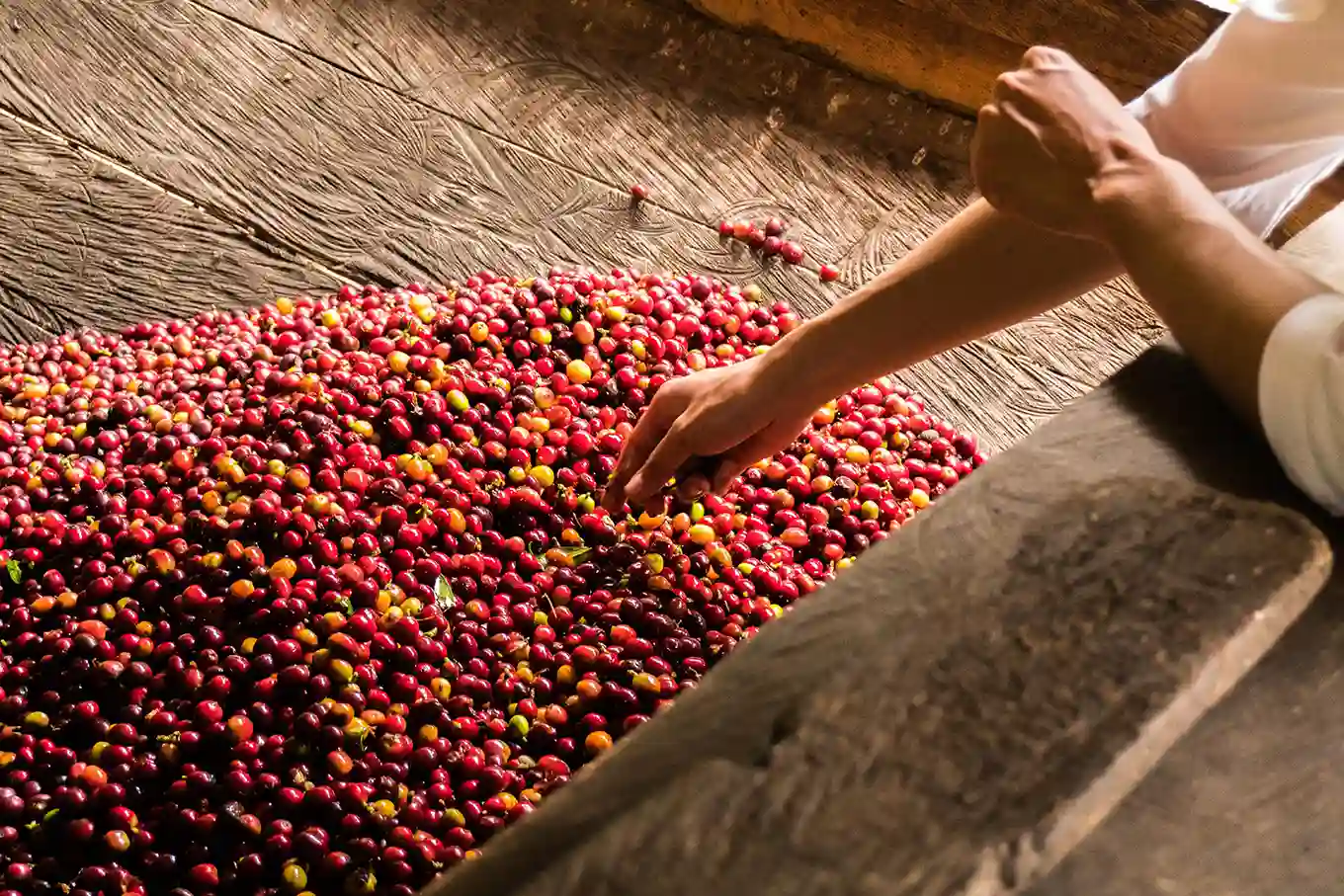
Cascara — which means “husk” in Spanish — is the skin and fruity pulp of the coffee fruit (often called the coffee cherry or coffee berry) and offers great potential to decrease the industry’s carbon footprint while providing value to consumers via upcycled food products.
What’s better is it presents the potential for farmers to generate additional revenue streams, decrease costs, and improve crop yields.
As world-wide coffee production continues to increase to meet a growing demand, so do the environmentally harmful by-products of the coffee supply chain. If best practices are widely adopted, there is an opportunity for the coffee industry to become a leader in carbon-neutral, zero-waste practices.
What is cascara?
While most people are familiar with coffee, it’s a lesser-known fact that coffee beans are actually the seed of a fruit called a coffee berry.
The berry itself contains caffeine (that’s how coffee gets its caffeine!) and is high in antioxidants. As coffee beans grow, the fruit protects them by deterring insects and other wildlife that could prevent the development of the seed.
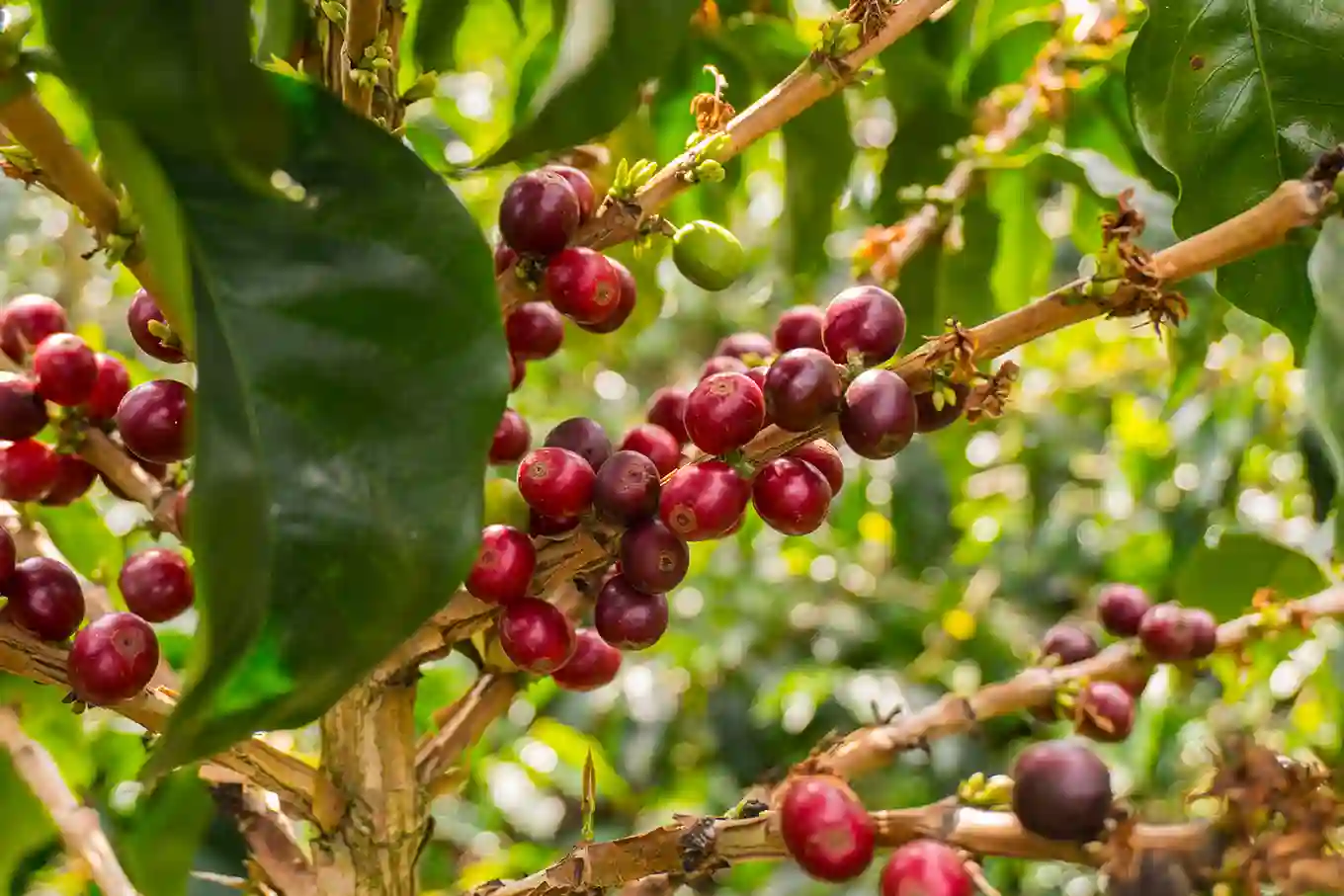
Cascara is usually thrown away — contributing to food waste — but it can instead be dried and brewed as a “tea,” served either hot or cold.
Similar drinks have long been brewed in Yemen and Ethiopia, the birthplace of coffee culture, where they are called quishr or hashara.
Although it comes from the coffee plant, cascara tastes nothing like coffee. It has a sweet, fruity, cherry-like flavor, most closely resembling an herbal tea. The taste of coffee berry tea can also depend on where it’s grown and how it’s handled, dried, and brewed.
Cascara is composted and used as fertilizer or biofuel about 30% of the time. The other 70% of cascara is thrown away.
According to Paul Evers, the CEO and co-founder of Riff, oftentimes, cascara is composted and used as a converted fertilizer or biofuel. This only happens about 30 percent of the time, Evers said, and the other 70 percent of cascara is thrown away.
“Very little of it is translated into a consumable food product,” Evers said. “By upcycling it and translating it into a food or beverage that appeals to a mass audience and working with our peers, we can hopefully expedite the building of this separate category and generate greater demand.”
When Riff began looking into this cascara-based beverage development, Evers said it was important to “operate with integrity” and reached out to Oregon State University environmental scientist Christina Schlachter, Ph.D. to help conduct research on the opportunities available for cascara and carbon neutral coffee production.
What came from this research was a full report on cascara and the coffee industry: “Solving Coffee’s Not So Little Dirty Secret: Opportunities for Upcycling and Recycling Coffee Fruit.”
"I think it’s really important in saying it’s cascara not just a byproduct; it actually has a tremendous amount of value."
“I think it’s really important in saying it’s [cascara] not just a byproduct; it actually has a tremendous amount of value,” Schlachter said. “So if we can capture that percentage of cascara that is food grade and use the other percent for biogas, or fertilizer, or compost for future crops, that would be an ideal situation.”
Riff is just one company aiming to do this. Even Starbucks has gotten in on the cascara trend, introducing a cascara latte and cold brew to the menu.
“We’re saving it [cascara] from going to waste and decomposing, contributing to greenhouse gas emissions, by injecting greater economic value into it,” Evers said. “It’s helping to potentially double revenue streams and employment for struggling farming communities, helping reverse coffee’s contribution to climate change, and also helping introduce greater sustainability for the industry itself.”
How could cascara change the world? — Here are 5 ways it can:
1. By stopping nutrient-rich food from going to waste, helping to curb climate change
In the 2018–2019 season alone, the coffee industry harvested 120 billion pounds of coffee berries, leaving nearly 100 billion pounds of by-product in the process, 58 percent of which was cascara. If not upcycled or recycled correctly, that 58 billion pounds could emit 14.2 million metric tons of CO2, which is equivalent to 35 billion miles driven by a car — enough to circle the globe almost 1.4 million times.
Some cascara is composted, but much of it is discarded into landfills or waterways, harming water quality and decreasing biodiversity.
“We know that not all cascara that’s created is food grade,” Schlachter said, emphasizing the importance of using cascara in creative ways so it’s “not just sitting there going unused, and in some situations, going into waterways, which means there’s too much organic material in the water, which can actually kill living animals in water sources.”
The use of cascara fruit presents a unique opportunity for upcycling to create biofuels, feedstock for animals, and even food products.
2. By benefiting independent smallholder farmers who need a reliable living
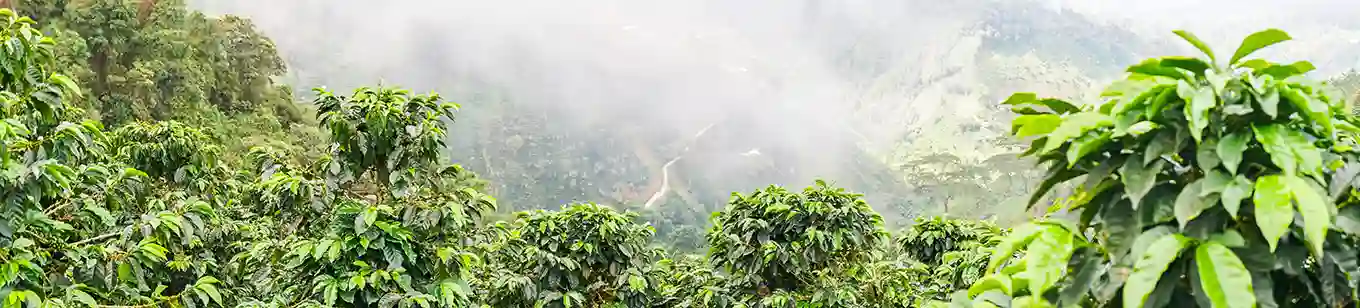
According to the International Coffee Council, over 100 million households depend on coffee for their livelihood, and almost 80 percent of global production is in developing countries on smallholder farms (farms that are less than five acres in size).
The coffee industry has a unique opportunity to become both carbon-neutral and zero-waste with proper investment and upcycling. This greatly benefits smallholder farmers, who, if the cascara market continues to scale, would increase revenue without needing to harvest extra product.
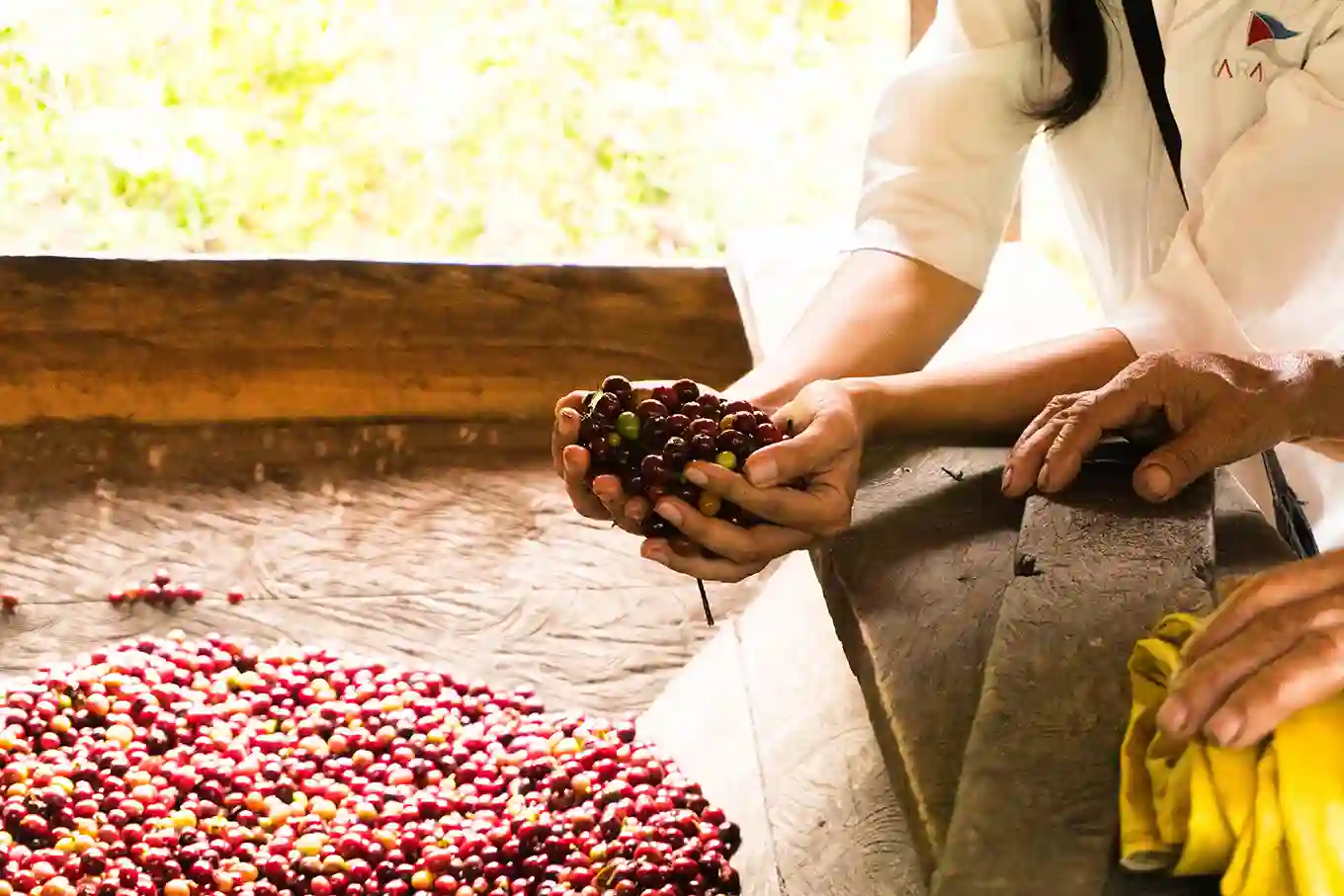
Smallholder farmers have limited resources to invest in new technology or machinery to update their practices, but a solution is to identify ways to minimize the impact of coffee by-products on the environment while increasing revenue and coffee yields for farmers. Enter: cascara.
Maximizing use of cascara presents this opportunity to turn waste into revenue. By creating a mass market for cascara, farmers can increase revenue with little expense, as the “waste” pays $.03 per pound.
“You could have a circular economy,” Schlachter said. “We're using the coffee fruit, we're putting money into the coffee farmers pockets. They're able to use the waste again more efficiently.”
3. By saving the coffee industry
“Ironically, [the coffee industry] is contributing to its greatest threat,” Evers said.
As the climate grows warmer, farmlands are at great risk of becoming unproductive, with an estimated 43 percent of the land becoming unfarmable by 2050. Ironically, the coffee industry is contributing to its greatest threat by creating greenhouse gas emissions through food waste.
As coffee consumption increases, there are two primary ways to meet demand: Convert more land for agricultural use, or increase yields of the coffee fruit.
Coffee-producing countries already face the risk of losing productive farmlands due to climate change. The option of converting more land for agricultural use is not an option, as converting forested lands into coffee farms adds greater stress on the environment by limiting the ability to capture carbon.
Increasing coffee yields through more sustainable farming practices is the only feasible path to meet the growing demand sustainably.
4. By providing a nutritious product for consumers
The coffee bean only makes up 20 percent of the weight of the coffee fruit when it is picked from the tree. But the “waste” is fruit rich in nutrients.
In its raw state, cascara is high in soluble dietary fiber, plant-based proteins, and antioxidants. Studies have found initial indications that the coffee fruit extract could help improve the immune system and improve brain function.
100g of cascara fruit contains 50 percent of the recommended daily intake of Biotin and Vitamin E, 35g of fiber, and 6.15g of protein, with less than 1g of fat. For consumers who are caffeine-intolerant, the fruit’s caffeine levels are about one-third that of coffee.
Products currently on the market include drinks and teas, flour containing dried portions of coffee cherries, chocolate, and energy bars.
“If you gave me the chance of drinking something that was processed or created from some other type of material, versus something that was organic, as an energy drink? Yeah, of course I’m going to have something that’s more organic and healthier, and helps the planet,” Schlachter said.
Riff sells a cascara-powered energy drink that you can buy online, you can buy cascara liqueur from Whiskey Caviar, and places like Valiant Coffee, Huskwell, and Lady Falcon Coffee Club sell cascara teas. Like we mentioned earlier, Starbucks even sells a cascara latte.
“I think a lot of it is educating people,” Schlachter said. “You can ask the average person in line for coffee how coffee is made and I’m pretty certain very few will know exactly the process. The education is that this product is available and there can definitely be a bigger market for it.”
5. By bringing innovation to the coffee industry and its devoted consumers
Whether it was the unicorn frappuccino or the illustrious pumpkin spice latte, American coffee drinkers are typically inclined to try something new for their daily grind. Cascara invites innovation into the drive-thru — this time, without the price of the planet.
“Over time, coffee became a part of the American daily routine,” Evers said. “Our familiarity with it was a robusta coffee that was poured into a white ceramic cup at a diner. So it’s deeply entrenched, our idea of what coffee was, and what people don’t know, because there’s never been any real exposure to it.”
It all starts with demand. If brands can create cascara products that consumers love, demand for cascara will increase, which increases revenue for farmers and can divert waste, minimizing food waste and curtailing the effects of climate change, which will help the coffee industry continue to thrive for decades.
With cascara, Evers hopes Americans develop a greater appreciation for the whole coffee fruit.
“We're solving multiple problems,” Evers said. “We're translating a nutrient-rich agricultural product to products for the benefit of humans.”
Frequently Asked Questions
How much caffeine is in cascara?
Cascara tea has around 25mg of caffeine per cup (compared to 80mg of caffeine per cup of coffee), no matter how long the steeping time is. Compared to black tea which rests at around 50mg of caffeine per cup, cascara compares best with green tea which also has around 25mg of caffeine per cup.
Is cascara banned?
For many years, Cascara was considered in Europe as a “novel” food. A 1997 EU law states that any “novel” food — that is, one that hadn’t already been widely consumed in the EU before the law came into effect — must be proven safe before it can be sold.
In other words, cascara was not officially legalized in Europe but neither prohibited. In June 2021, The European Food Safety Authority delivered a long technical report to the European Commission that paved the way for cascara beverages to be sold in the EU starting in September 2021.
There aren’t any regulations on cascara in the U.S.
How is cascara made?
Cascara is made using the peel or husk of the coffee fruit. After the coffee seeds are removed, the berry (which is high in antioxidants) can be used in food-grade cascara products, or in fertilizers or biogas.
Cascara is often sold as a dried product to be made similarly to tea, brewed using boiling water. Similar to different kinds of coffee beans, cascara has different flavor notes with an underlying taste, which Evers called “a citrus lemony tartness.”
Every day the Good Good Good team collects the best good news in the world and shares it with our community. Here are the highlights for this week!
If you want to get good news in your inbox every day, join the Goodnewsletter — the free daily newsletter designed to leave you feeling hopeful.
The Best Positive News We're Celebrating This Week —
Hawaii Volcanoes National Park was just gifted land that is home to endangered species and culturally significant artifacts
In a newly announced deal, Pohue Bay on Hawaii’s Big Island will now be a part of Hawaii Volcanoes National Park and will be managed and protected by the National Park Service.
Volcanoes National Park is already home to the world’s largest and most active volcanoes, Mauna Loa and Kilauea — and with the addition of Pohue Bay, will also be home to endangered hawksbill sea turtles, endangered Hawaiian monk seals, and other species native only to Hawaii. The land is also culturally significant, as it has remains of ancient Hawaiian villages, petroglyphs, burial sites, and more.
Immediately after acquiring Pohue Bay from a private owner, the Trust for Public Land, a national nonprofit and land preservation group, transferred ownership to Hawaii Volcanoes National Park. While the National Park Service hopes to open it to the public, it will first spend time consulting with local experts and residents about how best to protect and manage the land.
On Washington state’s first ‘agrivoltaics’ project, food and clean electricity are growing simultaneously
Part of the state’s first ‘agrivoltaics’ project, two greenhouse domes with roughly 1,000 square feet of crop space are growing a variety of vegetables and flowers, spread out horizontally and stacked on shelves vertically.
These more compact growing spaces also leave room for solar energy to grow outside. An adjacent two rows of solar panels will be capable of producing up to 20 kilowatts of electricity a year.
The solar cells will provide electricity to heat and run the watering equipment for the domes, and the food and surplus electricity will go directly to nearby homes. The planning and execution of the project is an example for planners, farmers, and engineers interested in learning more about a new way of using farmland to grow both food and electricity at the same time.
Thanks to global collaboration, there are now 40% more endangered tigers in the world than previously estimated
According to a new assessment, there are currently an estimated 3,726 to 5,578 tigers living in the wild globally — up 40% from 2015.
"A fairly significant chunk of that 40% increase is explained by the fact that we're better at counting them, that many governments in particular have really sort of moved heaven and earth to do massive scale surveys," Luke Hunter, executive director of the Wildlife Conservation Society's big cat program, told NPR.
Tigers are still considered an endangered species, and their numbers are still declining in parts of the world due to poaching, habitat loss, illegal trading, and more.
Like other endangered species, conserving and protecting tigers is critical for biodiversity, ecosystems, and more. While this is really good progress to celebrate — more must done to continue protecting tigers and all wildlife, like expanding and effectively managing protected areas, and working alongside local communities living around their habitats.
Frustrated by slow climate action, young activists have started directly targeting organizations contributing the most to the climate crisis
With mass climate protests dampened by years of COVID-19 restrictions, youth activists have been exploring new ways to hold institutions to account and accelerate action to avoid the worst impacts of a hotter planet.
That includes targeting protests more selectively at leaders of major institutions — from governments to banks — who hold the power to shift both the policies and money behind climate-wrecking emissions.
One of them just met with Deutsche Bank in Frankfurt, working with Ugandan youth activists to pressure the bank to abandon financing for a proposed new oil pipeline in East Africa and other fossil fuel expansion.
John and Hank Green’s ‘Awesome Coffee Club’ is helping build a hospital in Sierra Leone
The Awesome Coffee Club (ACC) is a subscription model that sends folks ethically-made items with 100% of profits donated to strengthen maternal and child health in Sierra Leone. In addition to $900,000 donated by the Awesome Socks Club, profits from the ACC are building a teaching hospital for maternal health in Sierra Leone.
John and Hank Green have been long-time supporters of nonprofit Partners in Health, founded by Dr. Paul Farmer, and their efforts to “radically reduce” maternal and child mortality in Sierra Leone stem from this ongoing relationship.
The hospital broke ground in April 2021, and the Maternal Center of Excellence (MCOE) is well underway with changing lives in Sierra Leone, where the maternal mortality rate is 1 in 20 (though this rate is quickly declining, thanks to the help of frontline healthcare workers and government initiatives like these).
Thanks to years of advocacy from Jon Stewart and veteran activists, the PACT Act passed Congress
Earlier this week, we celebrated Congress’ passage of the PACT Act. The bill extends Department of Veterans Affairs health care to millions of Iraq and Afghanistan veterans exposed to toxic substances, like burn pits, during their service even if they don’t have a service-connected disability.
While it shouldn’t have taken as long as it did to pass, we’re celebrating the news that veterans exposed to toxins like burn pits during their time in service will receive these essential and well-deserved health benefits.
We’re also celebrating the Helpers that made this good news possible. Along with notable celebrity activist Jon Stewart, veterans and their families have long been fighting for these benefits. One activist, Rosie Torres, and her husband started the organization Burn Pits 360 after he faced major health issues following burn pit exposure during his time serving in Afghanistan.
Burn Pits 360 not only advocates for better policies but works to improve “post-deployment health outcomes” for members of the military. Their work helps provide both direct support and create and create real, meaningful systemic change for veterans and their families — and the PACT Act is the latest, long overdue progress to celebrate.
More than 100 years after they disappeared, a land iguana is now naturally reproducing on the Galapagos Santiago Island
In 2019, the Galapagos National Park officials reintroduced more than 3,000 iguanas from a nearby island to help restore the natural ecosystem of Santiago. Now, they’ve reported the iguanas — one of three land iguanas that live on the islands — are officially reproducing naturally, with babies, males, and females spotted all over the island.
In the 1830s, Charles Darwin reported the island was filled with these reptiles. Scientists believe they then disappeared in the early 1900s. The iguanas are a critical part of the ecosystem.
"It's a great conservation achievement and strengthens our hopes of restoration on the islands that have been severely affected by introduced species,” said Galapagos National Park authority director Danny Rueda.
More good news of the week —
'Adopting' trees is helping both forests and incomes in Kenya. The carbon-curbing project goes beyond traditional planting projects by getting sponsors to pay to keep trees alive until they mature
An abandoned Berlin airport is being transformed into a carbon-free, walkable, bikeable neighborhood. Parts of the old airport are being repurposed, and schools, stores, parks, and more will all be within walking distance for residents.
Dartmouth College just named its first-ever woman president. The first in its over 250-year history, Sian Leah Beilock will officially take over as president in 2023.
A “housing first” initiative in Denver is on track to transition 100 people into homes this year. Up to 40% of Denver’s homeless population lives outdoors, and “Safe Outdoor Space” aims to help connect them with resources.
USPS announced it will now transition 40% of its mail delivery truck fleet to electric. Previously, it initially only planned to transition 10% of its fleet.
Cuba just approved a law change that would legalize same-sex marriage and civil unions. The far-reaching updates to its outdated family law would also allow same-sex adoptions, more women's rights, and more.
U.S. lawmakers overwhelmingly passed a bill extending health care benefits to veterans who developed illnesses from exposure to burn pits. President Biden says he will sign the PACT Act into law and help an estimated 3.5 million veterans from the U.S. wars in Afghanistan and Iraq.
Hawaii just received its last shipment of coal ever, with its last coal-fired power plant closing in September. In 2014, Hawaii became the first state to make a net zero pledge of getting to 100% renewable energy by 2045.
A federal task force just reunited 400 children that were separated from their parents at the U.S.-Mexico border. In most of the cases, parents were sent back to Mexico while their children remained in the U.S.
In July, Germany hit a solar power output record for the third time in a row. The country generated 8.23 terawatt hours or 20.1 percent of net electricity generation, and all renewables made up over 50 percent of generation.
Beto O’Rourke’s campaign for governor is the first-ever statewide campaign in Texas to be run by a unionized staff. The 129 staffers' contract includes overtime pay, a five-day work week, paid time off to vote early, severance pay, gas stipends, and more.
In a victory for reproductive health, voters in Kansas protected access to abortion. It was the first voter-led decision on abortion since the Supreme Court overturned Roe v. Wade earlier this year and reinforces public support for abortion access.
The Ocean Cleanup just removed its 100,000th kilogram of trash from the Great Pacific Garbage Patch. Since August 2021, The Ocean Cleanup has removed 101,353 kg of plastic in 45 extractions from an area of the ocean about the size of Rhode Island.
Europe is expected to install almost 40 gigawatts of solar capacity in 2022 alone. It’s a significant increase over the previous year’s installation of 27 gigawatts.
For the first time since Russia’s invasion, a ship carrying Ukrainian grain left the Ukraine port of Odesa. It’s part of a deal between Turkey and the United Nations and is expected to help ease the growing global food crisis.
Buying furniture is no small feat, especially when that furniture is the foundation of your nightly rest. If you’re looking for a new bed frame, there’s no doubt you’ve got a whole to-do list.
From measuring dimensions in your bedroom, the best support for your mattress, sticking to a budget, and trying to make an ethical, eco-friendly purchase, you might need to add Furniture Aficionado to your resume.
Never fret; we became experts so you don’t have to!
We are passionate about finding products that are good for you, good for your wallet, good for the people who make them, and good for the planet. Of course, shopping secondhand or recycled goods is the most sustainable way to go, but if you’re looking for something specific or want to buy a piece that will last you years, we want to help you out.
In fact, we recently just shared our favorite eco-friendly mattresses, sustainable bedding, eco-friendly pillows, eco-friendly mattress covers, eco-friendly weighted blankets, and even dog beds — and we know that having a smart sleeping setup is key to a good rest. Alongside this helpful guide to sustainable bed frames, you’ll be ready for the best sleep of your life.
At the end of this article, we’ve included a guide on what makes a bed frame eco-friendly — but the short version is: Look for a bed frame that will last a long time and is made from sustainable, thoughtfully-sourced materials.
By the way, some of the links in this article are affiliate links, which means if you make a purchase after clicking a link, we may earn a commission at no extra cost to you. Thank you!
Our favorite sustainable bed frames for a good snooze
The brands you see listed here sent members of our team a bed frame to review for this article. (Our reviews are always honest. Receiving free products for testing never impacts our writing — and brands don’t get any influence on our editorial process.) We broke down our reviews based on the bed frame’s packaging, aesthetic, assembly, and quality to help you make the best decision for your body, your bedroom — and Mother Earth.
Savvy Rest’s natural platform bed

What’s good: Savvy Rest is a furniture company dedicated to values of sustainability and community, offering safe, natural, and comfortable products certified by independent third parties. The wood used in its bed frames are certified by the Appalachian Hardwood Manufacturers, and the company as a whole is a member of Green America, is a certified B-corp, and donates to Carbon Fund, a non-profit committed to helping businesses and individuals reduce their climate impact. Savvy Rest is also an employee-owned company.

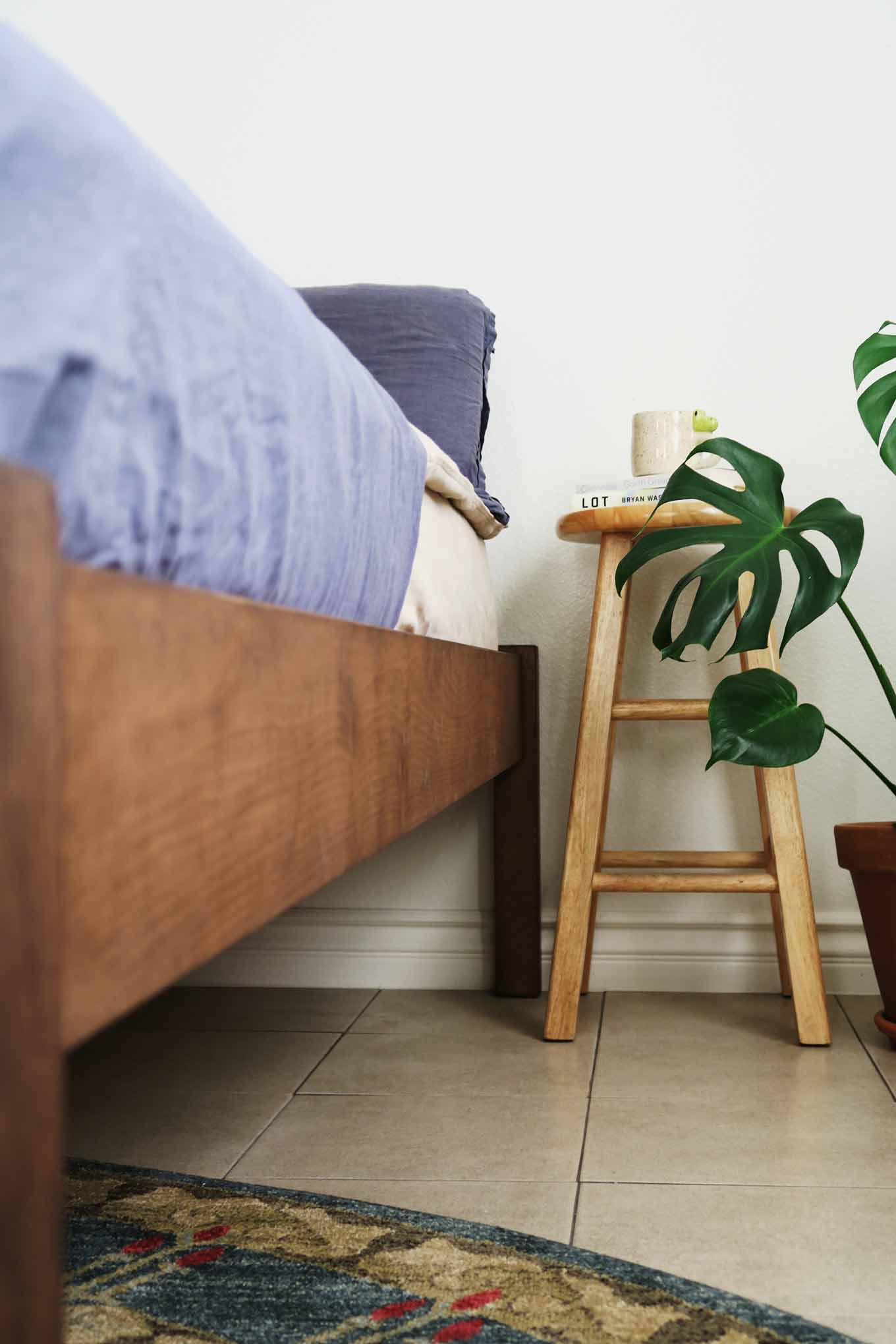
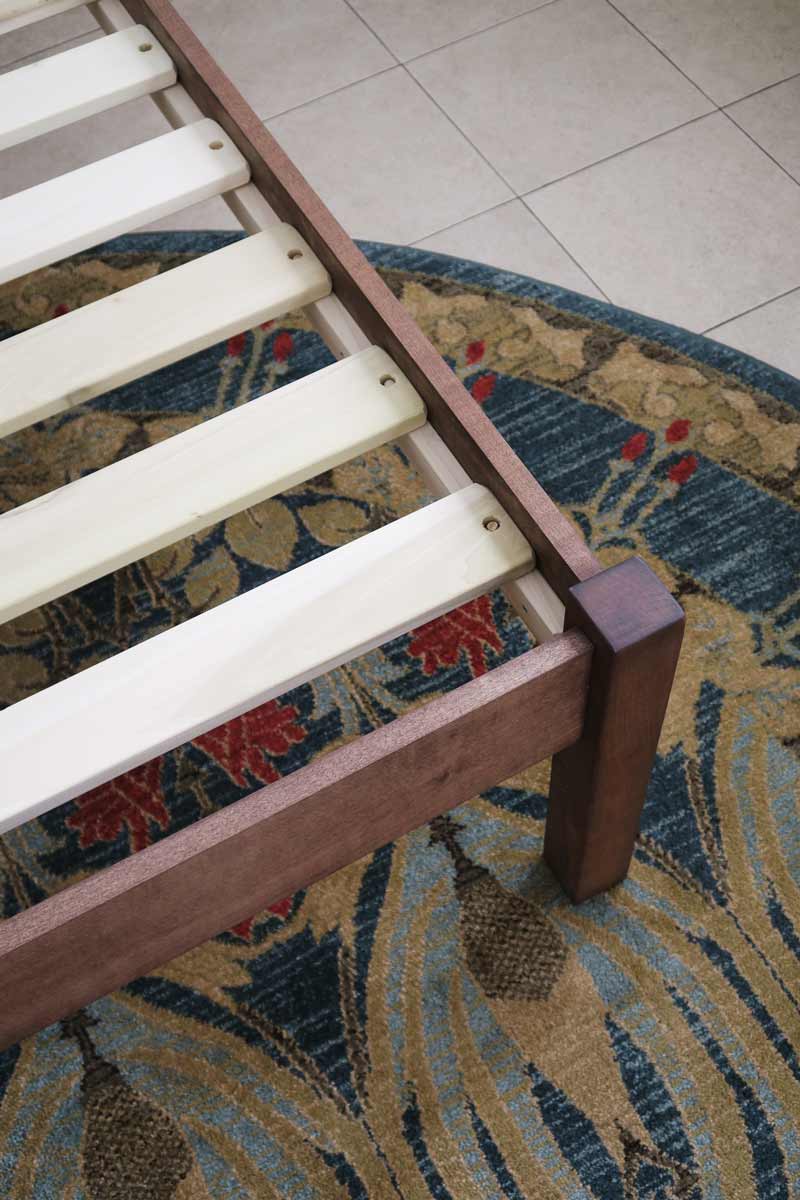
Details: Johnathan received a full-size Afton platform bed with a walnut finish. This bed is hand-made in Virginia by skilled woodworkers, using maple wood for the base and poplar wood for the slats — and zero-VOC oils and stains. No tools are required in assembly, as the bed features loosely-spaced slats that lock into place and brackets made with solid steel.
Price: Starts at $999 for a Queen (Check current price + you can use the code GOOD20 for 20% off your order)
Johnathan’s Thoughts:
- Packaging: The whole bed arrived in just two boxes that I was able to carry up two flights of stairs to my apartment alone (although, it was very heavy and I would recommend getting a friend to help). It was very organized and cushioned with rubber foam on the ends, so no corners or edges of the wood pieces were damaged in transit, even though some of the exterior of one cardboard box was starting to rip.

- Aesthetic: This bed has a perfect minimal look, and the wood stain (without any lacquers or varnishes) is even and matte. There is a ton of space underneath my bed now, which optically makes my room look larger. It is a super simple design, but it looks far from cheap. The excellent craftsmanship carries through to the overall aesthetic look and feel, and it looks really nice.
- Assembly: This bed frame requires no tools to assemble, as everything has precut slots and hardware already inside it for an easy assembly. I was able to assemble it completely alone in a matter of 15 minutes. The horizontal mattress slats were slightly more difficult to slide into their notches, but I think that snugness is what makes the bed so sturdy.
- Quality: All the pieces are solid wood, making it a very sturdy-feeling bed. Each piece of the bed fit together perfectly as they were intended to, and it’s very clear that Savvy Rest values craftsmanship and quality materials to elevate their design.
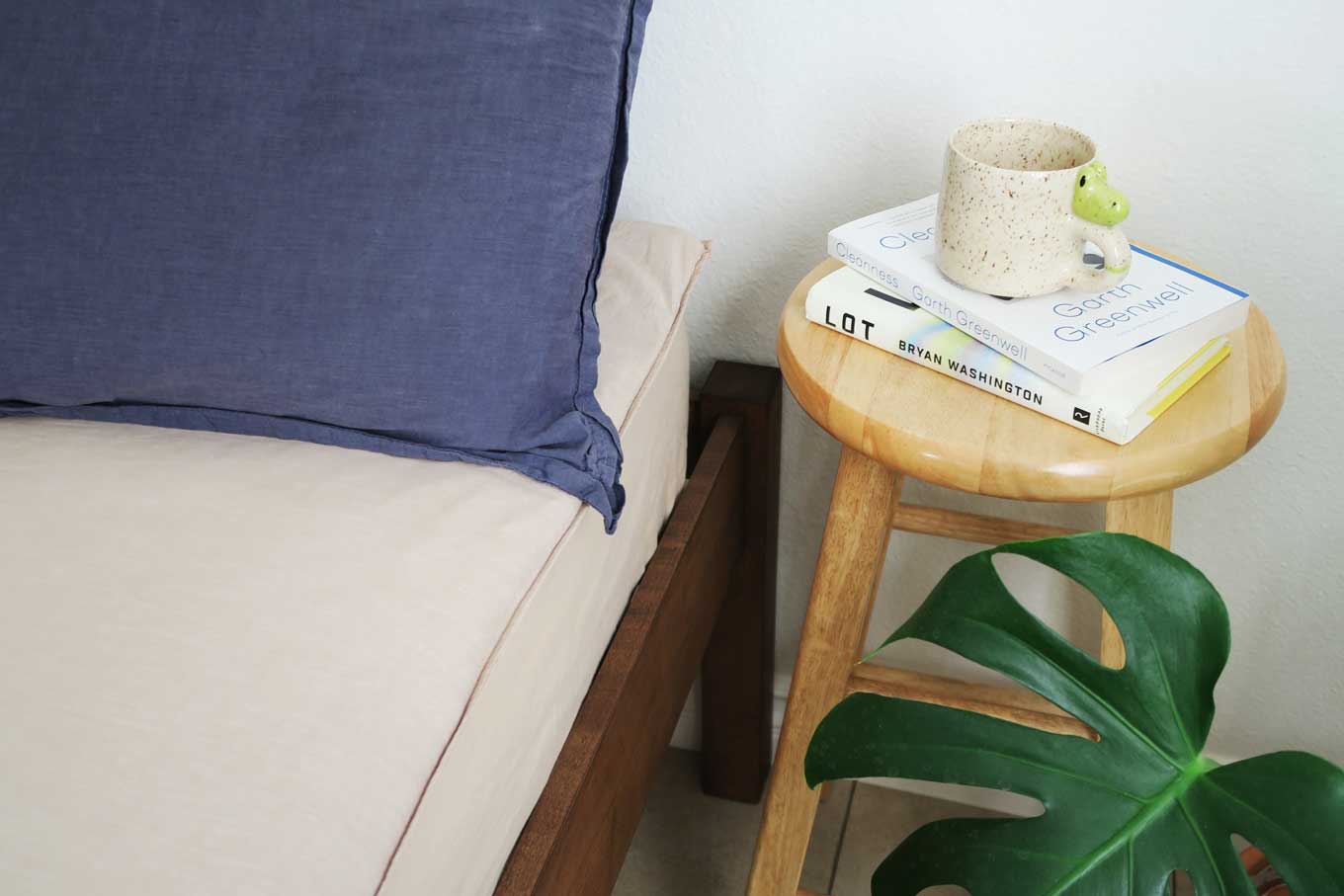
- Other Notes: I have only ever owned bed frames from IKEA, and the system they use with the slats that the mattress sits on top of is pretty typical, but they slide and hit each other when you get on and off the bed.
With the Afton, since all the slats fit so perfectly and snug in their spots, and since the wood is solid and hefty, there is no noise at all when you get on or off the mattress. And that’s been such a small thing for me personally that’s made such a big difference.
→ Shop The Afton by Savvy Rest and use the code GOOD20 for 20% off
Floyd’s Adaptable Bed Frame

What’s good: In 2022, Floyd pledged to become a carbon neutral furniture brand, meaning your purchase will be zero net carbon emissions. Additionally, Floyd is committed to longevity, offering a resale program and adaptable elements to make already existing pieces last longer. This is ingrained in the design ethos of the company, which prioritizes accessibility and necessity over frills and waste.
Lastly, Floyd shares a 5-part sustainability goal plan for 2025, including goals for gathering materials from renewable or recycled sources, minimizing packaging, and more.

Details: Floyd’s adaptable platform bed frame is a beautiful and utilitarian piece for any bedroom. It comes in Birch, Oak, and Walnut options and has the option to add or include a headboard and underbed storage components. You can also change the size of your bed frame if you were to get a larger mattress, and all you have to do is buy an expansion pack to do so.
All bed frames are created with natural, renewable materials (like birch plywood, wood oak hardwood, or sustainably-sourced walnut veneer), meaning the natural variation and even the scent of real wood are key players in the experience of this furniture. All panels are certified to ensure extremely low adhesive emissions, and Floyd boasts great durability and strength.
All bed supports are made from powder-coated steel from a series of 8 bends of a single piece of steel, reducing waste in production. Lastly, the bed system is completed with Nylon Ratchet Straps to secure panels without tools or screws.

Price: Starts at $1,075 for a Queen (Check current price)
Branden’s Thoughts:
- Packaging: The Floyd bed frame is delivered in entirely cardboard/paper-based packaging. A great deal of attention went into the way everything arrives and it almost feels like unboxing an Apple product.

- Aesthetic: I absolutely love the aesthetic of a minimalist platform bed — and Floyd was exactly what I was looking for. While the headboard is an optional add-on, I'm really glad I got it from an aesthetic and functional standpoint.

- Assembly: I found this bed frame to be incredibly easy to put together. To be honest, it kind of felt fun — like building something with legos. Plus, there are no screws, nails, etc involved. While the instruction booklet was helpful, I opted to watch their short “Setting up The Floyd Bed” video. Everything is really intuitive, with the only tricky thing being the strap and ratchet system.

- Quality: I've found the quality to be fantastic. The bed doesn't shift or creak. The only sound I experienced was the straps pulling against the metal feet — but after a few days they settled into place and I no longer heard them flexing.
I love that the frame is modular because it means that if one of the parts ever does fail, I can simply order a new part. I don't have to replace the whole system.
The only thing to watch out for: Because the platform bed sticks out more than a traditional bed frame (and the pieces are meant to be visible), you're a bit more likely to bump into it, and over time the wood will likely get little dents and scuffs. It's not a huge deal, but worth mentioning.

- Other Notes: I actually paid for this bed frame out of my own pocket. When we finally had to replace my bed frame of over 8 years, my partner and I were trying to decide which bed frame to commit to for the next 8+ years.
We decided on Floyd's offering because of how adaptable it is. If we ever move to a bigger apartment, we'll be able to buy an additional wood panel to convert our queen-size bed into a king-size. If we ever decide to get a different bed frame, we can always remove one panel to convert this into a twin-size frame for a kid. And again, if some component of the frame ever breaks, we can just replace that part instead of the whole frame.
The adaptability of this frame makes it a great financial investment and one of the most sustainable offerings on this list.
→ Shop The Bed Frame by Floyd
Saatva’s Santorini platform bed frame
What’s good: Saatva is known for its eco-conscious mattresses, but of course, your mattress needs a place to rest, too! Established in 2010, Saatva was founded on the principle that everyone deserves healthy and restorative sleep in a quality bed.
Of course, this means that all products and materials must meet the highest health and environmental safety standards. Just like its mattresses, Saatva hand-delivers its bed frames and sets them up right inside the customer’s home with “white glove delivery,” ensuring a smooth installation and sleep experience from the start.
Additionally, Saatva sources Fair Trade and certified organic materials, and plants trees with Evertreen, all while adhering to ethical labor standards.
While Saatva carries a number of various eco-friendly bed frames, the Santorini is the one our team tested and reviewed!
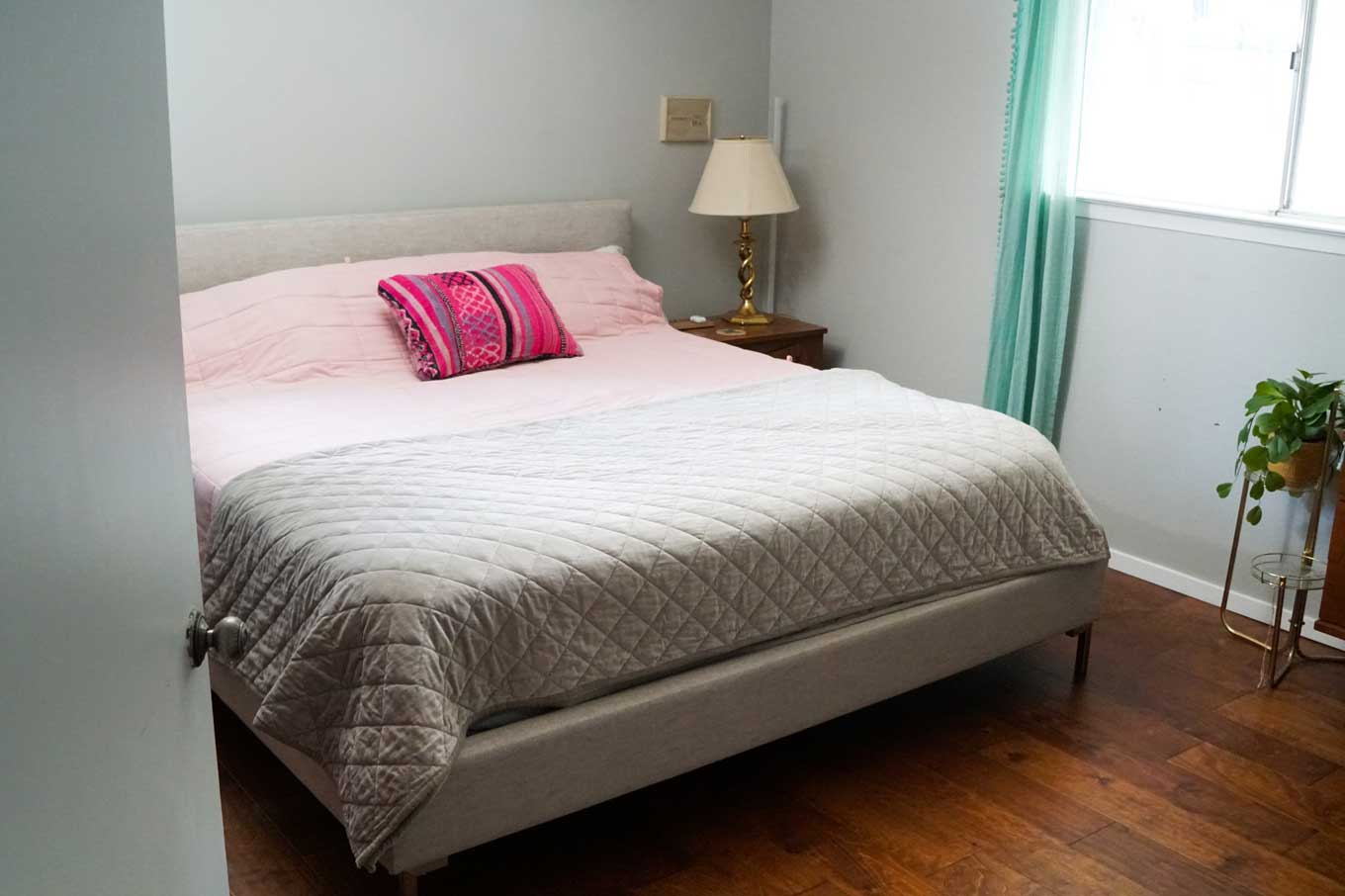
Details: Jessica received the Santorini bed frame in the Natural Linen color. The frame is made with sustainably-sourced, kiln-dried hardwood and fully upholstered with eco-friendly linen made from natural flax fibers.
Plywood slats have multiple support feet for added stability, and fortified bolts and brackets help keep the bed frame’s attachment points extra stable (let the monkeys jump on the bed!)
Price: Starts at $1,495 for a Queen (Check current price)
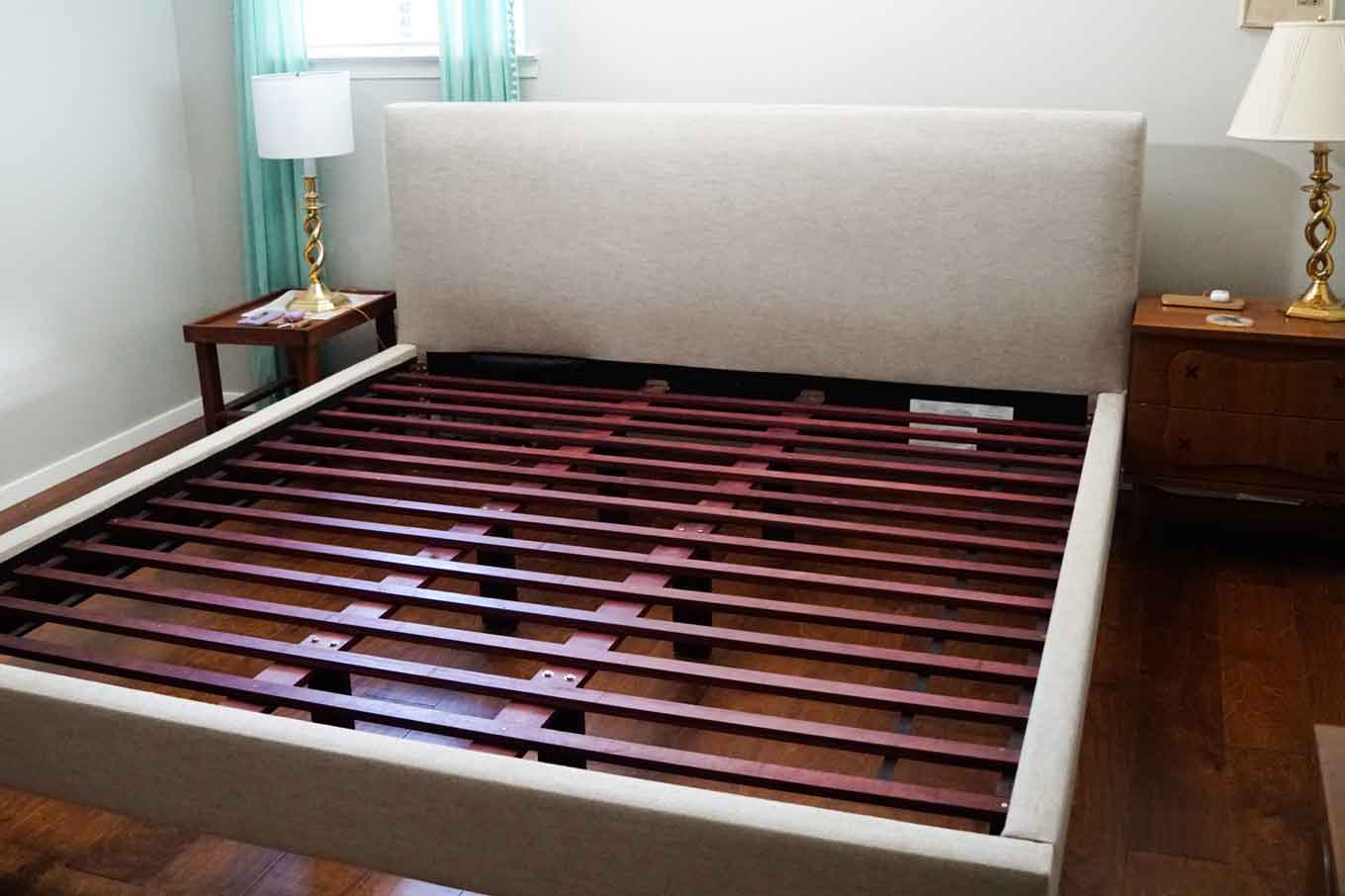
Jessica’s Thoughts:
- Packaging: Since my Saatva bed frame was assembled by the delivery company, I wasn't able to see all of the packaging. From what I could tell, the packaging used minimal plastic, and I was very happy to have help with delivery and installation.
- Aesthetic: This is my first upholstered bed frame and now I absolutely understand the hype! It instantly made our room feel cozier and more welcoming. It's amazing what a difference a bed frame can do in a space. The legs are also very minimal and sleek, while still seeming very sturdy and stable.
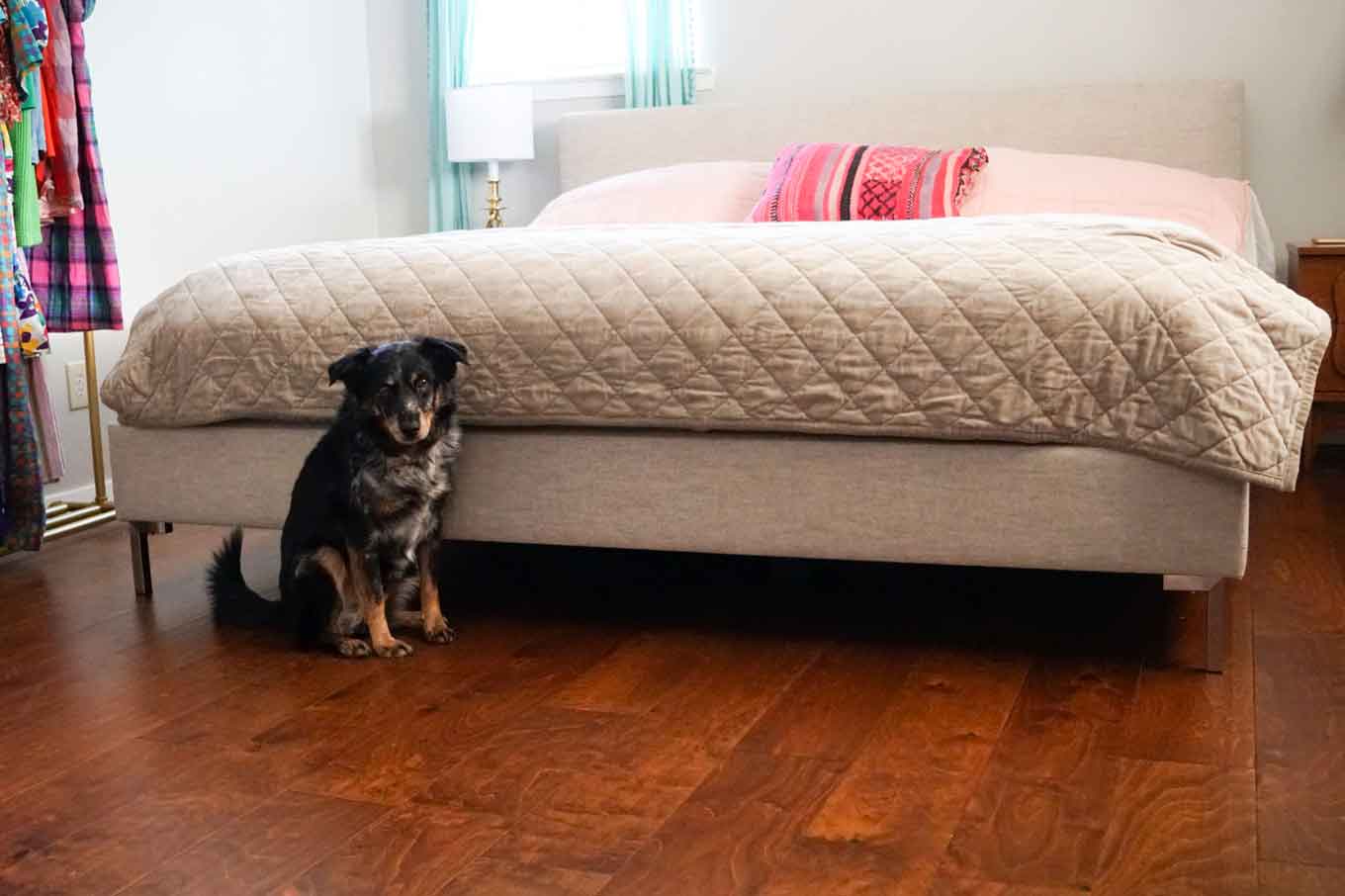
- Assembly: Saatva's (free) “White Glove Delivery & Setup” was such a pleasant surprise. When selecting the bed, I missed this featured service and it's a major benefit to opting for Saatva. The team was professional and promptly assembled the frame right in the bedroom.
- Quality: All of the upholstery is in beautiful condition and appears like it will hold up well over time. The frame itself is very sturdy and we haven't had any issues with it feeling loose or wobbly.
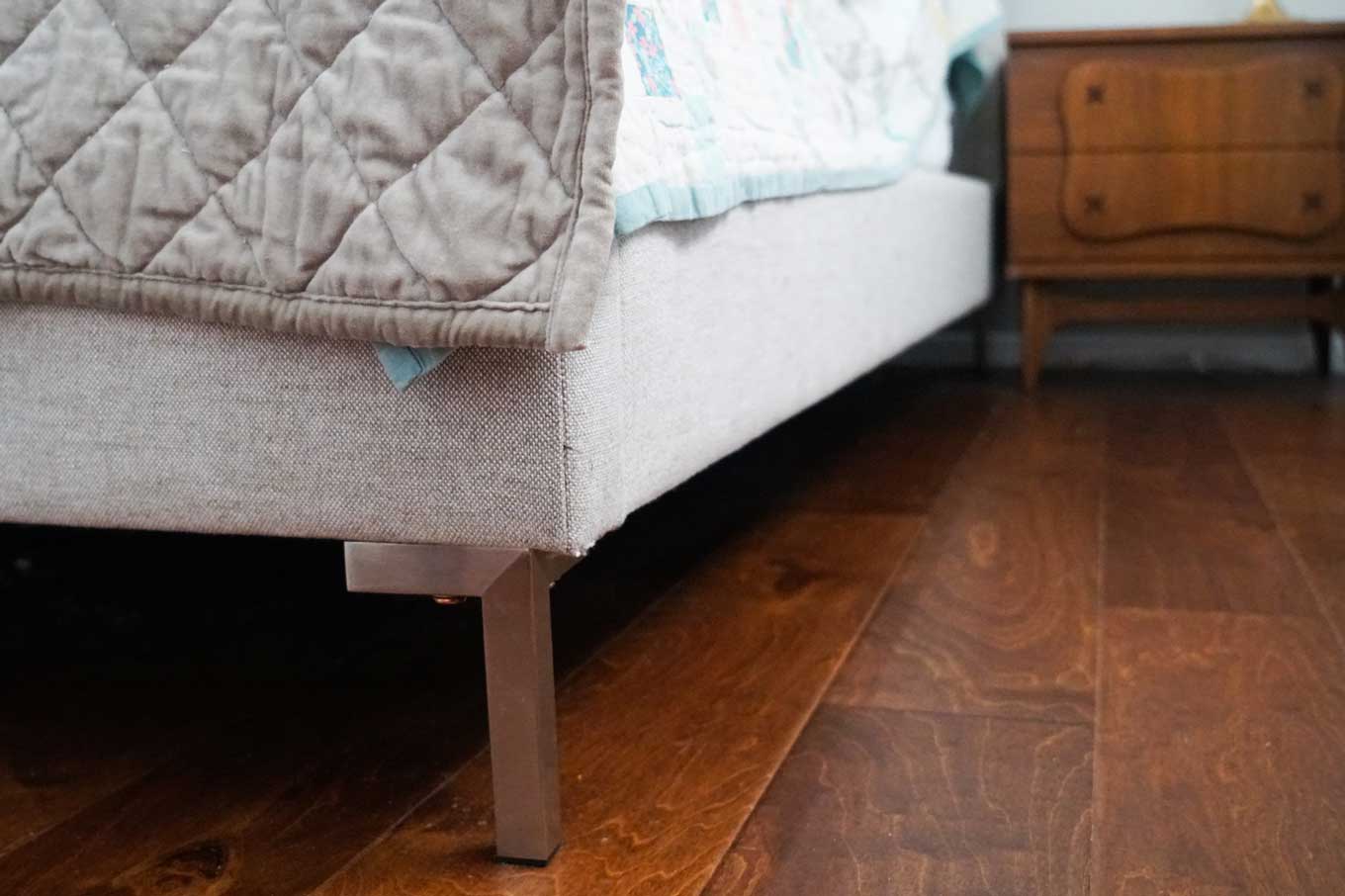
- Other Notes: The height of this frame is wonderful for ease of getting in and out of bed, but I didn't think about how it would impact our under bed storage. My previous bins don't fit underneath anymore, so I'm looking into alternative storage solutions. If you have a small space and utilize a lot under bed storage, definitely take this into consideration.
→ Shop The Santorini Bed Frame from Saatva
My Green Platform Bed

What’s good: My Green Mattress was founded as a company to provide people with a healthier, greener option for sleep. The company partners with 1% for the Planet to donate one percent of its total sales to environmental organizations working to create a healthier planet for all. In addition to certified green mattresses, the company creates sleep solutions that are Greenguard Gold certified and made with non-toxic materials.
Details: The My Green Platform Bed is made from untreated, sustainable American poplar wood and is free from wood stain, adhesives, and other toxic chemicals. The pieces are milled in Ohio and are packed and shipped to your home from the My Green Mattress factory. The bed’s slats are three inches apart and it sits eight inches off the floor to create consistent airflow for a deep, healthy sleep.
Price: $549 for a Queen (Check current price)

Megan’s Thoughts:
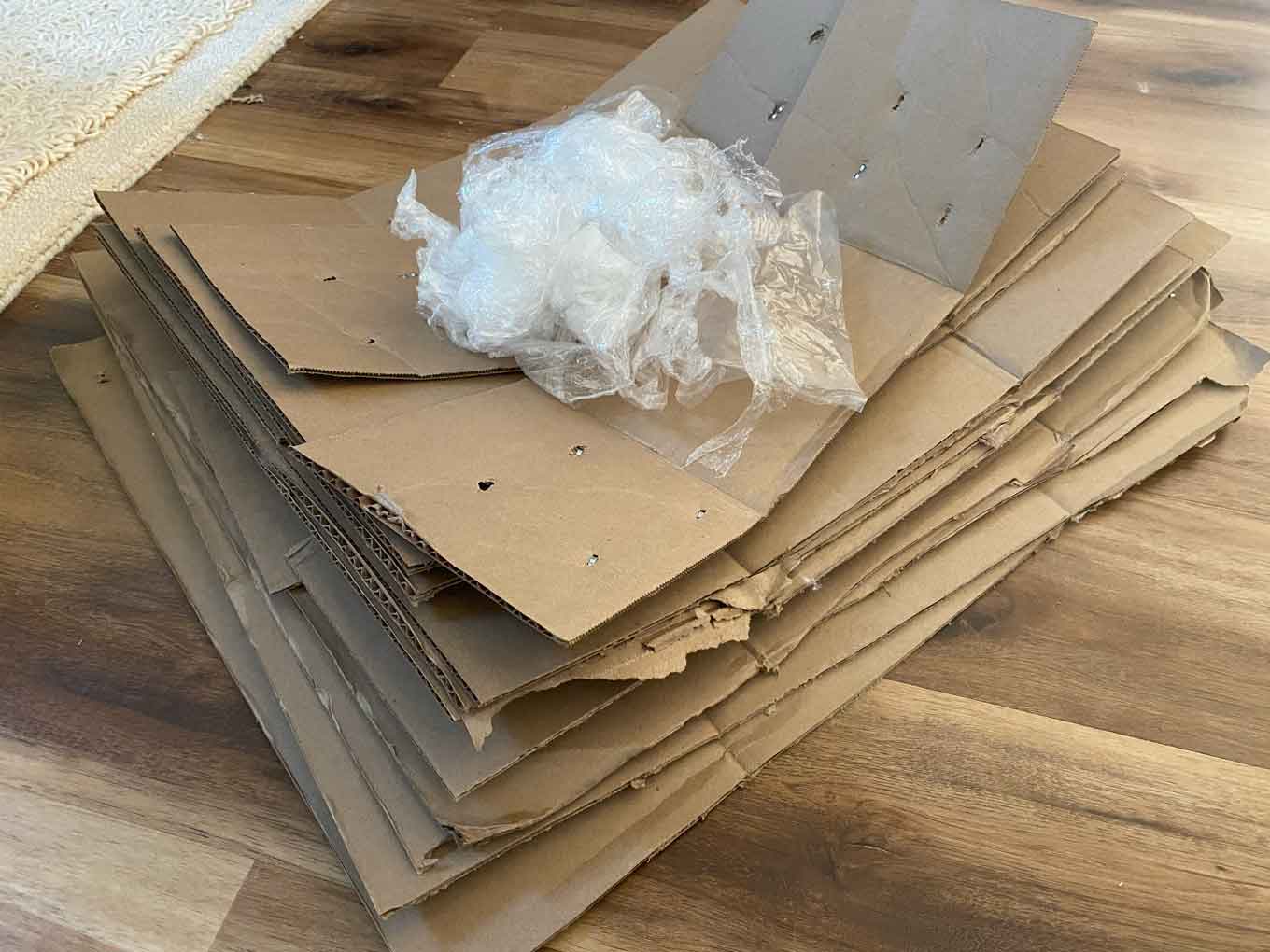
- Packaging: My Green Mattress uses impressively minimal packaging and materials to ship this bed frame. There was an outer box and just a few strips of plastic shrink wrap to hold the pieces together. Once the box was broken down, the amount of packaging waste was super minimal, and all except the bit of plastic wrapping (which could fit in one handful) was recyclable.
- Aesthetic: The poplar wood used for this bed frame is perfect for a minimalist who lines a toned-down natural wood tone, so it mixes well if you have other tones or colors in the room. It doesn’t have a lot of knots and is a very neutral color (no funky undertones). This bed is very understated and really allows your bedding or decor to be the star of the show.
- Assembly: Assembly is mostly done with an Allen wrench, with a few screws. The instructions said the screws could be driven in with just a screwdriver, but I’d recommend having a power drill on hand as they were extremely hard to screw in by hand.
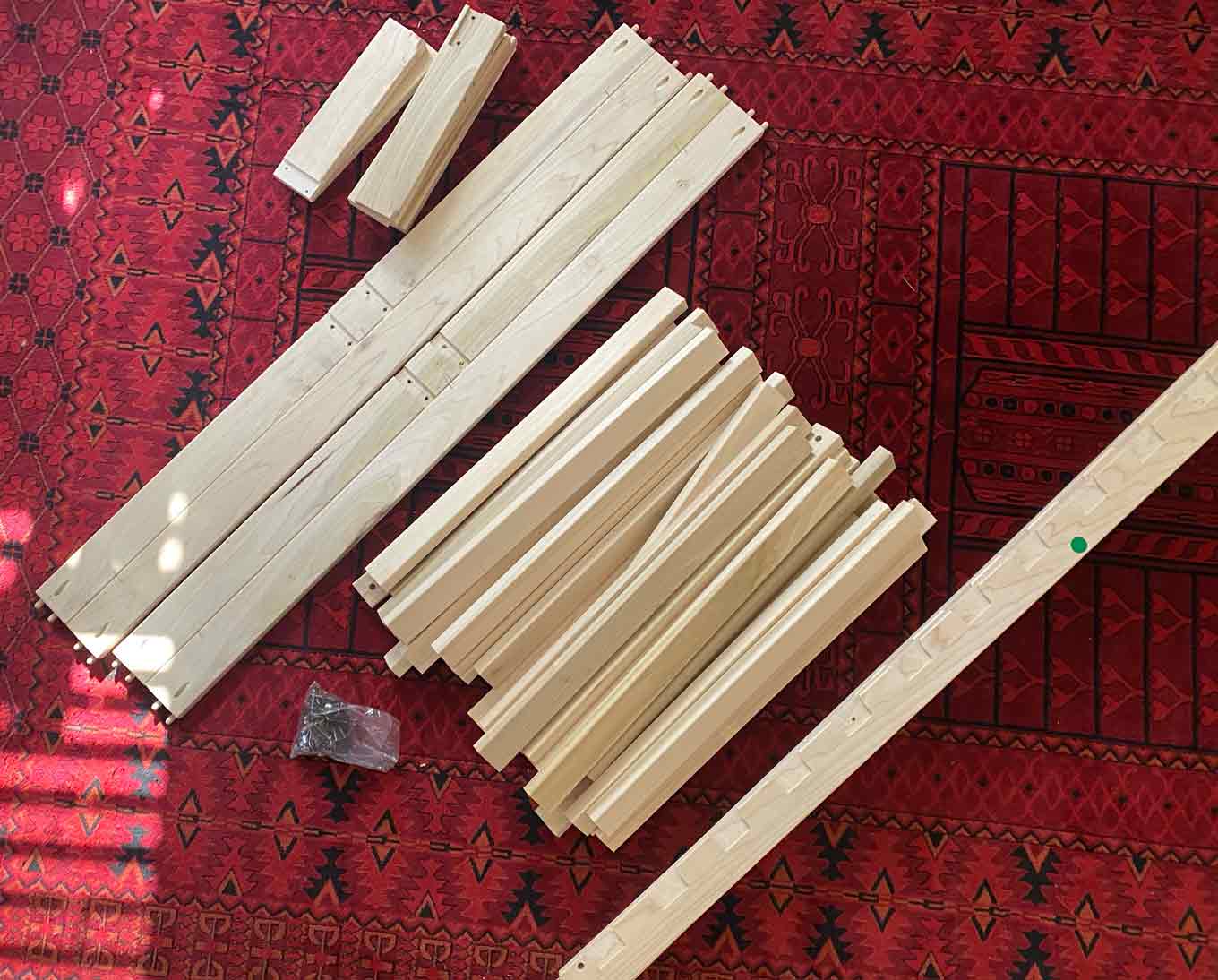
- Quality: In addition to being a very aesthetically pleasing wood tone, the frame itself once fully assembled is extremely sturdy. It doesn’t creak, wiggle, or feel unstable whatsoever.
- Other Notes: I wasn’t so sure about the stability of the thinner leg boards on this bed frame (I’ve only seen squared legs on platform beds), but I was pleasantly surprised to see them hold up just as well.
→ Shop the My Green Platform Bed from My Green Mattress
Other eco-friendly bed frame brands for sustainable sleeping
Parachute’s Horizon Bed Frame

What’s good: Parachute is a Climate Neutral-certified company, meaning it implements circular programs to offset its carbon footprint and emissions. Its materials are also sourced ethically and responsibly, partnering with Fair Trade and GOTS certified manufacturers. The company also partakes in a number of carbon offset projects and outlines long-term goals for sustainability and equity.
Details: Parachute’s Horizon bed frame is the most expensive on our list, but it sure is pretty! Inspired by timeless natural design elements and made to pair perfectly with the Eco Comfort Mattress, the Horizon is developed in an American factory and made to last.
This bed frame is created with kiln-dried hardwood and mortise-and-tenon joints designed to last a lifetime. It includes a subtle solid beachwood leg, and the piece is customizable with comfortable and natural linen cotton fabrics. It is also made without harmful chemicals and meets state requirements.
Price: $2,800 for a Queen (Check current price)
→ Shop The Horizon Bed Frame by Parachute
Wood Bed Frame by Helix

What’s good: Helix works to make sure your purchase is the right one, using sustainable and organic materials in both mattresses and bed frame furniture. All Helix items are 100% made in the U.S. and hand-assembled, and its Wood Frame is no different, sourcing certified materials from sustainable locations for a dependable and eco-friendly sleep.
Details: Helix’s Wood Frame (which comes in white and natural wood colors) is a simple and modern platform bed. Made with Appalachian hardwood bed rails, Southern Yellow Pine slats, and Appalacian Maple legs, all wood materials come from Forest Stewardship Council-certified locations and are sourced from sustainable wood species.
All wood finishes are water and UV-based with zero VOCs to be found. Constructed with durable wood materials, the Wood Frame is simple to build with tool-free assembly.
Price: Starts at $499 for a Queen (Check current price)
→ Shop the Helix White Wood Bed Frame
Avocado Malibu Bed

What’s good: Avocado’s mission is to be one of the “world’s most sustainable brands.” All of its products come highly certified, and its factories and wood shops in Los Angeles are powered entirely by renewable energy. Additionally, Avocado is the world’s only Climate Neutral Certified bedding brand, and one percent of all of the company’s revenue goes to environmental nonprofits with the help of 1% For The Planet.
Avocado is also a certified B-Corp, making the company legally required to consider the impact of its decisions on workers, customers, suppliers, community, and the environment.
Details: Their Malibu platform bed frame made with a high-quality maple hardwood. This design is also available in walnut wood, and no toxic glues or finishes are used in either style. Avocado also offers an optional 41-inch or 46-inch headboard that fits perfectly with any of the brand’s mattresses.
Every bed frame is made in Avocado’s clean energy-powered Forestry Stewardship Council-certified Los Angeles facility, combining craftsmanship with innovative climate responsibility.
Price: Starts at $1,699 for a Queen (Check current price)
→ Shop The Malibu Platform Bed Frame by Avocado
Naturepedic’s Organic Foundation

What’s good: Naturepedic’s environmental initiatives work to protect both the sleep environment inside our homes, as well as the larger environment of our living planet. This includes organic material sourcing, vigilant testing standards and certifications, and purpose-driven business practices, like renewable energy use, sourcing of recycled materials, advocacy of social causes, and more.
Naturepedic has been recognized by over 30 independent organizations for its commitment to sustainable business and is a member of 1% for the Planet, Mattress Recycling Council, and the American Sustainable Business Network, among others. To learn more, check out Naturepedic’s most recent Sustainability Report.
Details: Made with North American wood, organic cotton fabric, and extra slats for additional strength, Naturpedic’s Organic Bed Foundation uses no harmful chemicals or flame retardants for a comfortable, sturdy bed frame. By sourcing thoughtful materials and constructing a bed with additional strength, this frame adds years to your bed’s lifespan for continued sustainability.
The bed foundation ships collapsed for easy transportation and assembly. It is also endorsed by GOTS, Greenguard, and MadeSafe.
Price: Starts at $599 for a Queen (Check current price)
→ Shop the Organic Deluxe Mattress Foundation by Naturepedic
EcoSleep’s Reclaimed Railroad Track Bed Frame

What’s good: EcoSleep, a company by Brooklyn Bedding, provides sustainable solutions to bedroom furniture. Its mattresses and bedding accessories come highly certified, using quality, organic materials for a better night’s rest.
Details: If you’re looking for something simple, affordable, and unique, this bed frame from EcoSleep is the one for you. Made with reclaimed railroad tracks (yep, you read that correctly), this bed offers durable design and zero sharp edges or motion transfer you might experience with other metal designs.
Methane gas captured from nearby landfills provides a cleaner source of fuel to convert the railroad tracks into angle iron, allowing builders to use hardened steel and thoughtfully molded resins to manufacture the bed. It’s compatible with any mattress and most headboards (though it does require a box spring or foundation). EcoSleep also promises a tool-free assembly.
Price: $175 for a Queen (Check current price)
→ Shop EcoSleep’s bed frame
The Bed by Thuma

What’s good: Thuma uses environmentally-friendly, upcycled, and repurposed rubber wood from trees located close to craftsmen and factories. By using efficient material sourcing, Thuma minimizes the need for transportation and emissions.
Additionally, all products are packaged in recycled cardboard and protected with strategic design to remove the need for styrofoam packages. Lastly, Thuma partners with 1% for the Planet to ensure that one bed sold results in one tree planted.
Details: The Bed by Thuma is a simple and sleek platform design using handcrafted, repurposed wood. Choose from either Walnut or Natural wood colors with no MDF or veneers. The bed also features a PillowBoard, which is a headboard alternative made with certified foams and a linen-weave cover.
The slats of the bed are made with eco-fi felt made from recycled plastics and lock in place using Japanese craftsman techniques to avoid excess metal hardware. Easy to put together, and with pre-padded bottoms for floor protection, this bed provides comfort and support without damaging the environment. (The Bed is Greenguard Gold Certified!)
Price: Starts at $1,095 for a Queen (Check current price)
→ Shop The Bed by Thuma
What makes a bed frame eco-friendly?
Just like any eco-friendly product, the materials in a bed frame are what make it a sustainable purchase. Compared to other “fast furniture” retailers, companies that sell sustainably-made beds will use sturdier and safer materials, will source those materials thoughtfully, and will likely pay the people making them with higher wages and provide fairer working conditions.
A bed frame that lasts longer without breaking ensures you don’t have to go out and buy a new one too soon. Spending a bit more on a high-quality piece now will help save you money (and support the planet) in the long run.
When shopping for an eco-friendly bed frame, it’s important to look for a few specific indicators: What the materials are and how they were sourced, special industry certifications, and how the company supports sustainability as a whole.
Many standard bed frames that are not eco-friendly are made from flimsy materials like engineered wood or manufactured plywood. It is very common for beds to be made with resins, varnishes, paints, stains, glues, and adhesives that contain volatile organic compounds (VOCs) like formaldehyde and acetone.
These chemicals will slowly leak into the air over time, and that is no good for your health. And when that bed frame is discarded years later? It’s no good for the health of the planet, either. Additionally, many of these resins and adhesives are also created using energy-inefficient processes (we’re looking at you, crude oil industry).
Therefore, it’s better for you and the planet when you shop bed frames made from natural, safe materials. Since most bed frames are made from wood, you can find out what kind of wood is utilized in manufacturing, as well as the kinds of stains or varnishes involved in the process. Look for little to no adhesives, too!
Eco-friendly bed frames are certified by trusted independent organizations that provide rigorous testing and regulations, such as Greenguard or the Forest Stewardship Council.
Go above and beyond making your bedroom sustainable by checking out our guides to sustainable home goods and eco-friendly rugs.
Oh, and if you're outfitting your entire bedroom, you might also like our deep-dives on:
At Good Good Good, we’re inspired by the words of Mister Rogers when he said, “You will always find people who are helping.” No matter what disaster, disease, or injustice is impacting a community, there are always people who are stepping up to make a difference.
These courageous and impactful people are humanitarians. Whether they’re supporting their own community or supporting a community across the globe, aid workers sacrificially work for the betterment of humankind.
According to ReliefWeb (PDF), 274 million people needed humanitarian assistance and protection in 2022. According to the United Nations Office for the Coordination of Humanitarian Affairs, in 2023, the number of aid workers killed more than doubled in two years — from 118 in 2022 to 261 in 2023. 196 more were wounded and 78 were kidnapped. 96% of those killed were working in their own country.
The world needs humanitarian support more than ever — and those who step up to serve that role deserve our support. (And not only our support, but also the financial resources they need to be able to stay safe and healthy.)
World Humanitarian Day is an opportunity to celebrate, learn from, and support humanitarians around the world.
What is the meaning of World Humanitarian Day?
On August 19th, the world unites in celebrating the unwavering dedication of humanitarians worldwide who rise to meet global challenges. Despite the risks and challenges, they bravely journey into areas ravaged by disasters and conflict zones, committed to rescuing and safeguarding those in distress.
World Humanitarian Day is an annual international holiday that celebrates people who help other people. In honor of active humanitarians, and humanitarians who have lost their lives in the line of duty, the holiday is an opportunity to celebrate and recognize this important work.
Ideas & Activities To Celebrate World Humanitarian Day —

Learn the history of World Humanitarian Day.
Every year on August 19th, World Humanitarian Day is observed in recognition of the humanitarian workers who have died or been injured while engaged in their duties. It is also an important day to commemorate all aid and health workers who continue to provide life-saving care and protection to those who require it, overcoming many challenges to do so.
World Humanitarian Day was created in honor of the August 19th bombing of the Canal Hotel in Baghdad, Iraq, which killed 22 people, including humanitarian Sergio Vieira de Mello. The United Nations General Assembly designated this day as World Humanitarian Day in 2009.
Learn facts about some of the big issues facing the globe.
Humanitarians are amazing at helping individual people and communities who are impacted by enormous challenges, from war and conflict, to pandemics and climate disasters.
Part of honoring the work of humanitarians means understanding what they’re facing. Do your part to learn more about global issues, so it can be easier to stay up to date all year round.
Whether it’s the AIDS epidemic, unrest in Sudan, healthcare worker burnout, climate change, or the war in Ukraine, find a topic you’re passionate about and dig deep.
Stay up-to-date with humanitarian updates worldwide.
Of course, once you’re a little more well-versed in the challenges of the day, you’ll want to stay up-to-date with news from around the globe. Oftentimes, this news isn’t immediately presented when you open your social media apps or newsletters; you will need to seek it out.
Find a trusted source for your global news; whether that’s humanitarian organizations providing on-the-ground updates, a large, trusted news outlet (we love the Associated Press and Reuters), or a local news outlet covering the area of impact.
Just keep in mind that this news can be unsettling and disturbing — and really can have an impact on our mental health. To decrease compassion fatigue, consider how you can best consume the news intentionally.
Read books about humanitarianism.
The best way to truly understand the experience of humanitarians is to read their words — or detailed stories about their lives.
As you honor World Humanitarian Day, consider stopping by your local library, or purchasing a book about this life-saving work.
By the way, some of these book links are affiliate links, which means if you make a purchase after clicking a link, we may earn a commission at no extra cost to you. Thank you!
Here are a few recommendations to get your list started:
- “The Need To Help: The Domestic Arts of International Humanitarianism” by Liisa H. Malkkai (Bookshop) (Amazon)
- “Chasing Chaos: My Decade In and Out of Humanitarian Aid” by Jessica Alexander (Bookshop) (Amazon)
- “An Imperfect Offering: Humanitarian Action for the Twenty-First Century” by James Orbinski (Amazon)
- “We Fed an Island: The True Story of Rebuilding Puerto Rico, One Meal at a Time” by José Andrés (Bookshop) (Amazon)
- “Mountains Beyond Mountains: The Quest of Dr. Paul Farmer, A Man Who Would Cure the World” by Tracy Kidder (Bookshop) (Amazon)
- “I Am Malala: The Girl Who Stood Up for Education and Was Shot by the Taliban” by Malala Yousafzai (Bookshop) (Amazon)
- “The Education Of An Idealist: A Memoir” by Samantha Power (Bookshop) (Amazon)
Watch documentaries about humanitarians.
If you’re more of a visual learner, documentaries are also a great source of information about humanitarianism.
Consider checking out one (or more) of these recommendations:
- Bending The Arc (Netflix)
- We Feed People (National Geographic)
- The White Helmets (Netflix)
- He Named Me Malala (Amazon)
- Period: End Of Sentence (Netflix)
Read quotes from humanitarians.
Famous humanitarians throughout history have shared their wisdom with the next generation of world changers — and a great way to get started learning from them is via bite-sized quotes.
Read our collection of the best humanitarian quotes from difference-makers like Malala, Chef José Andrés, Nelson Mandela, Bono, Paul Farmer, Mother Teresa, Bryan Stevenson, and more. Share your favorites with others, include them in your next Instagram caption, and let them inspire you to take action.
Follow humanitarians online.
World Humanitarian Day honors the work of humanitarians who are no longer with us — as well as those who continue to do important humanitarian work.
There are so many humanitarians worth following, but here are a few recommendations to get you started:
- Ilwad Elman — @IlwadElman
- Chef José Andrés — @ChefJoseAndres
- Malala Yousafzai — @Malala
- Greta Thunberg — @GretaThunberg
- Umra Omar — @UmraOmar
Donate to humanitarian organizations.
Countless incredible humanitarian organizations are doing important work every day. You can support their ongoing efforts (and hundreds of individual humanitarians as a result) by donating to them in honor of World Humanitarian Day.
Here are a few recommendations to get you started:
- Partners in Health
- International Rescue Committee (and other refugee nonprofits)
- World Central Kitchen
- Mercy Corps
- Project HOPE
- CARE
Call your elected officials.
Individual donations to nonprofits are great — but governments have the ability to make a difference on a much larger scale. The United States currently spends less than 1% of its total budget on foreign assistance — but that 1% pays incredible dividends for making the world more safe, equitable, sustainable, and prosperous.
Make a call to your senators and representative and ask them to maintain or increase funding to USAID — to help support important humanitarian work around the world.
(Specifically, you can ask your senators to pass S.2956: The Global Malnutrition Prevention and Treatment Act. It already passed the House — and just needs to pass in the Senate.) (Editor's note: This has now been signed into law. Great work!)
Nervous about calling your elected officials or need quick access to their phone numbers? Rest assured, we have a guide to help you contact your representatives.
Follow the UN's guidance on taking action.
This year in particular, the United Nations is asking individuals to call upon their elected officials — and leaders around the world — to uphold international laws that require safety for civilians including humanitarians. Attacks on aid workers cannot be allowed to continue and should not become the norm.
Follow the UN's action steps on their website. (Editor's note: At the time of writing this, this page is currently down for maintenance, but hopefully it will be back online shortly.)
Be a humanitarian in your own backyard.
You don’t have to travel across the world to be a humanitarian. You can make a difference wherever you are. The keys to being a good humanitarian are to always listen to the people you’re serving above all else, focus on giving more than you receive from the experience, and persevere in your work even when things get tough.
Explore our articles on how to give back to your community and how to make a difference in the world.
Share action steps with your community.
Help others become helpers (meta, we know) by sharing action items and resources about some of the major issues humanitarians are confronting today.
It can be hard to stare directly in the face of all the overwhelming challenges across the globe, but we all have a role to play for the good of humanity.
Frequently Asked Questions —
What is the 2024 theme for World Humanitarian Day?
According to the United Nations, the theme for World Humanitarian Day 2024 is “Act for Humanity.” Last year was the deadliest year on record for humanitarian workers — and this year could be even worse. It's important that we confront the normalization of attacks on humanitarians by pressuring leaders to protect civilians — including humanitarians — in conflict zones.
What hashtags should I use for World Humanitarian Day?
The United Nations primarily uses the hashtag #WorldHumanitarianDay — and you can also use this year’s theme’s hashtag: #ActForHumanity.
What issues do humanitarians care about?
Humanitarian issues include, but are not limited to, the following:
- World Hunger
- Maternal Health
- Natural Disasters
- Poverty
- Access to Education
- Climate Change
- Inequality
What was the 2023 theme for World Humanitarian Day?
According to the United Nations, the theme for World Humanitarian Day 2023 was “No Matter What.” This highlighted the ability of humanitarians to prioritize the needs of the people they are helping — regardless of any other factors.
What was the 2022 theme?
According to the United Nations, the theme for World Humanitarian Day 2022 was “It Takes a Village.”
What was the 2021 theme?
World Humanitarian Day’s 2021 theme was designated “The Human Race” by the United Nations — centered around the idea that climate change affects everyone, especially the most vulnerable.
What was the 2020 theme?
The 2020 theme for World Humanitarian Day was “Real Life Heroes” in honor of frontline heroes at the forefront of the fight against COVID-19.
What were previous WHD themes?
You can explore all of the World Humanitarian Day themes from 2009 (the first year the holiday was celebrated) through this year on the United Nations site.
Many of us are proud of our contributions to fight climate change. We use our metal straws, save up for electric cars and solar panels, and contact our representatives to pass significant legislation to protect the planet. We all have a role to play.
However, it’s fair to say that few of us look as cool as the Wizzy Gang in our efforts to reduce our energy consumption.
The Wizzy Gang is a group of nine parkour athletes based in France. Their social media pages show death-defying feats, the acrobats leaping between buildings (Tom Holland’s Spiderman costume is obsolete, I guess?), or cleanly performing a backflip over a waterfall.
However, what made the group go viral was their goal to do more good.
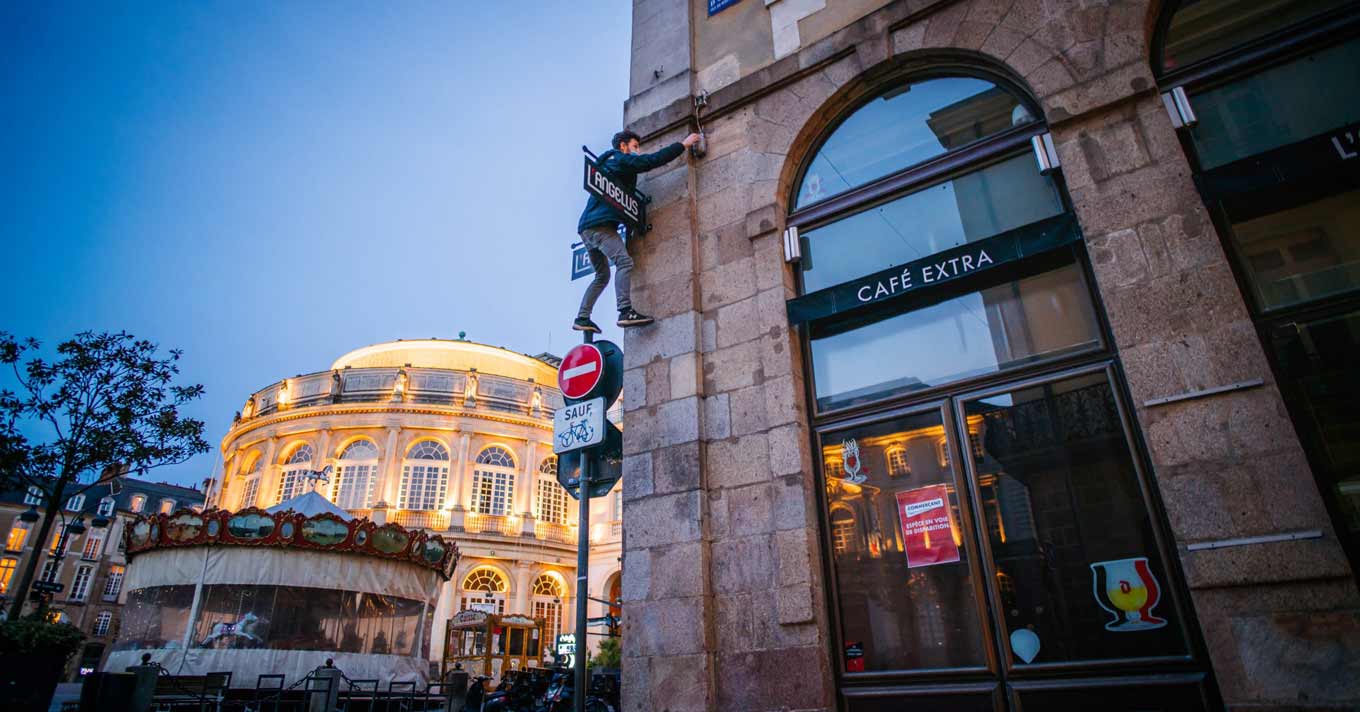
After seeing a video of someone turning off a street light using a wooden stick, Wizzy Gang members joked about their ability to jump up to high areas to turn off lights themselves.
In Rennes, France, where the group practices, lighted signs have small interrupter switches on the outside of buildings (usually storefronts). The athletes began turning off these lights in 2019, and in December 2020, posted their first compilation video on Instagram.
They call it Opération Luciole, which translates to Operation Firefly in English. While their neighbors are sleeping and the sun goes down, the group goes out on the town, turning off the lights.
“When the Parkour training is done, the sun is down. So, it was at night in the city, we walk around and see different lights of lots of shops. And we say, ‘oh, this one, this one’, and we will turn off the light of this one and it was like a little game,” Wizzy Gang member Mathieu Brulard told Insider. “It was cool because the light pollution is a big problem here in the city and other cities. We want to show that making improvements to ecological things is pretty fun, too.”
The Wizzy Gang hopes to travel across Europe for similar stunts and demonstrations. Their parkour initiatives thus far have inspired thousands to take light pollution into their own hands, too.
Why is light pollution a problem?
Although this form of guerrilla activism is a harmless and exciting way to fight climate change, the Wizzy Gang does encounter shop owners who want their lights kept on. Brulard told Insider that the group always attempts to educate businesses on why these stunts help the environment.
Light pollution is the excessive use of artificial light — most often in urban areas, where buildings, streetlights, electric cars, outdoor advertising, and factories are powered up at all hours of the day.
This impacts human health, wildlife behavior, and even our ability to look up at the stars.
According to National Geographic, artificial light can confuse the natural body rhythms of both humans and animals. Nocturnal light confuses our circadian rhythms and interferes with our sleep, lowering melatonin production. This can lead to increased headaches, fatigue, anxiety — and even a higher risk of cancer.
Animals are also greatly impacted by light pollution, which can affect migration patterns, sleep habits, and habitat formation. National Geographic reports, because of light pollution, sea turtles and birds guided by moonlight often get confused and lose their way, which even leads to death. Birds can also die upon contact with light sources, as they are drawn to insects that fly near artificial light.
Of course, it also takes a lot of energy to power large light fixtures. Traditional street lights are a huge energy drain on cities. In fact, a 2019 study by Visual Capitalist found that lighting in cities alone accounted for 19% of the world’s total electricity consumption.
However, many large urban areas have switched to induction or LED light bulbs. Smart tech increasingly allows for intentional energy decisions, but the best way to conserve energy is to reduce the amount of lights that stay on at night in the first place.
The Wizzy Gang is not the only group to worry about how light pollution impacts humans and animals in Europe. In fact, France does have a law in place that requires shop owners to turn off their lights within an hour of employees leaving. However, this law is rarely enforced, according to the Guardian.
Additionally, at the beginning of August of this year, Politico reported that a number of cities across Europe will be implementing similar protocols to save energy, including cities in towns in Austria, Spain, Italy, and Germany.
Why is this good news?

The Wizzy Gang shares on their website that they know these small actions do not eliminate the rising threat of climate change, but they do know that their work reaches people and raises awareness about light pollution worldwide.
“We are so happy that so many of you have joined us for an action like this,” the Wizzy Gang shares on their blog (which we translated from French to English). “We believe that this initiative reflects a new generation that has inherited global warming without being responsible for it, a generation that no longer expects decisions to come from the state. A generation that dares to act before it is too late.”
How can I help reduce light pollution?
First of all, you can make the simple switch of turning off lights around your home to save on energy costs — and reduce your carbon footprint.
However, the most important lights you turn off are outdoor lighting. Be sure to only use outdoor lights when needed and that they are properly shielded, directing light down instead of up in the sky, where birds and other animals are less likely to be impacted.
The International Dark Sky Association (IDA) also encourages folks to use dimmers, motion sensors, and timers on their lights to reduce illumination at night. The organization has a Seal of Approval for certain light fixtures, as well, to help you be mindful when selecting lighting options.
Lastly, the IDA encourages people to take action, like visiting a Dark Sky Place or advocating for a lighting ordinance in their town. Check out their helpful resource page to get your community started.
And, of course, if you’re proficient in parkour… you know what to do.
There is increasing recognition of the important role sleep plays in our brain health. Growing evidence suggests disturbed sleep may increase the risk of developing dementia.
I and University of Sydney colleagues have published a new study showing treating sleep apnea in older adults with mild cognitive impairment can improve memory, but not other areas of cognition, in the short term.
As there is no current treatment or cure for dementia, increasing efforts have focused on developing novel approaches to slow its progression. Mild cognitive impairment is the stage between the expected cognitive decline of normal ageing and the more serious decline of dementia.
In mild cognitive impairment, the individual, family and friends notice cognitive changes, but the individual can still successfully carry out everyday activities. Mild cognitive impairment is associated with an increased risk of developing dementia in subsequent years.
Researchers believe this is the optimal time to intervene to help prevent a future dementia diagnosis. Finding new ways to slow cognitive decline in those with mild cognitive impairment is therefore important.
How is sleep important for our brain health?
Sleep optimizes the ability of our brains to stabilize and consolidate newly learned information and memories. These processes can occur across all the different stages of sleep, with deep sleep (also known as stage 3 or restorative sleep) playing a key role.
We also now know the glymphatic system, or the waste management system of the brain, is highly active during sleep, especially during deep sleep. This process allows waste products, including toxins, our brain has built up during the day to be cleaned out.
Toxins in the brain include beta-amyloid, one of the key proteins in the development of Alzheimer’s disease. Disturbing sleep could disrupt this cleaning process and lead to more accumulation of beta-amyloid in the brain.
The important role of sleep in these vital processes has led to the investigation of whether sleep disruption, including sleep disorders, could be associated with changes in our cognition when we age, and a possible link to the development of dementia.
What is sleep apnea?
Sleep apnea is estimated to affect 1 billion people worldwide. In Australia, 5-10% of adults are diagnosed with the condition. Sleep apnea causes the throat (also called the upper airway) to close either completely (an apnea) or partially (a hypopnea) during sleep.
These closures or obstructions can range from ten seconds up to one minute and can lead to a drop in blood oxygen levels. To start breathing again, a short awakening occurs without the individual being aware.
In a person living with severe sleep apnea this process can happen 30 times or more an hour, causing very fragmented sleep. People with sleep apnea may snore, toss and turn, and others may notice them stopping breathing, choking or gasping for air during sleep. These repeated disruptions to sleep can cause sleepiness and reduce alertness during the day which, for some people, leads to difficulties performing tasks.
Does sleep apnea increase our risk of dementia?
The sleep fragmentation, as well as the drops in blood oxygen at night time, are a double blow in dementia risk. Studies have shown sleep apnea to be associated with a 26% increase in the development of cognitive impairment, as well as greater amounts of beta-amyloid in the brain. However, it is not clear if treating sleep apnea could reduce this risk.
The gold-standard treatment for sleep apnea is continuous positive airway pressure therapy, commonly known as CPAP, in which a mask connected to a pump blows continuous air down the upper airway, keeping it open. When the machine is being used it stops the airway from closing. It is not known whether treating sleep apnea will reduce the risk of dementia. Our new research, however, shows CPAP could be beneficial for memory in the short term.
Our study aimed to understand whether treating older adults with both sleep apnea and mild cognitive impairment could improve thinking and memory skills in the short term.
The trial assessed the effect of CPAP treatment on memory and thinking skills compared to no treatment. This was a crossover study, which means all participants had both CPAP and no treatment during the trial, but at different times. Some had CPAP first, then swapped. The others had no treatment first, then swapped. Trained staff helped participants get established with the therapy, and after using it for three months, participants underwent a series of cognitive tests.
The researchers found that compared to not treating sleep apnea, thinking skills were not improved with CPAP, whereas some improvements in memory were observed. This suggests treating sleep apnea could potentially improve outcomes in the short term, but it is unknown whether it would have any impact on long-term cognitive decline.
A previous study suggested CPAP could slow cognitive changes over one year in older adults with mild cognitive impairment and sleep apnea. However, studies of longer duration are needed before we can say what the long-term effects look like.
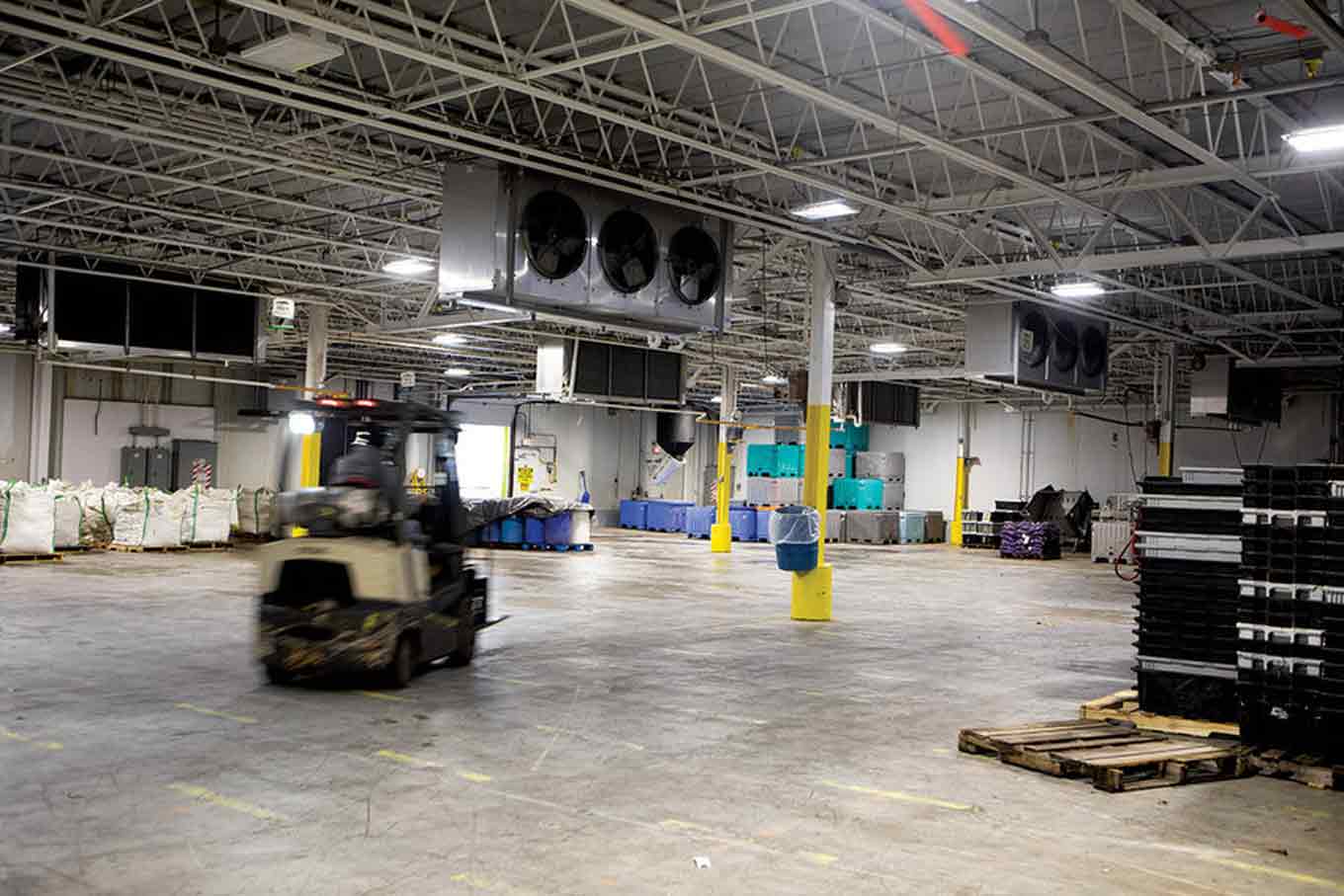
The landing dock of the Portland Fish Exchange is busy this afternoon, in a way that almost reminds David Townsend of when there were still groundfish to catch in Casco Bay, when this pier was piled with cod and haddock.
That was back when he captained his own boat and before he became operational manager at the exchange — back before the fisheries collapsed and people started to learn that the Gulf of Maine was warming faster than almost any other waters on Earth.
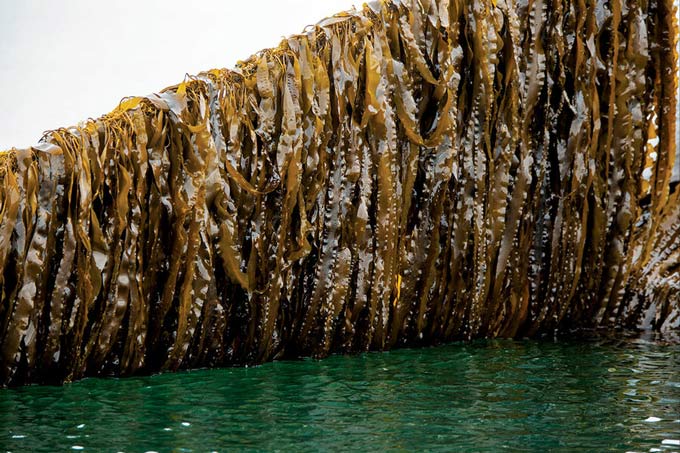
Now, Mr. Townsend waves down to Justin Papkee, who has maneuvered his boat up to the dock. Mr. Papkee is a lobsterman. But hours earlier, he and his crew harvested thousands of pounds of sugar kelp, hauling the seaweed onto his boat from the ropes where it had been growing, cutting off the leafy blades and stuffing them into half-ton potato sacks. The back of Mr. Papkee’s boat sags from the weight of it all.
“Let’s bring ’em up,” Mr. Townsend says, as the dock and boat crews start attaching bags to a pulley system, readying the forklift and scale.
There is another boat behind Mr. Papkee’s, where Stewart Hunt is waiting his turn to offload. Mr. Hunt owns a mooring company here. But he has incorporated kelp farming into his business plan, and now he and his son, who came up from New York to help with the harvest, stand next to their own white sacks full of seaweed, some 9,000 pounds in all.
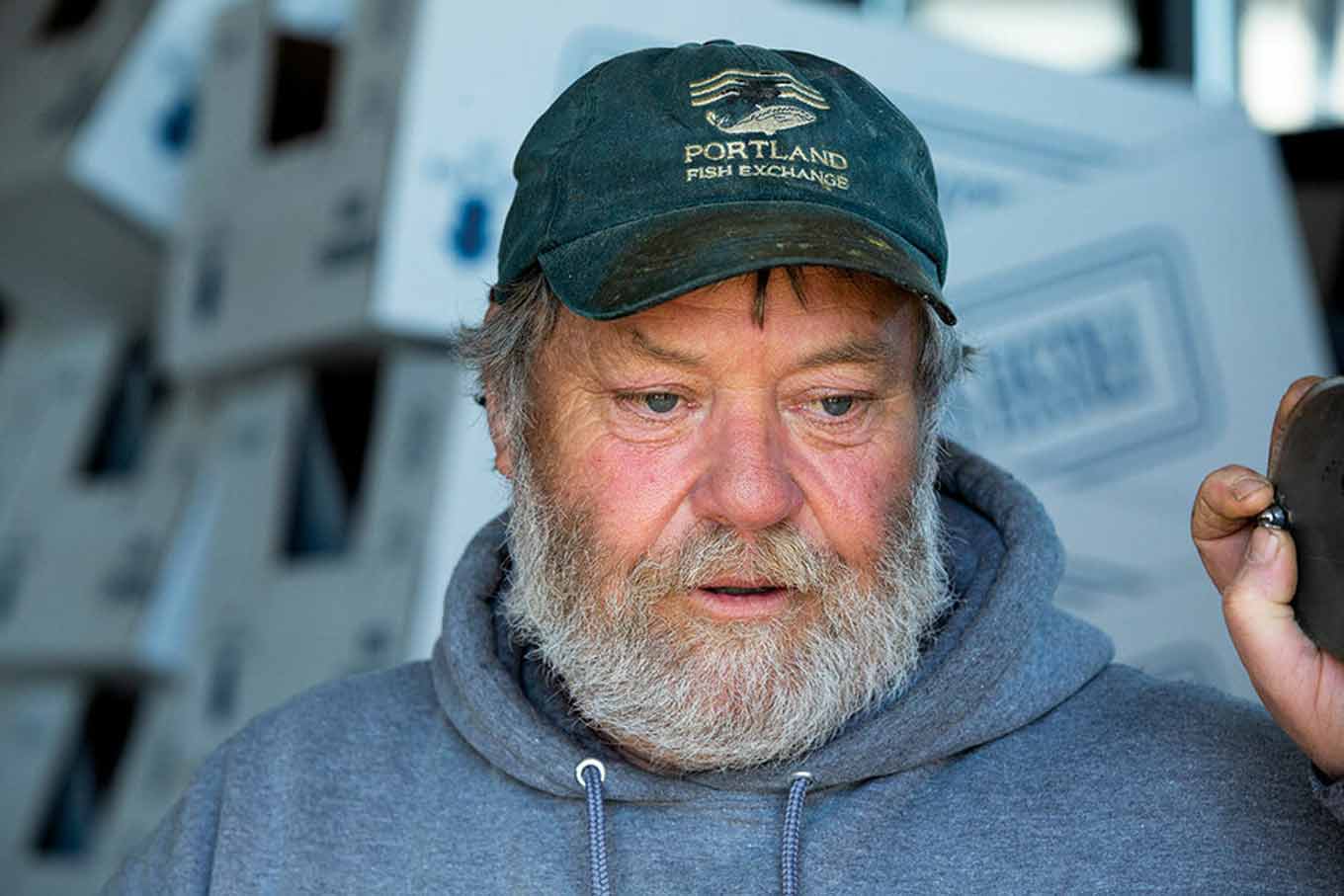
“We love the new business,” says Mr. Townsend. “This is the thing of the future.”
Briana Warner smiles when she hears this. This is a new tune for the dockworkers, who not long ago grumbled about how their lives had descended to this, landing ocean weeds. But as the boats keep coming in, their enthusiasm for her efforts has grown.
She ties off the huge white bundles as they come on to the dock, marking some with an organic label, kelp flecks on her arms. She made herself take a shower last night, even though she knew she would be right back here, smelling like fish and seaweed again.
It is a short harvest for kelp, and it’s busy. And it is her company, Atlantic Sea Farms, that is buying all of it, part of an ambitious effort to revamp not only Maine’s working waterfront, but also the way the state is fighting, and adjusting to, climate change.
“Kelp is the answer to so many of the questions that we’re facing here in Maine,” Ms. Warner says. “We are presenting a climate change adaptation tactic that also does no harm, and in fact does positive things. ... It makes the ocean better. It makes our coastal ecosystems better. It makes our coastal economy better. And it makes the consumer healthier.”
She shakes her head.
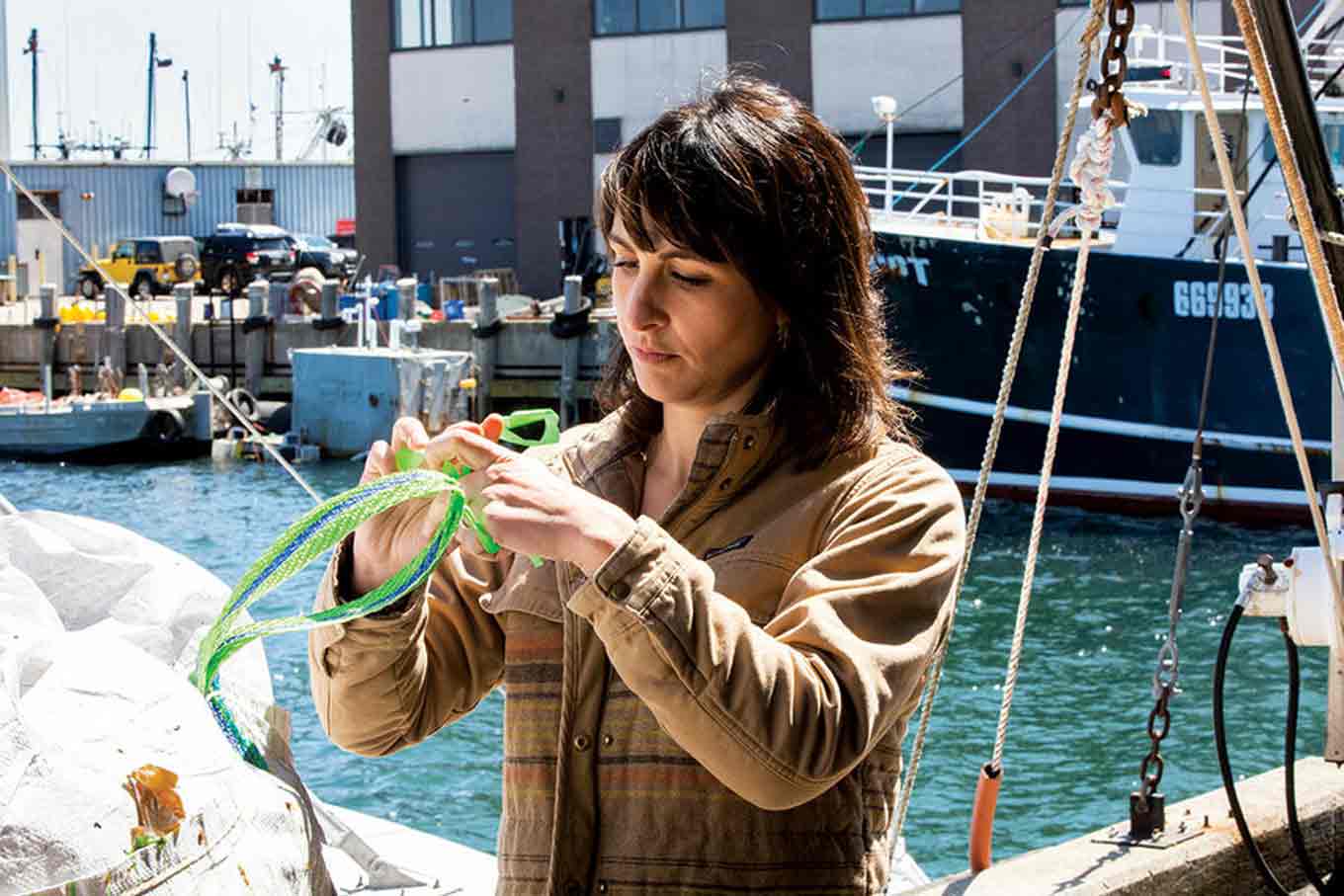
“It’s a hard road. Like, it’s extremely hard. ... But if we can prove we’re doing this — building a company that is based entirely on the integrity of the planet and our coastal ecosystem — that’s a proof of concept. The system doesn’t have to be broken.”
The story of seaweed here in Maine, and how it is evolving into what some are calling Maine’s new cash crop, is part of a global story. It is one that weaves together climate change, industrial food systems, nature-based solutions, economic challenges, and cross-sector cooperation.
But it is also intensely local. And this, climate activists say, makes it even more important for understanding how humans around the world might adjust to a quickly changing planet.
While few researchers would discount the importance of sweeping climate actions by international organizations and countries, there is a growing sense that, at least in the short term, real change will come from variations of what is happening in the waters off the coast of Maine. These will be place-specific initiatives. They will be based on cooperation and unity, not only between humans — the environmentally minded businesswoman and the sometimes conservative fishermen — but also among people and nature: the carbon and the kelp and the restaurateurs.
Alone, these efforts won’t fix all the ecological and economic problems brought about by climate change. But they will help, especially as they are repeated in different forms and ways.

“There’s no one silver bullet,” says Susie Arnold, a marine scientist at the Island Institute, a Maine nonprofit focused on preserving the state’s working waterfront. “It’s going to take everybody. And at this point, we’ve taken such a toll on the Earth that there are going to have to be trade-offs. It’s going to have to be about the big picture, and how everyone needs to pitch in.”
In Maine, this means developing a new understanding about what is happening — and what can happen — in and around the water.
For generations, life in this sparsely populated, ruggedly proud Northeastern state has focused on the ocean. Although Maine’s coast is only about 228 miles from north to south, when you include the various bays and inlets, the state’s shoreline measures more than California’s, totaling some 3,478 miles. Studies show that more than 80% of the household income in some communities traces back to fisheries.
When Mr. Townsend was younger, these fisheries were ecologically complex, with people who worked the sea bringing in a variety of groundfish and shellfish. But for a complex brew of reasons, involving everything from overfishing to ecological changes to new regulations, many species have largely disappeared from Maine’s waterfront.
Yet there has always been lobster.
For a generation now, lobster has been king of Maine’s seafood industry. It forms the base of a billion-dollar-plus business in the state, which provides the vast majority of domestically caught lobster in the United States.
Communities up and down Maine’s coast revolve around the lobster industry, both economically and culturally. And the people who hoist the traps take pride in crafting their own stringent measures to protect the fishery. They have imposed regulations on everything from who gets to catch lobster to what type and size of crustaceans are allowed to be pulled from the water.
“Lobster fishermen are notoriously good stewards of our coastal ecosystems,” says Jesse Baines, the marketing director at Atlantic Sea Farms, who grew up in a Maine lobstering family. “But we all know that the seasons are more variable every year.”
Yet the seasons are not just more variable, starting unpredictably later or earlier. On the water, they are also warmer.
“The Gulf of Maine is one of the fastest bodies of warming water in the world,” says Sebastian Belle, executive director of the Maine Aquaculture Association. “And frankly, it’s incredibly scary how fast it’s happening.”
The reason, scientists say, is climate change. As humans release more greenhouse gases into the atmosphere, the air warms. Much of that heat is absorbed into the oceans. There are also ocean currents that some scientists believe are being disrupted.
A shift in one particular circulation pattern has allowed warmer water coming up from the Gulf Stream to push away colder water coming down from Labrador, leaving warmer, saltier currents entering the Gulf of Maine. And that has prompted the lobster population to shift northward.
Already, researchers say, the lobster population in New Hampshire and Massachusetts has dropped dramatically, while in Maine the best lobster grounds have inched northward and eastward along the coast, or farther offshore. The lobster harvests might still be strong, but many boat crews recognize that the water is changing.
Meanwhile, the warmer water has caused other species to migrate to the area, including the endangered right whale. Legal battles have erupted among the lobster industry, interest groups, and the federal government over protecting the mammal.
Looking at all of this, economic development experts throughout the state are worried about the risk of so much of Maine’s economy being dependent on lobster.
Those experts include Ms. Warner. “Just a few more degrees in the water, and no matter what they do for conservation, no matter what license procedures we’ve put in there, the lobster larvae aren’t going to survive at the rate they are now,” Ms. Warner says.
“We would never say the lobster industry is going to end, because we have no idea what is going to happen. But we do know that it’s super volatile. And it’s really scary to have the entire coastline of Maine completely dependent on one species.”
Before she and her family moved to Maine, her husband’s native state, in 2013, Ms. Warner had spent nearly a decade as a U.S. Foreign Service economic development officer based in multiple African countries. There, she watched the struggles of individuals and communities working against forces far larger than themselves. And so she recognized what she was seeing in Maine.
“It’s just really devastating to see an industry that has taken such a leadership role in conservation and has no ability to stop the volatility because of the greater world’s usage of fossil fuels,” she says. “No matter what the lobster fishery does, they can only control so much because the ocean is just warming.”
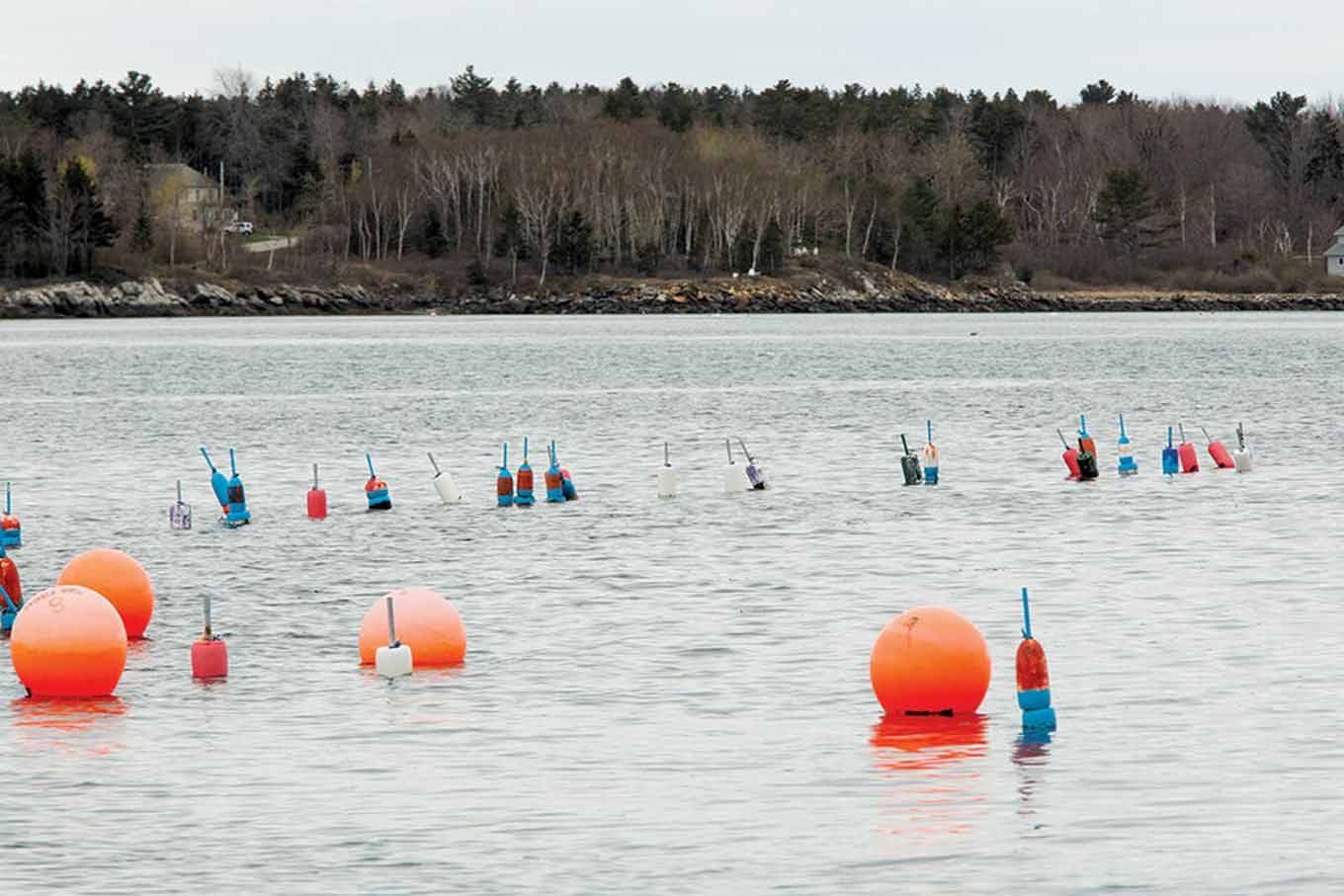
The industry needed another way to make money, she realized – one that would be ecologically helpful instead of harmful.
And that brought her to kelp.
The seaweed known as Saccharina latissima, or sugar kelp, is a yellowish brown alga that grows along rocky coastlines. It takes the shape of an elongated lasagna noodle, with crinkled edges, and can grow up to 16 feet long.
It is high in a variety of nutrients, and also has a gelling capacity that makes it a useful ingredient for everything from cosmetics to ice cream to toothpaste. And like all plants, kelp absorbs carbon while giving off oxygen.
Researchers are still trying to quantify how much carbon is sequestered through a kelp forest. This concept, though, is tricky, in the same way that the carbon-absorbing nature of cover crops, or tree farms, can be difficult to measure, because once a plant is cut and consumed, that carbon is no longer trapped within its cells.
There is some indication that debris from kelp makes its way to the ocean floor and is buried there, which would be true long-term carbon capture. But supporters of the plant’s climate impact say that matters less than the carbon benefit that comes from the sorts of food kelp can replace.
Kelp can be grown without fertilizer or some of the other fossil fuel-heavy elements of industrial agriculture. As a result, kelp-infused foods, such as plant-based burgers, have a lower climate impact than more traditional fare. Increasingly, scientists are looking at ways to use kelp in livestock feed. Other researchers are exploring kelp’s potential as a biofuel.
These uses are at the cutting edge of seaweed research, but the idea of kelp as both a food source and an environmental solution is not new. Indigenous people in the Americas harvested kelp for generations. In Asia, it’s part of a multibillion-dollar seaweed farming industry.
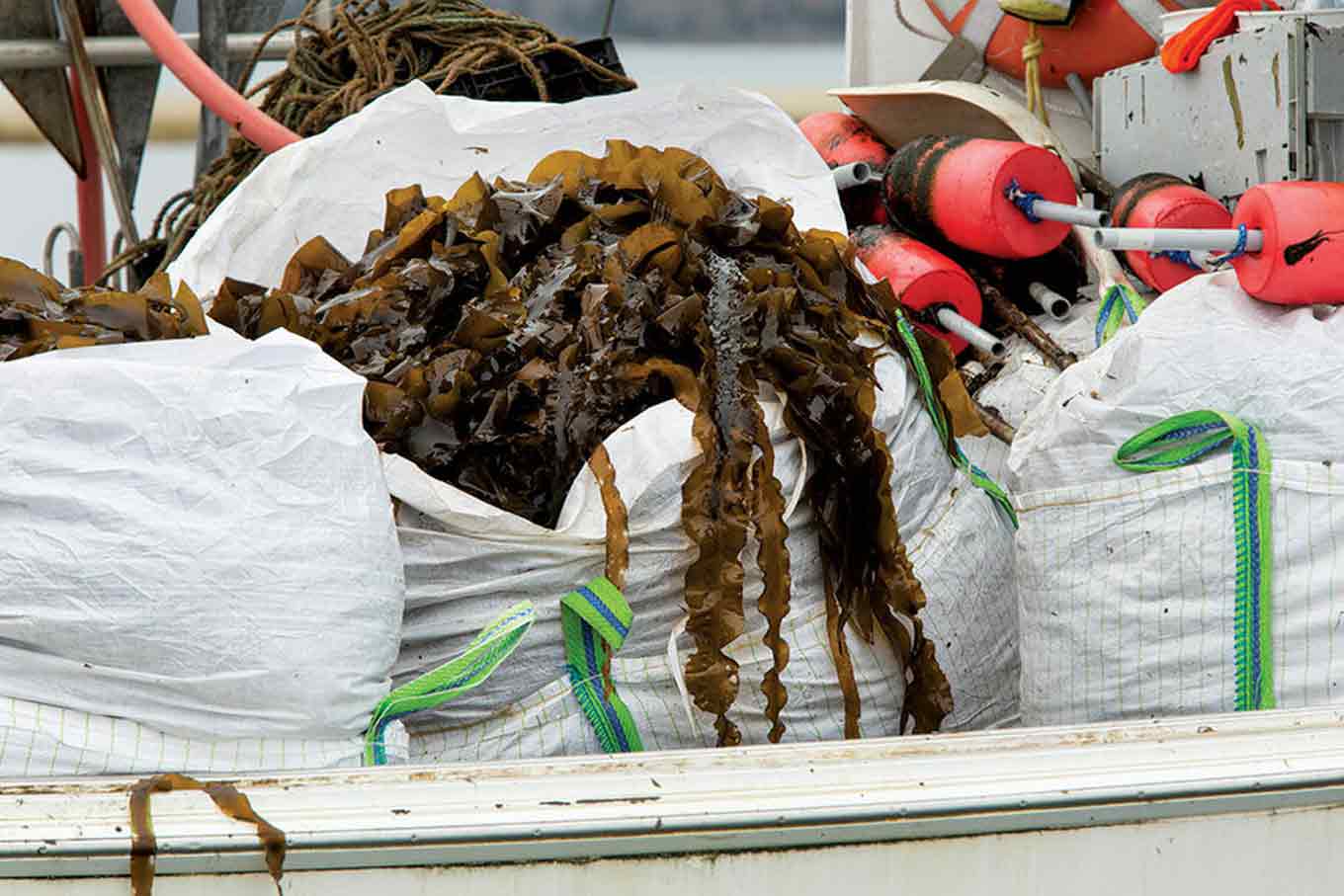
But in the U.S., where far fewer people eat seaweed, there has been scant commercial interest in kelp farming until recently. Overall, aquaculture, or sea farming, is one of the most rapidly growing food production methods in the country.
Although seaweed currently makes up only a small percentage of that industry, it is the fastest-growing subsector, according to the National Oceanic and Atmospheric Administration.
This is partly the result of efforts by people like Mr. Belle, the Maine aquaculture organization director, and groups like the Island Institute. They have taught farmers about the potential of kelp and also lobbied the state government to implement regulations that allow men and women who fish to test out the farming method without overly burdensome investments.
This work helped convince people like Mr. Hunt, whose boat was lined up at the Portland Fish Exchange, that kelp farming could supply a good chunk of his income.
The waterman started thinking about seaweed six years ago, after hearing another farmer talk at a conference. He quickly wrote up a business plan, and estimated that kelp could eventually make up a good 50% of his income, which was otherwise focused on servicing moorings.
The plan, he says, “was right on.” Mr. Hunt now farms 20,000 feet of kelp line. He does, however, make sure to keep some for himself. “I like a seaweed salad,” he says. “With sautéed shrimp, carrots, and tamarind sauce.”
Seaweed farming works well in Maine because it grows in the offseason for the lobster industry. That means people who already have the boats, equipment, and knowledge for working the sea can make an additional profit over the winter.
“It fits well with their traditional fishing,” Mr. Belle says.
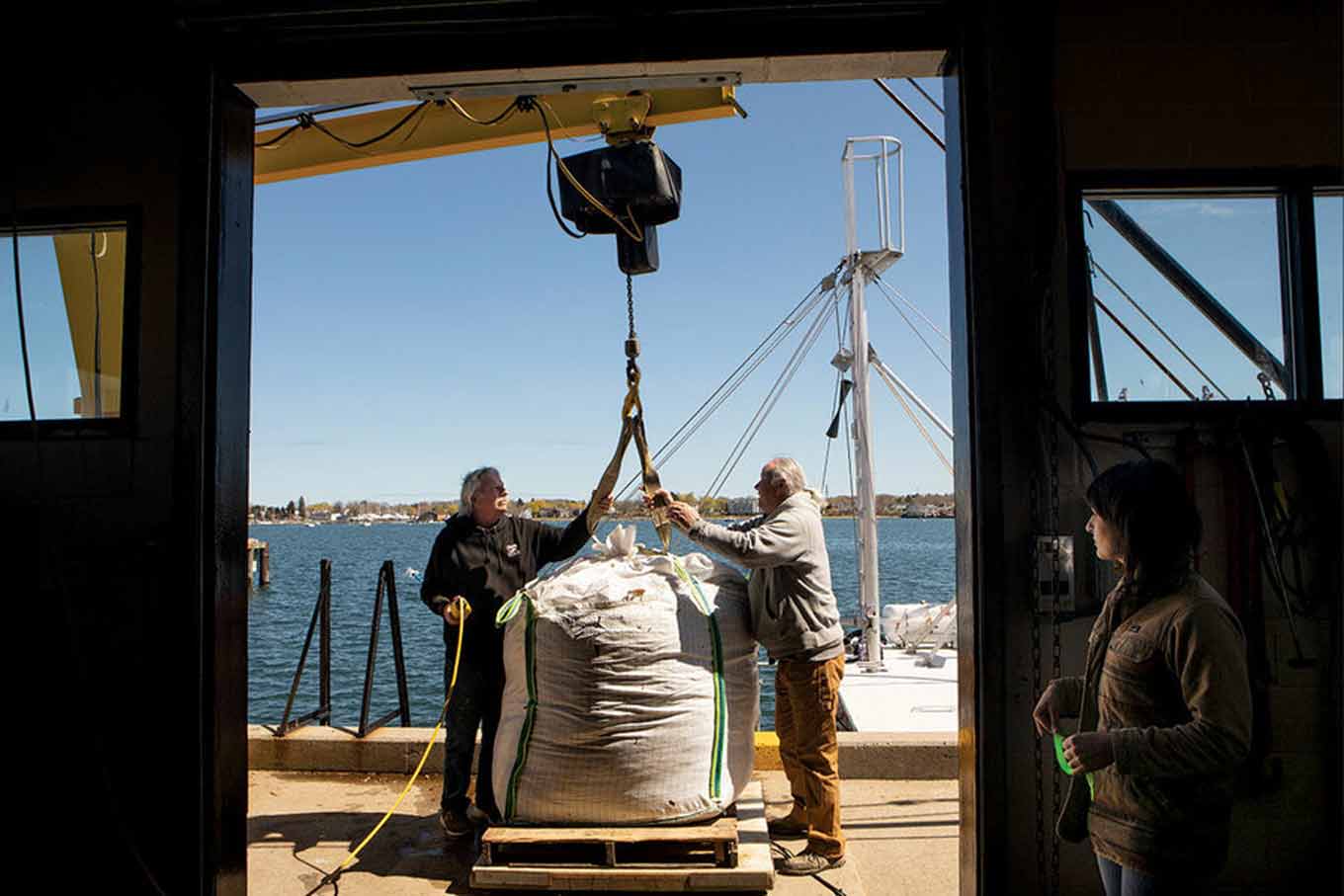
For these workers, kelp farming is not overly difficult. In the fall, they run ropes seeded with kelp across leased sections of water. Then they let the plant grow until early spring, when it becomes long enough to harvest. The issue, Mr. Belle says, is what to do then.
“We know we can grow a lot of seaweed,” he says. “We can grow hundreds of thousands of pounds of it. The challenge is what to do with that seaweed. For us in the U.S., seaweed isn’t part of our normal diet.”
That’s where Ms. Warner fits in.
In the mid-2010s, she was working with the Island Institute, focused on how to foster economic resilience in the face of warming water. As part of that effort she met the founders of a company called Ocean Approved, who wanted to grow, harvest, and market large volumes of seaweed.
In 2018, Ms. Warner took over the company. But she decided to change the business model. Rather than having her own large seaweed farms, she wanted to contract with people who fished up and down the coast and have them do the harvesting. She would supply the kelp seed, technical support, and training, as well as promise to buy all their kelp.
That last element — a guaranteed buyer — was key to many boat captains’ decisions to start growing seaweed. It meant that they could operate the same way that they did with lobsters: They would bring in their catch, have it weighed, and then get paid.
Ms. Warner renamed the company Atlantic Sea Farms. And she started to travel up and down the coast, working to convince the people who do lobstering to grow underwater forests.
She didn’t talk about climate change or nutrition or sustainable food systems. She just explained the business model and promised to buy their kelp.
Since then, Atlantic Sea Farms has gone from purchasing 30,000 pounds of seaweed a year to 1 million pounds, and from two small kelp farms to 27 partner farmers, with another dozen waiting for leases from the state. It has helped make Maine, by far, the top domestic producer of seaweed.
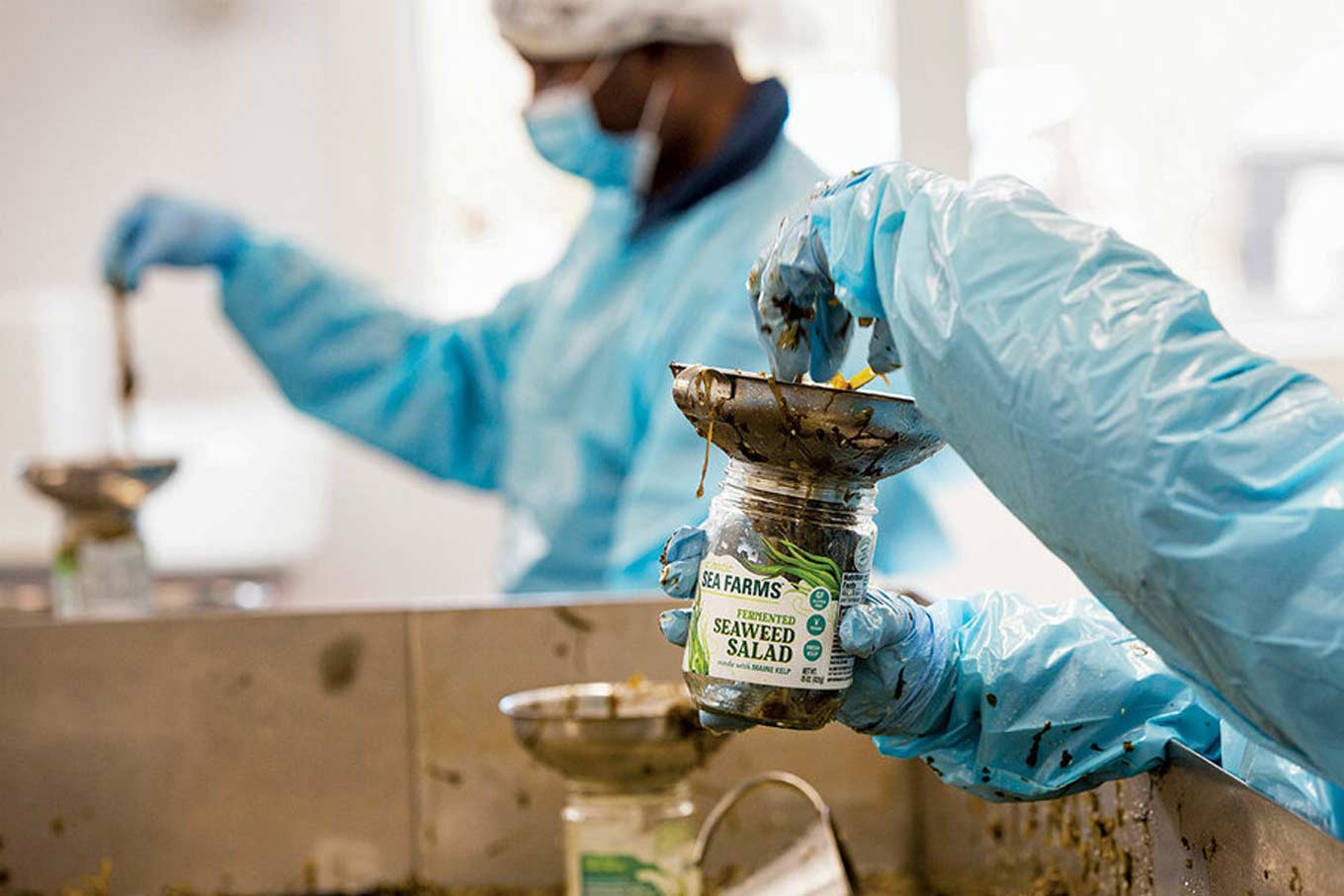
The growth has required a feat of logistics. Ms. Warner has had to invest in cold-storage units and refrigerated trucks, as well as build a market for all the kelp. To help do that, her company has developed a flash-freeze process that allows it to sell fresh kelp to restaurateurs and the food service industry. It also recently opened a new 27,000-square-foot facility in Biddeford, Maine, where there is a kelp nursery and production facilities.
On one recent day, a food production crew worked at stainless steel tables, mixing kelp and filling jars with seaweed salad for retail at grocery stores across the country.
The company’s next big goal is to expand its reach beyond the “smoothie, seaweed salad, vegetarian” clientele to more mainstream customers. This is possible, Ms. Warner believes.
“Aquaculture right now — especially kelp aquaculture, but also oysters and mussels — allows us the ability to be exactly who we’ve always been,” she says. In other words, people intimately connected to the sea.
That’s one reason Matthew Moretti farms kelp. He has always loved the ocean.
Growing up near Bangor, he regularly joined his father on a lobster boat and learned the ways that workers here tend to the long-term sustainability of the ocean. He knew, as he studied marine biology at Bates College in Lewiston, Maine, and then went to Northeastern University in Boston for graduate school, that he wanted to keep working the sea, producing food in a way that cooperated with the ecosystem rather than taking from it.
In 2010, his family became the new owner of Bangs Island Mussels, an aquaculture company based in Portland. Mr. Moretti started growing kelp the same year.
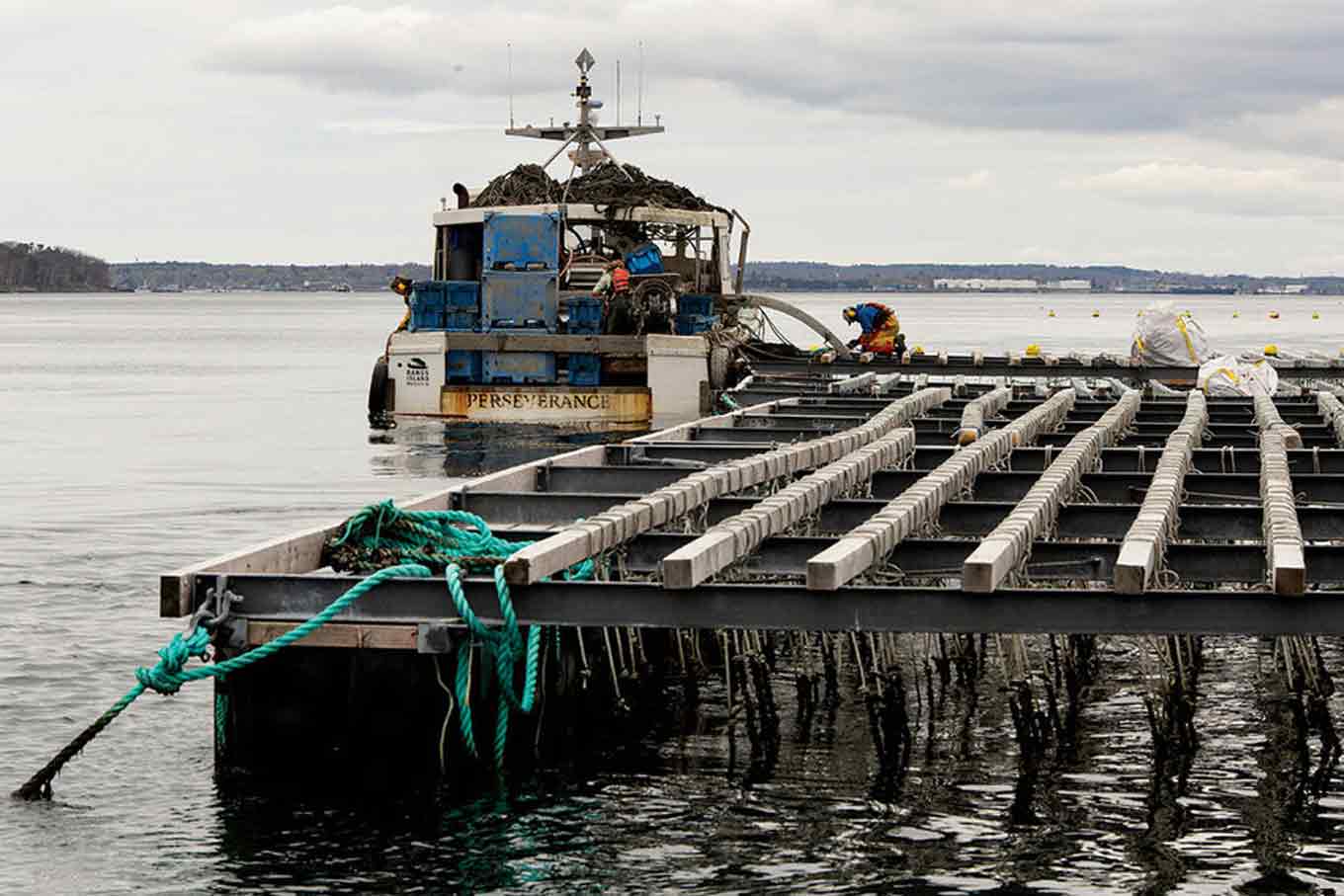
“We started farming mussels and then immediately began farming kelp because it was the most sustainable form of protein that we’d ever heard of,” he says.
At first, his company tried to process and sell its own product. But eventually he and his family co-owners collaborated with the company that would become Atlantic Sea Farms. They now sell their kelp to Ms. Warner — some 117,000 pounds last year.
“It’s a really great partnership that’s developed between us,” Mr. Moretti says. “It lets us focus on what we do well, which is growing. And they get to focus on what they do well, product development.”
But that wasn’t the only partnership that blossomed. Like kelp, mussels require no feed, no chemicals, and very little space to produce. But they are sensitive to the pH balance in the water. And the ocean, as it absorbs more carbon molecules, is becoming more acidic — a problem for mussels and many other shell-forming creatures.
Mr. Moretti realized that when he grew kelp near the mussels, his shellfish seemed to grow larger and healthier.
He began working with scientists to study what is now called the kelp “halo effect,” or how, around a seaweed farm, the water has more oxygen and is less acidic.
“The kelp is sucking carbon dioxide directly out of the water, and actually reducing the acidity of the water in its general vicinity,” he says. “So if you put the kelp close enough to the mussels, we have measurable, significant evidence showing that the kelp halo effect helps the mussels grow bigger and faster. It was just amazing to see that.”
The kelp also benefits, researchers have found. Mussels filter ocean water, removing possible parasites and bacteria that could damage the kelp.
“It’s not going to solve climate change,” Mr. Moretti says. “It’s not going to solve ocean acidification. But it’s one way we can make a difference that’s measurable and significant in our local ecosystem to help the problem.”
Four years ago Phoebe Autry packed up everything she owned, said goodbye to friends and neighbors in central Washington, and set off on a 45-plus hour drive northwest to Palmer, Alaska.
Exhausted by the “ever present danger of wildfires” that posed a risk to her West Coast farm, not to mention her life, Autry, now 32, sought somewhere to start her vegetable growing career afresh.
She’s not the only one. As farm numbers decline in most of the U.S., Alaska is bucking the national trend. Between 2007 and 2017, the number of farms in the country’s largest state increased by 44 percent even as the total number of U.S. farms dropped by more than seven percent. Most of that growth has been in small farms of up to nine acres.

The reasons for this are varied but include the very thing that drove Autry to leave the Lower 48 in the first place — climate change, which in Alaska at least has resulted in an extended growing season for most crops.
In more recent times, Covid-19 and the war in Ukraine have underlined how vulnerable Alaska is to supply chain shocks and, say agricultural experts, seen a growing number of Alaskans opt to grow their own food.
The upshot for this isolated state, which imports roughly 95 percent of its food, is clear. Far from being a gentle quirk in the evolution of its history, Alaska’s farming boom, while relatively localized, is vital at a time when further disruptions to the faltering global food system are inevitable.
“We are an incredibly food vulnerable state,” says Autry. “Even in normal times our grocery store shelves are pretty sad. If a boat gets stuck, we might not get fresh milk, yogurt, cabbage or broccoli for a few days.”
But with Alaska warming faster than any other state, something predominantly negative — not least for Alaska — is having the beneficial impact of making it more conducive to growing food. Over the past 60 years, state-wide air temperatures have increased by an average of 3°F.
The warmer weather and extended growing season mean that “more people are considering Alaska as a place to grow food,” says Autry, who is currently taking a break from farming to fill the role of interim executive director at the Alaska Farmland Trust.
Over the last five years the trust, which protects agricultural lands from development by putting conservation easements on them, has seen a “significant increase” in calls from farmers in other parts of the country who are seeking land.
Another factor that attracts farmers to Alaska is the cost of land. At 665,000 square miles large, the state is bigger than Texas, California, and Montana combined, and farmland is mostly cheaper than elsewhere in the U.S., making operating a farm more financially viable.
“In other states, most of the land is already spoken for,” says Amy Seitz, executive director at the Alaska Farm Bureau, the goal of which is to improve the economic wellbeing of agriculture in the state. “So when it comes to family farms, if there are multiple kids, a kid can’t buy a neighboring piece of property. So instead they are looking up here.”
Scott Mugrage, president of the Alaska Farm Bureau, moved to Alaska almost a decade ago after he and his son couldn’t afford to open a feedlot together back where they were living in Nebraska.
The two were considering what they might do next when they came across a farm online that was located in the Delta Junction, southeast of Fairbanks, Alaska’s second largest city. It was in disarray but they could afford it, so they relocated and fixed it up. Today, Mugrage Hay & Cattle is one of the largest producers of finished beef in the state, employing people year-round.
“We couldn’t have done this elsewhere in the States,” says Mugrage.
It’s not like Alaska has humongous tracts of land for industrial operations to snap up. There are some bigger farms in the Delta Junction, like the Mugrages’, but most of the farmers moving in from other places have established small-to-midsize farms.
And most of the properties that the Alaska Farmland Trust has protected have been relatively small, too. The biggest property that they’re currently working to protect with a conservation easement is 120 acres.
Of course, appealing as it all sounds, cheap land doesn’t always remain so. Autry says the Matanuska-Susitna borough where she lives is seeing a lot of pressure from housing development, which is driving land prices up. Autry and her fiancé are in the process of looking to buy their own farmland, but are worried they will be priced out.
As well as individuals like Autry and Mugrage, who moved to Alaska to set up food production operations, there are those born and bred in the state who are supporting its growing farming scene.
As part of this, Seitz and Autry both highlight a growing interest among Alaskans keen to grow their own food in the wake of a turbulent two years that has seen Covid-19 and the war in Ukraine seriously exacerbate existing food supply challenges.
What’s more, says Autry, with more locally produced food available, more Alaskans are opting to buy local where possible.
“Alaskans are very proud to be from Alaska,” she says. “So they do their best to support local businesses and buy Alaska-made and Alaskan-grown.”
This is reflected in the dramatic increase in farmers markets across the state. In 2005, there were just 13 farmers markets in Alaska. Today there are 56.
“That’s the most we’ve had, ever,” says Robbi Mixon, executive director of the Alaska Farmers Market Association, who adds that she’s seen increasing interest in locally grown food from regeneratively farmed land as part of these developments.
Despite the successes, if Alaskans really want to be food secure they’re going to need some help, says Mugrage. He laments, for example, that there’s not enough research going into wheat hybrids that might work in Alaska now that the growing season is longer.
“We have one flour mill in the state [and] three slaughter plants,” he says, adding that he doesn’t believe investment for this additional infrastructure will come from the private sector. “We need government to invest in infrastructure.”
For farmers like Autry, having some land of her own will be a dream come true.
“Sometimes it feels out of reach, but I have to remind myself I’m closer than I’ve ever been,” she says.
“Despite competition for land with developers, I think small-scale farming has a very bright future in Alaska. We live in a state where being self-sufficient is important and we are starting to get more buy-in from our state politicians. That, and the engagement we get from the community, is essential to making it all possible.”
In 2018, Burundi launched a vast national reforestation program to boost the country’s dwindling forest cover, which will run until 2025.
— Burundi has just 6.6% of its original forests remaining, the legacy of a brutal civil war in which forests weren’t spared the violence inflicted by either side.
— Today, the formerly warring factions are working together on the reforestation project that has been hailed as a fantastic initiative, especially as the planted trees are varied.
— However, key civil society stakeholders in nature conservation are calling for these efforts to be followed by awareness-raising campaigns among local populations and communities, to protect seedlings that have already been planted.
In 1993, the democratically elected president of Burundi, Melchior Ndadaye was assassinated in a coup. At the time, the country’s democratic institutions were still only three months old. The incident set off long-simmering ethnic tensions, leading to what would become a decade-long civil war.
“We ate whatever we found on our path. We knocked down trees here and there for cooking. The forest hid us and fed us during the civil war,” said Ndayuwundi Joseph, a war veteran and now a member of a local reforestation committee in central Burundi.
During the war, much of the country’s forests were destroyed. Today, only about 6.6% of the original forests remain, according to the Burundian Office for Environmental Protection (OBPE).
'When two elephants fight, it is the trees that perish'
A Burundi saying goes “when two elephants fight, it is the trees that perish.” This adage highlights the war that Burundi has experienced, when the forests perished amid the conflict.
Today, communities are working on reforestation alongside the Burundian military and police in an act that’s more than just symbolic. They represent large communities that use a lot of wood for cooking. Many former warring factions today have joined together, integrating veterans to make up security and defense groups.
“What I saw in the ’90s was terrible,” said Barampama Laurent. “Soldiers burned the forests searching for the rebels. The rebels in turn used the forest to hide. The forest was their home and their source of food … All of this was destroying the environment.”
Laurent and about 20 other people are community members of Shoots and Roots Burundi, who maintain tree nurseries to grow the seedlings used in the tree-planting campaign.

Getting the mountains 'dressed'
In 2018, the government launched a tree-planting campaign called “Ewe Burundi Urambaye!” which literally translates as “A well-dressed Burundi!”
Prime Minister Allain Guillaume Bunyoni expressed concern about the pressure on nature caused by human activity.
“Before, all we saw was banana plantations, fruit trees, oil palms,” he said. “Now, we see none. The mountains are bare, which is causing the flooding that puts our infrastructure at risk.”
The ultimate objective of the project, he said, is not only to fight climate change but also to raise awareness and mobilize the entire population to take part.
“The project is yours. There is no sustainable development in a country where the environmental sector is ridiculed,” Bunyoni said. “You must take ownership of it, as it will protect your viable land against erosion, and make it more fertile.”
At least 150 million trees planted
Since the start of the campaign four years ago, at least 150 million trees of various species have been planted across the country, over an area of 123,600 acres.
Prime Niyongabo, the army chief of staff, who oversees the coordination committee and the execution of the tree-planting project, the first phase was to organize “censuses of all the non-reforested state areas,” followed by establishing “nurseries and verifying the types of trees to be planted.”
Some species, such as eucalyptus, have been ruled out because they pose a threat to small rivers once planted along them.
Destructive activities
According to local media reports, some of the plants have been uprooted by unidentified people, especially in eastern Burundi.
According to Radio Isanganiro, in a report from a few months ago, at least 50 hectares (124 acres) of the project plantations have been burned or affected by destructive activities by unidentified people.
But for forest activist Leonidas Nzigiyimpa, winner of the 2019 Wangari Maathai “Forest Champions” award, raising awareness among local populations is also crucial, along with planting trees.

According to Nzigiyimpa, local communities must play a fundamental role in planting and protecting trees, even though the trees are planted in public spaces.
There are people who for the most part “have not yet understood the importance of preserving forests, who think that these are useless spaces that must be cultivated and valued in another way,” he said.
Nzigiyimpa even proposed sanctions against anyone caught destroying planted trees.
Additional measures
Additional measures laid out in a presidential decree have the specific objective of helping people to solve certain essential needs or to develop income-generating activities.
They will also make it possible to reduce obstacles to local development, but above all to acquire the knowledge and skills to restore and/or preserve the management of environmental resources.
Another activist has suggested there needs to be a change of mentality. Faustin Ndikumana, president of a local anti-corruption NGO, said the project needs good governance above all.
For him, these measures should be “accompanied by an improvement in governance, good management of public affairs as well as concrete awareness-raising actions to foster a change of mentality.”
The initiative is good, but it still lacks support measures, Ndikumana added.
Meindert Brouwer, an ecology writer and researcher, said “reforestation in Burundi is very important.” Brouwer, best known for his conservation publications, in particular his latest work, Central African Forests Forever, said the “analog forestry” policy adopted by Burundi — which replicates the plant diversity found in a natural forest rather than focusing on planting as many trees as possible — is important.
“How reforestation happens is especially important. Analog forestry is a good method of reforestation,” Brouwer said. “A forest with several different trees is better than a forest with only a few tree species.”
Smart Parks is a Netherlands-based organization deploying high tech and an R&D-focused approach to finding technological solutions to conservation problems.
— The organization is best-known for using LoRa (long range) wireless technology to create networks of connected sensors and devices within conservation areas.
— These are designed to help anti-poaching teams through access to real-time data such as animal locations, vehicle movements, and fence voltages, among other parameters.
— Working primarily in Africa, Smart Parks’ next phase of development is to add more sensors to tracking collars to collect additional data such as animal sounds and movement data, and then use machine learning to gain additional insights for research.
You’ve heard of smartphones, smart cars, smart cities, even smart refrigerators, but have you heard of Smart Parks? Smart Parks is a Netherlands-based team of technologists dreaming up inventive ways to realize the founders’ vision of bringing the power of modern technology to bear in conservation.
“Big tech organizations like Google and Microsoft have big conservation programs, but it’s not their core business,” says Tim van Dam, one of the co-founders of Smart Parks and a telecoms expert. “We know that if something is not your core business, you cannot get to the high-performance level that is needed for technological devices.”
Smart Park’s philosophy is to apply an innovative and research-and-development-focused approach, more commonly found in Silicon Valley, to conservation problems. While they explore many different forms of tech, they’re best-known for building so-called LoRa networks in parks and conservation areas, mostly in Africa, through which multiple devices can be connected to create “smart parks.”
LoRa, or long range, technology is a networking protocol that uses radio waves, much like the 4G and Wi-Fi networks. The key difference is that while 4G and Wi-Fi are designed to send a lot of data a short distance by using a lot of power, LoRa technology is designed to send tiny amounts of data — about the size of a text message — a very long way, using much less power.
“[LoRa] was the perfect match for connecting a lot of things in remote areas to make sure the park management protecting those areas have an opportunity to get way more data from the field,” van Dam said.
LoRa’s lower power requirements allow Smart Parks to design tracking devices that are smaller than traditional satellite collars. This is especially advantageous for tracking smaller animals like wild dogs, which can’t take the weight of a large battery, and, perhaps surprisingly, rhinos. While a rhino could easily carry the weight of a heavy battery, collars don’t work with their body shape.
Protecting the near-threatened southern white rhino (Ceratotherium simum simum) and the critically endangered black rhino (Diceros bicornis) is one of Smart Parks’ current main aims. Its rhino tracker is just under three centimetres cubed, small enough to be implanted into a hole cut into the rhino’s horn and then sealed by a vet.
“The industry has been searching for a very long time now on how to track a rhino with GPS,” said Geoff Clinning, technology development manager for African Parks, a conservation NGO that manages protected areas in partnership with governments and local communities, and which has put LoRa technology to use in many of its parks. “It’s such a massive leap forwards knowing where every rhino is every morning and every evening.”
Smart Parks’ hope is that the data collected through a range of sensors — such as animal locations, fence voltages and vehicle movements — and reported to a nerve center over a LoRa network will help give anti-poaching operations an advantage, something they call situational awareness.
“Everybody thinks anti-poaching is a matter of boots on the ground. It’s not,” said Jurgen Elbertse, director and co-founder of Timbo Afrika Foundation, who recently contracted Smart Parks to install a LoRa network covering 30,000 hectares (74,000 acres) in the Central Tuli Block in southern Botswana. “It is making sure you cleverly and intelligently look at the asset you want to protect.”
Elbertse drew an analogy with protecting a diamond: rather than trying to secure a whole building, you focus on constructing a secure vault to hold the diamond. In anti-poaching terms, the “situational awareness” gained through the sensors means you can strategically direct your efforts to key animal locations.
But while technology can certainly help give anti-poaching teams an advantage, it’s no silver bullet, Clinning said.
“LoRa is a very valuable tool in a park manager’s toolkit, but it’s one of many,” he said. “Even if you can track something, you still need to have well-trained rangers who can be on foot who can monitor [the animal].”
All sources agreed that LoRa is especially useful in remote areas where there are no mobile networks already in place. Parks need to pay an initial setup cost, which varies depending on the location’s infrastructure and whether the staff have the skills to set it up without help. If the park already has a good network of radio towers for communication, it can be as simple as adding a LoRa gateway to each tower at a cost of around $1,000 per tower.
Once the network is established, parks can gather reams of information beyond tracking animals to prevent poaching, such as temperature data or water levels in key water holes. They can even flick a switch to turn on a water pump — something that previously would have taken a ranger a round trip of several hours to do in some large parks.
Despite its advantages, LoRa isn’t necessarily the best solution everywhere, Clinning said. In conservation areas with good mobile networks, LoRa’s setup and maintenance costs might still be more expensive than using the cellular network.
In other places, the sheer size that the network would need to cover makes it less suitable. For example, Clinning said satellite collars are still the best tool to track the park’s mixed population of forest elephants (Loxodonta cyclotis) and bush elephants (Loxodonta africana) in Garamba National Park in the Democratic Republic of Congo. Here, the elephants travel across vast areas, and LoRa towers in certain locations would be vulnerable to vandalism.
For the Smart Parks team, building LoRa networks is just the beginning. Van Dam’s latest project is the ElephantEdge collar, which, in addition to transmitting its position, tracks animal sounds and motion. The hope is that this new wealth of data, combined with machine learning, could generate new insights into elephant behavior and ecology.
Smart Parks’ biggest challenge may be securing long-term funding rather than solving a technological puzzle. The organization is split between a nonprofit organization, which focuses on R&D, and a company that markets its products.
However, Smart Parks is reluctant to charge enough to make a profit on its collars, preferring to search for grants to cover R&D and keep the costs as low as possible for perennially cash-strapped protected areas.
But it isn’t easy, van Dam said. “A lot of big NGOs don’t understand R&D and they don’t understand technology innovation. Supporting the running costs of an organization like Smart Parks is not sexy somehow.”
Smart Parks also keeps all its technology open source, meaning the designs and code can be examined and modified by anyone. This is meant to ensure others in the industry don’t waste time repeating the same work, as well as making it possible for others to carry it forward, should the organization have to shut down. It also seeks to train local people so that the knowledge is shared, and others can replicate installations, for example, without the costs of flying in its expert team. For Elbertse, this knowledge sharing is a key plus of using a technological approach to conservation.
“The benefit is that you invest in a local person that you assist in getting more knowledge and education,” he said. “That is important. I’d rather have an electronics person working for me than people who have to carry guns — we think it’s a better investment.”
It's incredibly important that each of us takes the time to practice self care. Not just a shallow "bubble baths and pedicures" form of self care (though those are both fun, too) — but a meaningful, intentional, thoughtful self care, that actually helps us. When we practice genuine self care, we get the opportunity to understand ourselves better, recharge our batteries before they're empty, and maintain the ability to make a difference for our loved ones and communities.
Want to get started with your self care practice immediately? Check out our other self-care guides: 101 Self-Care Ideas | The Best Self-Care Apps | How To Practice Proactive Self-Care | How To Cheer Yourself Up | How To Build a Self-Care Kit | Self Care Journals & Planners | Self-Care Affirmations | International Self-Care Day | Self-Care Gifts
Explore our curated list of the best quotes about self care:
Inspirational Self-Care Quotes
“Self-care is one of the active ways that I love myself. When you can and as you can, in ways that feel loving, make time and space for yourself.”
— Tracee Ellis Ross
“You are imperfect, you are wired for struggle, but you are worthy of love and belonging.”
— Brené Brown
“Self-care is so much more than a beauty regimen or an external thing you do. It has to start within your heart to know what you need to navigate your life. A pedicure doesn’t last, but meditating every day does.”
— Carrie Anne Moss
“I have come to believe that caring for myself is not self-indulgent. Caring for myself is an act of survival.”
— Audre Lorde
“As you grow older, you will discover that you have two hands, one for helping yourself, the other for helping others.”
— Maya Angelou
“With every act of self-care your authentic self gets stronger, and the critical, fearful mind gets weaker. Every act of self-care is a powerful declaration: I am on my side, I am on my side, each day I am more and more on my own side.”
— Susan Weiss Berry
“The world would be a paradise of peace and justice if global citizens shared a common definition of love which would guide our thoughts and action.”
— bell hooks
“It’s okay to take time for yourself. We give so much of ourselves to others, and we need to be fueled both physically and mentally. If we are in balance, it helps us in all our interactions.”
— Faith Hill
“Rest and self-care are so important. When you take time to replenish your spirit, it allows you to serve from the overflow. You cannot serve from an empty vessel.”
— Eleanor Brown
“Faux self-care is a method — in the moment, going for a run might improve your mood, but it does nothing to change the circumstances in your life that led you to feel drained, energy-less, or down. On the other hand, the work of real self-care is about going deeper and identifying the core principles to guide decision-making. When you apply these principles to your life, you don’t just feel relief in the moment, you design a system of living that prevents the problems from coming up in the first place.”
— Pooja Lakshmin, Real Self-Care: A Transformative Program for Redefining Wellness
On Self Care Allowing You To Help Others
“Self-care is giving the world the best of you, instead of what’s left of you.”
— Katie Reed
“In dealing with those who are undergoing great suffering, if you feel ‘burnout’ setting in, if you feel demoralized and exhausted, it is best, for the sake of everyone, to withdraw and restore yourself. The point is to have a long-term perspective.”
— The Dalai Lama
“You are in a much better position to serve others when your basis needs are met and your ‘tank is full’.”
— Michael Hyatt
“Self-care is the number one solution to helping somebody else. If you are being good to yourself and your body and your psyche, that serves other people better, because you will grow strong enough to lift someone else up.”
— Mary Lambert
“When you take care of yourself, you’re a better person for others. When you feel good about yourself, you treat others better.”
— Solange Knowles
“By taking care of myself I have so much more to offer the world than I do when I am running on empty.”
— Ali Washington
“If your compassion does not include yourself, it is incomplete.”
— Jack Kornfield
“Every one of us needs to show how much we care for each other and, in the process, care for ourselves.”
— Princess Diana
“If you don’t love yourself, how the hell you gon’ love somebody else?”
— RuPaul

→ Read more quotes about making a difference and quotes about activism
Positive Self-Care Quotes
“Self-care is not self-indulgence, it is self-preservation.”
— Audre Lorde
“Nourishing yourself in a way that helps you blossom in the direction you want to go is attainable, and you are worth the effort.”
— Deborah Day
“Honoring your own boundaries is the clearest message to others to honor them, too.”
— Gina Greenlee
“Wherever you are, at any moment, try and find something beautiful. A face, a line out of a poem, the clouds out of a window, some graffiti, a wind farm. Beauty cleans the mind.”
— Matt Haig, Reasons to Stay Alive
“To me, self-care isn’t really shallow. Showing up for yourself, putting on a little moisturizer, can inspire so many different parts of your life.”
— Jonathan Van Ness
“Knowing how to be solitary is central to the art of loving. When we can be alone, we can be with others without using them as a means of escape.”
— bell hooks
Self Care Isn’t Selfish Quotes
“Self-care is never a selfish act—it is simply good stewardship of the only gift I have, the gift I was put on earth to offer to others.”
— Parker Palmer
“Rest and self-care are so important. When you take time to replenish your spirit, it allows you to serve others from the overflow. You cannot serve from an empty vessel.”
— Eleanor Brownn
“It’s not selfish to love yourself, take care of yourself, and to make your happiness a priority. It’s necessary.”
— Mandy Hale
“There is enough time for self-care. There is not enough time to make up for the life you’ll miss by not filling yourself up.”
— Jennifer Williamson
“The time to relax is when you don’t have time for it.”
— Sydney J. Harris

On Self Love
“Love yourself first and everything else falls in line. You really have to love yourself to get anything done in this world.”
— Lucille Ball
“To love oneself is the beginning of a lifelong romance. ”
— Oscar Wilde
"Having the ability to become friends with yourself is a powerful thing."
— Maybell Eequay
"Nothing can dim the light that shines from within."
— Maya Angelou
“When I loved myself enough, I began leaving whatever wasn’t healthy. This meant people, jobs, my own beliefs, and habits — anything that kept me small. My judgement called it disloyal. Now I see it as self-loving.”
— Kim Mcmillen
“Don’t take your health for granted. Don’t take your body for granted. Do something today that communicates to your body that you desire to care for it. Tomorrow is not promised.”
— Jada Pinkett Smith
“You have been criticizing yourself for years, and it hasn’t worked. Try approving of yourself and see what happens.”
— Louise Hay
“The greatest gift you can give yourself is a little bit of your own attention.”
— Anthony J. D’Angelo
“Nourishing yourself in a way that helps you blossom in the direction you want to go is attainable, and you are worth the effort.”
— Deborah Day
“Self-care is a deliberate choice to gift yourself with people, places, things, events, and opportunities that recharge our personal battery and promote whole health — body, mind, and spirit.”
— Laurie Buchanan, Ph.D.
“Bask in the warmth of your own light.”
— Amy Perez
“You can’t build joy on a feeling of self-loathing.”
— Ram Dass
“The real difficulty is to overcome how you think about yourself.”
— Maya Angelou
“Embrace the glorious mess that you are.”
— Elizabeth Gilbert
“Self-love has very little to do with how you feel about your outer self. It’s about accepting all of yourself.”
— Tyra Banks
→ Read more quotes about self love
For Mental Health
“Take a shower, wash off the day. Drink a glass of water. Make the room dark. Lie down and close your eyes. Notice the silence. Notice your heart. Still beating. Still fighting. You made it, after all. You made it, another day. And you can make it one more. You’re doing just fine.”
— Charlotte Eriksson

“My brain and my heart are really important to me, I don’t know why I wouldn’t seek help to have those things be as healthy as my teeth. I go to the dentist. So why wouldn’t I go to a shrink?”
— Kerry Washington
“Taking care is one way to show your love. Another way is letting people take good care of you when you need it.”
— Fred Rogers
“Allow yourself the things you need right now. Whether that’s space, rest, support, or something else, know that you are not a burden for taking care of yourself.”
— TWLOHA

→ Read more mental health quotes
On Inner Strength
“It is not the load that breaks you down. It’s the way you carry it.”
— Lena Horne
“If you get tired, learn to rest, not to quit.”
— Banksy
“Growth is necessary but don't convince yourself that those past versions of you were worthless. You wouldn't be here without them.”
— Megan Jayne Crabbe
“It's good to do uncomfortable things. It's weight training for life.”
— Anne Lamott
“Some days are going to be more of a struggle than others. That is okay and you need to forgive yourself in order to keep going — and growing.”
— Sara Ahmed
“We either make ourselves miserable, or we make ourselves strong. The amount of work is the same.”
— Carlos Castaneda
→ Read more quotes about staying strong and quotes about resilience
For Moms
“To be a good parent, you need to take care of yourself so that you can have the physical and emotional energy to take care of your family.”
— Michelle Obama
“I believe that the greatest gift you can give your family and the world is a healthy you.”
— Joyce Meyer
Taking care of yourself doesn't mean me first; it means me too.”
— L.R. Knost
“If we give our children sound self-love, they will be able to deal with whatever life puts before them.”
— bell hooks
“You are worth the quiet moment. You are worth the deeper breaths and you are worth the time it takes to slow down, be still, and rest.”
— Morgan Harper Nichols
For Women
“No woman can control her destiny if she doesn’t give to herself as much as she gives of herself.”
— Suze Orman

“Do something every day that is loving toward your body and gives you the opportunity to enjoy the sensations of your body.”
— Golda Poretsky
“People may flatter themselves just as much by thinking that their faults are always present to other people’s minds as if they believe that the world is always contemplating their individual charms and virtues.”
— Elizabeth Gaskell
→ Read more quotes for Women's History Month and quotes to empower women
For Teachers
“You are strong enough to handle whatever this week brings. Get some rest knowing you are capable.”
— TWLOHA
“As important as it is to have a plan for doing work, it is perhaps more important to have a plan for rest, relaxation, self-care, and sleep.”
— Akiroq Brost
“Carve out and claim the time to care for yourself and kindle your own fire.”
— Amy Ippoliti
“Self-compassion is simply giving the same kindness to ourselves that we would give to others.”
— Christopher Germer
“When you recover or discover something that nourishes your soul and brings joy, care enough about yourself to make room for it in your life.”
— Jean Shinoda Bolen
Funny Self-Care Quotes
“Almost everything will work again if you unplug it for a few minutes, including you.”
— Anne Lamott
“The world won’t get more or less terrible if we’re indoors somewhere with a mug of hot chocolate.”
— Kamila Shamsie
“Those who think they have not time for bodily exercise will sooner or later have to find time for illness.”
— Edward Stanley
Short Self-Care Quotes
“Talk to yourself like you would to someone you love.”
— Brené Brown

“Keep good company, read good books, love good things, and cultivate soul and body as faithfully as you can.”
— Louisa May Alcott
“Self-care is how you take your power back.”
— Lalah Delia
“Be you, love you. All ways, always.”
— Alexandra Elle

“Choose, every day, to forgive yourself. You are human, flawed, and most of all worthy of love.”
— Alison Malee
“When you feel like you can’t fight anymore — don’t give up. Just take some time to rest.”
— TWLOHA
“I took a walk in the woods and came out taller than the trees.”
— Henry David Thoreau
“And now that you don’t have to be perfect, you can be good.”
— John Steinbeck
“You have to create little pockets of joy in your life to take care of yourself.”
— Jonathan Van Ness
“Every small positive change we make in ourselves repays us in confidence in the future.”
— Alice Walker
“Sometimes the most important thing in a whole day is the rest we take between two deep breaths.”
— Etty Hillesum
“Take care of your body. It’s the only place you have to live.”
— Jim Rohn
“Adopt the pace of nature: Her secret is patience.”
— Ralph Waldo Emerson
“Self-care isn't selfish; it's essential.”
— Dr. Jamie Aten
More Self-Care Quotes
“Self-care is not a waste of time. Self-care makes your use of time more sustainable.”
— Jackie Viramontez
“Doing nothing has become one of the lost luxuries in these hectic times. But doing nothing, even for five minutes, can be rejuvenating. Go for it: You”
— Joan Marques
“I believe in manicures. I believe in overdressing. I believe in primping at leisure and wearing lipstick.”
— Audrey Hepburn
“To meditate means to go home to yourself. Then you know how to take care of the things that are happening inside you, and you know how to take care of the things that happen around you.”
— Thich Nhat Han
“Self-care is non-negotiable. That’s the thing that you have to do. And beauty is the thing that can be the benefit of self-care. Beauty is not the point. Beauty is just a cute side-effect from self-care.”
— Jonathan Van Ness
“It is said that we can’t attain enlightenment, let alone feel contentment and joy, without seeing who we are and what we do, without seeing our patterns and our habits. This is called maitri — developing loving-kindness and an unconditional friendship with ourselves.”
— Pema Chödrön
“Self-care has become a new priority — the revelation that it’s perfectly permissible to listen to your body and do what it needs.”
— Frances Ryan
“Caring for your body, mind, and spirit is your greatest and grandest responsibility. It’s about listening to the needs of your soul and then honoring them.”
— Kristi Ling
“When you do something noble and beautiful and nobody noticed, do not be sad. For the sun every morning is a beautiful spectacle and yet most of the audience still sleeps.”
— John Lennon
“Pause for a moment. Pay attention to what your body is telling you. Listen to your needs and your boundaries. Don’t forget to take care of yourself, too.”
— TWLOHA
“We delight in the beauty of the butterfly, but rarely admit the changes it has gone through to achieve that beauty.”
— Maya Angelou
“When we self-regulate well, we are better able to control the trajectory of our emotional lives and resulting actions based on our values and sense of purpose”
— Amy Leigh Mercree
“Life should be touched, not strangled. You've got to relax, let it happen at times, and at others move forward with it.”
— Ray Bradbury
“The only one you should compare yourself to is you. Your mission is to become better today than you were yesterday. You do that by focusing on what you can do today to improve and grow.”
— John Maxwell
“If you want to feel loving, I coached myself, do something loving. This is basic soul care.”
— Anne Lamott
By the way, you might also like these self-care resources: The Best Self-Care Apps | Self Care Quotes | How To Practice Proactive Self-Care | How To Cheer Yourself Up | 100+ Self Care Ideas
At Good Good Good, we shine a light on the people, ideas, and movements shaping the world for the better. Our mission? To help people reject cynicism — and feel more hopeful — so they can make a meaningful difference in the world.
We’ve already compiled the authoritative list of the best quotes on optimism and quotes on hope — and now we’re compiling... the opposite.
Dive into these quotes about cynicism. We hope they’ll help point you toward hope. (And if you need more help — check out our newsletter and newspaper focused on all the goodness happening in the world.)
Ultimate List of the Best Cynicism Quotes To Learn From —
Popular Quotes
“When too much cynicism threatens to engulf us, it is buoying to remember how pervasive goodness is.”
— Carl Sagan
“All I ask is one thing, and I’m asking this particularly of young people: please don’t be cynical. I hate cynicism, for the record, it’s my least favorite quality and it doesn’t lead anywhere. Nobody in life gets exactly what they thought they were going to get. But if you work really hard and you’re kind, amazing things will happen.”
— Conan O’Brien
“No one has a right to sit down and feel hopeless. There is too much work to do.”
— Dorothy Day
“Pessimism becomes a self-fulfilling prophecy; it reproduces itself by crippling our willingness to act.”
— Howard Zinn
“Cynicism masquerades as wisdom, but it is the farthest thing from it. Because cynics don’t learn anything. Because cynicism is a self-imposed blindness, a rejection of the world because we are afraid it will hurt us or disappoint us.”
— Stephen Colbert
“While skepticism is healthy, cynicism, real cynicism, is toxic.”
— John Oliver
Cynical Quotes
“It can sometimes feel like loving the beauty that surrounds us is somehow disrespectful to the many horrors that also surround us. But mostly, I think I’m just scared that if I show the world my belly, it will devour me. And so I wear the armor of cynicism, and hide behind the great walls of irony, and only glimpse beauty with my back turned to it...”
— John Green
“A man may be a pessimistic determinist before lunch and an optimistic believer in the will’s freedom after it.”
— Aldous Huxley
“What is a cynic? A man who knows the price of everything and the value of nothing.”
— Oscar Wilde
“Scratch any cynic and you will find a disappointed idealist.”
— George Carlin
“A cynic can chill and dishearten with a single word.”
— Ralph Waldo Emerson
“Pessimists are usually right and optimists are usually wrong but all the great changes have been accomplished by optimists.”
— Thomas Friedman
Pessimist Quotes
“Pessimism: We have a problem, but we can’t solve it. Optimism: We have a problem, and we can solve it. Responsibility: We have a problem. Can I help solve it? Initiative: We have a problem. Here’s how I’m solving it.”
— Adam Grant
“The poorest way to face life is to face it with a sneer. There are many men who feel a kind of twister pride in cynicism; there are many who confine themselves to criticism of the way others do what they themselves dare not even attempt. There is no more unhealthy being, no man less worthy of respect, than he who either really holds, or feigns to hold, an attitude of sneering disbelief toward all that is great and lofty, whether in achievement or in that noble effort which, even if it fails, comes to second achievement. A cynical habit of thought and speech, a readiness to criticize work which the critic himself never tries to perform, an intellectual aloofness which will not accept contact with life’s realities — all these are marks, not as the possessor would fain to think, of superiority but of weakness. They mark the men unfit to bear their part painfully in the stern strife of living, who seek, in the affection of contempt for the achievements of others, to hide from others and from themselves in their own weakness. The role is easy; there is none easier, save only the role of the man who sneers alike at both criticism and performance.”
— Theodore Roosevelt
“I don't believe in pessimism. If something doesn’t come up the way you want, forge ahead. If you think it’s going to rain, it will.”
― Clint Eastwood
→ Read these quotes about darkness (and, while you’re at it... quotes about light)
On Being Young
“Youthful cynicism is sad to observe, because it indicates not so much knowledge learned from bitter experiences as insufficient trust even to attempt the future.”
— Maya Angelou
“There is nothing so pitiful as a young cynic because he has gone from knowing nothing to believing nothing.”
— Maya Angelou
“Optimistic young adults stay healthier throughout middle age and, ultimately, live longer than pessimists.”
— Angela Duckworth
About Hope
“The pessimist complains about the wind; the optimist expects it to change; the realist adjusts the sails.”
— William Arthur Ward
“When asked if I am pessimistic or optimistic about the future, my answer is always the same: If you look at the science about what is happening on earth and aren’t pessimistic, you don’t understand data. But if you meet the people who are working to restore this earth and the lives of the poor, and you aren’t optimistic, you haven’t got a pulse. What I see everywhere in the world are ordinary people willing to confront despair, power, and incalculable odds in order to restore some semblance of grace, justice, and beauty to this world.”
— Paul Hawken
“Hope is an embrace of the unknown and the unknowable, an alternative to the certainty of both optimists and pessimists. Optimists think it will all be fine without our involvement; pessimists adopt the opposite position; both excuse themselves from acting.”
— Rebecca Solnit, Hope in the Dark
→ Read more quotes about hope
Don’t Be Cynical Quotes
“No one wants to follow a pessimist… You can be skeptical, you can be realistic, but you can’t be cynical. If your boss is Eeyore, do you want to work with someone like that? Oh, bother.”
— Bob Iger

“I can’t begin to heal until I’ve acknowledged my pain, and I can’t acknowledge my pain until I’ve kicked my dependence on cynicism.
Cynicism is a powerful anesthetic we use to numb ourselves to pain, but which also, by its nature, numbs us to truth and joy.
Grief is healthy. Even anger can be healthy. But numbing ourselves with cynicism in an effort to avoid feeling those feelings is not.”
— Rachel Held Evans
“Cynicism is the greatest barrier to love. It is rooted in doubt and despair. Fear intensifies our doubt. It paralyzes. Faith and hope allow us to let go. Fear stands in the way of love.”
— bell hooks
More Pessimism Quotes
“Our knowledge has made us cynical. Our cleverness, hard and unkind. We think too much and feel too little. More than machinery we need humanity. More than cleverness we need kindness and gentleness. Without these qualities, life will be violent and all will be lost.”
— Charlie Chaplin
“Cynicism may seem a mild transgression, but it is a patient predator that suffocates hope, slowly, over many years...”
―Rachel Held Evans
“A cynic is a man who, when he smells flowers, looks around for a coffin.”
— H.L. Mencken
We all know someone who has too much stuff collecting dust or not “sparking joy.” Consumable gifts are unique options for those who deserve to enjoy a little something without adding another trinket to the shelf.
In this article we’ve curated the best ideas for consumable gifts that range from DIY — to affordable — to fancy. We’ve broken them down into the following categories:
- Food
- Drinks
- Home
- Body
- Bathroom
- Unique
What is a consumable gift?
A consumable gift is a gift that can be used up one way or another. Great examples include: food, drinks, soap, gift cards, candles, and even audiobook credits. They’re the perfect gift for minimalists, environmentalists, or the person who has everything.
Instead of gifting a product that will need to find a place in your recipient’s house (or even thrown away), gifting a consumable gift allows your recipient to enjoy it right away without needing to make space for it in their lives.
Some consumable gifts are fun indulgences — like food or body lotion — while others are more utilitarian — like toothpaste tablets or laundry sheets.
Whether you buy a consumable gift to help reduce clutter or simply because your loved one has a sweet tooth, you’re helping reduce unnecessary waste and also sharing a special moment.
By the way, some of the links in this article may be affiliate links — which means that if you make a purchase, Good Good Good may receive a commission at no additional cost to you. As always, we only recommend products we actually think are great. Thanks for your support!
The Best Consumable Gifts For Any Occasion:
Food
Chocolate
There’s no shortage of ethical chocolate brands to gift. We recommend Tony’s Chocolonely, among the most ethical chocolate companies in the business. You can also check out our guide to the best vegan and plant-based chocolate.
Hot sauce
Whether you order the whole suite of “Hot Ones” sauces or opt for something like TRUFF (which gives back to (RED)) — these are a great gift for anyone who likes it spicy.
Fancy olive oils

This unique gift is going to leave your recipient thinking of you every time they enjoy a delicious meal. Check out:
- This wooden box set from Pelas Nature
- Squeezable olive oil from Graza
- An olive oil and balsamic tasting set from Uncommon Goods
Grow your own herbs kit
There’s nothing like using fresh herbs in a meal or cocktail. Gift a mint, basil, or cilantro plant (available online, apparently — or probably at your local grocery store, too).
Cookie or brownie mix
This easy-to-put-together gift makes it easy for your recipient to make a delicious treat at their convenience.
Combine it with a fun bowl or whisk for extra whimsy!
Soup mix
We recommend these soup mixes from Women’s Bean Project, a nonprofit that supports women who are chronically unemployed. This is also a great DIY.
Homemade baked treats

Everybody loves homemade fudge or fresh baked brownies or cookies. In addition to the delicious treat, they’ll also appreciate the time, love, and energy you invested in the kitchen. (Just check for any allergies or dietary preferences so you don't contribute to food waste.)
If you’re not a whiz in the kitchen, try something like this garlic herb focaccia kit to get started!
Fancy popcorn
A few ideas here:
- Buy kernels in bulk and gift them in a repurposed jar (alongside instructions on stove-popping)!
- Pick up fun-flavored popcorn from a local popcorn shop or brands like Opopop online.
- You can also check out bags of delicious pre-popped popcorn like these from Lesser Evil, or Gary Poppins.
- If your gift recipient loves trying innovative foods, AshaPops offers popped water lily seeds for a new approach to popcorn, too.
- While we’re at it, gifting popcorn seasoning is a fun idea too!
A favorite sweet or salty snack
Walk down the snack aisle at the grocery store and pick out a bag of chips or a box of cookies. (For bonus points: grab one of each!)
Candy

You can buy candy from the bulk bins at your grocery store and gift the treat in a cute repurposed jar! Dylan’s Candy Bar also has lots of fun gift options you can shop online in a pinch.
Granola
You can order granola online, buy it in bulk locally, or even make it yourself.
Spices & seasonings

Add some spice to your recipient’s life, with ethical, sustainable, and bold seasonings from Diaspora Co., Fly By Jing, or Curio Spices.
Jam, jelly, and spreads
Pick up a unique jam next time you’re at the grocery store — or check out some of these thoughtful options from Thrive Market. You can also try a sampler pack of artisan jams for someone who can’t pick a favorite.
A subscription meal box
Send a one-off or recurring box to a loved one who might benefit from having grocery shopping and meal prepping made simple. We recommend Green Chef, Misfits Market, and Purple Carrot.
A DoorDash gift card
Give the gift of not needing to worry about what to eat. Order a DoorDash (or Grubhub or Instacart) gift card online.
Drinks
Wine
Pick up a nice bottle of wine from the grocery store — or maybe even use Winc or Naked Wines to send a bottle or two through the mail.
Liquor
Gift a nice bottle of bourbon or mezcal. We’re big fans of Bruichladdich’s The Classic Laddie and Good Vodka for the ways they’re making the liquor industry more sustainable. A lot of bottles are easy to order through Mini Bar Delivery.
Bar cart accessories
Any home bartender could use sugar cubes, bitters, cocktail cherries, margarita salt — or our favorite craft cocktail mixers.
Beer growler
Find a local brewery to support and get a growler of your friend’s new favorite beer filled up. Plus, they’ll get to continue reusing the growler.
Zero proof spirits
Your friend doesn’t drink? There’s a new wave of alcohol-free spirits that make great gifts. Check out De Soi, Seedlip, and Monday to get started.
Kombucha or other fun drinks
Similarly, a great kombucha from a brand like Brew Dr. can feel like a great treat. You can also consider something new like a CBD soda or a prebiotic drink.
Tea

Check out loose-leaf tea or bagged tea from sustainable and ethical tea makers like Equal Exchange, Numi, Keats & Co Tea, and Arbor Teas.
Charcoal water filter
The perfect accessory for any emotional support water bottle, charcoal water filters purify and enhance the taste of your water. One stick usually lasts four months — and can be composted when they’re done.
Water flavorings
Pick up some Mio spray tubes, powdered drink mixes, sports drink tablets, or even some chill magnesium mix.
Hot cocoa
A no-brainer gift in the winter or around the holidays. Get creative with unique flavors or cocoa bombs.
A bag of coffee or a coffee subscription

Pick up a fresh bag of beans from a local roaster or order from an ethical coffee company like Keats & Co Coffee,Trade Coffee, or Grounds & Hounds Coffee Co.
Coffee gift card
Support a local business by picking up a gift card from a coffee shop close to your loved one. Many small shops also roast their own beans, so you could add that on, as well!
Home
Flowers

Pick up some flowers from a local florist, send a gorgeous shipment from a sustainable flower company online, or even send some long-lasting succulents.
Detergent pods or laundry sheets
Most of us do laundry — and most of us hate big, messy jugs of detergent. Gift some cute laundry pods from Dropps or some compact and easy laundry tablets from Blueland
Gift card to a zero waste shop
Allow your recipient to pick up their own dish soap, laundry detergent, or multipurpose spray without any waste by giving them a gift card to a local or online zero waste shop.
Eco-friendly candles

Give a vibey gift that’ll last for hours. We rounded up our favorite eco-friendly candles — many of which have cool secondary purposes for the vessels after the wax is used up.
Essential oils
Keep the chill vibes coming by gifting some essential oils.
Plants

We could all use a little bit more green in our lives. Gift a cute plant in a cute pot to help create a cute atmosphere. The Sill has dozens to choose from.
Dishwashing brush
Gift someone the gift of sustainable dishwashing with a wood brush with a replaceable head. We love this one from Package Free Shop and these from Vove.
Body
Chapstick
Chapstick is a little thing that makes a big difference. Gift a tube of chapstick from Burt’s Bees or these paper-based tubes from Blue Heron Botanicals.
Body lotion bar
Give the gift of zero waste, great smells, and relaxation with a cocoa butter lotion bar.
Shampoo or conditioner bar
It feels great to eliminate another plastic bottle from your life. Check out these shampoo and conditioner bars from Package Free shop.
Solid perfume or cologne

While many folks already have a perfume or cologne they like, the unique benefits of a solid scent will make it a welcome addition to anyone’s daily routine. Check out this one from Glossier or the solid perfume collection from Diptyque.
Makeup
If you have great taste in makeup, don’t be afraid to share that brilliance with your friends and family! We always recommend shopping with purpose-driven brands. Check out all of the makeup available on BLK+GRN, a Black-owned business, or Credo, a fantastic Amazon alternative.
Bathroom
Bamboo toothbrush

Everybody needs a toothbrush swap at some point. Give the gift of a less-wasteful toothbrush (that also looks cute).
Zero waste toothpaste
Similarly, you can give the gift of a new experience: zero-waste toothpaste tabs. They can be a bit weird to get used to at first — but they’re worth a try to reduce waste.
Floss
Flossing sucks. But there are a few brands that at least make you feel like you’re making a difference while you do it. Check out this zero waste floss from Public Goods and these floss picks with biodegradable handles.
Soap
We all need soap refills from time to time. Pick up some “Love Heals” soap from Thistle Farms, an organization that empowers women.
Sustainable toilet paper
Everybody poops. While toilet paper isn’t going to be a great gift for everyone, it can be a funny and practical gift. Check out the sustainable offerings from Who Gives a Crap or Reel.
More
Audiobooks

Audiobooks are a wonderful gift for that voracious reader in your life. Sure, you’ve heard of Audible — but we especially recommend using Libro.fm or other audiobook alternatives.
Movie theater gift card
Give someone the gift of being able to go out to the movies by picking up a gift card from a local theater (or national brands like AMC or Regal). You can also get them a gift card for digital movie rentals from Apple TV, Amazon Prime, or Google Play.
Dog treats

If you love your recipient’s dog, there’s no greater gift than some treats. Check out these doggone good treats from Open Farm and Honest to Goodness.
Dog poop bags
On the other end of the spectrum, most dog owners are constantly in need of new dog poop bags for dog walk droppings. Fortunately, we’ve curated a list of the best eco-friendly (and compostable) dog poop bags.
Car air fresheners
Pick up some classic tree-shaped air fresheners next time you’re at the gas station, or gift a unique, thoughtfully-made air freshener from Drift.
Chewing gum or breath mints
It’s always great to have gum or mints on hand — and there are so many cool brands making a difference through these products. Check out Project 7’s gum, Vermints, or Simply Mints. Just make sure that you mention that this isn’t because their breath smells bad!
The Goodnewspaper
We’d be remiss if we didn’t mention the Goodnewspaper: our print newspaper filled with good news. Your recipient will get a new dose of good news delivered in the mail every month.
After they read it, they’ll feel more hopeful and they can simply pass the good news newspaper along to someone else or recycle it. (Every issue is printed on recycled paper, using soy-based inks, and is completely carbon-neutral.)
Stationery
We often think of signing a card for our friends or family — but we don’t often think of just giving them a few blank cards. Consider giving the gift of blank greeting cards, postcards, stationery, or even journals. Check out our top recommendations for sustainable stationery.
An experience
Sometimes the best gift doesn’t need wrapping paper at all. By gifting an experience, you’re gifting the opportunity to try something new, helping them expand the way they see the world, and giving them a memory that will last a lifetime. Check out our curated list of experience gifts for inspiration.
A replacement
Did a friend’s beloved pants finally wear out? Did their hammock from college finally break? Buying someone a replacement for something that wore out is always a great gift idea. They obviously loved it the first time — and will hopefully love your replacement just as much.
Explore more eco-friendly gift guides: Best Eco Friendly Gifts | Inexpensive | For Him | For Her | For Mom | For Kids | For Coworkers
This article is sponsored by Alpaca and was written independently by the editorial team at Good Good Good.
Alpaca is a subscription box of supplies for teachers, paid for by parents and community members. Teachers at our member schools tell us what they need the most, and Alpaca delivers a delightful pack of gear, goodies, and gratitude to every teacher, every month. Alpaca helps teachers spend less out of pocket for their classrooms, while offering parents a new way to connect with their school and teachers.
Alpaca wants to hear about awesome teachers from all over! Tell them about a special teacher in your life and every month they’ll pick some of the best entries and send them a surprise gift!

It’s safe to assume most teachers aren’t in their particular career field for the money. Whether they simply love kids, want to make a difference in their communities, or dream of a more equitable future, teachers come to school with a passion for educating — and leave with a paycheck that does not even come close to reflecting their efforts.
In fact, teachers are being stretched thinner than ever before. Between daily lessons, standardized tests, administrative concerns, relationship-building with students and parents, navigating widespread public health and safety concerns, and more, they have reached a breaking point.
This year, the National Education Association (NEA) released findings from a survey that shows that 55% of teachers say they plan to leave the profession sooner than they planned.
And there is no one to replace them. The number of people enrolled in teacher preparation programs across the country fell by more than a third between 2010 and 2018, according to the Center for American Progress. And that was before the global pandemic.
Although teachers have every right to do what is best for them, those who stay are even further sent to the brink of burnout, as they take on additional responsibilities, care for larger class sizes, are at higher risks of getting sick — and still face low pay and minimal career advancement.
So how do we keep teachers teaching — and not just teaching, but living full, healthy lives?
Three ways to keep teachers teaching (and help prevent burnout):
1. Pay teachers more

First, we need to address the elephant in the room: money. College students who want to become teachers face a high accumulation of student debt and their salaries do not make that debt relief any easier (teachers in America, on average, make $63,000 annually, according to Education Week. Business Insider reports that the median necessary living wage across the U.S. is $67,690.)
However, according to Fast Company, over 80% of school expenditures already go to salaries and benefits, and these budgets are often controlled by local governments. Legislative pressure is needed to pay teachers more — in addition to subsidizing teacher prep, tuition fees, and testing certifications.
And there’s some great information to help you win over your local government: paying teachers more makes a big difference in student outcomes. Jason Baron, author of a paper in the American Economic Journal, discovered that additional spending on teacher salaries and support services positively affected test scores, dropout rates, and postsecondary enrollment, compared to expenditures on new buildings and renovations, which had little impact.
2. Make teachers’ jobs easier
Another solution to retaining and attracting new teachers is by implementing programs and procedures that make the job easier.
Whether it’s a new modality in digital learning, co-teaching, mentorship programs, or frameworks for wellness within a school district, both political and school leaders must be willing to embrace flexibility in this new era of education.
Experts also suggest that building belonging in school communities is vital to strengthening teachers’ well-being and professional development. The Center for Teacher Quality says it’s as simple as providing teachers with a place to share feelings and feedback — and implementing it.
School boards must welcome and embrace teachers in their decision-making processes, and administrators must prioritize relationship building with each individual teacher on their team.
“Research tells us that fostering strong relationships and giving students voice and agency, as well as opportunities for active learning, are necessary to engage and motivate them,” Educator Katy Farber writes for Edutopia.
“But aren’t these important for teachers, too? We know that students feel the stress teachers bring to their jobs. Therefore, protecting the professionalism and wellness of teachers will ultimately benefit students, too.”
3. Play an active role in your school community
Supporting teachers isn't just a job for administrators and school boards. We all have a role to play.
Parents and community members can encourage teacher support by electing school board candidates who prioritize modern teacher needs (no candidates like that in your area? Run for office!), speak up on the state level (or, again, run for office), and empower federal leaders to improve education standards nationwide.
While systemic changes must be made, taking care of one another truly does make a world of difference. Bring your child’s teacher a meal during a busy week (beyond just Teacher Appreciation Week!), gather a parent group together to chip in money for a massage, or even a much-needed vacation. Be a partner in your child’s education and encourage them to respect their teachers.
To keep teachers teaching, students learning, and families thriving, we must function in community. Teachers do incredible work to shape the future, but they aren’t invincible heroes; they are our friends, our neighbors, our fellow humans. It’s time to treat them as such.
A version of this article was originally published in The Education Edition of the Goodnewspaper.
Get your own Goodnewspaper by becoming a good news subscriber today.
This article is sponsored by Alpaca and was written independently by the editorial team at Good Good Good.
Alpaca is a subscription box of supplies for teachers, paid for by parents and community members. Teachers at our member schools tell us what they need the most, and Alpaca delivers a delightful pack of gear, goodies, and gratitude to every teacher, every month. Alpaca helps teachers spend less out of pocket for their classrooms, while offering parents a new way to connect with their school and teachers.
Alpaca wants to hear about awesome teachers from all over! Tell them about a special teacher in your life and every month they’ll pick some of the best entries and send them a surprise gift!
Teacher TikTok is the online classroom we all need
In 2019, fifth-grade teacher Josh Monroe’s students were coming into the classroom every day, dancing to “The Whoa” and making Fortnite references in between multiplication problems.
He shrugged off their goofy inside jokes and silly behaviors, but a year later, after COVID-19 relegated everyone to their computer screens, getting kids to participate in class became a challenge he had yet to encounter in his decade of teaching.
“So I broke down, and I joined them. I got on TikTok,” Monroe said. “And it worked. You know, if they could sit through the whole math lesson, they’d get to watch a 30-second video of their teacher being human.”
Monroe’s page started with one goal: to be a better teacher for his students. And two years later, with over 1.3 million followers, that goal remains the same.
Alongside his trusty sidekick (and school therapy dog) Nala, Monroe’s page (@mrmonroeandnala if you’d like a serotonin boost) rose to TeacherTok fame after he posted a “point-of-view” video (or POV, as the kids call it) telling a student it was OK to sleep in class.
The video got over 12 million views, and the comments came pouring in.
@mrmonroeandnala Know the situation before you react #teachersoftiktok #pov #boostyourmood ♬ original sound - Josh Monroe
“I read stories about kids who never experienced that kind of love and wish that they had it growing up,” Monroe said. “From there, I saw it as an opportunity to share experiences that I’ve had in classrooms, asking questions like: How do we approach situations with love? How do we approach them with empathy? How do we approach them, still, with accountability?”
Monroe teaches in a high-poverty area, in the very elementary school he attended as a kid. He knows the often difficult path his students walk, and two classrooms down is Mr. Henry, his fourth-grade teacher who inspired him to become an educator, too.
“He changed my life,” Monroe said. “Outside of my parents, outside of my immediate family, he loved me. That’s the first adult I remember loving me.”
So, above social studies and long division, that’s what Monroe teaches: love.
His videos are often POVs, redirecting pretend students with accountability, welcoming them with compassion when they’re late to class, or even complimenting a male student’s nail polish color after getting picked on by others. He speaks gently and confidently — and looks a little like John Krasinski.
“These are real experiences I’ve had with kids,” he said. “I’ve learned to take these situations, or think of a situation that might be difficult for an elementary school teacher to be in, and I act out how I’d want to react. How can I approach this with love instead of being responsive? Above anything else, it’s important for me. It’s building muscle memory.”
So, while TikTok is all in good fun, and Monroe has built a much-needed camaraderie of teacher friends near and far through the app, at its core, he calls it “professional development.”
Getting responses from other teachers, parents, doctors, students, and professionals from all over the globe, having important conversations about how to best care for young people, is the best field training available.
According to a 2023 study, TikTok videos from teachers have the second highest number of viewing hours of any profession — at 628,325,000 average hours watched.
“Sometimes I’ll get that negative feedback, but when it’s constructive, and I’m learning something new, as a teacher, that’s what I want to give my students,” he said. “How do you grow in your learning? How do you grow in your journey of being somebody that is ready to inherit society? TikTok helps me with that, so that I can help my kids, too.”
Monroe is only one of the hundreds of compassionate, authentic teachers on TikTok.
Whether it’s first-year teachers showing off their kindergarten projects, seasoned instructors who give pep talks to their students on camera, or educators who are downright exhausted and showing us a glimpse behind the curtain, TeacherTok takes education to an entirely new level — one many of us could have never imagined just a few years ago.
Meet a few of our favorite TikTok teachers using their platforms — and their classrooms — to bring more love, honesty, and empathy to the world.
Meet the top teachers to follow on TikTok:
Josh Monroe | @mrmonroeandnala
@mrmonroeandnala Every kid deserves love and support #teachersoftiktok #fyp #pov ♬ Paper Birds - Jordan Halpern Schwartz
Monroe (@mrmonroeandnala) obviously gets a spot on this list, encircling an audience of over 1.3 million followers in love daily. His videos are thoughtful, inclusive, and encouraging — not just to teachers, but to the fifth grader inside of us all.
His POV clips feel safe and comforting, all while holding us all accountable to be kinder humans. And seeing his classroom therapy dog Nala is the cherry on top.
Maddie Richardson | @themissrproject
@themissrproject Special thanks to @lisaearby for this wonderful game idea! What are your favorite silent reset games? #fyp #teachersoftiktok #teacher #classroommanagement #sel #love #you ♬ Just a Cloud Away - Pharrell Williams
Maddie Richardson (or better known as @themissrproject) is part of a grassroots micro-learning movement that’s using TikTok, Instagram, and YouTube to help teachers fall back in love with coming to school, help students reclaim the joy of entering the classroom, and better the education system.
She offers helpful (and fun) how-to videos on TikTok and YouTube around emergency classroom management strategies, social-emotional learning, and "e-breaks".
Arielle Fodor | @mrs.frazzled
@mrs.frazzled none of this is a joke 😡 this is how I teach 😡😡😡 no i won’t stop 😡😡😡😡 /s #msfrazzled #teachertok #kindergartenwords ♬ Another Day of Sun (From la La Land) [Piano] - JAIME CÓRDOBA
Arielle Fodor, a kindergarten teacher in Southern California (her loyal TikTok followers know her as @mrs.frazzled) offers a goofy, lighthearted, but also very real glimpse into the life of a teacher. We love how she actively sets boundaries as an educator and offers practical advice to fellow teachers.
Phil Cook | @chemteacherphil
@chemteacherphil This experiment seemed centsible. #learnontiktok ♬ original sound - Phillip Cook
If you have a love and curiosity for science, Phil Cook (otherwise known as @chemteacherphil) is a beloved high school chemistry teacher from Culver, Indiana. He first joined TikTok after a student encouraged him to turn his in-class experiments into short-form videos.
He’s since amassed 3.8 chemistry-curious followers by uploading quick easy science experiments you can try at home and science survival hacks.
Claudine James | @iamtheenglishteacher
@iamthatenglishteacher #complexsentences #commause #dependentclause #teachersoftiktok #teachingontiktok #grammarlesson #tiktokteacher #TESOL #Essaywriting #proofreadingtip #commasareimportant ♬ original sound - MsJames
If the misuse of “there,” “their,” and “they’re” is triggering for you, Claudine James (or @iamtheenglishteacher) is a dream TikTok follow.
The eighth-grade educator patiently walks her students (and 3.8 million followers) through daily grammar lessons that are now being used by other teachers all around the world — some even use them to help English language learners.
Nibaldo Calvo Buides | @spanishforeveryday
@spanishforeveryday #tiktoktaughtme #tiktokpartner #eshoradecomer ##spanish #spanishtiktok #spanishvocabulary #spanishteacher ♬ original sound - Spanish for Everyday
Nibaldo Calvo Buides (AKA @spanishforeveryday) is a Kentucky Spanish teacher whose energy and passion for learning Spanish translated into millions of eager students around the world. His fun, silly daily videos make learning a new language easy, practical, and not so frustrating.
Donovan Taylor Hall | @donofriend
@donofriend Wanna hear some of the powerful work my kids are doing? So proud. #teacher #teachersoftiktok #parents #parentsoftiktok #teachertok ♬ Love You So - The King Khan & BBQ Show
Donovan Taylor Hall, also known as “21st century Mister Rogers” (or @donofriend on TikTok) is well-known by his middle school students as someone who focuses on their strengths, instead of their perceived faults.
His wholesome lessons on how to cope with stress, practice gratitude, and how to love yourself went beyond his classroom walls when he began posting on TikTok. Today, students (and his followers) not only turn to him because of his infectious positivity but they’ve found bite-sized tools and skills to lean on when life gets a little tough.
Aditi | @thatfashionableteacher
@thatfashionableteacher #ByeByeSundayBlues #ScreamItOut #TurboTaxAndRelax #teachersoftiktok #teacherlife #teachermentalhealth #mentalhealthmatters #teachertok ♬ original sound - Aditi
For those looking for some teacher outfit inspo, Aditi (known by her TikTok followers as @thatfashionableteacher) brings so much style, humor, and joy into the classroom — and our phone screens.
Aditi shares her fun outfit of the day while also candidly talking about mental health and accessible resources educators can use in the classroom.
Phyllis Gaines | @signofdatimes
@signofdatimes ABC’s! #abcchallenge #asl #aslteacher #teachersoftiktok #foryourpage #foru #teach #signlanguage #teacher #foryou #foryoupage #4u #4upage ♬ Act up ABCs - Wesley Padilla
Phyllis Gaines, a high school American Sign Language teacher and dancer, is bridging the gap between the Deaf & performing arts community through her TikTok, @signofdatimes. Gaines leverages her background in dance as a way to educate her students and followers on the vast spectrum of communication.
Noye | @braillionofficial
@braillionofficial It’s Myth Busting Monday! We’re going to squish all the myths about blindness and the eyes👁! #Braillion #TeacherTok #Albinism #BlindTok #FORDfortheBuilders #LIKEABOMBSHELL @mollyburkeofficial ♬ The Future (Instrumental) - BLVKSHP
Noye (also known as @braillionofficial) was born with albinism, a genetic condition that affects her vision. Noye taught herself Braille at just nine years old and has since made it her mission to educate others. She is currently a student teacher studying to be a teacher of the Visually Impaired.
She’s built a platform centered on supporting and inspiring other special education teachers, Braille-learners, and anyone interested in Braille.
Joshua King | @joshuarylesking
@joshuarylesking Now walk it out! #teachersoftiktok #teacher #tiktokteacher #teachertok #teacherlife #schoollife #TopGunMode #fyp ♬ original sound - Joshua King
Joshua King (@joshuarylesking on TikTok) is a third-grade teacher that focuses on modeling kindness, respect, and acceptance in the classroom. He covers everything from classroom management tips to teacher mental health — all while keeping it fun and empowering!
A version of this article was originally published in The Education Edition of the Goodnewspaper.
Get your own Goodnewspaper by becoming a good news subscriber today.
Every day the Good Good Good team collects the best good news in the world and shares it with our community. Here are the highlights for this week!
If you want to get good news in your inbox every day, join the Goodnewsletter — the free daily newsletter designed to leave you feeling hopeful.
The Best Positive News We're Celebrating This Week —
Coral cover across the Great Barrier Reef is at its highest in at least 36 years
Two-thirds of Australia’s Great Barrier Reef, the northern and central sections, is now seeing the highest level of coral cover in the 36 years its been monitored by the Australian Institute of Marine Science.
According to the institute, the reef’s long-term health is still at risk due to climate change, as extreme weather events and mass bleaching become more frequent, but a few years of “relative calm” and the comeback of coral in parts of the Reef have proven it can recover.
"Our latest surveys show the Great Barrier Reef is still an amazing place, it's still vibrant, it can still recover if given the chance," said Dr. Mike Emslie.
In the northern section of the reef, coral cover is now at 36 percent, a significant increase from its low of 13 percent in 2017.
Scientists may have just cured the fifth person ever of HIV, and another is in long-term remission
HIV/AIDS is a pandemic that, as of 2018, affects nearly 40 million people worldwide, leading to hundreds of thousands of deaths. Scientists have long been working on both treatment and a cure for HIV, and a recent case involving a 66-year-old American man who appears to have been cured of the virus — the fifth person ever to be cured — is offering researchers another encouraging case in the fight against the virus.
And in another case, a woman who received an “immune-boosting regimen” is in “viral remission,” according to researchers in Spain — she still has HIV, but her immune system has stopped the virus from replicating for more than 15 years.
The man was possibly cured of the virus through a stem cell transplant used to treat blood cancer, the same approach used in the four prior successful cases. While the use of stem cell transplants to treat HIV is controversial, they offer hope of a 'functional cure' for people living with HIV.
And thanks to research just like this, treating HIV-positive individuals is more accessible than ever before and AIDS-related deaths have declined by 60 percent since their peak in 2003.
Engineering and technical college students in Texas designed and built a wheelchair-accessible swing at a local community park
A partnership between engineering students at Baylor University and welding, precision machining, and auto restoration students at Texas State Technical College, a community park near Waco, Texas now features a wheelchair-accessible swing so everyone can enjoy spending time at the park, no matter their physical ability.
“Not all disabilities are the same, so we had to craft an all-purpose design that could be enjoyed by all,” said Baylor grad Leonard Walker, a design team leader on the project.
The engineering students began designing the swing in the fall of 2021, and handed it off to the TSTC students this past spring to build it.
“In my eyes, engineers are meant to help communities,” Walker said.
Global electric vehicle adoption is already lowering oil consumption by millions of barrels per day
A new analysis from Bloomberg NEF found that in 2021, electric vehicles (EVs) prevented the consumption of about 1.5 million barrels of oil per day — and that number has been steadily increasing since at least 2015, and is projected to continue as EV sales continue growing.
The bulk of oil demand avoided — 67 percent — came from two- and three-wheeled EVs thanks to rapid adoption in Asia, with companies like Nepal’s first local motorbike manufacturer attracting customers.
Adoption of electric buses helped avoid 16 percent of oil demand, followed by passenger vehicles at 13 percent, which is the fastest growing segment, according to the report.
A new vaccine for Lyme disease is now in the third and final phase of a human clinical trial
Created by Pfizer and French drugmaker Valneva, a new vaccine for Lyme disease called VLA15 is now officially in its third and final phase of human clinical study. While it wouldn’t be available for a few more years, this is incredible progress to celebrate.
"We are extremely pleased to reach this important milestone in the development of VLA15," Valneva's chief medical officer, Juan Carlos Jaramillo, said in a statement. "Lyme disease continues to spread, representing a high unmet medical need that impacts the lives of many in the Northern Hemisphere."
About 6,000 people in the U.S. and Europe are participating in the study, and are at least 5 years old and live where Lyme disease is “highly endemic.” In earlier trials, the vaccine showed strong immune response in both kids and adults.
Lyme disease is pread by black-legged ticks (a.k.a. deer ticks), and they’ve found their way into more parts of the world due to climate change and deforestation, a well as the removal of predators that help control deer and mice populations.
To protect their water supply, Arizona residents are working to create the state’s first-ever citizen-initiated groundwater management area
The Arizona Water Defenders, a grassroots group, was formed in March 2021 by southeastern Arizona residents who were concerned about local wells going dry and increasingly visible ground fissures and land subsidence in two of the region’s watersheds.
In recent years, large-scale dairy and nut producers have bought land in the area and drilled deep new wells, and water table drawdown has become more noticeable and worrisome. Especially because it’s happening in areas that aren’t regulated under Arizona’s groundwater code, which are “one of the most comprehensive” in the country.
So, the Water Defenders jumped into action. They collected signatures and successfully secured a place for a ballot measures to create Active Management Areas — geographic designations where these strict groundwater regulations apply — out of the two water basins.
If voters pass the measures, the new management areas will be the first in the state to have been created by citizen petition. Similar to another citizen initiative to give water legal rights in Florida, and the ongoing work of Indigenous activists to protect water, it will also show that local, democratic approaches to regulating the increasingly scarce water resources are possible.
To fight deforestation, a teenage soccer player in Kenya plants trees for every goal he scores
Wanting to combine his passion for soccer and environmentalism, 18-year-old Kenyan footballer Lesein Mutunkei started planting 11 trees — one for each member of his team — for every goal he scored. He also started the “Trees 4 Goals” initiative to encourage other footballers to join him.
According to a report from Kenya’s Ministry of Environment and Forestry, the country loses the equivalent of 50 soccer fields worth of forest every single day.
“Football is a universal game and climate change is a universal problem,” Mutunkei said. “[It] has the power to connect, engage, educate and inspire my generation to create a safer and greener future.”
Mutunkei says his dream world is one where soccer teams measure their success in how much forest area they’ve helped plant — not in how many trophies they have. As he puts it, unlike trophies, trees grow alongside us.
More good news of the week —
A new addressing system developed by Google is both improving and saving lives. Derived from a location’s latitude and longitude, “Plus Codes” provide an accurate and navigable addressing system where traditional addresses don’t work — like unofficial slum communities.
Two engineers successfully developed a way to store wind and solar energy in sand. A more sustainable alternative to resource-intensive lithium batteries, the ‘sand battery’ is able to supply power year-round.
Helping save whales and reduce ocean pollution, a new “ropeless” fishing technology was just tested off the coast of Newfoundland. Fishers release the traps into the water and find them again through an “acoustic signal.”
Since launching in 2009, this search engine has used its advertising dollars to finance the planting of more than 124 million trees. In March 2021 alone, Ecosia brought in nearly $2.4 million, over 40% of which went to planting trees in 14 countries.
According to a new analysis, the U.S. just crossed the “tipping point” for mass electric vehicle adoption. Looking at 19 countries that moved to EVs, once a country passes 5% of new car sales powered only by electricity, “everything changes.”
During its third heat wave of the year, an animal shelter in France is making sure animals are safe, too. Prolonged heat and drought pose a major risk to the country’s ecosystem and the shelter is rescuing wildlife to help mitigate the damage.
Washington is now the first state to require new buildings to have all-electric heating. Under the state’s new energy code, most new large apartment and commercial buildings must install heat pumps.
A coffee company is reducing waste, helping the planet, and improving the well-being of farmers. By using all parts of a coffee plant’s fruit, including the husk, purpose-driven company Riff is helping both people and the planet.*
At a Michigan county “expungement fair,” thousands of people got felonies permanently removed from their record. The state’s attorney general said millions of Michigan residents may be eligible for expungement under the “Clean Slate Act.”
More people are embracing “eco-friendly” lawns with fruiting trees, native plants, pollinator gardens, and more. The movement requires less water use, is better for biodiversity, uses few or no chemicals, and is making perfectly manicured lawns a thing of the past.
eBay sponsored the 2022 season of Love Island UK and outfit all the contestants in secondhand, pre-loved clothing. It’s a really big shift for the show which has often used fast fashion brands, and represents major visibility and good news for sustainable fashion.
An 8-year-old did a 2-day, 206-mile Seattle-to-Portland bicycle ride and raised money for children’s education in India. Believed to be the youngest rider raising money, Jaanya Parthik fundraised for Asha for Education Seattle.
Four European countries have pledged to build at least 150 gigawatts of offshore wind capacity, enough to power 230 million homes. Building on the about 16 gigawatts currently installed, Germany, Belgium, The Netherlands, and Denmark are targeting 300 GW by 2050.
India’s Delhi airport is the country’s first to run entirely on hydro and solar energy. Since June 1, 6 percent of the airport’s electricity has come from on-site solar, and the rest from a hydropower plant.
Independent news outlets in Russia are fighting back against state-funded efforts to silence them to share accurate information with the public. Thanks to the power of the internet, independent journalists are able to collect and disseminate unbiased information publicly.
Frederick Buechner, an ordained Presbyterian minister and prolific writer whose work explored the intersection of faith and secular life, died on Monday, August 15th at his home in Vermont. He was 96.
A Pulitzer Prize nominee, Buechner was the author of more than 40 books, including novels, memoirs, collections of essays and sermons, and works of theology. His writing was often compared to that of Flannery O'Connor, Walker Percy, and other Southern writers who dealt with religious themes.
But Mr. Buechner's work was also notable for its humor and appeal to a wide range of readers, both religious and secular, progressive and conservative.
His most famous quotes speaks to how each of us can find our own vocation by understanding where our joy and talents intersect with the world’s needs.
(Buechner seems to have written and spoken dozens of versions of this quote over the course of his life, and we’ve included his most famous version, and a few unique versions of the iconic quote.)
Whether you are a person of faith, or not, may these words remind you of your power to make a meaningful difference with your life — through your vocation, in the lives of your neighbors, and in working for the joy and freedom of all.
Explore these spiritual and purposeful quotes from Frederick Buechner —
Frederick Buechner’s Famous Quotes
“Your vocation in life is where your greatest joy meets the world’s greatest need.”
— Frederick Buechner
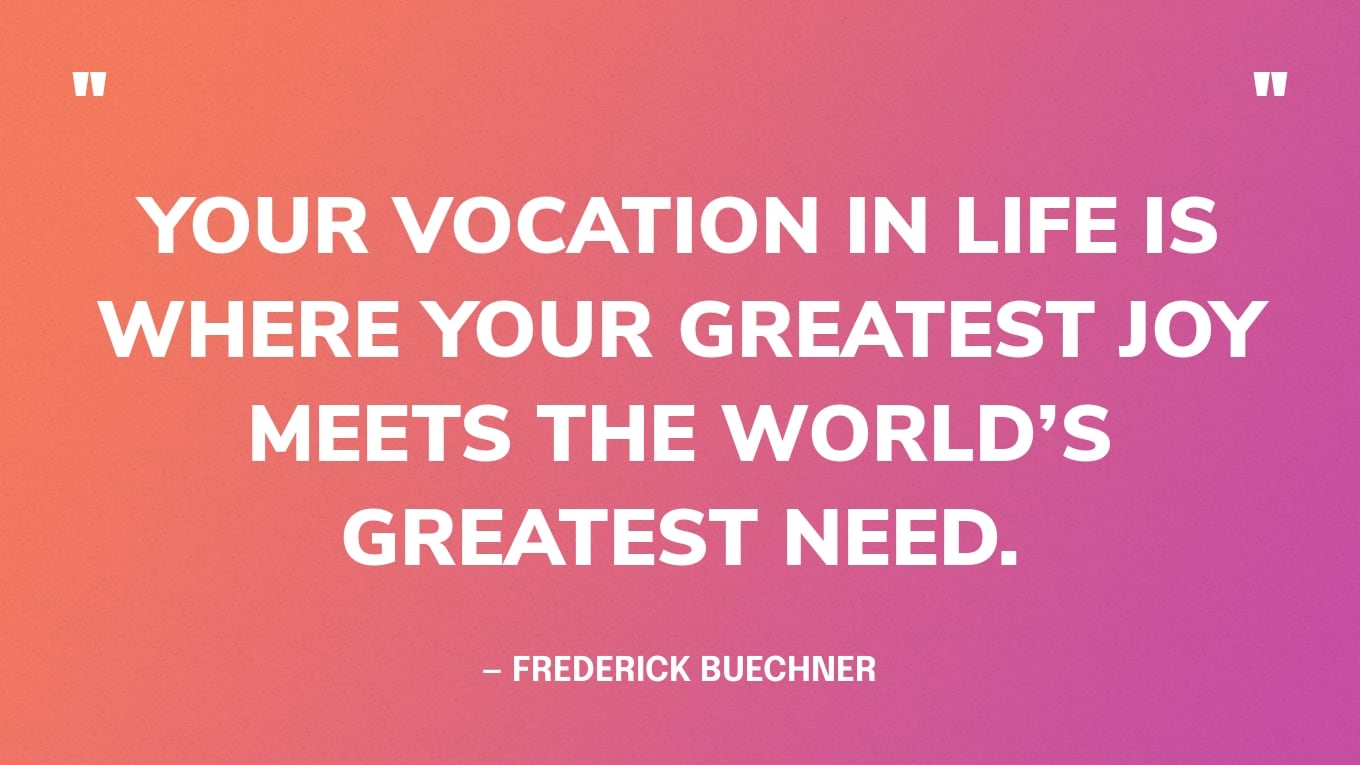
“Where your feet take you, that is who you are.”
— Frederick Buechner
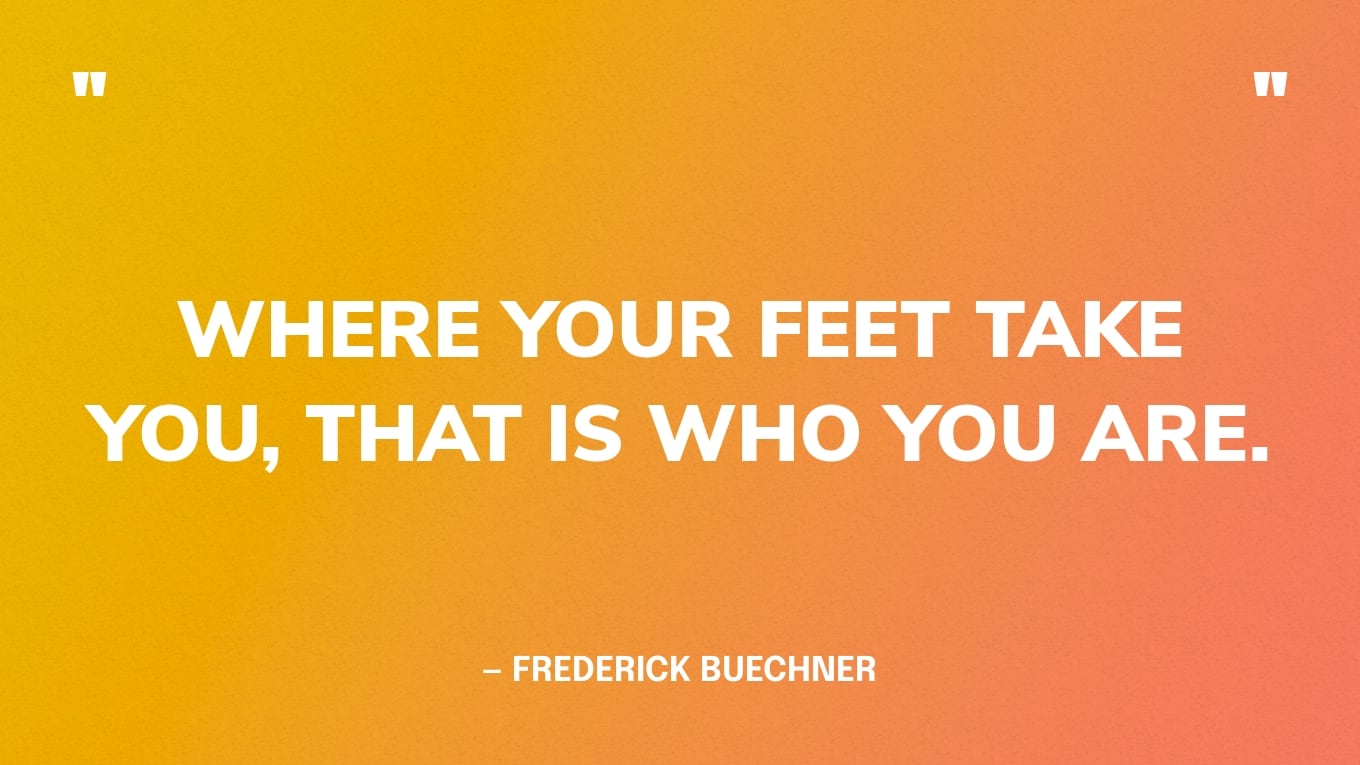
“Here is the world. Beautiful and terrible things will happen. Don't be afraid.”
— Frederick Buechner
On Grace
“Life is grace. Sleep is forgiveness. The night absolves. Darkness wipes the slate clean, not spotless to be sure, but clean enough for another day's chalking.”
— Frederick Buechner
“If you want to talk about grace, if you want to talk about revelation, talk about your life with some depth, which doesn't mean lurid revelations as much as simply looking at your own deep experiences and describing them as they are.”
— Frederick Buechner
On God
“The place God calls you to is the place where your deep gladness and the world's deep hunger meet.”
— Frederick Buechner
“Wherever people love each other and are true to each other and take risks for each other, God is with them and they are doing God's will.”
— Frederick Buechner
“The world says, the more you take, the more you have. Christ says, the more you give, the more you are.”
— Frederick Buechner
“Coincidences are God's way of getting our attention.”
― Frederick Buechner
“The kind of work God usually calls you to is the kind of work (a) that you need most to do and (b) that the world most needs to have done. If you really get a kick out of your work, you've presumably met requirement (a), but if your work is writing TV deodorant commercials, the chances are you've missed requirement (b). On the other hand, if your work is being a doctor in a leper colony, you have probably met requirement (b), but if most of the time you're bored and depressed by it, the chances are you have not only bypassed (a) but probably aren't helping your patients much either.”
— Frederick Buechner
On Love
“Your life and my life flow into each other as wave flows into wave, and unless there is peace and joy and freedom for you, there can be no real peace or joy or freedom for me.”
— Frederick Buechner

“... In the long run, there can be no joy for anybody until there is joy finally for us all.”
— Frederick Buechner
“If we are to love our neighbors, before doing anything else we must see our neighbors. With our imagination as well as our eyes, that is to say like artists, we must see not just their faces but the life behind and within their faces. Here it is love that is the frame we see them in.”
— Frederick Buechner
Short Quotes
“To be wise is to be eternally curious.”
— Frederick Buechner

“Go where your best prayers take you.”
— Frederick Buechner
“If you want to be holy, be kind.”
— Frederick Buechner

“The place God calls you to is the place where your deep gladness and the world’s deep hunger meet.”
— Frederick Buechner
“Remember me not for the ill I've done but for the good I've dreamed.”
— Frederick Buechner
More Quotes
“In the entire history of the universe, let alone in your own history, there has never been another day just like today, and there will never be another just like it again. Today is the point to which all your yesterdays have been leading since the hour of your birth. It is the point from which all your tomorrows will proceed until the hour of your death. If you were aware of how precious today is, you could hardly live through it. Unless you are aware of how precious it is, you can hardly be said to be living at all.”
— Frederick Buechner
“What we hunger for perhaps more than anything else is to be known in our full humanness, and yet that is often just what we also fear more than anything else. It is important to tell at least from time to time the secret of who we truly and fully are... because otherwise we run the risk of losing track of who we truly and fully are and little by little come to accept instead the highly edited version which we put forth in hope that the world will find it more acceptable than the real thing. It is important to tell our secrets too because it makes it easier... for other people to tell us a secret or two of their own...”
— Frederick Buechner
“Turn around and believe that the good news that we are loved is better than we ever dared hope, and that to believe in that good news, to live out of it and toward it, to be in love with that good news, is of all glad things in this world the gladdest thing of all.”
— Frederick Buechner
“You can kiss your family and friends good-bye and put miles between you, but at the same time you carry them with you in your heart, your mind, your stomach, because you do not just live in a world but a world lives in you.”
— Frederick Buechner
“Listen to your life. See it for the fathomless mystery it is. In the boredom and pain of it, no less than in the excitement and gladness: touch, taste, smell your way to the holy and hidden heart of it, because in the last analysis all moments are key moments, and life itself is grace.”
— Frederick Buechner
“When you remember me, it means you have carried something of who I am with you, that I have left some mark of who I am on who you are. It means that you can summon me back to your mind even though countless years and miles may stand between us. It means that if we meet again, you will know me. It means that even after I die, you can still see my face and hear my voice and speak to me in your heart.”
— Frederick Buechner
“For as long as you remember me, I am never entirely lost.”
— Frederick Buechner
On a hot Saturday in early autumn, workers were unloading grocery boxes, worth more than a thousand euros, from a truck parked next to a community center in Barcelona. Inside, five Honduran women wearing face masks assembled folding boxes before packing them with various food items.
“One of you put the beans, another one the rice, another one the coffee, and so on, please,” explained Paula Santos.
“How much tomato sauce?” one of the women asked.
“Three units,” Santos responded.
“If we don’t arrange it like a puzzle, it won’t fit,” one of the other women observed.
These women belong to Mujeres Migrantes Diversas (MMD) [“Diverse Migrant Women”], an association founded in 2017 by Honduran women working in domestic service and caregiving jobs in Barcelona. The group, coordinated by Santos and her colleagues, now has around 500 members, and aims at building mutual support networks and educating the women to stand up for their rights.
Two hours later, they had assembled 50 food baskets to be picked up the next day by women in need. Spain is still reeling from the effects of the pandemic, and undocumented immigrants are among the hardest hit. Often, they were essential workers unable to isolate themselves or work remotely, much like the domestic and care workers who make up MMD.
Santos’ group is one of dozens of migrant associations that have emerged over the last decade in Spain, a country that until the late 1980’s didn’t have massive migration flows.
When COVID-19 upended their livehoods, and the government provided little or no relief, these groups decided to tackle the issues that affect them by spearheading a movement to regularize undocumented immigrants known as the “Regularización Ya” (Regularization Now) campaign.
In April 2020 they launched their first campaign with the support of 900 migrant and solidarity groups in order to ask the Spanish government for “permanent and unconditional regularization in the face of the health emergency”.
As soon as it was possible to take to the streets, mobilizations were organized in different cities. Given the urgency of the COVID-19 crisis, Regularization Now presented a non-binding parliamentary initiative, with the endorsement of 10% of the deputies, in order to debate an extraordinary regularization bill in Congress.
Congresswoman for the minority group ERC Maria Dantas, a naturalized Spanish citizen from Brasil who at one time was also undocumented, presented their case in Congress.
Although their efforts are putting a bright spotlight on the issues faced by undocumented immigrants, so far, they have been unable to score any policy breakthroughs. The wave of public support they generated crashed against a gridlocked government where even those who support their cause have little political capital left due to the pandemic.
Meanwhile, far-right political parties are pushing anti-immigration platforms, often taking a lesson out of the playbook of politicians in the United States, Britain and Italy.
Despite the lack of policy wins, the campaign was a critical first step toward raising awareness of their plight and ensuring that all residents of the country are able to deal with the consequences of COVID-19 on equal footing. “
At the beginning of the lockdown the politicians said they were going to nationalize the heroes of COVID-19, then we went from victims to heroes. But we don’t want to be either; we just want rights,” says Aziz Faye, a spokesperson for the Barcelona Street Vendors Union, which is among the groups pushing for regularization.
“It cannot be that we are essential to work but not to have rights.”
Essential, but unprotected
More than a quarter of the household employees in the European Union are in Spain — only Italy has a larger share — according to the EU Labor Force Survey 2018 collected by the UGT Union. Most of these workers are cleaners and caregivers, often undocumented migrant women who live in the houses where they work.
Although the sector is more regulated than in other countries of the block, they are at heightened risk of exploitation and abuse, including sexual assault. It was that risk and vulnerability that drove these migrant women to organize themselves.
The seeds of MMD were sown when Santos met Johana López, another Honduran, while working as live-in maids for two related families who spent their vacations together. Now in their 30s, Santos and López have lived in Spain for more than a decade.
“When you work as a live-in maid, you are isolated and you despair, and you end up believing that you are going to be in that job all your life, that you have no other choice. They eliminate your life. All you think about is working, sending money and not getting fired,” said López.
For them, it was a blessing to meet each other and realize they were in the same situation, especially after months of loneliness and feeling misunderstood. That first emotional connection became a formal association in 2017.
“We don’t have labor rights, we don’t have decent contracts, we suffer sexual harassment and stigma. With the pandemic, we have the responsibility of not infecting those we care for — but who takes care of us?” asked Santos.
After healthcare workers, at-home women caregivers had the biggest exposure to COVID-19, with 16.3% of them contracting the virus, much higher than the nation’s average, which was around 10% at the height of the pandemic, according to a National Study of Seroepidemiology of Sars-Cov-2 infection, published at the end of 2020.
For one such worker, Teresa Garcia, 38, MMD’s food baskets were a lifeline. An undocumented immigrant, Garcia worked in Barcelona as a caregiver for an elderly couple aged 92 and 94, earning 750 euros a month (200 euros less than minimum wage). She typically works five hours a day, every day, with no holidays or days off.
She didn’t live with the couple, so when the pandemic started, she bought a scooter to avoid public transportation and reduce the chance of infection. The scooter also helped her avoid the police officers enforcing the lockdown.
Still, she was forced to quarantine in April 2020 for nearly a month when two of the four caregivers she shared a room with caught COVID-19. That meant earning no money as she was not entitled to sick leave or benefits.
Eventually, her employers decided to pay her 350 euros for that month, but 300 of it went toward the rent and related housing expenses. It was MMD’s food baskets, she said, that saved her from starvation.
Food is just one of the ways the association supports its members. With workshops on gender and labor rights, Catalan classes, support with immigration procedures and emotional comfort, the group is a lifeline for a lot of its members. When Teresa was evicted from her apartment, it was the network that helped her move to a safe, temporary accommodation, until she was able to find stable housing.
Many of the coordinators of Mujeres Migrantes Diversas have gone through similar experiences as Teresa. They all realized a safe haven was critical for migrant women’s survival. So they came together to open the “Feminist Community House for Domestic and Care Workers.”
It is a five-bedroom apartment with 11 beds in Gracia, a middle class neighborhood in Barcelona that provides a safe space to sleep, live and recover for migrant women facing temporary housing emergencies.
“This house is a dream. If only I had had this possibility when my daughter arrived and I needed help to find a suitable place for both of us,” said Santos.
In the next room, López sweeps and mops the floor. In the living room, Juanita Avila, another member of the collective, watches over her 8-year-old grandson and helps them where she can. “We are all volunteers, so we find time whenever we can,” says Avila.
Instead of investing in an office or paying for a coordinator, the association, which registered as a nonprofit, invests all the donations of individuals and foundations in this house and they fix it up collectively, thus reinforcing their community fabric and emancipating themselves from welfare housing projects.
During the pandemic, besides distributing food baskets, the group also raised funds to help with rent and provide protective equipment like masks and gowns during the early weeks of the pandemic.
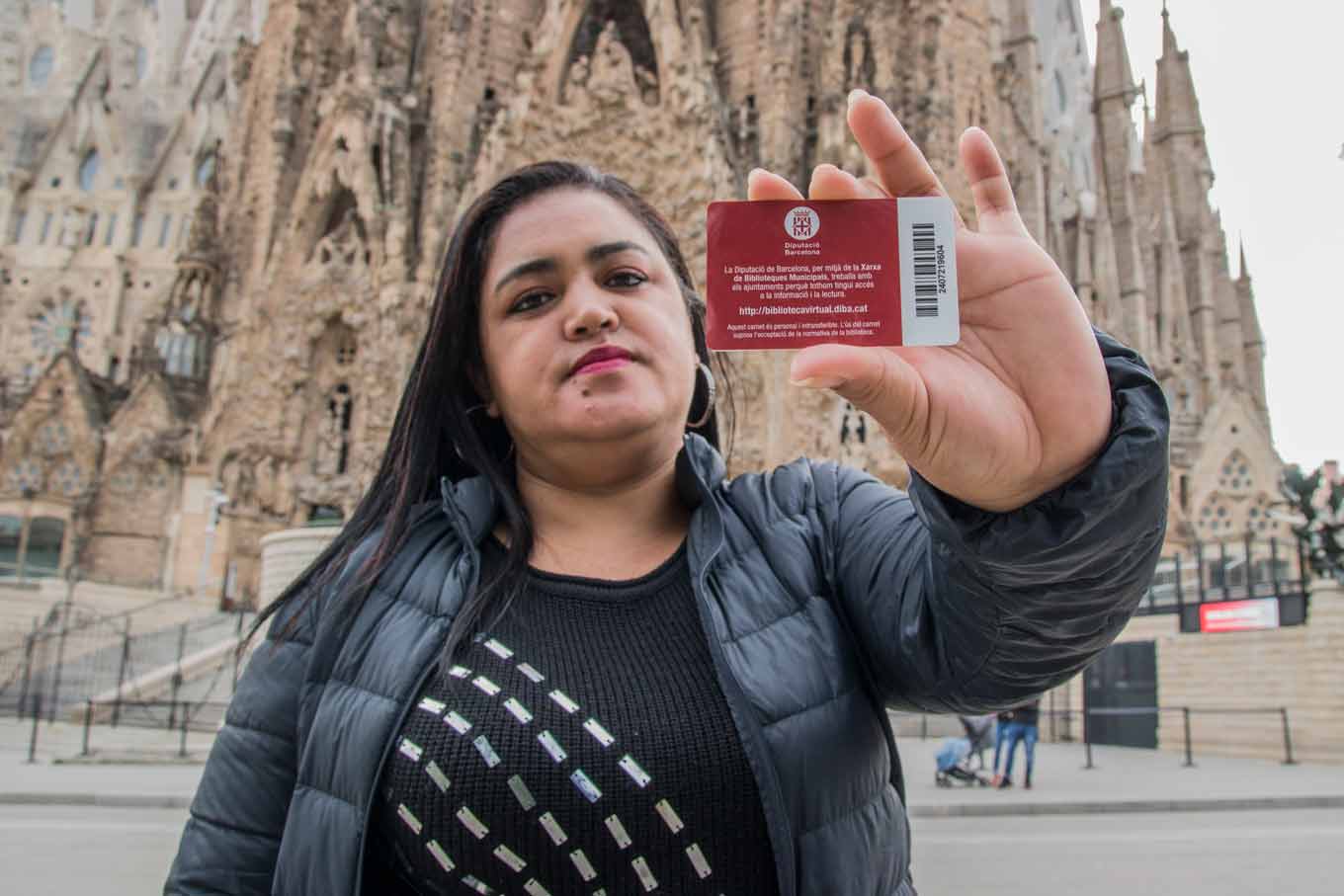
Stepping into activism
It wasn’t long before MMD realized that supporting migrant women meant political advocacy. It started when they were invited to speak to one of the commissions of the Catalan Parliament about their work conditions back in 2017, the year they formalized their group.
In December of that year, they made recommendations on public policies regarding domestic, cleaning and care workers to the Barcelona City Council, together with three other organizations in their sector. When the pandemic started, they joined other migrant organizations to highlight the importance of their work, particularly during lockdown, and the need for a path to citizenship.
The first Regularization Now proposal took inspiration from similar initiatives in neighboring countries that gave immigrants affected by the pandemic a streamlined path to citizenship.
Portugal, for example, regularized all migrants who had applied for a residence permit prior to the pandemic in order to guarantee their access to health care.
In Italy, a program for the temporary regularization of undocumented migrants working in agriculture and domestic work received 220,000 applications.
In France, where the data on COVID-19 is segregated by origin, the numbers reveal that migrants and ethnic minorities have experienced higher rates of infection, hospitalization and mortality than non-immigrants. In September 2020, the French government announced that it would naturalize those who had been in the frontline of the fight against Covid-19, but on December 22 they announced that they were processing these papers for only 700 people.
Spain didn’t even do that. After months of petitions and debates, the initiative started by Regularization Now was rejected by the legislature in September, with 278 out of 350 Congressmen voting against it. Not even Luc André Diouf, the first congressman of Senegalese origin, and a former undocumented worker himself, voted for the proposal, instead toeing the line of the ruling PSOE party.
While a blanket regularization effort has stalled, recently, the government has been making covert and sectorial regularizations. At the end of 2021 the Government changed the Immigration Regulations to facilitate the regularization of foreign minors.
The Ministry of Inclusion calculated that it is benefitting 8,000 protected minors and 7,000 young people between the ages of 18 and 23 who were in sheltered centers because when they arrived in Spain they were minors.
But this policy clashes with that of the Interior Ministry. While the former finances humanitarian programs for migrants and asylum seekers, the Interior Ministry, controls the detention centers and deportations and ultimately has the last word on migration policy — even more so than the Ministry of Defense.
In 2020, for example, while Italy and Portugal were carrying out partial regularizations, the Interior Ministry decided to increase the height of the fence separating Spain from Africa, which is now 10 meters high (32.8 feet) three feet higher than the U.S. wall with Mexico.
The pulse between competing policies inside the government is heavily tilted towards deportation. According to another investigation by the Por Causa Foundation, the Spanish state spends eight times more money (a total of 660 million euros between 2014 and 2019) detaining and removing migrants than facilitating their resettlement and social integration.
A brand (and a cause) born on the streets
Other undocumented migrants in Spain, mostly of African descent, make their living by selling pirated goods in the streets. They are known as “manteros” (which roughly translates as “blanket people”) because they display their merchandise on blankets, which can be easily folded and carried away if they see police approaching.
Facing increasing police harassment, (in 2015 the street vendor Mor Sylla died when he fell from a third-floor balcony while trying to flee from the police,) one hundred street vendors created the union to fight for their rights.
In 2017, they launched ‘Top Manta,’ their own, legal, clothing brand which combines western styles with some African motifs, often conveying the message that migration is not a crime. They could no longer be accused of selling piracy and had a vehicle to spread their message.
Shortly after, they managed to open their own store in the center of the city and since then they’ve been growing their business and gaining notoriety for their brand and their ideas.
Before the pandemic, Top Manta had its workshop on the back of the store, but by 2020 they had outgrown the space and moved to another building two streets up — a place run by anti-racism collectives in the Raval neighborhood of Barcelona. The two-speed banging of about twenty sewing machines didn’t stop during the hardest moments of the lockdown.
The street vendors could not go out to sell their wares, so they re-grouped in the union’s workshop and began to make masks, gowns out of garbage bags, protective caps and other protective gear which they distributed to hospitals, nursing homes and vulnerable people — free of charge.
Faye, the manager of the workshop, claims that they manufactured and distributed 14,000 pieces of protective gear in just three months. At the same time, another union member, Lamine Sarr, ran a food bank where they collected donations to feed the families of 154 manteros. The president of the union, Daouda Dieye, coordinated the finances of both initiatives.
Once the pandemic waned, the store resumed its regular activities. Faye, a native of Gambia, gave a pattern-making course in the mornings for the more advanced sewers, while volunteers taught Spanish and Catalan. After lunch, they would put the blackboard away, and the group of eight in the workshop grew to 20 people sewing masks, T-shirts or sweatshirts.
Despite their efforts, the union has been hit hard by the pandemic, as the flow of customers, both locals and tourists dried up for months and the lockdowns all but eliminated the opportunities for street sellers. The biggest challenge for the union has been generating the funds needed to support street vendors throughout the lockdowns. That motivated them to take an active role in the Regularization Now campaign.
“During the pandemic, Prime Minister Pedro Sanchez said that no one would be ’left behind’, and introduced the minimum living income, a minimum monthly income for the most vulnerable families; but it seems that we, undocumented migrants, are no one,” said Dieye.
“The union has been supporting the most vulnerable street vendors — something the government should have done — so now they should support us,” Faye concluded in a video.
Like MMD, the Street Vendors Union sees their activism as vital to the survival of their group.
“We didn’t come here to be “manteros”; we had our own trades and dreams,” says Dieye, adding that his struggle “goes beyond selling T-shirts; it’s political, it’s about our rights, and we’re going to keep on working.”
Early on, the union coordinated with other anti-racism groups in the city, such as Espacio del Inmigrante [“Immigrant Space”] or Tanquem els CIE [Let’s stop CIEs (CIEs are the detention centers where undocumented migrants are held for a maximum of 60 days while waiting for deportation)].
Soon, they became political actors, first as interlocutors with the Barcelona City Council, then at the national level. In 2017 they promoted decriminalizing street selling, and succeeded in getting it debated in Congress as a law initiative, although it was not approved.
Building on that experience, they have diversified their efforts to promote their cause at a wide variety of venues. They have given workshops about racism for school children, and lectures in universities; they have spoken in front of the Parliament of Catalonia, and have even managed to get an audience with the Pope. But perhaps most importantly, they have helped to set up collectives of street vendors in other major cities in Spain.
“We cannot wait for help from governments, from outside — we have to build a world where we can live with dignity by ourselves”, said Aziz Faye in one of the talks on the Regularization Now campaign, with Paula Santos, from MMD, sitting next to him.
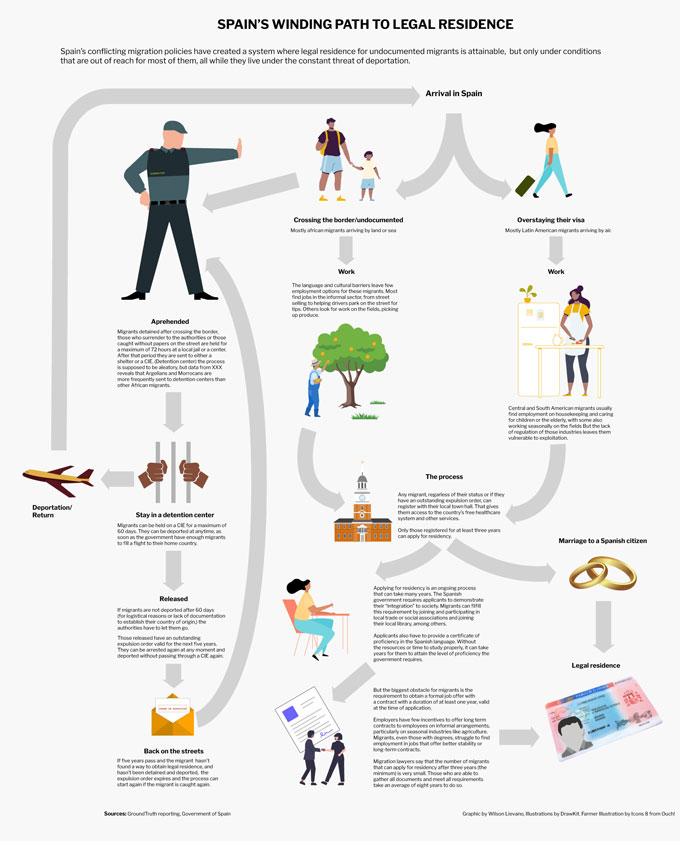
The case for regularization
Spain’s convoluted immigration and naturalization laws make it harder for undocumented migrants to find a path to citizenship outside regularization.
The Spanish Immigration Law allows migrants to apply for legal residence after a minimum of three years of residence in the country, starting from the moment the migrant registers with a municipality, but, during that time they are not allowed to work legally, a contradiction that pushes many immigrants to the informal economy.
Also, migrants must demonstrate a certain degree of social integration as well as fluency in Spanish — and Catalan too, in Catalonia. They must also have a full time job offer with a contract with a duration of at least one year.
In most cases, obtaining a one year job offer with a contract is hard, since employers typically offer three month contracts. This pushes migrants into informal work in agriculture, caregiving or tourism for meager salaries, while they look for a one-year contract.
Those who can’t find a job in those industries, resort to helping people park their cars on the streets for tips, collecting scrap metal or other odd jobs to make ends meet. Migrants can be detained and deported at any point of this process.
“The Immigration Law is feeding Spanish employers with cheap workers who lack rights, and uses the CIEs to terrorize and intimidate them,” states Aurea Martin, from ‘Tanquem els CIEs in Barcelona.
“Migrants have been an absolutely indispensable part of the social machinery and yet this is a system designed to punish them,” said Gonzalo Fanjul, a researcher at the Por Causa Foundation.
Around 500,000 undocumented migrants live in Spain, but their contribution to the tax base is limited, given that they only pay indirect consumption taxes, according to the study “Foreigners, undocumented and essential: A snapshot of irregular immigration in Spain,” co-authored by Fanjul and published in June 2020 by the Por Causa Foundation and Carlos III University.
They estimated that if these immigrants were granted residence, the Spanish economy would go from spending about 2,000 euros per immigrant per year to a net contribution to the tax base of 3,250 euros per immigrant. In other words, more than 5,000 euros per immigrant per year would be recovered by the Spanish economy simply by regularizing their status. This would amount to around 1.5 billion euros per year.
“It would be good business for the country, not to mention the ethical and moral side,” Fanjul says.
Spain is no stranger to amnesties. The country has carried out five mass regularizations of undocumented immigrants since the 1990s, with the latest being in 2005 under a socialist government. Those were times of economic bonanza and residence was granted to half a million people, who were able to join the Social Security contributions.
The condition for immigrants to gain legal status was that their employer had to sign a job contract with them for at least six months. An immediate consequence was that immigrants who were granted amnesty began to pay new taxes, particularly social security contributions.
In the paper “Understanding the Effects of Legalizing Undocumented Immigrants”, the economist of the Universitat de Barcelona, Joan Monras demonstrated that social security contributions increased by 4.189 euros for each immigrant who was legalized.
“These measures would provide these people with administrative dignity and rights, and they would send a very strong message in the fight against racism,” said Pablo Echenique, spokesperson of Unidas Podemos in Congress.
The first non-legislative proposal for mass regularization presented by the migrant movement was supported by 1,500 organizations but rejected by the Congress. However their influence is growing, last year Podemos included Serigne Mbayé, spokesperson for the Madrid Streetvendors Union, as a candidate in the regional elections. The same afternoon that he announced it, the alt right party Vox published Mbaye’s photo with the sentence “we will deport him” on Instagram and Facebook, despite Mbayé being a Spanish citizen since 2018.
Finally, Mbayé was elected to the Madrid Assembly, a small but significant step for immigrants in the country and proof that despite the setbacks, activism can lead to change.
Despite the setback in Congress, experts believe the regularization movement has gained ground with the pandemic. Recently, the ‘Regularization now’ campaign has shifted its approach and instead of trying to lobby politicians, it’s aiming to show them that their constituents are in favor of regularization.
The group is aiming to gather 500,000 signatures from Spanish citizens to present a popular legislative initiative that would force a debate of the issue in Congress and perhaps a new vote. The campaign is called ‘Esenciales’ (Essentials) appealing to the migrants contributions during the pandemic.
“We are facing something too big to ignore, 14% of migrants in our country are undocumented. The initiative allows us to change the lives of people who live with us but with a de facto segregation that we have assumed too naturally”, explains Fanjul from Por Causa.
Meanwhile, both the Barcelona Streetvendors Union, Mujeres Migrantes Diversas as well as other migrant organizations continue to stand up for and network on behalf of their undocumented comrades. “For me the most important thing now is networking; together we can achieve much more,” said Santos.
Surrounded by the waters of the Strait of Sicily in the far south of Italy, the island of Pantelleria is made up of 32 square miles of black volcanic rocks with no source of freshwater other than the 16 or so inches of rain that fall each year.
Yet, traces of the first farming terrace on the island date back to the Bronze Age, 16 centuries B.C. On such terraces, Zibibbo grapevines grow in hollows to trap moisture near their roots. The olive orchards are low, too; and capers, the other major local crop, stick out from dry stone walls.
These walls stretch in lines of stacked stones without the use of cement or mortar. They hold up beds of soil and create terraces, strips of flat land along slopes. These structures store heat during the day. But during the night, the stones cool down, and when the air rich in humidity from the sea encounters their surface, moisture condenses and forms dew. The stones help channel these precious tiny water drops into the wall’s drainage system and distribute them to the thirsty soil.
On this Mediterranean island, as in other parts of Italy and the world, architects, researchers, agronomists, and other professionals have rediscovered the value of ancient farming practices like terracing for resilience to climate extremes and preservation of biodiversity and cultural heritage.
As climate change makes water scarce across the Mediterranean, traditional farming practices from areas with little water, like Pantelleria, might provide solutions.
“We can learn from it, without being traditionalist, romantic, or nostalgic, but actually looking at our future,” says Giorgia De Pasquale, an architect, researcher, and assistant professor at Roma Tre University who grew up in Pantelleria. “We can find some innovation skills that respect at the same time the balance of our ecosystems and the environment.”
Geographers estimate that terraces once covered between 200,000 and 300,000 hectares of the Italian peninsula. But currently only what remains over about 170,000 hectares is still visible from maps and satellite images; Pantelleria is the most terraced municipality.
De Pasquale compared aerial maps from 1955 and 2016 and found roughly a quarter of rural areas were abandoned, mostly terraces. Out of the nearly 5,900 terraced hectares on Pantelleria, less than half are currently in use.
“Since the 1950s onward, we have lost especially farming terraced areas,” says De Pasquale, “mostly in favor of woods.”
Terraces require heavy labor that cannot be easily mechanized and have largely fallen out of use, despite their popularity across nearly every continent. But the undergoing climate crisis has revitalized terracing as a valuable form of adaptation both in places where rainfall is increasing or intensifying, as well as places it is decreasing, according to a recent report from the Intergovernmental Panel on Climate Change on solutions for land degradation.
Cultivated terraces offer a multitude of environmental benefits in addition to water retention. In Pantelleria, for example, an instance of arson in 2016 further highlighted the importance of well-maintained terraces.
The flames burned an area two and a half times the size of Central Park around Montagna Grande, Pantelleria’s highest relief, and Mount Gibele, just a few months before most of the island would become a national park. But in some central parts of the island, farmed terraces stopped the fire’s advance.
“In the Monastero valley, only the top of the hill had been affected by the fire,” says Graziella Pavia, a local agronomist who previously served as agriculture councilor for the municipal government. “Flames stopped at the foothill, because then they could find only cultivated land, and it’s very difficult for cultivated plots to burn.”
Terraces can also help with weather events, such as flooding, that become more likely under climate change.
“We are noticing extreme rain events and, at the same time, prolonged drought periods,” says Alessandro Sardella, a geologist at the Institute of Atmospheric Sciences and Climate of Italy’s National Research Council, where he works as a researcher in the unit focusing on the conservation of cultural heritage.
“Nicely manicured strips of land with well-maintained walls hold better chances to reduce the risk of erosion, the risk of landslides due to these extreme events, as well as favor water infiltration and act as a buffer for these long [drought] periods,” he says.
But when stonewalls are neglected, they do little to help and may, in fact, exacerbate collapses, erosion, and even fires when they are covered in dry vegetation.
For the past four years, Sardella, together with the nonprofit Dotteolie and the CNR-ISAC, has organized initiatives to restore the terraces of the Aeolian Islands, an archipelago higher up along Italy’s boot, where about 90% of the existing terraces is estimated to be abandoned.
He has run workshops with locals and landowners on how to build or repair stone walls using traditional techniques along with partners like the Italian segment of the International Terraced Landscapes Alliance.
ITLA was formed in China in 2010 to connect people working on terracing, from farmers to builders, architects, academics, and activists, to shed light on the challenges these rural landscapes face and ways to revive them.
Since then, it has grown to 315 members from 35 countries and has gathered three times, including once in 2019 in Madeira and the Canary Islands, which share certain farming techniques with Pantelleria.
Pavia says these congresses are an important way to share ideas about how to keep farming terraces alive. “It encourages comparisons and the exchange of common solutions, drawing on others’ experiences,” she says.
She believes Mediterranean islands have a lot to teach in terms of resiliency, being set apart from more complex supply systems. “Of course, we had some very bad years too,” she says.
“All the island suffered a lot.” But she holds out hope the terraces will help them survive future dry spells. Such farming techniques, developed in places with few resources, offer important hints for the future, she says. “As I see it, terraces might let us preserve the landscape as well as feed us at a micro and localized level.”
— Black Americans lost 90% of their land in the 20th century
— Land losses also impact generational wealth inequalities
— Pandemic, racial justice protests spark push for action
When Black land rights activists were offered a 150-acre plot in the U.S. South, they saw it as an opportunity towards righting a historical wrong.
Black Americans lost 90% of their lands across the United States during the 20th century, government figures show, due to factors such as predatory developers and a lack of access to the legal system and expert advice.
Now an alliance of Black farmers and civil society groups wants to get an equal amount of property back.
"We were stripped of that land," said Kenya Crumel, a director at the National Black Food & Justice Alliance (NBFJA), which includes nearly 50 Black-led organizations.
"Land is freedom. Historically in this country, so many policies were connected to land ownership — you couldn't vote if you didn't have land," Crumel told the Thomson Reuters Foundation.
The echoes of that loss continue to reverberate today, she said, noting a huge impact on "generational wealth".
The group is in the process of taking ownership of that Southern plot, which is being donated, as its first piece of land.
It ultimately aims to obtain between 15 million and 20 million acres across both rural and urban areas — an amount that Crumel said may seem "ridiculous" today but would match the estimated total acreage lost by Black households.
'Upset Inequities'
The project comes amid a growing focus on Black farmers and land dispossession, with projects working to help them get a fairer share.
White people own 98% of U.S. farmland, said Duron Chavis, a board member of the new Central Virginia Agrarian Commons (CVAC) nonprofit, which supports farmers of color.
"The gap we're trying to fill is the land control, land ownership, land tenure gap that Black and brown communities face not only in Virginia but across the nation," he said.
"Our work is to upset that inequity and put land back into the hands of the most marginalized in our community."
The organization is fundraising to purchase land as well as soliciting donations.
This month, landowner Callie Walker will give away 75 acres of her family plot in Amelia County, Virginia, to allow farmers of color to set up homes and agrarian businesses such as vegetable growing or beekeeping.
On a sunny May day, she surveyed the rolling fields and woodlands where she grew up, about an hour's drive west of the state capital Richmond. A line of bright orange surveyor's flags showed where the property was to be split in two.
"I've watched other people try to start a farm dream on borrowed land or some other kind of land deal, and it seems like it always falls through," said Walker, a United Methodist pastor.
"The vision is to collect beginning farmers or dispossessed farmers and to get the housing in place that would allow them to try living and farming here."
'Restorative Economics'
The burgeoning effort is increasingly focused on urban areas, too.
The national racial justice protests of 2020 after the police murder of unarmed civilian George Floyd sparked a growing momentum around using urban lands to foster agricultural work by small-scale farmers of color.
Those were also the early days of the coronavirus pandemic, when communities suddenly faced empty supermarket shelves fueled by widespread panic buying, recalled Erin PJ Bevel, co-founder of the Detroit Black Farmer Land Fund.
"It became very scary," she recalled of the confluence of Floyd's killing and the pandemic.
"This was a crisis for Black people."
The experience not only increased interest in locally-produced food, she said, but also brought new attention to the network of Detroit urban farmers who had been growing on vacant urban plots for years — often in a legal gray area.
Detroit has been buffeted by population losses for decades and has significant amounts of urban land left vacant.
While some of those properties have been available for a few hundred dollars, others in gentrifying areas have been priced at upwards of $6,000, Bevel said.
Two years ago, on the June 19 commemoration of the end of slavery, a coalition of groups created the Detroit Black Farmer Land Fund to address the issue.
Since then, the fund has crowdsourced more than $200,000, gathered donated land, and helped 70 farmers and farm businesses to navigate city processes allowing them to buy vacant urban plots.
Bevel said she sees the initiative as an example of "restorative economics," seeking to repair harm from injustices and help empower local residents to shape their own communities.
"We had no idea that this would blow up the way it did," she said, noting the project has spawned at least two similar funds in Michigan alone.
Urban Greenery
One of those the fund is seeking to help is Timothy Jackson, 38, co-executive director of Detroit Hives, a nonprofit that sells about 700 pounds (320 kg) of raw honey annually.
The grant will help Detroit Hives purchase two vacant lots.
"When you have ownership over your project in your community, it allows you to have a thorough investment — you're not just renting," Jackson said.
Another local farmer, Erin Cole, runs Nurturing Our Seeds, a farm that grows "everything that can be grown" and sold more than $30,000 in produce last year.
The farm started off as an effort to tame a vacant lot, and over the past decade has grown to eight lots — six of which the fund last year helped the nonprofit purchase.
Other projects are also looking to develop urban spaces for Black growers.
The Central Virginia Agrarian Commons, for instance, is in the process of purchasing parcels totaling nearly nine acres in the cities of Petersburg and Roanoke, said Ian McSweeney, director of the national Agrarian Trust.
The plots are in areas officially designated as "food deserts" where residents lack access to fresh food, he said.
They will be used for growing, farm training, and as a base to help growers on Walker's land and elsewhere to connect with urban markets.
The NBFJA is looking to use its collective heft to buy up spaces that are already being used informally.
"A lot of Black people are farming on vacant lots, and often they don't own those lots, but you can negotiate with cities or counties to get ownership," Crumel said.
"So we want to take advantage of that and use our power as a group to negotiate those terms, and through that mitigate loss."
This story was originally published by the Thomson Reuters Foundation, the charitable arm of Thomson Reuters, that covers the lives of people around the world who struggle to live freely or fairly.