A new species of seahorse was just discovered by an international team of researchers at Tuticorin harbour in southern India — and it was overlooked for more than a century.
“The thorny seahorse, Hippocampus histrix, has long been treated as a single, widely distributed species ranging from the Red Sea and western Indian Ocean to the western Pacific,” co-author Shalu Kannan observed in the new study, which was published in the scientific journal “Zootaxa” on August 5.
“Morphological and molecular evidence now demonstrate that this broad concept encompasses at least three diagnosable species.”
Those three species include the aforementioned H. histrix, the Hippocampus jayakari — a seahorse discovered in 1900 with a “shorter and deeper snout” and spines “confined to alternating tail rings” — and a third seahorse that had long been mistaken for both.
The newest entry is a spiny seahorse that is just 16 centimeters long (or about 6 inches) with a short snout. It has spines along its body and tail, with five short spines on its head that form an elevated “crown.”
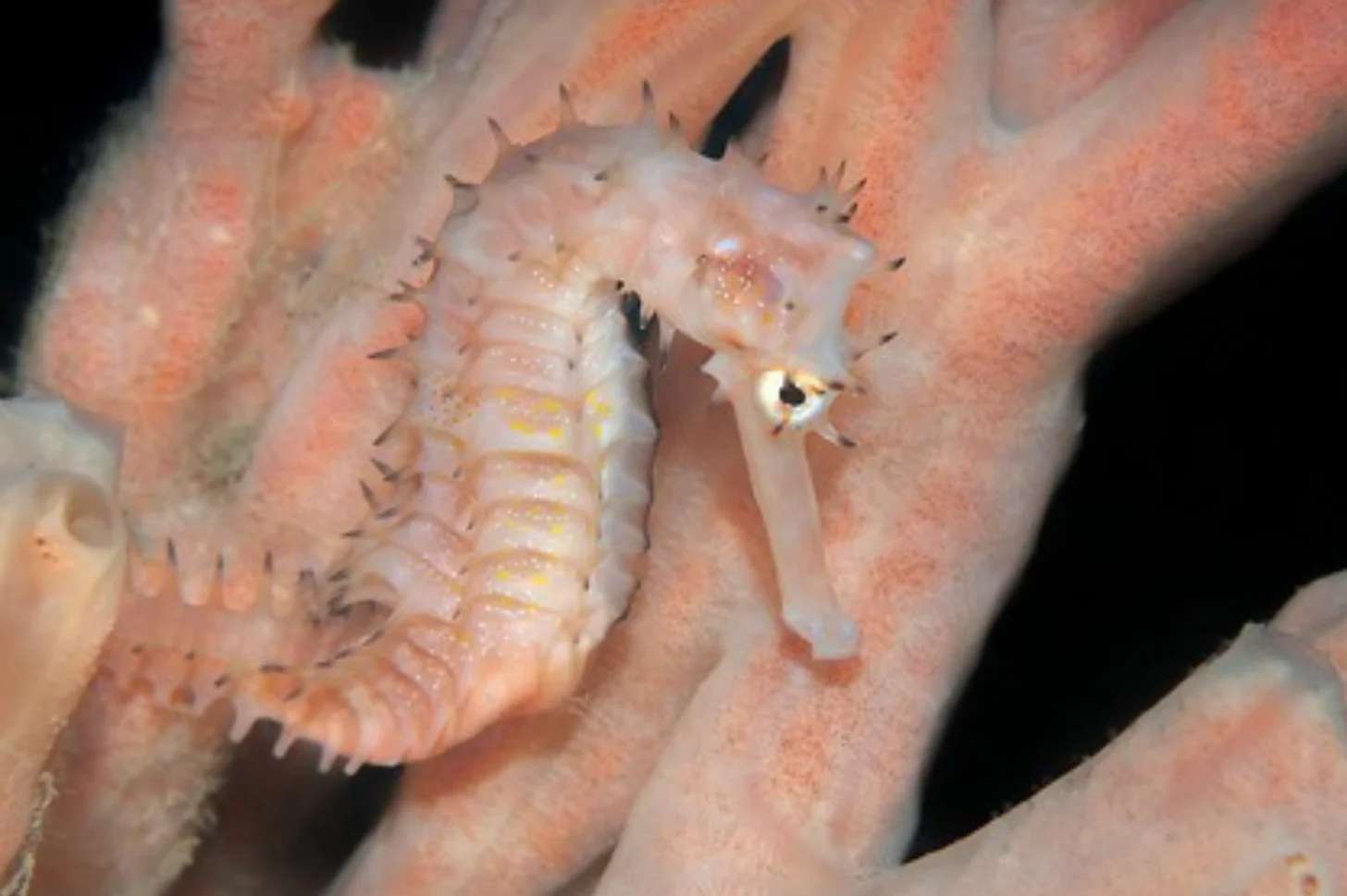
The researchers named the new species Hippocampus amandavincentae after Amanda Vincent, who is widely considered the “mother” of seahorse research and conservation.
“This honor makes my heart glow,” Vincent said in a press release for the University of British Columbia. “It’s amazing that such a wonderful creature was hiding in plain sight.”
Vincent, who doubles as the director and co-founder of the University of British Columbia’s Project Seahorse, was the first biologist to study seahorses underwater.
She also executed the first trade surveys on seahorses and developed the first seahorse field conservation program.
“I surveyed the array of fishes dragged up by trawlers in Tuticorin, India, where this new species was first found, and missed it completely,” she said. “Now I have yet another special reason to push hard at ending bottom trawl fishing.”
Bottom trawl fishing, which drags heavy nets across the seafloor, sweeping up marine life and entire habitats in its path, is one of the most destructive fishing practices on a global scale.
According to Project Seahorse, bottom trawl fishing catches thousands of fish species every year, many of which are the ocean’s most at-risk animals.
In early 2026, researchers at the University of British Columbia published a study that drew upon more than 9,000 records of fish species reported in bottom trawls from 1895 to 2021.
“This is the clearest picture we’ve had of the breadth of bottom trawling,” said lead author Sarah Foster, senior researcher and program leader at UBC’s Project Seahorse. “It reveals just how many species are being caught, and how much we have been missing.”
Most bottom trawl fishing practices occur within national waters, but they face major enforcement gaps.
“We can’t manage what we don’t know,” Foster said. “When we remove thousands of species without understanding the impacts on their wild populations, we risk destabilizing the very systems that fisheries depend on.”
In addition to being the world’s leader in seahorse conservation research, Project Seahorse has completed assessments for the International Union for Conservation of Nature’s Red List of Threatened Species, generated 35 marine protected areas, built alliances of subsistence fishers, and ushered in new national legislation.
Vincent said that she hopes the honorific for the exciting new species shines a spotlight on her marine conservation organization.
“The timing is especially meaningful as it coincides with celebrating 30 years of Project Seahorse achievements,” Vincent said. “I’m deeply grateful to my friends and colleagues for this kindness.”
You may also like: Scientists discovered a new species of horned lizard in Thailand. They named it after Rhaenyra's dragon in 'House of the Dragon'
Featured Image: Katy Ramm/Pexels