The ocean, with its vastness and depth, is a testament to the majesty and mystery of nature.
It’s a world teeming with diverse life forms, from the smallest plankton to the largest whale (and a few wonderfully ugly sea creatures thrown in), each contributing to a balanced, complex ecosystem.
Yet, our oceans, as immense and powerful as they may appear, are not immune to the effects of human activities. The pollution, overfishing, and climate change we cause have led to devastating effects on marine life and the health of our oceans.
The importance of protecting our oceans and their inhabitants cannot be overstated. They regulate our climate, produce a significant portion of the world’s oxygen, and serve as a vital source of food and livelihood for many communities.
We are intrinsically linked to the ocean and its well-being reflects our own.
Over time, many philosophers, environmentalists, and ocean-lovers have contemplated the beauty, power, and vulnerability of our oceans.
They’ve shared their insights, hoping to inspire a deeper appreciation for this vast blue world and a stronger commitment to its preservation.
We’ve gathered some of the most poignant ocean quotes here today — ones that capture its beauty, elucidate our connection to it, and underscore the urgency of its protection.
Whether you are an ardent ocean conservationist, a nature enthusiast, or someone who enjoys long walks on the beach, these quotes will touch your heart and stir your thinking.
Dive into this collection and let the wisdom of the ocean inspire you to be a champion for its preservation:
The Best Ocean Quotes
Famous Quotes
“With every drop of water you drink, every breath you take, you’re connected to the sea. No matter where on Earth you live.”
— Sylvia Earle
“The ocean stirs the heart, inspires the imagination and brings eternal joy to the soul.”
— Robert Wyland
“The heart of man is very much like the sea, it has its storms, it has its tides and in its depths, it has its pearls too.”
— Vincent van Gogh
“The ocean makes me feel really small and it makes me put my whole life into perspective… it humbles you and makes you feel almost like you’ve been baptized. I feel born again when I get out of the ocean.”
— Beyoncé
“The ocean is like a big blue heart that connects all living creatures. We must protect it for the sake of our own survival.”
— Eugenie Clark
“The cure for anything is salt water: sweat, tears, or the sea.”
— Karen Blixen
“My soul is full of longing for the secret of the sea, and the heart of the great ocean sends a thrilling pulse through me.”
— Henry Wadsworth Longfellow
“The sea, once it casts its spell, holds one in its net of wonder forever.”
— Jacques Yves Cousteau
“And it is an interesting biological fact that all of us have in our veins the exact same percentage of salt in our blood that exists in the ocean, and, therefore, we have salt in our blood, in our sweat, in our tears. We are tied to the ocean. And when we go back to the sea — whether it is to sail or to watch it — we are going back from whence we came.”
— John F. Kennedy, in a 1962 speech
“The sea possesses a power over one’s moods that has the effect of a will. The sea can hypnotize. Nature in general can do so.”
— Henrik Ibsen
Inspirational Quotes
“As the sea is beautiful not only in calm but also in a storm, so is happiness found not only in peace but also in strife.”
— Ivan Panin
“We know only too well that what we are doing is nothing more than a drop in the ocean. But if the drop were not there, the ocean would be missing something.”
— Mother Teresa
“When anxious, uneasy and bad thoughts come, I go to the sea, and the sea drowns them out with its great wide sounds, cleanses me with its noise, and imposes a rhythm upon everything in me that is bewildered and confused.”
— Rainer Maria Rilke
“But the sea
which no one tends
is also a garden.”
— William Carlos Williams, Pictures from Brueghel and Other Poems
“Individually, we are one drop. Together, we are an ocean.”
— Ryunosuke Satoro
“And as life began in the sea, so each of us begins his identical life in a miniature ocean within his mother’s womb.”
— Rachel Carson, The Sea Around Us
“For whatever we lose (like a you or a me), it’s always our self we find in the sea.”
— E. E. Cummings
“Limitless and immortal, the waters are the beginning and end of all things on earth.”
— Heinrich Zimmer
“If the ocean
can calm itself,
so can you.
We are both
salt water
mixed with
air.”
— Nayyirah Waheed
“I wish I could describe the feeling of being at sea, the anguish, frustration, and fear, the beauty that accompanies threatening spectacles, the spiritual communion with creatures in whose domain I sail. There is a magnificent intensity in life that comes when we are not in control but are only reacting, living, surviving. I am not a religious man per se. My own cosmology is convoluted and not in line with any particular church or philosophy. But for me, to go to sea is to glimpse the face of God. At sea, I am reminded of my insignificance — of all men’s insignificance. It is a wonderful feeling to be so humbled.”
— Steve Callahan
“I pray to be like the ocean, with soft currents, maybe waves at times. More and more, I want the consistency rather than the highs and the lows.”
— Drew Barrymore
Save the Ocean Quotes
“The ocean is a global commons, a precious resource that belongs to all of us. It’s our duty to protect and preserve it for future generations.”
— Emily Penn
“People ask: Why should I care about the ocean? Because the ocean is the cornerstone of Earth’s life support system, it shapes climate and weather. It holds most of life on earth. 97% of earth’s water is there. It’s the blue heart of the planet — we should take care of our heart. It’s what makes life possible for us. We still have a really good chance to make things better than they are. They won’t get better unless we take action and inspire others to do the same thing. No one is without power. Everybody has the capacity to do something.”
— Sylvia Earle
“We absolutely need to clean up the plastic that’s already in the ocean. It won’t go away by itself. But we do also need to make sure that no more plastic enters the oceans in the first place. These things should go hand in hand.”
— Boyan Slat
“Protecting the ocean is not just about saving marine life; it’s about safeguarding our own future. Our fate is intimately connected to the health of the ocean, and we must take urgent action to preserve it.”
— Greta Thunberg
“We must commit to a positive programme of ocean recovery to combat the effects of climate breakdown, and boost our oceans’ capacity to tackle climate change.”
— Barry Gardiner
“If man doesn’t learn to treat the oceans and the rain forest with respect, man will become extinct.”
— Peter Benchley
“Just as we have the power to harm the ocean, we have the power to put in place policies and modify our own behavior in ways that would be an insurance policy for the future of the sea, for the creatures there, and for us, protecting special critical areas in the ocean.”
— Sylvia Earle
About World Oceans Day
“To me, celebrating World Ocean Day means celebrating all the efforts that are made by individuals worldwide. It is a chance to recognize the progress we are making and to remind ourselves to keep going because our own wellbeing is dependent on our ocean’s wellbeing.”
— Rada Pandeva, World Ocean Day Youth Advisory Council Member
“I spend almost every day in the waters… photographing what I see, good or bad. I spent World Oceans Day painting a picture of one of my images. For me, this peaceful kingdom needs protection from the human race who are doing so much damage to it. The oceans are the planet’s controlling factor: you lose the health of the oceans, you lose our planet.
— Gill Williams, 58, underwater photographer, in an article from The Guardian
“Youth play an increasingly important role in the development and growth of World Ocean Day, celebrated annually in June, helping to raise the profile of the importance of our one shared ocean that connects us all. No matter where we live, we all depend on a healthy ocean to survive and thrive, and safeguarding the ocean will help us secure a stable climate into the future.”
— World Ocean Day Organization
“As young people we have the power to make a difference and protect our ocean. We can be the voice for the voiceless, the endangered species, and the climate. We can play a pivotal role in decision-making and dialogue, inspiring others to take action.”
— María Paz Dakota Ormeño Vasquez, World Ocean Day Youth Advisory Council Member
“World Oceans Day is an opportunity to celebrate collective action, now more than ever. On this day, we call not only on individuals, but also on governments, scientists, private companies, civil societies and local communities to join this global effort to manage the ocean for our common safety, well-being and prosperity.”
— Audrey Azoulay, Director-General of UNESCO, in a message about World Oceans Day
→ Read and share the best ways to celebrate World Oceans Day
Short Quotes
“The sea always filled her with longing, though for what she was never sure.”
— Cornelia Funke
“The breaking of a wave cannot explain the whole sea.”
— Vladimir Nabokov
“The sea does not link to be restrained.”
— Rick Riordan
“Every drop in the ocean counts.”
— Yoko Ono
“The sea, the great unifier, is man’s only hope.”
— Jacques Yves Cousteau
“I feel we are all islands — in a common sea.”
— Anne Morrow Lindbergh
“The sea is a desert of waves, a wilderness of water.”
— Langston Hughes
“Never underestimate the power of the ocean.”
— Heidi Klum
“At sea, I learned how little a person needs, not how much.”
— Robin Lee Graham
“Live in the sunshine, swim the sea, drink the wild air.”
— Ralph Waldo Emerson
“The sea is as near as we come to another world.”
— Anne Stevenson
“I need the sea because it teaches me.”
— Pablo Neruda
“Dance with the waves, move with the sea. Let the rhythm of the water set your soul free.”
— Christy Ann Martine
→ Read more inspirational short quotes
Wave Quotes
“The breaking of a wave cannot explain the whole sea.”
— Vladimir Nabokov
“A wave can kill you. Or you can ride it. It’s sometimes more dangerous to shy away. You can’t live your life in fear. You have to be prepared to get on your board and stand on your feet. If you are in the barrel of a wave you have to ignore the fear. You have to be in that moment. You have to carve on through. You get scared, and the next thing you know you are off your board and smashing your head on a rock. I’m never going to live in fear.”
— Matt Haig, How to Stop Time
“There is no new wave, only the sea.”
— Claude Chabrol
“You’re not a wave; you’re a part of the ocean.”
— Mitch Albom
“Feelings are much like waves: we can’t stop them from coming, but we can choose which one to surf.”
— Jonatan Mårtensson
“Waves are the voices of tides. Tides are life.”
— Tamora Pierce
“The waves of the sea help me get back to me.”
— Jill Davis
“I’m surfing the giant life wave.”
— William Shatner
More Quotes
“Because there’s nothing more beautiful than the way the ocean refuses to stop kissing the shoreline, no matter how many times it’s sent away.”
— Sarah Kay
“‘Doesn’t it seem to you,’ asked Madame Bovary, ‘that the mind moves more freely in the presence of that boundless expanse, that the sight of it elevates the soul and gives rise to thoughts of the infinite and the ideal?’”
— Gustave Flaubert, Madame Bovary
“...I live; I die; the sea comes over me; it’s the blue that lasts.”
— Virginia Woolf, Melymbrosia
“It contains so many colors. Silver at dawn, green at noon, dark blue in the evening. Sometimes it looks almost red. Or it will turn the color of old coins. Right now the shadows of clouds are dragging across it, and patches of sunlight are touching down everywhere. White strings of gulls drag over it like beads. It is my favorite thing, I think, that I have ever seen. Sometimes I catch myself staring at it and forget my duties. It seems big enough to contain everything anyone could ever feel.”
— Anthony Doerr, All the Light We Cannot See
“To me, the sea is a continual miracle; The fishes that swim — the rocks — the motion of the waves — the ships, with men in them, What stranger miracles are there?”
— Walt Whitman, Miracles
“The sea pronounces something, over and over, in a hoarse whisper; I cannot quite make it out.”
— Annie Dillard
“The land and the ocean are living, breathing entities that supported us, clothed us, fed us, and nurtured our culture from time immemorial.”
— Eden Robinson
“He always thought of the sea as ‘la mar’ which is what people call her in Spanish when they love her. Sometimes those who love her say bad things of her but they are always said as though she were a woman. Some of the younger fishermen, those who used buoys as floats for their lines and had motorboats, bought when the shark livers had brought much money, spoke of her as ‘el mar’ which is masculine. They spoke of her as a contestant or a place or even an enemy. But the old man always thought of her as feminine and as something that gave or withheld great favours, and if she did wild or wicked things it was because she could not help them. The moon affects her as it does a woman, he thought.”
— Ernest Hemingway, The Old Man and the Sea
“The ocean, to me, is like the greatest mystery on the planet. It’s everything I don’t know and everything I want to know.”
— Andrew Schneider
“It is a curious situation that the sea, from which life first arose should now be threatened by the activities of one form of that life. But the sea, though changed in a sinister way, will continue to exist; the threat is rather to life itself.”
— Rachel Carson, The Sea Around Us
“Hark, now hear the sailors cry,
Smell the sea, and feel the sky,
Let your soul & spirit fly, into the mystic.”
— Van Morrison, Into the Mystic
“The ocean is loud: Ship propellers, sonar, oil and gas drilling and other industrial work make sounds, even if, like the proverbial tree falling in the forest, no one can hear it.”
— Tatiana Schlossberg
“The Caribbean is an immense ocean that just happens to have a few islands in it. The people have an immense respect for it, awe of it.”
— Derek Walcott
“To me, the sea is like a person, like a child that I’ve known a long time. It sounds crazy, I know, but when I swim in the sea I talk to it. I never feel alone when I’m out there.”
— Gertrude Ederle
“I don’t think you can ever get closer to the natural world, than just a man — as in mankind — in an ocean, just you and it. It’s not about conquering the ocean, it’s about working with it.”
— Ben Fogle
“I’ve tried to be responsible when in or interacting with our oceans and I learn more every week. I hope to take care of these precious bodies of water as much as I appreciate them.”
— Kirsten Alana, photographer
“The ocean is the lifeblood of our world. If we were to lose our fish that we appreciate so much by overfishing; or if we were to lose some of our favorite beaches to overbuilding and pollution, then how would we feel? It’s become a case of not knowing what you’ve got until it’s gone.”
— Aaron Peirsol
“We’ve only explored about five percent of our ocean. There are great discoveries yet to be made down there, fantastic creatures representing millions of years of evolution and possibly bioactive compounds that could benefit us in ways that we can’t even yet imagine.”
— Edith Widder
“Why do we love the sea? It is because it has some potent power to make us think things we like to think.”
— Robert Henri
→ Read more quotes about nature
In the early hours of June 28, 1969, the New York Police Department unwittingly helped start the modern LGBTQ+ rights movement. At the time, clubs with gay or lesbian patrons weren't allowed to serve alcohol, but the Stonewall Inn still served booze to their customers, giving police cause to raid the bar.
The clientele pushed back, and 13 people were arrested. LGBTQ+ people and their allies protested for days.
Among the crowd was transgender activist Marsha P. Johnson, who later founded Street Transvestite Action Revolutionaries (STAR), an organization that provided resources for LGBTQ+ youth and sex workers.
After the events at Stonewall — which the NYPD eventually apologized for in 2019 — more and more people pushed for LGBTQ+ equality. Activists organized the first LGBTQ+ marches in the United States and worldwide, giving rise to annual Pride parades.
In 1973, the American Psychiatric Association no longer considered being gay or lesbian a mental illness, and the first openly lesbian politicians were elected the following year.
Currently, openly gay, bisexual, transgender, and queer candidates occupy political offices at most levels of government, including the U.S. House of Representatives and Senate, state Congressional chambers, and state governorships.
In the military, it took decades for gay, lesbian, and bisexual service members to win the right to enlist. It wasn't until 2011 that LGBTQ+ troops could openly serve in the United States armed forces. While the Obama Administration repealed the ban on transgender troops in 2016, former President Donald Trump effectively reinstated it in 2019 (though the ban was overturned by the Biden Administration in 2021).
Since Stonewall, the government has passed laws banning discrimination based on sexual orientation, and the Supreme Court declared same-sex marriage legal. But there is still more to be done.
At both the state and federal levels, hundreds of new pieces of legislation targeting youth, particularly trans youth, in health care and education have been introduced over the last several years. According to the Trans Legislation Tracker, 549 anti-trans bills have been introduced across the country as of May 2023—already setting a new record for a fourth consecutive year.
To learn more about LGBTQ+ history, Stacker combed through news reports and used data from GLSEN to compile over 50 years of LGBTQ+ progress. Read on to see the evolution of this movement from then to now.
(You can also explore our article on pre-Stonewall LGBTQ+ history)
1969: Stonewall Riots
Anger erupted after New York City police arrested 13 people during a raid at the Stonewall Inn, a bar and safe space for the LGBTQ+ community. Advocates protested for days despite confrontations with police who resorted to turning fire hoses onto the crowd. Many say the event catalyzed the modern LGBTQ+ civil rights movement.
1969: Gay Liberation Front forms
The events of Stonewall led to the creation of the GLF, a group that organized the Christopher Street Liberation Day in New York in 1970 — now considered the first Pride parade. It started with only a few hundred people, but by the time the group reached Central Park, thousands were marching for LGBTQ+ equality.
1972: Sweden allows people to legally change gender
In 1972, Sweden became the first country to give people the right to legally change their gender on identifying documents. However, they had to be over 18 years old, unmarried, and sterilized; the country didn't remove the mandatory sterilization law until 2013. In some U.S. states, people still need to undergo gender-reassignment surgery to legally change their gender.
1972: UK has first Pride parade
The United Kingdom held the country's first LGBTQ+ Pride parade on July 1, 1972. Britain's GLF organized the event, and about 700 people showed up to march. Their slogan was simple: "Gay is good."
1973: Lambda Legal forms
The Lambda Legal organization was formed to offer legal support for LGBTQ+ equality, but first, they had to represent themselves to fight for the right to exist in New York. In the '70s, the group fought for LGBTQ+ rights on the college and national levels. In 1983, they were successful in the first HIV/AIDS discrimination case in the U.S.
1973: Homosexuality is no longer classified as a mental illness
Until the early '70s, physicians could diagnose someone in a same-sex relationship as mentally ill. But in 1973, the American Psychiatric Association removed "homosexuality" from the Diagnostic and Statistical Manual of Mental Disorders.
1974: First openly lesbian officials elected
Kathy Kozachenko and Elaine Noble became the nation's first openly lesbian or gay elected officials in 1974. Kozachenko won a seat on the Ann Arbor City Council in Michigan, while Noble held a position in the Massachusetts General Assembly.
1977: First openly gay man elected
Harvey Milk made history when he won a seat on the San Francisco Board of Supervisors, becoming the first openly gay male politician elected to a position in a major city. Before he was assassinated a year later, Milk helped pass city ordinances to prevent discrimination based on sexual orientation.
1978: The rainbow flag is created
In 1978, Harvey Milk's friend Gilbert Baker brought his 30-by-60-foot rainbow flag to an LGBTQ+ rights rally in San Francisco. Afterward, it became an enduring symbol of pride for the LGBTQ+ community. According to The Washington Post, Baker sometimes referred to himself as "the Betsy Ross of gay liberation." He died in 2017 at the age of 65.
1979: First national LGBTQ+ march
Thousands of people marched for equality in the National March on Washington for Lesbian and Gay Rights. They gathered together to end discrimination based on sexual orientation, including within the federal government.
1981: Norway enacts anti-discrimination laws
In 1981, Norway amended its laws to include protections for LGBTQ+ people. The legislation stated that business owners couldn't discriminate against customers based on sexual orientation nor deny them access to public events. Hate speech was also prohibited.
1981: Gay men affected with 'rare cancer'
In 1981, the New York Times reported 41 gay men had been afflicted with a "rare cancer." Doctors originally thought HIV/AIDS was a skin cancer known as Kaposi's sarcoma. A year later, though, the CDC started calling the illness "acquired immune deficiency syndrome," or AIDS.
1982: Wisconsin passes LGBTQ+ anti-discrimination law
In 1981, Rep. David Clarenbach (D-Wis.) brought forth a measure to protect LGBTQ+ people from employment discrimination in public and private sectors, making Wisconsin the first in the U.S. to pass a statewide law against such discrimination. The law also banned landlords from denying housing based on sexual orientation.
1983: BiPOL forms
BiPOL, the first bisexual political group, started in San Francisco in 1983. They helped put on the Bisexual Rights Rally—which took place outside the Democratic National Convention — a year later.
1984: HIV discovered
After ruling out cancer, researchers in France and the United States discovered that a retrovirus caused AIDS. Scientists hoped a vaccine would be available by the late '80s, but it wasn't until 2012 that the FDA approved PrEP, the first drug to help prevent the transmission of HIV. In 2019, two men were "cured" of AIDS after blood stem cell transplants. More than 35 million people have died of AIDS or related illnesses.
1986: Bowers v. Hardwick
After Michael Hardwick failed to show up for a court summons for public drinking, a police officer went to his house. That's when he and a male friend were arrested for having consensual sex, which was illegal between two people of the same gender. The case, Bowers v. Hardwick, went to the Supreme Court, which ruled in favor of the state. The Court didn't strike down sodomy laws until 2003.
1986: New York passes anti-discrimination bill
After more than a decade of debate, New York City passed an anti-discrimination bill in 1986: Sexual orientation couldn't be the basis of discrimination in employment, housing, or public accommodations.
1987: UK opens first HIV/AIDS clinic
The HIV/AIDS crisis continued into the late '80s. In 1987, Princess Diana dispelled the myth that the disease could be transmitted by touch: Without gloves, she shook the hand of an infected man at the opening of the United Kingdom's first HIV/AIDS unit at the London Middlesex Hospital.
1987: Barney Frank comes out as gay
Although his straight allies and colleagues cautioned him against it, U.S. Rep. Barney Frank (D-Mass.) revealed his sexual orientation in 1987, making him the second openly gay congressman. Rep. Gerry Studds (D-Mass.) reluctantly came out in 1983. Frank announced his retirement in 2011.
1987: ACT UP
The AIDS Coalition to Unleash Power (ACT UP) helped change the way people thought about the disease. Their slogan was simple but effective: "Silence = death." Many say that the group jump-started a movement that led to the creation of HIV/AIDS drugs.
1988: National Coming Out Day starts
A year after the second March on Washington for Lesbian and Gay Rights, a group of activists founded National Coming Out Day (October 11), which aims to help LGBTQ+ people live openly.
1989: Denmark legalizes same-sex unions
Demark recognized same-sex domestic partnerships in 1989, which extended marriage rights to gay and lesbian couples. In 2010, same-sex couples in the country could register to adopt children, and by 2012, they could legally marry.
1990: First Pride parade in South Africa
Activist Simon Nkoli helped start the Gay and Lesbian Organisation of the Witwatersrand. In 1990, GLOW organized the first Pride parade in Johannesburg, South Africa, where people also marched against apartheid. Some LGBTQ+ marchers were so scared of exposing themselves that they marched with bags over their faces. Only about 800 people gathered for the first parade; by 2018, that number swelled to 22,000.
1994: 'Don't ask, don't tell' enacted
Then-President Bill Clinton signed "don't ask, don't tell" as a compromise with Republicans: Gay and lesbian service members could join the military, but they could not tell anyone about their sexual orientation. Some officials —including Colin Powell, chairman of the Joint Chiefs of Staff at the time — voiced concerns about AIDS and whether gay and straight soldiers would have to live in the same quarters.
1994: American Medical Association opposes conversion therapy
As the mid-'90s approached, the AMA told doctors to have "nonjudgmental recognition" of their gay, lesbian, and bisexual patients and also stopped recommending that physicians try to "reverse" a patient's sexual orientation. As of May 2022, Washington D.C. and 20 states have banned this type of conversion therapy.
1995: Gay and lesbian workers can get government security clearance
Until 1995, someone who was gay or lesbian might not get a federal security clearance because government officials considered sexual orientation a security risk, the rationale being that gay and lesbian people who kept their lives secret could be subject to blackmail. Then-President Bill Clinton signed an executive order ending the regulation.
1996: President Bill Clinton signs Defense of Marriage Act
In 1996, Clinton signed a law defining marriage as a union between a man and a woman. In 2013, he wrote an op-ed in The Washington Post asking the Supreme Court to overturn DOMA. In the piece, Clinton wrote he believed the law to be "incompatible with our constitution," and the Court agreed with him.
1996: High schooler starts Gay-Straight Alliance
After she started the Gay-Straight Alliance at her Utah high school, Kelli Peterson — a 17-year-old lesbian senior — made national news. The administration didn't want to allow her LGBTQ+ group, but the Equal Access Act meant the school couldn't legally prevent them from meeting. Instead, Salt Lake City's Board of Education banned all high school clubs. Students sued the school, and a federal judge ruled in their favor.
1997: Ellen DeGeneres comes out
Ellen DeGeneres told the world she was a lesbian on the cover of Time magazine. Her television character, Ellen Morgan, also became the first openly LGBTQ+ lead in a sitcom. DeGeneres won an Emmy for writing the series, but her show was canceled a year later. In 2003, she started her long-running eponymous talk show and later received the Presidential Medal of Freedom from then-President Barack Obama.
1998: Bisexual flag created
Michael Page created the pink, purple, and blue bisexual pride flag in the late '90s. In 1999, Page and other activists created Bi Visibility Day, which is celebrated every September 23.

2000: Vermont recognizes same-sex unions
A 1997 lawsuit led Vermont to pass a bill guaranteeing same-sex partners the same legal rights as married people. The Vermont Supreme Court held that the state was unconstitutionally discriminating against gay and lesbian couples. In 2009, Vermont became the fourth state to legalize same-sex marriage.
2000: Netherlands recognizes same-sex marriage
After changing one sentence in their legislation, gay and lesbian couples in the Netherlands were given the right to marry, divorce, and adopt. The Dutch country was the first in the world to legalize same-sex marriage.
2002: New York City passes LGBTQ+ rights law
When New York City passed the Sexual Orientation Non-Discrimination Act (SONDA), it became illegal to discriminate in work, housing, school, or public services based on someone's sexual orientation.
2003: US legalizes consensual same-sex acts
The Supreme Court legalized all consensual sex acts between same-sex adults after the ruling in Lawrence v. Texas. "Their right to liberty under the Due Process Clause gives them the full right to engage in their conduct without intervention of the government," wrote Justice Anthony M. Kennedy.
2004: Massachusetts performs first same-sex marriage
On May 17, 2004, Marcia Kadish and Tanya McCloskey became the first same-sex couple to get married in the U.S. A year earlier, the Massachusetts Supreme Court had ruled that the ban on marriage for gay and lesbian couples was illegal. It took until 2008 for another state (Connecticut) to follow suit.
2009: Hate Crimes Prevention Act
Then-President Barack Obama enacted the Matthew Shepard and James Byrd Jr. Hate Crimes Prevention Act to give the U.S. Department of Justice additional funding to investigate and prosecute hate crimes. This includes crimes committed based on a victim's race, sexual orientation, or gender identity; however, some activists feel the law did not do enough to increase prosecution of crimes against LGBTQ+ people.
2010: Same-sex marriage legal in Iceland
After same-sex marriage became legal in Iceland, the country's openly lesbian prime minister wed her long-time partner. Jóhanna Sigurðardóttir and Jónína Leósdóttir were previously in a civil union. That same year, same-sex marriage became legal in Portugal and Argentina.
2011: 'Don't ask, don't tell' repealed
At 12:01 a.m. on September 20, 2011, "don't ask, don't tell" was no longer in effect. Then-President Barack Obama signed a law repealing the policy in December 2010. The decision allowed gay and lesbian troops to serve openly in the military.
2012: First openly LGBTQ+ senator
Wisconsin's Tammy Baldwin became the first openly gay or lesbian senator in 2012. Before heading to the Senate, Baldwin served as one of only four openly gay members of the House at the time.
2013: Supreme Court recognizes same-sex marriage
In a 5-4 ruling, the Supreme Court held that the Defense of Marriage Act — which stated that marriage could only be between a man and a woman — was unconstitutional. They also decided not to hear a case about Proposition 8, the California ballot measure that banned same-sex marriage. This paved the way for nationwide marriage equality which would come two years later.
2014: Transgender students get federal protection
Under the Obama administration, the Department of Education extended Title IX coverage to transgender students. The civil rights law bans sex discrimination in schools or activities that the federal government funds. The Trump administration aimed to roll back trans protections and include only people who identify as the gender they were assigned at birth in the legislation.
2014: First transgender person nominated for Emmy
Transgender actress Laverne Cox became the first openly trans person nominated for an Emmy when she received the nod for her role in "Orange is the New Black." She also appeared on the cover of Time the same year. Cox made history again in 2018 when she became the first openly trans person on the cover of Cosmopolitan magazine.
2015: US legalizes same-sex marriage
On June 26, 2015, the U.S. Supreme Court historically ruled to legalize same-sex marriage in all 50 states. Justice Anthony Kennedy reasoned that the Constitution grants all couples "equal dignity in the eyes of the law."
2016: Ban lifted on transgender troops
In June 2016, the military lifted the ban on transgender troops. That same month, the Obama administration dedicated the Stonewall Inn as a national monument, the first LGBTQ+ site added to the National Parks System.
2017: First openly transgender state legislator elected
Virginia voters made history in 2017 when they elected transgender candidate Danica Roem to their state legislature. That same year, then-President Donald Trump announced that the military would no longer accept transgender troops because of "tremendous medical costs and disruption."
2018: 'Rainbow wave' in politics
Voters elected more than 150 LGBTQ+ politicians to office in 2018. Among the history-makers at the time were Jared Polis, the openly gay governor of Colorado; U.S. Rep. Sharice Davids, a Native American lesbian representing Kansas; and Malcolm Kenyatta, the first gay Black man elected to the Pennsylvania legislature.
2019: Taiwan passes same-sex marriage
Taiwan became the first Asian country to legalize same-sex marriage. Only a year before, lawmakers voted to deny the right to same-sex couples.
2019: Transgender troops banned from military
Then-President Donald Trump's restrictions on transgender people in the military went into effect on April 12, 2019. While the administration claimed there was no ban, transgender troops were required to serve as the gender they were assigned at birth under this regulation.
2019: Mayor Pete runs for president
Democrat Pete Buttigieg is the second openly gay man to run for president of the United States. (In 2012, Fred Karger, a lesser-known Republican, became the first.) Buttigieg —who entered the Navy Reserves under "don't ask, don't tell" — dropped out of the Democratic primary in March 2020 and endorsed Joe Biden. In 2021, he became the first openly gay Cabinet member in U.S. history, serving as Secretary of Transportation in the Biden administration.
2019: Being transgender no longer a 'disorder'
The World Health Organization no longer considers being transgender a mental illness. The WHO removed "gender identity disorder" from the International Classification of Diseases, a global manual for diagnosing mental illness. The update may help put an end to the practice of forcing transgender people to get surgery and forced sterilization in order to legally change their gender.
2020: NYC Pride March canceled by coronavirus
For the first time since its inception, the NYC Pride March was canceled out of an abundance of safety due to social distancing guidelines amid the coronavirus pandemic. Other events around the globe were similarly canceled. But that hardly means Pride Month was called off; instead, virtual events have since become common during the month of June to celebrate the historic milestones of the LGBTQ+ movement and to observe the battles still being fought for equal rights today.
2021: Biden reverses Trump-era ban on transgender people in the military
Five days after taking office, President Joe Biden signed an executive order overturning the previous administration's ban on transgender people in the military. Before the ban in 2017, it was estimated 2,450 service members were transgender, with about 0.1% of the total force seeking gender-related treatments. The Trump administration deemed gender-affirming care too expensive for the military to budget when, in actuality, it would only increase military spending by 0.04% to 0.13%.
2021: Gender-affirming care for minors is blocked — then allowed again
A law passed in Arkansas banned physicians in the state from providing gender-affirming health care to minors — even with parental consent. Trans children in the state were immediately unable to access trans-related health care, health care which has been proven to lower the risk of suicide among transgender youth. In July 2021, following a court case filed by the American Civil Liberties Union (ACLU) spurred by protests and activists, the bill was overturned, and gender-affirming care was once again accessible for minors.
Across the pond, in December 2020, the U.K.'s High Court ruled transgender children under the age of 16 could not consent to receive trans-affirming health care. Trans youth seeking medical treatment needed to consult a judge before receiving care. The National Health Service (NHS) appealed the decision and won in September 2021. Roughly 2,400 children a year in the U.K. seek gender-affirming health care through the NHS, making this overturned case paramount for a significant number of minors.
2021: Switzerland and Japan make strides toward marriage equality
In September 2021, a two-thirds majority in Switzerland voted to legalize gay marriage in a referendum vote. This referendum also extended family rights for same-gender couples, allowing them to adopt children and permitting couples of two women to have children through sperm donation. Switzerland is one of the last Western European countries to legalize same-sex marriage.
In Japan, the country inched closer to marriage equality in a ruling that claimed barring same-sex marriage was unconstitutional. Gay marriage is not yet legal in Japan, but this ruling will likely set a precedent for future legislation.
2022: Hundreds of anti-LGBTQ+ bills introduced in US states
Over 300 anti-LGBTQ+ bills were introduced across the U.S. in 2022, some of which became law in eight states. In Florida, one such measure — dubbed the "Don't Say Gay" bill by critics — prohibits elementary school teachers from educating students in grades K-3 about sexual orientation or gender identity.
In May, a judge partially blocked another law in Alabama that aimed to criminalize gender-affirming medical care for trans youth. A significant number of these bills specifically target transgender people. Trans Legislation Tracker ultimately tallied 174 bills across 33 states in 2022, 26 of which became law.
2022: First openly lesbian women elected governor
The U.S. has never had an openly lesbian woman hold the office of governor; however, during the November 2022 midterms, not one but two openly lesbian women won gubernatorial elections in their respective states.
Maura Healey of Massachusetts is both the first woman as well as the first openly lesbian woman to be elected governor in Massachusetts. Healey, who has been her state's attorney general for the last eight years, defeated Republican candidate Geoff Diehl by a wide margin to secure her spot as the next governor of the New England state.
Tina Kotek of Oregon was right behind Healey, becoming the second openly lesbian governor elected in the U.S. Kotek's race against Republican Christine Drazan was extremely close; however, her win continues a decades-long democratic hold on the governorship. Kotek is also the first openly lesbian woman to hold the position of Speaker of the Oregon House.
2023: Gender-Affirming Care
Just halfway through the year, 2023 broke the record for the number of anti-trans bills introduced nationwide. More than 70 have passed, while hundreds more remain active. At the federal level, 23 pieces of legislation are being discussed. Many of these bills focus on health care — particularly banning gender-affirming care and criminalizing this type of health care for the medical professionals who provide it and the legal guardians who permit it. For example, a bill introduced in Oklahoma proposes felony charges for providing gender-affirming care to people under 26 years old.
There have also been significant victories for gender-affirming care in 2023. In January, Colorado, which used to be dubbed the "Hate State," passed legislation protecting gender-affirming medical care as essential health care, becoming the first state to do so. Colorado's legal protections also apply to recipients of gender-affirming care from out of state, as well as medical providers both in and outside of Colorado. Four other states — Illinois, Maryland, New Mexico, and Minnesota — have passed similar legislation protecting transgender health care.
This story was originally published by Stacker and republished pursuant to a CC BY-NC 4.0 License.
Meatless burgers are having a moment. Once the province of vegetarian restaurants and college-dorm kitchens, they're now turning up everywhere from fast-food chains to big-box grocery stores.
Though some people have long avoided meat for ethical reasons, many today embrace a plant-based diet for its health benefits. Still others skip meat as a way to combat climate change. For some, all three reasons apply.
These instincts are spot on. The current mainstream mode of factory farming is terrible for animal health and welfare. And the highly processed, meat-heavy standard American diet is a key reason more than half of all Americans suffer from chronic illnesses, including type 2 diabetes, cardiovascular disease, cancer, and neurodegenerative conditions.
Factory-farmed meat contains higher levels of harmful inflammatory fats, while diets rich in whole, nutrient-dense plant foods support wellness.
Plus, conventional and feedlot livestock leave an outsize carbon "hoofprint": They're responsible for roughly 15 percent of all greenhouse-gas emissions.
Each factory-farmed cow releases 220 pounds of methane into the atmosphere every year, and methane warms the air at 28 times the rate of carbon dioxide.
It's clear that we need protein sources other than factory-farmed animals for personal and planetary health. Still, many health experts caution that processed meat substitutes may present challenges of their own.
"Today's faux meats present a conundrum," says Romilly Hodges, MS, CNS, who directs nutrition programs at Dr. Kara Fitzgerald's functional-medicine clinic in Connecticut and serves on the board of the American Nutrition Association.
"On one hand, reducing the consumption of carbon-heavy animal meats is a good idea for our environment. On the other hand, moving away from real foods to something manufactured with synthetic ingredients in a lab is not good for our health."
The Climate Impact of Fake Meat
Meatless options aren't new. Soy-based burgers and hot dogs have been available for decades, and people have been making bean burgers at home for even longer.
But food manufacturers are now creating plant-based substitutes that look, smell, and taste like actual meat, hoping to attract eaters who wouldn't otherwise consider a plant-based burger.
It's working. Today, meatless options that are virtually indistinguishable from beef are widely available. And they're selling — a fact that pleases many healthcare experts.
"Fast-food restaurants are seeing an upsurge of requests, and people are actually eating them there, which is a good sign." says functional nutritionist Mary Purdy, MS, RDN.
"I feel very hopeful and delighted that people are beginning to understand the effect of our food system — and specifically livestock production — on climate change. A cultural shift is happening."
Purdy's enthusiasm is tempered by other concerns, though. "I think the climate-conscious picture around food is quite complex," she says.
"If we simply stop eating meat as individuals, or reduce how much we eat, that won't necessarily change the current agricultural system. And the processed foods that are used in the creation of faux meats do not necessarily lend themselves to environmental sustainability."
One such ingredient is genetically modified soy, which is one of the most common crops planted in the United States.
Soy is typically grown as a monocrop: One type of plant is cultivated in the same place, in wide swaths, year after year.
Without diverse plant matter feeding the soil, it becomes depleted of essential nutrients and microbes, making the plants more susceptible to pests and increasing the need for chemical pesticides.
Soil with fewer nutrients and less microbial diversity also requires fertilizer — lots of it. Fertilizer releases nitrous oxide, a powerful greenhouse gas that increases planetary warming and damages the ozone layer.
Levels of nitrous oxide have increased sharply since the 1960s, when inexpensive synthetic fertilizers first appeared on the market.
In short, faux meat has a carbon footprint of its own. The average soy burger adds carbon dioxide to the atmosphere because of monoculture farming, while a beef burger made from a regeneratively raised animal removes carbon dioxide by helping to build topsoil that sequesters it.
"Once you dig into [the connection between climate change and agriculture], you find out there's a lot more than just plant-based versus animal-based protein," says nutritionist Katie Morra, MS, RD, IFMCP.
"In the grand scheme of things, a processed-meat substitute is likely a better option than a feedlot-beef patty, but compared to regeneratively raised beef, it may not take the cake."
Conventionally raised beef and lamb are the most resource-intensive of all animal foods.
Studies show that in countries where average meat consumption is high ("arguably too high to be healthy," says Hodges), reducing meat consumption can improve the household carbon footprint.
"Instead of switching to industrialized faux meats," says Hodges, "I would steer people toward increasing their whole-plant food intake — especially varied, colorful vegetables, nuts, seeds, whole grains, lentils, and beans. There are plenty of ways to fake a 'meaty' meal with plant options like portobello mushrooms, vegetable and nut patties, and well-seasoned legumes."
Meat Substitutes and Health
"Plant-based meat alternatives are not created equal," agrees Mark Hyman, MD, founder of the Cleveland Clinic's Center for Functional Medicine.
A whole-food organic mushroom or lentil burger is good for you, he notes, but "a highly processed GMO soy burger with 110 times the glyphosate needed to harm your microbiome? Maybe not."
Not only does the glyphosate used on GMO soy appear to harm the gut microbiome, it's been deemed a likely carcinogen by the World Health Organization's International Agency for Research on Cancer.
Research also suggests that glyphosate can trouble our endocrine systems.
Newer meat substitutes contain other dicey ingredients. "[A popular fake burger] contains pea-protein isolate, which is a processed pea protein, so it is stripped of many nutrients," says functional-medicine practitioner Liz Lipski, PhD, CNS, LDN. "The canola oil doesn't state that it's organic, which means it is GMO."
A lengthy, unpronounceable ingredients list qualifies a food as "ultraprocessed" — a classification most functional-medicine practitioners encourage us to avoid.
"For variety in my diet, I do enjoy an occasional Beyond Burger, which I think tastes great," says functional-medicine practitioner Robert Rountree, MD.
But, he adds, "products like this work best as a transitional food for people who are trying to eat more vegetarian." Long term, such processed foods aren't good for people or the environment.
For strict vegans and vegetarians, a faux burger at a barbecue or on a road trip is a nice treat. Just don't depend on them for protein.
"Homemade bean burgers — or lentil soup, beans and rice, or tofu stir-fry — have a comparable amount of protein and less processing," says Purdy.
As ever, the goal is to choose whole foods and preparations that satisfy you and your values. S
ays Morra: "It may sound too simple, but picking organic, non-GMO, and whole-food sources of protein is the best practice that anyone can follow, vegan or not."
The Best Meat-Like Substitutes
Beyond Burger and Impossible Burger
Beyond Burger and Impossible Burger are now widely available at supermarkets and fast-food restaurants. Both are designed to look, smell, and taste like beef.
The two products are relatively equal in terms of calories and macronutrients (protein, fat, and carbs); they're not that far removed from the calories and fat content of a fast-food beef patty, though they deliver more protein.
The real issue lies in the number of ingredients: The Beyond Burger and the Impossible Burger each contain around 20 ingredients, which involves a lot of processing.
To (m)eat or not?
These products can be a great option for committed vegans and vegetarians stuck without food options while traveling, when just looking for something easy to bring to a barbecue, or when you're craving the burger experience without the beef.
For personal and planetary health, however, it's best not to make them a regular source of protein.
Old-School Supermarket Veggie Burger
Like the newer meat substitutes, most supermarket veggie burgers sport long ingredient lists. That said, some experts find more nutritional merit in them.
"There are a few vegan options that are widely accessible that I can get behind when someone is in a pinch," says Morra.
"My favorite is likely Sunshine Burgers, which are non-GMO. The ingredients for their Garden Herb burger are as follows: organic cooked brown rice, organic ground raw sunflower seeds, organic carrots, organic chives, sea salt."
She also likes the ingredients in Quorn Meatless Fillets and Dr. Praeger's California Veggie Burgers.
Lipski recommends Gardenburgers for those who want or need a quick meat substitute. "When I read their label, it's at least mainly real food," she says. "The best advice is to read the ingredients list — are the ingredients ones you would use if cooking at home?"
To (m)eat or not?
As a processed food, supermarket veggie burgers come with some of the same concerns as the newer meat substitutes, but they can be a great option when you're seeking variety or you're too tired to cook dinner. Look for brands that contain mostly real food.
Seitan
Made from concentrated wheat gluten and high in protein relative to soy, seitan is a processed and potentially inflammatory food.
Anyone suffering from celiac disease should avoid it — and even the gluten-sensitive have reason to be wary. In these cases, research suggests gluten may damage the gut lining, which can cause inflammation.
To (m)eat or not?
Seitan can be an OK occasional option for gluten-tolerant vegans and vegetarians. It's best used as an occasional special dish, not as part of the daily diet.
Homemade Veggie Burger
Recipes for delicious, nourishing, plant-based burgers abound. Look for ones that use whole-food ingredients, and enjoy.
To (m)eat or not?
From a health perspective, and likely from a climate one, too, making your own plant-based burger is the winner. You can find recipes that combine phytonutrient-rich and protein-dense whole foods to create satiating, decadent meals. "It's pretty simple to cook some beans and add grains and onions and spices to make your own burgers," says Lipski.
Tempeh
Fermentation makes tempeh's protein more digestible, and its nutrients more bioavailable, than those of other soy foods. This gives it a leg up on tofu as well as other forms of nonfermented soy.
Tempeh also features a nice short ingredients list. When it contains items other than soy and culture, it's usually just seeds and seasoning.
To (m)eat or not?
Tempeh is among the least processed of all soy foods, and fermentation makes it the most digestible. While some research has highlighted potential health risks from eating a lot of soy, tempeh makes a good plant-based protein that you can enjoy more often than some others — just make sure it's non-GMO soy.
Grilled Portobello Mushroom
The ultimate whole-food, plant-based meat substitute! One ingredient and great all-natural meaty flavor. The only downside is the mushrooms' relative lack of protein, so if you make a mushroom your main course, you may not feel truly sated at the end of your meal. Grilling can also create carcinogenic compounds.
To (m)eat or not?
Enjoy in abundance! Pair your grilled mushroom with legumes, tahini spread, or another source of protein to increase satiety. Marinating mushrooms in a teriyaki or turmeric-garlic sauce before putting them on the grill can add even more vibrant flavor.
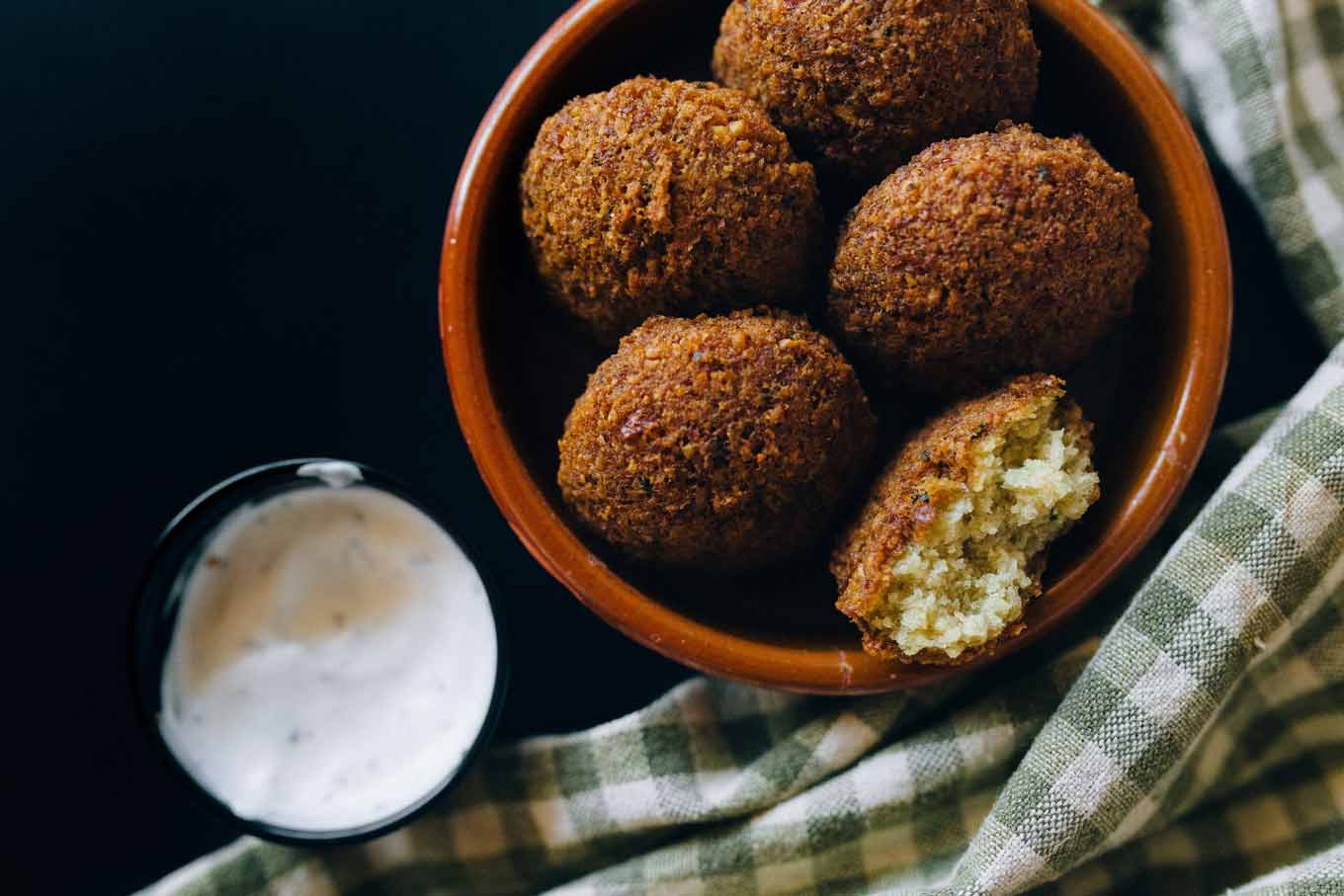
Falafel
Falafel is a Middle Eastern mixture of chickpeas, herbs, and spices, shaped into a ball. It's a good source of protein and contains only whole foods. It's traditionally deep-fried, however, which isn't ideal: Very high heat can transform even a healthy oil into a trans fat.
To (m)eat or not?
Falafel's ingredients are great, though its traditional deep-fried preparation method may negate some of its benefits. Enjoy falafel primarily at home, where you can fry it lightly in olive oil or bake it. Enjoy restaurant falafel as an occasional treat.
This story was originally published by Stacker and republished pursuant to a CC BY-NC 4.0 License.
When Charli Bonham opened Acute Salon — Fort Worth, Texas’s first gender-neutral hair salon — they did so as both an activist and a hairstylist.
This work is nuanced, Bonham balancing their values and providing resources for community members, while knowing it can be difficult to do so within systems that make it unsafe to be queer.
“Acute Salon strives to create a safer space while recognizing that a 100% safe space is not necessarily possible in a capitalist, patriarchal, white supremacist society,” Bonham told Good Good Good.
“We are committed to helping folks to express themselves through their hair regardless of gender identity… to cultivate an environment that is devotedly intolerant of racism, sexism, misogyny, transphobia, and bigotry.”
It’s a breath of fresh air in Texas, a state that amplified its anti-trans sentiments — and policies — in the state legislature this year.
Since 2018, Acute has developed multiple opportunities for guests to get free or discounted haircuts.
Acute partners with LGBTQ Saves, a local affirming youth center, and Finn’s Place, a local community center for trans and gender-diverse people, to provide free haircuts to LGBTQ+ folks.
Whether Acute hosts gender-affirming haircut events for the trans community, offers easy-to-access coupons for free LGBTQ+ youth haircuts, or even embraces the support of LGBTQ+ hair care lines, like Barb, which sponsors gender-affirming haircuts, the salon snips inaccessible personal care in the bud.
“Salons can be an intimidating place for folks in marginalized communities,” Bonham shared with Good Good Good. “Beauty and wellness in media is often coded white, thin, able-bodied, and hyper-feminine.”
“We have found that even outside of the queer community, folks struggle to find a safer space when dealing with issues like alopecia, trichotillomania, or sensory issues. We strive to do what we can to help facilitate a safer space, create community, and simply provide quality services that everyone needs.”
In addition to its partnerships, Acute offers sliding-scale appointments and free haircuts through new stylists’ apprenticeship programs (many of whom are also in the LGBTQ+ community themselves).
Apprenticeships also include training in mindful consultations and gender-neutral barbering, and all stylists at Acute have lists of local LGBTQ-affirming organizations, therapists, doctors, and more, to provide guests and their loved ones with resources for additional support.
“Positive representation has proven to be helpful in increasing self-esteem for people of marginalized groups,” Bonham said. “And there isn’t anyone who doesn’t want to feel a self-esteem boost after getting their hair done.”
A version of this article was originally published in The 2023 Pride Edition of the Goodnewspaper.
Get your own Goodnewspaper by becoming a good news subscriber today.
This year, a number of states across the country introduced (and, unfortunately, passed) bills that would criminalize drag performances for children under 18.
While these bills are deeply troubling on a number of fronts, including their threat to free speech, the goal of lawmakers who introduce and enact these bills is to criminalize queer and trans folks (though, of course, they typically don’t say the quiet part out loud).
But if there’s one word that best describes the drag community, it's fierce.
The art of drag — the performance of exaggerated gender expression (like cross-dressing, dramatic makeup, or specific choreography) — has been around for centuries. The history of drag travels from ancient Egypt to Shakespearean plays, all the way to its role in the Stonewall Riot of 1969 and today’s modern iterations of “RuPaul’s Drag Race” and Drag Queen Story Hour.
So, as politicians (who couldn’t apply winged eyeliner if their lives depended on it) try to outlaw something so historical and fabulous, we’re here to remind you of all the good drag brings to the world.
Whether it’s community members stepping up to protect drag performers or drag queens and kings who use their platform (heels) to make the world a better place, we’ll just be over here screaming “YAAAS” at the top of our lungs (and calling our representatives nonstop, thanks very much).
Good news about drag to celebrate —
This LGBTQ+ theatre company in Tennessee took the state to court.
Friends of George’s, an LGBTQ+ theatre company in Tennessee, hosts performances of original theatrical content (including drag shows) to raise funds for other LGBTQ+ area nonprofits.
This year, its board of directors filed a lawsuit against the state after the passage of a statewide drag ban. The resilience and community of this story are already good news.
But even better?
A Trump-appointed judge just struck down the ban, calling it “too vague” and “unconstitutional.”
“This win represents a triumph over hate,” Friends of George’s said in a statement. “Similar to the countless battles the LGBTQ+ community has faced over the last several decades, our collective success relies upon everyone speaking out and taking a stand against bigotry.”
West Texas A&M students sued their university president after he canceled a drag show on campus.
In March, West Texas A&M’s president, Walter Wendler, announced the cancellation of “A Fool’s Drag Race,” a campus drag show designed to raise awareness and funds for suicide prevention with The Trevor Project.
So, members of the LGBTQ+ student group, Spectrum WT, sued him.
“President Wendler can skip the show if he doesn’t want to see it, but he doesn’t get to decide how people express themselves,” Spectrum WT leadership wrote in a statement on Instagram.
“Drag shows are constitutionally-protected free expression, and President Wendler is a public official who must follow the law.”
Spectrum WT also created a GoFundMe fundraiser to support the show and blew past its goal of $5,000 in three days.
A squad of MMA fighters volunteered to work security detail at a local drag brunch.
In West Virginia, a squad of MMA fighters volunteered to work security detail for a local drag brunch after threats of violence forced performers to cancel the event.
Johnny Haught, the owner and head instructor at Ohio Valley MMA, led the charge to protect the performers.
“The drag show is no more offensive than a Broadway show, or a stand-up comedy show. In essence, it’s a mix of both,” Haught wrote on Facebook. “At the end of the day, it is entertainment; not part of some hidden agenda, like some would have you believe.”
Drag queen and environmentalist Pattie Gonia hosted her first drag show during Earth Week.
All in the name of protecting the planet, Pattie Gonia gathered some of her favorite drag performer friends to celebrate the beauty (and queerness) of Mother Nature.
Speaking of Pattie Gonia… we’re so glad The North Face stood by her in its annual Pride campaign!
This organization uses rainbow umbrellas to cover hateful protestors at drag events.
The Parasol Patrol is an organization that carries rainbow umbrellas to drag events to shield both children and performers from hateful protesters.
Volunteer “patrollers” take their compassion and turn it into action, providing a human shield of loving supporters when anti-LGBTQ+ protesters show up to events.
The Colorado organization has been out in full force this year, “showing we love kids, not in spite of who they are, but because of who they are.”
A Kentucky drag event raised nearly $3,000 for a gender-affirming community closet.
After receiving threats of violence, a Kentucky drag show unfortunately had to move to a digital format for their event.
This didn’t slow them down, as the community rallied and raised nearly $3,000 for a gender-affirming community closet.
“It has been very challenging but it has been very empowering as well. It just goes to show that there is always a silver lining and no matter how many lemons life throws at you, you can always make lemonade,” Lexington drag queen Corabelle Bundy Jolie told ABC 36 News.
These drag performers help people register to vote across the country.
Drag performers with Drag Out The Vote are hosting events across the country (and online) to register people to vote and help get them involved in civic engagement.
“Drag Out The Vote first burst into the workroom in 2020, a small-town girl with a big dream: Activate as many LGBTQIA+ voters as possible,” the organization’s website reads. “Now, Drag Out The Vote is entering her ALL STARS era.”
A veteran and a drag queen teamed up to disarm a gunman during a mass shooting in Colorado Springs.
When a gunman tragically opened fire on Club Q, an LGBTQ+ nightclub in Colorado Springs, a veteran and a drag queen teamed up to disarm him.
While the shooting should have never happened, the heroic actions of veteran Richard M. Fierro and drag performer Thomas James saved lives.
Following the Club Q shooting, drag performers raised over $50,000 to reopen and restore the Colorado Springs nightclub.
Following the horrific shooting at Club Q, drag performers came together to process their grief and host a fundraiser to help the community heal.
Together they raised over $50,000.
A San Francisco drag queen demonstrates Narcan tutorials during her performances.
Kochina Rude, a drag performer in California, demonstrates Narcan tutorials during her performances to help save lives and decrease overdoses.
Cary Escovedo, who plays Kochina Rude on stage, has a day job in public health, and when he saw a friend overdose at a party, he knew he had to use Kochina’s platform to take action.
“In that moment, I realized that there is a big community of people who were not getting the information they needed,” Escovedo told CBS. “I had a captive audience literally every Saturday night.”
A club in Tennessee hosted a family-friendly drag brunch to fight gun violence in schools.
New Beginnings, an LGBTQ+ club in Johnson City, Tennessee opened up for rare, family-friendly brunch hours to host a drag brunch that raised awareness and funds to combat gun violence in schools.
A total of $3,500 was raised from the event, including a $250 donation from the reality show RuPaul’s Drag Race.
A New York animal shelter raised over $14,000 with a drag show fundraiser.
Drag show fundraisers are so in! In New York, a local animal shelter hosted a drag show fundraiser and raised over $14,000 to help find dogs their forever homes.
One performer from the event, Trisha LaMoore, has been a part of the annual fundraiser for the last four years — plus, she’s a dog lover.
“The great thing about this craft is being able to do this art form,” LaMoore told WENY News. “I can use it for good benefits and to raise money for things like puppies, cancer societies, all different kinds of things.”
This “Drag Race” alum teaches math on TikTok.
Filipino drag queen and “Drag Race” alum KYRE teaches math on TikTok to an audience of over 1.2 million. Her goal was to make math more fun and fabulous for all.
“It’s really important for me not just to have queer representation in STEM, but to have STEM representation in queerness,” KYRE told Vice. “I want to also show people that gay people are not just all comedians or actresses, we’re not just there to be the butt of the joke.”
Two drag queens traveled two hours to perform for a dying woman in hospice care.
When Penny Poutre, an Iowa woman, began receiving hospice treatment at Humboldt County Memorial Hospital, she just had one dying wish: to see a drag show.
So two queens, Tyona Diamond and Vana B, drove two hours to give Poutre the performance of a lifetime. They dazzled her with renditions of tunes by ABBA and The Chicks.
“Penny was smiling the whole time and teared up a bit,” Diamond said on the TODAY Show. “You could tell she was happy.”
Despite threats to drag performers, new Drag Queen Story Hours are popping up around the world.
In Norfolk, a rural, conservative town in Canada, supporters heavily outnumbered protesters as a local bookstore hosted its first drag storytime event, which focused on “the beautiful humanity of each of us.”
Despite some backlash, Catherine Weibe, owner of Firefly and Fox Books, knew the event was the right thing for her community.
“As a bookstore owner, I feel like a really foundational piece of my mandate is creating a space where people can hear other people’s stories,” Weibe told The Hamilton Spectator. “When you sit in a room with someone who’s different from you, you learn so much from them.”
A version of this article was originally published in The 2023 Pride Edition of the Goodnewspaper. Get your own Goodnewspaper by becoming a good news subscriber today.
Every month at Good Good Good, we plan upcoming good news content for our Instagram, Goodnewsletter, Goodnewspaper, podcast, website, and more. Our work is always centered on hopeful stories about people making a difference in the world — and action steps on how each of us can join in with that good work.
With so many holidays, awareness days, education weeks, and activism months happening all year long, we’ve been slowly collecting all of these events in a private internal calendar for years.
We made our Monthly Cause Awareness Calendar publicly available earlier this year.
We’ve also published:
- Heritage Months Calendar
- International Days Calendar
- Environmental & Sustainability Calendar
- LGBTQ+ Pride Calendar
- Black Holidays Calendar
- Animal Awareness Calendar
- Pet Holidays Calendar
- Health Awareness Calendar
- Mental Health Awareness Calendar
- Disability Awareness Calendar
- Cancer Awareness Calendar
- HIV/AIDS Awareness Calendar
And now we’re publishing our guide to holidays for and about women.
Our hope is this resource will help you or your organization bring attention to important issues related to women — not just around International Women’s Day or Women’s History Month — but all year long.
Where applicable, we’ve included resources around highlighted holidays — usually in the form of good news around particular topics, relevant quotes or recommendations, or action steps on how to make a difference. We encourage you to share them if you find them helpful.
We’ve worked hard to make this the most comprehensive collection of women-related days and months on the internet. Always double-check dates, as organizers may occasionally change dates.
Bookmark this page and revisit it as often as you need. We’ll continue to update it and add to it over time.
→ You might also like: Good Good Good’s collection of good news by and for women
Women Awareness Months & Dates
January
Days
Women Rock! Day - January 3
National Human Trafficking Awareness Day - January 11
Cesarean Section Day - January 14
Grandma’s Day - January 21
Roe v. Wade Day - January 22
A Room of One’s Own Day - January 25
World Breast Pumping Day - January 27
Weeks
European Cervical Cancer Prevention Week - January 17 to 23
Months
Cervical Health Awareness Month
March of Dimes Birth Defects Prevention Month
National Hobby Month
Explore the ultimate guide to hobbies for women
National Slavery and Human Trafficking Prevention Month
National Stalking Awareness Month
February
Days
National Girls and Women in Sports Day - February 1
World Hijab Day - February 1
National Woman’s Heart Day - 1st Friday of February
National Women Physicians Day - February 3
International Day of Zero Tolerance to Female Genital Mutilation - February 6
National Girl and Women in Sports Day - Held on the 1st week of February
Grandmother Achievement Day - February 11
International Day of Women and Girls in Science - February 11
Canadian Sexual and Reproductive Health Day - February 12
Galentine’s Day - February 13
League of Women Voters Day - February 14
Women in Blue Jeans Day - February 2o
Introduce a Girl to Engineering Day - February 23
Weeks
Women’s Heart Week - February 1 to 7
Months
International Month of Black Women in the Arts
National Women Inventors Month
Women’s Role in History Month
Explore this timeline of milestones in women’s history from the year you were born
March
Days
Endometriosis Awareness Day - March 1
International Women of Color Day - March 1
National Black Women in Jazz and the Arts Day - March 1
Hinamatsuri / Doll’s Day / Girls’ Day in Japan - March 3
World Day of the Fight Against Sexual Exploitation - March 4
International Women’s Day - March 8
Read and share these ideas for how to celebrate International Women’s Day — plus, check out these International Women’s Day quotes
Women & Girls HIV/AIDS Awareness Day - March 10
Explore all of our good news articles about HIV/AIDS
National Women of Color in Tech Day - March 24
National Women in Agriculture Day - March 24
Weeks
International Women’s Week - Starts on the 1st Saturday of March
Women in Construction Week - 1st full week of March
Months
Women’s History Month
Read and share these ideas for how to celebrate Women’s History Month — plus, check out these Women’s History Month quotes
Endometriosis Month
Expanding Girls’ Horizons in Science and Engineering Month
Gender Equality Month
April
Days
International Day Against Victim-Blaming - April 3
National Inspiring Joy Day - April 3
Accelerate ACL Awareness Among Young Women Day - April 5
Women’s Entrepreneurship Day - April 5
National Girl Me Too Day - April 7
National Mature Women’s Day - April 9
There’s Nothing Like a Dame Day - April 17
International Girls in ICT Day - 4th Thursday of April
Red Hat Society Day - April 25
World Women’s Wellness Day - Last Friday of April
Lesbian Visibility Day - April 26
Weeks
Fibroid Awareness Week - Week-long event in April
Black Maternal Health Week - Week-long event in April
National Infertility Awareness Week - Last full week of April
National Princess Week - Last full week of April
Months
Black Women’s History Month
Cesarean Awareness Month
Informed Woman Month
National African-American Women’s Fitness Month
Sexual Assault Awareness Month
Women’s Eye Health and Safety Month
May
Days
World Maternal Mental Health Day - May 3
International Midwives Day - May 5
Red Dress Day - May 5
National Day of Awareness for Missing and Murdered Indigenous Women and Girls - May 5
National Bombshells’ Day - 1st Saturday of May
International Bereaved Mother’s Day - 1st Sunday of May
National Women’s Checkup Day - 2nd Monday of May
World Ovarian Cancer Day - May 8
National Birth Mother’s Day - 2nd Saturday of May
National Dog Mom’s Day - 2nd Saturday of May
Mother’s Day - 2nd Sunday of May
Read about this unique ‘phone calls not flowers’ campaign, celebrating Mother’s Day in a unique way
Hyperemesis Gravidarum Awareness Day - May 15
National Pinkfix Day - May 17
Turn Beauty Inside Out Day - 3rd Wednesday of May
National High Heels Day - May 20
National Women in Aerospace Day - May 20
National Boss Babes Day - May 22
World Preeclampsia Day - May 22
International Day to End Obstetric Fistula - May 23
International Women’s Day for Peace and Disarmament - May 24
Sally Ride Day - May 26
International Day of Action on Women’s Health - May 28
Menstrual Hygiene Day - May 28
Anniversary of Sojourner Truth’s ‘Ain’t I a Woman?’ Speech at the Women’s Rights Convention in Akron, Ohio - May 29
Weeks
National Women’s Health Week - Week-long event in May
National Women’s Health Week - Week-long event in May
Months
International Victorious Woman Month
Maternal Mental Health Month
Women’s Health Care Month
Women’s Mental Health Awareness Month
June
Days
National Old Maids Day - June 4
Equal Pay Act Anniversary - June 10
Women Veterans Day - June 12
International Day for the Elimination of Sexual Violence in Conflict - June 19
Title IX Anniversary - June 23
International Widows’ Day - June 23
Women in Engineering Day - June 23
International Day of Women in Diplomacy - June 24
Helen Keller Day - June 27
Months
Antiphospholipid Antibody Syndrome Awareness Month
Women’s Golf Month
July
Days
Malala Day - July 12
Read and share the best quotes by Malala Yousafzai
Emmeline Pankhurst Day - July 14
Women’s Union Establishment Day - July 20
National Women Touched By Addiction Day - July 23
World Day Against Trafficking in Persons - July 30
Pan-African Women’s Day - July 31
August
Days
Woman Astronomers Day - August 1
National Girlfriends Day - August 1
Mary Prince Day - Friday before the 1st Monday of August
Single Working Women’s Day - August 4
National Sisters Day - August 6
National Daughter-in-Law Day - August 19
Women’s Equality Day - August 26
Emirati Women’s Day - August 28
Weeks
World Breastfeeding Week - August 1 to 7
Months
National Breastfeeding Month
September
Days
National Little Black Dress Day - September 1
Wife Appreciation Day - 3rd Sunday of September
National Women’s Friendship Day - September 17
International Equal Pay Day - September 18
National Woman Road Warrior Day - September 19
American Business Women’s Day - September 22
National Girls’ Night In Day - September 22
Teal Talk Day - September 23
National Previvor Day - Last Wednesday of September
Listen to our podcast interview with Paige More, founder of The Breasties
National Women’s Health and Fitness Day - Last Wednesday of September
National BRAVE Day - Last Friday of September
Weeks
Gender Equality Week in Canada - 4th week of September
Months
Polycystic Ovarian Syndrome Awareness Month
October
Days
International Lesbian Day - October 8
International Day of the Girl - October 11
International Civility For the Girl Child Day - October 13
Metastatic Breast Cancer Awareness Day - October 13
National No Bra Day - October 13
International Day of Rural Women - October 15
National Breast Reconstruction Awareness Day - 3rd Wednesday of October
World Menopause Day - October 18
National Period Day - October 19
National Mammography Day - October 20
National Mother-in-Law Day - 4th Sunday of October
Weeks
European Gender Equality Week - Week-long event in October
Months
Breast Health Month
Breast Cancer Awareness Month
National Domestic Violence Awareness Month
National Pregnancy and Infant Loss Awareness Month
World Menopause Month
November
Days
National Ladies Learning Code Day in Canada - November 6
Women Entrepreneurs Day - November 19
Billie Jean King Day - November 22
International Day for the Elimination of Violence Against Women - November 25
18-Day Campaign to End Violence Against Women - November 25 to December 12
Choose Women Wednesday - Wednesday after Thanksgiving
December
Days
National Women Support Women Day - December 1
Rosa Parks Day - December 1
Read and share Rosa Parks’ most inspiring quotes
National Day of Remembrance and Action on Violence Against Women - December 6
18-Day Campaign to End Violence Against Women - November 25 to December 12
International Day to End Violence Against Sex Workers - December 17
Mother’s Day Around the World
Argentina - 3rd Sunday of October
Australia - 2nd Sunday of May
Bangladesh - May 11
Belgium - August 15
Brazil - 2nd Sunday of May
Canada - 2nd Sunday of May
China - 2nd Sunday of May (or International Women’s Day on March 8)
Costa Rica - August 15
Denmark - 2nd Sunday of May
Egypt - March 21
Finland - 2nd Sunday of May
France - Last Sunday of May (unless it coincides with Pentecost, then it’s 1st Sunday of June)
Germany - 2nd Sunday of May
Greece - 2nd Sunday of May
Hungary - 1st Sunday of May
India - 2nd Sunday of May
Indonesia - December 22
Italy - 2nd Sunday of May
Japan - 2nd Sunday of May
Mexico - May 10
Nepal - New Moon Day in Baisakh (April or May)
Norway - 2nd Sunday of February
Poland - May 26
Romania - 1st Sunday of May
Russia - Last Sunday of November
South Africa - 2nd Sunday of May
South Korea - May 8 (Parents’ Day)
Spain - 1st Sunday of May
Sweden - Last Sunday of May
Syria - March 21
Taiwan - May 8
Thailand - August 12
Turkey - 2nd Sunday of May
United Kingdom - 4th Sunday of Lent (Mothering Sunday), usually in March or early April
United States - 2nd Sunday of May
Vietnam - May 8
Is this list missing a holiday or awareness week/month? Let us know. We want to ensure this list is comprehensive and inclusive.
More Awareness Calendars: All Awareness Holidays | Heritage Months | International Days | Animals | Pets | Environment & Sustainability | LGBTQ+ | Black & African American | Women | Mental Health | Health | Healthcare | Disability | Cancer | HIV/AIDS
Awareness Days & Months: January | February | March | April | May | June | July | August | September | October | November | December
When Denver-based nurse Tara Rynders almost lost her life to an ectopic pregnancy, she experienced the first-hand impact of a nurse’s compassion and dedication to the comfort and safety of a patient.
“When I became a patient myself, I realized that nurses are everything to their patients — their voices, their advocates, their support, their healing hands,” Rynders told Good Good Good.
“I also realized how many opportunities I was missing as a nurse to authentically connect and see my patients. After my ectopic, I became passionate about offering authentic connection in my practice as a nurse, and everything pointed to one thing: Our nurses are tired, overworked, and our healthcare systems are not set up for them to thrive and successfully care for patients.”
Rynders was on to something. And this was in 2017 — before COVID-19.
A survey by the National Council of State Boards of Nursing, published in April 2023, found that about 100,000 nurses left the profession due to pandemic-related burnout and stress.
But Rynders knew nurse mental health was in crisis before a global pandemic took shape.
“When I tried to talk about this with nursing leadership, most downplayed our burnout,” she said. “It was at a time when we were not quite ready to talk about or admit we needed help.”
Rynders, who is also a dancer and choreographer, created an immersive theater performance at her hospital to raise awareness of compassion fatigue and nursing burnout.
The response was overwhelming, and it led her to co-create a six-week grief and trauma workshop series — which also led to a standing monthly meeting to process grief and trauma, conducted regularly throughout COVID-19.
“We used our monthly meetings as a place to debrief and share what was happening in our hearts, our homes, and our floors,” she said.
At the height of the pandemic, she and her team created a video: “COVID Stories,” which narrates stories of grief and trauma over footage of nurses expressing themselves through dance and movement.
And the workshops have continued.

The Clinic: (Re)Brilliancy workshops (a play on the word ‘resiliency’) are Rynders’s most impactful work. In fact, she has been commissioned by Kaiser Permanente to bring them to nurses across California.
“I was so tired of hearing everyone tell us to be more resilient during the pandemic. Nurses are some of the most resilient humans I know,” Rynders said, referencing the name of the workshop series. “What we need are resilient systems that reflect back the brilliant and resilient humans we already are.”
The workshops tap into Rynder’s dance background, integrating movement as a tool for healing and processing the unfathomable stress and trauma nurses carry every day.
“The arts, movement, and play are simply the container for us to soften into our humanity together — to tap into our healing powers as nurses, as humans, and share this healing with ourselves and others,” Rynders said.
And they really do make a difference. One attendee, Charlene Johnson, a nurse in Sacramento, said The Clinic provided her with a day of vulnerability and joy she could have never expected — especially as a Black leader in a field where she often feels invisible.
“The whole eight hours was full of wonder, play, and fun. No agendas, no metrics, no expectations — except to experience joy and be present,” she told Good Good Good. “For an organization to care enough to provide this type of workshop shows the type of care that we need to win our nurses and healthcare workers back to wholeness.”
And now, the work comes back to implementing these healing tools on a scalable, systemic level.
Rynders said the Denver Health system has implemented well-being initiatives through its RESTORE program (Resiliency and Equity Support for Organizational Renewal). This includes 24/7 peer support, in addition to The Clinic’s workshops.
The Clinic also offers licensing to other hospitals and healthcare leaders to provide workshops for their own teams, with the expectation of the program becoming more of a group exercise; not just another responsibility for healthcare workers to take on.
“This is a collective experience: It is not about self-care or asking our nurses to do more,” Rynders said. “It’s time we think innovatively about the support we provide our healthcare workers. What may have served us in the past is no longer working. We need spaces to feel joy and be celebrated.”
And three years into the collective trauma of a global health event, these spaces are needed more than ever.
“We must debrief, we must dance, we must play, we must have courageous spaces to tell the truth about how we are feeling. We must find people to do this work with,” Rynders said. “I think this is the key to processing this [COVID-19]. We must do it together. We heal together.”
These days, gender-affirming care and equal rights for LGBTQ+ folks seem like they’re dependent on a coin toss between states; something as essential as basic human rights tossed around with the value of something as small as a dime.
It’s nearly impossible to break down the attempts to ban gender-affirming care state by state, bill by bill, or lawmaker by lawmaker — there are simply too many.
In the most recent tally, the ACLU has tracked over 460 anti-LGTBQ+ bills introduced in state legislatures across the country in 2023 alone. And while some bills will be shot down, and others are only just now going into effect, the harm caused by such widespread transphobia already has heartbreaking implications.
Across the country, trans folks of all ages are put at further risk of life-threatening violence, persecution, and mental health crises.
In Montana, transgender Representative Zooey Zephyr was silenced and barred from the House floor for advocating for trans rights.
In Nebraska, Senator Megan Hunt was put under investigation for a “conflict of interest” for being a parent to a trans child and advocating against a bill that would ban gender-affirming care for minors.

While some left-leaning states have indeed become safe havens for gender-affirming care, the cause for concern is nationwide, transcending political binaries. But no matter where on the map you look, there are LGBTQ+ people (and allies) fighting for liberation.
There are people everywhere — no matter the laws of their respective statehouses — assigning real value and integrity to trans lives.
Hundreds have turned out in support of Zephyr in Missoula, Montana, rallying behind their representative, chanting “let her speak,” both in the name of democracy and equality.
Back in Nebraska, Hunt, Nebraska’s first openly LGBTQ+ state senator and mother to a transgender son, has filibustered the state legislature for nine straight weeks, alongside Senator Machaela Cavanaugh — allowing no other bills to pass until lawmakers kill the ban on gender-affirming care. Cavanaugh has audaciously promised to “burn the session to the ground over this bill.”
The duo, along with Senator John Fredrickson (the first openly gay man to be elected to the Nebraska legislature), created the Don’t Legislate Hate PAC to help put a stop to these discriminatory bills.
“Countless people have reached out asking how they can help push back against this extremely discriminatory agenda, and we felt that we needed to do more. Thus, our PAC was born,” Hunt told Good Good Good.
“We will use its national platform to support state-level candidates with the courage to stop anti-LGBTQ+ legislation across our country. Our PAC is here to let our LGBTQ+ community know that someone is fighting for them.”
Although the Nebraska legislative session has come to a close, and did indeed include the passage of a ban on gender-affirming care for minors, Hunt fought tooth and nail to keep it from happening.
While Nebraska became one of many states to create anti-trans legislation, other states around the country have solidified trans rights into the very fabric of their constitutions. States like Maryland, Michigan, Colorado, and Maryland have all passed legislation to expand gender-affirming care this year.
Colorado’s Senate Bill 188 protects people who are seeking abortion care or gender-affirming care.
“It’s about the state of Colorado saying that we have legally protected healthcare here in our state, and we’re going to protect the people providing that care and the people getting that care. We have a right to do that,” Colorado Representative Brianna Titone told Good Good Good.
“Colorado has done a lot when it comes to setting up rights for trans people here. We’re running out of things to do in Colorado, which is a good thing.”
Titone is the first transgender state legislator elected in the state of Colorado, and although she is grateful to live in a state where she feels energized and supported in collective efforts to further protect the rights of trans folks, she is still subjected to discrimination.
“I experience hateful remarks on the floor of my House, 10 feet in front of where I’m sitting now,” she said (in a video chat where she was literally on the Colorado House floor). “But at the end of the day, I get my way.”
“We passed the laws we want to protect people. And I always feel really terrible about what’s going on in other states where they are taking away their rights right in front of them.”
But, Titone urged, if trans people “have the stomach” to take the bad with the good, it’s vital that they are at the table.

One of her major accomplishments of this legislative session has been the passage of a “right to repair” bill for farm equipment, allowing farmers in Colorado to fix their own equipment — which is an exciting development for large agricultural states like Nebraska and Montana — both of which will likely pass anti-trans legislation this year.
“The question I have is: do they know that this bill that they’re so excited about was authored and shepherded through by a trans person?” Titone said.
“How would that change their mind if they knew that? I would like to see the smoke come out of their ears when they realize that the greatest thing that they’ve had happen in agriculture in a while was done by someone who they may despise.”
When it comes to trans representation in government, Titone is looking toward a future where the jobs of LGBTQ+ legislators are not to fight for their right to exist safely and comfortably — but to actually have the space and resources to work for their constituents.
“I want them to realize that trans people are working for them,” Titone said. “Even the people who may not like me, I’m still working for them. I want them to understand that we need to be in these spaces because we’re good at our jobs. And without us being in these spaces, you might not get the things you want.”
“We’re not monoliths; we’re just trying to do what’s best for all of our constituents.”
A mere hop, skip, and jump across state lines, Hunt maintains the same energy in Nebraska: Trying to do right by her constituents — whatever it takes.
“I find tremendous hope and drive from the countless supporters who contact my office from across the state. I am inspired by the countless transgender individuals who bravely share their stories and speak out against discrimination,” Hunt said.
“We are united in our commitment to upholding the values of equality, fairness, and respect for all individuals, and we will not back down in the face of bigotry and intolerance.”
In a confusing, conflicting time where injustice and cruelty infiltrate so much of American political life, both Titone and Hunt seek sustained hope.
“We just have to stick to our positions,” Titone said. “We have to speak truth to power and stick together and support each other. We’re going to get on the other side of this.”
The work between neighbors is not the same, but it is done with the same goal in mind: Safety and equality for all — no matter where they live.
“Now is the time for sustained outrage,” Hunt said. “Now is the time for constant and prolonged righteous rage. The kind of outrage that puts morality over civility. The kind of outrage that understands the power of protest and direct action.”
Whether it’s constant contact with elected officials, protests and rallies, letter-writing campaigns, community events, ongoing self-education, donations to local advocacy organizations, or even running for office, Hunt said it best:
“No action is too small or too big.”
A version of this article was originally published in The 2023 Pride Edition of the Goodnewspaper. Get your own Goodnewspaper by becoming a good news subscriber today.
There’s a pretty decent chance that if you’ve been in high school or college at any time during the last decade, you’ve been educated by a video created by John or Hank Green.
These videos are made by the Greens’ production company, Complexly, and consist of beloved titles like SciShow and The Art Assignment, though most of the company’s 14.7 million subscribers are there for the flagship production: Crash Course.
Whether folks are eager to learn about biochemistry, analyze classic literature, or delve into ancient history, they can do so for free, accessing hundreds of lessons with just a few clicks.
The goal of the platform is to “transform the traditional textbook model” and do so in a way that engages learners beyond the goal of just passing a test. Complexly’s videos are 100 percent free to millions across the globe, and the company’s offerings are growing by the year.
This includes a new Spanish language channel (Crash Course en Español), an ongoing partnerships with PBS, and a program with Arizona State University to help use Crash Course content as a means to receive college credit.
But high-quality curriculum and content come at a cost, and Hank Green is dedicated to ensuring that cost does not fall on the shoulders of those who most need access to free educational materials.
So, how do these productions get funded? The Crash Course Coin.
No, it’s not cryptocurrency. It’s an actual collector’s coin! These collectors items essentially represent a donation that comes from folks who can pay for the program, so that everyone else can access it for free.
“Knowledge weighs nothing,” the 2023 coin reads, with imagery inspired by photographs captured from the James Webb telescope in 2022. “Carry all you can.”
Coins are available for $100, $500, or $1,000, and each coin represents the ability to reach 2,000, 10,000, or 20,000 individual learners, respectively.
They’re made with different materials, too: The 2,000 Learner Coin is minted on nickel at a real mint in Arkansas; The 10,000 Learner Coin is minted on thicker brass; and the 20,000 Learner Coin is minted on sleek black iron.
This year, Complexly has already sold out of the 10k and 20k learner coins, and the $100 coin is nearing its annual sell-out mark, too.
“Every year we’re incredibly grateful for the support of our audience, and this year is no different,” Brooke Shotwell, Complexly’s communications coordinator, said in an email to Good Good Good.
Complexly hasn’t publicly shared how many 2,000 Learner Coins have been made available, but based on the 2023 quantities and prices of the other two coins, Good Good Good estimates that Complexly has already brought in more than $350,000 to fund their educational content.
This approach to funding is unique, and no other media or education company has rallied supporters in the same way as Crash Course.
Hank Green illustrated the difference between top-down and bottom-up companies in the education space. He described how top-down approaches tend to charge a lot of money and have a lot of profit, while not necessarily creating things with the “end user” — students and teachers — in mind. They usually spend a lot on marketing to outside stakeholders.
Meanwhile, Hank compared, bottom-up businesses, like Complexly, tend to keep costs low and focus entirely on actual students and teachers, spending a majority of their budget on creating the product.
“It’s a tricky business to run, but we have a pretty clear guiding light: The decisions we make should be about maximizing impact, not revenue,” Hank Green tweeted.
“And the reason we can do it is because of people who support us on Patreon and people who buy the Crash Course Coin,” he continued. “Those two sources of revenue together are the majority of our budget.”
Thousands of supporters buy their collectable coins — not just because they’re beautifully engraved — but because they want to make sure others can learn with ease.
“Getting these every year is a joy on many levels; not least of which is helping to provide free high quality education materials to the masses,” one supporter shared on Twitter. “If you’re able, you should start your coin collection today!”
“Easiest ‘donation’ I’ve made all year,” someone else tweeted. “Love Crash Course.”
Hank Green also tweeted to encourage a last round of coin collectors before this year’s annual fundraiser comes to an end. He reminded his followers that a $100 coin is the equivalent of an $8.30 monthly subscription for a year.
And John Green has been in on the fundraising kick, too.
“Each comes with a signed thank you note, and gosh, are they beautiful,” he shared. “Viewer support is the biggest piece of Crash Course’s budget — thanks for helping us keep CC free for everyone forever.”
The support from these funding efforts has allowed Crash Course to remain free — and to evolve into new offerings.
“Funding generated from the Coin campaign has, in part, funded series like Black American History, and our upcoming Art History series,” Shotwell said. “It has also allowed the Crash Course brand to grow and experiment with new projects and formats.”
By bringing in outside “investors” into the fold, the community around Crash Course — and education as a whole — rallies around values of accessibility, curiosity, and progress.
“We bought ours this morning,” a Twitter user replied to Hank Green’s tweet. “Our kids have benefited so much from Crash Course. And we have the means, so it's an honor to support this work!”
“I’m proud to have several of these now,” a supporter chimed in. “Crash Course is an unalloyed good. Please help support it!”
“Incredible thing about having my own money is finally being able to support Crash Course,” another supporter shared. “Because I would not have survived high school chemistry without it.”
There are a lot of awareness ribbons — trust us, we spent a lot of time putting together this list — and it can be challenging to know which colors are associated with which causes.
Fortunately, we’ve got your back. At Good Good Good we’re all about celebrating the good being done in the world — and helping people make a difference in the world.
And bringing awareness to important issues is a part of both of those!
Variations of awareness ribbons have been used since the middle ages — but they gained significant popularity in the early 1900s when yellow ribbons were given to U.S. soldiers. Since then, awareness ribbons have been used to represent hundreds of causes — most notably pink awareness ribbons for breast cancer and red awareness ribbons for HIV/AIDS.
In this article, we’re specifically diving into what orange awareness ribbons mean and what causes they represent:
What do different orange ribbons mean?
Orange ribbons are most commonly used to show support or raise awareness for gun violence prevention and suicide prevention. However, they are also worn to show support for individuals who have experienced self-harm, leukemia, multiple sclerosis, spinal cancer, or kidney cancers, among other causes.
Orange
- ADHD Awareness
- Agent Orange
- Cultural Diversity
- Chronic Regional Pain Syndrome
- COPD Awareness Month
- Gun Violence Prevention
- Harmony Day
- Hunger
- Kidney Cancer
- Leukemia
- Lupus
- Malnutrition
- Melanoma
- Motorcycle Safety
- Multiple Sclerosis
- National Suicide Prevention Month
- National Suicide Prevention Week
- Prader-Willi Syndrome
- Racial Tolerance
- Reflex Sympathetic Dystrophy Syndrome
- Self-Injury
- Self-Injury Awareness Day
- Sensory Processing Disorder
- Spinal Cancer
- Suicide Prevention
- United Nations International Day for the Elimination of Racial Discrimination.
- Work Zone Safety
Ready to learn more about awareness ribbons and their meanings?
We’ve collected, curated, and organized hundreds of awareness ribbon colors and their meanings. You can dive into the meaning of every color under the rainbow (plus rainbow ribbons themselves) in our guide to awareness ribbon color meanings.
There are a lot of awareness ribbons — trust us, we spent a lot of time putting together this list — and it can be challenging to know which colors are associated with which causes.
Fortunately, we’ve got your back. At Good Good Good we’re all about celebrating the good being done in the world — and helping people make a difference in the world.
And bringing awareness to important issues is a part of both of those!
Variations of awareness ribbons have been used since the middle ages — but they gained significant popularity in the early 1900s when yellow ribbons were given to U.S. soldiers. Since then, awareness ribbons have been used to represent hundreds of causes — most notably pink awareness ribbons for breast cancer and red awareness ribbons for HIV/AIDS.
In this article, we’re specifically diving into what red awareness ribbons mean and what causes they represent:
What do different red ribbons mean?
Red ribbons are most commonly used to raise awareness and show support for the fight against HIV/AIDS — though their meaning can also be associated with blood cancer awareness, drug-use prevention, and congenital heart disease awareness, and other causes.

Red
- Apert Syndrome
- Aplastic Anemia
- Blood Cancers and Disorders
- Bronchiolitis Obliterans
- Burn Victims
- Cardiovascular Disease
- Congenital Heart Defects
- Congenital Heart Disease
- Congestive Heart Failure
- Courage and Inspiration
- DARE
- Diamond Blackfan Anemia
- Driving under the Influence
- Dysautonomia
- Epidermolysis Bullosa
- Evans Syndrome
- Factor XI Deficiency
- Heart Disease
- Hemophilia
- High Blood Pressure
- HIV/AIDS
- Huffing
- Hypertension
- Inhalant Abuse
- Long Q-T Syndrome
- Love
- Lymphoma
- MADD
- Marfan Syndrome
- Poland Syndrome
- Project Red Flag
- Reflex Sympathetic Dystrophy
- Sniffing Abuse
- Stroke
- Substance Abuse
- Supraventricular Tachycardia
- Thrombotic Thrombocytopenic Purpura
- Tuberculosis
- Von Willebrand’s Disease
- Wegener’s Granulomatosis
- Wolf-Parkinson-White
Pink
- Birth Parents
- Breast Cancer
- Nursing Mothers
Cranberry
- Fibromyalgia
Maroon
- Multiple Myeloma
Peach
- Endometrial Cancer
- Uterine Cancer
- Vaginal Cancer
Burgundy
- Adhesions
- Antiphospholipid Antibody Syndrome
- Adults with Disabilities
- Brain Aneurysm
- Post-Polio Syndrome
- Cesarean Section
- AV Malformation
- Disabled Adults
- Lymphatic Malformation
- Factor V Leiden
- Headaches
- Hereditary Hemochromatosis
- Hemangioma and Vascular Malformation
- Hospice Care
- Meningitis
- Meningococcal Meningitis
- Migraine
- PHACES
- Cystic Hygroma
- Sickle Cell Anemia
- Hughes Syndrome
- Sturge-Weber Syndrome
- Thrombophilia and Williams Syndrome
Amber
- Appendix Cancer
- Pseudomyxoma Peritonei
Ready to learn more about awareness ribbons and their meanings?
We’ve collected, curated, and organized hundreds of awareness ribbon colors and their meanings. You can dive into the meaning of every color under the rainbow (plus rainbow ribbons themselves) in our guide to awareness ribbon color meanings.
Even those who are enthusiastically involved in their reproductive health will likely tell you how hard it can be to obtain birth control in the U.S.
Between hurdles with private insurance companies, long waitlists to see an OB-GYN, astronomical prices for folks without coverage, or even having trouble finding the right form of contraception, it is no easy feat to prevent an unintended pregnancy.
These unplanned pregnancies have major, individual impacts: derailments of work or career goals, increased maternal and child health risks, further barriers to economic security, and, of course, even persecution or legal trouble for those who may pursue an abortion in some states.
That said, nearly half of all pregnancies in the United States are unplanned, and many of those come from folks who use contraceptive methods such as birth control pills and are doing what they can to avoid an unplanned pregnancy.
Still, contraception can fail them, and in turn, so does the healthcare system at large.
Especially in a time when reproductive health is so shrouded in shame — and political concern — Mark Edwards, co-founder of Upstream USA, realized that the key to this crisis was to start at the helm.
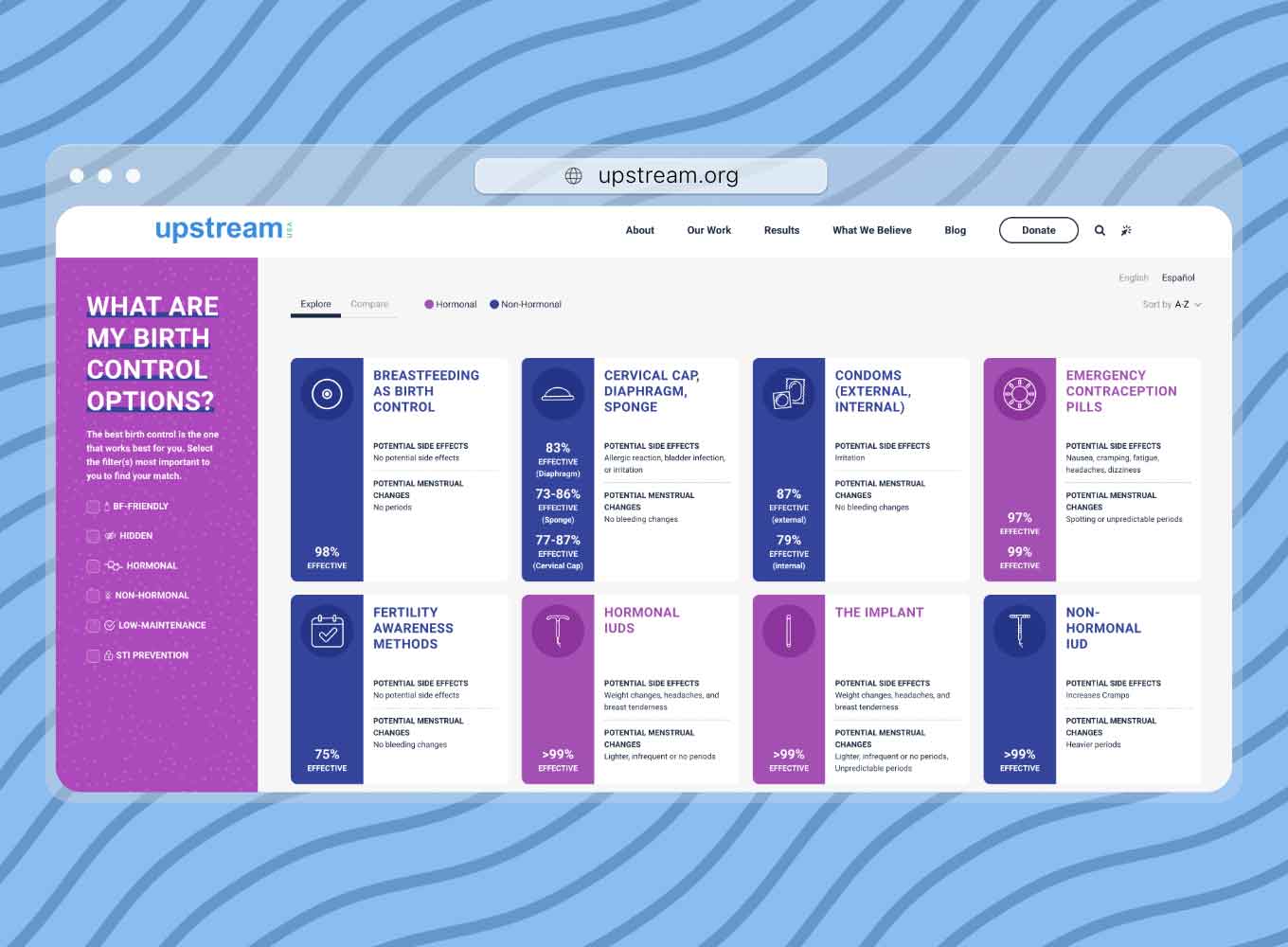
Upstream’s mission is to provide patient-centered contraceptive care in primary care systems. Rather than seeing a specialist to provide contraceptives, patients would be able to obtain this care from their primary care doctors.
To do this, Upstream provides high-quality training and technical assistance to healthcare providers, allowing them to provide patients with all the information they need to make contraceptive decisions that work best for them.
Edwards has worked to decrease poverty throughout his career and in 2009 founded an organization called Opportunity Nation, a bipartisan coalition of 300 national nonprofits dedicated to expanding economic mobility through community college and employment.
In this work, he spoke with many young people about the challenges that derailed their life trajectories. He began to see a trend with unplanned pregnancy.
He realized that the problem wasn’t coming from the irresponsibility of young people; it was coming from inequitable access to the full range of contraceptive methods.
So, in 2014, along came Upstream.
“By transforming the approach to contraceptive care and embedding it into primary care settings, we’re working to ensure that all people from all socioeconomic backgrounds have access to the type of contraceptive care they need and deserve,” Edwards told Good Good Good.
And it’s not just a quick conversation about the pill. The FDA has approved 18 different methods of birth control (some of which are even 20 times more effective than others).
The execution of Upstream’s programming is this: In a standard doctor’s visit, no matter why a patient comes in for care — they are asked a super-simple screening question: “Do you plan to become pregnant in the next year?”

If the answer is ‘yes,’ providers can open up a different conversation, but if the answer is ‘no,’ the patient would be offered the full range of FDA-approved contraceptive methods, with all pertinent information, and leave that visit with the birth control of their choice in their hands.
This approach has seen astonishing success. Upstream began its work as a state-wide program in Delaware. Between 2014 and 2017, births from unintended pregnancies dropped by 25% in Delaware.
Edwards shared even more optimistic stats in his 2023 TED Talk. Three years after Upstream’s intervention in Delaware, the state saw a 24% decrease in births from unplanned pregnancies overall (compared to 3% nationally), a 37% drop in abortions, and a 24% decrease in infant mortality.
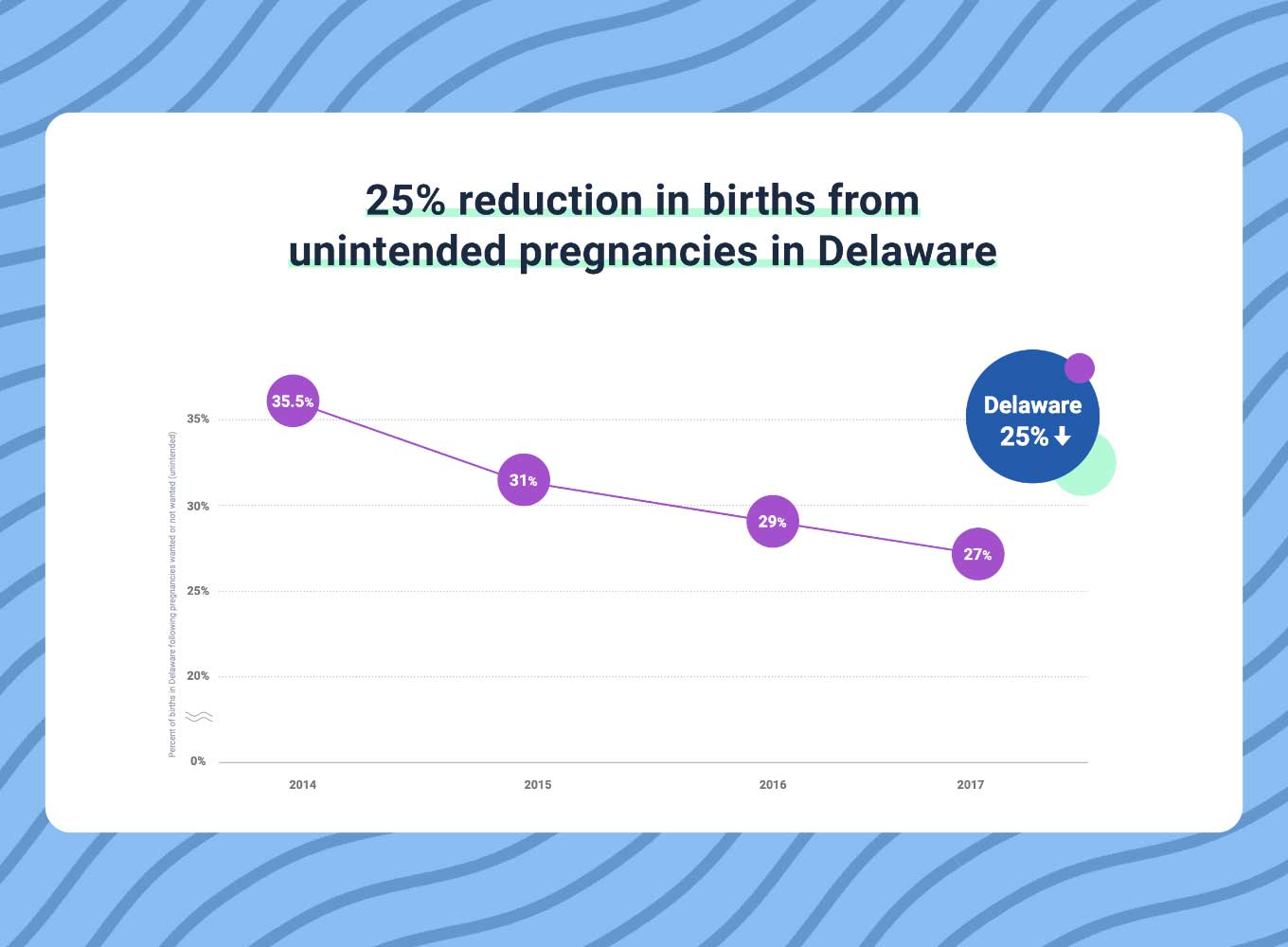
Now, the organization is working in over 100 health centers, across 16 states — all with varying political identities.
“I think we can all agree that people having access to birth control so they can plan their families or decide if they want to have one or not, isn’t a blue, red, or purple state idea,” he shared in his TED Talk. “It’s a smart, just, empowering idea for everyone.”
“What we’ve found is that equitable access to patient-centered contraceptive care is a nationwide need,” Edwards added in an interview with Good Good Good.
That’s the other element of success: patient-centered care. The goal of Upstream’s work is not just to decrease unintended pregnancy, but to put patients at the center of the decision-making about their bodies.
In Delaware, surveys showed the following results:
- 98% of patients did not feel pressured to choose a specific method of birth control
- 99% of patients made their own choices about birth control
- 98% of patients felt that health center staff listened to them and their preferences
This patient and justice-centered framework might seem like common sense, but it’s a radical approach in a system that has long made reproductive health seem like a specialty offering.
“Contraceptive care has historically been treated by our healthcare system as specialty care, when in actuality, contraceptive care is primary care,” Edwards said.
“When we integrate contraceptive care into the primary care setting, as Upstream has in our proven model, we increase equitable access to contraceptives, without logistical barriers, which inevitably improves health equity for all women.”
All of this work is done on a pro-bono basis, providing already stretched-thin healthcare providers with easy-to-implement training and resources.
“In all my years as a medical professional, I’ve never encountered a public health initiative that has made such a dramatic impact on practice change in such a short period of time,” Dr. Karyl Rattay, the Director of Delaware’s Division of Public Health, shared on the Upstream website.
Proving itself a worthy approach, Upstream has been expeditiously funded by the Audacious Project, the grant-giving arm of TED, which invests in social impact solutions.
With this support, Upstream aims to reach over 700 health centers in the U.S, and serve 5 million people of reproductive age by 2030.
This work could not come at a more crucial time. Equitable access to contraceptive care is clearly a more effective route to reducing abortions, than, say, banning them, and Edwards says birth control has strong bipartisan support across diverse political environments.
“We’ve reached a crucial point in our history, calling for an expanded approach to dramatically improve contraceptive access,” he said. “We envision a future where patient-centered contraceptive care is an integral part of healthcare for all people.”
While Upstream is zeroing in on states with the highest need of support, Edwards knows contraceptive access is vital — especially in a post-Roe America.
He encourages folks to have a conversation with their primary care providers about how they are equipped to provide their patients with the full range of birth control methods.
Starting that conversation can open a door to implementing solutions.
“We need to continue to break down long-standing healthcare silos in order to empower patients with the opportunity to decide if and when they become pregnant,” he said. “Giving them that autonomy puts them in charge of their physical, mental, and maternal health.”
“We want them to have the freedom to focus on their future on their own terms, and, if desired, become intentional parents — when they’re ready.”
Header image courtesy of Upstream USA
One of my favorite tweets of all time is a viral quip from user @mgracereyn from 2022: “A weighted blanket is not enough,” the tweet reads. “I need to be compressed into a .zip file.”
As an expert anxious person, I cannot endorse this message enough. But a weighted blanket is still a great start to comforting my sensory needs — and it’s important to find one that also meets the needs of the planet.
Although they can definitely be an investment piece, weighted blankets help folks who are anxious, neurodivergent, or just prefer some additional pressure when they cozy up in bed.
Weighted blankets deliver deep pressure stimulation and can be used in sensory integration therapy, making them both a comfy self-care tool, and a real resource for those with disabilities or mental health conditions.
Whether you’re looking for deeper sleep or deeper pressure, you don’t have to have it at the expense of the planet. We’re here with some tips — and recommendations — for finding your eco-friendly weighted blanket of choice.
By the way, you might also like our deep-dives on other eco-friendly bedroom products:
- Sustainable Bed Frames
- Sustainable Mattresses
- Sustainable Mattress Toppers
- Sustainable Bedding
- Sustainable Dog Beds
- Sustainable Pillows
By the way, some of the products and links in this article are partners and affiliates, which means we may earn a commission at no extra cost to you. Everything in this article was independently and honestly written by the Good Good Good team. Thank you for your support!
What makes a weighted blanket sustainable?
If you’ve explored our roundup of sustainable bedding, you already know that the sourcing, manufacturing, and shipping of your linens plays a big role in their environmental impact. Let’s dive deeper into the specifics:
Materials
When shopping for a planet-forward, non-toxic weighted blanket, some key materials to search for include:
- Certified organic cotton (with subcategories like velvet, percale,
- Bamboo (if made with closed-loop processes)
- Hemp
- Recycled materials like plastic bottles or polyester
Certifications
Just like other eco-friendly and organic bedding options, weighted blankets are certified by trusted independent organizations that require brands to meet rigorous standards and regulations.
These third-party groups keep companies accountable, so you can have the best, most health and environment-conscious product out there.
Keep your eyes out for products endorsed with the following labels:
Environmental Impact
Like with any ethical shopping selections, it’s vital to keep an eye on a brand’s environmental impact, reports, initiatives, and investments.
It’s clear to find those who are truly dedicated to sustainability and ethical business — they’ll have transparent information easily available about things like carbon offsets, packaging, sourcing, manufacturing, and more.
Some of these brands may also have partnerships with environmental nonprofits like 1% for the Planet or Climate Neutral.
Social Impact
Lastly, it’s important to monitor a brand’s reporting of its supply chain and labor practices. A solid indicator of an ethical brand are those with B Corp and Fair Trade certifications, so keep those labels handy!
Our reviews of sustainable and organic weighted blankets
This section contains honest reviews of weighted blankets our team actually reviewed. We unboxed, snuggled up with, and slept on each of these blankets — and broke down their impact on the environment, health, and, of course, our comfort.
The brands you see listed in this section sent members of our team sample weighted blankets to review for this article.
(Our reviews are always honest. Receiving free products for testing never impacts our writing — and brands don’t have any influence on our writing or editorial process.)
Nest Bedding
What’s good: Nest Bedding, with its wide selection of sustainable bedding, is Fair Trade, FSC, OEKO-TEX, and Ceti-PUR certified.
The family-owned business is known for its dedicated customer service and its organic, natural, and affordable bedding — like its popular weighted blankets!
Materials: Although Nest’s weighted blankets do use some polyester materials, a large portion of the blanket is made with 100% rayon from bamboo, as well as lead-free glass beads.
Weight(s):
Johnathan’s Thoughts: The Nest Luxury Weighted Blanket feels super nice on the skin. Its double-sided materials provide two different but equally comfortable options, depending on your personal preferences and how warm you want to be.
I opted for the King-sized blanket to cover my whole bed, and at 25 pounds, the blanket feels just weighted enough, but still thin and not suffocating in the slightest. The weight distribution is great, and it comfortably covers two people.
The blanket comes in a neat reusable Nest cotton tote bag, which maintains a quality similar to the blanket, feeling very sturdy and high-quality. The whole thing shipped in a plastic bag, in a larger cardboard box.
The Nest weighted blanket has been a game-changer because I love the feeling of being engulfed in comfort. The material of this blanket stays cool, with one side similar to a sleeping bag (but way softer), and the other feeling like a soft t-shirt. I know I’ll still be able to use it in the warmer months while still getting to experience that gentle pressure.
The blanket does not come with a duvet cover, nor does Nest sell a corresponding cover for this blanket, but it does have tiny loops on the ends if you do opt for a third party option.
→ Shop weighted blankets from Nest Bedding
Sunday Citizen

What’s good: Sunday Citizen is a company led by a fourth-generation textile family with a mission of creating “radical softness for the home, body, and soul.” Oh, yeah, that’s the good stuff.
The brand makes its goods with especially soft fabrics but still focuses on its environmental impact, like using recycled PET plastic bottles for its comforter filling. The brand also uses recycled materials in its packaging.
Materials: Sunday Citizen carries two types of weighted blankets. The Bamboo Crystal Weighted Blanket is made with 100% viscose from bamboo, microfiber, glass pearls, and natural crystals.
Its Snug Crystal Weighted Blanket isn’t as eco-friendly of an option, sticking with polyester and microfiber fabrics, but is still filled with glass pearls and natural crystals.
Weight(s):
- Bamboo Crystal Weighted Blanket: 10, 15 or 20 pounds
- Snug Crystal Weighted Blanket: 10, 15, 20, or 35 pounds
Megan’s Thoughts: Sunday Citizen sent me the Bamboo Crystal Weighted Blanket in the “off-white” color. I selected the 10-pound option to have as a personal relaxation companion.
The moment I opened the blanket’s zipper case and felt the blanket, exactly one word came to mind: luxurious. It is so soft and silky, and I love that the cover is removable so it can be washed if and when I need to. It also came with the cutest bag, filled with a few different kinds of crystals.
The zipper storage bag was made with plastic, which normally I don't mind because I can reuse them for storage — but unfortunately, this one arrived ripped from the zipper edge in one corner, so I won't be able to reuse it.
The blanket is a bit small to be a full bed blanket, so I love using it on the couch. As someone who has a difficult time turning my brain “off” at the end of the day, this sends me instantly into relaxation mode, calming both my brain and my body.
The luxurious feeling may also come from the fact that there are literal crystals inside the blanket, which you can feel when you hold on to it. I thought it would be weird to be able to feel the pieces through the fabric, but it's not at all once you've actually got the blanket on — you just notice the cozy, relaxing (friendly) bear hug.
→ Shop weighted blankets from Sunday Citizen
Saatva
What’s good: Saatva was founded on the belief that “everyone deserves healthy and restorative sleep on a quality bed.”
Whether it's the brand’s handcrafted, eco-friendly mattresses, pillows — or yes, weighted blankets — you can rest easy knowing they meet the highest health and environmental safety standards.
The brand sources Fair Trade and certified organic materials, adheres to ethical labor standards, and plants trees with Evertreen, meaning your purchases can increase reforestation around the globe.
To date, Saatva has planted over 7,000 trees across nine countries.
Materials: Saatva’s weighted blankets are made with 100% quilted cotton velvet, and all-natural glass beads.
Weight(s):
- Single: 12 pounds
- King/Queen: 20 Pounds
Jessica’s Thoughts: Saatva generously sent me the All-Natural Weighted Blanket in the “graphite vintage velvet” color way. I chose the 20-pound size, and this velvety-soft blanket is by far the coziest weighted blanket I’ve ever had!
It’s been my go-to on the couch in the evenings while winding down after a busy day.
While the velvet material is a big part of this blanket’s cozy factor, I wouldn’t recommend it for sleeping if you run hot in the night. My partner prefers a lighter cotton weighted blanket for this reason. It does fit on a king bed, with just a little overlap on the edges, but since I’ve been hogging for my own cozy time, I likely won’t use it as an aesthetic topper.
The blanket arrived in packaging that was plastic-free, which is always a pleasant surprise. It was wrapped beautifully with a ribbon and contained care instructions (spot clean or dry-clean only). I love that it’s also Fair Trade certified, so between that and its snuggly quality, I’d say this is a purchase you can feel good about!
→ Shop weighted blankets from Saatva
Baloo Living

What’s good: Baloo Living makes weighted blankets and weighted comforters with people and the planet in mind. The women-owned business is carbon neutral (and Ocean Positive) in partnership with Sea Trees and has a plastic-free supply chain.
Additionally, a portion of the brand’s profits go to Pajama Program, a nonprofit that partners with schools, shelters, and group homes to provide new books and sleep essentials so children can have a safe and secure good night’s sleep.
Materials: Baloo’s weighted blankets are made with natural and chemical-free materials like 100% cotton and glass microbeads, making it soft and breathable all year round. The brand’s weighted blankets do not use any synthetic liners or polyester fill.
Weight(s):
- Standard Weighted Blanket: 12-25 pounds
- Weighted Comforter: 15-25 pounds
- Mini Weighted Blanket: 9 pounds
- Weighted Lap Blanket: 8 pounds
Kamrin’s Thoughts: Baloo sent me a standard 20-pound weighted blanket in the “Pebble White” color. My Baloo blanket arrived in what I found to be an extremely compact cardboard box, knowing there was a very heavy queen-sized blanket inside. Upon opening the box, I discovered that the blanket was pristinely folded in a reusable canvas tote bag.
I chose between the 15 and 20 pound queen sizes after taking a quick 30-second quiz on the Baloo website, and I’m really happy I went with a heavier option.
Despite it being the weight of a small child, the blanket is really breathable and feels like something I can use even when those hot summer nights come around. The outer fabric is soft and silky, and I can feel the beads easily in each quilt square on the blanket.
There are also little loops on the edges of the blanket so it can be stored in a duvet cover, if desired. That said, I’ve been using it without a cover and love the feel and simplicity of the blanket all on its own.
As someone who has used a weighted blanket in the past, I really love how this one feels cool to the touch and is still heavier than other weighted blanket options I’ve tried before.
It provides me with sensory pressure that feels soothing and grounding, without the overwhelming, smothery sensation of being trapped. I call that a win!
→ Shop weighted blankets from Baloo Living
Other eco-friendly & non-toxic weighted blankets to consider
For this section, we’ve conducted research, read dozens of reviews, and included a breakdown of the environmental considerations of each weighted blanket — but we have not yet snuggled these ourselves.
Bearaby
What’s good: Bearaby is a woman-owned brand that creates knitted weighted blankets and other weighted products (like a weighted sweater — the “Napigan!”) that are functional and sustainable.
Using materials that are good for the planet, Bearaby is certified by both the FSC and Global Recycled Standard. Its cotton and eucalyptus blankets are biodegradable, too, contributing to a closed-loop practice. Materials are also grown with organic farming practices, making them chemical-free and kinder to the environment.
Lastly, Bearaby doesn’t use any filler in its blankets, since they’re all knitted with Fair Trade, chunky fabric.
Materials: Bearaby has a handful of weighted blanket options, depending on what you’re looking for – but all of them are made with the Earth in mind.
The Cotton Napper — and most other Bearaby blankets — are made with 100% organic cotton, but two other specialty blankets have other characteristics.
The Tree Napper is a cooling weighted blanket made with Tencel (a renewable eucalyptus wood pulp), and the Velvet Napper is made with “eco-velvet” created with recycled marine plastic, removing 900 plastic bottles from the ocean with each blanket.
Weight(s):
- Cotton Napper: 10, 15, 20, or 25 pounds
- Tree Napper: 15, 20, or 25 pounds
- Velvet Napper: 15, 20, or 25 pounds
- Hugger: 30 pounds
- Travel Napper: 6, 8, or 10 pounds
- Nappling: 6 or 8 pounds
→ Shop weighted blankets from Bearaby
Luna

What’s good: Luna is a woman-owned weighted blanket and bedding company that creates planet-friendly products. All of Luna’s natural materials are OEKO-TEX certified, and the brand is carbon neutral through its partnership with CarbonFund.
Additionally, Luna supports Mental Health America and the NYC Fair Trade Coalition.
Materials: While Luna carries a variety of weighted blanket options, most are either made with 100% cotton or 100% lyocell bamboo. They’re even machine washable!
Weight(s):
- Sweet Dreams Blanket: 10, 15, 20, 25 or 30 pounds
- “Cozy Comfort” Bamboo Blanket: 10, 15, 20, 25 or 30 pounds
- Cooling Blanket: 12 or 15 pounds
- “Dream Weaver” Kids Blanket: 5, 7, 10, 12, or 15 pounds
→ Shop weighted blankets from Luna
Nuzzie
What’s good: Nuzzie is another knit-style weighted blanket with the intention of providing higher-quality sleep and relaxation. The brand is a partner to 1% for the Planet and Climate Neutral and each blanket is made with over 500 plastic bottles.
Materials: Each of Nuzzie’s weighted blankets is made with jersey-knit polyester in an open weave design. Inside each weave is a mix of 100% recycled polyester fluff and recycled plastic bottles.
Weight(s):
- Twin Nuzzie Knit: 8 pounds
- Full Nuzzie Knit: 15 pounds
- Queen Nuzzie Knit: 20 pounds
- King Nuzzie Knit: 25 pounds
→ Shop weighted blankets from Nuzzie
Cariloha
What’s good: A certified B corp, Cariloha provides a “comfy way to save the planet.” The brand uses bamboo — one of the most naturally regenerative materials in the game — and maintains certifications from Fair Trade, FSC, Sustainable Forestry Initiative, CertiPur-US, OEKO-TEX, and Made In Green.
Cariloha is also on its way to becoming 100% carbon neutral and provides funding to various philanthropic projects each year.
Materials: Cariloha’s weighted bamboo blankets contain non-toxic glass beads and are made with a blend of textiles. The outer cover is mostly made with viscose from bamboo, as well as cotton and polyester. The inner blanket is made with 100% viscose from bamboo.
Weight(s):
- Weighted Bamboo Blanket: 15 pounds
→ Shop weighted blankets from Cariloha
Luxome

What’s good: Luxome makes bedding — like weighted blankets — that invoke feelings of comfort, calm, and — you guessed it — luxury. The brand finds a sustainable middle-ground between cotton and silk, using lyocell bamboo for a soft, temperature-regulating experience.
Plus, bamboo requires a third of the water to grow than that of cotton, doesn’t require pesticides or fertilizers, and is hypoallergenic and gentle on skin.
Luxome products also come shipped in reusable cotton tote bags that can be used over and over again.
Materials: Luxome weighted blankets come in the choice of lyocell from bamboo, ultra-plush “minky,” or a combination of the two. All blankets are OEKO-TEX certified and contain lead-free glass beads.
Weight(s):
- Weighted Blanket: 8, 15, 18, or 30 pounds
→ Shop weighted blankets from Luxome
TruHugs
What’s good: TruHugs is a small brand created by Jonathan Hsu, a designer on the spectrum who loves to understand how the world works. He has spent years perfecting the design of the brand’s weighted blankets and has worked closely with patients diagnosed with Parkinson’s and Alzheimer’s.
Between his passion for increasing the standard of living for those with disabilities, and doing so in a way that doesn’t harm the planet, TruHugs was born.
“Our sphere of influence is small, but even if we just help one person sleep better…that person may go on to help the world,” the brand’s website reads. “TruHugs is a gift from our hearts to yours.”
Materials: TruHugs uses a set of custom weaves, fillers, and fabrics designed to keep the body cool and supported all at once. Its many materials include organic linen flax, organic cotton, organic hemp, natural bamboo lyocell, natural eucalyptus lyocell, and recycled polyester.
Weight(s):
- TruHugs SOLO: 15, 23, or 30 pounds
- TruHugs DUO: 35 pounds
→ Shop weighted blankets from TruHugs
Silk & Snow
What’s good: Silk & Snow is a sustainable bed and bath brand committed to responsible sourcing and the use of traceable materials. Adhering to standards set by GOTS, GOLS, OEKO-TEX, and CertiPur-US, the brand prides itself on better materials, conscious manufacturing, and transparency.
Silk & Snow also partners with organizations like St. Vincent De Paul, Twice as Nice, and Friperie Cartier to recycle its products and provide a better night’s sleep to those in need.
Materials: Silk & Snow’s hand-knitted weighted blankets are made with 100% natural cotton, with no fillers or synthetic textiles.
Weight(s):
- Hand Knitted Weighted Blanket: 8, 12, 15, 20, or 25 pounds
→ Shop weighted blankets from Silk & Snow
There are a lot of awareness ribbons — trust us, we spent a lot of time putting together this list — and it can be challenging to know which colors are associated with which causes.
Fortunately, we’ve got your back. At Good Good Good we’re all about celebrating the good being done in the world — and helping people make a difference in the world.
And bringing awareness to important issues is a part of both of those!
Variations of awareness ribbons have been used since the middle ages — but they gained significant popularity in the early 1900s when yellow ribbons were given to U.S. soldiers. Yellow ribbons continued their cultural influence in the 1970s, with the rise of the international hit song “Tie a Yellow Ribbon Round the Ole Oak Tree.” Since then, awareness ribbons have been used to represent hundreds of causes — most notably pink awareness ribbons for breast cancer and red awareness ribbons for HIV/AIDS.
In this article, we’re specifically diving into what yellow awareness ribbons mean and what causes they represent:
What do different yellow ribbons mean?
Yellow ribbons are most commonly used to show support for active duty U.S. military troops — though they’re also commonly used for suicide prevention awareness, missing children awareness, liver disease awareness, and other causes.

Yellow
- Adenosarcoma
- Adoptive Parents
- Alternative Medicine
- Australian National Road Safety Week
- Bladder Cancer
- Bone Cancer
- Canadian Cancer Society
- Canadian Military Support
- Carbon Monoxide Poisoning
- Childhood Cancer Awareness Day
- Craniofacial Acceptance
- Cuban Five
- Dog Bite Prevention
- Endometriosis
- Equality
- Ewing’s Sarcoma
- Fire Services in Queensland, Australia
- Gulf War
- Hong Kong Pro-Democracy Protests Support
- Hydrocephalus
- Support for Hostages During Iranian Hostage Crisis
- Liver Cancer
- Liver Disease
- Livestrong
- Press Freedom in Malaysia
- Medal of Honor in Japan
- MIA / Missing in Action
- Microcephaly
- Military Service
- Missing Children
- Missing Persons
- Myxoid Liposarcoma
- Obesity
- Operation Yellow Ribbon in Canada
- Original HIV/AIDS Ribbon
- Osteosarcoma
- POW / Prisoners of War
- Refugees Welcome
- Resistance Movement in Russian-occupied Parts of Ukraine
- Sarcoma
- Save Albert Park in Australia
- Sinking of Dong Fang Zhi Xing in China
- Sinking of South Korean Ferry MV Sewol
- Spina Bifida
- Suicide Awareness
- Suicide Prevention
- The Disappeared
- U.S. Military Support
- Yellow Ribbon Project in Singapore
- Yellow September in Brazil
Red & Yellow
- Hepatitis C
- HIV/HCV Co-Infection
- Surviving Family Members of Someone Who Died By Suicide
Purple & Yellow
- Autoimmune Hepatitis
- Chemical Injury and Lupus
- Endometriosis
Blue & Yellow
- Designated Drivers
- Down Syndrome
- Spina Bifida and Hydrocephalus
- Thoracic Outlet Syndrome
- Ukraine
Pink, Blue, & Yellow
- Pansexual Pride
Red, Blue, & Yellow
- Trisomy
Frequently Asked Questions
Why are MLB teams wearing yellow awareness ribbons on their uniforms?
On September 3, 2023, MLB players across the league wore yellow ribbons and gold wristbands in honor of the MLB’s Childhood Cancer Awareness Day. As a part of the MLB Together platform, teams are showing support for the fight against childhood cancer.
Ready to learn more about awareness ribbons and their meanings?
We’ve collected, curated, and organized hundreds of awareness ribbon colors and their meanings. You can dive into the meaning of every color under the rainbow (plus rainbow ribbons themselves) in our guide to awareness ribbon color meanings.
There are a lot of awareness ribbons — trust us, we spent a lot of time putting together this list — and it can be challenging to know which colors are associated with which causes.
Fortunately, we’ve got your back. At Good Good Good we’re all about celebrating the good being done in the world — and helping people make a difference in the world.
And bringing awareness to important issues is a part of both of those!
Variations of awareness ribbons have been used since the middle ages — but they gained significant popularity in the early 1900s when yellow ribbons were given to U.S. soldiers. Since then, awareness ribbons have been used to represent hundreds of causes — most notably pink awareness ribbons for breast cancer and red awareness ribbons for HIV/AIDS.
In this article, we’re specifically diving into what white awareness ribbons mean and what causes they represent:
What do different white ribbons mean?
White awareness ribbons are primarily used to signify peace or bone cancer awareness — but they’re also commonly associated with support for people who self-harm, Holocaust awareness, adoption, and victims of terrorism and other violence.

White
- Abstinence from Alcohol
- Adoptee
- Adoption
- Anti-Child Pornography
- Anti-Domestic Violence
- Anti-Pornography
- Anti-War
- Blindness
- Bone Cancer
- Bone Disease
- Child Exploitation
- Child Sexual Abuse/Assault
- Community Support
- Congenital Cataracts
- Elderly Affairs
- Elimination of Sexual Harassment, Sexual Assault, and Domestic Violence Across the U.S. Military and Department of Veterans Affairs
- End Male Violence Against Women and Girls
- Gender Equality
- Gender Equity
- Hernia
- Holocaust Remembrance
- Hope and Support
- Innocence
- Molestation Survivor
- Multiple Hereditary Exostoses
- Online Sexual Predator Awareness and Internet Safety
- Osteoporosis
- Peace
- Postpartum Depression
- Retinoblastoma
- Safe Motherhood
- Salvation Army
- Scoliosis
- Sexual Purity or Temperance
- Stalking
- Student Sexual Abuse
- Support for People in Self-Harm Recovery
- Support for People Who Self-Harm
- Teen Pregnancy Prevention Awareness
- Victims of Terrorism
- Victims of Violence
- Various Political Movements
- White Ribbon Day
Cream
- Degenerative Disc Disease
- Paralysis
- Spinal Cord Injuries
- Spinal Disorders
- Spinal Muscular Atrophy
Pearl
- Emphysema
- Lung Cancer
- Lung Disease
- Mesothelioma
- Multiple Sclerosis
- Waldenstrom’s Macroglobulinemia
Black & White
- Anti-Racism
- Carcinoid Cancer
- Diversity
- Ehlers-Danlos Syndromes
- Equity & Inclusion
- Neuroendocrine Tumors
- Racial Justice & Equality
- Rare Diseases
- Rare Disease Day
- Transitions
Red & White
- Aplastic Anemia
- DVT
- Head and Neck Cancer
- Hereditary Hemorrhagic Telangiectasia
- Oral Cancer
- Squamous Cell Carcinoma
Burgundy & Ivory
- Laryngeal Cancer
- Oral head and neck cancers
- Oral Squamous Cell Carcinoma
- Pharyngeal Cancer
- Throat Cancer
Orange & White
- Bike Helmet Safety
- Bicycle Safety
Periwinkle & White
- Esophageal Atresia and Tracheoesophageal Fistula (EA/TEF)
Teal & White
- Cervical Cancer
Red & Pearl
- Latex Allergy
Ready to learn more about awareness ribbons and their meanings?
We’ve collected, curated, and organized hundreds of awareness ribbon colors and their meanings. You can dive into the meaning of every color under the rainbow (plus rainbow ribbons themselves) in our guide to awareness ribbon color meanings.
There are a lot of awareness ribbons — trust us, we spent a lot of time putting together this list — and it can be challenging to know which colors are associated with which causes.
Fortunately, we’ve got your back. At Good Good Good we’re all about celebrating the good being done in the world — and helping people make a difference in the world.
And bringing awareness to important issues is a part of both of those!
Variations of awareness ribbons have been used since the middle ages — but they gained significant popularity in the early 1900s when yellow ribbons were given to U.S. soldiers. Since then, awareness ribbons have been used to represent hundreds of causes — most notably pink awareness ribbons for breast cancer and red awareness ribbons for HIV/AIDS.
In this article, we’re specifically diving into what black awareness ribbons mean and what causes they represent:
What do different black ribbons mean?
A black awareness ribbon is primarily a symbol for mourning & remembrance — but it’s also commonly associated with melanoma awareness, anti-terrorism, POW/MIA, and students for gun control.

Black
- 9/11 Loss Remembrance
- Accidents
- Amish Support
- Anti-Terrorism
- Black Lives Matter
- Gang Prevention
- Gun Control
- Loss
- Melanoma
- Mourning
- Narcolepsy
- POW/MIA
- Primary Biliary Cirrhosis
- Remembrance
- Sadness
- Sleep Apnea
- Sleep Disorders
- Students for Gun Control
- Trauma
Black & White
- Anti-Racism
- Carcinoid Cancer
- Diversity
- Ehlers-Danlos Syndromes
- Equity & Inclusion
- Neuroendocrine Tumors
- Racial Justice & Equality
- Rare Diseases
- Rare Disease Day
- Transitions
Black & Blue
- Loss of a Brother
- Loss of a Male Child
- Mourning a Brother
- Mourning a Son
- Parkinson’s
Black & Pink
- Loss of a Female Child
- Loss of a Sister
- Mourning a Daughter
- Mourning a Sister
Black & Red
- Firefighters
- Loss of a Firefighter on Duty
- Murder Victims
- Murdered Children
Black & Purple
- Necrotizing Enterocolitis
- Tracheostomy
Ready to learn more about awareness ribbons and their meanings?
We’ve collected, curated, and organized hundreds of awareness ribbon colors and their meanings. You can dive into the meaning of every color under the rainbow (plus rainbow ribbons themselves) in our guide to awareness ribbon color meanings.
Artist Alys Jones has been a “Nerdfighter” for over a decade — a devoted fan and community member of “Nerdfighteria,” the compassionate corner of the Internet led by authors, educators, and activists John and Hank Green.
For casual Green brother fans who might not be privy to the world of Nerdfighteria, this is a space online where community members coalesce around shared values of kindness, generosity, and humanity.
Fans joyfully discuss the nuanced layers of the human experience, donate funds to worthwhile causes — and also just have fun (see: Hank’s many TikToks about not eating grass).
At the core of the community is a project that Hank and John have worked toward for years: helping to build a maternal health hospital in Sierra Leone.
In collaboration with global health nonprofit Partners In Health, the brothers Green (and their dedicated fanbase) have donated millions to fund powerful health initiatives in the country with the world’s worst rates of infant and maternal mortality.
The power of the Nerdfighters is not to be underestimated. The Maternal Center of Excellence broke ground in Sierra Leone in 2021.
These milestones are achieved through annual funding programs like Project For Awesome, a 48-hour live-streaming event, that brings in swaths of viewers (and donators), as well as businesses that donate 100% of their profits to Partners in Health: The Awesome Socks Club, The Awesome Coffee Club, and Sun Basin Soap.
But individual Nerdfighters like Jones enjoy leading their own fundraising projects, too.
Jones, who is an illustrator based in London, decided to create a digitally downloadable children’s book, all about Nerdfighteria, as a way to raise funds for Partners in Health.
Over the past few weeks I've been putting together a little Nerdfighter kids book... and I'm finally ready to release it into the world! It's 12 fully illustrated pages, and can be all yours for just a little donation to PIH! Little form here: https://t.co/RVnLnGcuiW pic.twitter.com/QPpGBM9Mtn
— alys (@alys_creative) May 23, 2023
The full-color, 12-page book is full of whimsical drawings and life lessons that stem from all kinds of illustrious Nerdfighteria lore. It’s named after the Green brothers’ slogan: DFTBA, or “Don’t forget to be awesome.”
“I was recently talking to some Nerdfighter friends and it struck me that a lot of us who have been around a while are getting to the age where we might have kids or might be thinking about having kids, and those kids are likely to be Nerdfighters, too,” Jones said in an email to Good Good Good.
“DFTBA! The Little Guide To Being Awesome” is filled with John and Hank Green’s words of wisdom, encouraging young ones to “imagine others complexly,” and “be silly and brave.”

Folks who want a copy of the book can fill out a form created by Jones, which includes a space to upload a screenshot of a donation to Partners In Health.
Jones’s goal is to raise $1,000 before her birthday on June 12th of this year.
“It’s an ambitious goal,” she said, “but it would really mean a lot to me to be able to achieve this.”
“I find real joy in helping people, and I'm always looking for opportunities to do good in the world and help to ‘decrease world suck,’ so it seemed natural to combine this little passion project with a chance to help raise funds for PIH.”
Jones is over halfway to her goal, and she’s been uplifted by support from throughout the community — even from John himself.
“Alys, this is THE BEST THING,” he tweeted. “Incredible.”
The community’s love of John and Hank is one fun element of a shared experience, but Jones sees this work going beyond fandom; it also makes real, tangible change.
“As a group of Nerds, we do so many things as a collective community, but the mindset and values that are at the core of the community mean that there are so many kind, thoughtful, and generous people who walk among us, who imagine people complexly, act with kindness, and want to help make the world a better place,” she said.
Jones felt most connected to the Nerdfighter community when she moved to a new city and felt all alone. She connected to the London Nerdfighter scene and suddenly had over 50 like-minded friends who welcomed her “with open arms.”
This led to her moving in with three other Nerdfighters, and later, falling in love and building a home together with her Nerdfighter soulmate.
The beauty of these relationships is, yes, in their weird, cosmic connection to a couple of goofy brothers on the Internet — but also their ripple effect in the pursuit of making this world a better, more empathetic place.

“There's so many big things we can do as a collective, but there are also millions of tiny great things that individuals in our community do every single day that help make the world a less sucky place to be,” Jones said. “And that's an amazing thing to be a part of.”
There are a lot of awareness ribbons — trust us, we spent a lot of time putting together this list — and it can be challenging to know which colors are associated with which causes.
Fortunately, we’ve got your back. At Good Good Good we’re all about celebrating the good being done in the world — and helping people make a difference in the world.
And bringing awareness to important issues is a part of both of those!
Variations of awareness ribbons have been used since the middle ages — but they gained significant popularity in the early 1900s when yellow ribbons were given to U.S. soldiers. Since then, awareness ribbons have been used to represent hundreds of causes — most notably pink awareness ribbons for breast cancer and red awareness ribbons for HIV/AIDS.
In this article, we’re specifically diving into what grey (and silver) awareness ribbons mean and what causes they represent:
What do different grey ribbons mean?
Grey awareness ribbons are primary used to show support for those with mental illness (specifically borderline personality disorder) — but they’re also commonly associated with allergies, asthma, diabetes, and brain cancer.

Grey
- Allergies
- Alpha-1 Antitrypsin Deficiency
- Aphasia
- Asthma
- Borderline Personality Disorder
- Brain Cancer
- Brain Tumors
- Diabetes
- Mental Illness
Silver
- Brain Disabilities
- Campaign for the Brain
- Disabled Children
- Dyslexia
- Elder Abuse
- Encephalitis
- Niemann-Pick
- Parkinson’s Disease
- Schizophrenia
- Sciatic Pain
- VACTERL
- Young Onset Parkinson’s Association
Silver & Gold
- Hearing Disorders
- Hearing Impairments
- Meniere’s Disease
- Tinnitus
Silver & Blue
- Corpus Callosum
Grey, Black, White, & Purple
Grey, Green, White, & Black
Ready to learn more about awareness ribbons and their meanings?
We’ve collected, curated, and organized hundreds of awareness ribbon colors and their meanings. You can dive into the meaning of every color under the rainbow (plus rainbow ribbons themselves) in our guide to awareness ribbon color meanings.
There are a lot of awareness ribbons — trust us, we spent a lot of time putting together this list — and it can be challenging to know which colors are associated with which causes.
Fortunately, we’ve got your back. At Good Good Good we’re all about celebrating the good being done in the world — and helping people make a difference in the world.
And bringing awareness to important issues is a part of both of those!
Variations of awareness ribbons have been used since the middle ages — but they gained significant popularity in the early 1900s when yellow ribbons were given to U.S. soldiers. Since then, awareness ribbons have been used to represent hundreds of causes — most notably pink awareness ribbons for breast cancer and red awareness ribbons for HIV/AIDS.
In this article, we’re specifically diving into what blue awareness ribbons mean and what causes they represent:
What do different blue ribbons mean?
The term ‘blue ribbon’ is traditionally used in reference to an award or honor given for excellence or for winning first-place in a competition. In terms of awareness ribbons, the color blue can also signify awareness for men’s health, Parkinson’s disease prostate cancer, and other causes.
Blue
- Acute Respiratory Distress Syndrome
- ACLU
- Alopecia
- Anal Cancer
- Ankylosing Spondylitis
- Anti-Bullying
- Apraxia
- Arthritis
- Autism
- Brachial Plexus Injuries
- Children’s Healthy Weight
- Chronic Fatigue Syndrome
- Colitis
- Colon Cancer
- Colorectal Cancer
- Crime Victims’ Rights
- Crohn’s Disease
- Cru du Chat Syndrome
- Drowning Awareness
- Drunk Driving
- Dysautonomia
- Dystonia
- Education
- Epstein-Barr Virus
- Erb’s Palsy
- Familial Polyposis
- Foster Care Awareness
- Free Speech
- Guillain Barre Syndrome
- Histiocytosis
- Huntington’s Disease
- Hurricanes
- Hydrocephalus
- Ichthyosis
- Interstitial Cystitis
- Juvenile Arthritis
- Juvenile Dermatomyositis
- Krabbe Disease
- Langerhans Cell Histiocytosis
- Leukodystrophies
- ME/CFIDS
- Myositis
- Oceans
- Osteogenesis Imperfecta
- Pompe Disease
- Prevent School Violence
- Restless Legs Syndrome
- Save the Music
- Say No To Female Genital Mutilation
- Stevens-Johnson Syndrome
- Teens Against Smoking
- Transverse Myelitis
- Usher’s Syndrome
- Victim’s Rights
- Victims of Hurricane Katrina
- Water Accidents
- Water Quality
- Water Safety
- West Nile Virus
Light Blue
- Addison’s Disease
- DiGeorge Sequence
- Chronic Illness
- Hydrocephalus
- Klinefelter’s Syndrome
- Cushing Syndrome
- Trisomy 18
- Lymphedema
- Men’s Health
- Graves’ Disease
- Hyperaldosteronism
- Behcet’s Disease
- Prostate Cancer
- Pro Choice
- Shprintzen Syndrome
- Spay or Neuter Pets
- Scleroderma
- Thyroid Disease
- Velo-Cardio-Facial Syndrome
Dark Blue
- Arthritis
- Child Abuse Prevention
- Colon Cancer
- Colorectal Cancer
Navy Blue
- Alopecia
- ARDS
- Child Abuse
- Chronic Fatigue Syndrome
- Colitis
- Colon Cancer
- Colorectal Cancer
- Crime Victims’ Rights
- Crohn’s Disease
- Death of Police Officer on Duty
- Drowning
- Education
- Epstein-Barr Virus
- Erb’s Palsy
- Free Speech
- Guillain Barre Syndrome
- Huntington’s Disease
- Hurricane Katrina
- Mastocytosis
- Rectal Cancer
- Restless Legs Syndrome
- Teens Against Smoking
- Victims’ Rights
- Water Accidents
- Water Quality and Water Safety
Pale Blue
- Achalasia Disease
Denim
- Hereditary & Genetic Diseases
- Jeans for Genes
Periwinkle
- Acid Reflux
- Anorexia Nervosa
- Bulimia Nervosa
- Eating Disorders
- Eosinophilic Disorders
- Esophageal Cancer
- Gastric Cancer
- Gastroesophageal Reflux Disease (GERD)
- Irritable Bowel Syndrome (IBS)
- Pulmonary Hypertension
- Small Intestine Cancer
- Stomach Cancer
Robin’s Egg Blue
- Pierre Robin Syndrome
Royal Blue
- Child Abuse Awareness
- Syringomyelia
- Transverse Myelitis
Teal
- Agoraphobia
- Anxiety Disorder
- Batten Disease
- Cervical Cancer
- Chiari Malformation
- Compulsive Disorder
- Dissociative Identity Disorder
- Ectodermal Dysphasia
- Food Allergies
- Fragile X Syndrome
- Hoarding Disorder
- Marker X Syndrome
- Martin-Bell Syndrome
- Myasthenia Gravis
- Obsessive Compulsive Disorder
- Ovarian Cancer
- Panic Disorder
- Polycystic Kidney Disease
- Polycystic Ovarian Syndrome
- Post Traumatic Stress Disorder (PTSD)
- Progressive Supranuclear Palsy
- Rape Awareness
- Sexual Assault
- Substance Abuse
- Tourette’s Syndrome
- Trigeminal Neuralgia
- Tsunami Victims
- Uterine Cancer
- Vulvar Cancer
Turquoise
- Addiction Recovery
- Congenital Diaphragmatic Hernia
- Dysautonomia
- Interstitial Cystitis
- Native American
- Native American Reparations
- Renal Cell Carcinoma
Rainbow with Black, Brown, Pink, & Blue
- LGBTQ+ Pride, Inclusive of Black and Brown Communities and the Trans Community
Rainbow with Black, Brown, Pink, Blue, and Yellow
- LGBTQ+ Pride, Inclusive of Black and Brown Communities, the Trans Community, and the Intersex Community
Blue & Pink
- Amniotic Fluid Embolism
- Baby Safe Haven
- Birth Defects
- Hyperammonemia
- Hyperemesis Gravidarum
- Infant Loss
- Infertility
- Male Breast Cancer
- Miscarriage
- Pregnancy Loss
- Premature Birth
- Pre-Natal Death
- Stillbirth
- Sudden Infant Death Syndrome (SIDS)
- Transgender Pride
- Turner Syndrome
- Twin-to-Twin Transfusion Syndrome
Blue & Red
- Congenital Heart Defects and Disease
- Hypoplastic Left Heart Syndrome
- Idiopathic Pulmonary Fibrosis
- Noonan’s Syndrome
- Osler Weber Rendu Syndrome (HHT)
- Pulmonary Fibrosis
- Rare Lung Diseases
- Seasonal Affective Disorder
- Sudden Arrhythmic Death Syndrome
Blue & Black
- Loss of a Brother
- Loss of a Male Child
- Mourning a Brother
- Mourning a Son
- Parkinson’s
Blue & Green
- A.K.A. Intracranial Hypertension
- Anal Cancer
- Earth Day
- Pseudotumor Cerebri
Blue & Yellow
- Designated Drivers
- Down Syndrome
- Thoracic Outlet Syndrome
- Ukraine
Blue & Purple
- Pediatric Stroke
- Rheumatoid Arthritis
Blue & Silver
- Corpus Callosum
Blue & Teal
- Suicide Awareness & Prevention
Blue & Yellow
- Down Syndrome
- Thoracic Outlet Syndrome
- Spina Bifida and Hydrocephalus
Ready to learn more about awareness ribbons and their meanings?
We’ve collected, curated, and organized hundreds of awareness ribbon colors and their meanings. You can dive into the meaning of every color under the rainbow (plus rainbow ribbons themselves) in our guide to awareness ribbon color meanings.
Every day the Good Good Good team collects the best good news in the world and shares it with our community. Here are the highlights for this week!
If you want to get good news in your inbox every day, join the Goodnewsletter — the free daily newsletter designed to leave you feeling hopeful.
The Best Positive News We’re Celebrating This Week —
A Pan-African organization is working to educate and provide a support system for 5 million girls by 2030
Based on what we hear about it, girls’ education is something of a cure-all for solving some of the world’s most urgent issues — and that’s true, but it goes a bit deeper. The systems around them need adjusting to support their continued success beyond graduation.
And CAMFED is doing that radical reshaping. It starts with a model that gives young women a comprehensive support system, including financial and material support, as well as holistic coaching — right in their school communities.
CAMFED then goes a step further: enabling the transition into work opportunities, through mentorship and a robust alumni network, which today has over 250,000 members.
Why is this good news? CAMFED recently received monumental funding from The Audacious Project at TED, which will ultimately lead to the educational success of 5 million girls across Africa.
Diverting calls from police to a crisis response team, San Francisco reduced the number of unhoused people by 15%
From 2019 to 2011, San Francisco reduced the number of people experiencing homelessness by 15% thanks at least in part to its Street Crisis Response Team. Now, it’s expanding that team and investing even more in diverting calls from police to experts trained in crisis response.
Currently, the city has a team of around 853 “first responders” who step in where the police might otherwise. And now, about 25 of the most experienced team members will be part of a one-year pilot program called HEART, Homeless Engagement Assistance Response Team.
In expanding its efforts, the city hopes to reduce the number of unhoused folks by 50% in the next five years.
It’s incredibly encouraging to see more and more cities not only successfully implementing alternatives to policing in responding to the needs of all members of a community — but investing more in them when they see them working! And we’ll keep celebrating it until every city has this kind of support.
→ Read more
International activists are fighting street harassment and gender-based violence with chalk art
In 2016, Sophie Sandberg began chalking the sidewalks of New York City with phrases and quotes that had been hollered at folks on the street — otherwise known as catcalls.
All entries in the library of catcalls are submitted from followers and community members, and Sandberg chalks them, word for — often gross and explicit — word, at the location where they were said.
Quickly, her artistry spiraled into a full-on movement: Chalk Back. This youth-led grassroots international organization is now the hub of street harassment stories from around the globe.
Why is this good news? Street harassment often leads to further violence and harm against marginalized communities. In fact, a study found that nearly 25% of women who were catcalled said the verbal harassment led to inappropriate touching, and 20% said it led to being followed by the harasser, whether their words were confronted or ignored.
By displaying these catcalls in public spaces, onlookers are forced to confront these daily threats.
→ Read more
Instead of police, a Brooklyn neighborhood had residents respond to all 911 calls for five days
A bold experiment is happening on a two-block stretch of the Brownsville neighborhood in Brooklyn: letting residents, not police, respond to low-level street crimes. A few times a year, all 911 calls are redirected to Brownsville In Violence Out workers.
And in something of a role reversal, police officers in plain clothes shadow the workers as they respond. While they can’t make arrests, the civilians have helped folks turn in illegal guns, prevented shoplifting and robbery, and more.
It’s part of the larger Brownsville Safety Alliance, which includes neighborhood and city groups, police officers, and the county district attorney’s office who share a mission: to ensure fewer people are arrested and wrapped up in the criminal justice system. And the experiment could help redefine policing in the whole city.
Why is this good news? As we uncover more and more of the ways the system of policing is broken in America, cities are implementing alternative approaches to crime prevention — from gun violence prevention to responding to things that aren’t crimes at all, from homelessness to mental health crises.
This is especially good news for marginalized communities that have long been the target of excessive police presence — and police violence.
Thousands of fans rallied to buy a ‘Crash Course Coin’ to bring free educational content to millions
If you've been in high school or college in the last decade, there's a good chance you've been educated by a video created by John or Hank Green. Made by the Greens’ production company, Complexly, most of the company’s 14.7 million subscribers are tuning in for its flagship production: Crash Course.
The videos are 100% free to millions across the globe, and its offerings are growing by the year. But high-quality curriculum and content come at a cost — and the Greens are dedicated to ensuring that cost does not fall on the shoulders of those who most need access to free educational materials.
So, how do they get funded? The Crash Course Coin. The annual collector's item essentially represents a donation that comes from folks who can pay for the program — so that everyone else can access it for free. And thousands of generous and enthusiastic fan base have already nearly sold out every single one of this year’s coins.
Why is this good news? As Hank explains, top-down approaches tend to charge a lot of money and have a lot of profit, while not necessarily creating things with the “end user” — students and teachers — in mind. Conversely, businesses like Complexly, tend to keep costs low and focus entirely on actual students and teachers, spending a majority of their budget on creating the product.
Thanks to equitable contraceptive care, unplanned pregnancies decreased by 25% in Delaware
Between hurdles with private insurance companies, long waitlists to see an OB-GYN, astronomical prices for folks without coverage, or even having trouble finding the right form of contraception, it is no easy feat to prevent an unintended pregnancy.
And Mark Edwards realized that an unplanned pregnancy wasn’t the result of the irresponsibility of young people; it was from inequitable access to the full range of contraceptive methods.
So, in 2014 he co-founded Upstream USA to provide patient-centered contraceptive care right in primary care systems. Upstream provides high-quality training and technical assistance to healthcare providers, allowing them to provide patients with all the information they need to make contraceptive decisions that work best for them.
This approach has seen great results: between 2014 and 2017, unintended pregnancies dropped by 25% in Delaware, compared to 5% nationally.
Why is this good news? Unplanned pregnancies (which make up nearly half of all pregnancies in the U.S.) have major, individual impacts: derailments of work or career goals, increased maternal and child health risks, further barriers to economic security, and even persecution or legal trouble for those who may pursue an abortion.
Therapist Rae McDaniel is helping folks look at gender and sexuality from a lens of curiosity and compassion
Rae McDaniel is a nonbinary gender and sex therapist, author, speaker, and transgender diversity and inclusion educator. While studying (and “falling in love with”) psychology in college, they began to notice their friends really struggling with their identities, with coming out, and with relationships.
Intrigued by this intersection, McDaniel decided they wanted to become a therapist and work with the LGBTQ+ community, specifically trans and non-binary folks. Their studies and work focused on sex therapy, helping people have pleasure in their bodies, and “helping people have relationships that felt really good to them.”
And McDaniel has seen people (no matter how they identify) benefit from exploring gender with open curiosity.
She told us, “When people can just relax with gender and let themselves be curious about what feels good and what doesn't, without it having to be this big life-changing thing, necessarily, people just have a lot more freedom to exist and to be present in their lives.”
→ Read more from our conversation with Rae
More good news of the week —
A federal judge ruled that Tennessee’s law designed to place limits on drag shows is unconstitutional. The judge ruled that it was both “unconstitutionally vague and substantially overbroad” and encouraged “discriminatory enforcement.”
Burdened by the impact of mass shootings targeting young children, a gun shop owner in Georgia is closing his store. While all of his firearm sales were legal, Jon Waldman grew to the point of worrying that any of them could end up in the wrong hands.
Focusing on growing renewables, India won’t consider proposals for new coal plants for the next five years. Energy and environmental experts are celebrating the news from a country that is currently reliant on coal for around 75% of its electricity.
After last week’s devastating train crash in India, local residents came to help with food, water, and transportation to the hospital. At least 275 people were killed in the disaster, and it’s one of the deadliest train wrecks in the country’s history.
In a strong showing of community, more than 40,000 people attended Salt Lake City, Utah’s Pride Parade. One of the parade’s 16,000 participants said the way the community gathered together creates a sense of safety.
Australian researchers just made a major, world-first breakthrough in treating endometriosis. Endometriosis impacts one in nine women and girls in Australia, and the scientists say their findings could rapidly change health outcomes.
In partnership with the state’s first lady, Dolly Parton’s literacy program is now expanding to Montana. Through the Imagination Library program, kids in every zip code in the state up to five years old will have access to free books.
Delegates from 180 countries just took the first concrete step toward a legally binding treaty to regulate plastic. The agreement could put the world on a path to actually tackling the global plastic pollution problem as soon as 2025.
Three companies will pay more than $1 billion to settle “forever chemicals” contamination claims. The chemicals, known as PFAS, are ubiquitous in everyday items, don’t break down in the body or environment, and can cause serious health problems.
A federal judge temporarily blocked Florida’s ban on gender-affirming care for minors. The ruling will allow three transgender children to continue with their treatment while the judge hears a lawsuit challenging the law.
A butterfly that became extinct in Britain in 1925 has just returned to the countryside outside of London. While enthusiasts are celebrating the butterfly’s reappearance, they caution that it doesn’t necessarily mean the species has returned for good.
A world-first trial for a rare and devastating form of pediatric brain cancer just launched at Sydney Children's Hospital. The two current treatments for ependymoma are surgery and radiation therapy, and one in three children relapse.
Protecting voting rights, the U.S. Supreme Court just ruled that Alabama’s voting maps were unfair to Black residents. A welcome surprise from the court, the 5-4 ruling said the state needed another district where Black voters could elect the representative of their choice.
For the first time ever, scientists successfully sent space-based solar power back to Earth. The breakthrough from Caltech moves us closer to achieving the transformative potential of harnessing the power of the sun from space.
The Biden administration just ordered a 20-year ban on oil and gas drilling around a sacred tribal site in New Mexico. Hundreds of square miles will be withdrawn from further oil and gas production on the outskirts of Chaco Culture National Historical Park.