
Let’s be real: The internet was practically created so we could see cute photos and videos of animals.
From the I Can Haz Cheezburger? cat memes of the early aughts to the current TikTok trend of interviewing dogs with tiny microphones, the internet has provided our beloved animal companions another avenue to make us smile.
The internet is also an amazing place to build support for a cause — like animal rescue and adoption — in ways that reach far beyond a “Dog For Adoption” flier on a telephone pole.
So many animal shelters and rescue organizations have creatively used social media to fundraise, share adoptable pets, and create a community of energized and activated animal lovers who want to do more good.
But the truth is, while there are hundreds of amazing animal shelters on Instagram and TikTok, there are also countless rescue groups that simply do not have the capacity to make silly content and edit trendy TikToks.
Stretched too thin with volunteer-run establishments or short-staffed animal care teams, shelters need all hands on deck to manage the day-to-day care of their animals and need all the support they can get.
So, as you scroll through this list of the best animal shelters to follow on social media, consider your role — not just as a fan and follower of cute animals — but as a community member.
Think about how you might even be able to contribute to your local animal shelter’s marketing efforts as a volunteer, how your financial contributions can help pay staff members, how you could one day adopt a dog of your own — or just how far a follow, share, or comment can go.
The Most Entertaining Animal Shelters To Follow on Social Media
Nebraska Humane Society
@nehumanesociety
@nehumanesociety the #puppycart is here with Diamond, Pearl, Garnet, and Topaz 💎 #adopt #fyp #nebraksa #animalshelter #puppies #nonprofit ♬ original sound - Nebraska Humane
The Nebraska Humane Society is a hall-of-famer when it comes to animal shelters on social media. Mastering the art of all popular platforms, the shelter has over 44,000 followers on Twitter, 41,000 followers on Instagram, and 210,000 followers on TikTok.
With hits like the #PuppyCart (content of new puppy intakes to the shelter, duh), hilarious names for adoptable animals (we’re looking directly at you, Goo Goo Cluster), timely plays on pop culture, and that perfect blend of absurdist humor and cute animals, the Nebraska Humane Society has created an audience that reaches far beyond the heartland.
KC Pet Project
@kcpetproject
@kcpetproject Congratulations Quincy! Have a wonderful life! #animalshelter #shelterdog #adopted #adopteddog ♬ So Much Happiness - Lux-Inspira
Another pro shelter pet account, KC Pet Project has made it big on TikTok — albeit for content that is a little less meme-y and a little more heartwarming.
The shelter’s TikTok account has over 1.3 million followers and its Instagram boasts over 100,000 followers, featuring loads of behind-the-scenes animal care videos, celebratory adoption day content, and of course, compilations of silly cat names.
While sometimes heartbreaking, all of the KC Pet Project animals’ videos end in happy stories — or calls-to-action that inspire people to come adopt these sweet friends!
Old Friends Senior Dog Sanctuary
@oldfriendsseniordogs
Originally known for its beloved Facebook page (which has over 1.7 million followers), Old Friends Senior Dog Sanctuary has extended its reach to TikTok — and it’s equally as adorable.
The sanctuary, which provides lifetime care to over 500 senior dogs, shares lots videos of those gorgeous gray-faced geezers in their daily lives — and with some cute voice filters.
While the sanctuary does house lots of senior dogs, its main goal is to find lifelong loving homes for these pooches to live out the remainder of their lives as part of a family.
One way this is done is through the Geezer Guardian program, where Old Friends covers the cost of all medical care for a dog that gets to live with their families — or Geezer Guardian — for the rest of their lives, without the barrier to vet costs and other challenges that can come with adopting a senior dog.
Kanawha-Charleston Humane Association
@adoptcharleston
@adoptcharleston This is the toughest question yet! #animalshelter #animalshelterlife #adopt #adoptme #adoptadog #adoptacat #shelterdog #sheltercat #wv #westvirginia #shelterlife #304 ♬ Cumbia Buena - Grupo La Cumbia
The Kanawha-Charleston Humane Association does life-saving work for the furry friends of West Virginia — and over 144,000 TikTok followers love to keep tabs on all the available animals.
The shelter shares adorable dog-point-of-view adventure videos, playful interviews with shelter staff, and even a little peanut butter ASMR.
The Gentle Barn
@thegentlebarn
@thegentlebarn The last one always surprises people! ❤️ Here are 5 signs we look for to make sure the rescued cows at our animal sanctuaries are happy, healthy & fulfilled #happycows #rescuecows #farmanimalsanctuary ♬ Turning Page (Instrumental) - Sleeping At Last
Beyond the typical cats and dogs you’d find at your nearby animal shelter, The Gentle Barn is a farm animal sanctuary and shelter with locations in California, Tennessee, and Missouri.
With over 1.6 million TikTok followers, The Gentle Barn is flooding For You Pages with adorable videos of snuggly cows, sheep playing soccer, and pigs applying their daily SPF.
While most come for the fiercely cute farm animal content, they stay for education and advocacy that comes with learning more about these majestic creatures.
NEKO Cat Cafe
@neko.cat.cafe
@neko.cat.cafe Snitches get scritches (pls dont tell our lawyers about this again 🙏) #nekocatcafe #catcafe #catcrimes #bellingham #seattle #catsoftiktok #cattok #washingtonstate #catcrime ♬ Cat Crime 5 - NEKO Cat Cafe
As cat cafes have gained popularity in cities across the globe, encouraging people to socialize with adoptable cats in a coffee shop setting, no one is doing social media quite like NEKO Cat Cafe, based out of Washington state.
NEKO’s TikTok following exceeds 430,000 — mostly thanks to the signature voiceover video format, detailing the crimes and trials of its frisky felines.
Folks can stop in and reserve their time in the cat playrooms during business hours, all while the cafe provides a sanctuary for adoptable cats until they find their fur-ever homes.
McKamey Animal Center
@mckameycenter
@mckameycenter Denali’s new years resolution is to find a furr-ever home… Will you help him? 🥺 #animalshelter #ShelterPetsofTikTok #shelterpets #dogsoftiktok #dogtok #adoptme #shelterdog #chattanooga #longestresident ♬ im so proud of you - nira
Equal parts heartwarming and hilarious, the McKamey Animal Center based in Chattanooga, Tennessee shares TikTok content with over 24,000 followers dedicated to improving the lives of shelter animals.
From high-demand adoption updates and “Wednesday Walk-Throughs” of the facilities, to sassy photo shoots for stylish pooches and tear-jerking clips set to viral TikTok sounds, there’s something for every animal lover.
Kansas Humane Society
@kshumanesociety
You might know the Kansas Humane Society for its viral social media campaign: OnlyPaws, where the social media team successfully raised over $8,000 by “selling feet pics” from its diverse group of shelter animals.
Besides this home-run of a campaign, the Kansas Humane Society has a loyal following across Facebook, Instagram, and TikTok. From making “Puppygrams” Valentine’s crafts, to sharing vital health and safety tips, the Kansas shelter is dedicated to making a better world for rescue animals — one toe bean at a time.
Austin Pets Alive!
@austinpetsalive
Austin Pets Alive! has helped save the lives of over 100,000 animals since 2008 — and the organization couldn’t do it without the support of its community.
On Instagram, Austin Pets Alive! shares invaluable information about dog care and behavior, fabulous photos of pups in costume, and even some true canine crime stories, to its audience of over 110,000.
Badass Animal Rescue
@badassanimalrescue
Based in Brooklyn, New York, Badass Animal Rescue “saves badass dogs from idiot humans.”
The organization’s potty mouth approach doesn’t make it any less responsible of a rescue — connecting countless foster parents, adopters, and community members to pups who need loving homes.
Whether it’s digital art fundraisers, darling updates on adoptable dogs, or the celebration of adoptaverseries, Badass Animal Rescue’s Instagram will leave you with a smile on your face for hours of scrolling.
TAPS No-Kill Animal Shelter
@tapspekinil
@tapspekinil Replying to @lifewithsaydi ♬ Married Life (From "Up") - Sergy el Som
TAPS No-Kill Animal Shelter in Pekin, Illinois has been rescuing furry friends since 1958 — long before TikTok trends even existed. These days, however, the shelter uses social media to share the same classic cuteness we’ve always loved in dogs.
With over 87,000 TikTok followers, TAPS shares adorable videos introducing its audience to new weekly arrivals at the shelter, hard-working cats in need of a good home — and of course, senior dog adoptions that made me cry so hard I was put out of commission for seven-to-ten business days. (In a good way.)

In April of this year, violent conflict struck Sudan. In the months to follow, violence between the Sudanese Armed Forces and the Rapid Support Forces would lead to the loss of over a thousand lives, injure nearly 12,000, and displace millions of Sudanese people.
As a result, the country is on the brink of collapse.
We know that heartbreaking current events like conflict and war can be difficult to understand and pay attention to — and inadequate mainstream news coverage, or a lack of funding and resources — can make it even harder to know what’s going on.
This article aims to briefly explain the situation in Sudan and provide folks unaffected by this conflict with some action steps to help those in need.
Because, at Good Good Good, if there’s one thing we know to be true, it’s this: There is always hope in the heartbreak.
What’s going on in Sudan?
The conflict in Sudan is horrific — and some say the events unfolding today are reminiscent of the Darfur Genocide that started just 20 years ago.
The abridged version goes like this: In the face of pro-democracy protests and the ousting of President Omar al-Bashir (who was in power for over 30 years), the leaders of the Sudanese Armed Forces (General Abdel Fattah Al-Burhan) and the Rapid Support Forces (General Mohamed Hamdan Dagalo, known as Hemedti) started on the same side.
Although plans were put in place to turn Sudan into a democracy, the two joined forces to stage a coup in 2021 and were briefly in power together, as Al-Burhan took control of the government and Hemedti remained in a powerful position.
However, a power struggle developed between them and led to a full-on war in April of 2023.
Here are a few other key things to know when it comes to understanding the conflict in Sudan:
Ethnic conflict has reignited in Darfur.
In Darfur, ethnic conflicts have been reborn. The Janjaweed, a Sudanese Arab militia group responsible for the Darfur Genocide, rebranded as the Rapid Support Forces in 2013, and still led by Hemedti, continues to violently control socioeconomic relations in the area.
Local tribes estimate that over 5,000 have been killed in El Geneina, Darfur, according to a report from Al-Jazeera.
“The situation is catastrophic,” Maysoon Dahab, co-director of the Sudan Research Group at the London School of Hygiene & Tropical Medicine, told Al-Jazeera. “This is, in essence, nothing short of a renewed genocidal campaign.”
Over 3 million people have already been displaced.
In recent reports, OCHA estimates that over 3 million people have been displaced due to this conflict, including 700,000 into neighboring countries like Egypt, Chad, Libya, South Sudan, and Ethiopia.
Those fleeing Sudan are also in need of dire medical care and humanitarian assistance, and neighboring countries are not equipped to provide the attention and resources needed for a refugee crisis of this size.
Additionally, millions are still trapped in Khartoum — the area where most of the fighting is concentrated.
To make matters worse, the area recently entered its rainy season, and flooding could pose even more serious threats to displaced communities — especially those living in shelters. Not to mention, a lack of clean water increases risks of infectious and waterborne diseases.
Prior to this conflict, Sudan was already home to about 3.8 million internally displaced people — the majority of whom lived in Darfur.
The healthcare system is being targeted.
Health facilities have been bombed, occupied, and looted across Sudan.
The WHO has verified at least 46 attacks on health workers and facilities, and at least 21 health workers have been killed, including doctors, staff, and medical students.
In addition to the loss of human life, this puts civilians at further risk, too, leading to widespread shortages of medicines and supplies.
The United Nations estimates that about 67% of hospitals in the affected areas are closed, and 60% of health facilities across Sudan are non-functional.
Humanitarian aid organizations are struggling to help.
The disbursement of humanitarian aid has also been disrupted by the war — and things are looking grim.
Right now, nearly 25 million people — more than half of the country’s population — are in need of urgent humanitarian aid, but on-the-ground responders lack secure access to supply routes, electricity, internet, and fuel. Reports suggest that militia groups are stealing and pillaging aid supplies, as well.
Prior to this conflict, Sudan was already in a dire humanitarian situation, and with increasing difficulty accessing entry points and vital supplies, medical intervention and other vital humanitarian resources have become even more limited.
Women and children face extreme risk.
As Sudan nears full-scale civil war, women and children are increasingly targeted and are in urgent need of protection.
According to UNICEF, over one million children have been displaced, 330 have been killed, and over 1,900 have been injured since April 15 of this year. Experts calculate more than 13 million children are in dire need of humanitarian assistance.
Coalescing with the lack of health services and gender-based oppression, women also face a severe shortage of reproductive and maternal health services. This includes approximately 262,800 pregnant women and over 2.6 million women and girls of reproductive age.
This is worsened by high instances of sexual and gender-based violence, as rape has long been used as a weapon of war in Sudan.
Without access to emergency contraceptives, HIV medication, and life-saving reproductive care, more lives will be lost to needless — and heinous — violence.
How to help Sudan:
This violent conflict in Sudan is horrific, and especially if you live in a different country or continent, it can be easy to feel helpless in the face of such unfathomable tragedy.
But we know better than that.
No matter where you are in the world, you have a role to play — even if it’s a small one — in helping those most vulnerable to violent conflict in Sudan.
Here are a few ways we can all do our part:
Raise awareness.
Sudan has seen consistent news coverage as events unfold, but in order to mobilize action, there must be bigger conversations about this conflict on social media, in mainstream news, and within our own circles.
“Of course, there are competing crises across the world, but Sudan is once again being overlooked by the international community,” an aid worker told Context by Reuters. “We need funding, we need security, we need the international community to intervene so that we can secure some kind of peace.”
One of the most impactful things you can do is to get people talking about what’s going on in Sudan, whether it’s chatting with a friend about current events, calling an elected official, sharing the news on social media, or — hey — even forwarding this article to someone who cares.
Donate to humanitarian organizations.
As illustrated, humanitarian organizations need help to distribute vital resources and help people to safety. Without funding, these organizations cannot afford to send much-needed supplies and shipments into Sudan — or launch refugee responses in neighboring countries.
Your donation — no matter how small — can impact someone receiving life-saving essentials and healthcare in these dire conditions.
Below are a few aid organizations working to support Sudan, but you can also find more reputable organizations via Charity Navigator.
Project HOPE
Project HOPE is a global health and humanitarian organization that has been supporting Sudan since the conflict broke out.
Working alongside local partner Nada Elazhar for Disaster Prevention and Sustainable Development (NADA), the nonprofit has provided vital training for healthcare workers, sexual and gender-based violence case management, mental health and psychosocial support, and PSAs and workshops on unexploded ordnance (explosive weapons and remnants of war).
Project HOPE has also sent two Interagency Emergency Health Kits to the Khartoum area, which will serve the primary healthcare needs of 20,000 people for up to three months. A shipment of 36,000 bottles of antibiotics is also being prepped for delivery.
International Rescue Committee
The International Rescue Committee (IRC) works in over 40 countries to assist those impacted by the world’s worst humanitarian crises. In Sudan — and Chad — the organization has been working to distribute urgent essentials like food, clean water, sanitation facilities, and primary healthcare programs.
The organization is also working to support Tigrayan refugees who are traveling into the area from Ethiopia.
IRC has established a main office in Khartoum to serve ongoing needs; launched health, water, and sanitation services in Khartoum; opened a field office in Gedaref to support Tigrayan refugees in eastern Sudan; built and repaired health facilities providing reproductive and COVID-19 care; and more.
Humanitarians are hoping to scale up these efforts and add new services, like increased support for women impacted by gender-based violence.
→ Donate to the International Rescue Committee
Doctors Without Borders
Teams from Doctors Without Borders have been providing lifesaving care in health facilities struggling with overwhelming needs in both Khartoum and Darfur.
This mainly includes treating war-wounded patients (especially children and older adults). Since early May, a surgical team has been working in Bashair Teaching Hospital in southern Khartoum, providing surgical care for hundreds of patients.
Meanwhile, in Darfur, Doctors Without Borders volunteers have been treating wounded people and providing emergency obstetric care, including over 600 surgical operations since April 15.
The organization is also working to distribute essentials and provide care in refugee camps in the area.
→ Donate to Doctors Without Borders
CARE
Like many other humanitarian organizations, CARE had already been working in the area to support other displaced groups when conflict struck Sudan.
CARE immediately increased its ongoing humanitarian response in several refugee camps, providing basic needs, like food, water, shelter, and sanitation facilities.
These programs and relief services are currently concentrated in East Darfur, South Darfur, South Kordofan, Kassala, Khartoum, and neighboring Chad.
Advocate for Sudanese refugees.
Although getting aid into Sudan is currently a logistical challenge, aid teams are supporting Sudanese people by providing relief to refugee response efforts in Chad and Egypt.
Nazik Salih is an information officer for Project HOPE, working in Poland — though she grew up in Sudan. She said aid workers have been trying to draw comparisons to how the world approached the war in Ukraine.
“Within 72 hours of the [Ukraine] war breaking out,aid organizations and donations overwhelmed the border between Ukraine and Poland,” Salih told Good Good Good in an email. “Poland, Romania, and other countries welcomed refugees with open arms and it was the main conversation in mainstream media.”
“The war in Sudan has been ongoing since April, and people have been stuck in border towns for months waiting for visas with next to no resources.”
Of course, financially supporting aid organizations is a great way to speed these processes along, but it’s also important to urge elected officials about the responsibility they have to the global community.
You can also engage with local refugee organizations to best learn how to support the people who may already be in your community or are connected to those seeking asylum from Sudan.
“With more than 3 million people fleeing their homes in just three months, this is among the worst displacement crises of the 21st century,” Elsadig Elnour, the county director for Islamic Relief in Sudan, said in a statement.
“The situation is more urgent than ever, and we pray the international community doesn’t forget about us.”
Stay up-to-date with the news.
As difficult as it can be, staying up-to-date with the latest happenings in Sudan will make you a much more well-equipped and action-minded global advocate.
Major news outlets are indeed covering Sudan, but it’s up to us to keep these stories relevant to our social media timelines, immediate circles, and passionate community organizers.
If you’re looking for some helpful media to learn more about the war in Sudan or to share with someone who might not be familiar with the crisis, consider the following:
Like many, when Steven Hoffen found himself in lockdown due to COVID-19, he wanted to do something meaningful with his time.
Unlike many, he was just 13 years old when he created an award-winning documentary in 2020.
The short film was inspired by a prior trip to Israel in 2019, where Hoffen worked with Sindyanna of Galilee, a nonprofit where Arab and Jewish women work closely together growing produce in hydroponic gardens.
(Hydroponic gardens are a type of soil-less gardening that can be done indoors or outdoors, and are especially helpful for people with very little gardening space to grow herbs and produce.)
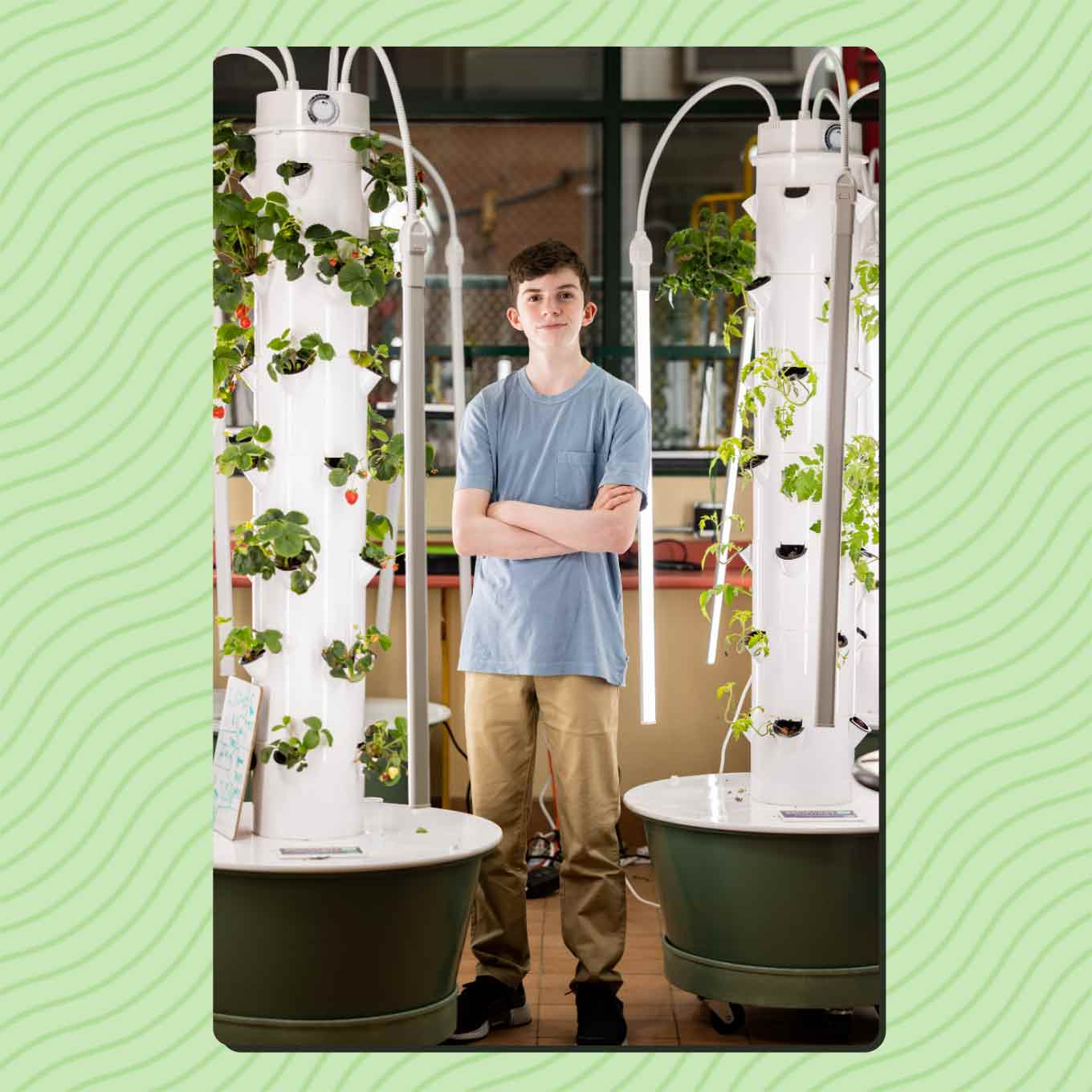
He was inspired by this innovative, multi-faith effort to provide food for communities in need, all while bringing together people from different backgrounds and providing economic opportunity to women. So, through a series of remote interviews conducted during the pandemic, his film, “Growing Peace in the Middle East,” was born.
The documentary went on to be featured at over 100 festivals, and Hoffen won Best Young Filmmaker at the Cannes World Film Festival — but something else blossomed out of this storytelling endeavor: a nonprofit of Hoffen’s own, Growing Peace.
Since Hoffen launched the effort, Growing Peace has installed four hydroponic gardens between New York and Tel Aviv.
“I was inspired by their efforts to fund and install a hydroponics garden at a food pantry in Tel Aviv that benefits Eritrean and Sudanese asylum seekers,” Hoffen told Good Good Good in an email.
The Growing Peace system in Tel Aviv feeds up to 600 families of asylum seekers twice a month with more than 2,100 servings of fresh food.
Following that project, Hoffen was able to raise funds to build his first towers in New York City, at Hope House, a facility for formerly incarcerated women.
From there, he supplied a hydroponics garden at the YM/YWHA of Washington Heights, which is used to teach students about sustainability and hydroponics, all while feeding elderly and disabled community members with fresh produce.
His most recent endeavor was developing a partnership with the Mosholu Montefiore Community Center, which services 30,000 people in one of the Bronx’s poorest neighborhoods. The hydroponics garden supplies the food pantry on site.
Hoffen’s three New York-based hydroponic towers produce up to 1,800 pounds of yearly produce and more than 6,300 services of fruits and veggies every year.
Now, that’s a lot of growth.
“I hope to play my part in improving the world by providing healthy and nutritional food where it is less available and sharing a platform that can help teach others to become more aware of the benefits of farming technologies that improve our climate,” Hoffen shares on the Growing Peace website.
Hoffen was also recently awarded a grant from the Diller Teen Tikkun Olam Awards, a foundation that annually selects 15 Jewish teens and awards them $36,000 each.
“All of the money I will receive from the Diller Teen Tikkun Olam Awards will go directly to building and installing more hydroponics gardens to address food insecurity in communities of need,” Hoffen said.
Right now, Hoffen is working with Topeka Sam and the Federal Bureau of Prisons to install gardens that provide folks who are incarcerated with healthy food and educational activities.
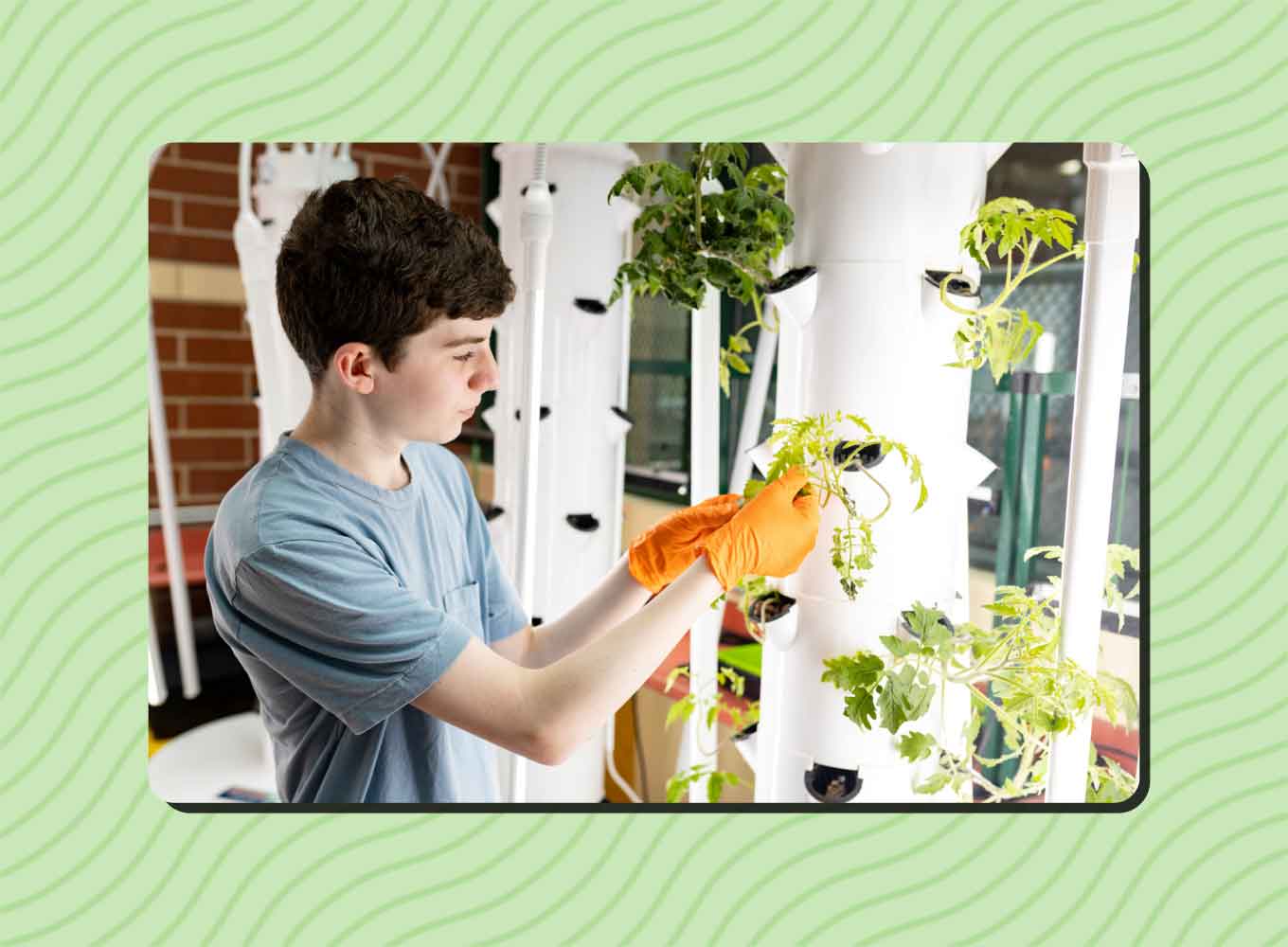
Above all, he is most proud of how he has found a way for food and nature to bring people of all kinds together.
The very start of the “Growing Peace” documentary shows a quote that encapsulates all of Hoffen’s work:
“The Earth is what we all have in common.” —Wendell Berry
July 24 is International Self-Care Day! This annual celebration is an opportunity to raise awareness about the importance of self-care around the globe, promote self-care in your organizations or communities, and of course, take good care of yourself, as well.
Although self-care has become a widely used (and let’s be honest, misused) vocabulary word, it has meaningful roots in the 1950s Civil Rights Movement, as Black activists and organizers integrated the term into their movements.
As we acknowledge the history of self-care, we can also see what it has become: A personal practice for everyone to proactively prioritize their minds, bodies, and spirits in the ways that serve them best.
And what better excuse for prioritizing ourselves than International Self-Care Day? Read on for some more information about this global holiday and some ideas for how you can best honor and care for yourself, too.
5 Facts About International Self-Care Day
- International Self-Care Day was developed by the International Self-Care Foundation in 2011.
- International Self-Care Day is on July 24 to represent the benefits of self-care experienced 24 hours a day, seven days a week.
- Part of the call to action of International Self-Care Day is to encourage organizations and workplaces to see self-care as a public health matter — and implement programs that make self-care more accessible.
- The National Institute of Mental Health defines self-care as “taking the time to do things that help you live well and improve both your physical and mental health.”
- The U.S. Senate designated July 24 as International Self-Care Day in 2014.
While it’s important to learn more about and prioritize our self-care every single day, it’s helpful to have somewhere to start. We’ve created a guide on how to celebrate International Self-Care Day this year.
By the way, some of the links in this article (like books!) are affiliate links, which means if you make a purchase after clicking a link, we may earn a commission at no extra cost to you. Thank you!
Activities and Ideas: How To Recognize International Self-Care Day
Learn
Learn what self-care is.
Like lots of “therapy terms,” self-care has taken on a life of its own, especially as wellness and beauty companies sell loads of products we all “need” to practice self-care.
But self-care goes beyond a bubble bath or face mask (though, those are still great sometimes!). Like the National Institute of Mental Health says, self-care is basically anything you do to improve your mental or physical health.
Additionally, the ISF has developed seven pillars of self-care, which include: Knowledge and health literacy, mental wellbeing, physical activity, healthy eating, risk avoidance, good hygiene, and rational use of products and services.
So, while self-care might feel like (and can be) enjoying a decadent dessert or painting your nails while watching a rom-com, it also consists of things like getting enough sleep, being able to visit a doctor when you need to, drinking enough water, moving your body joyfully, and more.
That’s the difference between reactive and proactive self-care: doing things that feel good in the moment and doing things that help you feel good more often.
Both are great ways to boost your mental health, and it’s up to you (and the systems you live within) to build a self-care culture that best serves you and all the other people in your community.
Read books about self-care.
We get it: Self-help books can be difficult to navigate. There are so many out there and only some that contain real nuggets of wisdom and support. So here are a few we’d really recommend to help you on your self-care journey!
- “How To Keep House While Drowning: A Gentle Approach to Cleaning & Organizing” by KC Davis (Bookshop) (Amazon)
- “Burnout: The Secret to Unlocking the Stress Cycle” by Emily & Amelia Nagoski (Bookshop) (Amazon)
- “Kaizen: The Japanese Secret to Lasting Change - Small Steps to Big Goals” by Sarah Harvey (Bookshop) (Amazon)
- “You Are Your Best Thing: Vulnerability, Shame Resilience, and the Black Experience” edited by Tarana Burke and Brene Brown (Bookshop) (Amazon)
- “The Comfort Book” by Matt Haig (Bookshop) (Amazon)
- “Toxic Positivity: Keeping it Real in a World Obsessed with Being Happy” by Whitney Goodman (Bookshop) (Amazon)
- “Rest Is Resistance: A Manifesto” by Tricia Hersey (Bookshop) (Amazon)
- “Real Self-Care: A Transformative Program for Redefining Wellness (Crystals, Cleanses, and Bubble Baths Not Included)” by Pooja Lakshmin (Bookshop) (Amazon)
- “The Collected Poems of Audre Lorde” by Audre Lorde (Bookshop) (Amazon)
Download self-care apps.
Sometimes, self-care means going screen-free. Other times, it means creatively combining technology with our daily lives to make us feel more balanced and grounded.
Lucky for us, there are loads of self-care apps out there that can actually help us slow down, create meaningful habits, and feel good.
→ Explore our round-up of the best self-care apps to download
Read quotes about self-care.
Oftentimes, the experts can explain it better than we lay people ever can. Read through some self-care quotes to define your own practice, consider the importance of self-care, and more.
→ Read our favorite self-care quotes
Take Action
Practice self-care.
This one’s the biggest “duh” out there, but there is truly no better excuse for practicing some self-care than a date on the calendar reserved for that very act.
One of the more exciting things about self-care is that it’s truly so personal and unique to every individual. Take some time thinking about what activities or interventions might best serve you today.
We’ll get you started with a list of over 100 self-care ideas — you’re welcome.
Encourage your organization or public health department to prioritize self-care programming.
Self-care is a huge component of both mental and physical health, but it can still be stigmatized as a frivolous or unnecessary thing.
If your workplace or organization is committed to equitable and accessible programs and policies, consider having a conversation about self-care.
This could look like improved paid time off for mental health or self-care needs, in-office accommodations like a relaxation room, flexibility in scheduling medical appointments, and more.
Your local health department may also get involved in these types of initiatives, creating campaigns for local companies or organizations to improve their self-care policies and programming.
Build a self-care kit.
If you live with a mental health condition, you might already be familiar with the idea of a self-care kit.
A self-care kit is a pre-curated collection of items that make it easier to practice self-care during a difficult time, like relaxation tools, medications, sensory aids, hygiene items, and more.
By putting all of these resources in one easy-to-access place, you make it easier for future you to access coping skills and resources that can guide and ground you in a time of stress, anxiety, or executive dysfunction.
Consider it an IRL toolbox for your day-to-day fluctuations in mental health and energy.
→ Check out our guide to building your own self-care kit
Practice self-care affirmations.
Positive affirmations might seem corny at first, but they really can make a huge difference.
In fact, repeating positive affirmations can help us build confidence, reduce stress, and increase our emotional resilience. What a great, simple way to boost your self-care practice!
Try implementing these affirmations into your daily routine. Maybe you write them on a sticky note to keep near your laptop, repeat them in the mirror, or write them in a journal before bed.
→ Here are over 50 self-care affirmations to get you off on the right foot.
Start a self-care journaling practice.
Just like affirmations, journaling is a great self-care tool. Keeping a regular journaling routine — like, say, the morning pages — is an excellent way to manage anxiety, reduce stress, and even cope with depression.
Sometimes, it can be hard to get the thoughts to flow, though, so guided self-care journals (or planners!) can be the perfect option for someone looking for a little more support.
→ Here are some of our favorite self-care journals to check out
Buy someone a self-care gift.
Surely there’s someone in your life who could use a kind gift to help them practice self-care. Fortunately, Good Good Good has worked to curate a helpful list of ideas for self-care gifts.
You might even choose to buy an item or two for yourself!
→ Check out our guide to self-care gifts to shop
Help someone else so they can prioritize their own self-care.
It might sound like the opposite of “self” care, but helping someone out can truly make a difference in both your life and theirs.
Researchers agree that acts of kindness bring a boost of all those good brain chemicals and improve our empathy levels — and might even be contagious!
While random acts of kindness help us feel better, they obviously also make someone else’s life easier. Just think: What can you do for someone in your life that would make it easier for them to take care of themselves?
Can you help them plan a grocery list for their meals that week? Maybe you can come with them to drop off that box of clothes at the donation center they’ve had in their car for weeks.
Sometimes hurdles to self-care can be knocked down with the simple support of someone who wants us to feel our best.
Frequently Asked Questions
Is there a National Self-Care Month?
In America, September is Self-Care Awareness Month. It was first recognized in 2017. However, the World Health Organization recognizes June 24–July 24 as Self-Care Month, culminating in International Self-Care Day on July 24.
When is National Self-Care Day?
In America, National Self-Care Day is on April 5. The holiday was created to remind people to take a break and put themselves first. The holiday became the first of its kind when Chicago-based development coach Laura Schwartz created it in 2010.
What is the theme of International Self-Care Day?
According to the Global Self-Care Federation, the 2025 theme of International Self-Care Day is “Self-Care is Healthcare.” This theme calls for prevention, empowerment, health literacy, and cost-effective access to healthcare systems as a means to improve self-care worldwide.
As one of the largest entertainment labor movements in modern U.S. history takes shape with thousands of members of the Writers Guild of America and the Screen Actors Guild-American Federation of Television and Radio Artists striking across the country, you might assume that super-fans are at home, pouting about delays in production of their long-awaited films and TV shows.
On the contrary — they’re part of the resistance.
Fandom Forward, a nonprofit dedicated to using popular media as a gateway to activism; Imperative 21, an organization that calls for a systemic reset of America’s economic system; and Abigail Disney, a filmmaker, philanthropist, and activist, have teamed up to launch a campaign dedicated to protecting Disney employees.
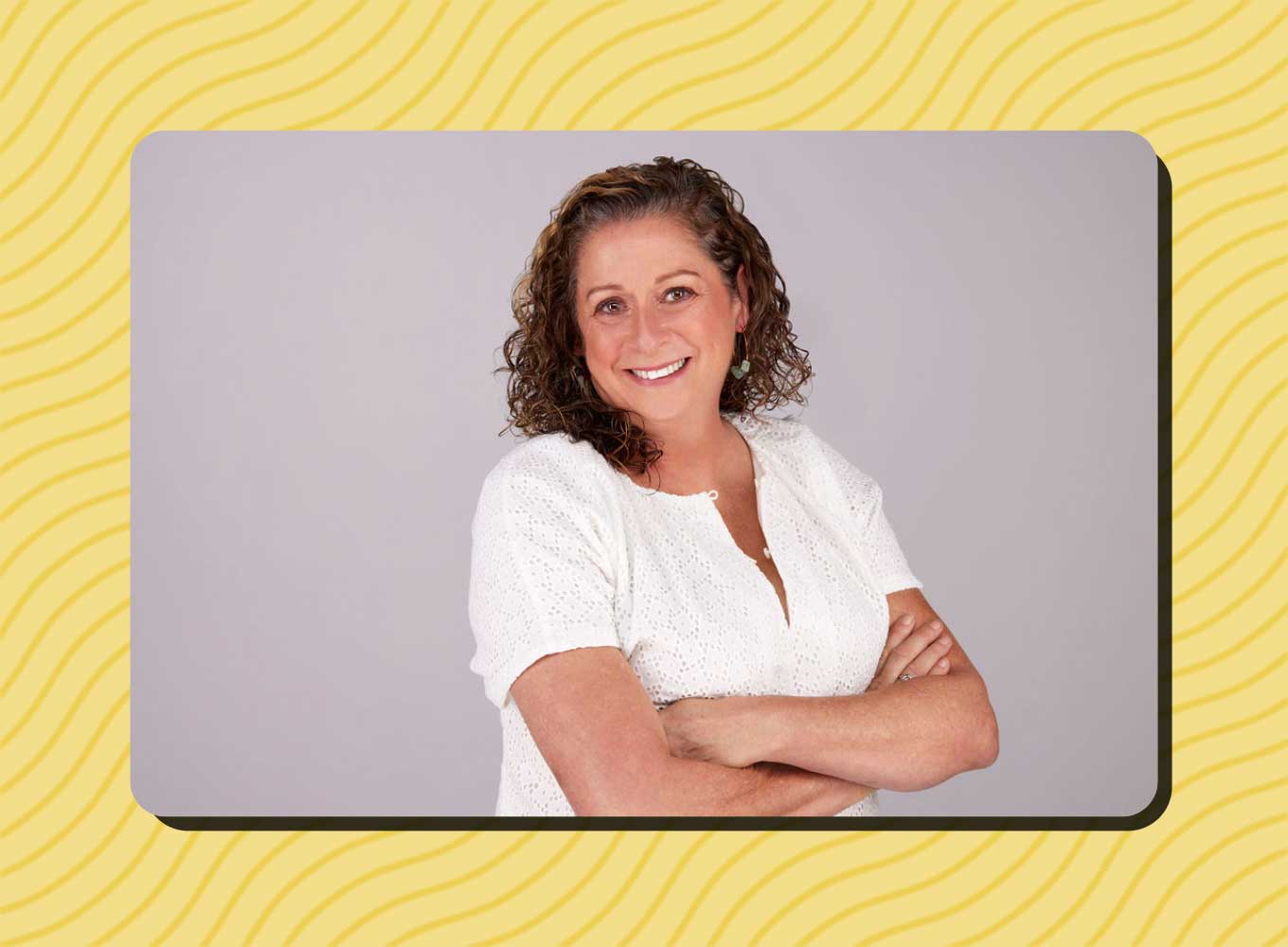
Their goal? To get fans committed to the safety and success of the people who make the magic possible.
Abigail Disney, granddaughter of Roy Disney, is obviously closely tied to the Disney empire — and has been lovingly urging it, and other companies, to do better by people and the planet for most of her career.
In fact, she was arrested last week for chaining herself to the Hamptons Airport, protesting the use of private jets and bringing awareness to the climate crisis.
When she’s not on the front lines of the climate justice movement, she is advocating for the rights of workers and consumers. Her most recent project, a documentary called “The American Dream & Other Fairy Tales,” investigates the exploitation of Disney workers across the company’s many sectors.
Now uniting with fan activists (some might call them “Disney Adults”), she has one urgent call to action: for Disney to become the hero of its own story.
Be A Hero Campaign
On Tuesday evening, leaders from Fandom Forward and other fan activist coalitions joined in a livestream with Abigail to announce the Be A Hero campaign.
The ask is simple: implore Disney’s shareholders to vote to expand its Duty of Care legal obligations to include its workers, not just its shareholders.
No worries: We’ll explain that for you.
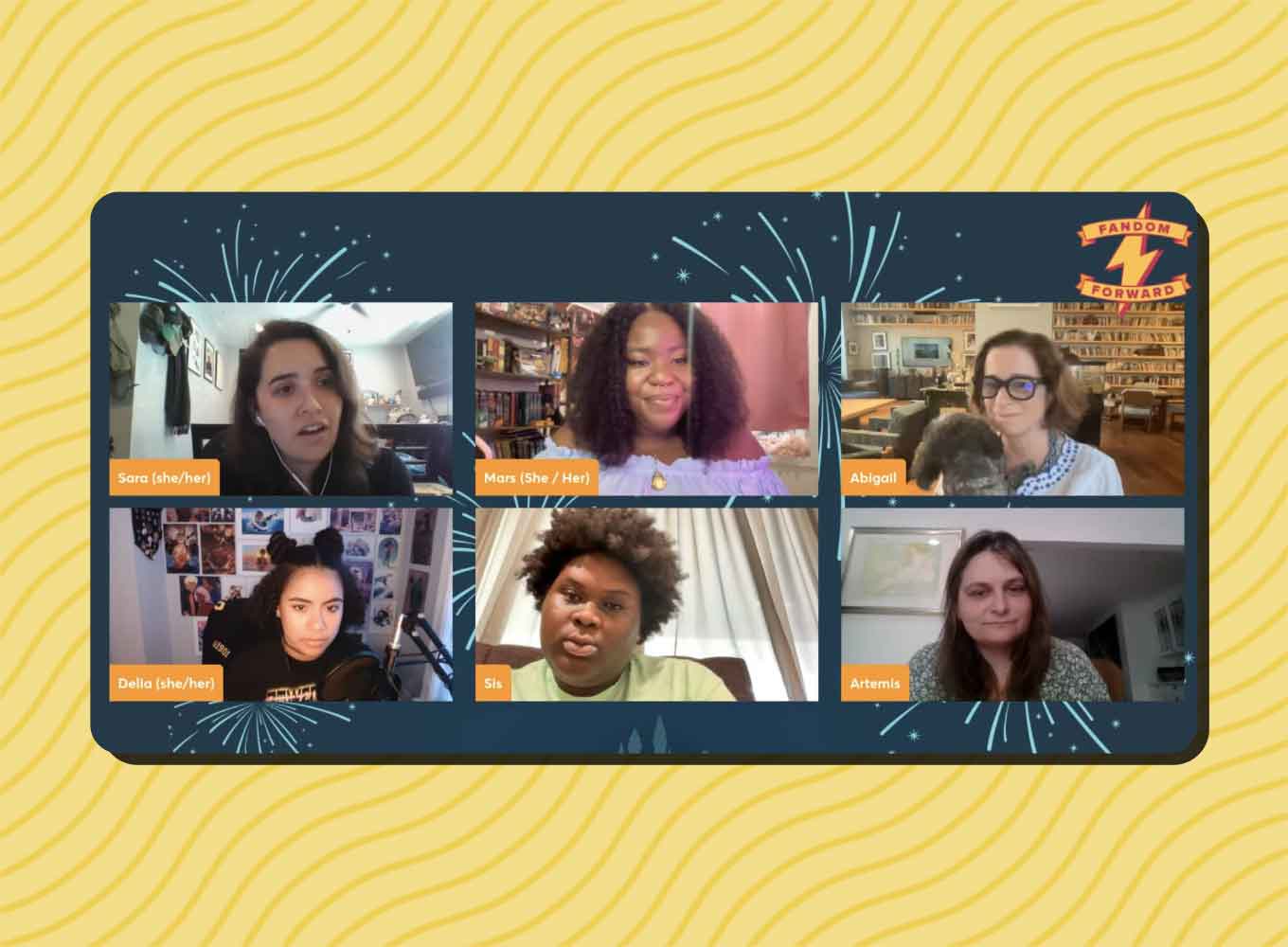
Like Abigail shares in the livestream, the issues many American corporations face come down to the interpretation of corporate law.
A “duty of care” requirement essentially means that a company has a legal responsibility to maintain the health, safety, and well-being of others. In Disney’s case, this legal responsibility only extends to its shareholders, not its employees.
This kind of disparity leads to the unlivable wages and poor working conditions Disney employees (or “cast members”) have been protesting for years. It’s what Abigail witnessed as she created her documentary. And it’s what she’s hoping to end with this call to action.
“People who value the long-term wellbeing of their stakeholders — including their employees, their customers, the environment, and the shareholders, equally — do better and survive longer,” Abigail said in the livestream.
“It’s our 100-year anniversary. We’re here because of the fans. We need to … restructure the way we understand what a corporation is and what a business is for. If it’s not for people, then what are we doing here?”
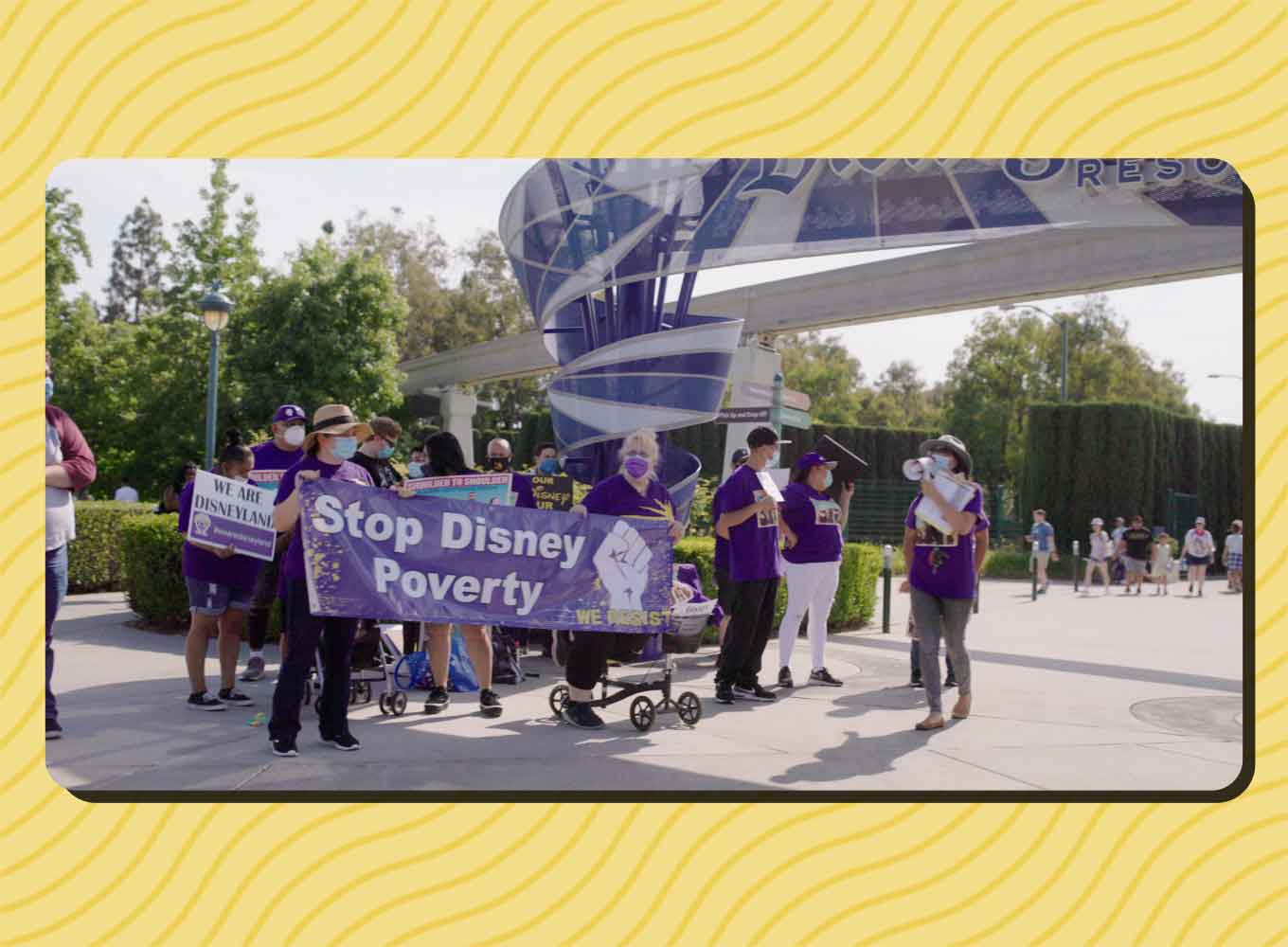
The talking points of the Be A Hero campaign draw on the transformative themes Disney is known for: believing in the impossible, being kind and caring, and creating magic together.
“We want Disney to be a new kind of company that puts people first,” a video for the campaign explained at the beginning of the livestream. “Imagine a world where companies have the freedom to care more about people than profit, to care as much about its cast members as its shareholders, to care as much about Main Street as it does Wall Street.”
Sara Mortensen, the campaigns director at Fandom Forward, summed it up succinctly:
“Disney at its core seems to be a caring company but it has this corporate structure that makes caring for its workers hard. And this is the kind of corporate structure that is pervasive throughout a lot of American companies,” she said. “All of us want Disney to be great, and that means doing good by its workers.”
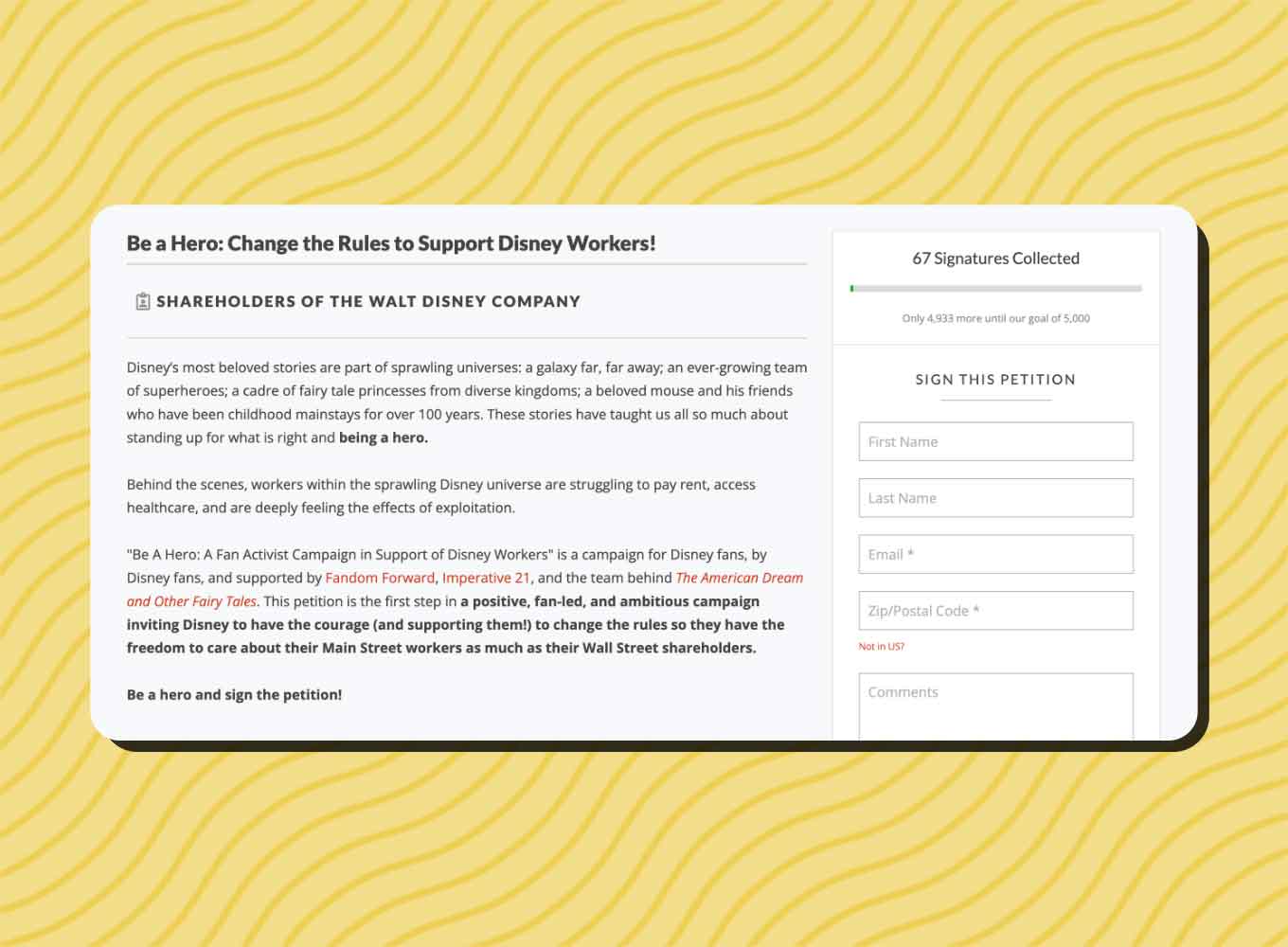
The first small action Disney fans can take is to sign a petition urging Disney shareholders to vote to expand its Duty of Care. Organizers also urge supporters to show up to the parks, to events, and to the annual shareholders meeting, to make this dream a reality.
Alongside Abigail, fan activists in the livestream included Delia Gallegos of Black Nerds Create; Mars Sebastian of Off Colour; Sis of Trans March on Broadway, and Artemis Bell, who worked as a night custodian at Disney in Anaheim for nearly a decade and actively participated in union negotiations for years.
Bell was also part of Abigail’s documentary and provided a crystal clear explanation of what’s at stake — both for the people who rely on Disney to pay their bills and feed their families and for the empire itself.
“It used to be much more common to look at the workers as the shareholders,” Bell explained in the livestream. “The fans are the people who are directly impacted by the quality of the things we’re putting out there. If [Disney is] making poor long-term decisions, as far as creativity, to maximize profits in the short-term — but they’re decreasing the quality of the art they’re creating or the experiences the fans are going to, because the workers stop having a personal buy-in — it ultimately affects the shareholders’ profitability.”
“I think it’s short-sighted — and just plain dumb — to actively stay on that path, if taking care of our cast members and taking care of our fans mean we can have a healthy company that takes care of the stakeholders in the long run, I don’t see why we would be so resistant to doing that.”
That resistance has been heard loud and clear over the past few weeks, as Disney CEO Bob Iger called striking workers “unrealistic” in their demands for better pay and residuals.
What’s not unrealistic? The power of community organizing.
This campaign invites fans to use their collective power to start a real conversation about labor, equity, and economics — and to tear down those barriers of resistance with love, creativity, and passion.
For this movement, the mouse ears are optional — but encouraged.
“Bringing fans together who are rooted in love for this company, it couldn’t be a better audience to take this to and say ‘we need your help,’” Abigail said. “This is an opportunity to create an invitation instead of a confrontation and to root it in the love we have for the history and capacity of this company to shape the society we live in and make it a better place.”
The thesis of this campaign — and what might make it seem so “unrealistic” to some — rests on the fact that Disney is an enormous player in the global economy.
Critical fandom means you love something deeply, and bc of that love, you want it to be the best. We love #Disney and want it to be the BEST: for park workers, #WGA writers, #SAGAFTRA actors, animators, fans - everyone. ❤️
— Fandom Forward (@FandomForward) July 19, 2023
If you do, too: https://t.co/H5KYWbO2io #BeAHero pic.twitter.com/AWEM1C54AT
Can a crew of, like, six fan activists really create the domino effect to change the way a major corporation operates?
“Disney is an incredibly strategic company to be talking about because it has hospitality, entertainment, amusement parks, consumer products, publishing. … It has so many different arms, that you could reach into all these different sectors with just this one company,” Abigail explains.
“When Disney changes, everybody else pays attention. It’s not just any company we’re talking about here, and it’s so close to the heart of what Americans think of, what America’s about. If we can shift at Disney — it seems impossible — but every Disney movie tells you to do the impossible thing.”
Mars Sebastian, the panelist from Off Colour, jumped in, gesturing to her video chat background of books, posters, and fan memorabilia illustrating her love for Disney.
“The world will be different because today’s fan is tomorrow’s worker,” she said. “I don’t want my dreams to die on the vine because I’m disappointed in you. The world can be better because we believe impossible is possible.”
Header image courtesy of Fandom Forward
Every day the Good Good Good team collects the best good news in the world and shares it with our community. Here are the highlights for this week!
If you want to get good news in your inbox every day, join the Goodnewsletter — the free daily newsletter designed to leave you feeling hopeful.
The Best Positive News We’re Celebrating This Week —
Cutting traffic and emissions, the first 11 miles of Hawaii’s new passenger train service just opened
Just over half of the “largest public works project in Hawaii’s history,” according to Honolulu’s mayor, is now open for passengers. The Skyline train is also the first passenger train service on Oahu since the 1940s, and it’s expected to service about 84,000 passengers daily.
Voters first approved building the train project 15 years ago, and once complete, it will stretch 20 miles from downtown Honolulu to communities outside of the city. Passengers have already reported the train’s ease of use, how quickly they get across town, and taking in the scenic views along the way.
It’s also expected to help reduce both the city’s persistent traffic jams and greenhouse gas emissions. Hawaii is working to reach carbon neutral by 2045, and ground transportation accounts for 20% of total state emissions.
What’s the nuance? Projects like these often take a long time to come to fruition — this rail project is taking longer and costing more than originally anticipated. And while personal electric vehicles can use existing infrastructure, that option isn’t accessible to everyone and doesn’t do anything to address traffic congestion.
Public transportation and other car-free alternatives are an important part of how we build our communities to serve everyone in them.
Deforestation in Colombia fell by 29% in 2022 over the previous year
Reaching the lowest level since 2013, deforestation in Colombia fell by 29.1% in 2022, thanks in large part to decreases in the Amazon region of the country. It’s also thanks to the government’s work with local communities, compensating them for protecting forests, and cracking down on illegal deforestation.
Down from 1,741 square kilometers in 2021, deforestation dropped by just over 500 square kilometers (193 square miles) to around 1,235 square kilometers in 2022. That also far surpassed the country’s goal of cutting the rate of deforestation to 1,400 square kilometers annually by 2026.
The country’s president has also called on wealthier nations to cancel the foreign debt of countries like Colombia in exchange for their work to protect and conserve ecologically critical areas like the Amazon — which are essential to combatting climate change.
Sweden is building the world’s largest wooden city, which will produce significantly less carbon emissions
The construction industry is responsible for nearly 40% of global emissions. Meanwhile, studies have found that building with wood (instead of steel and concrete) can reduce emissions by up to 26.5% when accounting for manufacturing, transporting, and installing the materials.
Sweden is about to embrace that low-emission benefit on a massive scale. Developers are gearing up to build the “world’s largest urban construction project in wood” in Stockholm. Once complete, “Stockholm Wood City” will have 7,000 office spaces, 2,000 homes, restaurants, and shops.
And it will join similar lower-polluting, timber-construction projects in Singapore and Norway, and potentially others to come.
What’s the nuance? This construction approach does come with one large risk: fire safety. However, experts land on both sides of that issue: some say any higher risk cited is just misinformation, while others express concerns over fire safety regulation issues.
Still, in an effort to reach net-zero global carbon emissions, construction will need even more creative, innovative solutions like this.
→ Read more
BlocPower is electrifying America one building at a time — getting them off of fossil fuels for good
No matter how hard you work to get outside, the reality is we spend a lot of time indoors — and buildings account for 30% of America’s total emissions.
With the belief that there is no true way forward in responding to the climate crisis without getting all of the existing buildings in America unplugged from fossil fuels, Donnel Baird founded BlocPower, a company dedicated to “greening” buildings across the country.
So far, the company has greened more than 1,200 buildings in 25 cities across the U.S. by replacing unhealthy fossil-fueled heating and cooling units with sustainable electric systems — especially those in low-income communities.
Why is this good news? Not only critical to addressing the climate crisis, but electrifying buildings is also good for our health. Recent studies show that gas heating systems in many homes and buildings leak chemicals like benzene, methane, and nitrogen dioxide — which are toxic and can lead to grave health complications that can be worse than breathing in secondhand cigarette smoke.
Chef José Andrés just became the first chef in the U.S. to put ‘no-kill’ chicken on the menu
Making history in the U.S., humanitarian and Chef José Andrés is now officially the first chef in the country to put cell-cultivated, “no-kill” chicken on his restaurant’s menu and serve it to customers.
Earlier this month, Andrés hosted a dinner at his Peruvian restaurant China Chilcano in Washington, D.C. where he served charcoal-grilled chicken to his guests. The dish will officially be on the menu and available to customers at the end of July.
The cell-cultivated meat created by Eat Just Inc. is the world’s first-to-market meat grown from animal cells instead of slaughtered livestock. It was just approved by the USDA in America.
Why is this good news? With the exception of a handful of cases where regenerative practices are implemented, the agriculture and animal-raising industry is notoriously harmful — to both the planet and the animals involved.
For a world-renowned chef to throw his name and support behind a product that meets an essential need for humanity (food) and doesn’t cause harm to the planet or animals is really good progress in our food production systems.
Amidst strikes, Abigail Disney and fan activists are uniting to protect and support Disney employees
With the WGA and SAG-AFTRA strikes underway, you may be inclined to think super fans are impatiently waiting out delays in production for their favorite films and shows — but you'd be oh, so wrong. They’re actually part of the resistance.
Fandom Forward, a nonprofit dedicated to using popular media as a gateway to activism); Imperative 21, an organization that calls for a systemic reset of America’s economic system; and Abigail Disney a filmmaker, philanthropist, and activist, have just teamed up to launch a new campaign dedicated to protecting Disney employees.
The Be A Hero campaign's ask is simple: implore Disney’s shareholders to vote to expand its “duty of care” legal obligations (a company’s legal responsibility to maintain the health, safety, and well-being of others) to include its workers — not just its shareholders.
Why is this good news? Not extending the duty of care obligations to workers (“cast members”) has led to the unlivable wages and poor working conditions that Disney employees have been protesting for years. By involving shareholders and involving all Disney fans (add your name to the petition!), this campaign can make real change for good.
A 13-year-old is using hydroponic gardens to fight food insecurity in New York City and Tel Aviv
In 2019, Steven Hoffen took a trip to Israel and worked with a nonprofit where Arab and Jewish women work closely together growing produce in hydroponic gardens — a type of soil-less gardening that can be done indoors or outdoors and is especially useful for those with little space.
Inspired by that multi-faith effort to provide food for communities in need, bring together people of different backgrounds, and provide economic opportunity to women — Hoffen created an award-winning film about it. Not only was it featured at over 100 festivals — it led to Hoffen starting his own nonprofit, Growing Peace.
Since launching, Growing Peace has already installed four hydroponic gardens between New York and Tel Aviv. The Growing Peace system in Tel Aviv, for example, feeds up to 600 families of asylum seekers twice a month with more than 2,100 servings of fresh food.
More good news of the week —
The cast of “Oppenheimer” left the movie’s premiere early in London in solidarity with the Hollywood writer’s strike. Florence Pugh, Matt Damon, Emily Blunt, and others left before the screening after SAG-AFTRA voted to join the screenwriters’ strike, which has been going on since May.
A painter uses intricate oil paintings to raise awareness and advocate for extinct and endangered species. Isabella Kirkland’s “Back” documents 48 species of flora and fauna brought back from the brink of extinction — or thought to be extinct and joyously rediscovered.
A federal judge upheld one of the toughest gun control laws in the country that was approved by voters in Oregon. The judge said banning large-capacity magazines and requiring a permit to purchase a gun is constitutional.
In an effort to cut down on waste and pollution, France is paying people to repair their clothes and shoes. Discounts will vary from $7 to $28 depending on complexity, and tailors, clothing brands, and repair shops can join the initiative for free.
The Biden administration just approved the construction of the country’s largest offshore wind farm. The 98-turbine Ocean Wind 1 project will be built about 15 miles off the coast of New Jersey and generate enough electricity to power 380,000 homes.
A group of immigrant moms in Denver made history as the first graduating class of parents between the ages of 30-40. The “community hubs” program through Denver Public Schools helped 28 single mothers get their GEDs.
The first RSV antibody treatment to protect all infants was just approved in the U.S. The treatment provides vaccine-like protection over the course of a single winter respiratory virus season and is the first time protection will be offered broadly to all healthy babies.
The Biden-Harris administration is investing $660 million to “plug” orphaned oil and gas wells throughout the country. Millions of Americans live within a mile of an orphaned oil and gas well, which pollute backyards, recreation areas, farmland, and public spaces — in addition to contributing to the climate crisis.
There have been over 200 sea turtle nests in Cape Hatteras so far this year — on pace with last year’s record. There were a record 379 nests in 2022, and 216 at this point in the summer, thanks to conservation efforts in the area.
Using recycled diapers, a new building technique is helping reduce landfill waste and lower housing costs. It’s particularly helpful in places like Indonesia, where population booms are putting a heavy strain on both housing demand and waste management.
Deserted after the pandemic, empty office buildings are being turned into vertical farms for food production. In 10 major cities, office usage rates are around 50% of pre-pandemic levels, and nearly 20% of office space is empty across the country.
A new carbon-negative cement just received third-party certification that it’s just as structurally and chemically the same as regular cement. Cement accounts for about a twelfth of global carbon dioxide emissions — it’s worse for the climate than flying.
The European Parliament agreed to historic, legally-binding targets to protect and restore nature across Europe. The first major legislation of its kind in the last 30 years will require countries to introduce measures to restore nature on a fifth of their land and sea by 2030.
A new 67-home neighborhood in Canada will be net-zero, off the grid, and leave room for nature to continue to grow. The neighborhood is designed to be walkable, the homes will produce more energy than they use, and they’ll be built on former farmland while helping protect and restore nearby forests and wetlands.
The EPA finalized a rule to move toward a 40% phasedown of the use of planet-warming hydrofluorocarbons. HFCs are used in refrigeration and air conditioning and can be hundreds or even thousands of times more potent than carbon dioxide.
As the internet continuously allows us to customize the way we consume media, many of us have become reliant on our “emotional support subtitles.” We simply turn on the closed caption setting when a video graces our screens, and the rest is history.
But for folks who are deaf or hard of hearing, subtitles are not just a boost to their experience — they are necessary. And for others who face language barriers, captions and translations are a vital resource for connecting and understanding others.
So, it’s no surprise that most humans — whether they have a hearing disability or just can’t bear the awkward interaction of saying “huh?” more than once — dream of a way to bring subtitles to the real world.
That's why two inventors decided to bring this tech off our screens and into reality — well, augmented reality.
What is TranscribeGlass?
TranscribeGlass is a startup founded by duo — Tom Pritsky and Madhav Lavakare — who are connected to the world of assistive technology.
The device itself is an AR wearable that attaches to a pair of glasses and pairs with a transcription software to project real-time captions in front of your eyes.
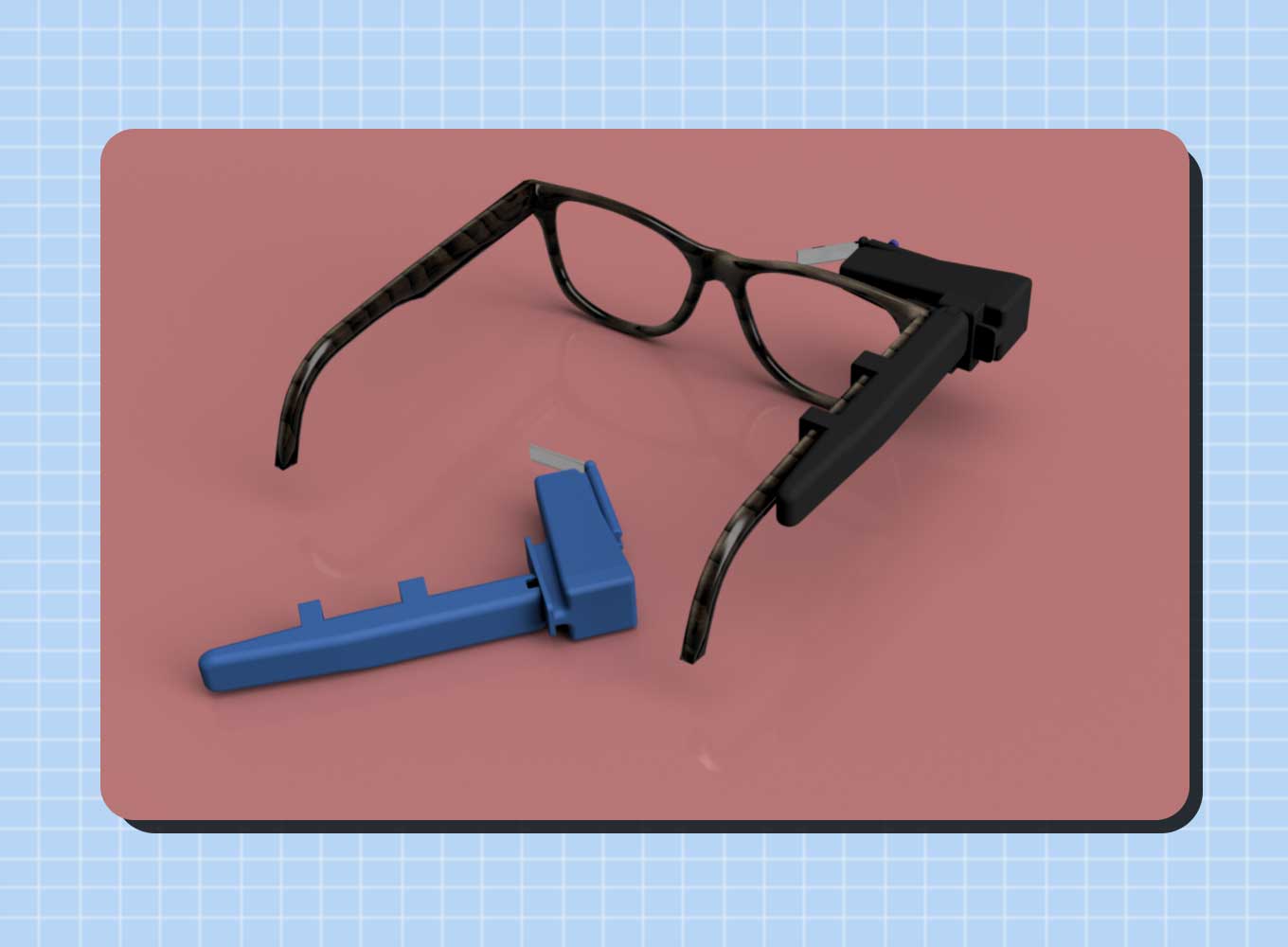
Lavakare was inspired to create TranscribeGlass as a high school student after learning that a friend had dropped out of school due to accessibility issues. Early prototypes of a heads-up cpationing solution won Lavakare several international design awards and even led to grant funding from Pfizer and the U.S. State Department.
Independently, Tom Pritsky's personal struggle with hearing loss inspired him to make heads-up captioning a reality by developing software solutions for existing augmented reality headsets. The two joined forces in 2021, while Lavakare was at Yale and Pritsky was at Stanford, to bring TranscribeGlass to the market.
Pritsky, who is getting a Master’s degree in biomedical informatics, has bilateral hearing loss and uses hearing aids and lip reading to communicate, according to the Stanford Daily. He wanted a way to “see the conversation.”
Lavakare has transitioned most of his responsibilities to Pritsky, who now leads the company as CEO and co-founder while Lavakare remains an active advisor and shareholder.
While it might look a little like an accessory that a superhero tech sidekick would wear in front of their nine computer monitors, this device is truly a game-changer. In fact, TranscribeGlass caught the attention of millions of TikTok viewers earlier this week, culminating in nearly six million views in just 24 hours.
In the viral video, Pritsky is shown on screen, a glasses lens in front of the camera, showing the device in action as it displays the real-time transcription of his speech.
@transcribeglass At TranscribeGlass we’re building the world’s first all-day wearable subtitles. Here’s our CEO Tom demonstrating what it would look like to use TranscribeGlass! #foryou #fyp #ai #hearing #assistivetech #accessibility ♬ original sound - transcribe
“With our device, you can actually see everything I say in your field of view, in real time, while also getting a good sense of my lips, my environment, and everything else around me,” he says.
Up to this point, the alternative options for those who are deaf or hard of hearing have typically been heads-down transcription technologies that keep people from making eye contact, lip-reading, or observing the full surroundings of an environment.
TikTok viewers were immediately eager to learn more.
“OK AS A SCIENTIST I NEED SO MUCH MORE INFORMATION PLEASE,” one person wrote, with caps-lock enthusiasm.
“Subtitles in real life?” another commented. “Yes please!!”
Many were curious about how the device works in a group of people or a crowded room, if the device has language translation capabilities, or even the placement of the words on the glass.
Pritsky quickly made a follow-up video addressing some questions and urged viewers to ask more questions.
First, he addressed, the design is intended to be light-weight and have a full-day battery life.
“The other really cool thing about TranscribeGlass is that it retrofits, meaning it can mount onto the glasses you’re already wearing,” Pritsky explains.
For folks who already have prescription glasses, the device can be used “right out of the box” and be easily clipped onto existing glasses. (But it also comes with empty spectacle frames if you have 20/20 vision.)
According to the TranscribeGlass website, users also have full control of how captions are displayed, allowing them to change font sizes, adjust the position of the text to be on top, below, or beside a speaker — and the choice of language.
The TranscribeGlass app works in companionship with the device through Bluetooth, connects to any caption source or transcription software, streams conversations in real time, and can even save transcripts for later reference.
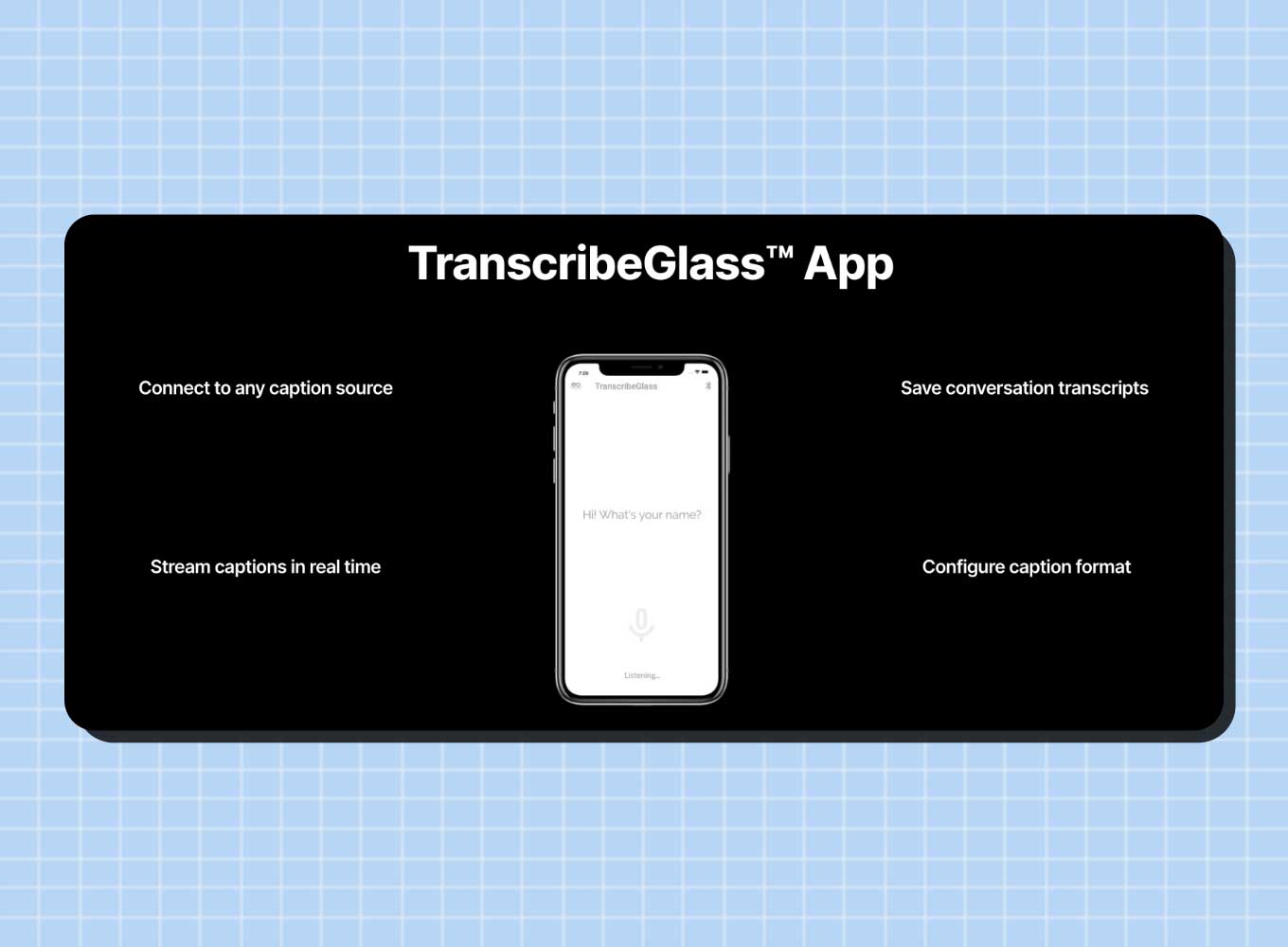
TranscribeGlass is still in beta testing, but those who are interested in trying it out can sign up easily online prior to the anticipated winter 2023 launch. It is not yet clear how much the device will cost.
While there are certainly still features to perfect and integrate into the final design, the general consensus (according to TikTok) is: Wow.
“This is one of the best inventions I’ve seen in a long time,” one user wrote on TranscribeGlass’s first video.
Another chimed in: “This is the future.”
Looking for a new hobby? Me too.
Over the last few years I’ve been trying to be more intentional about carving out time for hobbies. It’s easy to get so caught up in the hustle and bustle of life that you forget to do things for yourself.
By now, you’ve probably heard the quote, “Find three hobbies you love: One to make you money, one to keep you in shape, and one to be creative.”
I love this idea because it provides a simple framework for making sure I’m investing in hobbies that will bring joy and value to my life in a few different ways.
Of course, as the founder of Good Good Good, I’d amend the quote to also include “one to make the world a better place.” There’s no shortage of ways to make a difference — for people, the planet, or animals. And we should be able to have fun while doing good.
"Find four hobbies you love: One to make you money, one to keep you in shape, one to be creative, and one to make the world a better place."
— Good Good Good
Whether you’re here because you’ve entered a new chapter of life, ready to make more time for yourself — or you’re simply ready to try something new — you’ve come to the right place.
The Good Good Good team and I have worked hard to compile the most comprehensive and diverse list of hobbies on the internet. We guarantee you’ll find a few ideas you’ve never heard of or considered before.
We’ve broken this article into sections: Outdoor | Indoor | Creative | Sports | Volunteering | Collecting | DIY/Home | Food | Travel | Social
Feel free to scroll straight to the list of hobbies for adults.
But in case you need a little bit more convincing, we’ve prepared a breakdown of why you should start a new hobby:
Why Hobbies Are Important
Hobbies have been proven to boost mental health. According to a 2022 study published in the International Journal of Public Health, engaging in hobbies was found to significantly reduce symptoms of stress, anxiety, and depression.
Hobbies can improve physical health. A new study — published in BMC Public Health — found that engaging in physical hobbies, such as gardening, hiking, or dancing, can lead to improved physical health.
Hobbies can help manage stress. A 2022 study published in the Journal of Clinical Medicine found that participating in hobbies is a great way to alleviate and prevent stress.
Hobbies can enhance cognitive function. A 2022 study published in Frontiers in Psychiatry found that engaging in certain hobbies can lead to increased cognitive function.
Hobbies can improve longevity. You’ve heard the quote, “I’m here for a good time, not a long time.” But it turns out you can have both — at least according to a 2022 study published in the Journal of Epidemiology.
Hobbies can foster social connections. If you want to make new friends, picking up a hobby is the easiest way to build social connections — according to a 2022 study published in Child and Adolescent Social Work Journal.
Plus: Hobbies can boost self-esteem, increase life satisfaction, foster creativity, and provide a sense of purpose.
So yes, you should absolutely pick up a new hobby or two! Enjoy the ultimate list of hobby ideas —
You might also like these related articles: Hobbies for Women | Fun Things To Do When Bored | Self-Care Ideas
The Ultimate List of Hobbies
Outdoor Activities
Adventure Racing
Archery
Backpacking
Basketball
Beach Volleyball
Beachcombing
Beekeeping
Birding
Birdwatching
Bonfire Making
Bonfire Storytelling
Bonsai Gardening
Bouldering
Bungee Jumping
Camping
Canoe Camping
Canoeing
Canyoning
Cave Diving
Caving
Conservation
Cross-Country Skiing
Crossfit Training
Cycling
Disc Golf
Diving
Dog Sledding
Dragon Boat Paddling
Expeditions
Figure Skating
Fishing
Flying Model Airplanes
Foil Surfing
Foraging
Forest Bathing
Frisbee Golf
Gardening
Geocaching
Glamping
Golfing
Hammock Lounging
Hiking
Horseback Riding
Ice Hockey
Ice Skating
Ironman Training
Jet Skiing
Jogging
Kayaking
Kite Flying
Kiteboarding
Labyrinth Walking
Landscape Painting
Letterboxing
Marathon Training
Metal Detecting
Motorcycling
Mountain Biking
Mountain Climbing
Mountaineering
Nature Journaling
Nature Painting
Nature Scavenger Hunts
Nature Sketching
Nature Walks
Nature-Inspired Crafts
Off-Roading
Orienteering
Orienteering Races
Outdoor Barbecuing
Outdoor Boot Camps
Outdoor Concerts
Outdoor Cooking
Outdoor Crafting
Outdoor Festivals
Outdoor Film Screenings
Outdoor Grilling
Outdoor Journaling
Outdoor Markets
Outdoor Meditation
Outdoor Movie Nights
Outdoor Obstacle Courses
Outdoor Painting
Outdoor Painting Workshops
Outdoor Photography
Outdoor Reading
Outdoor Sketching
Outdoor Theater Performances
Outdoor Writing
Outdoor Yoga
Outrigger Canoe Paddling
Paragliding
Parkour
Photography Expeditions
Picnicking
Rafting
River Rafting
Riverboarding
Rock Balancing
Rock Climbing
Rollerblading
Rowing
Running
Sailing
Scuba Diving
Skateboarding
Skiing
Skydiving
Slackline Yoga
Slacklining
Snorkeling
Snowboarding
Snowmobiling
Snowshoeing
Soccer
Spelunking
Stand-Up Paddleboarding
Stargazing
Surfing
Survival Skills Training
Tennis
Trail Running
Tree Climbing
Triathlon Training
Tubing
Ultimate Frisbee
Urban Gardening
Wakeboarding
Walking
Water Skiing
Whitewater Kayaking
Whitewater Rafting
Wildlife Observation
Wildlife Photography
Wildlife Tracking
Windsurfing
Yachting
Ziplining
Indoor Activities
Antiquing
Computer Programming
Crossword Puzzle Solving
Escape Rooms
Indoor Rock Climbing
Indoor Stargazing
Interior Design
Interior Painting
Interior Wall Art
Jewelry Making
Jigsaw Puzzling
Journaling
Knitting
Knitting Blankets
Learning a Musical Instrument
Learning About History Through Books
Learning About History Through Documentaries
Learning Magic Tricks
Learning New Languages
Learning Sign Language
Letter Writing
Listening To Audiobooks
Explore our guide to the best places to get audiobooks (that aren’t Audible)
Listening To Music
Listening To Podcasts
Listening To Records
Mahjong
Manga Reading
Manicure Design
Meditation
Mindfulness Practices
Morse Code
Nail Art Design
Online Board Games
Online Research
Online Shopping
Organizing Recipes
Organizing Spaces
Origami
Paint by Numbers
Painting
Painting Scale Models
Paper Crafts
Paper Mache Crafts
Party Planning
Peloton
Pet Care
Photography Editing
Photography Post-Processing
Pilates
Plant Care
Playing Musical Instruments
Podcasting
Poker
Pottery
Practicing Magic Tricks
Practicing Memory Techniques
Practicing Morse Code
Practicing Speed Reading Techniques
Preserving
Puzzle Making
Quilting
Read this good news story about the LGBTQ+ community using quilting for good
Reading Fiction
Reading Magazines
Reading Memoirs and Biographies
Reading Newspapers
Reading Nonfiction
Reading Poetry
Reviewing Books
Explore our guide to the best Goodreads alternatives for tracking and reviewing books
Scrapbooking
Sculpting
Sewing
Singing
Sketching
Soap Making
Solving Rubik’s Cubes
Solving Sudoku
Solving Wordle
Studying Ancient Archaeology
Studying Ancient Civilizations
Studying Old Globes
Studying Old Maps
Studying Philosophy
Studying Rare Photographs
Studying Vintage Photographs
Tarot Card Reading
Video Gaming
Virtual Reality Gaming
Watching Anime
Watching Documentaries
Watching Movies
Watching Sports Games
Watching Television
Watching YouTube
Web Design
Wine Tasting
Word Scrambles
Writing
Writing Poetry
Writing Short Stories
Writing Songs
Yoga
Creative Pursuits
3D Modeling
3D Printing
Abstract Art
Acting
Altered Book Art
Animation
Audio Production
Baking
Balloon Twisting
Bartending
Beading
Beatboxing
Block Printing
Blogging
Bodypainting
Bookbinding
Cake Decorating
Calligraphy
Calligraphy Workshops
Calligraphy Writing Workshops
Carving
Ceramic Glazing
Ceramics Sculpting
Chalk Art
Collaging
Coloring
Comic Book Creation
Composing Music
Cosplaying
Craftivism
Read our guide to the gentle art of craftivism
Creative Writing
Crocheting
Cross-stitching
Culinary Arts
Dance Choreography
Dancing
Decoupage
Design Clothes
Digital Art
Digital Painting
Digital Scrapbooking
DisneyBounding
DJing
Dollhouse Building
Doodling
Drag
Drawing
Embellishing Clothing
Embroidery
Encaustic Painting (Wax Painting)
Fabric Dyeing
Fabric Printing
Fashion Design
Fashion Illustration
Filmmaking
Floral Arranging
Found Object Art
Glass Painting
Glassblowing
Graffiti Art
Graphic Design
Growing Bonsai
Hair and Wig Styling
Hand Lettering
Home Brewing
Illustration
Impersonations
Improv
Interior Design
Journaling
Juggling
Knitting
Latte Art
Leathercraft
Lettering
Listening Music
Macrame
Magic
Makeup
Makeup: Beauty
Makeup: FX
Makeup: Tutorials
Making Candles
Making Cards
Making Dolls
Making Fan Merch
Read about how subtle, fan-made merch puts connection over consumerism
Making Jewelry
Making Metal Jewelry
Making Soap
Making Stickers
Making Wreaths
Making Zines
Explore our guide to incredible zine artists
Metal Jewelry Stamping
Metalworking
Mixed Media Art
Mixology
Model Building
Mosaic Art
Nail Art
Learn about how Black women are finally getting the credit they deserve for nail art trends
Origami
Painting
Painting Rocks
Paper Crafting
Paper Mache Crafting
Paper Marbling
Papercutting
Photography
Photography: Aerial
Photography: Astrophotography
Photography: Concert
Photography: Drone
Photography: Editing
Photography: Fashion
Photography: Film
Photography: Food
Photography: Long Exposure
Photography: Macro
Photography: Nature
Photography: Portraiture
Photography: Post-Processing
Photography: Sports
Photography: Still Life
Photography: Stock
Photography: Underwater
Playing a Musical Instrument
Playing an Instrument
Playing in a Band
Plein Air Painting (Outdoor Painting)
Podcasting
Poetry Writing
Portrait Drawing
Portrait Painting
Pottery
Pottery Painting
Printmaking
Punch Needling
Puppetry
Pyrography (Wood Burning)
Quilling
Quilting
Read this good news story about the LGBTQ+ community using quilting for good
Scrapbooking
Screen Printing
Sculpting
Sewing
Singing
Sketch Comedy
Sketching
Slam Poetry
Social Media: Instagram
Social Media: Pinterest
Social Media: TikTok
Social Media: YouTube
Songwriting
Stained Glass Art
Stand-Up Comedy
Storytelling
String Art
Teaching Musical Instruments
Textile Design
Theater Production
Tie-Dyeing
Urban Sketching
Videography
Vlogging
Voice Lessons
Weaving
Website Design
Wire Wrapping
Woodworking
Writing
Writing Music
Writing Poetry
Sports & Fitness
Adventure Racing
Aerial Hoop
Aerial Silks
Aerobics
Aikido
Air Hockey
Archery
Badminton
Barre
Baseball
Basketball
Bocce Ball
Bodybuilding
Bootcamp Workouts
Bossaball
Bouldering
Bowling
Boxing
Brazilian Jiu-Jitsu
Bungee Jumping
Calisthenics
Canoe Camping
Canoeing
Canyoning
Cheerleading
Chess Boxing
Cornhole
Crabbing
Cricket
Cricket Batting Cages
Cross-Country
Cross-Country Skiing
Crossfit
Curling
Cycling
Dance
Dance: Ballet
Dance: Dance Dance Revolution
Dance: Hip-Hop
Dance: Just Dance
Dance: Salsa
Disc Golf
Downhill Skiing
Duathlon
Fencing
Figure Skating
Football
Free Diving
Frisbee
Gaelic Football
Golf Driving Range
Golfing
Gymnastics
Half Marathon Running
Handball
Heliboarding
Heliskiing
High-Intensity Interval Training (HIIT)
Highland Games
Hiking
Horse Racing
Horseback Riding
Horseshoe Throwing
Hula Hooping
Ice Hockey
Ice Skating
Jet Skiing
Jogging
Judo
Kabaddi
Karate
Kayaking
Kendo
Kickboxing
Kiteboarding
Kung Fu
Lacrosse
Longboarding
Marathon Running
Martial Arts: Judo
Martial Arts: Karate
Martial Arts: Taekwondo
Mountain Biking
Obstacle Course Races
Orienteering
Orienteering Races
Outdoor Boot Camps
Paintball
Paragliding
Parkour
Peloton
Pickleball
Pilates
Playing Catch
Pole Dancing
Powerlifting
Quidditch
Read about how niche sports (like Quidditch) are championing social justice
Racquetball
Rafting
Reiki
Retreats: Meditation
Retreats: Yoga
Rock Climbing
Roller Derby
Roller Skating
Rollerblading
Rowing
Rugby
Running
Running Track
Scuba Diving
Skateboarding
Skiing
Skydiving
Slacklining
Snorkeling
Snowboarding
Snowkiting
Soccer
Softball
Spikeball
Spin Classes
Squash
Stand-Up Paddleboarding
Strongman Training
Surfing
Swimming
Synchronized Swimming
Table Tennis
Tai Chi
Target Shooting
Tennis
Trail Running
Trampoline Jumping
Triathlon
Ultimate Frisbee
Ultramarathon Running
Underwater Hockey
Volleyball
Wakeboarding
Water Polo
Water Skiing
Weightlifting
Wing Surfing
Wrestling
Yoga
Zumba
Volunteering & Making a Difference
Activism
Read our guide to the different types of activism — with examples
Calling Your Elected Officials
Explore our guide on how to contact your elected officials (it’s easier than you think!)
Charity Work
Craftivism
Read our guide to the gentle art of craftivism
Joining a Board of Directors for a Nonprofit Organization
Marching
Protesting
Visiting Your Elected Officials
Volunteering: After-School Program
Volunteering: Animal Shelter
Volunteering: Community Center
Volunteering: Food Bank
Volunteering: Fundraising
Volunteering: Homeless Shelter
Volunteering: Litter Clean-Up
Volunteering: Local Charity
Volunteering: Local Museum or Art Gallery
Volunteering: Local School
Volunteering: Mentoring
Volunteering: Moms Demand Action
Volunteering: Music Festivals
Volunteering: Participating in Charity Fundraisers or Events
Volunteering: Political Campaigns
Volunteering: Senior Center or Retirement Home
Volunteering: Soup Kitchen
Volunteering: Tutoring
Volunteering: Wildlife Observation
Volunteering: Youth Organization
Collecting
Action Figures
Advertising Signs
Anime
Antique Bells
Antique Bookends
Antique Buttons
Antique Cameras
Antique Dollhouse Furniture
Antique Dollhouses
Antique Fans
Antique Fishing Lures
Antique Furniture
Antique Glass Bottles
Antique Gloves
Antique Hat Pins
Antique Jewelry
Antique Locks
Antique Medical Instruments
Antique Microscopes
Antique Photo Albums
Antique Pocket Watches
Antique Postcards
Antique Pottery
Antique Puzzles
Antique Radios
Antique Rugs
Antique Silver Spoons
Antique Silverware
Antique Swords
Antique Tapestries
Antique Tea Sets
Antique Tools
Antique Toy Cars
Antique Trunks
Antique Typewriters
Art
Autographs
Band Merch
Baseball Cards
Beer Cans
Books
Bottle Caps
Brand Merch
Bugs and Insects
Children’s Books
Clocks and Watches
Coca-Cola Memorabilia
Coins
Comic Books
Concert Tickets
Cups and Glassware
Explore the Good Good Good guide to eco-friendly recycled glassware
Depression Glass
Disney Memorabilia
Dolls
Feathers
Festival Merch
First Editions
Fountain Pen Ink
Fountain Pens
Gemstone Jewelry
Gemstones
Historical Documents
Jewelry
Jordans
Keychains
Legos
License Plate Frames
License Plates
Lighters
Explore the Good Good Good guide to rechargeable electric lighters
Manga
Manuscripts
Matchbox Cars
Meteorites
Military Memorabilia
Minerals
Miniatures
Movie Memorabilia
Movie Props
Musical Instrument
Old Globes
Old Maps
Perfume Bottles
Pez Dispensers
Photographs
Photography Equipment
Photography Gear
Pinball Machines
Postcards
Posters
Quotes
Explore the Good Good Good guide to the best positive quotes
Rare Photographs
Religious Artifacts
Rocks
Seashells
Sneakers
Soda Bottles
Special Editions
Sport Tickets
Sports Cards
Sports Equipment
Sports Memorabilia
Stamps
Stickers
Teacups
Teapots
Teddy Bears
Ticket Stubs
Toys
Video Games
Vintage Advertising
Vintage Advertising Signs
Vintage Board Games
Vintage Buttons
Vintage Camera Lenses
Vintage Clothing
Vintage Clothing Accessories
Vintage Fashion
Vintage Hats
Vintage Jewelry
Vintage Lunchboxes
Vintage Magazines
Vintage Photographs
Vintage Postcards
Vintage Posters
Vintage Sewing Machines
Vintage Sheet Music
Vintage Stamp Dispensers
Vintage Tins
Vintage Watches
Vinyl Records
Vinyl Toys
Wine
Zippo Lighters
DIY & Home Improvement
Aquaponics Projects
Block Printing
Building: Bicycle Racks and Storage
Building: Birdhouses and Feeders
Building: Bookcases and Shelving Units
Building: Custom Aquariums
Building: Custom Pet Feeding Stations
Building: Dog Houses or Cat Trees
Building: Fire Pits
Building: Garden Trellises and Arbors
Building: Greenhouses
Building: Outdoor Furniture
Building: Outdoor Kitchens or Barbecue Areas
Building: Outdoor Structures
Building: Plant Stands and Hangers
Building: Playground Structures
Building: Raised Flower Beds
Building: Raised Garden Beds
Building: Storage for Garages and Workshops
Car Customization Projects
Car Maintenance and Repairs
Carpentry
Collage
Composting
Concrete Projects
Cord Management
Creating: Pet Furniture
Creating: Custom Vinyl Decals and Stickers
Creating: Holiday Decorations and Ornaments
Creating: Mosaics
Creating: Outdoor Lighting Fixtures
Creating: Outdoor Water Features
Creating: Wedding Decorations
Crocheting
DIY Bookbinding
Drywall Installation and Repair
Electrical Repairs and Installations
Electronics Projects
Embroidery
Engraving
Experimenting with DIY Science Projects
Fabric Dyeing
Fashion Design
Felting
Fence Painting and Staining
Flooring Installation
Flower Arranging
Flower Pressing
Furniture Restoration
Home Audio Projects
Home Cleaning
Home Decluttering
Home Decor Projects
Home Decorating
Home Energy Efficiency Improvements
Explore these energy efficient swaps for your home & garden
Home Insulation Improvements
Home Organization
Home Renovation
Home Repairs and Maintenance
Hydroponics Projects
Installing Smart Home Technology
Installing Solar Panels
Knife Sharpening
Knitting
Labeling
Landscaping
Leather Crafting
Leatherwork
Making Bath and Body Products
Making Cabinets
Making Candles
Making Children’s Forts
Making Children’s Playhouses
Making Diffusers
Making Fragrance Blends
Making Handbags and Wallets
Making Homemade Soap
Making Jewelry
Making Accessories
Making Journals
Making Natural Cleaning Products
Making Natural Skincare Products
Making Perfumes
Making Personal Care Products
Making Picture Frames
Making Planters and Flower Pots
Making Window Blinds or Shades
Miniature Garden Making
Minimalism
Mod Podge Crafts
Natural Dyeing
Natural Pest Control Solutions
Origami
Painting Walls and Furniture
Paper Crafts
PC Building
Pet Toys and Accessories
Planner Decorating
Plumbing Repairs and Installations
Quilting
Read this good news story about the LGBTQ+ community using quilting for good
Recycling
Refinishing Antique Furniture
Refinishing Wooden Floors
Refurbishing Old Appliances
Refurbishing Vintage Furniture
Repairing Clothes
Repairing Technology
Restoring Antique Furniture
Restoring Vintage Cars
Restoring Vintage Motorcycles
Reupholstering Vintage Furniture
Scrapbooking
Screen Printing
Sewing
Smart Home Projects
Soap Carving
Soap Making
Soap Sculpting
Stained Glass Making
Sustainable Living Projects
Tablemaking
Terrarium Making
Tie-Dye
Tiling
Tissue Paper Crafts
Tool Maintenance and Sharpening
Upcycling and Repurposing Items
Upcycling Projects
Upholstery Projects
Wallpaper Installation
Welding
Woodworking
Cooking & Baking
Artisanal Bread Baking
Artisanal Cheese Making
Bagel Making
Bagel Sandwich Making
Baguette Making
Baking
Baking Bread
Baking Classes
Baking Workshops
Bartending
Beer Tasting
Biscuit Making
Bread Braiding
Bread Loaf Shaping
Bread Pudding Making
Bread Roll Making
Bread Twist Making
Breadstick Making
Brewing Beer
Brioche Baking
Brioche Bun Making
Bundt Cake Making
Cake Batter Making
Cake Carving
Cake Crumb Making
Cake Crumb Topping Making
Cake Decorating
Cake Frosting and Decorating
Cake Layering and Stacking
Cake Macaron Making
Cake Sculpting
Cake Tasting
Cake Truffle Making
Candy Making
Canning
Cannoli Making
Caramel Making
Cheese Making
Cheesecake Making
Chocolate Making
Chocolate Modeling
Chocolate Sculpting
Chocolate Tempering
Chocolate Truffle Making
Chocolatiering
Choux Pastry Making
Cinnamon Roll Making
Cocktail Mixing
Coffee Brewing
Coffee Roasting
Cookie Baking
Cookie Decorating
Cookie Dough Making
Cooking
Cooking and Baking with Seasonal Fruit and Veggies
Explore our guide to which fruits and vegetables are in season right now
Cooking Classes
Cooking Workshops
Crème Brûlée Making
Crepe Making
Croissant Making
Crostini Making
Cupcake Baking and Decorating
Custard Filling Making
Danish Pastry Braid Making
Danish Pastry Glazing
Danish Pastry Making
Danish Pastry Topping Making
Dessert Tasting and Critique
Doughnut Hole Making
Doughnut Making
Dumpling Making
Éclair Making
Fermentation Projects
Flaky Pastry Making
Flatbread Making
Flavor Pairing
Focaccia Bread Making
Fondant Making
Food Blogging
Food History Research
Food Photography and Styling
Food Plating
Food Presentation
Food Styling
Food Writing
French Pastry Making
Fudge Making
Gluten-Free Baking
Gourmet Chocolate Making
Gourmet Cupcake Making
Gourmet Marshmallow Making
Gourmet Popcorn Making
Gourmet S’mores Making
Grilling
Herb Blending
Historical Recipes Recreation
Homemade Ice Cream Making
Homemade Jam and Jelly Making
Homemade Pasta Making
Ice Cream Making
International Cuisine Exploration
Jam Making
Kombucha Making
Layered Dessert Making
Liquor Infusing
Macaron Making
Matcha Brewing
Meal Planning
Meringue Making
Mille-Feuille Making
Mixology
Mousse Making
Muffin Baking
New Recipe Exploring
New Recipe Making
Olive Oil Infusing
Pancake and Waffle Making
Pasta Making
Pastry Making
Pickling
Pie Baking
Pie Crust Making
Pita Bread Making
Pizza Dough Making
Pizza Making
Popsicle Making
Pretzel Making
Puff Pastry Making
Quiche Making
Recipe Adaptation
Recipe Collection
Recipe Development
Recipe Experimenting
Recipe Modification
Recipe Organization
Recipe Sharing
Recipe Testing
Rice Pudding Making
Sauce Making
Shortbread Making
Simple Syrup Infusing
Smoking Meats
Sourdough Bread Making
Spice Blending
Sticky Bun Making
Sugar Work
Swiss Roll Making
Tart Filling Making
Tart Making
Tiramisu Making
Truffle Hunting
Truffle Making
Trying Different Bars
Trying Different Breweries
Trying Different Brunch Spots
Trying Different Restaurants
Trying Different Wineries
Vegan or Vegetarian Baking
Vegan or Vegetarian Cooking
Wine Tasting
Winemaking
Travel & Transportation
Adventure Travel Experiences
Airplane Sightseeing
Appreciating Architecture in Different Cities
Archaeology and Exploring Ancient Civilizations
Arctic or Antarctic Expeditions
Attending Cultural Events
Attending Cultural Festivals
Attending Travel Conferences and Workshops
ATV Riding
Backpacking
Backpacking Through Europe
Beach Vacations
Bungee Jumping
Camping
Canal Boat Cruises
Canoeing
Charity Work Aboard
Collecting Postcards from Different Places
Collecting Souvenirs from Different Places
Cross-Country Train Journeys
Cruise Ship Vacations
Cruising
Culinary Vacations
Cultural Exploration
Cultural Immersion Trips
Cycling
Desert Camping
Desert Exploration
Discovering Local Folklore and Legends
Eco-Tourism
Experiencing Local Music
Exploring Local Markets
Fishing Charters
Food Tasting
Geology
Glamping
Hiking
Horseback Riding
Hot Air Ballooning
Hot Springs Exploring
Island Hopping
Kayaking
Kiteboarding
Language Immersion Trips
Learning About Indigenous Cultures and Traditions
Mountain Biking
Mountaineering
Music Festivals and Concerts
Off-Grid Camping
Off-Roading
Off-the-Beaten-Path Destinations
Paragliding
Practicing Foreign Languages While Traveling
Rafting
Rafting Expeditions
Responsible Tourism
Retreats: Meditation
Retreats: Religious
Retreats: Spa
Retreats: Spiritual
Retreats: Wellness
Retreats: Yoga
Reviewing: Hotels
Reviewing: Restaurants
Riding Trains
River Cruises
Road Cycling
Road Trips
Rock Climbing
RV or Motorhome Travel
RVing
Safari Adventures
Sailing
Scenic Road Trips
Scuba Diving
Seeking Out Unique and Unusual Accommodations
Shopping for Unique Items
Ski Resort Getaways
Skiing
Skydiving
Snorkeling
Snowboarding
Snowmobiling
Snowshoeing
Spa and Wellness Getaways
Stand-Up Paddleboarding
Studying Architecture in Different Cities
Surfing
Tours: Architecture
Tours: Art and Culture
Tours: Canopy
Tours: Cycling
Tours: Food
Tours: Helicopter
Tours: Motorcycle
Tours: Segway
Tours: Wine Tasting
Travel Blogging
Travel Journaling
Travel Photography
Travel Planning
Travel Research
Travel Writing
Trekking
Trying Different Modes of Transportation
Van Life
Visiting: All 50 U.S. States and Territories
Visiting: Archaeological Sites
Visiting: Bookshops
Explore our guide to the best online bookshops (that aren’t Amazon)
Visiting: Botanical Gardens
Visiting: Every Country in a Continent
Visiting: Every Country in the World
Visiting: Every County in Your State
Visiting: Every National Park
Explore helpful resources and good news about national parks
Visiting: Every ‘Springfield’ in the U.S.
Or any other common town name
Visiting: Famous Landmarks and Iconic Sites
Visiting: Historical Sites
Visiting: Libraries
Explore our guide to why libraries are important
Visiting: Museums
Visiting: Natural Reserves
Visiting: Natural Wonders of the World
Visiting: Religious or Spiritual Landmarks and Sites
Visiting: Theme Parks
Visiting: TV and Movie Filming Locations and Sets
Visiting: Unesco World Heritage Sites
Visiting: Wildlife Sanctuaries
Voluntourism
Wellness Cruises
Whale Watching Expeditions
Wildlife Conservation Trips
Wildlife Photography Expeditions
Wildlife Safaris
Windsurfing
Wine Country Getaways
Wine Tasting
Yachting
Zip-Lining
Social Hobbies
Acting
Activism
Learn about the many different types of activism — with examples
Attending Live Music Events
Attending Live Music Festivals
Attending: Art Exhibitions or Gallery Openings
Attending: Art Workshops or Classes
Attending: Comedy Shows or Open Mic Nights
Attending: Community Clean-Up or Beautification Projects
Attending: Community Events and Festivals
Attending: Community Gardening or Urban Farming Events
Attending: Cooking Classes
Attending: Cooking Demonstrations or Food Tasting Events
Attending: Cultural Festivals or Celebrations
Attending: Film Festivals
Attending: Film Screenings
Attending: Live Music Concerts
Attending: Mixology Classes
Attending: Poetry Readings
Attending: Poetry Slams or Spoken Word Competitions
Attending: Storytelling Events
Attending: TED Talks, TEDx Talks, or Other Public Speaking Events
Explore all of our live coverage from TED events
Attending: Theater Performances
Attending: Themed Parties
Attending: Workshops or Classes On Personal Development
Attending: Workshops or Classes On Self-Improvement
Charity Work
Community Gardening
Community Organizing
Community Painting and Art Projects
Community Service
Community Theater
Costume Events
DisneyBounding
Group Bike Rides
Hosting: Board Game Nights with Friends
Hosting: Brunch
Hosting: Dinner Parties
Hosting: Food-Sharing Events
Hosting: Game Nights
Hosting: Themed Parties
Joining a Class: Dance
Joining a Class: Languages
Joining a Class: Martial Arts or Self-Defense
Joining a Class: Sign Language
Karaoke
Organizing or Participating In: Charity Fundraiser Event
Organizing or Participating In: Charity Walk or Run
Organizing or Participating In: Community Art Project
Organizing or Participating In: Community Board Game or Card Game Night
Organizing or Participating In: Community Garage Sale
Organizing or Participating In: Community Gardening Swap or Seed Exchange
Organizing or Participating In: Community Talent Show
Organizing or Participating In: Dance or Fitness Flash Mob
Organizing or Participating In: Environmental Conservation Project
Organizing or Participating In: Game Night with Friends
Organizing or Participating In: Knitting or Crochet Charity Group
Organizing or Participating In: Local Choir or Singing Group
Organizing or Participating In: Local Community Council or Neighborhood Council
Organizing or Participating In: Local Community or Neighborhood Cleanup Initiative
Organizing or Participating In: Local Theater Production
Organizing or Participating In: Martial Arts or Self-Defense Tournament
Organizing or Participating In: Neighborhood Block Party
Organizing or Participating In: Neighborhood Garage Sale
Organizing or Participating In: Potluck Dinner
Organizing or Participating In: Pub Quiz
Organizing or Participating In: Storytelling or Writing Workshop
Organizing or Participating In: TEDx Events
Participating in Clubs
Participating in Clubs: Astronomy
Participating in Clubs: Birdwatching or Nature Photography Club
Participating in Clubs: Book Clubs
Participating in Clubs: Book Swapping or Lending
Participating in Clubs: Chess
Participating in Clubs: Crafting
Participating in Clubs: Cycling or Mountain Biking
Participating in Clubs: Debate
Participating in Clubs: Film Watching and Discussions
Participating in Clubs: Gardening
Participating in Clubs: Hiking and Walking
Participating in Clubs: Outdoor Adventures
Participating in Clubs: Painting or Drawing
Participating in Clubs: Photography
Participating in Clubs: Public Speaking
Participating in Clubs: Running or Jogging
Participating in Clubs: Sports Fans
Participating in Clubs: Stargazing
Participating in Clubs: Strategy Games
Participating in Clubs: Toastmasters
Participating in Groups: Band or Orchestra
Participating in Groups: Beach Cleanup or Coastal Conservation
Participating in Groups: Birdwatching or Wildlife Observation
Participating in Groups: Buy Nothing
Participating in Groups: Chocolate Tasting
Check out these delicious vegan chocolates
Participating in Groups: Choir or Vocal Ensemble
Participating in Groups: Community Gardening
Participating in Groups: Community Service Projects or Initiatives
Participating in Groups: Cooking or Baking
Participating in Groups: Cycling or Biking
Participating in Groups: Digital Marketing
Participating in Groups: Film Discussion
Participating in Groups: Hiking or Nature Conservation
Participating in Groups: Historical Society or Heritage
Participating in Groups: Knitting or Crochet
Participating in Groups: Language Exchange Programs
Participating in Groups: Local Singing or Vocal Group
Participating in Groups: Meditation or Mindfulness
Participating in Groups: Neighborhood Cleanup
Participating in Groups: Professional Association or Industry-Specific Networking
Participating in Groups: Singing
Participating in Groups: Social Media
Participating in Groups: Social or Professional Networking
Participating in Groups: Storytelling or Spoken Word Events
Participating in Groups: Team Sports Leagues
Participating in Groups: Theater
Participating in Groups: Trivia Nights
Participating in Groups: Walking Tours
Participating in Groups: Wine Tasting
Participating in Workshops: DIY
Participating in Workshops: Paint-and-Sip
Participating in Workshops: Writing
Play: Board Game Tournament
Play: Online Gaming and Multiplayer Experiences
Play: Retro Video Gaming
Play: Tabletop Gaming
Play: Video Game Tournament
Protesting
Public Speaking
Running in a 10k
Running in a 5k
Running in a Fun Run
Running in a Marathon
Socializing at Coffee Shops or Tea Houses
Trivia Nights
More Examples of Hobbies & Interests
Alchemy
Animating
Antiquing
Astrology
Astronomy
Cryptography
Crystal Growing
Deep-Sea Exploration
Dog Training
Drone Piloting
Dumpster Diving
Falconry
Fencing
Feng Shui
Fossil Hunting
Ghost Hunting
Historical Reenactment
Historical Sword Fighting
Juggling
Knife Throwing
Learning About Personality Types: DISC
Learning About Personality Types: Enneagram
Learning About Personality Types: Myers-Briggs
Lock Picking
Making Clocks (Horology)
Making Historical Costumes
Meteorology
Paper Airplane Designing
Paper Folding
Practicing Zero Waste
Pumpkin Carving
Robotics
Roller Coaster Riding
Sex
Explore our resources and articles about sex and intimacy
Shopping
Silversmithing
Sound Bath Meditation
Survival Skills Training
Taxidermy
Thrifting
Explore our guide to the best online thrift stores — plus, the best sites and apps to sell used clothes online
Whistling
Whittling
Wikipedia Editing
Frequently Asked Questions
What are good hobbies for a resume?
Some of the best hobbies you can include on your resume are volunteering, photography, graphic design, writing, blogging, learning languages, traveling, playing sports, reading, unique research, brewing coffee, and art.
What are some good mindless hobbies?
Hobbies with repetitive motions are perfect for people who want to spend hours mindlessly doing something simple yet productive. Try hobbies like crocheting, knitting, and punch knitting. You might also consider trying paint-by-numbers kits, cross-stitching, or origami.
What are some unique hobby ideas?
There’s nothing like meeting someone who participates in really unique hobbies. If you’d like to take up a unique hobby of your own, consider trying out dragon boat paddling, paper airplane designing, falconry, archery, hot springs exploring, collecting lunch boxes, and more.
What are some good quotes about hobbies?
We’ve collected a few great hobby quotes:
- “In burnout cultures, people are judged by the sacrifices they make. Hobbies, vacations, and even family time are viewed as distractions to penalize.
In healthy cultures, people are judged by the commitments they keep. Interests outside work are seen as passions to celebrate.”
— Adam Grant - “I can never read all the books I want; be all the people I want and live all the lives I want. I can never train myself in all the skills I want. And why do I want? I want to live and feel all the shades, tones and variations of mental and physical experience possible in my life. And I am horribly limited.”
— Sylvia Plath - “My favorite hobby = collecting hobbies”
— Dani Donovan - “Your hobbies don't need to be competitive or lucrative. You don't need to be a master or make money. Hobbies are for joy, relaxation, friendship, expression, exploration!”
— Headspace - “Unsolicited advice: Hobbies = good for mental health.
But if it enhances your career, like reading books about your profession, it’s not a hobby.
A hobby is something you work to perfect even though achieving perfection will change literally nothing important.”
— Jason Kander - “Legendary innovators like Franklin, Snow, and Darwin all possess some common intellectual qualities — a certain quickness of mind, unbounded curiosity — but they also share one other defining attribute. They have a lot of hobbies.”
— Steven Johnson - “Find three hobbies you love: One to make you money, one to keep you in shape, and one to be creative.”
— Anonymous - “Find four hobbies you love: One to make you money, one to keep you in shape, one to be creative, and one to make the world a better place.”
— Good Good Good
Every month at Good Good Good, we plan upcoming good news content for our Instagram, Goodnewsletter, Goodnewspaper, podcast, website, and more. Our work is always centered on hopeful stories about people making a difference in the world — and action steps on how each of us can join in with that good work.
With so many holidays, awareness days, education weeks, and activism months happening all year long, we’ve been slowly collecting all of these events in a private internal calendar for years.
We made our Monthly Cause Awareness Calendar publicly available earlier this year. We’ve also published dozens more awareness calendars since then — including a Calendar of Library Celebrations by Month.
And now we’re publishing our guide to book awareness holidays.
Our hope is this resource will help you or your organization bring attention to books, authors, libraries, and literacy — not just around the main book-related holidays — but all year long.
Where applicable, we've included resources around highlighted holidays — usually in the form of good news around particular topics, relevant quotes or recommendations, or action steps on how to make a difference. We encourage you to share them if you find them helpful.
We’ve worked hard to make this the most comprehensive collection of book-related days and months on the internet. Always double-check dates, as organizers may occasionally change dates.
Bookmark this page and revisit it as often as you need. We’ll continue to update it and add to it over time.
Book Awareness Months & Days — Plus: Literary & Reading Holidays
January
Days
New Year’s Day - January 1
Explore this guide to picking out your “word of the year”
National Science Fiction Day - January 2
J.R.R. Tolkien’s Birthday - January 3
National Trivia Day - January 4
World Braille Day - January 4
Poetry at Work Day - 2nd Tuesday in January
Winnie the Pooh Day - January 18
Alan Alexander Milne’s Birthday - January 18
Thesaurus Day - January 18
Edgar Allan Poe’s Birthday - January 19
Burns Supper / Robert Burns’s Birthday - January 25
Family Literacy Day (Canada) - January 27
International Holocaust Remembrance Day - January 27
Martin Luther King, Jr. Day - 3rd Monday of January
Read and share the best MLK quotes and this guide on how to celebrate MLK Day
Library Shelfie Day - 4th Wednesday of January
Weeks
Universal Letter Writing Week - Week-long event that starts on the 2nd Sunday of January
American Library Association (ALA) LibLearnX Conference - Dates vary each year
Months
American Library Association Youth Media Awards
Financial Wellness Month
National Braille Literacy Month
National Hobby Month
Read and share this curated list of hobbies
National Mentoring Month
February
Days
Charles Dickens’s Birthday - February 7
Laura Ingalls Wilder’s Birthday - February 7
Read in the Bathtub Day - February 9
Mo Willems’ Birthday - February 11
Judy Blume’s Birthday - February 12
Library Lovers Day - February 14
Read and share this guide on why libraries are important
International Book Giving Day - February 14
Amy Tan’s Birthday - February 19
Tell a Fairy Tale Day - February 26
John Steinbeck’s Birthday - February 27
World Read Aloud Day - 1st Wednesday of February
Take Your Child to the Library Day - 1st Saturday of February
Digital Learning Day - Last Thursday of February
Safer Internet Day - Date varies each year
Weeks
Children’s Authors and Illustrators Week - 1st week of February
Freelance Writers Appreciation Week - 2nd week of February
Freedom to Read Week (Canada) - Week-long event in February
Months
Black History Month
Read and share this guide on how to celebrate Black History Month
Low Vision Awareness Month
National Canned Food Month
National Embroidery Month
National Library Lovers Month
March
Days
Read Across America Day - March 2
Dr. Seuss’ Birthday - March 2
National Grammar Day - March 4
World Book Day (U.K. and Ireland) - March 4
World Book Day - March 7
Amanda Gorman’s Birthday - March 7
Read and share the best Amanda Gorman quotes
Douglas Adams’ Birthday - March 11
Pi Day - March 14
National Write Your Story Day - March 14
National Freedom of Information Day - March 16
World Poetry Day - March 21
James Patterson’s Birthday - March 22
National Tolkien Reading Day - March 25
Kate DiCamillo’s Birthday - March 25
Robert Frost’s Birthday - March 26
Pencil Day - March 30
Weeks
Teen Tech Week - 1st full week of March
Return Borrowed Books Week - 1st full week of March
Read an ebook Week - 1st full week of March
Read and share this guide to the best Kindle alternatives (including Kobo reviews) to read ebooks
American Library Association (ALA) Core Interest Group Week - 1st full week of March
Public Library Association’s Leadership Academy - Dates vary in March
Public Library Association’s National Conference - Dates vary in March or April
Months
Association of College and Research Libraries Conference - Dates vary in March or April
Music in our Schools Month
Read Across America Month
Women’s History Month
Read and share this guide on how to celebrate Women’s History Month
Youth Art Month
April
Days
Reading is Funny Day - April 1
International Children’s Book Day - April 2
Hans Christian Andersen’s Birthday - April 2
National School Librarian Day - April 4
Maya Angelou’s Birthday - April 4
Read and share the best Maya Angelou quotes
National Read a Roadmap Day - April 5
Encourage a Young Writer Day - April 10
National Drop Everything and Read (D.E.A.R.) Day - April 12
Beverly Cleary’s Birthday - April 12
National Scrabble Day - April 13
Rubber Eraser Day - April 15
World Art Day - April 15
National Librarian Day - April 16
National Haiku Poetry Day - April 17
National Columnists’ Day - April 18
Poetry and the Creative Mind Day - April 19
International Cli-Fi Day - April 20
Read and share this guide to the best climate change-related fiction books
William Shakespeare’s Birthday - April 23
Take Action for Libraries Day - April 23
English Language Day - April 23
National Talk Like Shakespeare Day - April 23
World Book and Copyright Day - April 23
World Book Day - April 23
National Poem in Your Pocket Day - April 25
National Tell a Story Day - April 27
National Great Poetry Reading Day - April 28
Harper Lee’s Birthday - April 28
Terry Pratchett’s Birthday - April 28
Great Poetry Reading Day - April 28
El día de los Niños / El día de los Libros - April 30
Celebrate Teen Literature Day - 2nd Thursday of March
Independent Bookstore Day - Last Saturday of April
Read and share this guide on how to celebrate Independent Bookstore Day
Poem in Your Pocket Day - Date varies each year
Earth Day - April 22
Read and share this guide on how to celebrate Earth Day
National Library Workers Day - Tuesday of National Library Week
National Bookmobile Day - Wednesday of National Library Week
Celebrate Teen Literature Day - Thursday of National Library Week
Global Youth Service Day - 2-day event; Date varies each year
Weeks
National Library Week - 2nd week of April
Read and share this guide to nontraditional items to check out at your local library
National Volunteer Week - 3rd week of April
Crime Victims’ Rights Week - Week-long event in April
National Park Week - Week-long event in April
Read and share these articles about national parks
Money Smart Week - Week-long event in April
Public Library Association’s National Conference - Dates vary in March or April
Association of College and Research Libraries Conference - Dates vary in March or April
Months
Arab American Heritage Month
Read and share this guide on how to celebrate Arab American Heritage Month
Diversity Month
Drop Everything and Read (D.E.A.R.) Month
Jazz Appreciation Month
National Autism Awareness Month
National Deaf History Month
National Poetry Month
National Stress Awareness Month
School Library Month
Sexual Assault Awareness Month
May
Days
May Day - May 1
Mother Goose Day - May 1
Harry Potter Day - May 2
Star Wars Day - May 4
National Cartoonists Day - May 5
Hank Green’s Birthday - May 5
Read and share Hank Green’s best quotes
Cinco de Mayo - May 5
Peter Pan Day - May 9
James M. Barrie’s Birthday - May 9
National Limerick Day - May 12
Eliza Doolittle Day - May 20
Mary Pope Osborne’s Birthday - May 20
National Speak in Sentences Day - May 31
Walt Whitman’s Birthday - May 31
Free Comic Book Day - 1st Saturday of May
Mother’s Day - 2nd Sunday of May
National Library Legislative Day - 2-day event, date varies in May
Weeks
Children’s Book Week - 1st full week of May
Deaf Awareness Week - 1st full week of May
Reading is Fun Week - 2nd week of May
Months
Asian American and Pacific Islander Heritage Month
Read and share this guide on how to celebrate AAPI Heritage Month
Jewish American Heritage Month
Read and share this guide on how to celebrate Jewish American Heritage Month
Mental Health Awareness Month
Read and share this guide on how to celebrate Mental Health Awareness Month
National Get Caught Reading Month
National Inventors’ Month
National Mobility Awareness Month
Short Story Month
June
Days
Joseph Hill’s Birthday - June 4
Richard Russell Riordan Jr.’s Birthday - June 5
National Ball Point Pen Day - June 10
Maurice Bernard Sendak’s Birthday - June 10
Anne Frank’s Birthday - June 12
Autistic Pride Day - June 18
National Garfield the Cat Day - June 19
Juneteenth - June 19
Read and share this guide on how to celebrate Juneteenth
Octavia Butler’s Birthday - June 22
Weeks
Association of College & Research Libraries’ Rare Books and Manuscripts Conference - Dates vary in June
American Library Assocation Annual Conference - Dates vary in June
Months
African-American Music Appreciation Month
Audiobook Appreciation Month
Read and share this guide on the best places to get audiobooks — that aren’t Audible
Black Music Month
Immigrant Heritage Month
National Oceans Month
Pride Month
Read and share this guide on how to celebrate Pride Month
Rainbow Book Month
July
Days
Dean Koontz’s Birthday - July 9
E.B. White’s Birthday - July 11
Ernest Hemingway’s Birthday - July 21
National Paperback Book Day - July 30
Weeks
Hemingway Days - 3rd week of July
Months
Disability Pride Month
Read and share this guide on how to celebrate Disability Pride Month
National Minority Mental Health Awareness Month
American Artist Appreciation Month
National Park and Recreation Month
Read and share this guide to fee-free national park days (and other ways to get free access to national parks)
Read an Almanac Month
August
Days
National Coloring Book Day - August 2
Esther Day - August 3
Read and share this guide about why and how to celebrate Esther Day
National Book Lovers Day - August 9
S.R. Ranganathan’s Birthday - August 9
International Day of the World’s Indigenous People - August 9
Bad Poetry Day - August 18
Poet’s Day - August 21
John Green’s Birthday - August 24
Read and share the best John Green quotes
Women’s Equality Day - August 26
Mary Wollstonecraft Shelley’s Birthday - August 30
We Love Memoirs Day - August 31
Weeks
International Federation of Library Associations and Institutions’ World Library and Information Congress - Dates vary in August
Months
American Artist Appreciation Month
Black Business Month
September
Days
Richard Wright’s Birthday - September 4
Newspaper Carrier Day - September 4
Subscribe to the Goodnewspaper — a print newspaper filled with good news
Read a Book Day - September 6
International Literacy Day - September 8
National Ampersand Day - September 8
Roald Dahl Day - September 13
Tomie dePaola’s Birthday - September 15
International Dot Day - September 15
Constitution Day (U.S.) - September 17
Read an E-book Day - September 18
George R.R. Martin’s Birthday - September 20
Stephen King’s Birthday - September 21
Hobbit Day - September 22
Dear Diary Day - September 22
National Punctuation Day - September 24
F. Scott Fitzgerald’s Day - September 24
National Comic Book Day - September 25
Shel Silverstein’s Birthday - September 25
Banned Websites Awareness Day - Wednesday of Banned Books Week
National Poetry Day (U.K. and Ireland) - Date varies in September or October
Weeks
Banned Books Week - Last week of September
Read and share our guide on how to fight book bans during Banned Books Week
National Adult Education and Family Literacy Week - Week-long event in September
Months
Be Kind to Writers and Editors Month
Civic Awareness Month
Hispanic Heritage Month - September 15 to October 15
Read and share this guide on how to celebrate Hispanic Heritage Month
Library Card Sign-up Month
October
Days
Anne Rice’s Birthday - October 4
Mad Hatter Day - October 6
Love Your Bookshop Day (Australia) - October 7
NZ Bookshop Day (New Zealand) - October 7
R.L. Stine’s Birthday - October 8
Myths and Legends Day - October 11
Indigenous Peoples’ Day - 2nd Monday of October
Bookshop Day (UK) - October 14
Bookshop Day (Ireland) - October 14
Dictionary Day - October 16
Noah Webster’s Birthday - October 16
Oscar Wilde’s Birthday - October 16
National Day on Writing - October 20
National Frankenstein Day - Last Friday of October
All Hallow’s Read - October 31
National Poetry Day (U.K. and Ireland) - Date varies in September or October
Weeks
Global Media and Information Literacy Week - October 24 to 31
Mystery Series Week - 1st full week of October
National Newspaper Week - 2nd week of October
Subscribe to the Goodnewspaper — a print newspaper filled with good news
Teen Read Week - 3rd week of October
National Friends of Libraries Week - 3rd week of October
International Open Access Week - Last full week of October
Library Information Technology Association National Forum - Dates vary in October or November
Months
American Archives Month
Children’s Magazine Month
Church Library Month
Family History Month
Global Diversity Awareness Month
Hispanic Heritage Month (September 15 to October 15)
Read and share this guide on how to celebrate Hispanic Heritage Month
Information Literacy Awareness Month
LGBTQ+ History Month
Medical Librarian Month
National Arts & Humanities Month
National Book Month
Read and share this guide on how to celebrate National Book Month
National Bullying Prevention Awareness Month
National Cookbook Month
National Reading Group Month
TeenTober
November
Days
National Authors Day - November 1
National Family Literacy Day - November 1
National Non-Fiction Day - November 6
Bram Stoker’s Birthday - November 8
Neil Gaiman’s Birthday - November 10
Veterans Day - November 11
National Chicken Soup for the Soul Day - November 12
Neil Shusterman’s Birthday - November 12
Robert Louis Stevenson’s Birthday - November 13
Astrid Lindgren’s Birthday - November 14
I Love To Write Day - November 15
National Philanthropy Day - November 15
High-Five a Librarian Day - November 18
Transgender Day of Remembrance - November 20
Louisa May Alcott’s Birthday - November 29
Madeleine L’Engle Camp’s Birthday - November 29
Book Lovers Day - 1st Saturday of November
Young Readers Day - 2nd Tuesday of November
International Games Day - 3rd Saturday of November
National Gaming at Your Library Day - Date varies in November
Weeks
National Young Readers Week - 3rd full week of November
National Book Award Week - 3rd full week of November
National Hunger & Homelessness Awareness Week - Week before Thanksgiving
Media Literacy Week - Week-long event in November
Library Information Technology Association National Forum - Dates vary in October or November
Young Adult Services Symposium - Dates vary in November
World Nursery Rhyme Week - Dates vary in November
Months
Dinovember
Native American Heritage Month
Read and share this guide on how to celebrate Native American Heritage Month
National Family Literacy Month
National Life Writing Month
National Novel Writing Month
National Scholarship Month
Picture Book Month
December
Days
Sherlock Holmes Day - December 1
Jan Brett’s Birthday - December 1
Letter Writing Day - December 7
Dewey Decimal System Day - December 10
Jane Austen’s Birthday - December 16
Crossword Puzzle Day - December 21
National Short Story Day - December 21
Jolabokaflod / Christmas Book Flood (Iceland) - December 24
A’phabet Day / No L Day - December 25
Weeks
Computer Science Education Week - Week-long event in December
Months
Bingo Month
Learn a Foreign Language Month
Read a New Book Month
Write to a Friend Month
Is this list missing a holiday or awareness week/month? Let us know. We want to ensure this list is comprehensive and inclusive.
Every month at Good Good Good, we plan upcoming good news content for our Instagram, Goodnewsletter, Goodnewspaper, podcast, website, and more. Our work is always centered on hopeful stories about people making a difference in the world — and action steps on how each of us can join in with that good work.
With so many holidays, awareness days, education weeks, and activism months happening all year long, we’ve been slowly collecting all of these events in a private internal calendar for years.
We made our Monthly Cause Awareness Calendar publicly available earlier this year. We’ve also published a comprehensive Book & Literature Holidays Calendar to celebrate.
And now we’re publishing our guide to library celebrations and holidays.
Our hope is this resource will help you or your library highlight relevant holidays — not just around the big holidays — but all year long, with niche celebrations.
Where applicable, we've included resources around highlighted holidays — usually in the form of good news around particular topics, relevant quotes or recommendations, or action steps on how to make a difference. We encourage you to share them if you find them helpful.
We’ve worked hard to make this the most comprehensive collection of library-related days and months on the internet. Always double-check dates, as organizers may occasionally change dates.
Bookmark this page and revisit it as often as you need. We’ll continue to update it and add to it over time.
Library Celebrations, Themes, and Holidays by Month
January
Days
New Year’s Day - January 1
Read and share this guide to “Word of the Year” ideas
Copyright Law Day - January 1
National Science Fiction Day - January 2
National Trivia Day - January 4
World Braille Day - January 4
Religious Freedom Day - January 16
Thesaurus Day - January 18
Family Literacy Day (Canada) - January 27
International Holocaust Remembrance Day - January 27
Martin Luther King, Jr. Day - 3rd Monday of January
Read and share the best MLK quotes and explore this guide on how to celebrate MLK Day
Library Shelfie Day - 4th Wednesday of January
Weeks
Universal Letter Writing Week - Week-long event that starts on the 2nd Sunday of January
American Library Association (ALA) LibLearnX Conference - Dates vary each year
Months
American Library Association Youth Media Awards
Financial Wellness Month
National Braille Literacy Month
National Hobby Month
Read and share this list of hobby ideas
National Mentoring Month
February
Days
Read in the Bathtub Day - February 9
Valentine’s Day - February 14
Library Lovers Day - February 14
International Book Giving Day - February 14
Tell a Fairy Tale Day - February 26
World Read Aloud Day - 1st Wednesday of February
Take Your Child to the Library Day - 1st Saturday of February
Digital Learning Day - Last Thursday of February
Safer Internet Day - Date varies each year
Weeks
Children’s Authors and Illustrators Week - 1st week of February
Freelance Writers Appreciation Week - 2nd week of February
Freedom to Read Week (Canada) - Week-long event in February
Months
Black History Month
Read and share this guide on how to celebrate Black History Month
Low Vision Awareness Month
National Library Lovers Month
March
Days
Read Across America Day - March 2
National Grammar Day - March 4
World Book Day (U.K. and Ireland) - March 4
Pi Day - March 14
National Write Your Story Day - March 14
National Freedom of Information Day - March 16
World Poetry Day - March 21
National Tolkien Reading Day - March 25
Pencil Day - March 30
International Transgender Day of Visibility - March 31
Weeks
Teen Tech Week - 1st full week of March
Return Borrowed Books Week - 1st full week of March
Read an Ebook Week - 1st full week of March
Read and share this guide on the best e-readers (that aren’t Kindles) — and this review of the best Kobo e-readers
American Library Association (ALA) Core Interest Group Week - 1st full week of March
Public Library Association’s Leadership Academy - Dates vary in March
Public Library Association’s National Conference - Dates vary in March or April
Months
Association of College and Research Libraries Conference - Dates vary in March or April
American Red Cross Month
Music in our Schools Month
National Nutrition Month
Read Across America Month
Women’s History Month
Read and share this guide on how to celebrate Women’s History Month
Youth Art Months
April
Days
Reading is Funny Day - April 1
International Children’s Book Day - April 2
National School Librarian Day - April 4
National Read a Roadmap Day - April 5
Encourage a Young Writer Day - April 10
National Drop Everything and Read (D.E.A.R.) Day - April 12
National Scrabble Day - April 13
Rubber Eraser Day - April 15
World Art Day - April 15
National Librarian Day - April 16
Read and share this guide on why libraries are important
National Haiku Poetry Day - April 17
National Columnists’ Day - April 18
Poetry and the Creative Mind Day - April 19
International Cli-Fi Day - April 20
Read and share this guide to the best climate change-related fiction books
Take Action for Libraries Day - April 23
English Language Day - April 23
National Talk Like Shakespeare Day - April 23
World Book and Copyright Day - April 23
World Book Day - April 23
National Poem in Your Pocket Day - April 25
National Tell a Story Day - April 27
National Great Poetry Reading Day - April 28
Great Poetry Reading Day - April 28
El día de los Niños / El día de los Libros - April 30
Celebrate Teen Literature Day - 2nd Thursday of March
Independent Bookstore Day - Last Saturday of April
Read and share this guide on how to celebrate Independent Bookstore Day
Poem in Your Pocket Day - Date varies each year
Earth Day - April 22
Read and share this guide on how to celebrate Earth Day — and read these Earth Day quotes
National Library Workers Day - Tuesday of National Library Week
National Bookmobile Day - Wednesday of National Library Week
Celebrate Teen Literature Day - Thursday of National Library Week
Global Youth Service Day - 2-day event; Date varies each year
Weeks
National Library Week - 2nd week of April
If you’re wondering ‘why are libraries are important?’ — look no further than this guide
National Volunteer Week - 3rd week of April
Preservation Week - Last week of April
Money Smart Week - Week-long event in April
Public Library Association’s National Conference - Dates vary in March or April
Association of College and Research Libraries Conference - Dates vary in March or April
Months
Arab American Heritage Month
Read and share this guide on how to celebrate Arab American Heritage Month
Diversity Month
Drop Everything and Read (D.E.A.R.) Month
Jazz Appreciation Month
National Autism Awareness Month
National Deaf History Month
National Poetry Month
National Stress Awareness Month
School Library Month
May
Days
National Cartoonists Day - May 5
National Limerick Day - May 12
National Speak in Sentences Day - May 31
Free Comic Book Day - 1st Saturday of May
National Bike to Work Day - 3rd Friday of May
Memorial Day - Last Monday of May
National Library Legislative Day - 2-day event, date varies in May
Weeks
Children’s Book Week - 1st full week of May
Choose Privacy Week - 1st full week of May
Deaf Awareness Week - 1st full week of May
Reading is Fun Week - 2nd week of May
Months
AAPI Heritage Month
Read and share this guide on how to celebrate Asian American and Pacific Islander Heritage Month
Jewish American Heritage Month
Read and share this guide on how to celebrate Jewish American Heritage Month
Mental Health Awareness Month
Read and share this guide on how to celebrate Mental Health Awareness Month
National Get Caught Reading Month
National Mobility Awareness Month
Older Americans Month
Short Story Month
June
Days
National Ball Point Pen Day - June 10
Autistic Pride Day - June 18
Juneteenth - June 19
Read and share this guide on how to celebrate Juneteenth
Weeks
Association of College & Research Libraries’ Rare Books and Manuscripts Conference - Dates vary in June
American Library Assocation Annual Conference - Dates vary in June
Months
African-American Music Appreciation Month
Audiobook Appreciation Month
Read and share this guide to the best places to get audiobooks (that aren’t Audible)
Black Music Month
Immigrant Heritage Month
National Oceans Month
Pride Month
Read and share this guide on how to celebrate Pride Month
Rainbow Book Month
July
Days
International Non-Binary People’s Day - July 14
National Paperback Book Day - July 30
Months
Disability Pride Month
Read and share this guide on how to celebrate Disability Pride Month
National Minority Mental Health Awareness Month
American Artist Appreciation Month
Read an Almanac Month
August
Days
National Coloring Book Day - August 2
National Book Lovers Day - August 9
International Day of the World’s Indigenous People - August 9
Bad Poetry Day - August 18
Poet’s Day - August 21
We Love Memoirs Day - August 31
Weeks
International Federation of Library Associations and Institutions’ World Library and Information Congress - Dates vary in August
Months
American Artist Appreciation Month
Black Business Month
September
Days
Newspaper Carrier Day - September 4
Subscribe to the Goodnewspaper — a print newspaper filled with good news
Read a Book Day - September 6
International Literacy Day - September 8
National Ampersand Day - September 8
International Dot Day - September 15
Read an E-book Day - September 18
Dear Diary Day - September 22
National Punctuation Day - September 24
National Comic Book Day - September 25
Banned Websites Awareness Day - Wednesday of Banned Books Week
National Poetry Day (U.K. and Ireland) - Date varies in September or October
Weeks
Outside the Lines - 2nd week of September
Banned Books Week - Last week of September
Read and share this guide to how to fight banned books — and celebrate Banned Books Week
National Adult Education and Family Literacy Week - Week-long event in September
Months
Be Kind to Writers and Editors Month
Civic Awareness Month
Classical Music Month
Hispanic Heritage Month - September 15 to October 15
Read and share this guide on how to celebrate Hispanic Heritage Month
Library Card Sign-up Month
October
Days
Myths and Legends Day - October 11
Dictionary Day - October 16
National Day on Writing - October 20
All Hallow’s Read - October 31
National Coming Out Day - October 11
Indigenous Peoples’ Day - 2nd Monday of October
National Poetry Day (U.K. and Ireland) - Date varies in September or October
Weeks
World Space Week - October 4 to 10
Global Media and Information Literacy Week - October 24 to 31
Mystery Series Week - 1st full week of October
National Newspaper Week - 2nd week of October
Subscribe to the Goodnewspaper — a print newspaper filled with good news
Teen Read Week - 3rd week of October
National Friends of Libraries Week - 3rd week of October
International Open Access Week - Last full week of October
Library Information Technology Association National Forum - Dates vary in October or November
Months
American Archives Month
Children’s Magazine Month
Church Library Month
Family History Month
Global Diversity Awareness Month
Hispanic Heritage Month - September 15 to October 15
Read and share this guide on how to celebrate Hispanic Heritage Month
Information Literacy Awareness Month
LGBTQ+ History Month
Medical Librarian Month
National Arts & Humanities Month
National Book Month
Read and share this guide on how to celebrate National Book Month
National Bullying Prevention Awareness Month
National Cookbook Month
National Reading Group Month
TeenTober
November
Days
National Authors Day - November 1
National Family Literacy Day - November 1
National Non-Fiction Day - November 6
National Chicken Soup for the Soul Day - November 12
I Love To Write Day - November 15
High-Five a Librarian Day - November 18
Transgender Day of Remembrance - November 20
Book Lovers Day - 1st Saturday of November
Young Readers Day - 2nd Tuesday of November
International Games Day - 3rd Saturday of November
National Gaming at Your Library Day - Date varies in November
Weeks
National Young Readers Week - 3rd full week of November
National Book Award Week - 3rd full week of November
National Hunger & Homelessness Awareness Week - A week before Thanksgiving
Read and share these quotes about hunger and quotes about homelessness
Media Literacy Week - Week-long event in November
Library Information Technology Association National Forum - Dates vary in October or November
Young Adult Services Symposium - Dates vary in November
World Nursery Rhyme Week - Dates vary in November
Months
Native American Heritage Month
Read and share this guide on how to celebrate Native American Heritage Month
National Family Literacy Month
National Life Writing Month
National Novel Writing Month
National Scholarship Month
Picture Book Month
December
Days
Letter Writing Day - December 7
Dewey Decimal System Day - December 10
Crossword Puzzle Day - December 21
National Short Story Day - December 21
Jolabokaflod / Christmas Book Flood (Iceland) - December 24
A’phabet Day / No L Day - December 25
New Year’s Eve - December 31
Read and share this guide to “Word of the Year” ideas and “Word of the Month” ideas
Weeks
Computer Science Education Week - Week-long event in December
Months
Learn a Foreign Language Month
Read a New Book Month
Write to a Friend Month
Is this list missing a holiday or awareness week/month? Let us know. We want to ensure this list is comprehensive and inclusive.
In the face of life’s inevitable ups and downs, it’s the strength within us that anchors us, helping us weather all storms.
This strength, of course, isn’t merely physical — it is a powerful blend of mental, emotional, and spiritual fortitude that enables us to persevere even when the odds are stacked against us.
Tapping into this inherent strength during our most challenging times often leads to some of the most transformative periods of our lives.
Throughout history, many wise individuals — from philosophers and authors to leaders and survivors — have shared their thoughts on the importance of staying strong. Their words offer solace, inspire courage, and remind us of the indomitable spirit within each of us.
We’ve collected some of these powerful ‘Stay Strong’ quotes here.
These pearls of wisdom can serve as a beacon of light in challenging times, a testament to human resilience and determination. Whether you’re going through a tough time, caring for someone else, or simply need a motivational boost — these quotes are here to inspire you and reinforce your strength.
Let these profound words uplift and empower you:
The Best Quotes About Staying Strong
Famous Quotes
“Strength does not come from physical capacity. It comes from an indomitable will.”
— Mahatma Gandhi
“A hero is an ordinary individual who finds the strength to persevere and endure in spite of overwhelming obstacles.”
— Christopher Reeve
“Courage isn’t having the strength to go on — it is going on when you don’t have strength.”
— Napoléon Bonaparte
“He who conquers others is strong; He who conquers himself is mighty.”
— Lao Tzu
“When you get into a tight place and everything goes against you, till it seems as though you could not hang on a minute longer, never give up then, for that is just the place and time that the tide will turn.”
— Harriet Beecher Stowe
“Success is not final, failure is not fatal: it is the courage to continue that counts.”
— Winston Churchill
“Inside of a ring or out, ain’t nothing wrong with going down. It’s staying down that’s wrong.”
— Muhammad Ali
“Strength does not come from winning. Your struggles develop your strengths. When you go through hardships and decide not to surrender, that is true strength.”
— Arnold Schwarzenegger
“It takes strength to face our sadness and to grieve and to let our grief and anger flow in tears when they need to. It takes strength to talk about our feelings and to reach out for help and comfort when we need it.”
— Fred Rogers
→ Read more quotes about courage
Motivational Quotes
“Stay strong. Stay true to yourself and to who you are because there is a community out there. It may not be in your town or perhaps even in your family, but you are wanted and you are loved and there are places in the world where you will be safe and supported.”
— Emma Walton Hamilton
“Inaction breeds doubt and fear. Action breeds confidence and courage. If you want to conquer fear, do not sit home and think about it. Go out and get busy.”
— Dale Carnegie
“People are always blaming their circumstances for what they are. I don’t believe in circumstances. The people who get on in this world are the people who get up and look for the circumstances they want, and if they can’t find them, make them.”
— George Bernard Shaw
“Feeling fear is human, but conquering it will make you feel empowered, courageous, and proud.”
— Alex Niles
“He who believes is strong; he who doubts is weak. Strong convictions precede great actions.”
— Louisa May Alcott
“Go ahead and believe that no one shines brighter than you. Become amazing, and be happy.”
— Demi Lovato
“Someday, everything will make perfect sense. So for now, laugh at the confusion, smile through the tears, be strong, and keep reminding yourself that everything happens for a reason.”
— John Mayer
“We don’t even know how strong we are until we are forced to bring that hidden strength forward.”
— Isabel Allende, Island Beneath the Sea
“The greatest test of courage on the earth is to bear defeat without losing heart.”
— R. G. Ingersoll
“If one dream should fall and break into a thousand pieces, never be afraid to pick one of those pieces up and begin again.”
— Flavia Weedn
After Death
“May you find the strength and resolve today, to allow a deeper sense of healing to begin.”
— Eleesha
“You will lose someone you can’t live without, and your heart will be badly broken, and the bad news is that you never completely get over the loss of your beloved. But this is also the good news. They live forever in your broken heart that doesn’t seal back up. And you come through. It’s like having a broken leg that never heals perfectly — that still hurts when the weather gets cold, but you learn to dance with the limp.”
— Anne Lamott
“When you lose what you love remember to stay strong. Look out the window and remember life goes on.”
— Drew Chadwick
“The reality is that you will grieve forever. You will not ‘get over’ the loss of a loved one; you will learn to live with it. You will heal and you will rebuild yourself around the loss you have suffered. You will be whole again but you will never be the same. Nor should you be the same nor would you want to.”
— Elizabeth Kubler-Ross, On Grief and Grieving: Finding the Meaning of Grief Through the Five Stages of Loss
Through Hard Times
“Some people believe holding on and hanging in there are signs of great strength. However, there are times when it takes much more strength to know when to let go and then do it.”
— Ann Landers
“Adversity is like a strong wind. It tears away from us all but the things that cannot be torn so that we see ourselves as we really are.”
— Arthur Golden
“I can be changed by what happens to me. But I refuse to be reduced by it.”
— Maya Angelou
“Your strength doesn’t come from winning. It comes from struggles and hardships. Everything that you go through prepares you for the next level.”
— Germany Kent
“When adversity strikes, that’s when you have to be the most calm. Take a step back, stay strong, stay grounded, and press on.”
— LL Cool J
“Out of suffering have emerged the strongest souls; the most massive characters are seared with scars.”
— Khalil Gibran
“A warrior is worthless unless he rises above others and stands strong in the midst of a storm.”
— Yamamoto Tsunetomo, Hagakure: The Book of the Samurai
“Character cannot be developed in ease and quiet. Only through experience of trial and suffering can the soul be strengthened, ambition inspired, and success achieved.”
— Hellen Keller
“Do not pray for an easy life, pray for the strength to endure a difficult one.”
— Bruce Lee
“You should never view your challenges as a disadvantage. Instead, it’s important for you to understand that your experience facing and overcoming adversity is actually one of your biggest advantages.”
— Michelle Obama, Becoming
About Life
“Life is very interesting… in the end, some of your greatest pains become your greatest strengths.”
— Drew Barrymore

“Life’s challenges are not supposed to paralyze you, they’re supposed to help you discover who you are.”
— Bernice Johnson Reagon
“Sometimes our light goes out, but is blown again into instant flame by an encounter with another human being.”
— Albert Schweitzer
“Talents are best nurtured in solitude, but the character is best formed in the stormy billows of the world.”
— Johann Wolfgang von Goethe
“Success is not final, failure is not fatal: it is the courage to continue that counts.”
— Winston Churchill
“A life spent making mistakes is not only more honorable but more useful than a life spent in doing nothing.”
— George Bernard Shaw
“The human capacity for burden is like bamboo — far more flexible than you’d ever believe at first glance.”
— Jodi Picoult
“Life is not easy for any of us. But what of that? We must have perseverance and, above all, confidence in ourselves. We must believe we are gifted for something and that this thing must be attained.”
— Marie Curie
→ Read more quotes about life
Keep Fighting
“In the depth of winter, I finally learned that within me there lay an invincible summer.”
— Albert Camus
“There is a stubbornness about me that never can bear to be frightened at the will of others. My courage always rises at every attempt to intimidate me.”
— Jane Austen
“Pain can change you, but that doesn’t mean it has to be a bad change. Take that pain and turn it into wisdom.”
— The Dalai Lama
“Don’t be afraid to give your best to what seemingly are small jobs. Every time you conquer one it makes you that much stronger. If you do the little jobs well, the big ones will tend to take care of themselves.”
— Dale Carnegie
“When someone tells you that you can’t do something, perhaps you should consider that they are only telling you what they can’t do.”
— Tom Freston
“Remember: Every champion was once a contender that refused to give up.”
— Rocky Balboa
“When everything seems to be going against you, remember that the airplane takes off against the wind, not with it.”
— Henry Ford
“There is no better than adversity. Every defeat, every heartbreak, every loss, contains its own seed, its own lesson on how to improve your performance the next time.”
— Malcolm X, The Autobiography of Malcolm X
“Don’t give up. There are too many nay-sayers out there who will try to discourage you. Don’t listen to them. The only one who can make you give up is yourself.”
— Sidney Sheldon
→ Read more quotes about resilience
Short Quotes
“You may have to fight a battle more than once to win it.”
— Margaret Thatcher
“It is not the strength of the body that counts, but the strength of the spirit.”
— J.R.R. Tolkien
“You just can’t beat the person who never gives up.”
— Babe Ruth
“When you have exhausted all possibilities, remember this: you haven’t.”
— Thomas Edison
“Our greatest glory is not in never falling but in rising every time we fall.”
— Confucius
“The weak can never forgive. Forgiveness is the attribute of the strong.”
— Mahatma Gandhi
“The harder the struggle, the more glorious the triumph. Self-realization demands very great struggle.”
— Swami Sivananda
“If you run into a wall, don’t turn around and give up. Figure out how to climb it.”
— Michael Jordan
“Ever tried. Ever failed. No matter. Try Again. Fail again. Fail better.”
— Samuel Beckett
“The world breaks everyone, and afterward, some are strong at the broken places.”
— Ernest Hemingway, A Farewell to Arms
“The only person you are destined to become is the person you decide to be.”
— Ralph Waldo Emerson
“I am not afraid of storms, for I am learning how to sail my ship.”
— Louisa May Alcott
More Quotes
“There comes the point when you either embrace who and what you are or condemn yourself to be miserable all your days. Other people will try to make you miserable; don’t help them by doing the job yourself.”
— Laurell K. Hamilton
“Even when matches don’t work out the way you planned, you’ve always got to stay strong in defense; it’s a matter of willpower and intelligence.”
— Becky Sauerbrunn, American soccer player
“It takes more courage to reveal insecurities than to hide them, more strength to relate to people than to dominate them, more “manhood” to abide by thought-out principles rather than blind reflex. Toughness is in the soul and spirit, not in muscles and an immature mind.”
— Alex Karras
“And the day came when the risk to remain tight in a bud was more painful than the risk it took to blossom.”
— Anaïs Nin
“Most of the important things in the world have been accomplished by people who have kept on trying when there seemed to be no hope at all.”
— Dale Carnegie
“Strength is the ability to break a chocolate bar into four pieces with your bare hands — and then eat just one of those pieces.”
— Judith Viorst
“The depth and strength of a human character are defined by its moral reserves. People reveal themselves completely only when they are thrown out of the customary conditions of their life, for only then do they have to fall back on their reserves.”
— Leonardo da Vinci
“Things happen to you to make you realize your true potential, strength, willpower, and heart. You’ve got to have faith.”
— Jennifer Lopez
Shopping for any home and bedroom essentials can be overwhelming as it is. What even is a thread count? Are box springs out? What should I look for in a warranty?
It gets even more challenging when you are dedicated to shopping sustainably and ethically. But that doesn’t mean it’s impossible!
Sure, there are thousands of products out there you could buy for your bedroom, but choosing to spend a bit more time researching the best options and potentially investing a bit more money on these essentials culminates in a little extra effort that goes a long way.
Think about how often you sleep in your bed (uhh, every night). Now, think about how your health — and the health of the planet — will be protected when you choose to shop for non-toxic and sustainably-sourced furniture and bedding.
Plus, even if you are spending more out of pocket on these eco-friendly items, you’ll likely be saving money in the long run, as these higher-quality products will last longer before needing to be replaced. It’s a win-win!
But, like we said, we understand how overwhelming it can be to find the best fit for you, your budget, and your lifestyle. So, we’ve worked hard to research and vet loads of bedroom products over the course of months — and we’ve compiled some key information right here.
(But remember, before we dive in: The most sustainable thing you can do is to keep, repair, or repurpose what you already own before you buy something new.)
This article includes everything from bedding to beds, pillows to mattresses, and rugs to candles. We hope it helps you find the best products to make your bedroom the peaceful place you deserve.
By the way, some of the links in this article are from our partners and affiliates, which means we may earn a commission at no extra cost to you. Everything in this article was independently and honestly written by the Good Good Good team. Thank you for your support!
Sustainable Bedroom Items Your Home — and the Earth — Will Love
Bed Frames

Shopping for furniture of any kind is definitely a little scary. It’s such a big investment in something you’ll use every day! If you’re starting to balance your budget for a new staple piece, like a bed frame, it’s important to keep in mind the environmental impacts that come with this big decision.
Is this bed frame made with ethically and sustainably sourced wood or other materials? Will it last you a long time? What about other considerations, like packaging and delivery? Every little step in the process matters, but once you feel comfortable committing to an eco-friendly option, you’ll reap the rewards of longevity and quality.
We recommend:
→ Explore our entire guide to the best eco-friendly bed frames
Mattresses

Next to buying a car or a house, buying the perfect mattress is a big task. You want it to be comfortable and cozy, yet safe and supportive. It makes sense — we spend about a third of our lives sleeping!
So, let’s make that time count. Lots of sustainable mattresses are made with ethically sourced latex or are a hybrid of materials like latex, organic cotton, and recycled metal springs.
We recommend:
→ Explore our entire guide to the best eco-friendly mattresses
Mattress Toppers

A white mattress on a wooden frame.
Mattress toppers are a great product to shop if you’re not ready to buy a whole new mattress, are looking to extend the life of your current mattress, or add a bit more comfort and support to your sleeping setup.
Similar to mattresses, you’ll want to look for a mattress topper made with materials like latex, organic cotton, or bio-engineered foams.
We recommend:
- Natural Latex Topper from Saatva
- Cloud Cover Mattress Topper from Boll & Branch
- BioFoam Mattress Topper from Brentwood Home
→ Explore our entire guide to the best organic mattress toppers
Pillows

Nothing feels better than laying your head down on your pillow after a long day. Make it one you can feel good about!
The technology behind eco-friendly and non-toxic pillows is truly vast and fascinating. You can find a number of organic latex options, some made from eucalyptus or hemp, or even some that you can adjust with additional fluff to last even longer.
We recommend:
- FluffBase Eucalyptus Pillow from SIJO
- Natural Latex Pillow from Saatva
- Adjustable Latex Pillow from Naturepedic
→ Explore our entire guide to the best non-toxic & eco-friendly pillows
Bedding

There are few things in this world more luxurious than the feeling of crisp linens. The only thing that feels better is knowing that your sheets are made with eco-friendly materials and processes!
When looking for sustainable bedding, keep your eyes peeled for sheets made from organic hemp, linen, or cotton, as well as bamboo, tencel, lyocell, and eucalyptus.
We recommend:
- Organic Sateen Sheet Set from Saatva
- Organic Sheets from Savvy Rest
- Eucalypso Tencel Bedding from Eucalypso Home
→ Explore our entire guide to the best sustainable bedding
Weighted Blankets

If you’re someone who appreciates deep pressure stimulation and loves a gentle pressure sensory experience when you cozy up on the bed (or couch!), a weighted blanket might just be your new prized possession.
But they don’t have to come at the expense of the planet. Eco-friendly weighted blankets use certified materials, like organic cotton or bamboo, to provide lasting comfort without increasing your carbon footprint.
We recommend:
→ Explore our entire guide to the best eco-friendly weighted blankets
Dog Beds

You didn’t think we’d forget about the pups, did you?
Those furry friends sure can sleep! We understand it’s important to find a bed (or you know… a couple of beds for each room in the house) that are durable, supportive, and easy on the environment.
A number of dog beds on the market are made with organic and natural materials, but there are also many available that are made with recycled materials and/or are recyclable at the end of their lifespan. We’ll wait here while you consult your picky pooch.
We recommend:
- Bolstered Pet Bed from Nest Bedding
- Runyon Orthopedic Dog Bed from Brentwood Home
- Organic Dog Bed from Avocado Mattress
→ Explore our entire guide to the best eco-friendly dog beds
Rugs
A good rug can truly tie a whole room together!
Whether you’re looking for a chic runner for the entryway to your bedroom, or something to go under your bed, you’ll want to pick a versatile and easily washable option that has a long lifespan (and is made ethically and with sustainable materials).
We recommend:
- Braided Wool Rug from Parachute Home
- Reversible Washable Rug from Lorena Canals
- Recycled Polyester Washable Checker Rug from Revival Rugs
→ Explore our entire guide to the best sustainable rugs
Candles

Last but not least, when you want to really cozy up in your bedroom, you deserve a non-toxic and eco-friendly candle as the cherry on top.
Whether you’re setting the mood or just snuggling up with a good read, we recommend sourcing candles made with natural and organic waxes, and cotton, hemp, or wooden wicks.
We recommend:
Doing good is more than just a commendable act; it’s a reflection of our innermost values and the manifestation of our shared humanity.
When we choose to uplift others, champion justice, or simply spread kindness, we’re weaving a tapestry of positivity that can ripple through communities and change the world.
Throughout history, countless individuals — from grassroots activists to global leaders — have demonstrated the profound impact that a single act of goodness can create. Their actions have not only transformed communities, but they’ve also ignited movements, inspiring others to step forward and carry the torch.
Of course, this is exactly why I founded Good Good Good — to help celebrate good news stories about people doing good... and to help more people join in and get involved in doing good.
We’ve curated an array of quotes centered around the essence of doing good — capturing the wise words of those who have dedicated themselves to making a positive difference.
Whether you’re seeking motivation to do some good, or simply looking to inject a dose of inspiration into your daily life — these quotes are sure to resonate.
Immerse yourself in the wisdom of those who have recognized the profound beauty of doing good, and let their words inspire your next altruistic endeavor.
You might also like: Quotes about making a difference | Quotes about activism | Quotes about kindness | Quotes about giving back | Quotes about caring
The Best Quotes About Doing Good
Famous Quotes
“When we give cheerfully and accept gratefully, everyone is blessed.”
— Maya Angelou
“Do all the good you can, for all the people you can, in all the ways you can, as long as you can.”
— Hillary Clinton
“Whatever you choose to do, leave tracks. That means don’t do it just for yourself. You will want to leave the world a little better for your having lived.”
— Ruth Bader Ginsburg
“Spread love everywhere you go. Let no one ever come to you without leaving happier.”
— Mother Teresa
“For me, an area of moral clarity is: you’re in front of someone who’s suffering and you have the tools at your disposal to alleviate that suffering or even eradicate it, and you act.”
— Paul Farmer
“We can't just hope for a brighter day, we have to work for a brighter day. Love too often gets buried in a world of hurt and fear. And we have to work to dig it out so we can share it with our family, our friends, and our neighbors.”
— Dolly Parton
Inspirational Quotes
“One person can make a difference, and everyone should try.”
— John F. Kennedy
“Start where you are. Use what you have. Do what you can.”
— Arthur Ashe
“The purpose of life is not to be happy. It is to be useful, to be honorable, to be compassionate, to have it make some difference that you have lived and lived well.”
— Ralph Waldo Emerson
“By cultivating the beautiful we scatter the seeds of heavenly flowers, as by doing good we cultivate those that belong to humanity.”
— Robert A. Heinlein
“Gentleness can be a great strength, and quiet action can sometimes speak as powerfully amid the noise as the loudest voice.”
— Sarah Corbett
“We all have the power to make a positive impact on the world. It starts with small acts of kindness and compassion.”
— Evelyn Laude
“A joyful rebellion is you living differently not because you’re mad at how things are but because you are swelling with joy at the thought of how things could be.”
— Kid President
“The difference between what we do and what we are capable of doing would suffice to solve most of the world's problems.”
— Mahatma Gandhi
On Doing Good in the World
“What we do for ourselves dies with us. What we do for others and the world remains and is immortal.”
— Albert Pine
“Peace is the opposite of dreaming. It’s built slowly and surely through brutal compromises and tiny victories that you don’t even see. It’s a messy business, bringing peace into the world.”
— Bono
“Doing good holds the power to transform us on the inside, and then ripple out in ever-expanding circles that positively impact the world at large.”
— Shari Arison
“Do it! What are you waiting on? Do it! Stand up for what you believe in. The world needs your voice. Whoever you are, you have something to say. Say it.”
— Kerry Washington
“The best way to not feel hopeless is to get up and do something. Don’t wait for good things to happen to you. If you go out and make some good things happen, you will fill the world with hope, you will fill yourself with hope.”
— Barack Obama
“Do your little bit of good where you are; it is those little bits of good put together that overwhelm the world.”
— Desmond Tutu
“We have a duty to show up in the world with meaning and purpose and commitment to doing good. And to use any privilege that we have to make positive change and to disrupt oppressive systems.”
— Meena Harris
Doing Good To Others
“What greater bliss than to look back on days spent in usefulness, in doing good to those around us.”
— Dorothea Dix

“I tell my students, ‘When you get these jobs that you have been so brilliantly trained for, just remember that your real job is that if you are free, you need to free somebody else. If you have some power, then your job is to empower somebody else. This is not just a grab-bag candy game.’”
— Toni Morrison
“As you grow older, you will discover that you have two hands — one for helping yourself, the other for helping others.”
— Audrey Hepburn
“We all are Citizens of the World. What’s good for you, must be good for all. If you are lost, share a plate of food with a stranger... you will find who you are.”
— Chef José Andrés

“I’d like to build a way for people doing good work to connect, to learn from each other, protect each other, and then I want to get out of their way.”
— Craig Newmark
“Those who are happiest are those who do the most for others.”
— Booker T. Washington, Up from Slavery
“No one is useless in this world who lightens the burdens of another.”
— Charles Dickens
“I’m convinced of this: Good done anywhere is good done everywhere. For a change, start by speaking to people rather than walking by them like they’re stones that don’t matter. As long as you’re breathing, it’s never too late to do some good.”
— Maya Angelou

Short Quotes
“No act of kindness, however small, is ever wasted.”
— Aesop
“Immortality is to live your life doing good things, and leaving your mark behind.”
— Brandon Lee
“The best way to find yourself is to lose yourself in the service of others.”
— Mahatma Gandhi
“I am no longer accepting the things I cannot change. I am changing the things I cannot accept.”
— Angela Davis
“We rise by lifting others.”
— Robert Ingersoll
“You don’t have to choose between doing good and doing well. It’s a false choice, today more than ever.”
— Tim Cook
“Pick up the battle and make it a better world. Just where you are.”
— Maya Angelou
“The smallest act of kindness is worth more than the grandest intention.”
— Oscar Wilde
→ Read more inspirational short quotes
More Quotes and Captions
“What you do makes a difference, and you have to decide what kind of difference you want to make.”
— Jane Goodall, Reason for Hope: A Spiritual Journey
“The world is full of what seem like intractable problems. Often we let that paralyze us. Instead, let us spur you to action. There are some people in the world that we can't help, but there are so many more that we can. So when you see a mother and her children suffering in another part of the world, don't look away. Look right at them. Let them break your heart, then let your empathy and your talents help you make a difference in the lives of others. Whether you volunteer every week or just a few times a year, your time and unique skills are invaluable.”
— Melinda Gates
“How far that little candle throws its beams! So shines a good deed in a naughty world.”
— William Shakespeare, The Merchant of Venice
“I cannot prevent anyone from getting angry, or mad, or frustrated. I can only hope that they’ll turn that anger and frustration and madness into something positive”
— Harvey Milk
“I don’t want to have lived in vain like most people. I want to be useful or bring enjoyment to all people, even those I’ve never met.”
— Anne Frank
If you hate Mondays, you’re most certainly in good company. After a couple of days off, many of us have difficulty settling back into our routines and work duties. You may even have dread and anxiety that seeps into the weekend in the form of “Sunday scaries”.
You can’t always change your schedule or obligations to make Mondays more appealing, but you may be able to “reprogram” your brain to think about the week differently.
Our brains love predictability and routine. Research has shown that lack of routine is associated with decline in wellbeing and psychological distress. Even though the weekend heralds a leisurely and pleasant time, our brain works hard to adjust to this sudden change to a routine.
The good news is that the brain does not need to make too much effort when adjusting to the weekend’s freedom and lack of routine. However, it’s a different story when coming back to the less pleasant activities, such as a to-do list on Monday morning.
One way to adjust to post-weekend change is introducing routines that last the whole week and have the power to make our lives more meaningful. These may include watching your favorite TV show, gardening or going to the gym. It is helpful to do these things at the same time every day.
Routines improve our sense of coherence, a process that allows us to make sense of the jigsaw of life events. When we have an established routine, be it the routine of working five days and taking two days off or engaging in a set of actions every day, our lives become more meaningful.
Another important routine to establish is your sleep routine. Research shows that keeping consistent sleep time may be as important for enjoying Mondays as how long your sleep lasts or its quality.
Changes in sleep patterns during weekends trigger social jetlag. For instance, sleeping in later than usual and for longer on free days may trigger a discrepancy between your body clock and socially-imposed responsibilities. This is linked to higher stress levels on Monday morning.
Try to keep a set time for going to bed and waking up, avoid naps. You might also want to create a 30 minute “wind-down” routine before sleep, by turning off or putting away your digital devices and practicing relaxation techniques.

Hormones can also play a role in how we feel about Mondays. For instance, cortisol is a very important multifunction hormone. It helps our bodies to control our metabolism, regulate our sleep-wake cycle and our response to stress, among other things. It is usually released about an hour before we wake up (it helps us feel awake) and then its levels lower until the next morning, unless we’re under stress.
Under acute stress, our bodies release not only cortisol, but also adrenaline in preparation for fight or flight. This is when the heart beats fast, we get sweaty palms and may react impulsively. This is our amygdala (a small almond-shaped area in the base of our brains) hijacking our brains. It creates a super fast emotional response to stress even before our brains can process and think whether it was needed.
But as soon we can think — activating the brain’s prefrontal cortex, the area for our reason and executive thinking — this response will be mitigated, if there is no real threat. It is a constant battle between our emotions and reason. This might wake us up in the middle of the night when we’re too stressed or anxious.
It shouldn’t be surprising then that cortisol levels, measured in saliva samples of full-time working individuals, tend to be higher on Mondays and Tuesdays, with the lowest levels reported on Sundays.
As a stress hormone, cortisol fluctuates daily, but not consistently. On weekdays, as soon as we wake up, cortisol levels soar and variations tend to be higher than on weekends.
To combat this, we need to trick the amygdala by training the brain to only recognize actual threats. In other words, we need to activate our prefrontal cortex as fast as possible.
One of the best ways to achieve this and lower overall stress is through relaxation activities, especially on Mondays. One possibility is mindfulness, which is associated with a reduction in cortisol. Spending time in nature is another method — going outside first thing on Monday or even during your lunch hour can make a significant difference to how you perceive the beginning of the week.
Give yourself time before checking your phone, social media and the news. It’s good to wait for cortisol peak to decrease naturally, which happens approximately one hour after waking up, before you expose yourself to external stressors.
By following these simple tips, you can train your brain to believe that the weekdays can be (nearly) as good as the weekend.

Once refugees tend to their immediate needs of food, water, shelter, and safety, it is paramount that they have access to psychological support.
As the war in Ukraine rages on, folks displaced by the conflict are in desperate need of mental health care — not only for their survival and day-to-day health and well-being — but to mitigate and cope with the long-term effects of violence and war on the brain and body.
In Poland, the Zustricz Foundation has been formally and informally supporting Ukrainians since 2014, helping refugees and migrants integrate into Polish society and adapt to a new environment with psychological consultations, language lessons, meetings with specialists, activities for children, and more.
Upon the invasion of Ukraine in February 2022, the organization immediately pivoted to provide aid and establish individual and group psychological support.
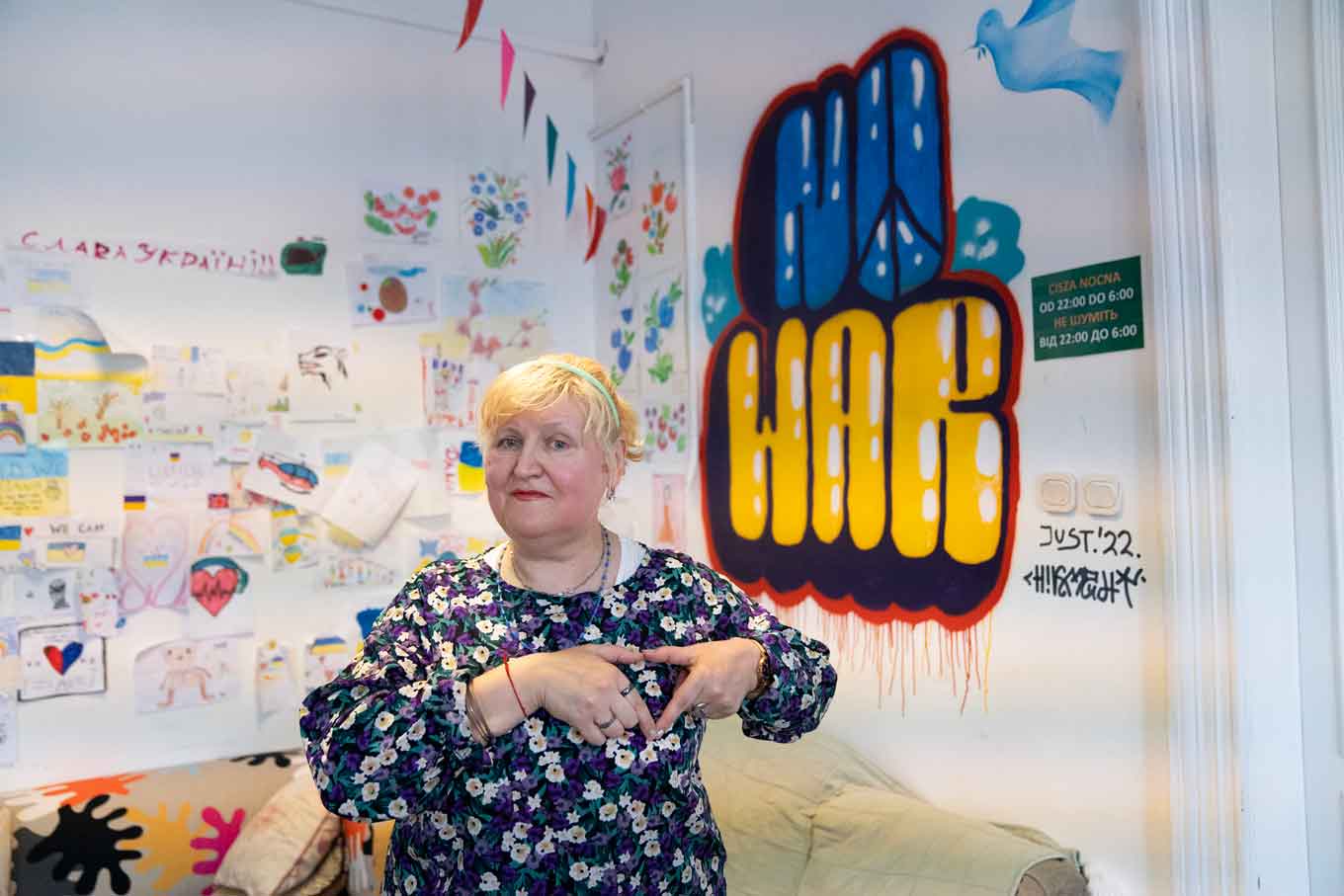
In just days of the invasion, they worked with partner organizations to establish a 24/7 Support Point in Krakow and quickly organized specialists to provide psychological support to refugees.
“They also agreed then how to help the helpers,” Nazik Salih, a regional information officer with Project HOPE who works with the Zustricz Foundation in Poland, said. “They trained, supervised, carried out group interviews, and provided individual support. Quick communication channels were created for groups of psychologists.”
It was in September of 2022 that these channels widened and the organization opened its Psychological Support Center, providing employment for 22 psychologists, the majority of whom are refugees themselves.
Poland’s Psychological Support Center
The Psychological Support Center is a hub for, well, psychological support. A Ukrainian women-run operation, the center provides individual and group therapy sessions to demographics such as women, children, teens, soldiers’ wives, and people with disabilities, integrating practices like art therapy and language classes.
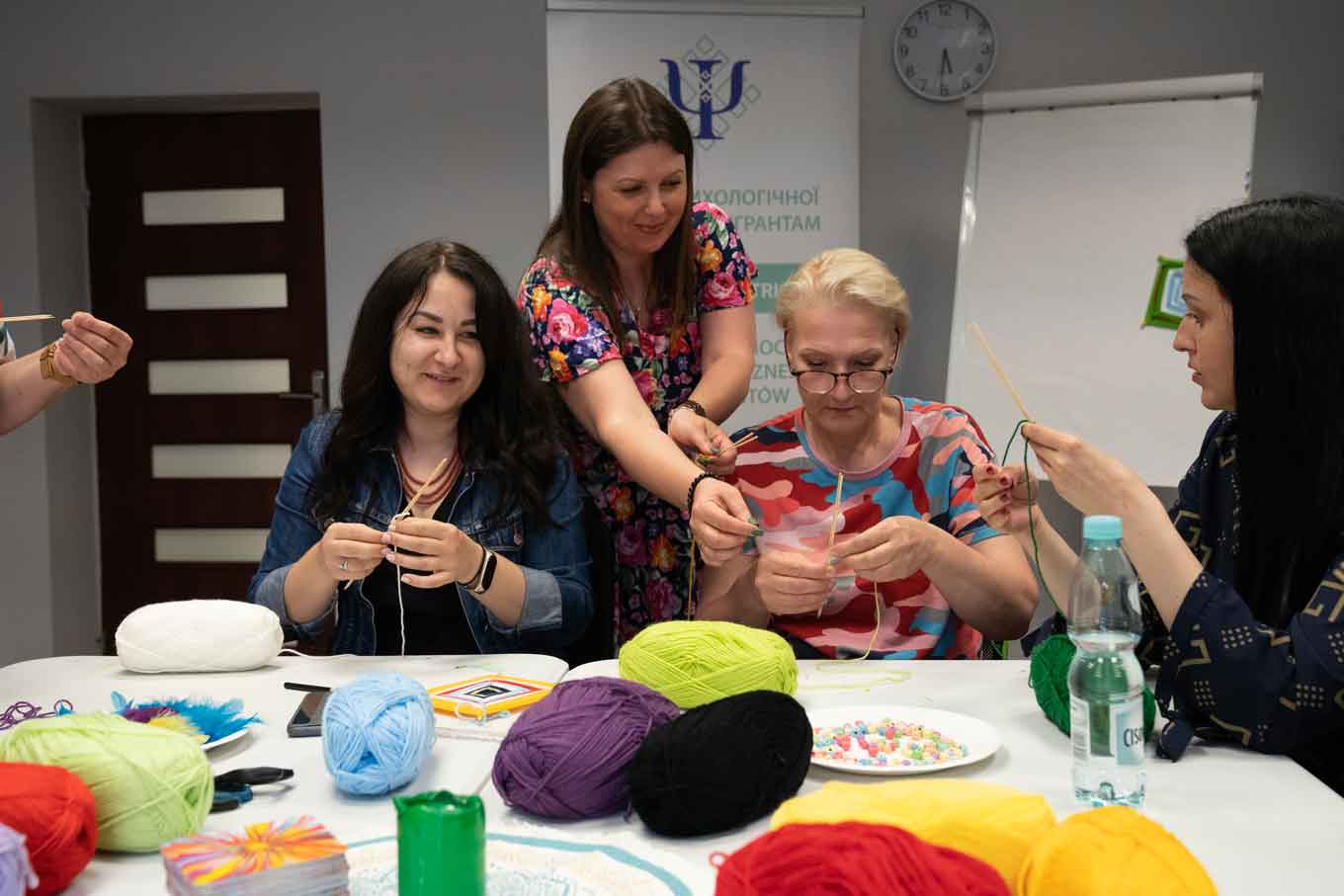
This work also extends to 28 mobile sites, where psychologists visit communities where refugees live for one-on-one support.
“The majority of Ukrainian refugees need some level of mental health and psycho-social support, having endured stressful and traumatic experiences before leaving Ukraine and throughout their desperate journey into neighboring countries,” Salih told Good Good Good.
“This unprecedented, massive movement of women and children raises serious concerns on their heightened vulnerabilities to human trafficking and various forms of abuse. Therefore, good quality mental health and psycho-social support tailored to refugees is critical to the emergency response effort.”
Project HOPE has helped fund the employment of Zustricz psychologists and the implementation of its many programs. After all, who better to take care of the mental health of refugees than other refugee psychologists who have been in their place?
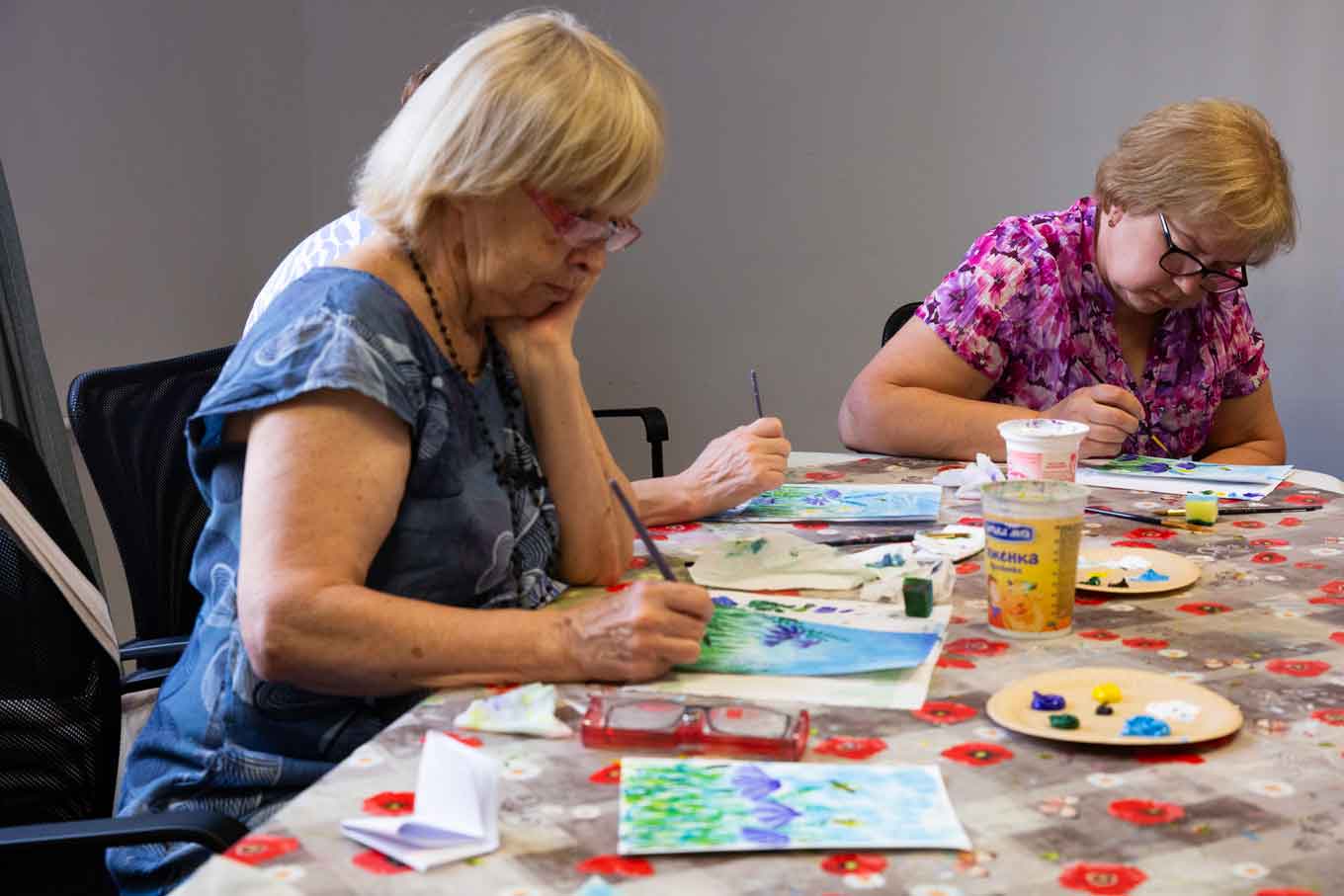
“These are highly qualified specialists who were forced to leave their homes and jobs. For these psychologists, their work is not just a job — it's a calling. It's an opportunity to make a real difference in the lives of their fellow Ukrainians during a time of suffering,” Salih said.
“This is their contribution to bringing the victory closer. This work also helps psychologists preserve their own mental health and well-being, reminding them of the power of human connection and the resilience of the human spirit.”
Not only are these Ukrainian psychologists bringing support and safety to their peers in Poland, but they get to maintain a level of normalcy, accessing professional development and financial stability in a time of unfathomable upheaval.
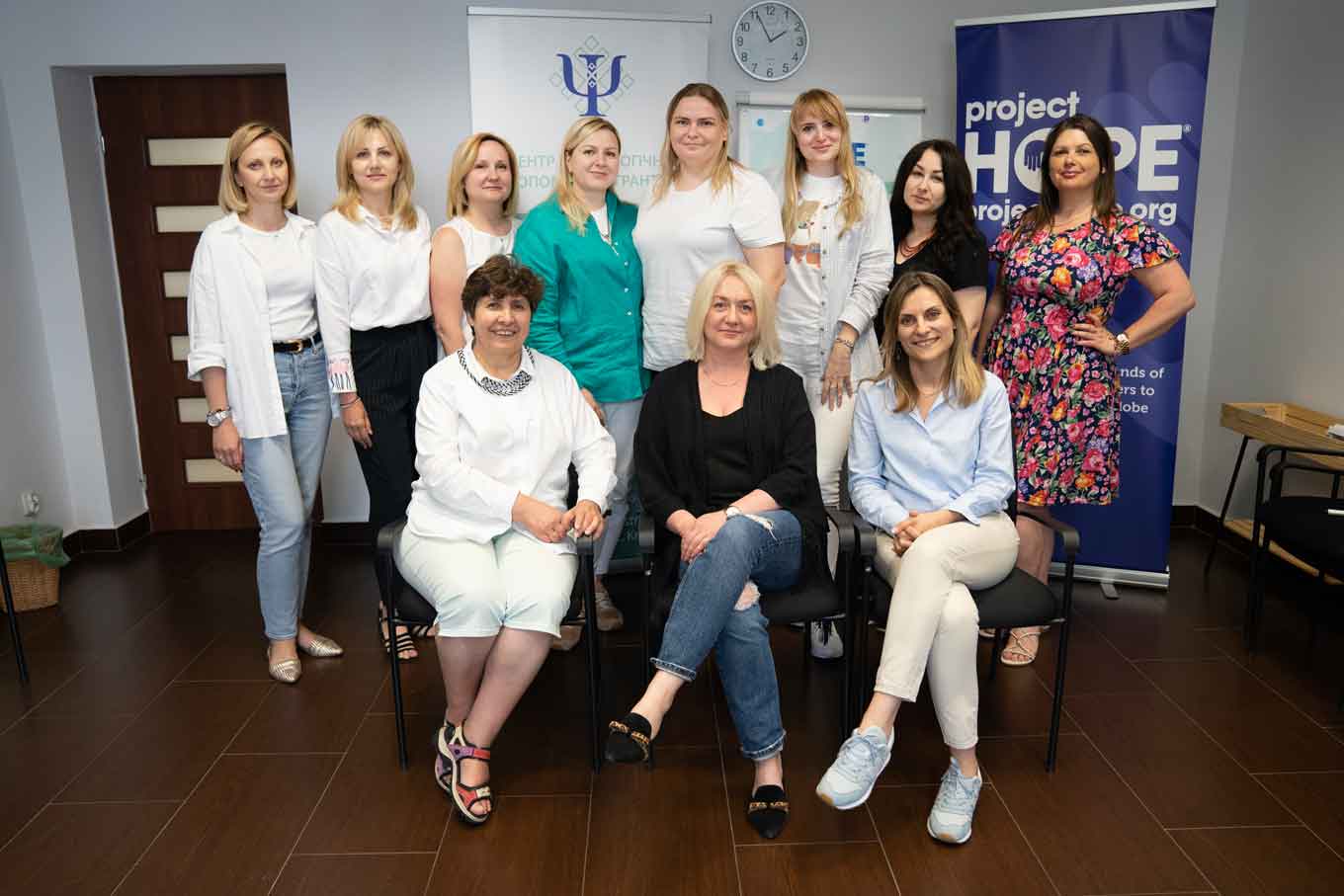
“I’m very grateful for the opportunity to be in this profession, to grow and develop, and to help people,” Eugenia, a refugee psychologist who arrived in Poland with her son in 2022, shared in a Project HOPE blog post.
“After feeling safe, being in my profession is the most important support for me in such a difficult time. I’m grateful for the opportunity to be useful, to feel alive and stable among my own, and for my own.”
Most dogs love a car ride: windows down, ears flapping in the wind, their wet noses capturing the scents of the world as it races by.
But sometimes the destination is even more rewarding.
Subaru’s Las Vegas retailer — which was recently recognized company-wide for its dedication to giving back — has added a car-ride-loving component to its showroom: a pack of therapy dogs.
It all started when Subaru of Las Vegas partnered with local charity Michael's Angel Paws, a Nevada-based organization that trains service and therapy support dogs for community members facing physical or emotional challenges.
This began as a standard corporate charity relationship. After all, Subaru is known for its give-back initiatives under the Subaru Love Promise umbrella.
One of the pillars of this campaign is “Subaru Loves Pets,” which prompts retailers across the country to connect with animal adoption and rescue groups to increase adoptions and raise funds for animals in need.
Jennifer Vitale, the assistant general manager at Subaru of Las Vegas told Good Good Good that these partnerships are about creating lasting relationships with communities and customers — which means making the showroom dog-friendly, too.
“We welcome all animals into our showroom; we even have a dog park for our four-legged friends, pet beds for them to relax and enjoy, a pet sink, and treats for pets of all sizes,” Vitale told Good Good Good in an email.
“Watching the interactions in our showroom between dogs, customers, and employees made me realize that dogs provide more than companionship; they show us what real love is and bring indescribable joy to those around them.”

Through Subaru’s philanthropic work, the Las Vegas location has raised over $64,000 for Michael’s Angel Paws, but Vitale said the employees — a team of dog lovers themselves — didn’t want to stop there.
“[We] host yearly adoption events to help local shelter pets find loving homes, but the reality is that humans aren’t always the ones doing the saving. Dogs have an innate ability to love unconditionally and provide affection, comfort, and support, which can benefit individuals in settings such as hospitals, retirement homes, nursing homes, and schools,” Vitale said.
“I wanted to take the love I witnessed daily on our showroom floor between dog and human and extend that beyond our four walls.”
With the help of experts at Michael’s Angel Paws, employees volunteered to train their own dogs as therapy dogs.

Therapy dogs differ from service dogs, which are protected under the Americans With Disabilities Act and are trained as a working animal with special skills to specifically serve a handler with a disability.
Therapy dogs, on the other hand, are pets that are trained to provide affection and support and often volunteer in places like schools, hospitals, and nursing homes.
Still, this requires training. Vitale shared that Subaru employees who wanted to take their pups to the next level committed to weekly training sessions for 25 weeks.
“Each dog underwent an evaluation with a Michael’s Angel Paws trainer, who identified the best canines for the job based on temperament and ability to follow commands,” Vitale explained.
“25 weeks and a cumulative 500 hours of training later, we were proud to introduce the Subaru of Las Vegas therapy dog team: Momo, Jambo, Denver, and Frankie.”

The five dogs have since been on a number of out-of-office expeditions, reading books to children in elementary schools, visiting patients at a local children’s hospital, delivering toys to families in need during the holidays, and connecting with community members at a nearby assisted living facility.
The dogs are also a welcome support system to the Subaru staff, too. Momo (who, yes, has her own entry on the retailer’s Meet Our Team web page) is the go-to source for emotional support in the showroom, Vitale said.
“The impact on the dog owners and our broader team, in general, has been surprising in the best way possible. The automotive industry can be a fast-paced environment that presents its own set of challenges at times,” Vitale said. “Momo brings everyone a smile and has influenced other employees who are dog lovers to inquire about getting their dog therapy-certified, too.”
Of course, Vitale shared, the most rewarding thing of all is supporting community members through that special human-canine connection. Plus, the therapy dog team has taken the retailer’s commitment to animals and elevated it in a new way.
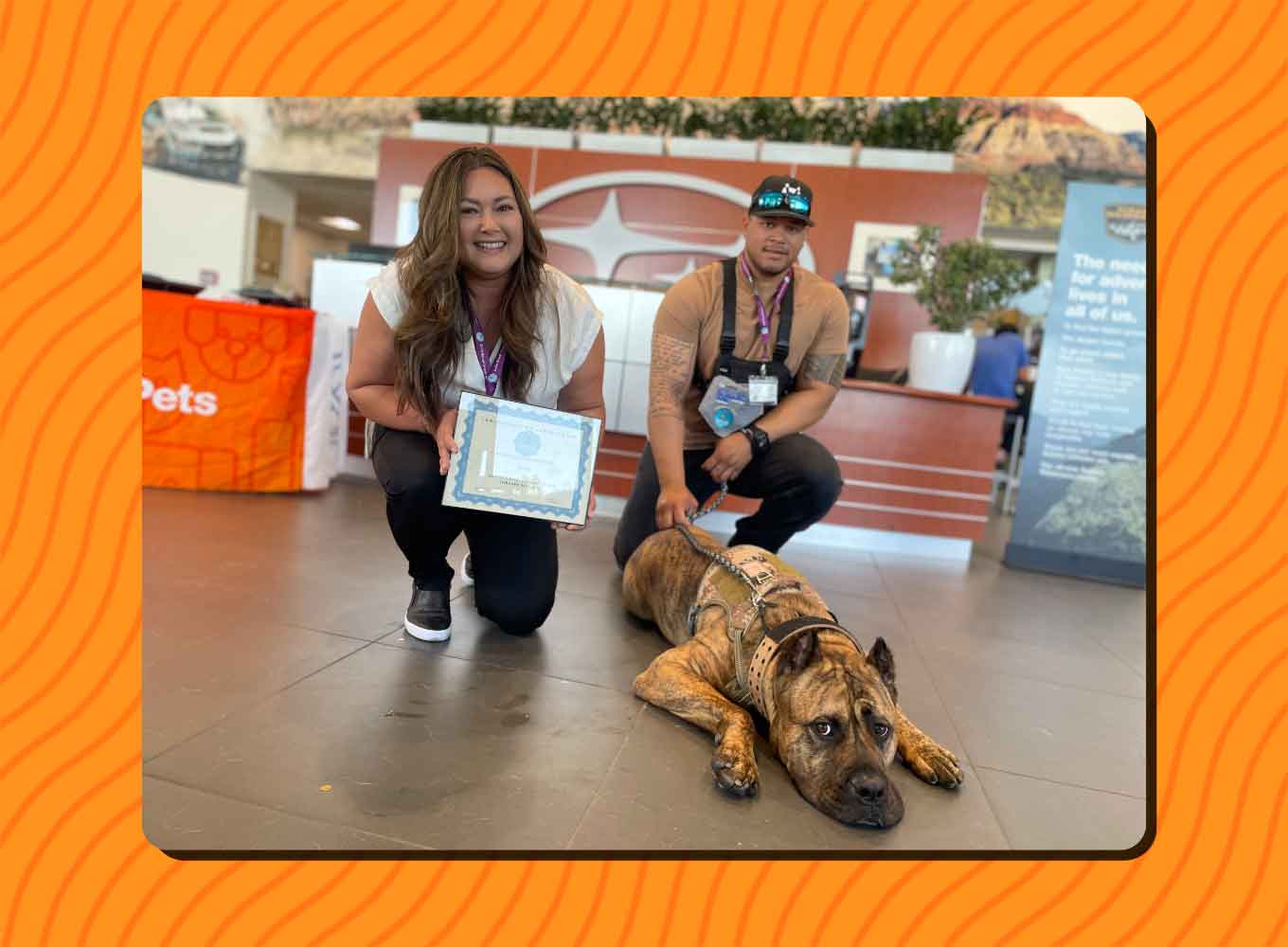
This includes microchipping clinics, supporting programs that provide financial assistance to those who cannot afford their dog’s veterinary costs, and funding the training of service dogs for community members with disabilities.
Vitale said: “The therapy dog program has shown us how powerful a dog’s love can be.”
August 3 is Esther Day! This annual celebration honors Esther Earl, a young woman who died of thyroid cancer in 2010 and was an active member of Hank and John Green’s fan community, the Nerdfighters.
Esther Day is dedicated to celebrations of platonic and familial love, and of course the life and legacy of Esther herself.
As a member of the Nerdfighter community and a big influence in John Green’s writing of his best-selling novel “The Fault In Our Stars,” John proposed before her passing that he and his brother celebrate Esther’s birthday on August 3 for as long as their YouTube channel continued.
He told her that the holiday could be focused on a theme or topic of her choosing, and Esther chose love.
Esther was passionate about love between friends and family, and since her passing, her family has continued her vision of supporting families affected by childhood cancer.
While it’s important to learn more about and uplift the experiences of folks impacted by cancer every single day, Esther Day provides a helpful place to start. We’ve created a guide on how to celebrate Esther Day this year.
By the way, some of the links in this article (like books!) are affiliate links, which means if you make a purchase after clicking a link, we may earn a commission at no extra cost to you. Thank you!
Activities and Ideas: How To Recognize Esther Day
Tell someone you love them.
Tell someone you love them — and make sure it’s someone you don’t always say it to. We’re not talking about just your spouse or your dog … but also those friends and family members who are just always there — and already know how you feel but deserve to hear it.
John said it best in his 2021 video about Esther Day: “[Esther] imagined a holiday where people celebrated all the kinds of non-romantic love, the love in friendships, in families, that too often goes unspoken,” he says.
“Like, what is it that makes it so hard for me to tell my brother that I love him, when I love him so much. So much that I feel the ache of it behind my solar plexus. It’s almost embarrassing, Hank, to talk about how deeply and dearly I love you.”
Hank vulnerably shared the sentiment in his video the year following, sharing that it gets easier and easier to say he loves his brother with every Esther Day.
“I am more aware of the fact that all of this is temporary. There is just a deeper, truer thing than earning each other’s respect through accomplishment and that thing is going to be more and more important in the future,” Hank said in 2022. “And, God bless her for it, Esther made us practice.”
Donate to This Star Won’t Go Out.
This Star Won’t Go Out (TSWGO) is a charity that the Earl family created to help other families going through childhood cancer in 2011.
Since then, TSWGO has helped hundreds of families with over $500,000 in direct funding to alleviate some of the financial hardship related to childhood cancer.
Funding projects are “extremely grassroots” and stem from folks around the world who host creative fundraisers in support of the families who need the most support.
→ Donate to This Star Won’t Go Out
Read Esther’s book.
Esther was a voracious writer and reader — which is part of why she was so drawn to John and Hank Green’s content to begin with. A few years after her passing, a collection of her writings was published and quickly rose to the New York Times bestseller list.
The book also contains photos and essays by family and friends, as well as an introduction from John Green.
“This Star Won’t Go Out: The Life and Words of Esther Grace Earl” is available on Bookshop and Amazon.
Read other books about platonic and familial love.
To celebrate Esther’s love of books and storytelling, Esther Day is a great opportunity to read and reflect on platonic and familial love. Here are a few recommendations to choose from:
- “Will Grayson Will Grayson” by John Green & David Levithan (Bookshop) (Amazon)
- “Code Name Verity” by Elizabeth Wein (Bookshop) (Amazon)
- “Tomorrow And Tomorrow And Tomorrow” by Gabrielle Zevin (Bookshop) (Amazon)
- “Bridge to Terabithia” by Katherine Paterson & Donna Diamond (Bookshop) (Amazon)
- “Mayflies” by Andrew O’Hagan (Bookshop) (Amazon)
- “Little Women” by Louisa May-Alcott (Bookshop) (Amazon)
- “My Ex-Life” by Stephen McCauley (Bookshop) (Amazon)
- “The Inexplicable Logic of My Life” by Benjamin Alire Saenz (Bookshop) (Amazon)
Host a fundraising event for Esther Day.
According to the TSWGO website, past fundraising efforts have included ideas as simple as selling T-shirts and bracelets, or all-night rock-a-thons, carnivals, bake sales, battles-of-the-bands, head-shavings, and even a 5,000-piece domino art project.
For this year’s Esther Day, consider hosting a fundraiser of your own!
Support a family impacted by childhood cancer in your community.
Another great way to help folks impacted by childhood cancer is to simply get out in your community and provide support directly to those in need.
Look for programs at local hospitals, join a meal train, provide support in the form of pet, child, or home care — or simply contribute financially to a GoFundMe or other fundraising platform.
Attend 2024’s Esther Day Virtual Party event.
This year on Saturday, August 3rd (at 8:00 pm EDT), online creators are coming together to celebrate love and friendship in honor of Esther. It’s hosted by Wheezy Waiter and Chyna and includes segments from John Green, Jessi from Animal Wonders Montana, Brian Ross from Draco and the Malfoys, and Esther’s mom: Lori Earl. The ticketed digital event is free to attend, but you can also pay for a raffle ticket, buy a party pack, or simply make a donation.
Frequently Asked Questions
When is Esther Day?
Esther Day takes place every year on August 3 in celebration of Esther Earl’s birthday. The day is celebrated in the online “Nerdfighter” community, led by Hank and John Green, to remind folks to express their love for friends and family.
Is “The Fault In Our Stars” based on Esther?
Esther Earl inspired the character Hazel Grace Lancaster in John Green’s novel, “The Fault in Our Stars.” Esther died of cancer at the age of 16 in 2010, and her name means ‘star’ in Persian. Her parents also started the nonprofit This Star Won’t Go Out in her honor.
How did John Green meet Esther?
John Green met Esther at LeakyCon, a convention for Harry Potter fans. They were both devoted fans of the book series and were active members of the Harry Potter Alliance (now Fandom Forward). The two formed a bond and became friends.
What are some Esther Day quotes?
We’ve compiled a few Esther Day quotes (from John and Esther) in our guide to the best August quotes.
Words are more than just a means of communication — they have the power to evoke a wide spectrum of emotions and set the tone for any narrative.
At Good Good Good, we love and celebrate positivity, but also know that positivity cannot exist without the acknowledgement of negativity.
We’ve compiled this comprehensive list of hundreds of mood and tone words designed to help you accurately depict these varied moods.
This guide includes words that can paint a picture of joy, gratitude, serenity, anxiety, resentment, and despair, among others. These words can help you express everything from whimsy to melancholy, energy to tranquility.
Whether you’re seeking to understand your own feelings, crafting a heartfelt letter, penning a captivating story, or exploring the world of literature — may this resource be a helpful tool for you.
You might also like: Ultimate List of Emotions | Ultimate List of Personality Traits | List of Good Character Traits
List of Words That Describe Moods
Positive Mood Words:
- Accepted
- Accepting
- Accomplished
- Affectionate
- Affirming
- Amazed
- Ambitious
- Amorous
- Amused
- Amusement
- Animated
- Appreciative
- Astonished
- Audacious
- Authentic
- Avid
- Awake
- Awed
- Blissful
- Bold
- Bouncy
- Brash
- Bright
- Bubbly
- Buoyant
- Calm
- Carefree
- Caring
- Charming
- Cheerful
- Cheery
- Chill
- Chilled
- Chipper
- Chuffed
- Cold
- Colorless
- Comfortable
- Comforted
- Comical
- Communicative
- Companionable
- Compassionate
- Complacent
- Composed
- Confident
- Contemplative
- Content
- Contented
- Cool
- Cordial
- Courageous
- Covetous
- Cranky
- Crappy
- Craving
- Creative
- Cross
- Curious
- Decisive
- Deep
- Delighted
- Demure
- Determined
- Dignified
- Dorky
- Dreamy
- Earnest
- Easy-Going
- Emotional
- Empathetic
- Empowered
- Energetic
- Energized
- Enlightened
- Enthralled
- Enthused
- Enthusiastic
- Euphoric
- Excited
- Exhilarated
- Exuberant
- Fantastic
- Fascinated
- Fearless
- Felicitousness
- Festive
- Flamboyant
- Flirty
- Focused
- Friendly
- Fulfilled
- Full
- Funny
- Geeky
- Giggly
- Good
- Gracious
- Grateful
- Gratitude
- Happy
- Harmonious
- Helpful
- High
- Honest
- Hope
- Hopeful
- Hospitable
- Hot
- Humorous
- Hungry
- Hyper
- Idyllic
- Imaginative
- Important
- Impressed
- Inclusive
- Indescribable
- Infatuated
- Inspiration
- Inspired
- Interest
- Interested
- Introspective
- Invigorated
- Jovial
- Joyful
- Joyous
- Jubilant
- Kind
- Liberated
- Liberating
- Light
- Lighthearted
- Lively
- Love
- Loved
- Loving
- Meditative
- Mellow
- Merry
- Moody
- Motivated
- Mystified
- Nerdy
- Nostalgic
- Open
- Optimistic
- Outgoing
- Passionate
- Peaceful
- Pensive
- Peppy
- Perseverant
- Philosophical
- Playful
- Pleasant
- Pleased
- Pompous
- Positive
- Powerful
- Proud
- Pumped
- Quiet
- Radiant
- Realistic
- Reflective
- Refreshed
- Rejuvenated
- Relaxed
- Relieved
- Renewed
- Reserved
- Reverent
- Romantic
- Safe
- Sanguine
- Satiated
- Satisfied
- Sedated
- Sentimental
- Serene
- Serenity
- Settled
- Shocked
- Sleepy
- Smart
- Snappy
- Sociable
- Sparkling
- Spirited
- Sunny
- Sympathetic
- Talkative
- Tender
- Thankful
- Thoughtful
- Thrilled
- Touched
- Tranquility
- Triumphant
- Troubled
- Trustful
- Understanding
- Unfeeling
- Unhappy
- Untroubled
- Upbeat
- Vibrant
- Vigorous
- Vivacious
- Warm
- Welcoming
- Whimsical
- Wistful
- Withdrawn
- Witty
- Wretched
- Yearning
- Zen
Negative Mood Words:
- Abandoned
- Aflutter
- Afraid
- Aggravated
- Aggrieved
- Agitated
- Alienated
- Alone
- Aloof
- Angry
- Annoyed
- Annoying
- Antagonistic
- Antsy
- Anxious
- Apathetic
- Apprehensive
- Argumentative
- Arrogant
- Ashamed
- Awe
- Baffled
- Barren
- Belligerent
- Bemused
- Betrayed
- Bewildered
- Bitter
- Blank
- Blue
- Bored
- Bothered
- Brooding
- Brutal
- Callous
- Cantankerous
- Capricious
- Chapfallen
- Cold
- Combative
- Complacent
- Confining
- Confrontational
- Confused
- Cranky
- Crappy
- Crazy
- Cruel
- Crushed
- Cynical
- Dark
- Dead
- Defeated
- Deflated
- Dejected
- Demoralized
- Depleted
- Depressed
- Desolate
- Despairing
- Desperate
- Despondent
- Destitute
- Detached
- Devious
- Devoid
- Devouring
- Difficult
- Dirty
- Disappointed
- Discontent
- Discontented
- Disgruntled
- Disheartened
- Disheartening
- Dismayed
- Dispirited
- Dispiriting
- Distant
- Distressed
- Distrustful
- Dither
- Ditzy
- Down
- Downcast
- Drained
- Dreadful
- Dreary
- Drunk
- Dysphoric
- Eager
- Edgy
- Elated
- Embarrassed
- Empty
- Enraged
- Envious
- Erratic
- Exanimate
- Exasperated
- Exhausted
- Famished
- Fatalistic
- Fearful
- Foreboding
- Fretful
- Frightened
- Frustrated
- Frustrating
- Futile
- Giddy
- Gloomy
- Glum
- Goofy
- Gorged
- Gormandizing
- Grief-Stricken
- Grim
- Groggy
- Grumpy
- Guilty
- Hangry
- Haunting
- Heartbroken
- Helpless
- Hesitant
- Hollow
- Hopeless
- Hostile
- Humiliated
- Impulsive
- Inconsolable
- Indifferent
- Indignant
- Inferior
- Inferiority
- Infuriated
- Insatiable
- Insecure
- Insidious
- Insolent
- Intimidated
- Irascible
- Irate
- Irritated
- Isolated
- Jealous
- Jittery
- Jumpy
- Lamentable
- Lazy
- Lethargic
- Listless
- Lonely
- Lonesome
- Lost
- Low
- Mad
- Madness
- Manipulative
- Mean
- Melancholy
- Merciless
- Mischievous
- Miserable
- Moody
- Morose
- Mournful
- Mysterious
- Naughty
- Negative
- Nervous
- Neurotic
- Nightmarish
- Numb
- Obsessed
- Ominous
- On Edge
- Ornery
- Ostentatious
- Outraged
- Overwhelmed
- Painful
- Panicked
- Pensive
- Perplexed
- Pesky
- Pessimistic
- Petrified
- Petulant
- Powerless
- Predatory
- Pretentious
- Pride
- Puzzled
- Quarrelsome
- Queasy
- Quiet
- Rash
- Ravenous
- Rebarbative
- Reckless
- Regretful
- Rejected
- Remorseful
- Remote
- Repellant
- Resentful
- Restless
- Rushed
- Sad
- Scared
- Self-Conscious
- Serious
- Shameful
- Shocked
- Sick
- Silly
- Sinister
- Skeptical
- Somber
- Sorrowful
- Starved
- Strange
- Stressed
- Sullen
- Suspenseful
- Suspicious
- Temperamental
- Tense
- Terrified
- Terrifying
- Threatened
- Threatening
- Tired
- Touchy
- Troubled
- Unattached
- Uncaring
- Uncertain
- Uncertainty
- Uncomfortable
- Uneasy
- Unfeeling
- Unfriendly
- Unhappy
- Uninterested
- Unmotivated
- Unnerved
- Unpredictable
- Unsettled
- Upbeat
- Uptight
- Useless
- Vacant
- Vengeful
- Violent
- Volatile
- Voracious
- Vulnerable
- Weary
- Weird
- Withdrawn
- Worried
- Wretched
Neutral Mood Words:
- Calm
- Collected
- Composed
- Cool
- Curious
- Detached
- Easygoing
- Fair
- Focused
- Honest
- Impartial
- Indifferent
- Objective
- Open-Minded
- Patient
- Peaceful
- Poised
- Relaxed
- Respectful
- Serene
- Thoughtful
- Unbothered
- Unemotional
- Unfazed
- Unmoved
- Unperturbed
- Unruffled
Other Mood Words:
- Absorbed
- Alert
- Bittersweet
- Competitive
- Contemplative
- Crabby
- Dyspeptic
- Eclectic
- Ecstatic
- Feminine
- Fiery
- Giving
- Human
- Hungry
- Hyper
- Hyperactive
- Indescribable
- Livid
- Masculine
- Okay
- Quixotic
- Recumbent
- Resilient
- Sexy
- Shy
- Snobbish
- Surprised
- Whimsical
Frequently Asked Questions
What are some common mood words?
Some common words describing moods include: joyful, grateful, excited, optimistic, energetic, and cheerful for positive moods; anxious, resentful, sad, angry, cynical, and despairing for negative moods; and calm, composed, curious, unfazed, posed, and indifferent for neutral moods.
What are some synonyms for happy?
Some synonyms for happy include:
- Joyful
- Delighted
- Pleased
- Thrilled
- Cheerful
- Blissful
- Content
- Merry
- Elated
- Gleeful
- Satisfied
- Exuberant
- Radiant
- Jovial
- Ecstatic
More positive words that start with…
A | B | C | D | E | F | G | H | I | J | K | L | M
N | O | P | Q | R | S | T | U | V | W | X | Y | Z
You might also like:
Every day the Good Good Good team collects the best good news in the world and shares it with our community. Here are the highlights for this week!
If you want to get good news in your inbox every day, join the Goodnewsletter — the free daily newsletter designed to leave you feeling hopeful.
The Best Positive News We’re Celebrating This Week —
Two Stanford students created glasses that provide real-time subtitles in real life
For folks who are deaf or hard of hearing, having closed captions isn’t a helpful bonus to a video-viewing experience, it’s a necessity. So, two students at Stanford decided to bring that caption technology off our screens and into augmented reality.
Connected to the world of assistive technology themselves, Tom Pritsky and Madhav Lavakare, founded TranscribeGlass, and the device itself is an AR wearable that attaches to a pair of glasses. It pairs with a transcription software to project real-time captions in front of your eyes.
It’s truly a game-changer, but don’t take our word for it: it recently caught the attention of millions of TikTok viewers, culminating in nearly six million views in just 24 hours.
Why is this good news? For folks who are deaf or hard of hearing, subtitles are not just a boost to their video-viewing experience — they are a necessity. And for others who face language barriers, captions and translations are a vital resource for connecting and understanding others.
New research found eating a planet-friendly diet can reduce the risk of death from chronic illness by 25%
Scientists have found that people who followed a more sustainable diet — eating more plant-based foods like whole grains, fruits, vegetables, and nuts — reduced their risk of death from cancer, heart disease, and other chronic illnesses by 25%.
Their research builds on existing research that these kinds of foods are also less harmful to the environment than red and processed meats. And based on their findings, the researchers developed a new score that uses scientific evidence to determine a food’s impact on both human health and the environment.
For impact on the environment, the research measures impacts like water use, land use, nutrient pollution, and greenhouse gas emissions.
What’s the nuance? It’s important to acknowledge that this research is only as good as these kinds of foods are widely accessible to everyone — both in availability and affordability. Food deserts, rising costs, and more leave people around the world without even the option to choose planet-friendly foods.
In the first half of the year, wind and solar generated more power than coal in the U.S.
One-quarter of greenhouse gas emissions in the U.S. come from generating electricity — and coal is the dirtiest source. New data shows those dirty days were behind us, at least for the first half of the year.
Between January and June 2023, wind and solar produced 343 terawatt-hours (TWh) of electricity, while coal produced 296 TWh. That might not seem like a very notable difference — but it is when you compare it to just five years ago, when coal produced four times more TWh than wind and solar combined.
It’s an incredible milestone and point of progress to celebrate in the clean energy transition. And it comes just six months after a record-breaking year for carbon-free power generation: in 2022, all renewable sources (including hydropower and geothermal) out-generated coal.
Next up: lowering our dependence on gas.
For the first time in decades, the U.S. is raising fees for drilling for oil on federal lands
For decades, the rules surrounding oil and gas extraction on federal lands haven’t changed — until now. The Interior Department recently announced major changes to protect public lands, save taxpayers money, and hold oil and gas companies accountable for cleanup.
Under the new rules, the minimum royalty rate increases to 16.7% (up from 12.5%), raises the minimum land lease bid to $10 per acre (up from $2), and increases the minimum bond to $150,000 per lease (up from $10,000). The rules also prioritize leasing where fossil fuel infrastructure already exists — which will leave space to develop more renewable energy capacity and protect wildlife habitats.
The increase in the minimum bond is particularly significant — that money is used to plug and clean up oil wells at the end of their life, and $10,000 was just a fraction of the cost. Many experts say it (along with the other, outdated rules) functioned as a subsidy for oil and gas companies.
What’s the nuance? While environmental groups are celebrating and welcoming these long-overdue changes, it comes with a caveat: it still leaves federal lands open to new drilling. And new drilling is something we desperately need to stop in the face of the climate crisis.
Still, new barriers for companies to implement new drilling is important, necessary progress.
The first cargo ship in the world to run on green methanol just started its first voyage
By the end of the decade, Maersk (one of the largest shipping companies in the world) is looking to transport one-quarter of its ocean cargo ships using green fuels. Two years in the making, it just took the first major step towards reaching that goal.
The first cargo ship in the world to run on green methanol — made from methane captured from food waste at landfills — just started its first voyage from South Korea to Denmark. Maersk is also working to make 25 more ships and retrofit older ships to use green methanol.
The use of green methanol to fuel a cargo ship can cut its emission by up to 70% — which adds up to a significant amount considering the shipping industry is responsible for around 1 billion tons of CO2 emissions annually (about the same as the airline industry).
What’s the nuance? In short: green methanol can’t fully eliminate emissions. While not a perfect solution, it’s one that’s available right now to start making a (relatively significant) dent in reducing emissions — which is something the shipping industry must do to meet Paris climate goals.
A new California policy will protect beavers an use their natural behaviors to help with water issues and wildfires
For a long time, beavers were considered a nuisance in California. Now, recognizing the environmental benefits of the animals, the state is changing its tune.
It just implemented a new policy to both protect and preserve beavers — and their nature-loving habits, which can be especially helpful in the face of climate change. Beavers can help restore biodiversity, improve groundwater supplies, and safeguard against wildfires.
Now, rather than immediately seeking a permit to kill them, people are being encouraged to try other methods of discouraging beaver damage to their property. The state also has two official relocation programs in place for those who need it.
Why is this good news? Right now, hundreds of permits are requested to kill beavers in California. While it’s unkown how many live in the state, an estimated 10 to 15 million total live in all of North America — it used to range between 100 and 200 million.
While beavers themselves aren’t endangered, they do create healthy habitats for species that are, like coho salmon.
Thanks to the activism of two women, adult changing tables are now required under Minnesota law in all new public bathrooms
Linda Hood is a marathoner who lost the use of her legs from a virus. Last year, she become Miss Wheelchair Minnesota, and declared it her mission to get adult changing tables in public restrooms. Sarah St. Louis’ son Ezra has a traumatic brain injury, so she struggled to change him in public restrooms given he was too big for infant tables.
And like other disabled Minnesotans, being forced to use the floor of a public restroom to use the bathroom was a dehumanizing and disgusting experience — so they came together to make a change.
Working with two state Senators over the course of four years, they got a bill passed to mandate adult changing tables in all new public restrooms in Minnesota — and the governor recently signed it into law.
Especially good news to hear during Disability Pride Month, the new law is effective in January, and will mean that any large public buildings (movie theatres, malls, stadiums) must be built with adult changing tables. It also offers up to $20,000 in incentives for existing businesses to update their restrooms.
More good news of the week —
Canada joined nearly 20 other nations calling for a moratorium on deep-sea mining. Proponents of the practice say it's less destructive, but countries more countries want to pause while the international community develops regulations around it.
Botanists are working to revive extinct plant species by using seeds from dry, preserved specimens. While they face many challenges to the task, it offers a glimpse of hope at resurrecting species that are important to biodiversity but were wiped out.
An organization sews reusable period pads for refugees and vulnerable communities. Ella Lambert started the Pachamama Project as a student in August 2020 and it's since grown into a global network of 2,000 volunteers who have sewn 100,000 pads.
With a record-setting $155 million on opening weekend, “Barbie” is now the biggest debut ever for a film directed by a woman. Greta Gerwig’s film made box office history, also becoming the largest opening weekend of the year so far.
A new California law will require incarcerated parents to be placed in the correctional facility closest to their child’s home. The “Keep Families Close” also applies to caregivers and legal guardians, and will have a positive impact on both children and people who are incarcerated.
The Women’s World Cup broke the previous ticket sales record ahead of this year’s tournament. Close to 1.4 million tickets were purchased for the 64 matches, surpassing the record total for the tournament eight years ago in Canada.
The U.S. will officially establish a national monument in honor of Emmett Till and Mamie Till-Mobley. President Biden signed the proclamation yesterday, and the monument will be at three significant sites across Illinois and Mississippi.
Google Maps’ fuel-efficient driving routes have helped prevent an estimated 1.2 million metric tons of carbon dioxide emissions. Google released the feature in 2021 and said the emissions prevented would be like taking 250,000 cars off the road for a year.
The eight South American nations that make up the Amazon rainforest will adopt Brazil’s pledge to end illegal deforestation by 2030. It’s the most ambitious government effort yet to protect the world’s largest rainforest, whose preservation scientists see as key to helping avert climate change.
Michigan introduced a bill that would institute a “bill of rights” for those experiencing homelessness in the state. Introduced by Rep. Emily Dievendorf, the bill would offer the same rights to unhoused people as other members of society, like equal treatment, medical care, voting, and more.
A Texas oak tree thought to be extinct for a decade was just discovered in Big Bend National Park. As the climate has gotten hotter over the last thousand years, the Quercus Tardifolia oak tree has struggled to survive in the state.
The largest battery manufacturer just introduced an aviation division to develop electric airplanes. The aviation industry is notoriously polluting (see above), and recent breakthroughs in battery production have made them more commercially viable.
A 14-year-old’s eyesight was restored using gene therapy delivered through eye drops. Researchers believe this medical breakthrough could lead to similar therapies to treat millions of people with other eye diseases.
New energy efficiency standards on water heaters could save consumers $11 billion per year. The standards would also reduce more than 500 million metric tonnes of carbon dioxide emissions over 30 years, which is about equal to the combined annual emissions of half of U.S. homes.
With its largest investment in over 50 years, passenger rail could reach almost every major city in the U.S. in 15 years. Thanks to the federal infrastructure bill, Amtrak is proposing improvements to 25 existing routes, the addition of 39 new routes, and adding 20 million trips annually.
Whether it’s potholes in your city’s streets, frustrating delays with private airlines, or antiquated infrastructure in both rural and urban communities, all Americans have likely experienced the downfalls of the country's transportation and infrastructure systems.
U.S. Secretary of Transportation Pete Buttigieg — and the Department of Transportation (DOT) — have spent the last two-and-a-half years working to remedy these downfalls and help communities across the country move more smoothly. Because, no matter where you land on the political spectrum, you still need to get around.
In fact, the Bipartisan Infrastructure Law, enacted in 2021, is the largest federal investment in public transportation in American history, authorizing up to $108 billion to be used for public transportation.
This funding has been foundational to the department’s work in recent years — and reminds us that the seemingly “boring” challenges in public life can be met with some of the most innovative, sustainable, and equitable solutions.
These solutions are so exciting to us that we decided to focus an entire issue of the Goodnewspaper on transportation and mobility, and since we like to be cute, we called it the Go Go Go Edition.
As part of that edition, Secretary Buttigieg sat down with us to talk about the importance of mobility, the future of transit, and how delivering for communities leads to a stronger democracy.
This interview has been edited for length and clarity.
In Conversation with U.S. Secretary of Transportation Pete Buttigieg
Kamrin Baker, Good Good Good: Transportation is key to a community’s ability to thrive. Can you speak a little bit to how equitable and sustainable transit makes a positive impact? Essentially, why should we care about transit?
Sec. Buttigieg: Mobility is one of those things that you don’t always think about, especially when it’s working well. But it absolutely drives our opportunities in life. The ability to get to work, school, to get to loved ones, to get to where you need to be — really makes or breaks your day, and can make or break how your life goes in the long term, as well.
In the public sector, we have a responsibility to set people up for success by creating the mobility options that allow people to live a life of their choosing. The better mobility we can provide, the more barriers we’re tearing down.
It hasn’t always been equitable and sustainable in the past. We have a chance to really change that, especially because we have levels of funding that have not been available, certainly in my lifetime, thanks to the President’s Bipartisan Infrastructure Law.
We’re deploying that funding across the country to take care of the basics: to make sure transportation is safer, to make sure that it’s actually connecting people the way it’s supposed to, and to learn from mistakes in the past so that we do a better job of reaching everybody — so that we have fewer so-called “transit deserts” where you can’t get access to the mobility you need.
And, of course, to do it on cleaner, greener terms than would have happened certainly a half-century ago when the interstate highway system was being built, for example.
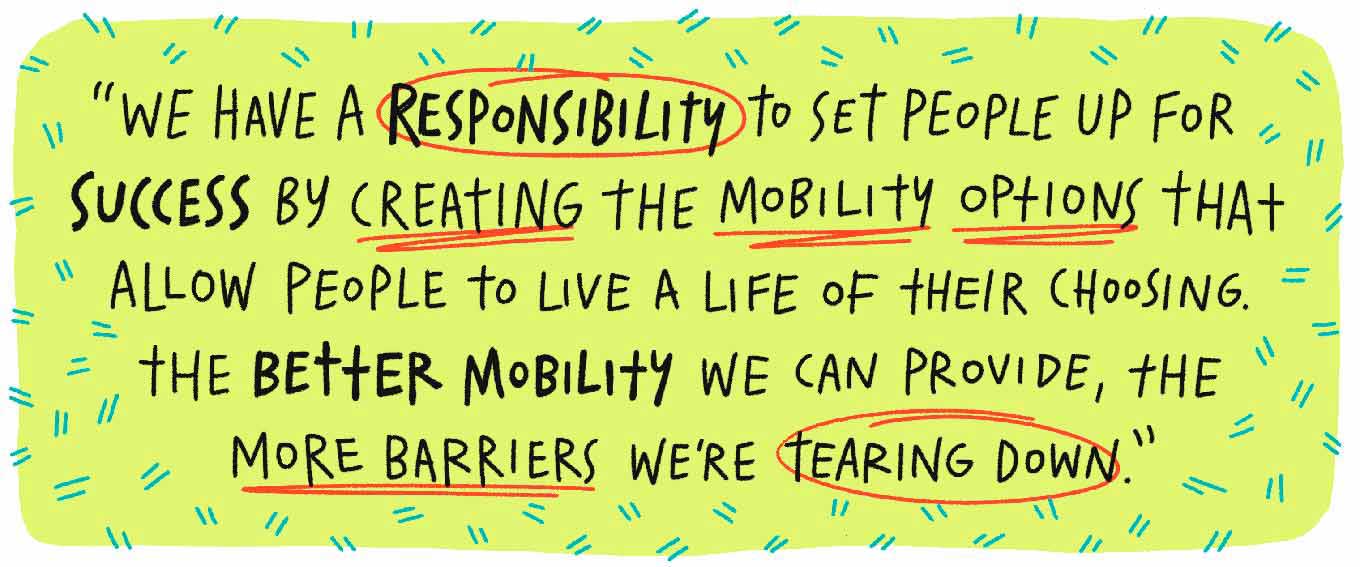
Kamrin: I was just about to touch on the Bipartisan Infrastructure Law, which is obviously a huge milestone for the DOT and for the nation as a whole. If someone maybe hasn’t been paying attention to it or isn’t so sure what it’s all about, could you give me the elevator pitch on what this law has allowed you to do?
Sec. Buttigieg: Well, it’s the biggest transformation to our roads and bridges, our trains and transit, our ports and airports, in more than a half-century.
One of the reasons it passed with bipartisan support — which doesn’t happen often in today’s Washington — is that the need exists in every part of the country: red, blue, and purple.
This was something President Biden promised when he was running for President. It’s something that previous presidents have tried to do and couldn’t get over the hump. And it’s something that, now that we’ve got the funding, we’re very intentional about putting to work.
We spent most of our first year around here trying to get that bill passed. And then we got it passed. President Biden signed it in November of our first year here.
And then last year, our second year, was really about getting the programs up and running. It created 46 new programs in the Department of Transportation alone — everything from a program to eliminate railroad crossings — which can be a huge headache and a safety issue, especially in rural communities — to a program that’s going to help us build more resilient infrastructure that is better equipped to survive fires, floods, and earthquakes and everything in between.
We spent a lot of last year designing those programs. Now, if year one was the bill passing, and year two was the programs launching, years three and four are really about the money moving and the dirt flying.
This is when we actually get to the rewarding part, which is to identify the communities that are going to benefit and see the projects actually begin to take shape.
Kamrin: I know there are so many grants coming out of your office all the time to help different communities. Could you share a few components or projects that you are really excited about?
Sec. Buttigieg: One of the first projects we were able to announce was in Perry County, Indiana, where they have a port that’s really a floating crane. It gets crude iron off of the barges that come up the Ohio River so that they can go up to a foundry that is responsible for 1,000 jobs in a town of 7,000 people.
When the water is too high or too low, the crane doesn’t operate very efficiently. So, we funded them to move that crane on the land. That’s a very simple and specific and important example of how a community can be much better off when we put this funding to work.
In Detroit, we’re helping to take I-375, which was laid like a gash through a largely Black neighborhood in Detroit a couple of generations ago, and elevate it, turn it into a boulevard that’s going to better handle the traffic. And now it’s a connection instead of a division in the community.

I was just in North Dakota, where there’s a railroad crossing that the community has been trying to get rid of since 1991 because slowed and stopped trains blocked emergency vehicles and cars from being able to get to and from the area around the university. And we’re finally able to do it through the railroad crossing elimination funding that’s here.
There’s really something for everybody in this funding, and that’s what’s exciting is to get out to the communities where we’re helping.
In the West, we’re doing wildlife crossings — not just to benefit the wildlife, but to save human lives — because there are fatalities and injuries from collisions.
And then it goes all the way through to the bread-and-butter work that you do hear a lot about, like fixing up airport terminals or improving a streetscape in a big city or a small town.
Kamrin: We’re talking to the guy at the top here, but I know a lot of our readers care deeply about what’s going on in their own backyards, on their roads, on their highways.
If someone cares a lot about mobility in their community, what can they do to take action to help improve public transportation and infrastructure on that grassroots level?
Sec. Buttigieg: We choose a lot of programs that come in through competitive processes here at the department, but actually, the majority of the funding is going to states and localities, and the decisions are being made closer to home.
People who care about transit and transportation should feel very empowered right now and need to know that it might be your state legislators or even your city councils that will be making some of the most important decisions about how this money will be used. You don’t have to come all the way to Washington to knock on my door in order to have a role in how this funding gets deployed.
[Funding dollars] find their way into communities based on decisions that are made by metropolitan planning organizations, where your council member or county commissioner might be on that board. Or again, in state legislatures, where often, regular citizens can testify at committee hearings.
It’s really important to realize you might have more of a voice than you think in how these dollars get used.
Kamrin: That’s always really empowering to remember our place as citizens, especially in local government. You started off as a mayor, so you know what that looks like! Such a great point.
I know a lot of your work has also been focused on modernizing transit and infrastructure. Can you speak a little bit to some of those projects and initiatives? How are we meeting the moment when it comes to transit?
Sec. Buttigieg: We are in a moment that I think will be very transformational for transportation — probably some of the biggest changes since the middle of the last century in terms of what we should expect from the 2020s.
That’s everything from the electrification of vehicles — which is obviously the biggest transition to cars since they were invented — to things like smart signaling, which can save a lot of time and a lot of emissions by moving vehicles more efficiently through communities.
Better, safety technologies that we didn’t really have access to before. The potential for automated driving to make cars safer in the long run, but advanced driver assistance to make cars safer in the short run.
As a matter of fact, we just put out a rule on automatic emergency braking, requiring that it become part of a standard for cars instead of just a bell and whistle that you had to pay extra to get — because we want everybody to be protected by that.
We’re working with communities that are trying to use technology in new ways to help move people around better. And certainly, we’re seeing transit get very creative. For example, taking some of the same technology and approach that goes into Uber and Lyft and applying that in the transit context so more people can get rides on demand.
Kamrin: We’ve been talking about all the really good stuff, and that doesn’t negate the fact that there have been a lot of challenges for the DOT. Even in the last six months, you know, airline issues, the East Palestine trail derailment — What work is being done, and what do you hope is done, to improve private transit and make it safer for people and the planet?
Sec. Buttigieg: We’re determined to make sure that freight railroads are safer than we found them. And we’re well on our way to that, with a number of initiatives that include work to require that there be at least two people on board a train. (Believe it or not, that’s not guaranteed right now, even though it sounds very common sense.)
There’s also a new rule we’re announcing on hazardous materials, helping first responders better prepare by requiring railroads to notify communities about what’s coming through when there’s an incident.
We got to work on day one with many of these initiatives. I think the Norfolk Southern derailment in East Palestine really woke up Americans to how often derailments happen and how severe they can be.
Even if there are no fatalities, the environmental consequences, as the people of East Palestine have been living through, can be incredibly serious. And that’s why we need to continually raise the bar on safety.
When it comes to airlines, there have been a lot of headaches for sure. But also here, too, I think we have a lot to show for our work. In fact, I would argue we’re in the middle of the biggest expansion of passenger rights in decades.
And what that means is compared to even one year ago, you can go to flightrights.gov and get a lot of good information and see what’s changed. More airlines are now guaranteeing things like taking care of your ground expenses, hotels, meals, taxes, and rebooking if you get stuck. That was something we really pushed to get.
And we’re working right now on a rule that would require compensation in the case of extreme delays — not just getting a refund or a rebooking — but cash, or some real compensation, for the time that you’ve lost.
We’re working to make the air travel experience better than it’s been, and we’re well on our way. There’s more work to do. But even compared to one year ago, passengers are definitely better off and better protected than when we got here.
Kamrin: That gives me a lot of hope. Speaking of which, I know you have a couple of little ones at home. When you imagine a more hopeful future for your kids, what does that look like in terms of equitable and sustainable transportation?
Sec. Buttigieg: They are going to inherit better transportation options than were around on the day they were born. And it’s exciting to think about that.
I’m determined to make sure by the time they’re of driving age, that transportation is much safer and much more sustainable than it was when I got my driver’s license, and that they have more options to get around — whether they’re going to wind up behind the wheel or not. And that’s definitely something we can actually start to deliver with this funding that we have.
I also just think they’re going to live in a richer and more robust democracy. Part of how we work to make that possible is to show that democracies can deliver, which is part of what’s at stake in taking care of the basics. It’s why President Biden has been so focused on things like transportation, broadband Internet access, clean water and pipes.
We’re taking care of the basics so that there’s greater public confidence in what good government can achieve.
A version of this article was originally published in The Go Go Go Edition of the Goodnewspaper.
Get your own Goodnewspaper by becoming a good news subscriber today.