You don’t have to be Leslie Knope to have a heartfelt appreciation for a good park. And, of course, the best parks are arguably the 423 federally protected national park sites in the United States.
The National Park System comprises over 400 areas that cover more than 84 million acres, all of great national significance, recognized and protected by special laws and regulations.
If you’ve been fortunate enough to travel to any of these parks, you know how breathtaking and unique they can be. From Zion and Yellowstone to Acadia and the Everglades, it’s no wonder folks want commemorative t-shirts and maps to treasure their national park outings.
And — even more importantly — these beloved sites are under attack. Now more than ever, they need our support and enthusiasm.
We’ve compiled a list of all the best gifts that give back to national parks and public lands, so you can spoil your loved ones during the next holiday season — all while promoting the protection of these beloved natural spaces.
By the way, some of the products and links in this article are partners and affiliates, which means if you make a purchase after clicking a link, we may earn a commission at no extra cost to you. Everything in this article was independently and honestly written by the Good Good Good team. Thank you!
PS: You might also like our articles about the best quotes about national parks or the best days and ways to visit national parks for free
The perfect gifts for national park enthusiasts
America The Beautiful Pass

It wouldn’t be a national park gift guide without the America The Beautiful Pass!
This pass is good for a year’s worth of visits to more than 2,000 federal recreation sites across the U.S, including all the national parks. Take the stress of parking and logistics out of your loved one’s next trip and support the parks all at the same time.
What’s good:
- Proceeds are used to improve and enhance visitor services and activities at national park sites nationwide
Shop: REI
Toad&Co Merino Heartfelt Hoodie

Cozy up on the trail or in a tent with this hooded sweater from one of the most beloved “brands for public lands,” Toad&Co!
This style is just one favorite piece from the brand, which also offers plenty of comfortable and fashionable looks, all made with eco-friendly or recycled materials.
What’s good:
- Toad&Co is a member of 1% for the Planet
- Its use of eco-friendly materials limits the number of chemicals, water, and wastewater used in production
- The brand is also a member of the Conservation Alliance’s Brands for Public Lands, a coalition of more than 125 businesses dedicated to protecting public lands from threats
- Toad&Co supports organizations directly through financial giving and volunteer time, including Conservation Alliance, California Outdoor Recreation Partnership, and Channel Islands Park Foundation
Shop: Toad&Co
Parks Project Fleece

Who among us doesn’t love a comfy, well-designed apparel item to take on the trails? You can’t go wrong with a cozy fleece from Parks Project, a brand entirely dedicated to funding the protection and stewardship of public lands.
What’s good:
- Certified B Corp
- Every purchase benefits national parks and public lands
- Has donated over $2.7 million to parklands since 2014, including building habitat and wildlife restoration, advocacy and education, and volunteer programs
Shop: Parks Project
The Landmark Project Graphic Tees

Want something a little more versatile for year-round wear? T-shirts from The Landmark Project are the perfect gift for any park-loving pal.
Shop for designs featuring a favorite park destination, Smokey Bear, or Leave No Trace principles.
What’s good:
- All garments are made with GOTS-certified organic cotton or recycled fibers
- Plastic-free packaging
- Every purchase supports public lands nonprofits like the National Wildlife Federation, Leave No Trace, the National Forest Foundation, and the U.S. Forest Service
- The Landmark Project has raised over $1.3 million in funds for their conservation partners
Shop: The Landmark Project | REI
Hydrascape Stickers

While your gift recipient might already have an impressive sticker collection, they likely don’t have one like this.
Hydrascape Stickers are uniquely long decals, designed to overlap themselves to create an infinite landscape around any size water bottle. They are also a colorful addition to laptops, car bumpers, coolers, and more. Hydrascape designs feature Nationals Parks and other favorite landmarks across the U.S.
All stickers are waterproof, dishwasher safe and UV-resistant. Perfect for stocking stuffers!
What’s good:
- Hydrascape gives back to environmental organizations
- Uses recycled materials in its packaging
- Uses both the given and Indigenous names of featured landscapes in product descriptions
Shop: Hydrascape | REI
National Parks Rumpl Blanket

Keep warm at your campsite, festival, or sporting event with any of these national park-themed Rumpl blankets.
What’s good:
- Made with recycled plastic bottles
- Rumpl is a certified B Corp with partnerships with Climate Neutral and 1% for the Planet, which includes donations to organizations that protect public lands
“Defend the Parks” Merch Bundle

Ensure your park-loving gift recipient can spread the word unapologetically: Our parks need defending.
This pocket tee and water bottle combo from Parks Project should do the trick.
What’s good:
- Certified B Corp
- Every purchase benefits national parks and public lands
- Has donated over $2.7 million to parklands since 2014, including building habitat and wildlife restoration, advocacy and education, and volunteer programs
Shop: Parks Project
Yellowstone Geysers Beanie

Chilly ears in the winter? A hat is an accessory we can all count on. Even better? A national park hat! This Yellowstone-inspired beanie from Parks Project is our favorite.
What’s good:
- Certified B Corp
- Every purchase benefits national parks and public lands
- Has donated over $2.7 million to parklands since 2014, including building habitat and wildlife restoration, advocacy and education, and volunteer programs
Shop: Parks Project | Free People
“You Are On Native Land” Hat

Speaking of hats, we’d be remiss if we didn’t mention this one that delivers an important message, from your dog walks to your 14-ers.
The “You Are On Native Land” hat from Urban Native Era is a great gift for anyone who cares about the planet and the people who take care of it.
Pssst… everyone on the Good Good Good team has one. No joke.
What’s good:
- Founded by an Indigenous designer, the company strives to recruit and hire Indigenous talent in modeling, set design, photography, and more.
- Nearly $40,000 donated to Indigenous nonprofits since 2023
- Hats are 100% organic cotton and sourced sustainably
Shop: Urban Native Era
National Park Trucker Hat

For those who like a little mesh backing to their headwear, these trucker hats are a great pick.
Each has a classic patch on the front to rep their favorite park.
What’s good:
- For every item Pendleton sells from its national park collection, the National Park Foundation receives a royalty, with at least $2.4 million donated so far
Shop: Pendleton
National Park Road Trip Ornament

Help your gift recipient deck the halls this holiday season and cherish their national park travels all at once.
This road trip ornament is available with a number of landscapes, including Yosemite, Grand Canyon, Great Smoky Mountains, and Yellowstone.
What’s good:
- 4% of all proceeds go to parks, forests, and oceans
- Wild Tribute has donated over $2.5 million in funds through its “4 The Parks” program
Shop: Wild Tribute
National Park Socks

Every hiker, camper, and outdoorsy human knows how important a good sock collection is. You might as well make those socks on-theme for their next adventure!
We love the Camp Cup and Give A Hoot sock designs by The Landmark Project!
What’s good:
- All garments are made with GOTS-certified organic cotton or recycled fibers
- Plastic-free packaging
- Every purchase supports public lands nonprofits like the National Wildlife Federation, Leave No Trace, the National Forest Foundation, and the U.S. Forest Service
- The Landmark Project has raised over $1.3 million in funds for their conservation partners
Shop: The Landmark Project
Conscious Step Gift Box for National Parks

Conscious Step creates stylish, sustainable, and 100% organic cotton socks that support independent farmers while also giving back to over 20 different organizations doing good in the world.
Select a gift box featuring three pairs of socks that protect national parks — and keep your gift recipient’s tootsies toasty at the same time.
What’s good:
- Conscious Step is part of 1% for the Planet
- Some of their socks give back to rainforests, plant trees, restore oceans, and protect animals
- Every pair of socks is made with GOTS Organic and fair-trade certified cotton, as well as recycled polyester. These socks are also vegan-certified!
Shop: Conscious Step
National Park Candles from Good & Well Supply Co.

The sights and sounds of America’s favorite national parks would be nothing without the smells! Bring home a little piece of one of these magnificent places with any of these national park-inspired (and eco-friendly) candles.
What’s good:
- Good & Well Supply Co. makes annual donations to the National Park Foundation and Washington National Park Fund
- Candles are vegan, phthalate-free, and come in recyclable aluminum packaging
Shop: Good & Well Supply Co.
Paddywax Candle National Park Collection

Another great option? These delightfully-designed and nature-inspired national park candles from Paddywax.
What’s good:
- Paddywax gives a minimum annual donation of $30,000 to the National Park Foundation
- The brand is working to plant 10,000 trees with the Appalachia Project
- All national park candles are in ceramic vessels that can be repurposed after the candle has burned
Shop: Paddywax
National Park Coffee Mug

Everyone needs to fuel up before hitting the road!
These Pendleton coffee mugs are perfect for any warm beverage of choice.
What’s good:
- For every item Pendleton sells from its national park collection, the National Park Foundation receives a royalty, with at least $2.4 million donated so far
Shop: Pendleton
National Park Posters
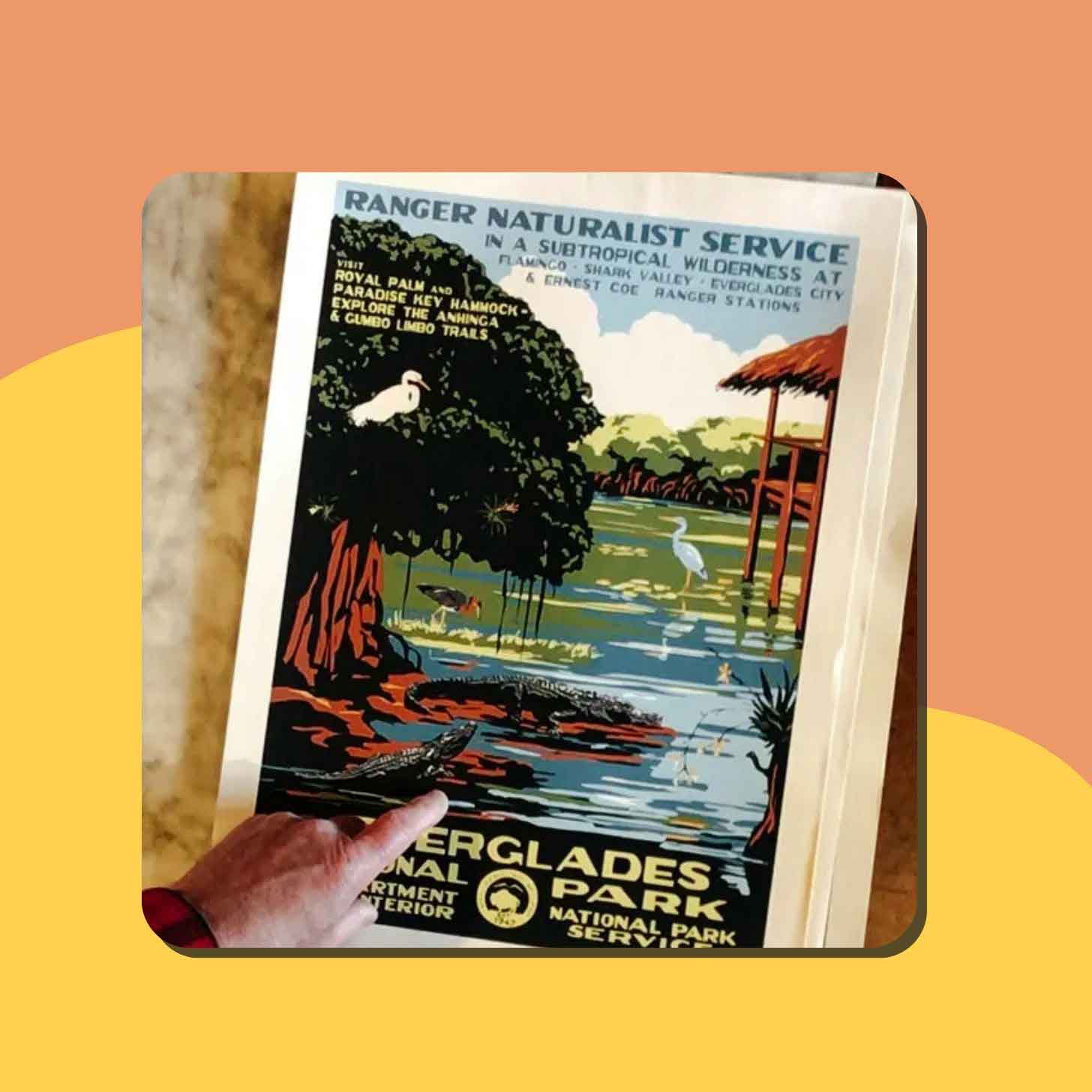
Between 1935 and 1943 the WPA's Federal Art Project printed over two million posters in 35,000 different designs to stir the public's imagination for education, theater, health, safety, and travel.
Only 2,000 of those original posters have survived, but after lots of hard work, a number of those original designs have been restored to be offered as screened prints.
What’s good:
- Since 1998, Ranger Doug has donated 1% of gross sales to nonprofits that preserve and protect art and architecture within and around our national parks
Shop: Ranger Doug’s Enterprises
Bandits Bandanas

You don’t have to be a cute pooch or an old-timey cowboy to rock a bandana anymore. In fact, bandanas are a perfect accessory for a national park excursion and have the added bonus of being a utilitarian item to have on hand.
What’s good:
- Bandits Bandanas are designed by different artists, and 10% of the final sale price of each bandana is donated to a charity of the artist’s choice
- Each bandana is handmade from sustainably-sourced, 100% organic cotton
Shop: Bandits
National Park Sculpture Necklace

Handmade by artist Grace Vanderbush, these wearable clay sculptures capture the intricate details of some of America’s favorite national parks. Choose from 15 park landscapes.
What’s good:
- $2 of your purchase will go directly to the National Parks Foundation
Shop: Uncommon Goods
2026 National Parks Calendar

Plan your year with adventure in mind! This calendar is filled with bold, colorful art that honors the beauty of some of America’s favorite parks.
What’s good:
- Certified B Corp
- Every purchase benefits national parks and public lands
- Has donated over $2.7 million to parklands since 2014, including building habitat and wildlife restoration, advocacy and education, and volunteer programs
Shop: Parks Project
Patagonia Black Hole Bags

We know you’re probably like “my [insert loved one here] already has so many bags and luggage!” But… do they have Patagonia’s Black Hole Bags?
From versatile, lightweight totes to expandable backpacks to incredibly efficient suitcases — these durable bags can pack all your essentials and more.
What’s good:
- Made with 100% recycled nylon
- Patagonia has a long history of preserving public lands, with “Earth” being the company’s “only shareholder”
Shop: REI
“Never Hike Alone” Tote Bag

For the people who always bring their four-legged friend along on the journey, this tote bag is the perfect companion for all their adventures.
What’s good:
- 4% of all proceeds go to parks, forests, and oceans
- Wild Tribute has donated over $2.5 million in funds through its “4 The Parks” program
Shop: Wild Tribute
Nomadix National Park Towel

A versatile, easy-to-pack towel for any camping, beach, or swimming trip, Nomadix made them even better by adorning them with images of our favorite national parks.
What’s good:
- Made from postconsumer recycled plastic bottles
- A portion of each sale from the national park collection is donated to the Conservation Alliance
National Park Pins

While you’re at it, add any of these national park traveler pins to that tote bag — or jacket or pin banner!
What’s good:
- Plastic-free packaging
- Every purchase supports public lands nonprofits like the National Wildlife Federation, Leave No Trace, the National Forest Foundation, and the U.S. Forest Service
- The Landmark Project has raised over $1.3 million in funds for their conservation partners
Shop: The Landmark Project
National Park Pin Display Shadow Box

Or… display those collectible pins in a beautifully crafted display box. The frame comes with a wood panel with an arrowhead cutout and is backed by a layer of cork and foam board.
What’s good:
- Every purchase includes a donation to the support national parks
Shop: National Park Obsessed
National Parks Bucket List Water Bottle

Help them chronicle their national park adventures — all while staying hydrated.
Each stainless steel water bottle is laser-engraved with all 63 U.S. parks and comes with 63 accompanying stickers to decorate as your gift recipient completes their journeys.
The bottles and stickers are weatherproof and dishwasher-safe.
What’s good:
- 5% of every purchase is donated to the National Parks Conservation Association
Shop: Uncommon Goods
Pendleton Throw Blanket
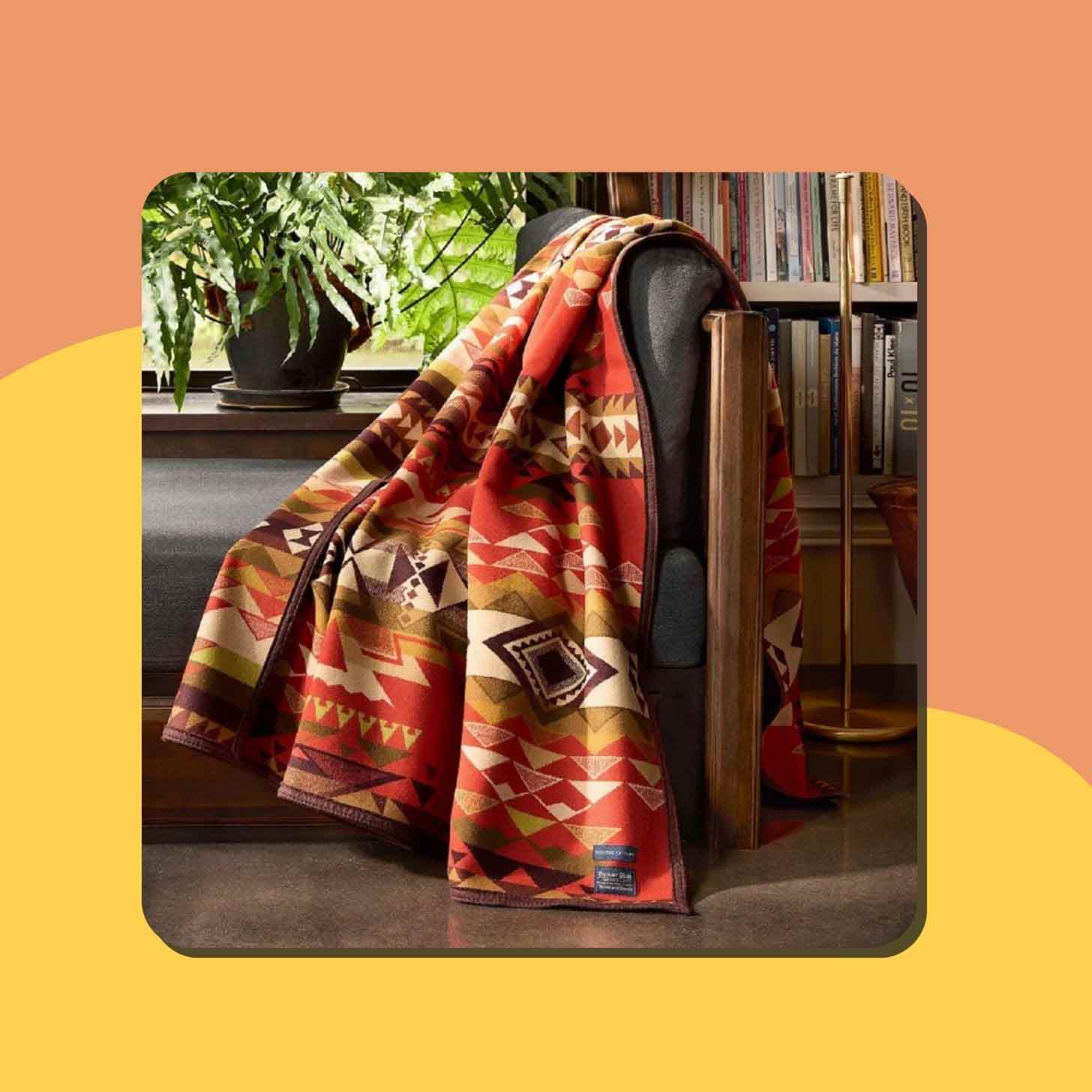
Pendleton’s cozy throw blankets are a classic luxury staple for anyone who loves the outdoors.
These come in a variety of colors inspired by national parks, including Joshua Tree, Crater Lake, Grand Canyon, Zion, and more.
All blankets also come with a leather carrying strap.
What’s good:
- For every item Pendleton sells from its national park collection, the National Park Foundation receives a royalty, with at least $2.4 million donated so far
Shop: Pendleton
Hand-Drawn National Park Map Print
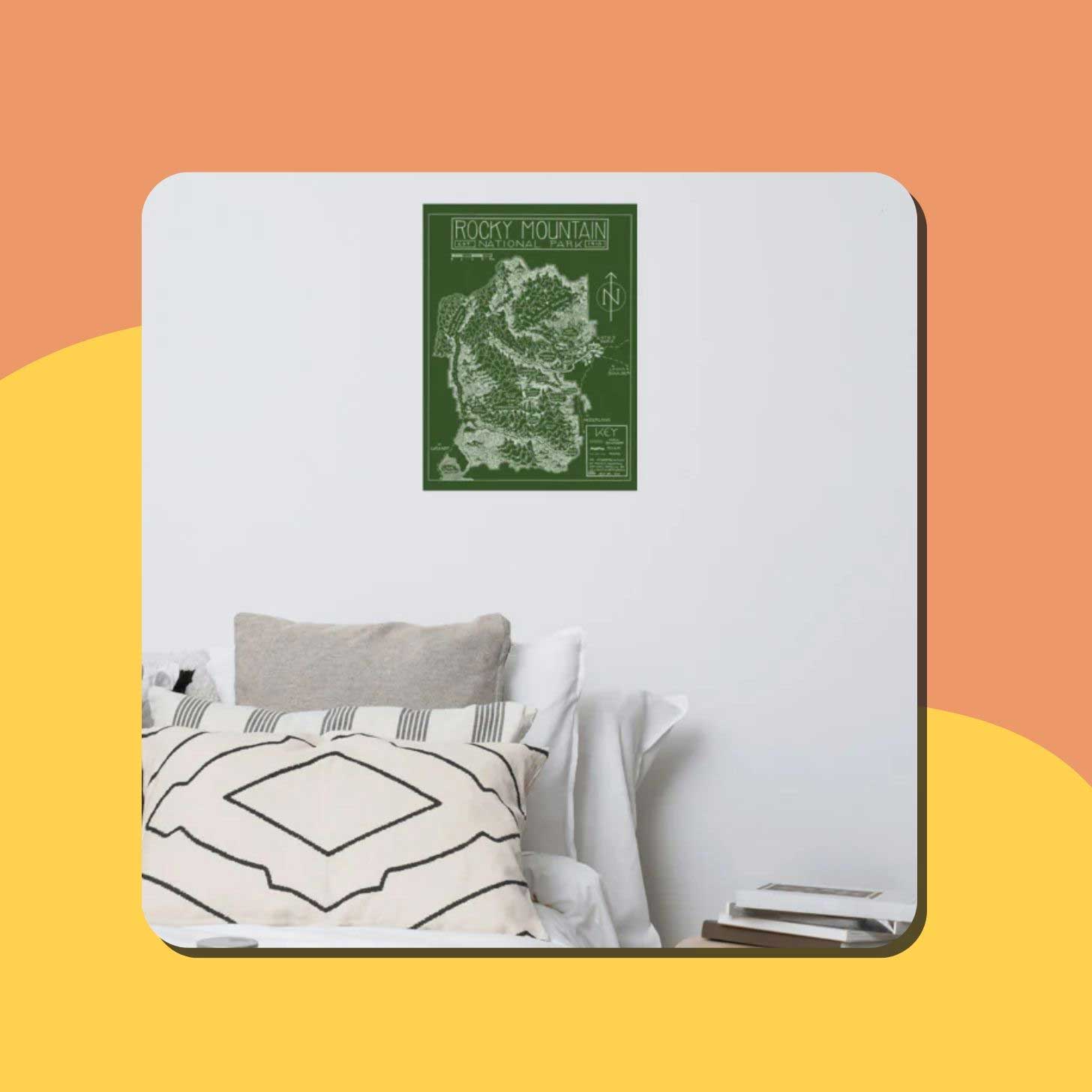
A beautiful art print for any park lover’s home, these hand-drawn maps are made with a LAMY fountain pen and ink with a high degree of detail.
Based on the maps provided at national park visitor centers, these detailed prints are artistic representations that’ll bring travelers right back to their favorite landmarks from the comfort of their homes.
What’s good:
- Every purchase includes a donation to the support national parks
Shop: National Park Obsessed
National Park Fill-In-The-Blank Poster
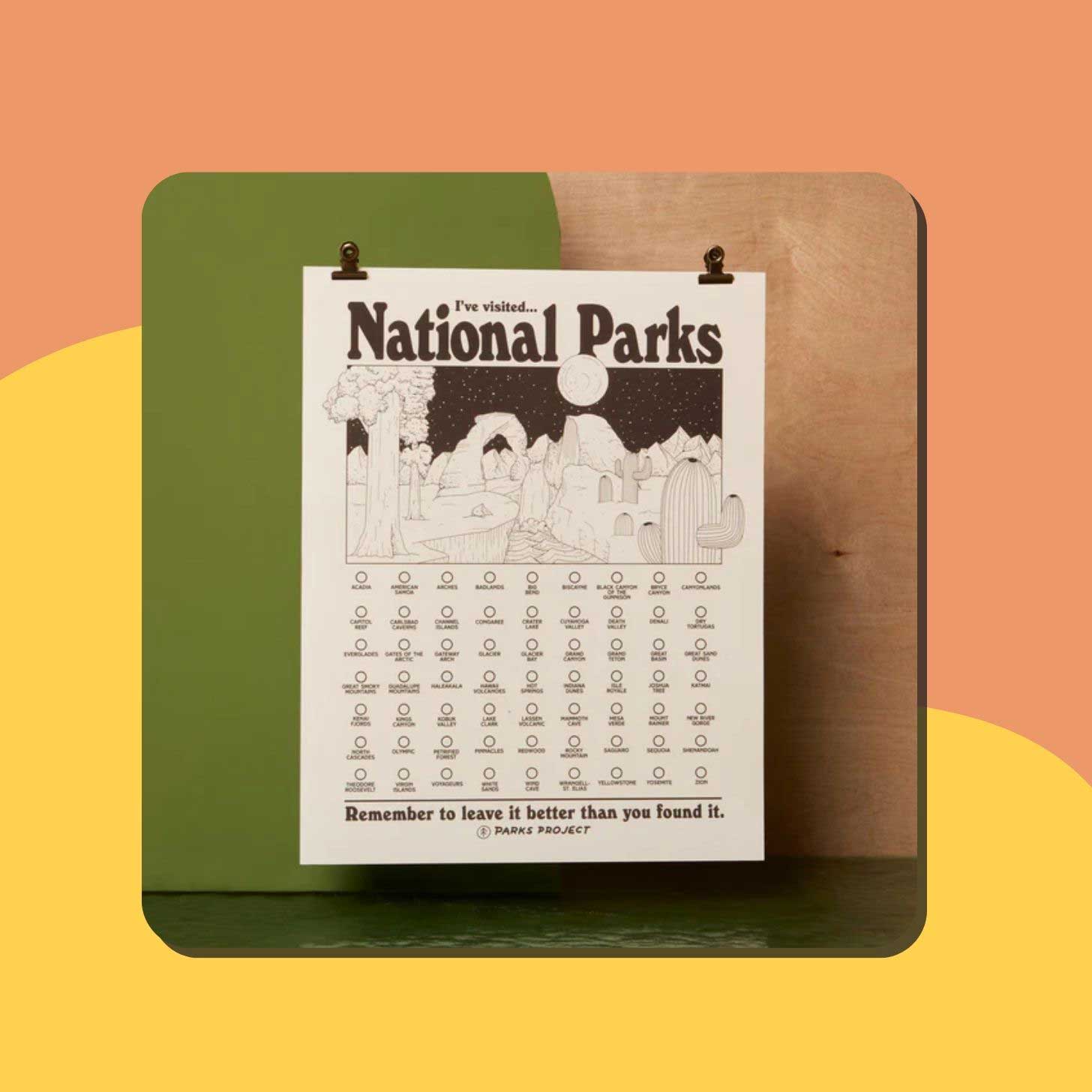
Help them track their travels with a poster that doubles as great decor. Plus, it includes a little reminder to always adventure responsibly.
What’s good:
- Certified B Corp
- Every purchase benefits national parks and public lands
- Has donated over $2.7 million to parklands since 2014, including building habitat and wildlife restoration, advocacy and education, and volunteer programs
Shop: Parks Project
Bark Ranger Bandana

Utilitarian and stylish, this Bark Ranger bandana is full of desert survival tips that you can easily tie to yourself or your pup for easy access.
The microfiber fabric gives UPF 35 protection and is quick-drying and odor-resistant.
What’s good:
- McGovern & Co. dedicates 1% of total sales to programs that promote public land stewardship, including the National Park Foundation, Public Lands Alliance, and more
Shop: McGovern & Co.
Camp Chairs

The one downside to national parks is that there aren’t too many comfortable places to sit.
Help your gift recipient bring the furniture to the forest or beach with these lightweight, packable camp chairs from Parks Project.
What’s good:
- Certified B Corp
- Every purchase benefits national parks and public lands
- Has donated over $2.7 million to parklands since 2014, including building habitat and wildlife restoration, advocacy and education, and volunteer programs
Shop: Parks Project
Pendleton National Park Patch Pillow
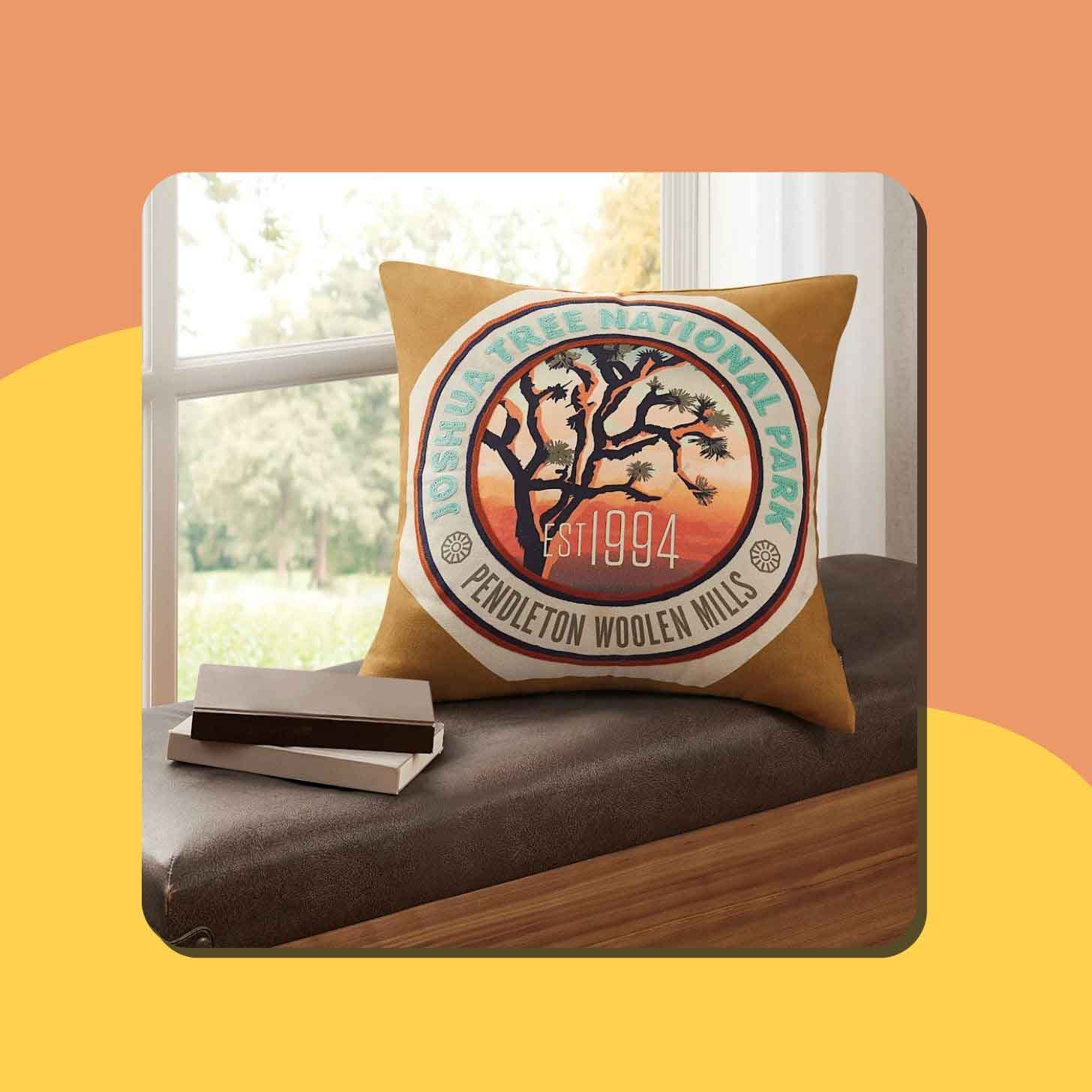
The perfect throw to add to any room, these pillows feature colorful embroidered details honoring a myriad of beloved parks: Crater Lake, Joshua Tree, and Acadia.
What’s good:
- For every item Pendleton sells from its national park collection, the National Park Foundation receives a royalty, with at least $2.4 million donated so far
Shop: Pendleton
Playing Cards

Every (properly sanctioned and extinguished) campfire needs a deck of playing cards to pass the time under the stars. These national park-themed cards make for a fabulous stocking stuffer!
What’s good:
- Plastic-free packaging
- Every purchase supports public lands nonprofits like the National Wildlife Federation, Leave No Trace, the National Forest Foundation, and the U.S. Forest Service
- The Landmark Project has raised over $1.3 million in funds for their conservation partners
Shop: The Landmark Project
PARKS Board Game

Encourage a little healthy competition with this national parks strategy game. This award-winning, immersive board game encourages players to hike along different trails and collect resources.
Take the journey solo or play with up to 5 other players.
What’s good:
- Supports 1% for the Planet and the Forest Stewardship Council
Shop: Amazon
Smokey Bear Jigsaw Puzzle

This 200-piece puzzle will be fun for the whole family! Featuring an adorable wilderness scene and some favorite characters, it’ll be a delight to put together during a cozy cabin weekend.
What’s good:
- Plastic-free packaging
- Every purchase supports public lands nonprofits like the National Wildlife Federation, Leave No Trace, the National Forest Foundation, and the U.S. Forest Service
- The Landmark Project has raised over $1.3 million in funds for their conservation partners
- All Smokey Bear products are licensed through the U.S. Forest Service, and 10% of the proceeds support wildfire prevention education.
Shop: The Landmark Project
National Park Jenga
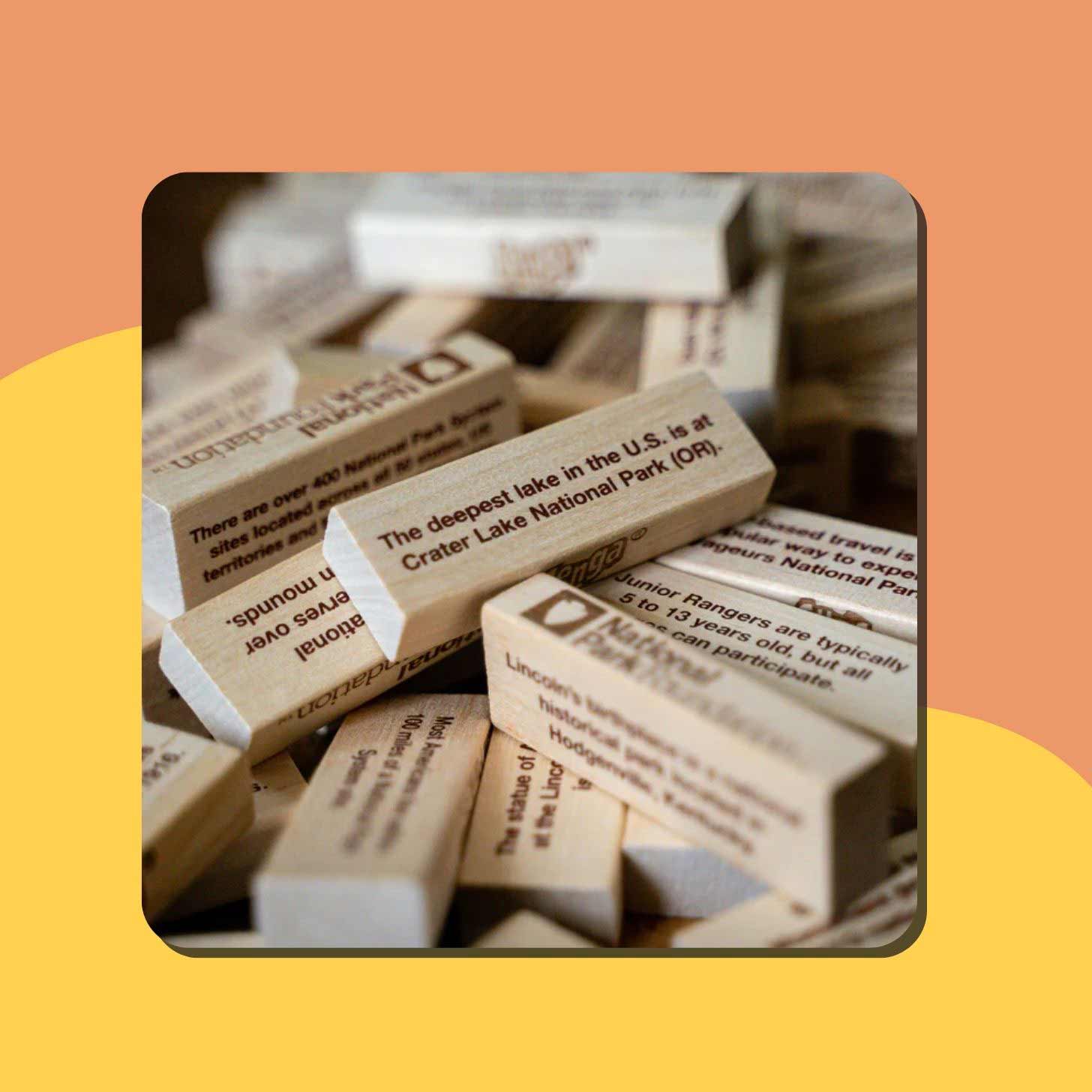
It’s the classic Jenga game with a national park twist. Pull out a block without crashing the stack — and show off your national park passion all at the same time.
What’s good:
- A portion of proceeds benefit the National Park Foundation
Shop: Amazon
Pendleton Dog Coat

If their furry friend is hitting the trails, they deserve to be cute and comfy, too.
Get this iconic coat in colors inspired by Joshua Tree, Acadia, Grand Canyon, Crater Lake, and Glacier National Parks.
What’s good:
- For every item Pendleton sells from its national park collection, the National Park Foundation receives a royalty, with at least $2.4 million donated so far
A Donation

Give a donation in your gift recipient’s name to any of the following nonprofits that work tirelessly to protect our national parks, public lands, and the people who care for them.
- Donate to the National Park Foundation
- Donate to the National Park Conservation Association
- Donate to the National Forest Foundation
U.S. National Parks are incredible. A visit to a national park is an opportunity to enjoy nature, protect the planet, and celebrate time with friends, family, and fellow park-goers.
And national parks are even better when they’re free!
Every year the National Park Service announces several “fee-free days” to ensure that the parks remain accessible to everyone.
“Whether on an entrance fee-free day or throughout the year, we encourage everyone to discover their national parks and the benefits that come from spending time outdoors,” said former NPS Director Chuck Sams in a statement.
“National parks are for everyone and we are committed to increasing access and providing opportunities for all to experience the sense of wonder, awe, and refreshment that comes with a visit to these treasured landscapes and sites.”
There are more than 420 national parks in the United States and 110 have admission fees. This means that during 365 days, more than 310 parks are completely free to visit.
In this article we’re highlighting this year’s fee-free days, alternative ways to get free or discounted park passes, and ways you can make a positive difference for national parks all year round —

2026 Free National Park Days
The NPS has made eight days completely free to visit in 2026:
| Date | Holiday |
| Monday, February 16, 2026 | Presidents Day |
| Monday, May 25, 2026 | Memorial Day |
| Sunday, June 14, 2026 | Flag Day/President Trump's Birthday |
| July 3 - July 5, 2026 | Independence Day Weekend |
| Tuesday, August 25, 2026 | 110th Birthday of the National Park Service |
| Thursday, September 17, 2026 | Constitution Day |
| Tuesday, October 27, 2026 | Theodore Roosevelt's Birthday |
| Wednesday, November 11, 2026 | Veterans Day |
For the first time — beginning in 2026, free entrance on these days applies to U.S. citizens and residents only. According to the NPS, nonresidents will pay the regular entrance fee and any applicable nonresident fees.
You can also keep an eye out for other fee-free days offered by other federal and state land management agencies including the U.S. Fish & Wildlife Service, the Bureau of Land Management, the U.S. Forest Service, the U.S. Army Corps of Engineers, and the Bureau of Reclamation. (We recommend searching “Fee Free” on their respective websites when planning your next trip — or following their Facebook pages to stay on top of fee-free days.)

How else can I get free or discounted access to national parks?
Free Access
Fourth Graders and Their Families

Thanks to the Every Kid in a Park program and the Every Kid Outdoors Act, fourth graders in the United States get free entry into National Parks. We wish we would have had this when we were kids!
The pass is valid from September 1 through August 31 of a student’s fourth-grade year.
According to the Every Kid in a Park program, when a fourth grader travels with their family and friends in one vehicle, they get everyone in for free (at participating sites that charge per vehicle). And if visiting a site that charges per person, the fourth grader and up to three accompanying adults will be admitted for free.
So, it’s about time you befriended a cool kid — they come with perks!
You can learn more about the fourth grade pass at everykidoutdoors.gov.
People with Disabilities

The National Park Service offers a free lifetime Access Pass to any U.S. citizen or permanent resident who “has been medically determined to have a permanent disability… that severely limits one or more major life activities.”
You can learn more about how to qualify and access the National Park Access Pass on the National Park Service’s Accessibility page.
U.S. Military Members and Their Dependents

Current U.S. military members and their dependents, Reserve, and National Guard members can get an annual America the Beautiful - National Parks & Federal Recreational Lands Military Pass for free!
U.S. Military Veterans

Veterans get free access to national parks for life! All you need is to present one of the following forms of identification:
- Department of Defense Identification Card (non-expired CAC Card)
- Veteran Health Identification Card (VHIC)
- Veteran ID Card
- Veterans designation on a state-issued U.S. driver’s license or identification card
There are also new lifetime passes available to veterans — which is especially helpful for national parks where there isn’t a person to present your identification to.
Learn more about these benefits and read FAQs from the National Park Service.
Gold Star Families
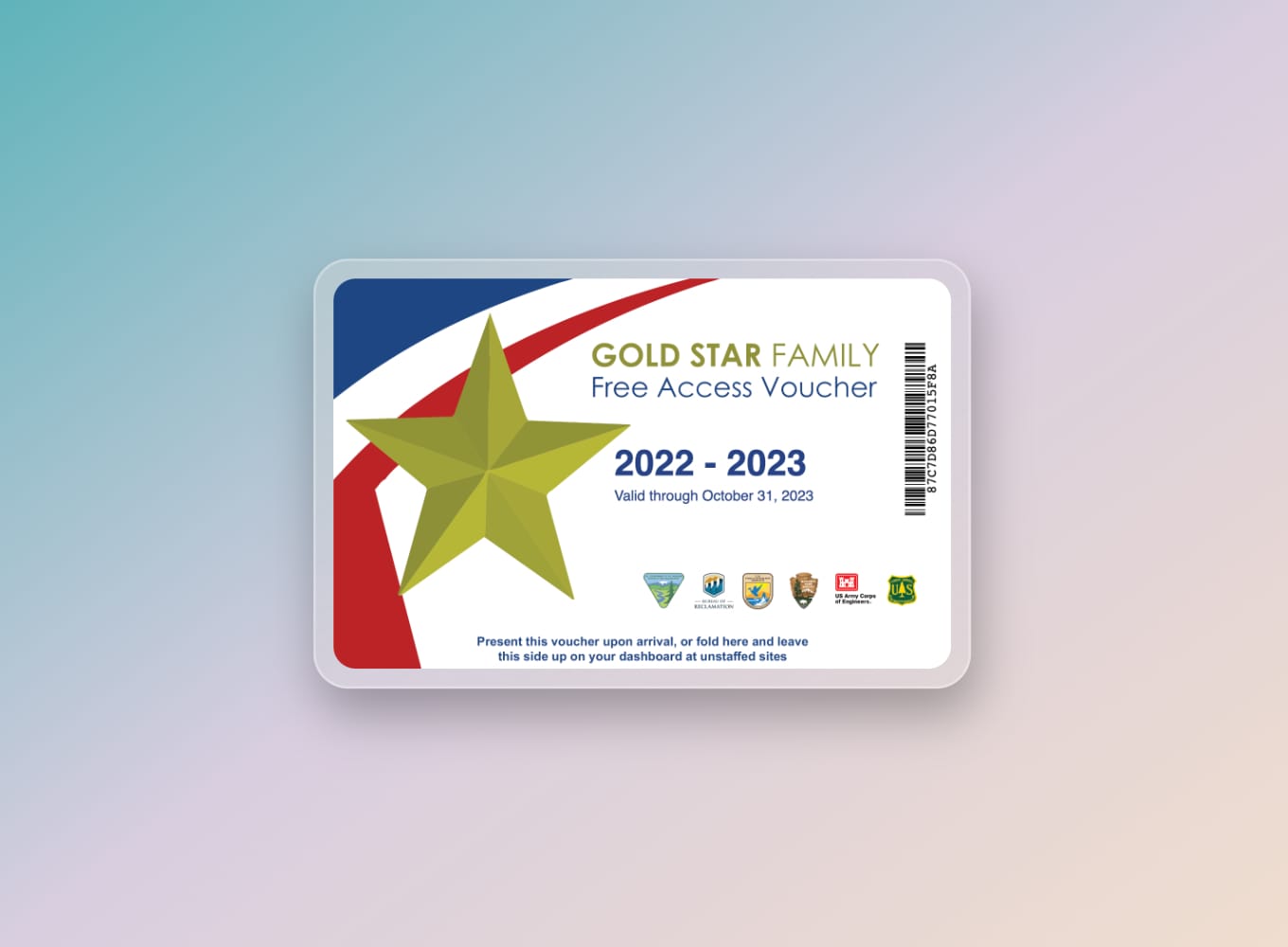
Gold Star families receive similar National Parks benefits to veterans. According to the National Park Service, Gold Star family members must “download and print a voucher to present to park staff, exchange for an Interagency Military Pass, or place on the vehicle dashboard at unstaffed sites.”
Explore the list of federal locations that issue passes or access your voucher online on the National Park Service military FAQ page.
Eligible National Park Service Volunteers

The Volunteers-in-Parks (VIP) program provides opportunities for parks-lovers of all ages to volunteer in national parks. You can volunteer as much or as little as you want, but if you complete at least 250 volunteer hours —with a federal agency participating in the Interagency Pass Program (IPP) — within one year, you will receive a one-year Volunteer Pass.
This will give you access to more than 2,000 federal recreation areas participating in the IPP — including every national park!
Discounted Access
U.S. Citizens Over 62 Years Old
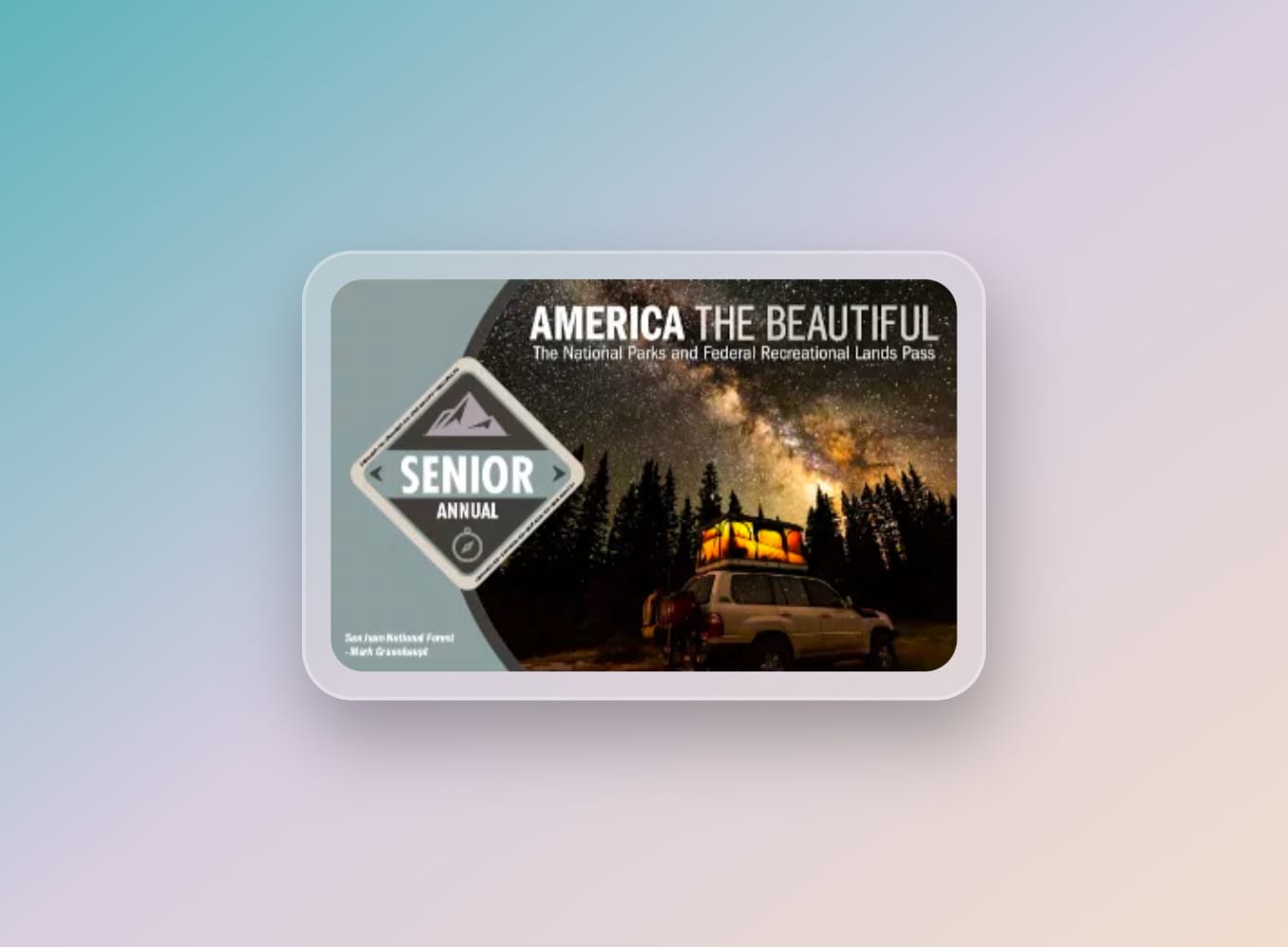
On your 62nd birthday (or anytime after), you can (and should!) buy an $80 lifetime pass. This pass will get you into any U.S. national park for free for the rest of your life. You can also purchase a significantly discounted $20 annual pass.
Anyone & Everyone

If you’re going to visit multiple parks in a year, the annual America the Beautiful National Parks and Federal Recreational Lands Pass is only $80. It’ll pay for itself in just a few visits!
This is especially helpful for trips to locations — like Arizona or Utah — where you might be visiting multiple national parks in a day or week.
This pass is available to anyone — and according to the National Parks Service, those traveling with passholders can usually enter parks for free.
We recommend buying the pass from (our wonderful affiliate partner!) REI, because they’ll also donate 10% of the pass’s proceeds to the National Forest Foundation, the National Park Foundation, and the U.S. Endowment for Forestry & Communities.
The pass is good for one year from the month you purchase — so there’s no need to wait until the beginning of the year to buy.

How much do national park admission fees cost?
Admission fees for national parks range from $5 to $35. For example, Zion National Park currently charges $20 per person — and Pictured Rocks National Park charges $5 per person.
Many parks allow you to pay per vehicle — which brings the price down significantly if you’re visiting with your whole family or a group of friends.
According to the National Park Service, all of the money from admission fees remain with the service — and 80%-100% of the money stays in the park where it was collected.
And again, the annual America the Beautiful National Parks and Federal Recreational Lands Pass is only $79.99.

How else can I support U.S. National Parks?
Practice Responsible Recreation

When you visit national parks (or anywhere, really), you have the opportunity to leave the place better than you found it.
Pick up your trash, pick up someone else’s trash, stay on marked trails, follow park rules, be thoughtful about fire, and thank a park ranger. It’s what Leslie Knope would want you to do.
Buy Products That Support National Parks
If you’re going to shop anyway, you might as well choose to buy products that make a positive difference. There are a number of incredible brands that donate a portion of their profits to support national parks.
Explore our curated recommendations of gifts for national park lovers
Call Your Representatives
Our national parks are protected because of intentional legislative choices throughout American history. By calling your elected officials, you can help ensure that national parks have the funding they need, are cared for after disasters, and are never auctioned off to the highest bidder.
Simply let your representatives know that you value national parks and want them to work to protect them. This becomes especially relevant when national parks are in the news.
Become a Volunteer

Giving a little bit of your time and energy to a national park near you can make a big difference — and there’s a diverse range of opportunities available.
“Some positions are specialized and require particular talents, knowledge, skills, and abilities, as well as a background check,” reads the NPS website. “Other positions only require a desire and willingness to volunteer.”
Unique volunteer opportunities include:
- Group volunteering events
- Citizen science opportunities
- The Community Volunteer Ambassador Program
- Artist-in-Residence programs
- The Girl Scout Ranger Program
- Boy Scout volunteer programs
- The International Volunteers-in-Parks Program
- The Amtrak Trails & Rails Program
Some volunteer opportunities come with small stipends, free housing, or other perks.
Regardless of the volunteer position you take on, it’s a wonderful opportunity to spend quality time in the parks, make a meaningful difference, and, as mentioned earlier, a great way to get a free national parks pass.
You can explore volunteer opportunities at volunteer.gov.
Become a Park Ranger

People who work in recreation-centric careers, including park rangers, consistently rank their jobs among the most meaningful jobs in the United States. And every day you get to play a role in protecting and celebrating nature.
While jobs in the National Park Service are highly competitive, there are plenty of ways to get your foot in the door — including specific career opportunities for students and for adults over 55 years old.
If the life of a park ranger aligns with your lifestyle, budget, and values, it’s an absolutely dreamy career choice.
Explore employment opportunities on the NPS website.
You might also like:
- Explore the best quotes about national parks
- Explore the best quotes about trees
- Read about the efforts to rename public lands that carry derogatory names
- Read about the ecologists saving ancient sequoia trees with “good fires”
- Dive into Good Good Good’s calendar of environmental holidays
This story is part of Cool Project, a series about surprising ways cities are cranking down the heat in a warming world. Learn more about the series and the artwork here.
Along the tree-lined sidewalks of Tel Aviv’s Atidim Park, a business and commercial district in the north of the city, a curious new addition to the urban canopy arrived a few months ago.
Resembling something between a satellite dish and a ship’s sail, the structure known as LumiWeave is made of an innovative lightweight fabric designed to provide shade during the day and solar-powered lighting once the sun sets in the Israeli city.
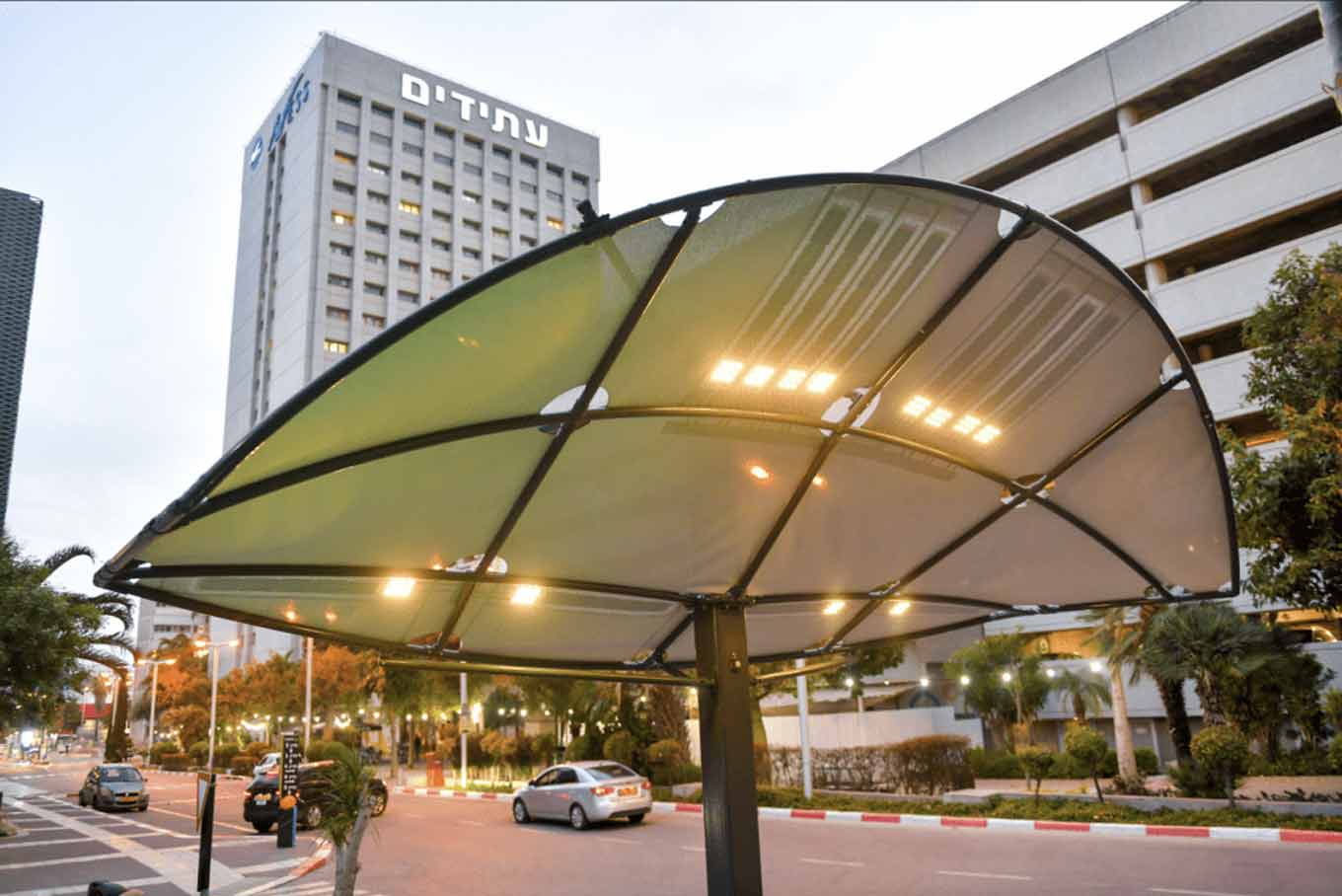
“We want to incentivize walking and mobility,” says Gaby Kaminsky, managing director at CityZone, an urban innovation hub that is a collaboration between Tel Aviv-Yafo Municipality, Tel Aviv University and Atidim Park, a district that sees 10,000 people pass through it every day. “
If people have to stand in the sun, they’ll get all sweaty and just won’t do it. So we have to make the city a tolerable place even on hot days.”
For all its obvious cooling benefits, shade has often been overlooked by authorities when it comes to responding to extreme heat. But Tel Aviv, where peak summer temperatures can regularly exceed 40 degrees Celsius (104 Fahrenheit), has been shining a light on the importance of shade through a number of municipal projects as the world grapples with a rapidly warming planet.
The impact of shade on the body is unique. It’s well established that cities have microclimates known as “urban heat islands,” yet high air temperatures are not the only reason for heat stress. Research shows that standing in the shade can reduce perceived heat by 8.3 degrees Celsius (15 Fahrenheit) compared to direct sunlight, hugely mitigating health threats such as cardiovascular and respiratory disorders, heat stroke and even death.
At least 363 Israelis died during heatwaves between 2012 to 2020, according to a study by Israel’s Ministry of Environmental Protection and Tel Aviv University.
Climate change will lead to more frequent, severe and prolonged heatwaves. Research published in the Communications Earth and Environment journal found 92 percent of the 165 countries studied are expected to have extremely hot annual temperatures once every two years by 2030 under current national emission reduction commitments.
In the pre-industrial era it was as little as once in one hundred years.
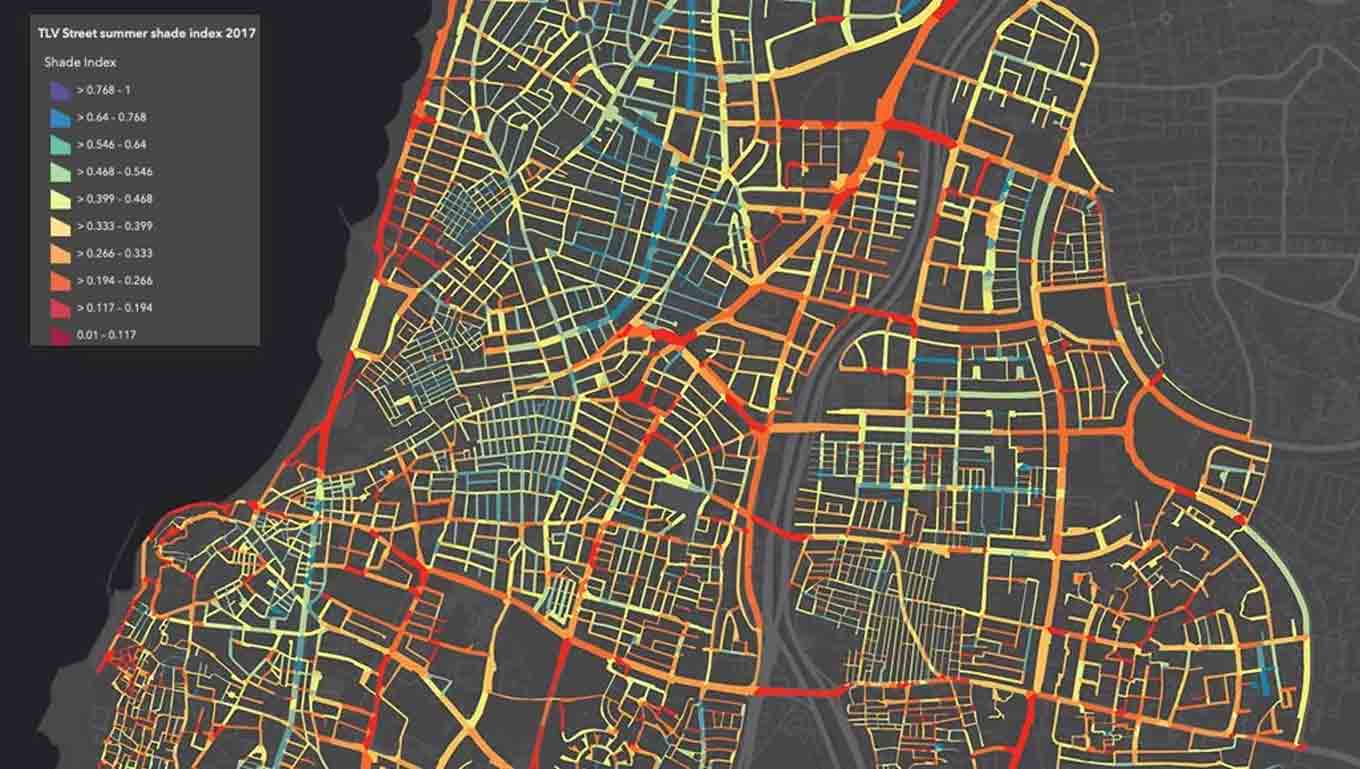
Tel Aviv is taking these figures and the role shade can play in mitigating extreme heat seriously. Prior to the launch of LumiWeave, the city developed “shade maps,” which document the shading of public space provided by things such as buildings, trees, colonnades and pergolas.
According to Dr. Or Aleksandrowicz, an assistant professor at the Israel Institute of Technology’s Faculty of Architecture and Town Planning who led the mapping initiative, the maps allow rare insight at the street and neighborhood-level. “We need more shade, but where and what?” asks Aleksandrowicz, who developed the maps with a small team over several months in 2018 and 2019.
The team used state-of-the-art analysis to create an indicator called the Shade Index, allowing for comparison of shade provision across the city on a scale of 0 to 1. They found classic indicators such as Tree Canopy Cover or Sky View Factor, while easier to calculate on a city-level, can misrepresent daily and annual variance in solar levels.
To minimize costs, they also concluded that denser urban areas supplemented by tree planting may be a better approach to urban design than more open spaces, which require many more trees to provide similar levels of street shade.
“Trees are something we cherish and want to plant more of,” says Aleksandrowicz. “But if you plant them without space for roots, you will have a constant source of problems. Trees require much more infrastructure investment to make space for them.”
Precise mapping of urban trees can be useful not only for shade mapping but also for understanding the efficacy in tree planting for climatic purposes, according to a report published in 2021 by C40’s Cool Cities Network. In that regard, Tel Aviv’s shade maps could soon bear fruit: In January, Israel announced it would plant 450,000 trees in urban areas by 2040 at an estimated cost of NIS 2.25 billion ($676 million).
One problem Aleksandrowicz’s team highlighted, however, was that they only had 2.5D rather than 3D city-scale mapping of buildings and tree canopies, meaning that shade may have been overestimated since it was calculated as maximal during the entire day, irrespective of solar orientation and leaf density. They also called for universal regulations on shade provision that could be used for setting benchmarks.
Sam Bloch, a New York-based journalist who’s in the process of writing Shade, a book exploring shade’s relationship to climate and inequality, says that modern municipalities have tended to overlook shade because of technology such as air conditioning and smart glass that blocks sunlight, as well as the dominance of cars, whose need for wide roads narrows the potential area for sidewalks and gives less space for trees.
“But shade has this special value,” says Bloch. “It’s where people want to be on hot days. It maintains common spaces and social connections.”
Shade, too, can play a role in countering inequality. Bloch says there can be 10 to 15 degrees difference in air temperature between neighborhoods in the same city due to infrastructure. “There’s a distinction between public and private shade,” he says. “And there tends to be shade poverty in poorer areas. Cities should react to this.”
Across various civilizations, shade has played an important role, according to Bloch. Before the idea of the street tree, the Roman Empire often had arcaded walkways in towns. Historic Middle Eastern and North African settlements, meanwhile, had very narrow streets, allowing buildings to create shade.

Nowadays, while Tel Aviv is is leading the way, Bloch says, others are taking different tacks: Vienna offers citizens a grant to install exterior window blinds and awnings; Phoenix is turning its black asphalt streets gray, using a special sealant that reflects rather than absorbs the desert sun; Melbourne supports its tree shade through greywater recycling; and Singapore has a network of canopy walkways for rain and sun protection, as well as regulations stating that at least 50 percent of public areas must be in shade during the day.
Back in Tel Aviv, the municipality has made LumiWeave orders for 10 more locations across the city. The fabric, created by designer Anai Green, is embedded with solar, organic photovoltaic cells. It requires no electrical infrastructure, saving on costs, and can provide lighting at night for up to three days without sun. But that shouldn’t be an issue as Tel Aviv has an average of about 300 sunny days a year.
Alongside LumiWeave, CityZone is working with other Tel Aviv-based start-ups such as SolCold, which has developed a paint — to be piloted later this year — that actively cools down when exposed to the sun, in theory reducing temperatures to lower than shade. BioShade, meanwhile, uses hydroponic systems to grow shading plants by up to 10 inches a day, helping to accelerate and simplify the process of tree growth.
“We don’t have time to waste,” says Aleksandrowicz. “We need to use the knowledge we have now for large-scale implementation of shade.”
Editor’s note: This piece discusses suicide and the mental health crises among U.S. farmers and ranchers.
Monte Bush was only 15 when his grandfather died by suicide on the family farm outside Riverton, Wyoming. One minute, they were working on a pivot irrigator and discussing how expensive a new pump would be; an hour later, Bush found his grandpa’s body.
He took over that summer as the property’s caretaker with his grandmother, making sure malt barley, pinto beans and alfalfa were harvested on time and managing a herd of 400 sheep.
“I never grieved,” he said. “I buried it, and I got back to work.”
More than 30 years passed before Bush’s trauma and untreated mental health problems bubbled over. He turned to whiskey for solace, and after a night of drinking near the town of Greybull, took off in his truck and slammed into an oncoming vehicle. He wore no seatbelt, and his forehead struck the windshield. Doctors later said that he and some of the other vehicle’s four occupants were lucky to survive.
A new hotline seeks to help people like Bush before they hit their breaking point.
The AgriStress Helpline for Farmers and Ranchers is staffed 24 hours a day, seven days a week by professionals trained to work with members of agricultural communities.
It’s run by AgriSafe, a nonprofit that seeks to reduce disparities in rural health care, and Via Link, a crisis support provider. The hotline, which is also available in Pennsylvania, Texas, Missouri and Virginia, is supported with grant funding from each state’s Department of Agriculture. So far, Wyoming is the only Western state to get involved.

The launch comes at a time of renewed attention to mental health resources across the country. The federal crisis number, 988, which accesses networks of local and state-funded crisis centers, became available to all landline and cellphone users in mid-July.
Mental health is a particularly important issue in Wyoming. The state had the nation’s highest rate of suicides per capita in 2020; according to the Centers for Disease Control and Prevention, its suicide rate is more than double the national average.
Wyoming’s suicide prevention line only recently received funding for 24/7 coverage, although staffing is still limited.
Farmers and ranchers in need can always call the National Suicide Prevention Lifeline. But they might meet providers who don’t understand the unique challenges they face: keeping the ranch in the family, operating on slim financial margins, battling waves of grasshoppers or watching crops wither during drought.
“There are so many factors in agriculture that are out of their control,” said Tara Haskins, who runs AgriSafe’s mental health programming and the help line.
“They can’t control the market. They can’t control the weather. They feel the need to keep working regardless, because when they spend time away, they can equate that to money lost.”
“There are so many factors in agriculture that are out of their control.”
AgriStress line callers will receive a more personalized response. While the line offers the same suicide prevention services as calling 988 does — to make sure they are not in physical danger or at risk of imminent self-harm, providing emotional support and coping techniques, referring clients to additional resources — the new hotline’s providers have extra agricultural training and regional expertise.
They know what’s locally grown and raised, and what common stressors are.
Clinton Wilson, program director of AgWell, an organization that provides stress-management support to agricultural workers throughout Wyoming, Colorado and New Mexico, sees the need for empathetic mental health resources specifically designed for farmers and ranchers.
“Mental health does get kicked further down the priority list because you’ve got a calf to deliver, you’ve got a row of corn to harvest, or you’ve got weeds to go and attend to,” he said.
Wyoming’s line just started in July, so the Wyoming Department of Agriculture lacks usage statistics. But according to AgriSafe, the Texas and Pennsylvania lines have seen a 10% gain in calls every month since they launched earlier this year.
Farm labor help, crisis de-escalation and financial help are the top three reasons for calls, and AgriSafe hopes the pilot states will eventually inform a national rollout. Other Mountain West states, including Alaska, Montana, New Mexico, Idaho and Colorado, also have higher-than-average suicide rates.
It often takes a while for people to find or share a hotline number and feel comfortable using it, so call volumes are expected to increase over time.
“It’s been bred into farmers and ranchers and people working in agriculture that you should be able to do it yourself, you shouldn’t need to depend on anyone,” Wilson said.

Other mental health lines are relatively underused, considering the need. According to Vibrant, the company that administers the National Suicide Prevention Hotline, the line receives about 3.5 million calls a year, a small fraction of the approximately 150 million people who have mental and/or substance abuse disorders, or who have been exposed to potentially traumatizing events.
Experts say that a conversation’s outcome is likely a better indicator of success than overall call volume, even though it’s trickier to track. “Did the call potentially save a life?” said Natalie Roy, executive director of AgriSafe. “That’s hard to measure.”
“It was something I was scared of, because my grandfather was depressed, but I didn’t want to go get help.”
Today, Bush is sober and on a mission to spread awareness about the importance of mental health care, as well as the dangers of drinking and driving.
“Mental health was never talked about,” he said, thinking back to his childhood on the farm. “It was something I was scared of, because my grandfather was depressed, but I didn’t want to go get help.”
In small towns, where everyone knows everyone’s vehicle, parking your truck outside a therapist’s office isn’t easy. That’s why Bush thinks a hotline like AgriStress could be useful to rural Wyomingites.
“If they know they can get help, or at least start the process, from the comfort of their home … keeping that privacy would be extremely beneficial,” he said. “Once you ask (for help), then you get to start the journey and work through things.”
If you or someone you know needs help, call 988 or 1-800-273-8255 for the National Suicide Prevention Lifeline, or visit suicidepreventionlifeline.org. You can also text HELLO to 741741 to speak with a trained professional at the Crisis Text Line. The AgriStress hotline is available for agricultural producers in Wyoming, Texas, Missouri, Pennsylvania and Virginia at 833-897-2474.
On a quiet side street tucked back in an industrial section of West Baltimore, Damon Ray Harrison revs the engine of his red dirt bike. He sits askew, unable to reach the ground with both feet. The street is empty except for a few other dirt bikes and riders.
Harrison lowers the visor on his helmet and takes off down the street lined with industrial buildings that are set back from the road. Then he pops a wheelie. With the front wheel still in the air, he jumps off the back of the bike, runs a few steps, then jumps back on, continuing his ride down the stretch of empty road.
The teen has been a dirt bike guy since well before his uncle bought him his first bike. “My mother says I loved bikes, immediately.”
But in Baltimore, as in most major cities in the U.S., owning and riding a dirt bike is illegal and can mean jail time and fines for those caught. Government officials from Atlanta to Oakland point to crashes and deaths involving dirt bikes as the reason for the non-violent offense laws established in their cities.
In 2016, Baltimore launched a Dirt Bike Police Task Force to handle the “noise and nuisance” problem; last year, it was disbanded.
Still, dirt bikes remain a hobby for enthusiasts in Charm City. “Dirt bikes are as much a part of Baltimore as the [Inner] Harbor, as SnoCones. And when I think about being Black in the city, [dirt bikes are] part of my blackness,” says Brittany Young. An engineer who worked with both NASA and McCormick Spice Co., she has been working for seven years to change how the city perceives riding and riders.
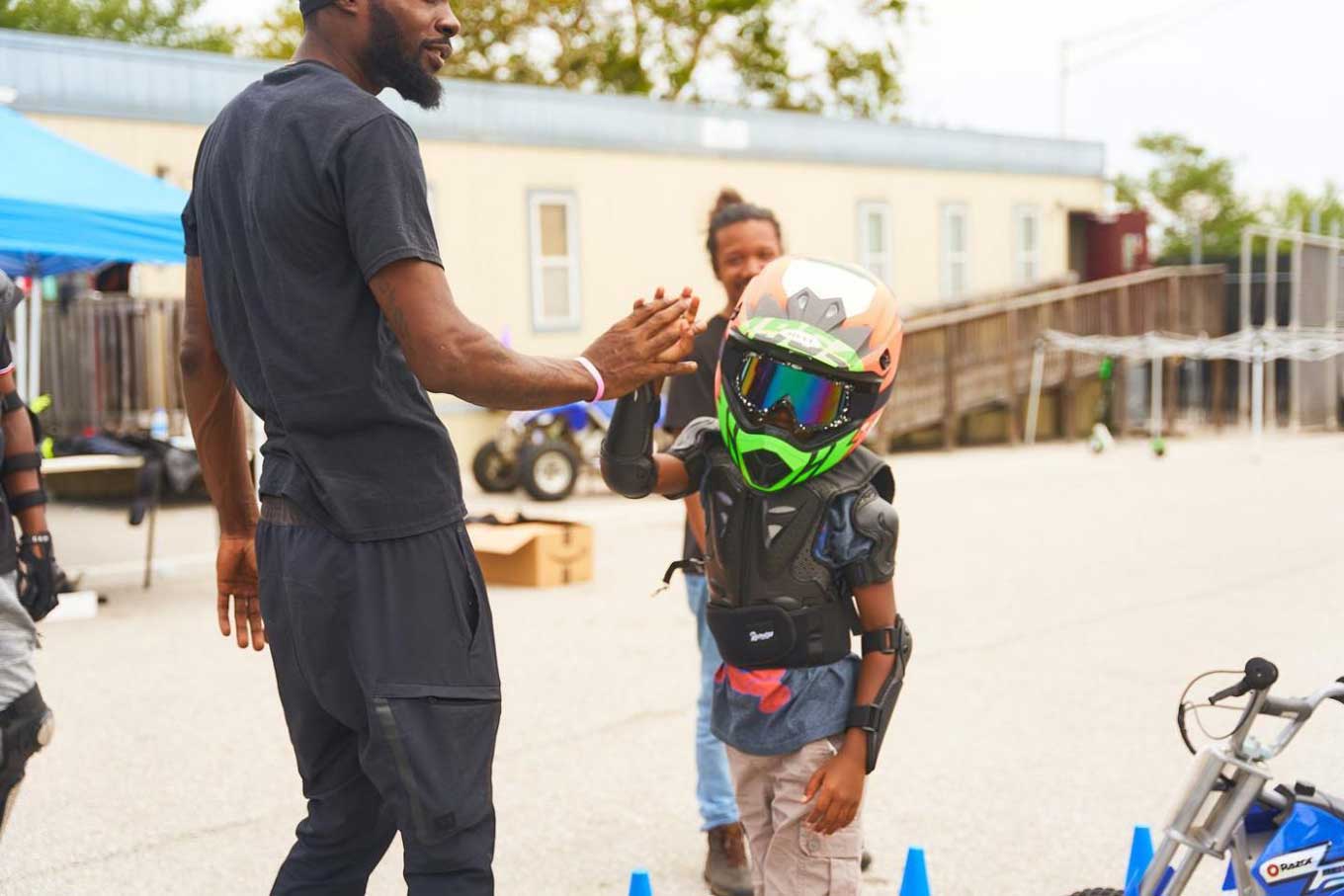
In 2017, Young returned to her roots in West Baltimore and launched a nonprofit called B-360. The name itself calls on people to “be the revolution” – that is, a 360-degree angle. Through a partnership with police, youth can legally ride dirt bikes as part of B-360’s educational programming.
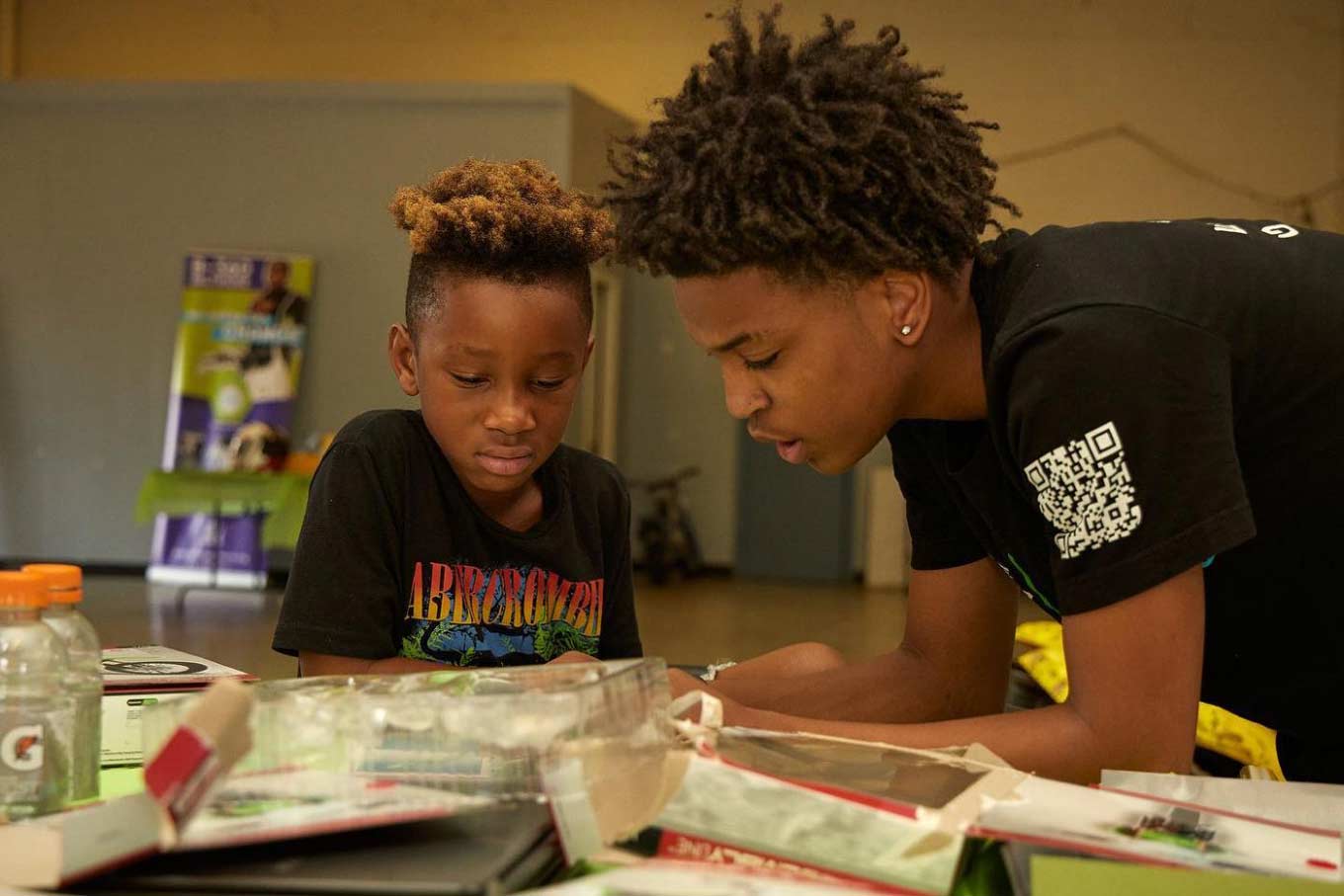
And through hands-on training and workforce development, they can develop their skills and find their way into careers in science, technology, engineering and math. Already, they’ve worked with over 8,500 young Baltimoreans.
“It’s not just about dirt bikes; it’s about Black freedom,” says Young, 33, of her mission. “So, literally, be part of a change, be part of a revolution, be part of systemic change beyond dirt bikes, for Black people across the country.”
Young, who grew up watching riders at Druid Hill Park, says legislators get it wrong when they ban a sport that’s part of Black and Brown culture instead of using it to improve lives through education and open doors to opportunity. Those are two of the key problems that Young says B-360 aims to fix: “The opportunity divide for Black and Brown people, and the need for programmatic solutions instead of incarceration for Black and Brown people.”
B-360 is using dirt bikes to teach STEM to kids of color and hosts events that show off a style of riding that she says has, so far, been ignored by the $42 billion motocross industry.
It’s an attitude that confounds Young: Motocross, she argues, could be a $100 billion dollar industry if it didn’t neglect the talent and drive of Black and Brown riders.
According to a Baltimore Sun report on the history of the city’s dirt biking community, back in the 1970s dirt bikes were not ridden on city streets but on state park trails and dirt roads, which is what their lighter bodies and treaded tires were designed for; but, within a decade, laws against the use of dirt bikes outside of the city had passed. “That’s when — local dirt bike riders say — they moved to the city streets,” the Sun reports. Soon after, dirt bikes became illegal to use on streets in Maryland’s cities, too.
By criminalizing dirt bikes, Young says, the city has spent decades ignoring rather than tapping into unrecognized potential. “A dirt bike police task force is not a strategy or a game plan,” says Young. “Programmatic solutions that unlock potential is a much better approach.” As a “solutionist,” she says, her approach has been using dirt bike culture to help end the cycle of poverty, disrupt the prison pipeline and build bridges in communities.
This month, the mayor’s office announced its second round of the American Rescue Plan Act to nine nonprofit grant recipients. B-360 was awarded $1.25 million in funding to support its STEM education programming and workforce development.
It’s all about perspective, Young says. The Black men and women who ride dirt bikes are seen as the problem, but for her, it’s exactly the opposite. Riders can be the solution, and B-360 is showing how.
Some of the teachers B-360 hires are riders paid to teach students everything from mechanics to stunts, “acknowledging their assets,” Young says. According to the group’s own assessment, B-360 has employed 57 former dirt bike riders, decreased dirt bike arrests by 81% and saved the city $1.2 million in taxpayer dollars by employing locals at risk of incarceration.
Other teachers, like 23-year-old Shavone Mayers Dixon, heard about the program and wanted to get involved. Born and raised in Baltimore, Mayers Dixon graduated from Arizona State with a degree in biomedical engineering. Now, she works full time as a software engineer and part time at B-360’s summer camp.
“We definitely need more young Black people in science, and this is a bridge to do that,” says Mayers Dixon. “It’s doing something that’s fun for them – dirt bikes – to get them engaged and incorporating the education aspect to help them go into careers… That’s all up my alley, just helping out kids, science. It was perfect and I thought, ‘sign me up.’”
When Young was in first grade and “Bill Nye the Science Guy” was her favorite show on TV, her teacher told her that she would never grow up to be an engineer.
Despite being fascinated by science, despite her math and reading levels being beyond her classmates, and despite the lab she’d built for herself in the basement of her West Baltimore home, Young recalls that her white teacher told her that she couldn’t be an engineer.
Why? Because she is Black, female and her parents didn’t go to college.
As Young describes it, she was ready for the world of science, but the world wasn’t ready for her. In corporate America, she was usually the only Black female in a room of engineers, mistaken for a secretary more times than she can count.
“The problem is the receiving side,” says Young. “We can be equipped, prepared, intelligent, but if the work isn’t done to better the reception, it’s always going to be the same issue.”
Her adult experiences were a culmination of the uphill battle she’d fought since childhood. The advanced public middle school into which she’d tested meant a five-hour round-trip commute on up to five buses to the other side of Baltimore, starting at the age of 10. The commute continued when she was accepted into The Baltimore Polytechnic Institute, a top STEM-oriented high school.
Educating Baltimore’s Black and Brown youth and providing better experiences than she had to endure are huge drivers for B-360. Though she was working at Key Technology, Inc. doing prototyping for medical devices and, at the same time, working at EMG in asset management for the construction and engineering firm, Young decided it was time to leave corporate life to become a catalyst for change to her city and beyond.
Baltimore at that moment was still reeling from the death of Freddy Gray at the hands of police. “I knew there were a lot of people going through challenges like me, being from this city and not being heard and not being acknowledged,” she says.
“Sometimes when it comes to Black societies and Black voices the easiest thing to do is silence us, or police us, or to make the things that we like to do criminal.”
“Everyone in Baltimore that rides dirt bikes has dealt with the task force in some capacity,” says Young. Too many people in the city see dirt bike riders as criminals because that’s the policy, she says.
Michael Chesser, a B-360 teacher who has been with the program since its founding, has had run-ins with the law. “I just think that they don’t understand where we’re coming from – why we ride, what’s our cause,” says Chesser, 24, who started riding when he was five.
“I just think they see us as individuals who…want to do harm,” he says. But for Chesser and others learning or teaching at B-360, dirt bikes are “my outlet. I feel free. I feel like all my problems go away…It clears my mind.”
While Chesser has taught more than 1,000 students through B-360, the program has also been a fork in the road for him and he wants to stay with Young’s foundation. “I want to help build B-360 everywhere, so everyone can understand the opportunities that it has. It can actually change a kid’s life.”
Wheelie-popping Harrison didn’t realize that he was learning science and math while riding until he joined B-360 four years ago. “I want to be a mechanical engineer when I get older,” he says.
Harrison is one of 8,500 youth with whom B-360 has worked since 2017. Young says if the money from dirt bike task forces around the country were channeled into initiatives like hers, it could affect positive change for hundreds of thousands of youth who are being criminalized for enjoying a hobby. Young wants to take her program and expand to other cities where there is an urban dirt bike culture, including D.C., Cleveland, Oakland and Detroit.
“It really needs to get started in cities before it’s too late, before we have more hashtags,” says Young of her programmatic approach. “And so I think cities have hopefully learned some hard lessons. You don’t want to put officers in positions to enforce policies that can cause turmoil. But you also have to maintain public safety,” says Young. “We have to hit the reset button.”
“B-360 exists at the unlikely intersection of three lanes; unrecognized potential, dirt bike culture and STEM education,” says Young. And to that intersection, Young has brought together government officials and riders.
“We literally created a table for them to talk,” says Young of the figurative space she’s carved out in Baltimore. Her goal is “to build safe spaces, create better practices, and make sure [officials] are thinking about dirt bikes solutions holistically.”
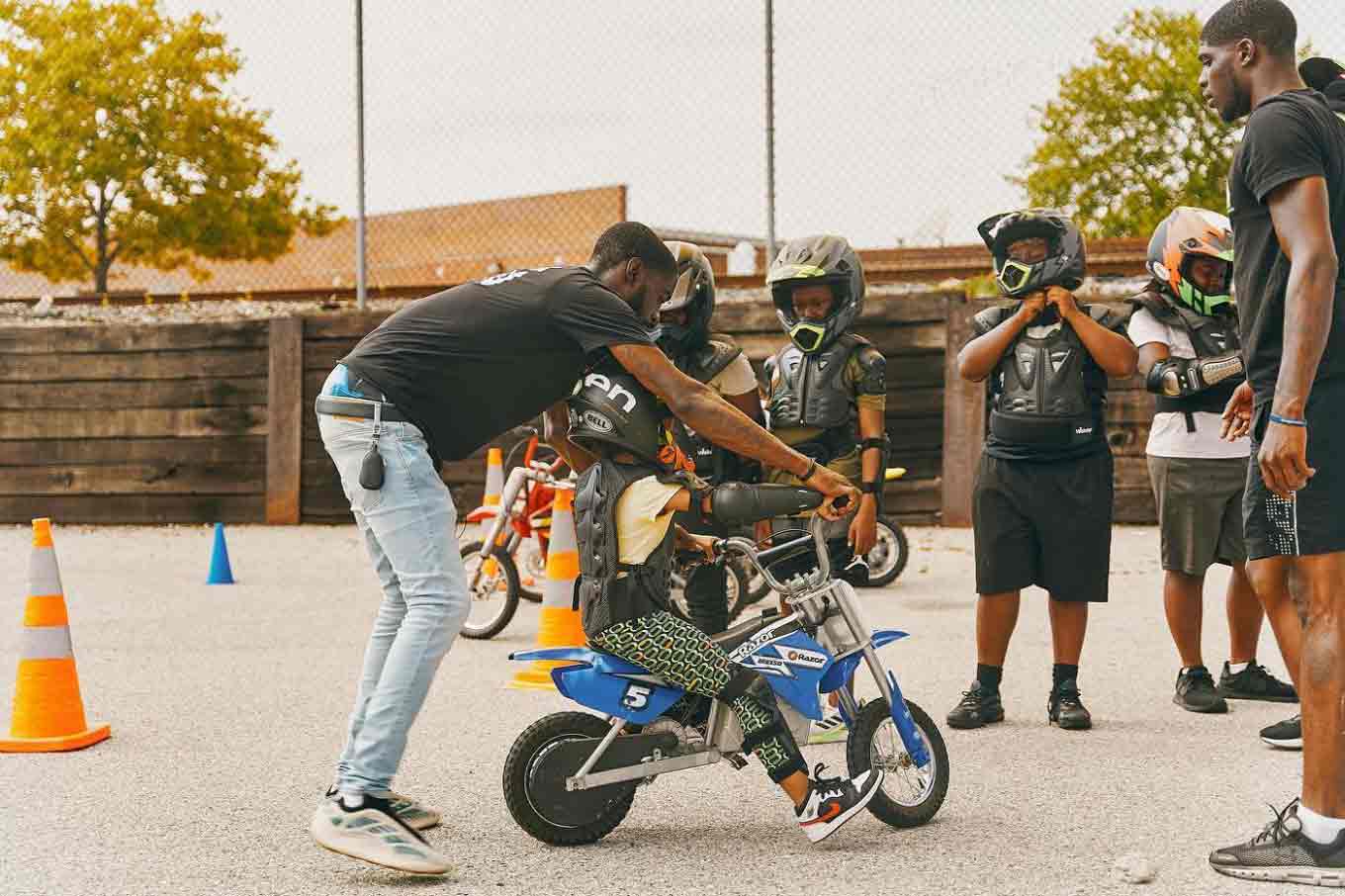
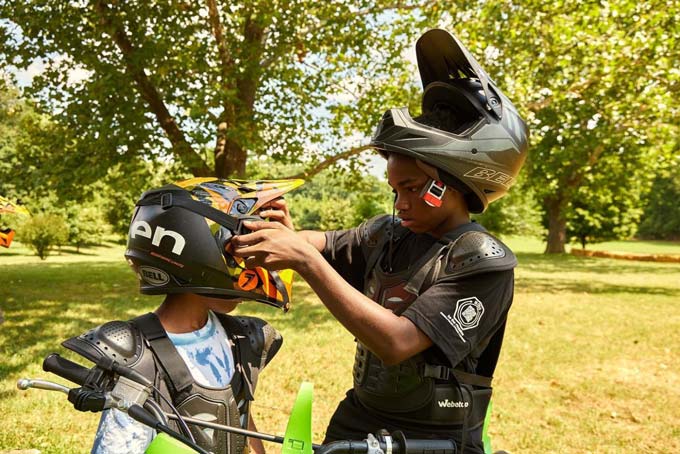
Safety starts with a helmet and riding off main roads, as well as learning how to maintain a safe bike. But it extends beyond the bike itself.
For Young and those she mentors, it means embracing one of the mantras of dirt bike riders: “Bikes up, guns down.” It’s about feeling safe within one’s own city, within one’s own community. It’s about having access to a safe outlet and not falling victim to street life, she says.
Young knew that for her educational programming to work with Baltimore’s youth, she needed to make STEM more relevant. So she teaches science through dirt bikes — basically, applied learning. Popping a wheelie becomes a physics equation, tuning an engine is a class in engineering, finding the gas-to-oil ratio to make sure your engine doesn’t explode is a chemistry experiment.
“A rider has to think about how much time it will take to pop a wheelie, get down a street at whatever speed they are going and make sure they don’t crash,” explains Young. That can be solved through D = V x T, or distance equals velocity times time. “That’s the type of math they can do in their head, and that is the type of math they just know naturally.”
Since her STEM programs require skilled teachers, B-360’s workforce programs also give riders a formal home for teaching — everything from dirt bike mechanics to stunts.
Beyond the classroom, B-306’s advocacy is paving new strategic avenues for dirt bike riders, both literally and physically. As the Baltimore Police Dirt Task Force disbanded in spring of 2021, Young teamed up with the Baltimore City’s State’s Attorney’s office to create a diversion program for those arrested for riding dirt bikes on the street.
As part of the program, which kicked into gear in March 2021, when someone is arrested for a dirt bike offense they have the opportunity to complete 20 hours of programming at B-360. Once their hours are fulfilled, their case is dismissed.
According to Young, many of the individuals who enter B-360 through the new diversion program stay on, voluntarily, to learn even more about STEM and entrepreneurship.
“We literally are making sure people don’t go to jail. We are changing people’s lives,” says Young. “One, we want to make sure these young men, 17, 18, 19 year olds, have career and job opportunities, transferable skills, like fixing and repairing bikes and cognitive reasoning.
Two, that all charges get dropped which will change their trajectory. And then three, making sure that they know that the skills they possess will give them a new outlook on life.”
One young man in the diversion program is a 19-year-old who had faced a slew of charges ranging from dirt bike possession to traffic violations. After taking part in B-360’s program, he graduated high school and recently found his first job in manufacturing, based on the skills he learned with B-360.
Another young man who faced criminal charges is still with B-360. After completing the program, the 20-year-old chose to stay on board. Now he’s working as an instructor at the group’s summer camp every day, teaching the city’s youth on everything from rider safety to bike repair.
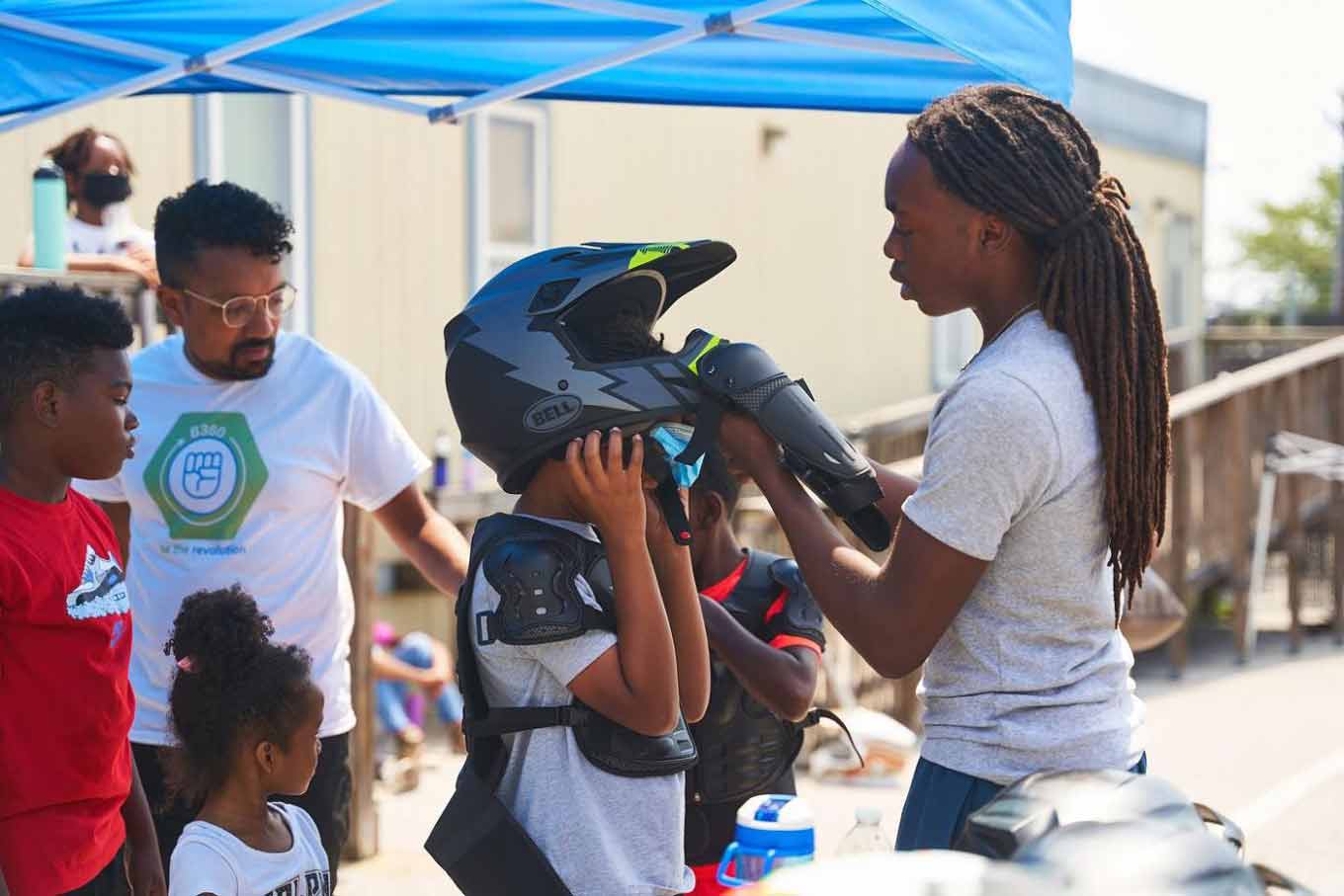
“What Brittany’s program does is completely counter to what the criminal justice system does with an individual. We’ll lock somebody up for 120 days and that can ruin your life,” says Michael Collins, Strategic Policy and Planning Director for the Baltimore City’s State’s Attorney.
“As a country we deal with nuisance problems and ‘quality-of-life offenses’ almost exclusively through a criminal justice lens. But we recognize that most of the people riding dirt bikes and being arrested are people of color. They’re riding for fun. It’s not malicious, per se.”
Collins says that what B-360 was offering was a solution outside the criminal justice system – “a safe middle ground where we are getting individuals off the street and putting them on the right track,” as he puts it, particularly for individuals with no other offense except the possession of a dirt bike.
While this new diversion program is just over a year old, Collins said there is much to be done to support groups like B-360. The city of Philadelphia, which has long struggled to deal with its dirt bike subculture, has already reached out to him to learn more about Baltimore’s model.
“At the end of the day we’ve tried the approach of incarceration and that didn’t work,” says Collins. “We are in a moment in the country where we are trying to reimagine policing…We are trying to limit people going into the criminal justice system unless they are a discernible safety threat.”
There has been talk of building a dirt bike park in Baltimore for years — a place to ride safely and legally. There’s been similar chatter in Cleveland. Neither city has been able to get their ideas off the ground.
The irony of these failed efforts is not lost on Young, who points out how White hobbies are incorporated into cityscapes.
When skateboarders become nuisances on city sidewalks, communities build skateparks; when cyclists are endangered, cities build bike lanes and teach motorists to ‘share the road,’ and when motorized scooters become the go-to transport of choice for thousands, rideshare companies launch money-making ventures.
“None of these activities are criminalized,” says Young.
Rather than waiting for stagnating efforts to bring a dirt bike park to Baltimore, Young is moving forward, fostering relationships with city businesses. Last year, the B&O Railroad Museum gifted B-360 the use of 2.5 acres of the museum’s land in Southwest Baltimore for safe riding. Along with the gated, empty parking lot, B-360 used the site trailers for classroom space.
“She can literally be saving lives,” the B&O Railroad Museum’s Executive Director Kris Hoellen says of Young and her program. “Putting kids in ‘the system’ that are trying to overcome so many challenges that they face already, is not going to be helpful…But if you can spark a kid with a passion and use that passion for learning, then you’ve got them.”
This year, B-360 is housed at an unused recreational center in Southwest Baltimore. Surrounded by 10 acres of land, it serves as an example of how vacant buildings can be given new life.
Young’s goal is to raise $10 million by 2024 and secure about 20 acres of land and a permanent campus, which would be the first of its kind anywhere in the country.
Her aim is to create an auto body shop, an educational space for STEM programming, and an indoor and outdoor dirt bike riding course.
“Initiatives like B-360 absolutely save the public money and frees up resources which we can use to invest in our young people and to catalyze their future,” says Fagan Harris, CEO of Baltimore Corps, which works to recruit and retain social impact leaders to Baltimore.
Harris, who is the chairman of B-360’s advisory board, says Young’s “ideas and solutions, for our communities, are big.” Young was one of Baltimore Corps’ inaugural Elevation Awardees.
Last year B-360 was awarded a $300,000 grant through Microsoft’s community skills program, which promotes racial equity in the U.S. It was one of 50 Black-led nonprofits selected nationally.
“We need your funding, but we want people to trust us with our own ideas,” says Young.
“I’m a person changing from being in survival mode my entire life…a fight-or-flight mentality, to the person that can now think about sustainability.”
The media is all over the story that Governor DeSantis was notified that the danger threshold for evacuation was hit on Sunday, but he waited until Tuesday to order one (leaving a trail of dead bodies in his wake).
But there's another story out of Florida — a good news story — that's not getting anything close to the coverage it deserves.
Just 12 miles northeast of Fort Meyers — a community devastated by the hurricane with total loss of power, water, and massive loss of life — another community not only came through the hurricane just fine but never even lost power.
Today's crises in Florida and Puerto Rico should kick-start an entirely new generation of building codes and energy systems that can quickly go nationwide.
If you've been watching the coverage, you know by now that much of the loss of life in Florida was in Lee County. What you may not know is that the Babcock Ranch community — a small town, really, partly in Lee County — not only suffered only minimal damage but is now a refuge for people displaced by the storm.
When groundbreaking for Babcock Ranch — Florida's first 100% solar-powered community with over 700,000 panels providing more than enough electricity for all 2000 homes — happened in 2015, it wasn't a bunch of environmentally-minded old hippies putting the project together. In fact, the community — like the region around it — tends to vote solidly red.
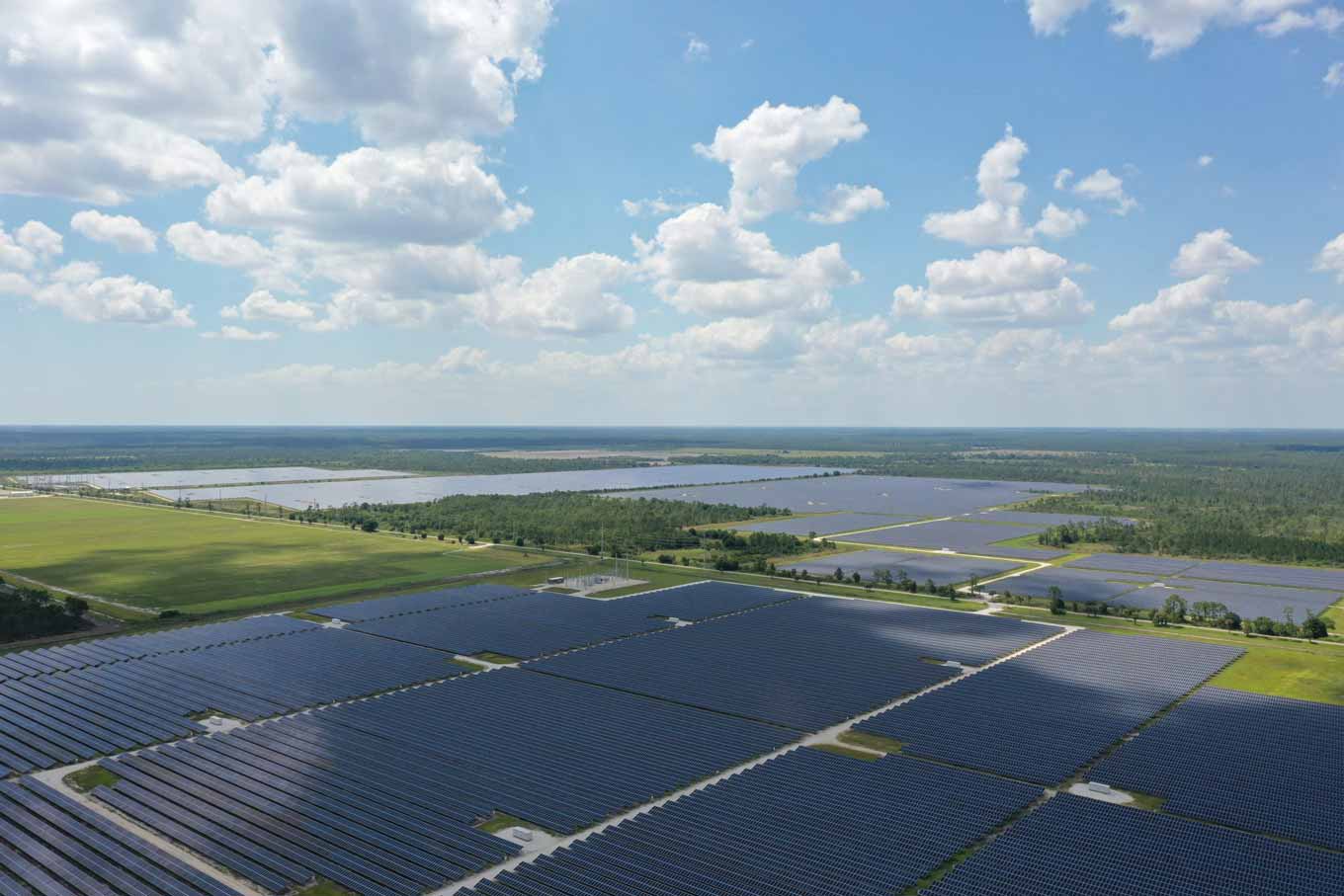
It wasn't to save the world that they built an all-electric, all-solar community: it was to avoid exactly what happened to the surrounding area; electric and water outages and the collapse of infrastructure that typically accompanies a hurricane.
In 2010 it cost around $6/watt to install residential solar with batteries (just the solar panels themselves were around $2/watt), so a typical home's system cost between $40,000 and $60,000.
Today it's around $1.40/watt (the panels themselves are now around $.38/watt) and not only is the price typically below $20,000 but there are huge federal incentives to make the systems even cheaper.
Solar and wind are now the cheapest ways to produce electricity in the United States. This is why over a quarter-million Americans today earn their living installing and maintaining solar and wind systems.
Babcock Ranch designed their homes with a low wind profile and the houses were set far enough above the streets that the streets themselves are designed to flood (and run off) leaving the homes high and dry. Power and internet lines are buried and using native plants as landscaping helped to catch and slow runoff to minimize flood damage.
Which is why Babcock Ranch homes came through Hurricane Ian largely intact and its solar-powered school and community center is now full of refugees from nearby towns.
While Babcock Ranch is an upscale community with homes in the half-million to million-dollar (and up) range, that's because it's larger homes on big lots, rather than the result of the community's hurricane-proof design and super-resilient solar power system.
These resilience aspects should be a model for all of Florida — and the rest of the country that experiences floods, derechos, and hurricanes — starting right now. This isn't rocket science and it's about the same price as throwing up stick houses that'll simply explode or get washed away in the next storm: when you add in the reduced cost and increased reliability of electricity and other essential services, it's cheaper than typical construction over the life of the homes.
There are even innovative economic models already adopted by other countries we could use to rapidly propagate solar across the United States as part of an effort to harden our electric systems.
In September, 2009 I was invited to join German Member of Parliament Herman Scheer to give presentations at a conference (page 11) put on at the Centre de Cultura Contemporània de Barcelona in Spain.
Almost a decade earlier, Scheer had shepherded his "100,000 Rooftops" program through the German Parliament and was eager to talk about how it worked and could work in Spain.
We talked at length about his program (his presentation was brilliant), which, in his original idea (which was only partially implemented; there were tons of compromises, most having to do with Russia) was elegantly simple.
By the 1990s, Germany was facing an energy crisis of sorts: people were freaked out about the nation's nuclear plants and wanted them shut down. For good reason, it turns out.
Back in 1986 on my birthday, May 7th, I flew into Frankfurt to finalize my work visa to move my family to Germany for the following thirteen months (we moved in June). It was a gray, rainy day when I walked out of the Hauptbahnhof (main train station) in downtown Frankfurt to walk a block or two to my favorite hotel.
I was shocked to see the city I'd visited so many times completely empty of pedestrians and nearly drained of cars.
At the hotel, the clerk was frantic to take my wet hat and raincoat and send them to the hotel's laundry. "Chernobyl melted down two weeks ago," he told me, "and the cloud with the radiation is right above us now. You must go take a shower immediately!"
As I learned living in rural northwest West Germany for the rest of that year and most of 1987, all of Germany was as flipped out as the hotel clerk.
I'd brought a hand-held Geiger counter with me when we moved, and walking through the rural supermarkets it'd occasionally click rapidly, particularly when I passed local mushrooms or meat. That would always draw a crowd (and dirty stares from the shopkeepers!).
And I wasn't the only one walking around with a Geiger counter: the German government had to change the acceptable standard for radiation in milk, and people were constantly finding "hot" radioactive particles from Chernobyl in the nearby forests.
Germans wanted to get rid of their nuclear power, but how? They didn't want to revert to more coal or oil power; that's why they'd gone to nuclear in the first place.
So Scheer's original proposal, as he laid out the concept to me, was simple and elegant.
Banks would loan people the money to put rooftop solar on their houses at a super-low interest rate, with defaults backstopped by the government. No risks, in other words, to the banks.
Power utilities would buy surplus power from those homes at a "feed-in tariff" rate that was higher than the retail price of electricity until their bank loans were paid off (typically 5-10 years).
The tariffs were set so, for example, if the monthly payments on your loan for your rooftop solar system were $100, the local utility would be paying you (or reducing your normal electric bill) by around $100 a month as that "feed in tariff."
The tariff payments would last until your loan was paid off: in effect, you'd get the solar system, which will last for decades, for free.
What the utilities got out of it was immediate expansion of their power-generating sources at no expense to them whatsoever. They didn't have to build expensive new power plants: the nation's houses and office buildings would provide that.
As more and more homes came online, the power that was then being generated by nuclear plants would be replaced by electricity from the "100,000 rooftops" and the extra expense to the utilities for the feed-in tariffs would still cost less than building a new power plant, be it nuclear or fossil fuel-powered.
Everybody wins economically, the government handles the risk by backstopping the banks and utilities (and it's a minor expense for a national government), and Germany gets off its growing nuclear power addiction.
Scheer got the feed-in tariffs passed in 1999 as part of his 100,000 Rooftops program, followed by the German Renewable Energy Act of 2000. It wasn't implemented as simply and elegantly as I've described here and as he shared with me over lunch in Barcelona (politics intervened, of course, leading to imports of Russian natural gas), but it got a long way there.
Other countries around the world copied parts of his program, although some of Germany's for-profit and regional utilities were committed to sabotaging it and have had some successes in that effort since his untimely death at age 66 in 2010.
And in most parts of the world — and most all of the USA — solar works even better than in Germany, which is the cloudiest country in Europe and at the same latitude as Calgary. The science proving this can work even better in the US is both solid and irrefutable.
Today, as a result of Scheer's visionary leadership two decades ago, over a million German homes have both solar panels and battery storage, and the country is upgrading their system to a "smart grid" to handle it all. There's an absolutely amazing collection of charts and graphs explaining it all here.
Additionally, they were shutting down their last nuke (it's on hold because of the Ukraine crisis), and beginning the process of phasing out coal (although slowdowns on renewables are causing them to have to default to natural gas in a few places).
As the MIT Technology Review notes: "The country avoided pumping about 74 million metric tons of carbon dioxide into the atmosphere in 2009. The German environment ministry also touts a side benefit: nearly 300,000 new jobs in clean power."
Milton Friedman, the godfather of "disaster capitalism," was fond of pointing out that most people and most countries would only consider significant changes to the way they do things in the face of a crisis.
We're there, now.
Today's crises in Florida and Puerto Rico should kick-start an entirely new generation of building codes and energy systems that can quickly go nationwide.
Much of the work has already been done by California, which mandated in 2018 that most new construction must have solar rooftops starting in 2020 and recently updated and tightened their standards for 2022.
Building a resilient and low-carbon America will save both money and lives. We need to start now.
This article was first published by Common Dreams and was republished with permission via (CC BY-NC-ND 3.0).
Every month at Good Good Good, we plan upcoming good news content for our Instagram, Goodnewsletter, Goodnewspaper, podcast, website, and more. Our work is always centered on hopeful stories about people making a difference in the world — and action steps on how each of us can join in with that good work.
With so many holidays, awareness days, education weeks, and activism months happening all year long, we’ve slowly collected all of these events in a private internal calendar for years.
We made our Monthly Cause Awareness Calendar publicly available earlier this year. We’ve also published:
- The Ultimate Calendar of Heritage Months
- Disability Awareness Days Calendar
- LGBTQ+ Pride Days, Weeks, & Months Calendar
- Environmental Holidays and Sustainability Calendar
- Cancer Awareness Months Calendar
- Animal & Pet Awareness Calendar
And now we’re publishing our guide to mental health awareness and advocacy holidays.
Our hope is this resource will help you or your organization bring awareness and attention to important mental illnesses all year long.
Where applicable, we've included resources around highlighted holidays — usually in the form of good news around particular topics — or action steps on how to make a difference. We encourage you to share them if you find them helpful.
We've worked hard to make this the most comprehensive collection of mental health-related days and months on the internet. Always double-check dates, as organizers may occasionally change dates.
Bookmark this page and revisit it as often as you need. We'll continue to update it and add to it over time.
Mental Health Awareness Holidays & Months
January
Days
No specific mental health holidays in January
Get the year started by subscribing to these top mental health podcasts and by reading mental health good news
Weeks & Months
Self Love Month
Create a permanent reminder that loving yourself is important... with a mental health tattoo
Mental Wellness Month
Read and share quotes about mental health
National Stalking Awareness Month
Dry January
No Name Calling Week - Week-long event in January
February
Days
Time to Talk Day - Every 1st Thursday of February
Safer Internet Day - February 8th
National Random Act of Kindness Day - February 17th
Try one of our recommended random acts of kindness
World Day of Social Justice - February 20th
Explore the best quotes about social justice
Weeks & Months
National School Counseling Week - First full week of February
National Eating Disorders Awareness Week - Last week of February or first week of March
March
Days
Self-Injury Awareness Day - March 1st
World Compliment Day - March 1t
Learn about the power of compliments and explore the ultimate list of the best compliment ideas
Zero Discrimination Day - March 1st
World Teen Mental Health Day - March 2nd
Dissociative Disorder Awareness Day - March 5th
Emetophobia Awareness Day - March 5th
Insomnia Awareness Day - First Monday following the change to daylight saving time
University Mental Health Day - First Thursday of March
Explore and share the best mental health newsletters
International Day of Happiness - March 20th
TWLOHA Day - March 29th
World Bipolar Day - March 30th
Weeks & Months
Self-Injury Awareness Month
National Eating Disorders Awareness Week - Last week of February or first week of March
Creative Arts Therapies Week - Week-long event in March
Read this good news story about the art therapist using TikTok to help people
April
Days
World Health Day - April 7th
Explore and share quotes about public health
National Alcohol Screening Day - Thursday of the first full week of April
Day of Silence (for LGBTQ+ Youth) - Second Friday of April
Learn how to support and advocate for LGBTQ+ youth
World Breathing Day - April 11th
Read about the power of breathwork on mental health
National Therapy Animal Day - April 30th
Weeks & Months
Stress Awareness Month
Alcohol Awareness Month
Sexual Assault Awareness Month
National Counseling Awareness Month
This is the perfect month to start counseling! Learn how to find a therapist.
National Volunteer Week - Every third week in April
Learn from Crisis Text Line about the best strategy for effective volunteering
May
Days
World Maternal Mental Health Day - May 3rd
PPP (Postpartum Psychosis) Awareness Day - First Friday of May
National Children’s Mental Health Awareness Day - May 7th
Mental Health Action Day - May 18th
Learn about the people working to support mental health around the world
World Meditation Day - May 21st
National Schizophrenia and Psychosis Awareness Day - May 24th
Learn more about Schizophrenia and other commonly misunderstood mental disorders
Weeks & Months
Mental Health Awareness Month
Read Good Good Good’s comprehensive guide on ideas and activities for celebrating Mental Health Awareness Month
Borderline Personality Disorder Awareness Month
UK Maternal Mental Health Awareness Month
Children’s Mental Health Week - First week of May
Neurodiversity Celebration Week - Week-long event in May
June
Days
National Say Something Nice Day - June 1st
World Eating Disorders Action Day - June 2nd
World Drug Day - June 26th
PTSD Screening Day - June 27th
Weeks & Months
PTSD Awareness Month
Listen to our podcast conversation with Richard Casper, a veteran using art to help other veterans recover from PTSD
Infant Mental Health Awareness Week - June 10th to 16th
July
Days
Panic Attack Awareness Day - July 10th
National Seasonal Affective Disorder (SAD) Day - July 24th
International Self-Care Day - July 24th
Learn how to celebrate International Self-Care Day. Plus: Explore the ultimate list of self-care ideas and this collection of inspirational self-care quotes
Weeks & Months
Minority Mental Health Awareness Month
BIPOC Mental Health Month
Explore these Black mental health resources
Disability Pride Month
Get ideas for thoughtfully celebrating Disability Pride Month this year
Birth Trauma Awareness Week - Week-long event in July
August
Days
Wear It Purple Day - Last Friday of August
National Grief Awareness Day - August 30th
International Overdose Awareness Day - August 31st
September
Days
R U OK Day - September 9th
Learn how to ask the hard mental health questions that could save a life
World Suicide Prevention Day - September 10th
Read about student advocates taking the lead to curb campus suicide
National Sober Day - September 14th
Weeks & Months
National Suicide Prevention Month
Read our guide on activities and ideas for National Suicide Prevention Month
National Recovery Month
National Self-Care Awareness Month
Practice self-care with these self-care ideas and get inspired by these self-care quotes
Mullets For Mental Health Month
Read this good news story about the Australians sporting mullets to raise money for mental health research
National Alcohol & Drug Addiction Recovery Month
Pain Awareness Month
Listen to our podcast interviews with Ruthie Lindsey and Grace Theisen about their experiences dealing with chronic pain
National Suicide Prevention Week - Week-long event in early September
Read our guide on ideas and activities for National Suicide Prevention Week
October
Days
Dermatillomania Awareness Day - October 1st
Disabled Authors Day - October 2nd
Read and share the best books about disabilities — written by disabled authors
National Depression Screening Day - Thursday of the first full week of October
Depression Awareness Day - Thursday of the first full week of October
National Day Without Stigma - October 9th
World Mental Health Day - October 10th
Explore our guide to activities to celebrate World Mental Health Day — and, of course, explore Good Good Good’s collection of mental health resources
International Stuttering Awareness Day - October 22nd
Read about stuttering and the organization working to reduce the stigma
Weeks & Months
National Depression Education and Awareness Month
National Disability Employment Awareness Month
National Bullying Prevention Awareness Month
ADHD Awareness Month
Explore Good Good Good’s resource guide — featuring the best podcasts, blogs, and TikToks about ADHD
National Depression and Mental Health Screening Month
Listen to our podcast interview with John Moe, a comedian fighting depression with humor — and read about the U.S. decreasing depression stigma for the first time
Mental Illness Awareness Week - First week of October
Explore the best mental health shirts that give back to charity
Borderline Personality Disorder (BPD) Awareness Week - October 1st to 7th
Trichotillomania Awareness Week - October 1st to 7th
OCD Awareness Week - Second week of October
Read our guide to how to support someone with OCD
November
Days
National Stress Awareness Day - Every first Wednesday of November
International Day Against Bullying and Violence - First Thursday of November
Veterans Day - November 11th
Use Veterans Day as an opportunity to support veteran mental health.
World Kindness Day - November 13th
Explore the best ways to celebrate World Kindness Day and try one of these ideas for random acts of kindness
International Survivors of Suicide Day - Saturday before Thanksgiving
Read this good news story about the mom who created uplifting signs in response to suicides in her community
Giving Tuesday - First Tuesday after Thanksgiving
Read and share this article about how and where to donate on Giving Tuesday (plus more ideas to make a difference) and share these Giving Tuesday quotes
Weeks & Months
Movember
UK Self Care Week - Week-long event in November
Learn about how to practice proactive self care instead of reactive self care
December
Days
International Day of Persons with Disabilities - December 3rd
Explore our calendar of disability awareness days and weeks
Weeks & Months
Seasonal Affective Disorder Awareness Month
Is this list missing a holiday or awareness week/month? Let us know. We want to ensure this list is comprehensive and inclusive.
With energy costs and our collective concern for protecting the planet on the rise, many are looking for ways to conserve resources and cut costs.
While energy-efficient alternatives have seemed out of reach thanks to up-front costs and lack of accessibility, federal and state tax credits and incentives are making it much more accessible for people to purchase energy-efficient home products.
We’ve compiled a list of energy-efficient swaps and helpful tips that reach a range of budgets and lifestyles. Regardless of where you stand financially, there are simple ways to curate a loving, thoughtful home for you, your wallet, and our planet!
Changes and Swaps For an Energy-Efficient House —
Landscaping Ideas:
A well-designed landscape is not only pleasing to the eye, but it can also reduce your overall heating and cooling costs. Just by adding energy-efficient landscaping to a non-shaded yard, the U.S. Department of Energy (DOE) found that it can save up to 25% of energy compared to other homes.
Before you dive into any big landscaping decisions, figure out the general climate zone you live in. This can help determine the best energy-saving strategies for your home. (Check out this climate zone map provided by the DOE).
Plant drought-tolerant gardens
The beauty of drought-tolerant plants is that they (as the name suggests) can survive droughts — aka they require way less water to survive. These plants also tend to be disease and pest-resistant, and attract essential pollinators.
Consider incorporating these drought-resistant plants into xeriscaping, a landscaping alternative that can help reduce outdoor water usage by up to 50%. Gardener’s Path has a great guide to help you choose the best drought-tolerant plants for your lawn.
Strategically plant trees outside your home
Depending on where you live, a strategically-placed tree can help conserve energy inside your home and induce a natural cooling effect around your property.
The DOE recommends planting tall shade trees as the best way to protect your home from solar heat and from those cold blasts in winter. In the south, evergreen trees can shield your home all year long, while typically, in Northern regions, deciduous trees are best to use.
A good rule of thumb is to lean more on native plants and trees. This will help reduce the amount of water used to maintain them.
Water your lawn early in the morning
Water usage varies depending on the type of lawn you have. However, generally speaking, setting your sprinkler systems to water your lawn in the morning (preferably before 10 a.m.) when temperatures are cooler) allows the water to soak into the soil before it can evaporate.
Alternatively, if you can only water in the evening, Scotts suggests trying between 4 and 6 p.m.
Transition to solar
Rather than powering your outdoor areas with your home’s electricity, opt for solar lights to brighten up your landscape at night. From pathway lighting to string and holiday lights, you can harness free energy from our generous sun to power up your lawn without draining energy!
Opt for electric lawnmowers
While you’ll more than likely find gas-powered lawn mowers being marketed to consumers, there’s a growing number of electric options offering people an alternative to sprucing up their lawns. In fact, states like California are banning sales of new gas-powered lawn mowers to curb greenhouse gas emissions.
Remember, though, where your power comes from will impact just how clean and efficient your electric mower is (we’ll talk more about that in the next section).
Roofing Ideas:
According to Green Building Alliance (GBA), 90% of roofs in the U.S. are poorly designed and built with dark, non-reflective materials that absorb rather than reflect heat.
Traditional rooftop temperatures can get 90 to 100 degrees hotter than the natural outdoor temperature — which typically transfers over into your attic and, ultimately, your home — according to GBA.
While good insulation helps shield your home from absorbing all that heat, having a darker heat-absorbing roof makes it easier for heat to transfer over into the attic. However, there are ways to help reduce excess heat transfer so that your air conditioners don’t have to work harder than they should.
Install a “cool roof”
Swap your dark, heat-absorbing roof with a “cool roof” — roofing material designed and constructed to reflect more heat than it absorbs.
The DOE provides a good overview of cool roofs, but generally, opting for metal roofing is by far one of the most energy-efficient options for residential homes. They can last more than 50 years, not to mention they require minimal maintenance.
If you prefer the look of traditional roof shingles, keep an eye out for Energy Star-certified roof shingles. In addition to federal tax credits and other incentives for energy-efficient home products, some states also offer grants, incentives, or credits.
Consider installing alternative energy solutions
Alternative residential energy solutions like solar are sustainable, renewable, and efficient. Though understandably not an option for everyone, the cost of installing solar panels to produce your home’s electricity has decreased annually, according to the DOE.
The financial returns and lower monthly utility bills that solar offers make this option attractive to many. However, there are multiple factors and considerations when deciding to make the switch.
When it comes to reducing energy usage and water consumption, though, the DOE reports that solar gives homeowners a great return in the long run.
Contact your electricity company
Speaking of alternative energy, find out where your home’s energy sources come from by contacting your electricity company or accessing the Environmental Protection Agency’s (EPA) Power Profiler.
At least 50% of customers in the U.S. — according to the DOE — have the option to purchase renewable electricity directly from their power supplier, and everyone has the option of purchasing renewable energy certificates. This kind of power is often referred to as green or clean power.
Insulation Ideas:
Yep, that draft you might feel can impact your energy bill. The EPA estimates that homeowners can save an average of 15% on heating and cooling costs (or an average of 11% on total energy costs) by air sealing their homes and adding insulation in attics, floors over crawl spaces, and basements.
Being mindful of your insulation can offer so many cost and environmental benefits.
Make sure your windows, doors, and roof are properly insulated.
Hiring a licensed contractor to check on your insulation or doing it yourself is an excellent first step in ensuring that your home is properly sealed.
Doing so prevents the air conditioning and heating units from overworking and keeps any harsh external conditions from seeping into your house.
Upgrade to double pane windows, if you can.
This tip comes with a caveat: it’s expensive. (The average cost as of 2022 is $505 to $1,075 — per window)
According to HomeAdvisor, double-pane windows can reduce energy usage by up to 24% during winter and up to 18% in the summertime. Keep in mind that to see energy-saving results, you must replace all old and faulty windows in your home — not just one.
Level up your curtain-game
If double-pane windows are outside your budget, try a nice insulated set of curtains. The DOE suggests opaque and tightly woven fabric with a light-colored awning that can reflect more sunlight.
The best energy-efficient curtains are designed to retain heat in the winter, keep cool air inside during the summer, and reduce outside noise and light.
Not only can curtains reduce heat loss by up to 30%, but shall we state the obvious: they also come in stylish colors and patterns! Win, win, win!
Lighting Ideas:
When switching to energy-efficient lighting, you can actually light your home using the same amount of light, for less money.
In the U.S., lighting accounts for about 15% of an average home's electricity use, with the average household saving about $225 in energy costs per year just by using LED lighting, according to the DOE.
Switch to LED light bulbs
Instead of the more traditional halogen and fluorescent light bulbs, switch to LED lighting. The DOE reports that residential LEDs — especially Energy Star-certified ones — use at least 75% less energy, and last up to 25 times longer than incandescent lighting. This swap, as previously mentioned, can save the average household about $225 in energy costs per year.
You can learn more about LED light bulbs and how you can incorporate them into your holiday lighting, recessed downlights, and more by visiting the DOE website.
Install timers and motion-detected lights in low-traffic areas
Automate your light usage by installing timers or motion-detected lights around your house. Adding motion detectors in “low-traffic” areas is a relatively effortless energy-conserving solution that could cut your overall light usage.
Similarly, installing timers in outdoor and living spaces, as well as on your home appliances, can result in significant savings on your electric, heating, and cooling bills throughout the year.
Laundry Room Ideas:
Consumer Reports found that most Americans over-wash their clothes (ahem, an estimated 300 loads of laundry per year…that’s almost a load for every day of the year).
With about 90% of the energy used while doing our laundry going towards heating, the general consensus is: Our planet might actually detest laundry day as much as we do!
The good news is, over the past two decades, increasingly tough federal regulations have required manufacturers to make washers that use less energy and water. Not to mention, there are other, more sustainable and energy-efficient alternatives to keeping our clothes nice and clean.
Wash your clothes in cold water
According to the Sierra Club, as much as 90% of the energy consumed by our washing machines goes towards heating the water. “The simplest and easiest thing to do with no sacrifice at all is to always use cold water wash,” says Noah Horowitz, senior scientist at the Natural Resources Defense Council.
If you need to use hot water, the NRDC says that even turning the dial down to warm can cut the energy use in half.
Properly set your machine
Next time you’re about to throw a load of laundry into a machine, take a brief moment to ensure you select the proper load size (so that the machine doesn’t use too much water). “How you use your device really dictates what your environmental impact is,” says Horowitz.
As for your dryer, the Sierra Club recommends using the machine’s presets (like Normal or Standard) as they engage the machine’s sensors to automatically shut off once the clothes are dry. By comparison, manually selecting a drying time often leads to more energy consumption.
Air dry your clothes
The most energy-efficient solution to drying your clothes? Air drying. Not only do studies show the effects of high heat usage on our clothing, but it produces a considerable amount of heat (and energy).
Air drying your clothes doesn’t have to be daunting or complicated, though. If you can hang dry your clothes outside, the sun’s UV rays naturally kill bacteria and viruses, says Carol DerSarkissian, M.D.
However, indoor drying racks can easily be folded down and discreetly stored if you don't have space for a clothesline. You can even drape your clothes over a towel rack or shower rod.
Wash less
Okay, hear us out. Studies have found that unless someone in your household has a contagious illness, there’s no evidence that skipping washes is bad for health or hygiene.
Obviously, undergarments, socks, and gym clothes should be washed regularly. For other clothing items, try limiting the amount of synthetic material (such as polyester and nylon). These fibers tend to trap odors and require more attention than their natural fiber counterparts (cotton, silk, and wool).
Most garments that are worn — but not dirty — could simply be aired out overnight. If we’re still not convincing you to ditch over-washing your clothes, test out using a lint brush or a fabric steamer to freshen and sanitize clothes before wearing them again.
Kitchen Ideas:
From the food we consume to the appliances we use, our kitchen space is home to a whole host of energy-saving opportunities.
When it comes to home electricity use, our kitchens typically use the most, according to the Wright-Hennepin Cooperative Electric Association. This is due to a collection of heavily used energy-draining appliances like stoves and refrigerators.
Even if we can’t afford to buy new energy-efficient appliances, there are other ways to be mindful of our energy consumption.
Reduce your meat consumption
‘Eating local’ is a recommendation we often hear – even from prominent sources, like the United Nations. While it’s important to support our local businesses, Our World in Data suggests that we focus more on what we eat, rather than where we eat.
Pulling data from the largest meta-analysis of global food systems to date, Our World in Data found that agriculture is a significant source of greenhouse gas emissions — with beef at the top of the list.
Overall, animal-based foods tend to have a higher energy footprint than plant-based, and even just slightly adjusting our diets can be a way we can reduce our energy consumption in and outside of our homes.
Look for Energy Star-certified appliances
When it's time to upgrade your appliances, keep an eye out for a bright blue and white Energy Star label. Products containing this certification had to meet strict energy efficiency criteria set by the EPA and the DOE.
Consumer Reports shared that you can reduce your carbon footprint by 8,200 pounds over five years — the equivalent of driving 9,300 miles in your car — just by making the switch over to Energy Star-certified products.
Plus, upgrading to an Energy Star-rated appliance allows you to take advantage of rebates, tax credits, or sales tax exemptions for energy-efficient products that your state and local utilities may offer.
Organize your refrigerator
We’ve all been there: “Where’d the ketchup bottle go?” or “Where’d I put the butter this time?” We don’t realize it, but our lack of refrigerator organization could negatively impact our energy usage.
Simply taking time to incorporate an organizational system can help reduce the open-door time needed to find food — further lowering energy consumption.
Run your dishwasher or washing machine early in the morning or late at night
Most energy companies charge higher rates for energy usage during peak hours. Check in with your energy company and ask about its peak hours. Simply waiting to run your dishwasher (and washing machine and dryer, too) at another time can save you money and conserve energy.
Generally, though, running the dishwasher early in the morning or late at night is the best time.
Switch to a tankless water heater
The average household spends $400-$600 annually heating its water, according to the DOE. That makes heating water the second largest expense in your home (behind air conditioning and heating), accounting for 14-18% of your utility bills.
Tankless water heaters, also known as on-demand water heaters, have become a more energy-efficient alternative to traditional ones. Unlike traditional water heaters — which continuously maintain water temperature — tankless heaters are built to provide you with hot water only when needed.
Bedroom Ideas:
While many of the ideas shared in previous sections could easily be incorporated into creating a comfortable, energy-efficient space, there are some that could help us recharge our batteries while keeping our bills and planet in mind.
Use an advanced power strip
Electronics still draw electricity when we’re not using them, adding up to about $200 in yearly energy costs for an average home, according to the National Renewable Energy Laboratory.
A simple solution: advanced power strips. Plug your devices into an advanced power strip and flip the switch off before leaving the house. Power strips work well in other areas like your TV room or office where technology is often used.
Opt for fans instead of lowering your AC
A fan-tastic way to rely less on your thermostat is through the use of fans. Instead of lowering the AC at night, run your fan in a counter-clockwise direction during the summertime and opt for Energy Star-certified fans (60% more energy efficient than conventional units).
Turn your fan off
Yeah, you read that right: turn your fan off. Fans are meant to cool people, not rooms. As your fan circulates air in the room, you feel the breeze across your skin, which gives that cool, refreshing feeling. However, the temperature of the room hasn’t changed.
Running any kind of fan in an empty room, unfortunately, wastes energy. Remember to turn your fan off if no one is in the room.
Bathroom Ideas:
Our trips to the bathroom almost always revolve around water consumption. We inevitably consume a lot of energy in this part of the house, however, there are ways to reduce it.
We’ve heard time and time again that taking shorter, cold showers helps, but we’ve found other ways you can enjoy your bathroom — without feeling rushed.
Switch to low-flow plumbing fixtures
According to the Natural Resources Defense Council (NRDC), a low-flow faucet can save a home 700 gallons of water, and upgrading a toilet can save $140, annually. Switching to low-flow plumbing fixtures (like toilets, faucets, and shower heads) can be a simple cost and energy-efficient swap.
For homes where upgrades are a little more difficult, simply putting a plastic bottle filled with water in the toilet tank can reduce the amount of water used per flush.
Switch to a bidet
When toilet paper was in short supply in 2020, investing in a bidet suddenly became a good idea (though many have been enjoying the benefits of this device for ages).
According to Business Insider, investing in a bidet seat or attachment can lower your spending on toilet paper by 75% or more while also reducing the demand for toilet paper — which requires a lot of energy and natural resources to produce.
Look for tree-free toilet paper
Can’t quite let go of toilet paper yet? Totally cool! Try looking for tree-free options like bamboo offerings from Who Gives a Crap or read through the NRDC’s “Issue with Tissue 2.0” report, which includes a new sustainability ranking for commonly used toilet paper brands in the U.S.
A version of this article was originally published in The Home Edition of the Goodnewspaper.
Get your own Goodnewspaper by becoming a good news subscriber today.
Every day the Good Good Good team collects the best good news in the world and shares it with our community. Here are the highlights for this week!
If you want to get good news in your inbox every day, join the Goodnewsletter — the free daily newsletter designed to leave you feeling hopeful.
The Best Positive News We're Celebrating This Week —
The U.K.’s first clothing collection for people with dwarfism just debuted at London Fashion Week
After meeting a teenager with dwarfism while studying fashion in college, Chamiah Dewey was made aware of a serious gap in the clothing market. Dewey then spent the next few years working on her clothing brand and researching and designing her first collection.
The first Chamiah Dewey Fashion clothing collection launched earlier this year, created and designed exclusively for people 4’10” and under. It just made its runway debut featuring models with dwarfism at London Fashion Week.
Dewey said it was the best day of her life, and that “You could see they were finally seen and heard. I cried because it was just so amazing and impactful. All I wanted to do was make people with dwarfism or short stature feel confident and happy in clothes.”
Guaranteed income programs are being rolled out in an increasing number of cities
Since 2020, more than four dozen guaranteed income programs have been rolled out in cities around the U.S. In addition to places like San Diego, Minneapolis, Denver, and Atlanta, the largest program was rolled out in Los Angeles. There, 3,200 people with at least one child and an income below the federal poverty line are benefiting from the program.
The idea behind them is by providing the most vulnerable people in a community with the funds to meet their basic needs is the best way to close the wealth gap and help people build a more stable life. And while some believe they incentivize people to not work, it’s also true that they help place value on “work” that traditionally doesn’t receive compensation — like caregiving, parenting, and more.
We’re thrilled to see more cities trialing these programs so we can gather more data on whether or not they are a viable, sustainable way to uplift people, especially historically marginalized people, in a community.
A small town in Oregon is home to the first utility-scale plant that combines wind energy, solar energy, and large batteries
With the capacity to power 100,000 homes, the first utility-scale plant combining wind and solar energy as well as onsite batteries just opened in a small town outside of Portland, Oregon. While many renewable energy installations have onsite storage, this is the first to do it at this scale.
When operating at maximum capacity, the Wheatridge Renewable Energy Facility can produce over half the power that was generated by Oregon’s last coal plant, which was demolished in August.
Since the facility can store energy onsite, it’s addressing a key challenge in the clean energy transition — not relying on fossil fuels for energy when the wind isn’t blowing and the sun isn’t shining.
New carbon credit programs are helping small-scale landowners cash in on keeping their forests intact
Though logging is common in regions like rural Pennsylvania, smaller-scale landowners are finding a better use for their forests. The American Forest Foundation’s Family Forest Carbon Program helps landowners with as little as 30 acres do something new: access fast-growing “carbon markets”.
These forests absorb and store carbon, and the credits for that effective reduction in climate-changing emissions will in turn be sold to help corporations such as outdoor outfitter REI move toward their “net zero” emissions goals.
A Florida community made it through Hurricane Ian with minimal damage and without losing power thanks to green infrastructure
Just 12 miles northeast of Fort Meyers — a community devastated by the hurricane with total loss of power, water, and massive loss of life — another community not only came through the hurricane just fine but never even lost power.
Babcock Ranch is Florida's first 100% solar-powered community with over 700,000 panels providing more than enough electricity for all 2,000 homes — and it’s now helping serve as a refuge for people displaced by the storm. Its streets are designed to flood, homes are built with high winds in mind, and more, and shows the promise of a clean energy future.
Two environmentalists picked up 310 pounds of trash that washed up on the beach during Hurricane Ian
Though the southeast coast of Florida didn’t see a lot of damage from Hurricane Ian, tropical-storm-force winds did make it to places like Miami, and they pushed garbage from the ocean depths onto the beach.
Manny Rionda and Andrew Otazo saw old lobster traps, marine rope, and other waste piling up on Key Biscayne Beach and jumped into action to start cleaning it up with the help of a couple of strangers, too.
Not only can the lobster traps in particular cause significant damage to coral reefs and marine life, but they’re also a significant risk to turtles and birds on land. In total, they collected 310 pounds of trash — ensuring it stays out of the ocean and off land, too.
A Florida man who went viral for saving a cat during Hurricane Ian has now raised over $28,000 for displaced pets and people in need
Michael Ross was with his family sheltering from Hurricane Ian in Bonita Beach when he spotted a cat sitting on top of an air conditioner with storm surge flooding rising around it.
A video of him wading through the waters to rescue the cat went viral on social media. Shortly after the video was taken, the storm surge rose even more, washing the home and air conditioner away.
The response to the video was unexpected, and Ross told USA Today, “we're trying to take advantage of that by raising money.”
They started a GoFundMe to raise money to help other displaced pets as well as people in need in the area — so far, it’s raised over $28,000. Oh, and until they can find an owner, the cat is staying with Ross.
More good news of the week —
In response to recent drownings, cities are investing in youth water safety education through free swimming lessons. Drowning is the leading cause of accidental death for children under 5 in the U.S., and Black children are especially at risk.
The most-polluting coal plant in Australia will close more than a decade sooner than originally planned. It’s responsible for more than 3% of the country’s emissions alone, and will now close in 2035.
An all-electric airplane just completed its first successful test flight. The Eviation Alice plane holds nine passengers and flew for eight minutes before landing.
Engineers at Purdue University created the whitest-ever paint, which could help reduce or eliminate the need for air conditioning. It has a “cooling power of 10 kilowatts… more powerful than the central air conditioners used by most houses.”
Psychiatrists in Brussels are "prescribing" free museum visits to treat anxiety and stress. Believed to be the first program of its kind in Europe, one of the goals is to reinforce access to culture after the pressured days of lockdown.
A sanctuary farm in Minnesota is helping animals that have been abused, neglected, or have health issues rest and recover. Farmaste Animal Sanctuary provides its cows, pigs, goats, sheep, and more with plenty of space, food, veterinary care, and a comfortable place to live out their days comfortably.
The FDA just approved a new drug to treat ALS that was created with funds raised from the “Ice Bucket Challenge.” $2.2 million of the funds that were raised from the challenge went into funding the development and trial of the new drug.
A hospital in Massachusetts has a treatment team “on call” to help patients struggling with addiction. Similar in scope to having specialists on call for other diseases, the team has already helped treat 448 patients with opioid addiction.
A Ukrainian teenager was named the “global student of the year” for his work on detecting landmines. Igor Klymenko was selected from more than 7,000 students and won a $100,000 prize.
Mackenzie Scott just donated $20 million to a Texas nonprofit working to improve health and health care in the state. It’s the latest in a series of large donations for the billionaire philanthropist.
Beginning in April 2023, New Zealand will ban all animal exports from the country. The new animal welfare law was passed in response to a ship that sunk in a typhoon, killing its crew and 6,000 cattle.
A major Australian mining company is investing billions of dollars to eliminate the use of fossil fuels by 2030. Fortescue says the investment in solar, wind, storage, and more will lower energy costs and help produce low-carbon steel.
President Biden just pardoned thousands of people with federal marijuana possession convictions. He called on state governors to do the same at the state level and says his administration will look into changing how the drug is classified, too.
Years in the making, rare turtles just bred 41 hatchlings at the San Diego Zoo. It makes it the first accredited organization in North America to hatch and raise the endangered Indian narrow-headed softshell turtle.
Backed by groups like the ACLU and NAACP, Delaware just passed a new law that will end fines and fees that criminalize poverty. The state has ranked 46th in the nation when it came to protections against abusive fines and fees.
If you’re like us, you find it really important to have a safe, happy, comfortable home to relax and refuel in before going out and making a difference in the world.
Whether you rent or own your home, we all have the opportunity to make eco-friendly shopping choices from what kind of mattress we sleep on at night (or afternoon nap); items we fill kitchen cabinets and bookshelves with; to the candles we light (and what we light them with).
Much like how our clothes are made and what they’re made from makes a huge difference for people and the planet — how rugs are made is really important too!
We’ve put together a quick guide to help you find the perfect rug to complement your home — and not at the harm of the planet. We’ll also give you some more information about eco-friendly rugs and textiles to give you some context as you shop.
What makes a rug eco-friendly?
As with most purchases we make, sustainable consumption really comes down to two factors: people and the planet. When it comes to choosing an eco-friendly rug, that means making sure the materials used to make it neither harmed the planet when they were created or sourced, nor will harm it at the end of the rug’s “life” either.
Additionally, we want the people who made the rug to have safe working conditions and be compensated appropriately for their labor.
Here’s how to choose a sustainable and ethical rug:
✅ Look for natural and renewable materials
✅ Double check for transparent and ethical labor practices
✅ Consider shopping secondhand, when possible
Choose a rug made from natural and renewable materials
When it comes to materials, look for fibers and fabrics that are natural and renewable, like cotton, wool, and jute.
Many rugs are made from polyester, a type of plastic made from petroleum. While turning petroleum into a rug doesn’t necessarily have the same negative impact as burning it for fuel — the process to make it is still carbon-intensive and devastating for the planet, from the drilling to the manufacturing.
Additionally, because polyester is really cheap to make (only in terms of dollars, the cost of making it is truly so high in every other area), manufacturers often over-produce it. Petroleum-based products are also non-renewable and non-biodegradable — so at the end of its life, a polyester-based rug will be in a landfill for hundreds of years.
At the the same time, it’s important to note that there are unsustainable ways to harvest natural, renewable materials like wool and cotton, too. An eco-friendly rug should never come with the additional cost of land degradation from poor cotton farming practices, or animal mistreatment by over-shearing sheep for wool.
Companies who truly care about sustainability and caring for the planet will be transparent about their supply chain, and may even get certifications like the Responsible Wool Standard, Recycled Claim Standard, and/or Global Organic Textile Standard.
Choose rugs from brands that are transparent about their labor practices
When it comes to protecting the people who make our rugs, the best certification we can look for is items that are Fair Trade Certified, meaning the company improves livelihoods, protects the environment, and builds resilient, transparent supply chains.
It’s important to note that getting certified can be cost-prohibitive, especially for smaller businesses, so you can also look for transparency on a brand’s website about their labor practices — and if there are gaps or you have questions, reach out!
At the very least, your concern will communicate to the company that these principles are something you care about as a consumer.
Shopping secondhand is the most eco-friendly way to purchase a rug
And as always, the most eco-friendly thing you can do when rug shopping is to shop secondhand! These items — even ones made with polyester or synthetic materials — already exist in the world, and the most eco-friendly thing we can do is keep them out of a landfill and extend their “life” in our homes.
It also helps ensure companies don’t over-produce items and create more than is truly needed by consumers. Depending where you live, a quick search in your local Facebook marketplace, no-buy group, or other item swap group can yield so many great secondhand options.
If after looking for something secondhand, you find you’re still in the market for a new, eco-friendly rug for your home, we scoured the internet for brands that meet our criteria for sustainability, caring for both the planet and people.
Here are our favorite sustainable rugs
The brands you see listed here sent members of our team a rug to review for this article. (Our reviews are always honest. Receiving free products for testing never impacts our writing — and brands don’t get any influence on our editorial process.)
We broke down our reviews based on the rug’s packaging, quality, and design to help you make the best decision for your home, your wallet — and the planet.
By the way, some of the links in this article are affiliate links, which means if you make a purchase after clicking a link, we may earn a commission at no extra cost to you. Thank you!
CICIL

What’s good: CICIL makes its rugs from 100% natural, renewable, and non-toxic materials sourced directly from a farmers collective where small batches of wool are compiled from family farms around New York, Vermont, and Pennsylvania. CICIL’s rugs are sewn by hand in North Carolina by a family-owned manufacturer, Carolinas, which also helps keep the company’s carbon footprint small.
CICIL uses no petroleum-based fibers, synthetic dyes, or toxic chemicals that other companies use to enhance and prolong rug “performance” because, as they say on their website, “There’s no need - wool is already a natural performance fiber, with inherent antimicrobial and stain resisting properties.”
Shearing is actually necessary for sheep, and CICIL’s farmers shear theirs in late spring or early summer, to”lighten their load” for the hotter months ahead. Unlike other wool rug manufacturers, CICIL uses all fiber colors to reduce waste and add value for their farmers.
Details: Megan got to test CICIL’s Curvy Runner, which is made from 72% wool and 28% jute. For stability, the wool is braided around the jute, which the company sources from deadstock fibers — materials that would otherwise end up in a landfill. It’s sewn together with 100% cotton thread so the entire rug is natural and fully biodegradable.

Megan’s thoughts:
- Packaging: I loved that it arrived in plastic-free packaging — just the exterior box, tied with a cotton ribbon, and recyclable paper tag/card.
- Quality: Recently turned on to wool rugs for their natural stain-resistance and durability, I was so impressed with the sturdy yet soft and cozy feel of this CICIL runner.
- Design: The shape is so unique and unlike anything I’ve found or seen anywhere else. It’s minimalistic, with a bit of fun and interest, which is my favorite combo.
Lorena Canals
What’s good: Lorena Canals is a woman-owned and woman-founded company that got its start creating washable rugs for kids. Now, understanding the demand and sustainability offered by washable rugs, the brand offers them for every room of the house.
In addition to using textiles and dyes that are both safe for people and the planet, Lorena Canals uses no chemicals in its production process. The company also created a “RUGCYCLED” collection that uses cotton leftovers and scraps from their other products to maintain a zero-waste status.
Based in Barcelona, the Lorena Canals factory is in India, where artisans make each of the pieces by hand. The brand employs more than 170 artisans under fair trade practices, provides employment opportunities for women, and has its own foundation, which provides food and education to low-income children in India.
Details: Kamrin got to test Lorena Canals’ Natural Cotton Terrazzo Rug, which is made from 97% cotton, 3% “other fiber” with a recycled cotton base. It’s handmade using natural cotton and nontoxic dyes and is completely washable in a conventional, household washing machine.
Kamrin’s thoughts:
- Packaging: My rug came folded in a large cardboard box with no plastic packaging. I was so happy to see that it was in good condition and that there wasn’t any unnecessary waste inside the package. It was super easy to roll out in my space and easily recycle the box.
- Quality: I love how plush and soft this rug is. You can tell it’s made with quality fibers, and it’s built to last, while still being light and easy to transport.
- Design: I chose this rug because the colors were fun and matched well with my interior space without being too ostentatious. The artistry in the design is my favorite thing about this piece!
Other notes: I love how this rug is made from great materials, but also that it’s able to be washed in a regular washing machine! With its light background, I don’t have to worry about a few small stains or regular wear, since I can take care of it easily.
→ Shop rugs from Lorena Canals
Archive New York via Made Trade

What’s good: Made Trade is an online marketplace that sources high-quality, sustainable goods — from clothing and shoes to furniture and home decor. Made Trade believes anything we consume should put people and the planet first, so the company puts fair wages above profits, sustainability over mass production, and transparency above everything.
And its collection of rugs are no different.
Made Trade’s rug options include options of all shapes and sizes, made of materials like jute, wool, and cotton, for both indoor and outdoor use, and at a variety of price points.
This rug brand in particular, Archive New York, uses small batch production cycles by a family-owned rug business outside of Oaxaca. Archive New York’s team works exclusively with artisan weavers in Mexico, Guatemala, and India to help preserve fragile art forms (like foot loom weaving). All their artisans receive living wages through either direct trade or certified Fair Trade groups.
Details: Amanda got to try the Zapotec Checkered Wool Rug by Archive New York, which is handwoven by artisans in the community of Teotitlán del Valle, Mexico, where ancestral techniques, foot looms, and the rug-making practice has been passed down through generations.
Each rug is tightly woven with hand-dyed, 100% locally grown wool. It’s advised that this particular piece be dry cleaned or spot cleaned if necessary.
Amanda’s thoughts:
- Packaging: My stylish new runner came rolled up in a medium-sized cardboard box with no plastic packaging. I loved how they included a simple informational tag with the product’s origin story, care instructions, and a sweet card from Made Trade detailing its social mission.
- Quality: The quality craftsmanship behind this piece is shown in the way it was constructed. Its tightly woven wool structure makes it soft enough to comfortably walk on but durable enough for daily use. The blue hand-dyed color is beautifully vibrant and consistent throughout the rug.
- Design: Call me a maximalist, but I love playing with color and texture! The checkered design immediately elevated my kitchen space while also adding a much-needed pop of color — all without (in my opinion) overpowering the area.
→ Shop Archive New York rugs on Made Trade
→ Shop all rugs on Made Trade
Other environmentally-friendly rug brands
While Good Good Good team members haven’t gotten a chance to enjoy these area rugs (yet), we’ve spent time reading reviews, researching claims and certifications, and compiling some other great options for our readers.
Absolutely consider these sustainable and ethical rugs as you’re shopping:
YaYa & Co.

What’s good: YaYa & Co. sources sustainably-made rugs from artisans and ensures they are paid “more than fairly” for their work. Rather than rugs that wear out and have to be thrown away, all of their rugs are intended so high-quality they can be passed down for generations.
Details: YaYa & Co.’s rug collection features a variety of flatwoven, vintage-style, and tufted options. While the certifications for each varies, the techniques used to make their rugs make them truly one-of-a-kind rugs. You’ll find rugs that are Fair Trade Certified, made in family-owned factories, use organice materials, naturally hand-dyed colors, and are OEKO-TEX® Certified, which means the materials are safe for human health.
Rug Options:
Parachute

What’s good: Parachute is a woman-owned and woman-founded home goods brand that’s committed to offering high-quality products with expert craftsmanship, thoughtful design, and social responsibility.
Parachute’s rugs are Fair Trade Certified, and the company partners with the United Nations’ Nothing But Nets campaign, which provides life-saving malaria-prevention bed nets to those in need.
Details: Parachute is also OEKO-TEX Certified, so their products are made without chemicals or synthetics that are harmful to the maker, consumer, and environment. So you can walk, play, wrestle with your dog, and lay on their rugs knowing they’re safe for you and everyone who comes into your home.
Rug Options:
Salam Hello
What’s good: Salam Hello brings the artistry and tradition of Moroccan rug weaving to a truly remarkable new level — we could spend hours just looking at the photos on their website of artisans hand-weaving the rugs!
All Salam Hello’s rugs are made with sheep, goat, or camel wool. Their artisans use “live wool,” meaning the wool has been taken from live animals, without harming them — it also means the wool is healthier and stronger.
While their price point makes them more of an investment piece, Salam (“Peace” in Arabic, used as a greeting) Hello rugs are heirloom-quality and sourced with care and transparency.
Details: Salam Hello personally meets each rug artisan, asks about the story behind their textiles (which they then share in each rug’s product description!), and ensures they are compensated fairly for their time and labor — never offering below an artisan’s asking price. If you’re looking for an heirloom-quality rug that was made and sourced with care and transparency, look no further than Salam Hello.
Rug Options:
Cold Picnic

What’s good: Designed in Brooklyn and handcrafted by artisans in India, Cold Picnic’s collection of rugs are made with wool, cotton, bamboo, and/or hemp using eco-friendly dyes.
They are Goodweave Standard certified, ensuring their products are produced without child, forced, or bonded labor with complete supply chain transparency. They also have a Care & Fair certification, which is an initiative working to end child labor in India, Nepal, and Pakistan, and to ensure workers are paid fairly.
Notably, all of Cold Picnic’s hand tufted weaving machines run on 100% solar energy, and their factory founded and fully funds a school that currently has 140 students enrolled.
Details: Cold Picnic offers rugs that are suitable for low-, medium-, and high-traffic areas of your home. They even have a collection of limited-edition rugs (some are one-of-a-kind!) made from deadstock wool yarn — leftover yarn from other rug designs that would otherwise be wasted.
Rug Options:
Revival Rugs

What’s good: Revival Rugs brings quality rugs directly to shoppers and offers transparency and fairness in pricing. Initially, the brand offered exclusively vintage rugs (some are decades-old!), and has since expanded its offerings to new, traditional-style rugs, as well as washable rugs.
All of Revival’s new rugs are made with natural fibers (with the exception of its outdoor rugs, more on that below!), handspun, and handwoven by artisans using traditional techniques. Revival is committed to offering rugs that offer both functionality and style, so its rugs stand the test of time and trend — which has the added benefit of reducing waste.
Uniquely, Revival Rugs also makes great, durable outdoor rugs using completely recycled materials.

Details: While we mentioned earlier that you should look for natural fibers in your rugs, there is one caveat when it comes to outdoor rugs. In this instance, the durability of polyethylene terephthalate (P.E.T.) is useful, as it’s a material that can withstand the elements and last much longer outdoors than a natural-fiber rug.
P.E.T. is a type of polyester, which is a type of plastic made from petroleum — so it’s best to look for rugs made from 100% recycled P.E.T., as this didn’t require the production of any new plastic. And the good news is: all of Revival’s outdoor rugs are made from 100% recycled P.E.T.
Rug Options:
LOOMY Home

What’s good: LOOMY is a woman-owned, woman-founded business started by an interior designer who wanted to bring high quality, expertly crafted rugs to your home. The brand believes that all of our consumption should consider its impact on the world — from the people who make it to the planet.
LOOMY’s rugs are ethically sourced from artisans around the world who have been making rugs for generations. Also for those with a bit of a higher budget, these rugs are made from naturally sourced, eco-friendly man-made, or recycled materials.
Details: LOOMY makes stylish, designer-quality rugs — but with sustainable, ethical manufacturing practices. From bold prints and patterns, to more minimalistic and neutral, their rugs come in all shapes and sizes for any room in your home. They even have a rug finder quiz to help you make the best choice for you, your style, and your home — which will help ensure you love it for a long time!
Rug Options:
- Natural Rugs
- Vegan Rugs
- Pet-friendly Rugs
- Vintage Rugs
- Indoor/Outdoor Rugs
- Performance Rugs
- Also: Decorative Pillows, Throws
Ocelot Market

What’s good: Ocelot Market was founded in 2018 as a handcrafted shoe company — working to make a conscious impact within the communities that made their products in Thailand, Morocco, and Turkey. Ocelot has since expanded its offerings beyond shoes to accessories, home decor, and rugs!
The company believes “the life behind the product is so much more important than the product itself” and in the power of our purchases to make a difference in communities and throughout the world.
Details: When it comes to details, Ocelot knows quite literally all of them. They prioritize complete transparency in their supply chain and only work with makers and brands that know every detail about theirs, too — from where the materials came from, to the names of the people who touched them. Though they boast a smaller collection of rugs, their selections are thoughtfully curated and come in mostly neutral tones.
Rug Options:
→ Shop rugs from Ocelot Market
We will continue to update this article as we try out new rugs and continue to monitor wear and tear on old rugs. If you have ideas on more rugs we should consider, please don't hesitate to let us know!
Every month, there are hundreds of national and international celebrations dedicated to raising awareness and support for meaningful causes.
For those working to bring attention to important topics, it can be challenging to keep track of the next relevant awareness event. We’re here to help.
At Good Good Good, we aim to help people feel more hopeful and do more good. For years we’ve privately curated a comprehensive list of important cause-themed holidays that we’ve used for creating content on our good news Instagram, our Goodnewsletter, our Goodnewspaper, and on this very website.
We’ve organized this list of observances and events by month — and are making them public for the first time. Our hope is that this list of December awareness days and months will help you or your organization bring attention to important issues.
We should note that December is among the most sparse months for awareness days and months — likely because traditional winter holidays tend to overshadow any awareness holidays.
Regardless, where applicable, we’ve included resources (usually good news around particular topics, action steps on how to make a difference, or relevant quotes) — and encourage you to share them if you find them helpful.
The main days and months you should know about for December are:
| December Holidays | Date |
| Dressember | December 1 |
| World AIDS Day | December 1 |
| International Day of Persons with Disabilities | December 3 |
| Wildlife Conservation Day | December 4 |
| Human Rights Day | December 10 |
| Bill of Rights Day | December 15 |
December is the twelfth month of the year and has 31 days. It includes the shortest day of the year in the Northern Hemisphere, the Winter Solstice, and marks the beginning of summer in the Southern Hemisphere. December is filled with diverse cultural and religious celebrations worldwide, including Christmas, Hanukkah, and Kwanzaa.
Explore our comprehensive list of national and international months, weeks, days, and birthdays for the month of December:
December Celebrations:
Awareness Months
There are several awareness months celebrated in December — though the five that often get the most attention include HIV/AIDS Awareness Month, Universal Human Rights Month, Seasonal Affective Disorder Awareness Month, Learn a Foreign Language Month, and Dressember.
Dressember
Learn more about how Dressember is using dresses to make a difference
HIV/AIDS Awareness Month
International Sharps Injury Prevention Awareness Month
Learn a Foreign Language Month
National Car Donation Month
National Drunk & Drugged Driving (3D) Prevention Month
National Human Rights Month
Safe Toys and Gifts Month
Seasonal Affective Disorder Awareness Month
Universal Human Rights Month
World Twin To Twin Transfusion Syndrome Awareness Month
Worldwide Food Service Safety Month
Awareness Weeks
National Handwashing Awareness Week
Week-long event in December
Awareness Days
Rosa Parks Bus Seat Refusal Anniversary - December 1
Read and share the best quotes from Rosa Parks — including quotes about refusing to give up her bus seat
World AIDS Day - December 1
Celebrate World AIDS Day by reading good news about the fight against HIV/AIDS and shop products from (RED)
Giving Tuesday - 1st Tuesday after Thanksgiving
(Takes place in December in 2024, 2025, and 2026)
Read and share our article on ideas for how to celebrate Giving Tuesday
International Day of Persons with Disabilities - December 3
Wildlife Conservation Day - December 4
Meet these famous wildlife conservationists you may not know yet
International Cheetah Day - December 4
International Volunteer Day - December 5
Read this article about the secret to consistent volunteering and explore our guide to how to make a difference in your community
World Soil Day - December 5
Pansexual/Panromantic Pride Day - December 8
Meet these celebrities who have come out as pansexual
National Llama Day - December 9
International Genocide Prevention Day - December 9
Human Rights Day - December 10
Explore all of Good Good Good’s good news stories about human rights
Nobel Prize Day - December 10
International Animal Rights Day - December 10
Explore all of Good Good Good’s good news stories about animals
International Mountain Day - December 11
Monkey Day - December 14
Bill of Rights Day - December 15
Read the ultimate guide to the Bill of Rights and other constitutional amendments
International Day to End Violence Against Sex Workers - December 17
International Migrants Day - December 18
International Human Solidarity Day - December 20
International Day of Epidemic Preparedness - December 27
Visit the Zoo Day - December 27
Trans Youth Day - December 28
Read our article about how to protect LGBTQ+ youth
New Year’s Eve - December 31
Explore our guide to New Year’s resolutions that make a difference
Notable Birthdays
Birthdays of leading activists, nonprofit leaders, and other world-changers:
Janelle Monae’s Birthday - December 1
Terence Lester’s Birthday - December 4
Listen to our podcast conversation with Terence Lester
Ella Baker’s Birthday - December 13
Pope Francis’s Birthday - December 17
Leah Thomas’s Birthday - December 17
Learn about Leah Thomas and read about the movement she started around intersectional environmentalism
Ronan Farrow’s Birthday - December 19
Alyssa Milano’s Birthday - December 19
Jane Fonda’s Birthday - December 21
Read and share iconic quotes from Jane Fonda
LeBron James’ Birthday - December 30
You might also like: The Best December Quotes
Explore More Events:
Main Awareness Calendars: All Awareness Holidays | Heritage Months | International Days
More Awareness Calendars: Animals | Pets | Environment & Sustainability | LGBTQ+ | Black & African American | Mental Health | Disability | Cancer | HIV/AIDS
Awareness Days & Months: January | February | March | April | May | June | July | August | September | October | November | December
Is this list missing a holiday or awareness week/month? Let us know. We want to ensure this list is comprehensive and inclusive.
Whether you’re planning your first national park trip or you’ve visited all 423 federally protected national park sites in the United States — you already know how beautiful these landscapes are.
Every year, more than 297 million people visit the National Park System — which is comprised of more than 84 million acres and is generously cared for by more than 279,000 volunteers!
Sometimes words (and even photos) can’t describe the beauty of a hike or adventure through a national park — but it’s always worthwhile to try to capture the experience anyway.
Fortunately, we’ve curated the best quotes about national parks from conservationists, adventurers, presidents, park rangers, and even Leslie Knope. We hope that as you explore these quotes, you feel energized to explore another national park!
You might also like:
- Calendar of Fee-Free Days at U.S. National Parks
- Best Gifts for National Park Lovers
- Best Ideas for National Park Week
- Best Ideas for National Public Lands Day
- Best Earth Day Quotes for Environmentalists
The Best National Park Quotes
Famous Quotes
“There is nothing so American as our national parks… The fundamental idea behind the parks… is that the country belongs to the people, that it is in process of making for the enrichment of the lives of all of us.”
— Franklin D. Roosevelt

“The parks do not belong to one state or to one section… The Yosemite, the Yellowstone, the Grand Canyon are national properties in which every citizen has a vested interest; they belong as much to the man of Massachusetts, of Michigan, of Florida, as they do to the people of California, of Wyoming, and of Arizona.”
— Stephen Mather, first director of the National Park Service

“National parks and reserves are an integral aspect of intelligent use of natural resources. It is the course of wisdom to set aside an ample portion of our natural resources as national parks and reserves, thus ensuring that future generations may know the majesty of the earth as we know it today.”
— John F. Kennedy

“If you drive to, say, Shenandoah National park, or the Great Smoky Mountains, you’ll get some appreciation for the scale and beauty of the outdoors. When you walk into it, then you see it in a completely different way. You discover it in a much slower, more majestic sort of way.”
— Bill Bryson

“I encourage everybody to hop on Google and type in ‘national park’ in whatever state they live in and see the beauty that lies in their own backyard. It’s that simple.”
— Jordan Fisher

“That is all the National Parks are about. Use, but do no harm.”
— Wallace Stegner

“It is good to realize that, if love and peace can prevail on earth, and if we can teach our children to honor nature’s gifts, the joys and beauties of the outdoors will be here forever.”
— Jimmy Carter
“I need to be outside. I need to be in the world and to remember that I am of it.”
— John Green
→ Read more quotes about nature
Inspiring Quotes About National Parks
“If future generations are to remember us with gratitude rather than contempt, we must leave them something more than the miracles of technology. We must leave them a glimpse of the world as it was in the beginning, not just after we got through it.”
— Lyndon B. Johnson

"Who will gainsay that the parks contain the highest potentialities of national pride, national contentment, and national health? A visit inspires love of country; begets contentment; engenders pride of possession; contains the antidote for national restlessness.... He is a better citizen with a keener appreciation of the privilege of living here who has toured the national parks."
— Stephen Mather, first director of the National Park Service
“Within National Parks is room — glorious room — room in which to find ourselves, in which to think and hope, to dream and plan, to rest and resolve.”
— Enos Mills

On the Beauty of National Parks
“A national park is not a playground. it’s a sanctuary for nature and for humans who will accept nature on nature’s own terms.”
— Michael Frome

“When I was about fifteen, I went to work at Yosemite National Park. It changed me forever. Nature had carved its own sculpture, and I was part of it, not the other way around.”
— Robert Redford
“The scenic ideals that surround even our national parks are carriers of a nostalgia for heavenly bliss and eternal calmness.”
— Robert Smithson

“Our national parks belong to each of us, and they are natural places to learn, exercise, volunteer, spend time with family and friends and enjoy the magnificent beauty of our great land.”
— George W. Bush
“Stepping out onto any lookout, you are invited to connect with an amazing example of some of the most unusual terrain on this planet, making you feel as though you are stepping foot on the edge of another world.”
― Stefanie Payne, A Year in the National Parks: The Greatest American Road Trip
“In a world that is becoming increasingly virtual, the parks remain places of visceral beauty. Places where we can remember that we are but a small part of the life on this planet, and that it is a truly wonderful planet and the only one we've got.”
― Nevada Barr

On the Wilderness
“Without wilderness, we will eventually lose the capacity to understand America. Our drive, our ruggedness, our unquenchable optimism and zeal and elan go back to the challenges of the untrammeled wilderness.”
— Harvey Broome

“In wilderness is the preservation of the world.”
— Henry David Thoreau

“If the national park is, as Lord Bryce suggested, the best idea America has ever had, wilderness preservation is the highest refinement of that idea.”
— Wallace Stegner
“I am glad I will not be young in a future without wilderness.”
― Aldo Leopold
“Wilderness is a necessity… there must be places for human beings to satisfy their souls”
— John Muir

By Ken Burns
“The National Parks are the Declaration of Independence applied to the landscape.”
— Ken Burns, in an interview with Farmers Almanac

“The parks attract us in a deeply spiritual way; they are a place where so many of us have had a transformative moment; where we had our sense of place in the universe confirmed, or at least we were awakened to.”
— Ken Burns, in an interview with Farmers Almanac
“I think we’re at a moment when reminding people of the treasures that we own in common, particularly in an economic crisis, where it might be pleasing to realize how rich we actually are; that you and I own some of the most spectacular ocean-front property; that you and I own, together, some of the most amazing mountain ranges; the highest free-falling waterfalls on the continent; the most spectacular collection of geothermal features on Earth; and the grandest canyon in the world — that we own these together.”
— Ken Burns, in an interview with Farmers Almanac
“The original impulse for the national parks I think is spiritual. The next impulse is conservation, the next is patriotic, the next one is sort of economic development. It’s only recently that we’ve begun to add the complex ecological and environmental motivations that are part of our conversation today.”
— Ken Burns, in an interview with National Parks Traveler
“In particularly tough times, we fall back on these questions of who we are, where do we come from. The national parks are our best idea and therefore, are the places where we can find the answers to those questions.”
— Ken Burns, in an interview with Frommer’s

“It's essential to the survival of the country that people use and exercise their parks. Like anything that doesn't get exercise, it has a tendency to atrophy. We want people to go out and see their property. You own the grandest canyon in the world. All you have to is go out and visit it.”
— Ken Burns, in an interview with Frommer’s

By Theodore Roosevelt
“There can be nothing in the world more beautiful than the Yosemite, the groves of the giant sequoias and redwoods, the Canyon of the Colorado, the Canyon of the Yellowstone, the Three Tetons; and our people should see to it that they are preserved for their children and their children's children forever, with their majestic beauty all unmarred.”
— Theodore Roosevelt

“The farther one gets into the wilderness, the greater is the attraction of its lonely freedom.”
— Theodore Roosevelt
“There is a delight in the hardy life of the open. There are no words that can tell the hidden spirit of the wilderness that can reveal its mystery, its melancholy and its charm. The nation behaves well if it treats the natural resources as assets which it must turn over to the next generation increased and not impaired in value. Conservation means development as much as it does protection.”
— Theodore Roosevelt

By Leslie Knope
“There are very few things I have asked for in this world. To build a new park from scratch, to eventually become president, and to one day solve a murder on a train.”
— Leslie Knope

“It is my dream to build a park… that I one day visit with my White House staff on my birthday. And they say President Knope, this park is awesome.”
— Leslie Knope
“I love parks. I don't know if that's something I've communicated before.”
— Leslie Knope

“I always carry emergency s'more rations in my car.”
— Leslie Knope

“No one achieves anything alone.”
— Leslie Knope

By Interior Secretary Deb Haaland
“Everyone should have access to the outdoors no matter where they live, how much money they have, or what their background is.”
— Deb Haaland, in the swearing-in ceremony of National Park Service Director “Chuck” Sams III

“The National Park System is huge — not only does it include the beautiful outdoor spaces that everyone knows and loves, but also sites that tell the story of our country.”
— Deb Haaland, in an interview with the U.S. Department of the Interior
“National parks are for everyone and they’re everywhere — even in urban areas. We all have a right to visit and enjoy them.”
— Deb Haaland, in an interview with the U.S. Department of the Interior
“We all should respect our public lands, so when you’re enjoying national parks be sure whatever you bring with you also goes back out with you. Nothing says you care more than leaving a place better than you found it.”
— Deb Haaland, in an interview with the U.S. Department of the Interior

By “Chuck” Sams III
“Just looking at that huge canyon [I recognize] the grandeur and the beauty and how small we are, what a great, immense responsibility we have as American Indians to be stewards of our resources.”
— “Chuck” Sams III, first Native American director of the National Park Service, in an interview with OPB

“We will continue to fulfill our responsibilities of making sure that the landscape is not only protected, preserved, but also enhanced in the way that will be here for future folks to be able to enjoy and recreate in.”
— “Chuck” Sams III, first Native American director of the National Park Service, in an interview with OPB
“We want to continue to ensure that there's a broader education so that there's a greater reflection of every American within the national park system.”
— “Chuck” Sams III, first Native American director of the National Park Service, in an interview with USA TODAY

By Betty Reid Soskin
“As a woman of color, my history with the park is a bit different. My experience was not as a Rosie the Riveter; that tended to be a white woman’s story. Black women had been working outside their homes ever since slavery.”
— Betty Reid Soskin, oldest National Park Ranger in the United States

“Being a primary source in the sharing of that history — my history — and giving shape to a new national park has been exciting and fulfilling. It has proven to bring meaning to my final years.”
— Betty Reid Soskin, oldest National Park Ranger in the United States
By Barack Obama
“The generation of our kids are more mindful of how we haven’t always taken care of the planet, and with climate change affecting everything, they are demanding action. Nature is more resilient than we think, if we are intentional about it.”
— Barack Obama, in an interview with TODAY

“One of the great things about national parks is they belong to everybody.”
— Barack Obama, in an interview with TODAY

“I’m hoping that by us reminding ourselves of how precious these resources are that we’re going to learn something, not just about how to maintain national parks, but why it’s so important to deal with issues like climate change that threaten the entire planet.”
— Barack Obama, in an interview with TODAY
“It’s not just the iconic mountains and parks that we protect. It’s the forests where generations of families have hiked and picnicked and connected with nature.”
— Barack Obama
“Wild spaces are where we can connect with ourselves, our families, and something greater than us”
— Barack Obama, in a video
“When it comes to a natural marvel like Yosemite or Grand Canyon, that tells everybody’s story, the story of humanity exploring and seeing and being amazed.”
— Barack Obama, in an interview with National Geographic

→ Explore more quotes from Barack Obama
By Joe Biden
“America’s national parks are irreplaceable treasures. They amaze us, inspire us, fill us with pride, and belong to all of us in equal measure.”
— Joe Biden

“Protection of public lands must not become a pendulum that swings back and forth depending on who’s in office. It’s not a partisan issue.”
— Joe Biden
“National monuments and parks are part of our identity as a people. They are more than natural wonders; they’re the birthright we pass from generation to generation — a birthright of every American.”
— Joe Biden, in a speech on Restoring Protections for National Monuments

By John Muir
John Muir played a significant role in conservation efforts in Yosemite Valley and in protecting Sequoia National Park. While his iconic quotes have become ubiquitous in the world of national parks, more attention has recently been given to some of his other words, namely his racist remarks and views. In recent years, the organization Muir founded, The Sierra Club, has condemned him for the racist comments he made about Black and Indigenous people.
If you're currently researching quotes about trees and the outdoors, we encourage you to think twice about using John Muir quotes — or consider also including quotes from Black and Indigenous environmentalists. (You can find more in our roundups of Earth Day quotes and tree quotes.) The outdoors has no place for racism and xenophobia — and we all have a role to play, as intersectional environmentalists, to care for all people as we celebrate nature.
“Between every two pine trees there is a door leading to a new way of life.”
— John Muir

“Climb the mountains and get their good tidings. Nature’s peace will flow into you as sunshine into trees.”
— John Muir
“There is a love of wild nature in everybody, an ancient mother-love showing itself whether recognized or no, and however covered by cares and duties”
— John Muir

“Everybody needs beauty as well as bread, places to play in and pray in, where Nature may heal and cheer and give strength to body and soul alike. This natural beauty-hunger is made manifest in the little window-sill gardens of the poor, though perhaps only a geranium slip in a broken cup, as well as in the carefully tended rose and lily gardens of the rich, the thousands of spacious city parks and botanical gardens, and in our magnificent National parks — the Yellowstone, Yosemite, Sequoia, etc. — Nature's sublime wonderlands, the admiration and joy of the world.”
— John Muir
“Thousands of tired, nerve-shaken, over-civilized people are beginning to find out that going to the mountains is going home; that wildness is a necessity; and that mountain parks and reservations are useful not only as fountains of timber and irrigating rivers, but as fountains of life.”
— John Muir

On Specific National Parks
Grand Canyon
“There will never be a photograph of the Grand Canyon that can adequately describe its depth, breadth, and true beauty.”
— Stefanie Payne, A Year in the National Parks: The Greatest American Road Trip

“The wonders of the Grand Canyon cannot be adequately represented in symbols of speech, nor by speech itself.”
— John Wesley Powell
“The glories and the beauties of form, color, and sound unite in the Grand Canyon - forms unrivaled even by the mountains, colors that vie with sunsets, and sounds that span the diapason from tempest to tinkling raindrop, from cataract to bubbling fountain.”
— John Wesley Powell
“I can still remember my first experience of standing at the edge of the Grand Canyon and looking into it. It was so awesome, it took a fair amount of restraint to prevent me from jumping into it, because I was certain I could fly.”
— Mark Goulston
“I don’t believe that anyone can see the Grand Canyon area for themselves and not know that we have to do everything we can to protect it for future generations.”
— Nolan Gould
“It’s like trying to describe what you feel when you’re standing on the rim of the Grand Canyon or remembering your first love or the birth of your child. You have to be there to really know what it’s like.”
— Harrison Schmitt

Yosemite National Park
“When I was about fifteen, I went to work at Yosemite National Park. It changed me forever. Nature had carved its own sculpture, and I was part of it, not the other way around.”
— Robert Redford

“I knew my destiny when I first experienced Yosemite.”
— Ansel Adams
“Yosemite Valley, to me, is always a sunrise, a glitter of green and golden wonder in a vast edifice of stone and space.”
— Ansel Adams
“Yosemite Park is a place of rest… None can escape its charms. Its natural beauty cleans and warms like a fire, and you will be willing to stay forever in one place like a tree”
— John Muir
“But no temple made with hands can compare with Yosemite. Every rock in its walls seems to glow with life...as if into this one mountain mansion Nature had gathered her choicest treasures.”
— John Muir

Arches National Park
“Mother Nature is a master sculptor and in no place is that more evident than at Arches National Park.”
— Stefanie Payne

“Standing there, gaping at this monstrous and inhumane spectacle of rock and cloud and sky and space, I feel a ridiculous greed and possessiveness come over me. I want to know it all, posess it all, embrace the entire scene intimately, deeply, totally...”
— Edward Abbey, Desert Solitaire
Yellowstone
“Yellowstone, of all the national parks, is the wildest and most universal in its appeal... Daily new, always strange, ever full of change, it is Nature's wonder park. It is the most human and the most popular of all parks.”
— Susan Sessions Rugh, Are We There Yet?: The Golden Age of American Family Vacations

“You can hike into the Yellowstone backcountry. You can camp in the Yellowstone backcountry. You can take food into the Yellowstone backcountry, and you're surrounded by grizzly bears. And it's - it's a very, very thrilling, peculiar situation. Every sound that you hear in the night, you wonder is this a grizzly bear coming to tear into my tent?”
— David Quammen
On the National Park Service
“The primary duty of the National Park Service is to protect the national parks and national monuments under its jurisdiction and keep them as nearly in their natural state as this can be done in view of the fact that access to them must be provided in order that they may be used and enjoyed. All other activities of the bureau must be secondary (but not incidental) to this fundamental function relating to care and protection of all areas subject to its control.”
— Stephen Mather, first director of the National Park Service

“The National Park Service today exemplifies one of the highest traditions of public service.”
— Stewart Udall
“The American way of life consists of something that goes greatly beyond the mere obtaining of the necessities of existence. If it means anything, it means that America presents to its citizens an opportunity to grow mentally and spiritually, as well as physically. The National Park System and the work of the National Park Service constitute one of the Federal Government's important contributions to that opportunity. Together they make it possible for all Americans — millions of them at first-hand — to enjoy unspoiled the great scenic places of the Nation... The National Park System also provides, through areas that are significant in history and prehistory, a physical as well as spiritual linking of present-day Americans with the past of their country.”
— Newton B. Drury
“The establishment of the National Park Service is justified by considerations of good administration, of the value of natural beauty as a National asset, and of the effectiveness of outdoor life and recreation in the production of good citizenship.”
— Theodore Roosevelt

More Quotes About National Parks
“The level of comfort and peace that I experience in the parks flows like a stream throughout my life, so that no matter where I am or what I am experiencing, there is a core of me that cannot be disturbed. It keeps me in balance all the time.”
— Audrey Peterman

“One of the beautiful things about the US National Parks is that they created specifically for the enjoyment of all people — in the beginning, now, and for the future.”
— Stefanie Payne, The National Parks Journal: Plan Record Your Trips to the US National Parks
“The idea of preserving in a national grouping such spots of scenic beauty and historic memory originated here in this country. In Europe, Asia, Africa, and Latin America, other countries have followed our pioneering example and set aside their most magnificent scenic areas as national treasures for the enjoyment of present and future generations.”
— Dwight D. Eisenhower
“The national park idea has been nurtured by each succeeding generation of Americans. Today, across our land, the National Park System represents America at its best. Each park contributes to a deeper understanding of the history of the United States and our way of life; of the natural processes which have given form to our land, and to the enrichment of the environment in which we live.”
— George B. Hartzog, Jr.
“We never fell ill, not once during one year in the U.S. national parks — perhaps proof of the therapeutic properties of our natural world.”
— Stefanie Payne, A Year in the National Parks
More than 122,000 homes have been destroyed or damaged in Ukraine — but people are coming together to rebuild and provide shelter:
How nonprofit leaders, engineers, and businesspeople are rebuilding Ukraine
On February 24, 2022, Russia invaded Ukraine in what would become an ongoing, lifetime-defining war, replete with thousands of egregious war crimes and immeasurable destruction.
Where they were attacked with unimaginable horror, however, Ukrainians also found unimaginable support.
Refugees were met with open arms in a number of neighboring countries, while Ukrainians who chose to stay in their homeland uplifted each other — and continue to do so.
Eight months after the initial attacks by the Russian military, however, Ukraine remains under siege.
In the midst of an enormous global geopolitical event, rife with countless atrocities, Ukraine is now facing another major humanitarian crisis within its own borders: over 8 million internally displaced persons (IDPs).

Over 8 million displaced Ukrainians desperate to start anew
Internally displaced persons are people who have been forced to leave their homes but remain within their country’s borders. Although they experience many of the same challenges as refugees, they do not fall within the legal definitions of refugees, and as a result, lack many international resources in their journey to safety.
This war has caused the largest and fastest-growing displacement crisis in Europe since World War II, according to the New Humanitarian. More than 4.8 million people have been documented as refugees since February, and more than 8 million are estimated to be internally displaced inside Ukraine.
This displacement stems from the need to evacuate out of dangerous war zones and becomes an even larger crisis as people's homes are destroyed in combat. Since the February invasion, over 110,000 individual houses and 12,000 apartment buildings have been destroyed or damaged, according to the Council of Europe.
Many IDPs have chosen to stay in Ukraine for any number of reasons — to join the resistance, to remain with family, or because they cannot leave due to disability or financial limitations.
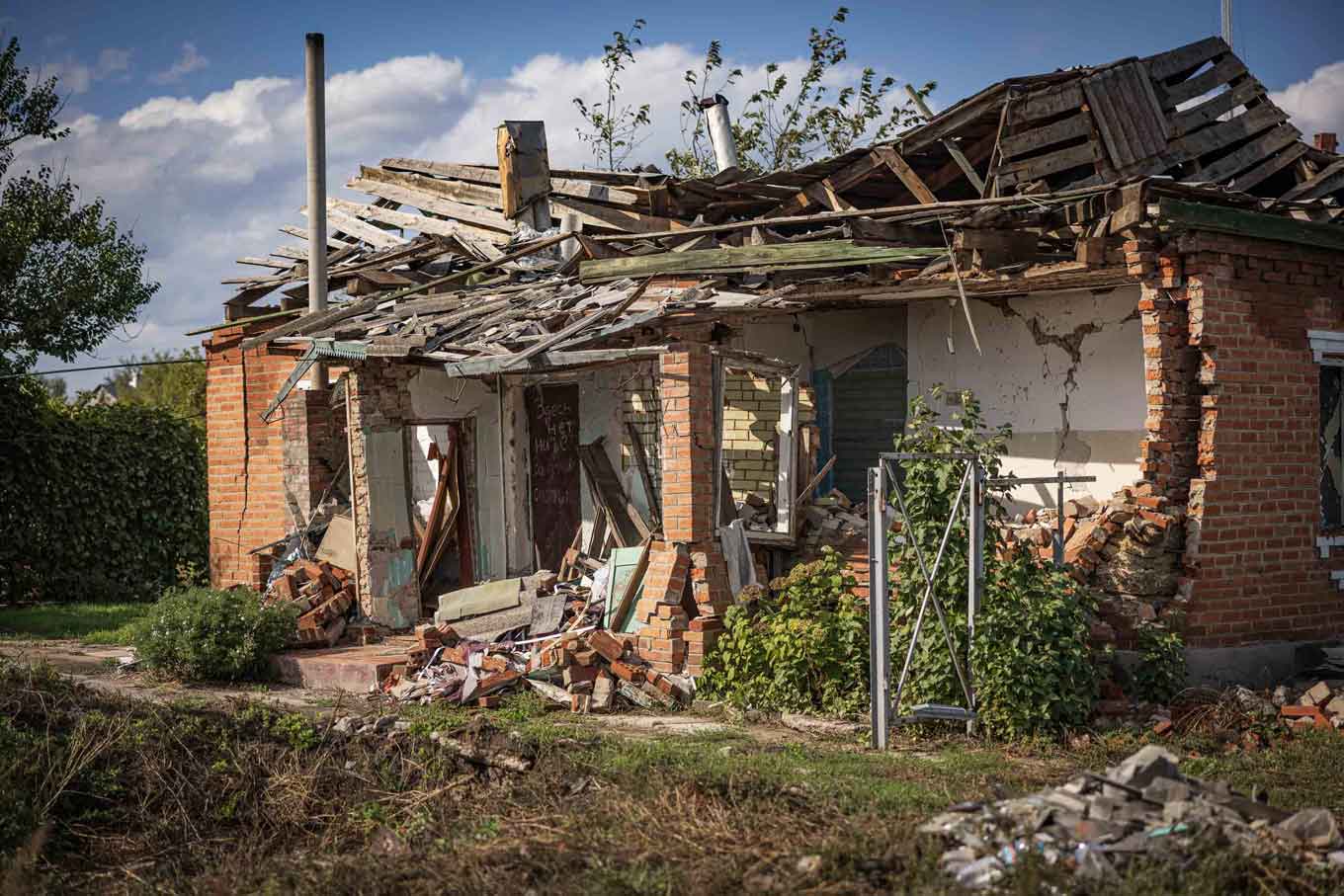
Many IDPs have chosen to stay in Ukraine for any number of reasons — to join the resistance, to remain with family, or because they cannot leave due to disability or financial limitations.
Intense fighting continues in the Eastern part of the country, but many have sought asylum in western Ukraine, where the war is less intense. This mass migration was exacerbated in the spring and summer of 2022, when thousands moved to avoid attack after direction from Volodymyr Zelenskyy, the President of Ukraine.
An overwhelming number of current IDPs have returned to Ukraine since leaving the country earlier in 2022, as well.

As many refugees who remain in other countries have found some level of support at the hands of major humanitarian missions, IDPs do not have the same legal classification as refugees and are left with little access to resources.
The Red Cross has developed a small compensation program for Ukrainians who house their displaced neighbors, offering roughly the equivalent of $12 USD per month. The Council of Europe provides similarly small resources for Ukraine’s IDPs.
Despite these modest efforts, displaced Ukrainians are uplifted primarily by their neighbors and local municipalities, which are overwhelmed with the need, lacking the infrastructure and money necessary to care for thousands more residents.
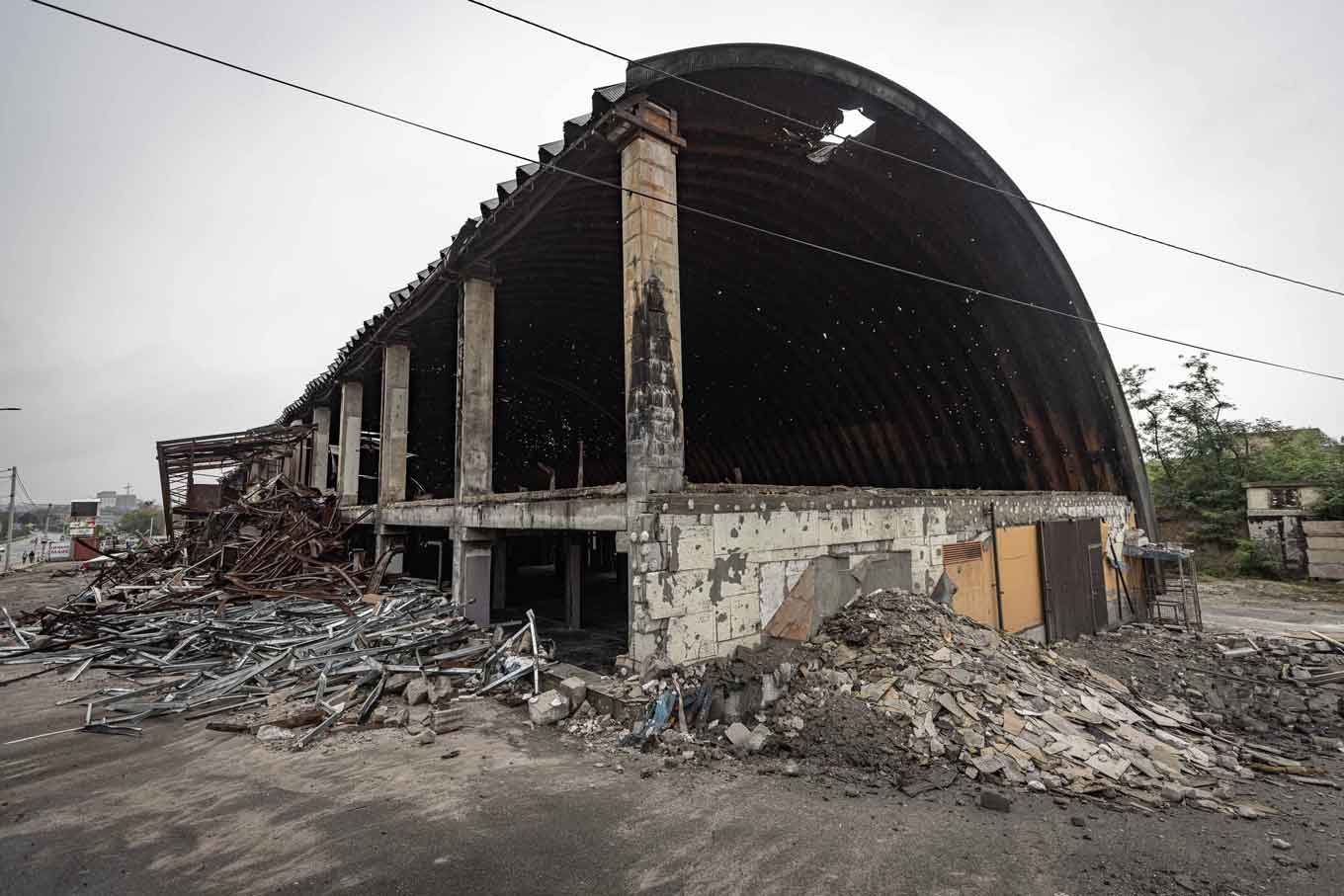
While the main hurdle to safety IDPs face is housing, folks who are displaced face a myriad of other challenges. Whether it’s finding work, accessing necessities, or even keeping warm in the upcoming harsh winter, the need for support is staggering.
Dr. Eric Rasmussen, a global disaster resilience expert who also served in the U.S. Navy for 25 years, has seen the first-hand impact of displacement experienced by those in the throes of war.
"When you cross the border, you get all the weight of the UN and the international community to support you. That's not true if you're inside your borders as an IDP."
“When you cross the border, you get all the weight of the UN and the international community to support you. That’s not true if you’re inside your borders as an IDP,” Rasmussen says.
“A local village mayor in Ukraine received an unfunded mandate to support 1,500 families in this village. There’s no process for that. The money doesn’t exist. The labor doesn’t exist. The materials don’t exist. The design doesn’t exist.”
How do you house displaced people when you don’t even know what tomorrow will bring for your country?
Meet MoveUkraine
Patricia (Tuscia) Shmorhun Hawrylyshyn met her husband, John Shmorhun during his service as a pilot in the U.S. Navy. He was an American, and she was a Canadian hailing from Switzerland.
She said he reminded her of a “Top Gun” Tom Cruise, and before they knew it, the two were married and had three children.
In 1992, after a stint in Switzerland for John’s business education, he began working for energy company DuPont, and the Shmorhuns moved to Ukraine. John was in charge of operations in Russia, Ukraine, and other Commonwealth states in his role at DuPont before becoming CEO at AgroGeneration, a grain production corporation.
Meanwhile, Tuscia spent those years in the NGO sector, creating a small nonprofit dental clinic and school, and co-founded a nonprofit, the Bohdan Hawrylyshyn Family Foundation, which works with young changemakers and UN delegates.

After more than 20 years living in the region, the couple wholeheartedly call Ukraine home, and when tensions rose between Russia and Ukraine in 2014, they agreed they would not leave the country if war were to happen.
So, they stayed — and in 2022, they continued to stay.
And they helped.
When they saw the dire need for housing of displaced Ukrainains, the duo — and their friend Andy Kuzich — founded their newest nonprofit endeavor: MoveUkraine.

The mission of the organization? To execute rapid and innovative solutions to meet the needs of Ukraine’s displaced people.
And there are a lot of needs to be met. Of the 8 million internally displaced Ukrainians, they’ve estimated at least 1.5 million have absolutely no place to stay, no family to call, and are desperate for help.
MoveUkraine refurbishes and repurposes existing buildings to provide safe, secure, and dignified housing for as many displaced folks as possible. They also work with partners to provide food, medicine, childcare, and emotional and psychological support for families traumatized by war.
Between Tuscia’s nonprofit connections, John’s far-reaching career in the region, and Andy’s financial and logistical smarts on job sites, the trio is at the helm of recovering and integrating IDPs into their new communities.
"We want to build homes, not houses. Because when you're displaced, it's not just physical displacement. It's a mental displacement. We knew we would be quick and nimble. We're actually helping to pull it all together."

“We want to build homes, not houses,” John says. “Because when you’re displaced, it’s not just physical displacement. It’s a mental displacement. We knew we would be quick and nimble. We’re actually helping to pull it all together.”
In June 2022, the team called upon donors big and small to forge ahead.
Related articles:
- Meet one Ukrainian Etsy seller creating in the midst of conflict
- Through online platforms, thousands open their homes to Ukraine’s Refugees
- Good news & how to make a difference from the first month of the conflict in Ukraine
- Solar microgrids are keeping Ukraine’s hospitals running
On mission to rise from the rubble
While MoveUkraine’s mission is centered around housing, it initially mobilized alongside legacy organizations (like the International Organization for Migration, the Norwegian Refugee Council, and Ireland’s Siobhan’s Trust) to provide both short-term and ongoing resources to neighbors who needed food and other necessities.
In one anecdote relayed by the team in an interview, the organization partnered with Siobhan’s Trust to distribute 1,000 pizzas in a day.
"This country organized immediately. Grandmas would bake bread and bring it to the streets, kids would carry toys to humanitarian centers. Millions helped millions, and it's still happening today. It gives you the fire to keep treading."
“This country organized immediately,” Tuscia says. “Grandmas would bake bread and bring it to the streets, kids would carry toys to humanitarian centers. Millions helped millions, and it’s still happening today. It gives you the fire to keep treading.”
One of the organization’s first designated projects was to rebuild an old student dormitory in Stryi, housing 150 displaced Ukrainians. The team completed electric and plumbing work, developed classrooms for English language and skills training, and provided safe housing for its newly displaced residents.
Tuscia talks about one of the women MoveUkraine helped move into the dormitory: a young anesthesiologist who lost her home and livelihood, watched her husband leave to fight in the war, couldn’t speak English, and sought shelter for herself and her seven-day-old baby. She wanted to get help, so she could get back to work.
“This could be any of us,” Tuscia says. “Really, it could.”
Another project took a former school in Mostysche and turned it into a communal home for nearly 30 people. The new residents, made up of a director and children from an orphanage, a foster family, and mothers with disabled children, were worried about being separated after enduring such unimaginable traumas together.

Although the MoveUkraine team does not typically place displaced Ukrainians in new homes (that’s usually a job for other professionals), this particular project was different.
“We just said, you know, ‘we have to do this. We have to keep them together,’” Tuscia says. “I think when you look for good, you find good. And we found so much good.”
John and Tuscia say it’s important for their work to extend beyond a dignified home, working to ensure that people have the resources they need to thrive in jobs, build communities, and access mental healthcare.
“If you put people together under these types of circumstances and you don’t provide those services, everything that’s needed to help them reintegrate, you create ghettos in the worst sense,” John says.
"All these people who did not know each other before went through all these phases of trauma, having to leave under missiles, having lost everything, having lost friends, teachers, finding themselves going through the stages of emotional and cultural adaptation together.
People need to live a normal life — displaced and non-displaced."
“This is a huge country,” Tuscia says. “All these people who did not know each other before went through all these phases of trauma, having to leave under missiles, having lost everything, having lost friends, teachers, finding themselves going through the stages of emotional and cultural adaptation together. People need to live a normal life — displaced and non-displaced.”
A new normal. That’s what MoveUkraine seeks to create.
Other projects, all solicited by regional governments and organizations, ask for MoveUkraine’s help to get all the logistics in place.
“The help we have received from MoveUkraine is very much needed and appreciated,” Lviv Mayor Andriy Nayda says. “We all understand that our community cannot afford investments in repairs, furniture, etc. MoveUkraine is providing a lot of help and inspiring the local communities to want to help their new IDP neighbors.”
They retrofit schools, factories, and bus stations to keep families together, with privacy, heat, food, care, and essential services — especially as a harsh winter becomes even more imminent.
"It's a form of resistance to say:
'You destroy. We build.'"
“It’s a form of resistance to say: ‘You destroy. We build,’” Tuscia says. “Sometimes I feel like I’m living in those war movies and there’s this horror we’re confronted with every day, but at the same time, there are people who have this incredible energy, who are so determined to keep the economy going, to work in whatever capacity they can. We need them here.”
They also need the funds to do this work, and to do it quickly. Thanks to their myriad of friends, former colleagues, and fellow nonprofits across the globe, the MoveUkraine team has been able to fundraise with lightning speed.
John, Andy, and Tuscia’s friends from university donate monthly, a Canadian beer company sends a portion of profits to MoveUkraine every month, and major initial funds have contributed to these first projects.
But the need is ongoing, and as winter approaches (in Ukraine, temperatures can hit freezing by October 1), more support is needed now than ever. Tuscia is proud to share that 90% of all donations go directly to help Ukraine’s IDPs, to give them safe, dignified places to live.
“Every dollar counts and every dollar is stretched. Every dollar changes a life for sure,” Tuscia says. “We send pictures to our donors. We go weekly to our projects. We know the people we work for. We meet the refugees that live there. We’re going to go back and back so people can have a direct connection.”
Rebuilding with help from around the world
Remember Rasmussen? On the other side of the planet, he’s been hard at work garnering support for these housing efforts, too. His nonprofit, the Applied Hope Foundation, has used a process called “forward grant making” to take his foundation’s U.S. donations, meet federal tax requirements through the IRS, and then pass that money along to MoveUkraine.
His financial support hasn’t been the only help, though. Rasmussen has been working with local contractors in Washington state to add an additional layer to support Ukraine’s IDPs.
In addition to retrofitting old buildings, MoveUkraine hopes to be able to provide the tools to build more transitional housing options for displaced residents.
Rasmussen and the MoveUkraine team called up a few housing savvy friends, Dan Kenney and Aaron Sauerhoff, and began working on a number of designs for small homes in Ukraine. They were subsequently discarded, as the limited access to and supply of building materials was an insurmountable hurdle.
Back to the drawing board, the team turned to a very specific document. Kenney found a resource created after World War II, titled the Plans of Farm Buildings For Northeastern States. This was a project funded by the U.S. Department of Agriculture and developed by the University of Wisconsin to help develop simple-to-build housing and farm buildings.

“You will see these architectures in any rural area throughout America, as they allowed farmers and ranchers, with the help of friends and family, to build their structures using these simple and practical plans,” Kenney says.
Simple-to-build housing, requiring few building materials, constructed by friends and family, is exactly the tool displaced Ukrainians need.
Considering this World War II-era document a case study on what could be done to house Ukrainians, Kenney knew these concepts were from the 1950s and 60s and are not currently engineering-approved for use in the U.S.
He and his fellow engineers would have to get crafty.
The group of innovators jumped head-first into developing a game plan for small, highly insulated homes that can be built locally and used for transitional housing in Ukraine.
"We're saying 'here's how you build with rubble: If all you have is broken sticks and broken bricks, here is how you put together a shelter to get through the winter."
“We’re saying ‘here’s how you build with rubble,’” Rasmussen says. “If all you have is broken sticks and broken bricks, here is how you put together a shelter to get through the winter.”
These designs are the blueprints for simplified small homes that are rugged, insulated, and easy to construct. Planned to be about 12 feet by 20 feet, and created with concrete and foam (easy-to-source materials that are accessible even in a war zone), they’re about as DIY as it gets.
The designs are an adaptation of a homeless mitigation site in Olympia, Washington, where Sauerhoff’s company, Earth Homes built 60 shelters. The design has been simplified to be a larger stressed skin cement and foam structure, based on available resources in Ukraine.

These super simplified gambrel-style shelters eliminate the need for complex construction work, all while maintaining structural and insulating integrity.
Right now, the designs are in the process of being approved by local Ukrainian governments and have been brought to the International Organization for Migration.
MoveUkraine is in several discussions with local authorities to locate land suitable for building — that’s also close enough to schools to be accessible for families.
While this element of MoveUkraine’s work is in its infancy, the organization has all the skills and resources to get started once approvals are granted. Rasmussen is confident that widespread dissemination and adoption of these small home building plans is possible.
“We have the attention of an organization capable of disseminating these templates to the places they need to be. We also have the ability to source the building and teaching materials that are required to help people who are all out there by themselves build a home that will keep them safe through the winter — and probably last three to five years,” Rasmussen says. “Here we have something that will help us save lives.”
What comes next?
MoveUkraine still has a long way to go, and a lot of hard work to do, before many of its goals are met.
But housing isn’t the only thing displaced folks need. While this work is vital, all infrastructure that helps keep communities healthy and thriving must be in working order for IDPs to realize their full dignity and personhood.
Folks need transportation, roads, electricity, clean water, and so much more beyond immediate shelter. When the homes are built, can Ukraine keep its people safe?
John says city administrators need to manage new displaced residents as they move in and out of various areas in the country. IDPs also need guaranteed access to food, schooling, and support for regular expenses. This is an ongoing logistical project of enormous proportions.
"If you are not helping or serving, you are being helped."
“If you are not helping or serving, you are being helped,” John says. “Displaced Ukrainians must be integrated into their new communities. They need to find jobs, be treated for PTSD.”
Much of this work is already being facilitated by MoveUkraine and its many partners, which include: Ukrainian Education Platform, UNICEF, Siobhan’s Trust, Franklin Covey Ukraine, Help Us Help, and even U.S. Congresswoman Marcy Kaptur and her work with Medwish and United Ukrainian Organizations of Ohio.
But above all, the war must end.
“Russia’s invasion is an existential threat to the existence of Ukraine,” John says. “The people know this.”
Unimaginable loss calls for unimaginable community
Despite the unknown that comes with each day, and the devastation people can barely even begin to sift through as they must mobilize in droves — life does, somehow, go on.
Tuscia speaks highly of a new sushi restaurant that opened in their neighborhood during the war. She mentions a bridge that had been rebuilt just a month after catastrophic bombings in Kyiv.
"I think this war has given a lot of people a chance to do good again, to do something that's impactful, that helps your fellow person."
“There is this kind of weird new reality of normalcy,” she says. “I think this war has given a lot of people a chance to do good again, to do something that’s impactful, that helps your fellow person.”
Rasmussen’s work in humanitarian aid calls upon this grassroots approach to crisis. He’s quite literally a scholar in it, recently publishing an article in the Journal of Health and Human Experience about the cultural history of humanitarian assistance, or as he calls it: “applied hope.”
“I have had a chance to revisit what ordinary humans have done over the past 2,000 years to get better and better at responding to natural and manmade disasters,” Rasmussen says. “There’s this volunteer spirit that has, over time, infused society with the kind of ethos that says: ‘You’re supposed to help.’”
This contradicts what we have so long believed to be the evolution of humankind to protect one’s family and tribe against any threat — and perhaps do everything in our power to impede caring for others. But, Rasmussen posits, partly in thanks to grassroots movements, that we live in a time of a different philosophy.
It aligns with the increase of civilian casualties in war, he says.
“Over the course of the 20th century, more and more civilians became a fraction of the casualties, and eventually became a deliberate fraction of the casualties,” Rasmussen says.
He refers back to his time in the military.
“I watched the humanitarian impact because that eventually became my job. I was shifted away from taking care of injured soldiers and given to the Humanitarian Operations Center in Iraq as the medical director,” Rasmussen says. “So I had an opportunity to see just what a toll was being taken on civilians deliberately targeted for the psychological impact of reducing resistance. As a consequence, the civilians who are being harmed are being cared for by the civilians that are near them.”
He details some of the atrocities occurring now in Ukraine — like undetectable land mines in crop fields that make them impossible to harvest, depleting food and financial sources for civilians.
It’s bleak. And it calls for resilience and kinship like nothing else.
“You keep fighting,” Rasmussen says. “You don’t let the bad guys win. We need to find a little titanium here. Until you are crushed to nothing but jelly, you don’t let the bad guys win.”
With a place to stay to survive the winter, Ukrainians won’t back down.
“The first responders in an emergency are the people standing next to you; your neighbors and friends,” Rasmussen says. “This is a story about people rising to the occasion. This is what’s happening with MoveUkraine.”

It’s not even a question of bravery, of finding the courage to confront a problem that seems so unscalable. They do it because they have to, and they do it one person, one family, at a time.
"We're not going anywhere. This is our home. We're going to rebuild, because this is our home."
“We’re not going anywhere,” Tuscia says, astounded that there could even be an alternative. “This is our home. We’re going to rebuild, because this is our home.”
A version of this article was first published in the Goodnewspaper — Good Good Good’s monthly print newspaper filled with good news and ways to make a difference.
You can also find more good news in the Goodnewsletter — the free daily email filled with reasons to feel hopeful.
Two weeks ago, more than 160 gun owners in Richmond, Virginia, turned in 474 firearms in the city’s first-ever gun buyback event.
City officials offered Walmart, Amazon, and Kroger gift cards in various amounts for different unwanted firearms: $250 for assault-style weapons, $200 for handguns, $150 for rifles and $25 for non-functioning guns. No questions asked.
The event’s organizer, community activist Pati Navalta, knows all too well that guns that are stolen or bought on the streets are used in crimes; the men who shot and killed her son, Robby Poblete, in September 2014 during an attempted robbery in Vallejo, California, obtained their handgun illegally.
After her son’s death, Navalta launched the Robby Poblete Foundation to support gun buyback events throughout the country. The events have been held in several cities in California — including Vallejo — along with Augusta, Georgia, and Richmond, Virginia, and have collected more than 2,000 firearms. Reducing the number of guns in communities is essential, said Navalta.
“It’s really difficult to quantify the number of crimes prevented or the number of lives saved with every weapon we collect,” she said. “But the probability that a gun is used in a crime drops to zero when it gets bought back.”
Most police departments incinerate the weapons collected in such events, but the guns obtained in the Robby Poblete Foundation buybacks are used to create art exhibits through the foundation’s Art of Peace program to spark a discourse on gun violence — an homage to Poblete’s love of welding.
Elsewhere, Oakland, California, forges them into garden tools, while Miami is sending guns from a buyback event this month to Ukraine for its defensive efforts against Russia.
American cities have been running buybacks since at least the 1970s, and they are broadly popular, even in conservative, gun-friendly states.
Over the past two months, for example, gun buyback events in Houston netted 845 guns, Dane County, Wisconsin, received more than 500 guns and Spartanburg, South Carolina, collected 165 guns.
But while many communities include buybacks in their overall gun violence prevention strategies, most research shows these events are ineffective at reducing homicides and suicides.
“It’s a waste of resources if the entities that are sponsoring believe that it’s going to have a positive effect on reducing crime,” said Keith Taylor, an adjunct professor at John Jay College of Criminal Justice, which is part of the City University of New York system.
“But if the purpose is to provide a means for individuals to get rid of weapons from their households that they don’t want to have anymore, it absolutely is a good option.”
Taylor, a former assistant commissioner at the New York Police Department, said if people wanted to get rid of unwanted guns, they don’t have to wait for a buyback event; most police departments will allow people to turn in firearms without a reward.
But that doesn’t appeal to people who may use their firearms for crimes and a means of earning a living, he said.
Mark Anderson, a professor of economics at Montana State University, published a study with the National Bureau of Economic Research last year on the ineffectiveness of buyback events across the United States.
The study cited research showing buybacks offer too little money, tend to take place in low-crime areas and collect firearms that tend to be older and less functional.
“Who’s choosing to turn their gun in?” Anderson asked. “It’s probably not the person on the margins whose gun we’re trying to get off the street. That gun from Grandpa is not the one that is going to be involved in a crime later on. It’s the voluntary nature of these things.”
An effective buyback would have to be a national event, paired with federal gun safety legislation, similar to what Australia did in 1996, said Bradley Bartos, an assistant professor of government and public policy at the University of Arizona, who studied the impact of the Australian model in a 2019 paper in Prevention Science.
After a man killed 35 people and wounded 28 others in a mass shooting in Port Arthur, Tasmania, Australia implemented federal gun safety legislation that in part banned automatic and semi-automatic rifles and shotguns. But it also included a mandatory buyback of newly illegal firearms.
Officials collected and destroyed more than 650,000 firearms — about 20% of the guns in Australia. Gun-related homicides and suicides plummeted in the following years, research shows.
“Gun buybacks can work and have been shown to work in settings outside the U.S.,” said Bartos. “But those same factors in Australia aren’t present in the U.S.”
For one, Australia is geographically isolated, controlling the import of firearms at the federal level, he said. But more broadly, guns are too prevalent in the United States to substantially reduce their numbers voluntarily, he added.
There are more guns than people in the U.S. For every 100 Americans, there are more than 120 firearms, according to a 2018 study by the Small Arms Survey, a Switzerland-based project that researches armed violence.
And even if a gun buyback event nets hundreds of guns, cities struggle with guns trafficked from states with less restrictive gun laws or from the influx of untraceable, 3D-printed “ghost guns,” he said.
Some community activists are trying to lobby their city officials to find ways to make buybacks more appealing, including through greater incentives.
The amount of money that officials offer for firearms at buyback events vary by community. While Nashville, Tennessee, offered $50 Kroger gift cards for all guns in its buyback event earlier this month, Columbus, Georgia, gave out $250 gift cards for any handgun, rifle or shotgun turned in at its event last month. Nashville netted 76 guns. Columbus, on the other hand, obtained 111 guns.
If the purpose of these events is to appeal to criminals who obtained their guns illegally, these financial incentives need to be much larger, said Jonathan Wilson, founder of the Fathership Foundation, a nonprofit that provides community education and workforce development in Philadelphia and in Wilmington, Delaware.
Ideally, local officials should offer at least $100 for rifles, $200 for small caliber revolvers, $400 for semi-automatics and $500 for assault weapons, he said.
While this would be substantially more money than communities currently offer, it would be far less than what they spend on prosecuting and jailing people who commit gun violence, said Wilson, who calls himself the “poster boy” of this issue, having been shot four times. He was paralyzed in a 2011 shooting and uses a wheelchair.
“They’re offering food vouchers for $100; it’s a joke,” he said. “We need to get more creative. I guarantee you if you offer $400 a gun, they’re going to be flying off the street.”
Although gun buybacks are by themselves inadequate to prevent gun violence, they do have a role to play in a broader approach to reducing the number of deaths and injuries from firearms, said Dr. Max Hazeltine, a general surgeon at the University of Massachusetts Memorial Medical Center.
Having treated “devastating” injuries from gunshots, he is convinced that a multipronged approach to gun violence prevention is required. And that includes gun buybacks, he said.
“A gun buyback in and of itself is helpful,” Hazeltine said. “But it’s not going to be as effective if it’s done in isolation.”
For more than a decade following the Revolutionary War, America was governed by the Articles of Confederation, which provided for only a weak and minimal federal government while allowing states to operate like individual sovereign countries. That was until 1787, when delegates of the Constitutional Convention signed the Constitution of the United States of America in Philadelphia.
Since then, the document has been altered 27 times through the amendment process provided by Article V of the Constitution itself. Requiring a two-thirds majority vote by both the House and Senate or by a constitutional convention called for by two-thirds of the country's state legislatures, amending the Constitution is no easy task.
The first 10 amendments to the Constitution are collectively called the Bill of Rights. Written by James Madison, the Bill of Rights puts specific limits on government power and enshrines specific personal liberties. With issues such as free speech and the right to possess and carry firearms seemingly unerring issues in today's political climate, Stacker compiled a look at all 27 amendments to the Constitution in order to provide an overview of precisely what was at stake each time our elected leaders voted to amend America's governing document.
Amendment I: Religion, speech, press, assembly, and petition
Year ratified: 1791
The First Amendment is the cornerstone of America's basic liberties. It guarantees both the freedom of religion and, from religion, a free press, the freedom to assemble peaceably, to speak freely, and to petition the government for a redress of grievances.
Amendment II: Right to bear arms
Year ratified: 1791
Perhaps no part of the Bill of Rights is more hotly contested than the Second Amendment, which provides that "a well regulated Militia, being necessary to the security of a free State, the right of the people to keep and bear Arms, shall not be infringed." The language of that statement has sparked fierce debates—in a country that suffers tens of thousands of gun deaths every year—over whether the framers meant that gun ownership is an individual right or that gun ownership is guaranteed only for regulated defense organizations.
Amendment III: Quartering of troops
Year ratified: 1791
Today, the Third Amendment has virtually no impact on our daily lives; it has been litigated less than any other amendment in the Bill of Rights, and the Supreme Court has never heard a case on it; however, when the framers wrote it, Britain's long history of forcing its subjects to quarter (house) soldiers in Europe was fresh on their minds, as was the Boston Massacre—the deadly culmination of protests by Massachusetts colonists who were frustrated with their obligation to quarter and provide for British troops.
Amendment IV: Search and seizure
Year ratified: 1791
The framers of the Constitution could not have imagined smartphones, cloud storage, SUV glove compartments, or even organized police forces. Yet the Fourth Amendment they crafted, which protects citizens against unreasonable search and seizure, has been interpreted and applied to all those developments in modern history and many more over the past decades and centuries.
Amendment V: Grand jury, double jeopardy, self-incrimination, and due process
Year ratified: 1791
While watching a courtroom drama unfold on TV, you've probably heard a reluctant witness "take the Fifth." That's a reference to the Fifth Amendment, which guarantees the right to refuse self-incrimination, as well as other basic protections, including exclusion from double jeopardy and the guarantee that people will not be deprived of life, liberty, or property without due process.
Amendment VI: Right to a speedy trial by jury, witnesses, counsel
Year ratified: 1791
The Sixth Amendment contains many protections that lay the groundwork for the American criminal justice system and the rights it guarantees to the accused. Among them are the right to be informed of the charges against them, the right to confront accusers, the right to call witnesses, the right to legal counsel, and the right to a speedy, public trial before an impartial jury.
On May 23, 2022, the Supreme Court decided that a federal court cannot consider new evidence outside of the state-court record in deciding whether the state violated an individual's right to effective assistance of counsel at trial under the Sixth Amendment. The decision, handed down by a 6-3 majority and written by Justice Clarence Thomas, concerned two cases in which people were sentenced to death despite receiving constitutionally ineffective counsel during their respective trials.
The ruling does not revert the protections provided by the Sixth Amendment; however, it weakens them, as individuals who received inadequate counsel in trial and/or post-trial conviction proceedings no longer have recourse to appeal their verdicts to a federal court on that basis. In its dissent, the court's minority stated its belief that, as a result of the ruling, "the Sixth Amendment's guarantee is now an empty one."
Amendment VII: Jury trial in civil lawsuits
Year ratified: 1791
The Seventh Amendment is one of the oddest and most loosely enforced entries in the Bill of Rights. Not only does it specify the seemingly arbitrary benchmark of $20, but it also makes the United States one of the few remaining countries to require that civil trials be conducted by jury, even though less than 1% of such trials are actually decided in this manner.
Amendment VIII: Excess bail or fines, cruel and unusual punishment
Year ratified: 1791
The framers of the Constitution included the Eighth Amendment to ensure that American courts would not institute the extreme forms of torture associated with the Spanish Inquisition and other primitive justice systems suffered by their European ancestors; however, it is one of the most controversial and contentious elements of the entire Bill of Rights, as "cruel" and "unusual" are both subjective concepts.
Amendment IX: Non-enumerated rights
Year ratified: 1791
The Ninth Amendment is one of the most ferociously contested of all the amendments in the Bill of Rights, and its legal effects are still widely disputed. Like the 10th Amendment, it deals with popular sovereignty and seeks to ensure that citizens do not surrender any rights that aren't specifically guaranteed in the Bill of Rights.
Amendment X: Rights reserved to states or people
Year ratified: 1791
Like the Ninth Amendment, the 10th (and final) Amendment in the Bill of Rights reiterates the theme of popular sovereignty in the American form of government. The decision of whether or not to include a Bill of Rights in the Constitution was hotly contested by its framers, some of whom were worried about the infringement of rights that weren't expressly guaranteed.
Amendment XI: Suits against a state
Year ratified: 1795
The 11th Amendment prohibits federal courts from hearing specific lawsuits brought against states by citizens from other states or foreign countries.
Amendment XII: Election of president and vice president
Year ratified: 1804
The 12th Amendment was written in response to the peculiar and massively consequential election of 1800, which represented the first time in history that an incumbent, John Adams, was defeated. That defeat resulted in an Electoral College tie between Aaron Burr and Adams' vice president, Thomas Jefferson. A congressional vote eventually broke the tie, but the fiasco revealed major flaws in the way presidents and vice presidents were elected under the original Constitution.
Amendment XIII: Abolition of slavery
Year ratified: 1865
The 13th Amendment outlawed slavery — with one gaping loophole: "except as a punishment for crime." When Reconstruction ended, every Southern state installed the brutal system known as convict leasing. For decades following emancipation, hundreds of thousands of Black Americans who had committed no real crime were kidnapped off the streets by corrupt sheriffs. They were hustled through corrupt local court systems, convicted of vague crimes like vagrancy, issued fines they couldn't pay, and forced to work off those fines building railroads, mining coal, and picking cotton under conditions that were often worse than those endured by people enslaved prior to the 13th Amendment's ratification.
Amendment XIV: Privileges and immunities, due process, equal protection, apportionment of representatives, civil war disqualification, and debt
Year ratified: 1868
One of three amendments designed to protect Black Americans in the immediate aftermath of the Civil War, the 14th Amendment guaranteed equal protection under the law without regard to race. Like the 13th and 15th Amendments, it created dramatic change during Reconstruction, but Black citizens were quickly denied its protections when Reconstruction ended. Millions of newly freed enslaved persons were left to the mercy of their defeated and enraged former masters, who reclaimed control of local and state governments.
Amendment XV: Right to vote not to be denied on account of race
Year ratified: 1870
The 15th Amendment gave Black men the right to vote though that right was largely symbolic until major civil rights legislation was signed in the mid-1960s—nearly a century after the Reconstruction era . When Reconstruction ended, white supremacist governments once again took over the South as well as many other areas of the country. They used mechanisms ranging from poll taxes and literacy tests to acts of violence and terrorism to keep Black people as disenfranchised as possible.
Amendment XVI: Income tax
Year ratified: 1913
The 16th Amendment was part of a wave of early 20th-century reforms that changed the relationship between the federal government and the citizens of the United States. The enabling of a nationwide income tax played a key role in the rise of the modern, powerful federal government, which would quickly come to rely on income tax as its chief source of revenue.
Amendment XVII: Popular election of senators
Year ratified: 1913
It's been more than a century since the 17th Amendment empowered the people to directly elect the senators who represent their states. It's hard to imagine what Congress would look like today if senators were still chosen by state legislatures, as they were prior to 1913.
Amendment XVIII: Prohibition
Year ratified: 1919
More than a half-century before Richard Nixon declared a "war on drugs," America established the 18th Amendment, which prohibited the manufacture, transportation, and sale of intoxicating liquors. But in reality, Prohibition did none of that. Americans kept drinking—and similar to the illegal drug trade, the act created a black market that fueled an unprecedented rise in violent crime and urban warfare as organized gangs battled for control of the lucrative underground trade.
Amendment XIX: Women's right to vote
Year ratified: 1920
Representing a watershed moment for equality and freedom in American history, the 19th Amendment was the crowning achievement of a nearly century-long active struggle for women's rights. The codification of women's suffrage with the ratification of the 19th Amendment was built on the shoulders of giants like Susan B. Anthony, Elizabeth Cady Stanton, and Lucretia Mott, whose relentless protests changed the consciousness of the American patriarchy.
Amendment XX: Presidential term and succession
Year ratified: 1933
Few amendments have been passed with less fanfare, controversy, and discussion than the 20th Amendment, which modifies part of the Constitution and the 12th Amendment, mostly to clarify start dates for terms of office. To this day, it has never been the subject of a Supreme Court decision.
Amendment XXI: Repeal of prohibition
Year ratified: 1933
Fourteen years after the 18th Amendment made Prohibition the law of the land, the 21st Amendment repealed it. It remains the only time in American history that the Constitution was amended to overturn a previous amendment.
Amendment XXII: Two-term limit on presidency
Year ratified: 1951
Few issues puzzled the framers of the Constitution more thoroughly than the process of choosing a president and determining the length of time for which a president should serve. After all, European monarchies offered no precedent on which to base the new executive office. While many framers wanted the presidency to be a lifetime appointment, President George Washington's decision to retire after his second term set the tone for a voluntary two-term limit. This lasted for 150 years, but the dual crises of the Great Depression and World War II led Americans to elect Franklin D. Roosevelt to four terms in office, stoking fears of future tyranny that led to the ratification of the 22nd Amendment.
Amendment XXIII: Presidential vote for DC
Year ratified: 1961
Washington D.C. has been the seat of government in the United States for nearly as long as America has been a country, but residents of the District of Columbia have only been allowed to vote in presidential elections since 1961. The 23rd Amendment granted that right. As a city with a Black majority, newly acquired votes added even more steam to the escalating civil rights movement. In turn, the measure encountered fierce resistance in the South.
Amendment XXIV: Abolition of poll taxes
Year ratified: 1964
The 24th Amendment prohibits the use of the poll tax, a mechanism Southern states used to enforce white supremacy and disenfranchise Black Americans for nearly a century following the Civil War and Reconstruction. With poverty rampant among Black and white Southerners, few could afford to pay to exercise their right to vote. Grandfather clauses, however, often exempted anyone whose ancestors voted before the Civil War, which allowed many poor whites to vote for free while excluding virtually all Black Americans living in former slave states.
Amendment XXV: Presidential disability and succession
Year ratified: 1967
The issue of presidential succession was addressed in Article 2, Section 1, Clause 6 of the original Constitution. But flaws in the document's vague and convoluted wording were exposed in 1841 when President William Henry Harrison died, leaving Vice President John Tyler to fight for his claim to the presidency. One of the more complex amendments, the 25th Amendment, clarifies the issues of presidential succession in four sections.
Amendment XXVI: Right to vote at age 18
Year ratified: 1971
The 26th Amendment lowered the voting age from 21 to 18. Debates over the hotly contested amendment started during World War II and came to a head during the Vietnam War. The country was collectively outraged that 18-year-old men could be drafted for involuntary military service and foreign combat right out of high school but were still three years away from being old enough to vote for their own leaders.
Amendment XXVII: Compensation of members of Congress
Year ratified: 1992
The 27th Amendment seems fairly straightforward, maintaining that members of Congress may not alter their salaries midterm. But the so-called compensation amendment's bizarre centuries-old saga from its original proposal to ratification was a meandering journey. It started during the first session of Congress in 1789 and didn't end until the dawn of the digital age. No other amendment languished in limbo for a longer period of time.
This story was originally published by Stacker and republished pursuant to a CC BY-NC 4.0 License.
Every month, there are hundreds of national and international celebrations dedicated to raising awareness and support for meaningful causes.
For those working to bring attention to important topics, it can be challenging to keep track of the next relevant awareness event. We’re here to help.
At Good Good Good, we aim to help people feel more hopeful and do more good. For years we’ve privately curated a comprehensive list of important cause-themed holidays that we’ve used for creating content on our good news Instagram, our Goodnewsletter, our Goodnewspaper, and on this very website.
We’ve organized this list of observances and events by month — and are making them public for the first time. Our hope is that this will help you or your organization bring attention to important issues.
Where applicable, we’ve included resources (usually good news around particular topics, action steps on how to make a difference, or relevant quotes) — and encourage you to share them if you find them helpful.
The main days and months you should know about for November are:
| November Holidays | Type | Date |
|---|---|---|
| Native American Heritage Month | Month | November 1 |
| Hunger & Homelessness Awareness Week | Week | November 11-18 |
| World Kindness Day | Day | November 12 |
| Giving Tuesday | Day | November 28 |
| Veterans Day | Day | November 11 |
| Trans Day of Remembrance | Day | November 20 |
November is the eleventh month of the year and has 30 days. It marks the beginning of winter in the Northern Hemisphere and summer in the Southern Hemisphere. Known for Thanksgiving in the U.S., it’s a time of gratitude and family gatherings, characterized by feasting, parades, and football.
Explore our comprehensive list of national and international months, weeks, days, and birthdays for the month of November:
November Celebrations:
Awareness Months
There are several awareness months celebrated in November — though the five that often get the most attention include Native American Heritage Month, Movember, Diabetes Awareness Month, Epilepsy Awareness Month, and National Homeless Youth Awareness Month.
Native American Heritage Month
Explore this guide on how to how to celebrate Native American Heritage Month
Movember
National Homeless Youth Awareness Month
COPD Awareness Month
Diabetes Awareness Month
Epilepsy Awareness Month
Lung Cancer Awareness Month
Pancreatic Cancer Awareness Month
Dercum’s Disease (Adiposis Dolorosa) Awareness Month
Adopt a Turkey Month
Manatee Awareness Month
Awareness Weeks
Hunger and Homelessness Awareness Week
Week prior to Thanksgiving
Read quotes about hunger and learn about world hunger stats
International Stress Awareness Week
1st week of November
Transgender Awareness Week
1st two full weeks of November
World Kindness Week
Week-long event in November
Explore the best ways to celebrate World Kindness Week
Polar Bear Week
1st week of November
UK Self Care Week
Week-long event in November
Explore the best (non-cliché) self-care ideas and self-care quotes
Restorative Justice Week
3rd week of November
National Family Week
3rd week of November
National Farm-City Week
3rd week of November
Awareness Days
World Vegan Day - November 1
Listen to our podcast episode about how going vegan can change the world
International Stress Awareness Day - November 2
World Jellyfish Day - November 3
National Bison Day - First Saturday of November
Read about how wild bison are back in the UK for the first time in thousands of years
International Day for Preventing the Exploitation of the Environment in War and Armed Conflict - November 6
Aicardi Syndrome Awareness Day - November 8
Intersex Day of Remembrance - November 8
National STEAM Day - November 8
World Adoption Day - November 9
Veterans Day - November 11th
Explore these activities and ideas for how to celebrate Veterans Day and read these good news stories about veterans
World Usability Day - November 11
World Pneumonia Day - November 12
World Kindness Day - November 13
Check out these ideas for how to celebrate World Kindness Day and try one of these ideas for random acts of kindness
World Diabetes Day - November 14
National Recycling Day - November 15
World Ohtahara Syndrome Awareness Day - November 15
International Day for Tolerance - November 16
World COPD Day - 3rd Wednesday of November
World Pancreatic Cancer Day - 3rd Thursday of November
Social Enterprise Day - November 17
Read good news stories about businesses making a difference
National Hiking Day - November 17
Check out the “free days” at U.S. national parks and while you’re at it, explore the best national parks quotes and gifts for national parks lovers
International Transgender Day of Remembrance - November 20
International Survivors of Suicide Loss Day - 1st Saturday before Thanksgiving
World Fisheries Day - November 21
Read the good news story about land-based aquaculture startups that are producing healthier fish without polluting the sea
Humane Society Anniversary Day - November 22
International Day for the Elimination of Violence Against Women - November 25
Unthanksgiving Day - The same day as Thanksgiving
The National Day of Mourning - The same day as Thanksgiving
National Day of Listening - 1st Friday after Thanksgiving
Green Friday - 1st Friday after Thanksgiving
Explore this sustainable shopping guide to make sure your holiday shopping is eco-friendly
Small Business Saturday - 1st Saturday after Thanksgiving
Explore the best ideas for how to celebrate Small Business Saturday
Giving Tuesday - 1st Tuesday after Thanksgiving
Read and share our article on how and where to donate for Giving Tuesday (plus more ideas)
International Jaguar Day - November 29
International Day of Solidarity with the Palestinian People - November 29
Shift Worker Sunday - Last Sunday of November
Notable Birthdays
Birthdays of leading activists, nonprofit leaders, and other world-changers born in the month of November:
Dorothy Day’s Birthday - November 8
Yvon Chouinard’s Birthday - November 9
Learn more about the founder of Patagonia by reading Yvon Chouinard's best quotes about the environment, sustainable business, and adventure
Bryan Stevenson’s Birthday - November 14
Read the best quotes from Bryan Stevenson — and learn about his admirable work
RuPaul’s Birthday - November 18
Brené Brown’s Birthday - November 18
Read and share the best quotes from Brené Brown
Sister Corita Kent’s Birthday - November 20
Mark Ruffalo’s Birthday - November 22
Jamie Lee Curtis’ Birthday - November 22
Bill Nye’s Birthday - November 27
You might also like: The Best November Quotes
Explore More Events:
Main Awareness Calendars: All Awareness Holidays | Heritage Months | International Days
More Awareness Calendars: Animals | Pets | Environment & Sustainability | LGBTQ+ | Black & African American | Mental Health | Disability | Cancer | HIV/AIDS
Awareness Days & Months: January | February | March | April | May | June | July | August | September | October | November | December
Is this list missing a holiday or awareness week/month? Let us know. We want to ensure this list is comprehensive and inclusive.
The same article of clothing that some of us literally walk all over is the same item being used to address today’s most urgent social issues.
So, if we’re already buying socks, why not make a difference doing it?
Supporting businesses that actively seek ways to connect us to important causes is an almost seamless way of ensuring that our purchases are met with positive, sustainable solutions.
We’ve curated the ultimate list of sock companies that are making it easier for us to elevate our sock game while supporting the causes we care most about.
By the way, some of the products and links in this article are partners and affiliates, which means if you make a purchase after clicking a link, we may earn a commission at no extra cost to you. Everything in this article was independently and honestly written by the Good Good Good team. Thank you!
Shop the best socks for a cause —
Conscious Step

Conscious Step creates stylish, sustainable, and cause-centered socks that are vegan, GOTS Organic, and Fair Trade-certified. Every pair gives back to a dedicated nonprofit organization:
- … that conserves rainforests
- … that educates kids
- … that empowers women
- … that provides meals
- … that protects pollinators
- … that finds a cure
- … that saves shelter animals
- … that plants trees
- … that protects endangered species
- … that provides water
- … that restores oceans
- … that saves LGBTQ+ lives
- … that supports mental health
- … that supports self-checks
- … that protects national parks
- and more!
To date, customers have helped contribute more than $1.7 million (and counting) to organizations!
Whether you’re in the market for a pair of crew or ankle socks, a thoughtful gift box, or a subscription service featuring different causes and designs every month, this company provides an easy gateway for you to give back.
Conscious Step is also a part of 1% for the Planet, meaning it gives 1% of its annual gross sales to the organization’s approved nonprofit partners that are working towards environmental solutions.
→ Shop socks from Conscious Step
Bombas

Socks are the #1 requested item in homeless shelters, and Bombas provides socks to individuals facing housing insecurity across the U.S.
The B Corp-certified business was named after the Latin word for ‘bee,’ because Bombas believes that just as bees work cooperatively to make the hive a better place, so too should humans.
For every item purchased, an equal item is donated to Bombas’s network of over 3,500+ Giving Partners, including overnight shelters, transitional living facilities, street outreach teams, rehabilitation centers, Title 1 schools, and medical service professionals. That’s a lot of toasty toes!
To date, customers have had a hand in donating over 150 million essential clothing items. Bombas has also expanded its product offerings to underwear and shirts — the #2 and #3 most requested items at shelters.
Parks Project

Parks Project was born out of its founders’ love for national parks and desire to see them flourish.
Purchasing socks from Parks Project means investing in advocacy and education, habitat and wildlife restoration, visitor programs, and youth initiatives. That’s a lot of power in just one pair of socks!
The brand offers retro and nature-inspired sock collections of crew and fuzzy socks that are great to pack on your next hiking trip.
To date, Parks Project has contributed over $2.7 million to help fund vital projects in national parks around the U.S. — including some of your favorite national parks like the Grand Tetons, the Great Smokey Mountains, and more!
PS, if you or someone you know is also a big national park fan, we’ve got the gift guide for you!
→ Shop socks from Parks Project
Pact

Pact is a clothing brand that partners with Fair Trade-certified factories to make socks and other basics from organic cotton and earth-friendly materials. The brand uses sustainable manufacturing practices that aim to support both people and the planet.
Its men’s and women’s sock collections come in a range of fun designs and styles. Each product page discloses where the socks were made and the resources used (and saved).
The give-back component comes in Pact’s partnership with Give Back Box, which offers its customers a zero-hassle, free (yes, free!) way to donate gently used and forgotten items to participating charities.
→ Shop socks from Pact (and Give Back, too!)
Awesome Socks Club

Awesome Socks Club is a monthly sock subscription service that donates 100% — yes, 100% — of its profits towards decreasing maternal and child mortality in Sierra Leone — the country with the highest rate of maternal death in the world.
Headed by famed YouTubers, authors, and philanthropists John Green and Hank Green, Awesome Socks Club mails subscribers a uniquely designed pair of socks every month. And, y’all, they really are awesome.
So far, purchases made through this — and the Green brothers’ Good Store — have helped build a hospital in Sierra Leone where the next generation of Sierra Leonean healthcare workers will be trained.
Readers can take 10% off their order with code GOODGOODGOOD.
→ Subscribe to Awesome Socks Club
Darn Tough

Darn Tough is a family-owned business (and the fastest-growing American manufacturer of performance outdoor and lifestyle socks) committed to crafting premium merino wool socks to help end food insecurity in Vermont.
The company, which has been hand-knitting socks for 40 years, has served over one million meals to its local community through its Knit to Give efforts — an online-exclusive program that features uniquely designed socks every quarter.
Each pair is created with overstock yarn — excess material from knitting mills — with profits supporting food banks, trail conservation, and more.
Solmate Socks

You might just fall in love with Solmate Socks. This cleverly named B-Corp-certified company has been in the sock game for over 20 years. Through its Solmate Socks Give Back Collection, each purchase contributes to various charities across the U.S. supporting ocean conservation, saving the bees, and more!
Its vast sock collection has something for kids and adults alike, including made from sustainably-sourced, eco-friendly fibers. You love to see it (and step on it).
All of the brand’s products, including its socks, are manufactured at its own mill in Hickory, North Carolina. Solmate takes pride in not only supporting important causes but also in caring for its employees by paying each of them a living wage and medical benefits — which only a handful of mills in the American hosiery industry offer.
→ Shop socks from Solmate Socks
Shongolulu
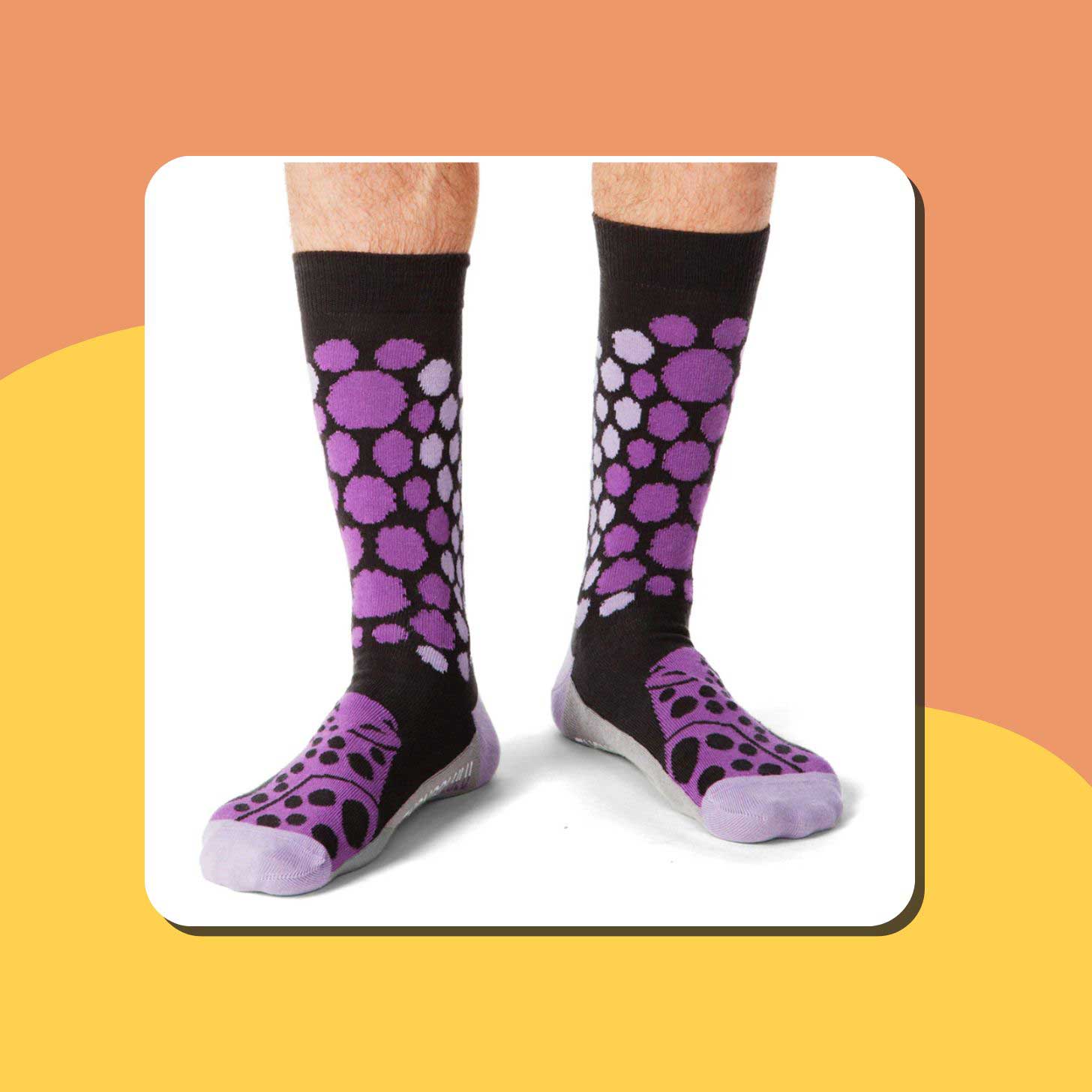
Help protect wildlife just by stepping into the world. Shongolulu is a wildly passionate brand dedicated to protecting endangered animals and their habitats. A portion of the proceeds generated from each sock purchase goes towards global wildlife conservation efforts.
The organizations Shongolulu support are committed to fighting poaching and deforestation, as well as rehabilitating and releasing injured animals back into the wild. (Which is a lot better than my dog stealing my socks when I’m trying to do laundry).
Shongolulu’s mission isn’t solely focused on financially contributing to conservation efforts. Each pair of socks (like these cheetah and elephant pairs) highlight an endangered animal in an effort to provide lasting impact through education and awareness.
Maggie’s Organics

While you may have used an old sock as a DIY duster around your house, Maggie’s Organics is on a mission to clean up the apparel industry in a different way.
Each purchase goes towards supporting immediate and long-term needs facing our planet — such as helping Ukrainian refugees, organizations protecting endangered species, and community-led reforestation projects.
Maggie’s Organics includes a variety of fair trade, organically grown cotton and merino wool socks for kids and adults — even for those who have highly sensitive skin! Each pair is made by skilled workers who earn a fair, living wage and work in co-ops (that Maggie Organics helped build).
→ Shop socks from Maggie's Organics
United By Blue
One brand’s trash is another brand’s treasure.
United By Blue is a B Corp and Climate Neutral-certified outdoor clothing brand obsessed with trash — particularly its negative impacts on our environment.
For every product purchased, a pound of trash is removed from oceans and waterways. To date, the brand has cleaned up 5.3 million pounds of trash (check out its popular community clean-up events!).
Among many of the products it offers, United by Blue’s socks are responsibly made and sourced in the U.S. Each pair is crafted to be durable, antibacterial, and softer with every wear. Not only that, but the company partners with third-party-verified factories that hold the highest standards for its facilities and personnel.
→ Shop socks from United By Blue
Hippy Feet
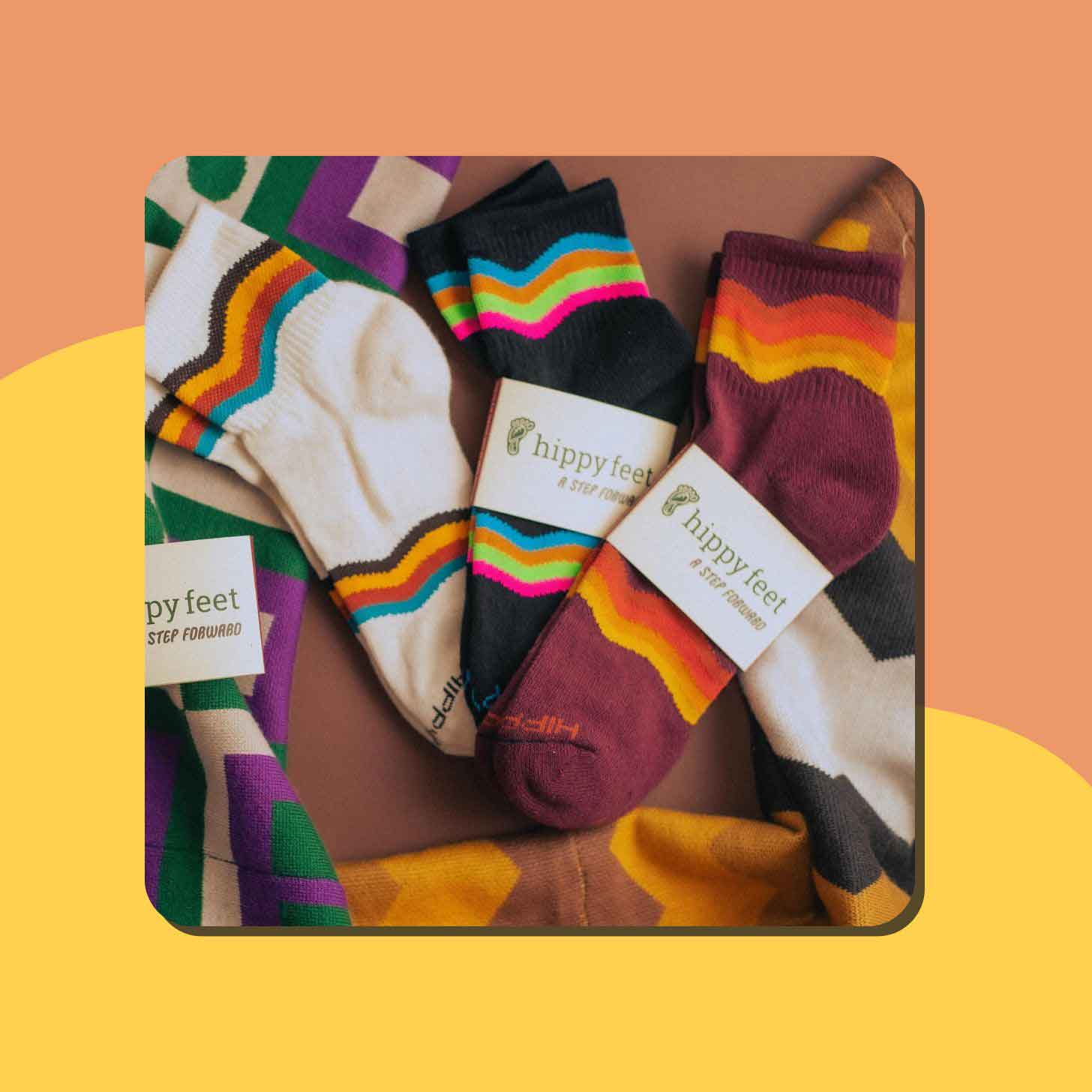
Hippy Feet is a sock and apparel brand on a mission to support organizations serving homeless youth. The company donates 50% of its net profits to organizations providing “the holy trinity” of social services: housing initiatives, employment and job readiness programs, and healthcare. They have given over $80,000 to date!
Offering a variety of colorful designs and styles for men and women, Hippy Feet makes each pair of socks out of sustainable materials like recycled cotton.
You can also participate in Hippy Socks’ Sock of the Month Club, where the brand ships out a pair of socks that directly contribute to programs providing valuable resources to youth experiencing homelessness each month.
Bonfolk

Bonfolk is a female-founded brand focused on providing essential items (like socks and towels) to homeless service organizations across the U.S. And its socks are super cute, too!
For each whimsical, unique pair of socks that are purchased, one is donated to nonprofits across the U.S — and 500,000 pairs of socks have been donated to date.
The socks donated to shelters are not just any kind of socks, but are specially designed to withstand constant daily wear and tear, contain reinforced soles, and have moisture-wicking technology.
Go beyond buying socks — donate socks in your community
Want to take matters into your own hands? Look into local nonprofits, community closets, or schools that accept gently used or brand-new sock donations. Whether you donate what you already own or bulk-purchase socks to donate, try to be mindful of the condition and quality of the items.
While any pair of socks certainly help, most aren’t designed for continual use. Opt for natural moisture-wicking crew socks with anti-microbial treatment — which help create an environment less prone to the growth of fungus and bacteria, and are a little more durable for continuous everyday use.
Every day the Good Good Good team collects the best good news in the world and shares it with our community. Here are the highlights for this week!
If you want to get good news in your inbox every day, join the Goodnewsletter — the free daily newsletter designed to leave you feeling hopeful.
The Best Positive News We're Celebrating This Week —
Thanks to four giant, 'smart' sails, a new supertanker uses nearly 10% less fuel
As the shipping industry looks to lower its carbon footprint, one shipping company introduced a “supertanker” whose four, 130-foot sails reduce average fuel consumption by nearly 10%.
The technology behind the sails is pretty revolutionary, too. The lightweight sails are retractable, made with corrosion-resistant carbon fiber, and are programmed to constantly monitor the wind and weather conditions to continually adjust the angle of the sails to make the most out of the available wind.
While 10% may not seem like a lot (there is still a long way to go to decarbonize the industry), it’s good progress to celebrate. For example, on a route from the Middle East to the Far East, fuel savings would prevent an estimated 2,900 tons of carbon dioxide emissions per trip.
Global electricity demand grew by 389 TWh in the first half of 2022 — renewable energy met 100% of the rise
According to a new report from energy think tank Ember, in the first six months of 2022, global electricity demand increased by 389 terawatt hours (TWh). Wind, solar, and hydroelectric energy generation increased by 416 TWh — meeting and exceeding the rise in demand.
Wind and solar alone met 75% of the demand, and the three together prevented a possible 4% increase in fossil-fuel generation, $40 billion in fuel costs, and 230 million tonnes of CO2 emissions.
“Wind and solar are proving themselves during the energy crisis,” said Malgorzata Wiatros-Motyka, senior analyst at Ember. “The first step to ending the grip of expensive and polluting fossil fuels is to build enough clean power to meet the world’s growing appetite for electricity.”
As people and places around the world get more creative, strategic, and productive with their clean energy installations, we’re hopeful there’s only more good news to come on this front.
To combat worsening extreme heat, Tel Aviv is creatively adding shade throughout the city
Research shows that standing in the shade can reduce perceived heat by 15 degrees Fahrenheit compared to direct sunlight, hugely mitigating health threats such as cardiovascular and respiratory disorders, heat stroke, and even death.
At least 363 Israelis died during heatwaves between 2012 and 2020, and heat waves will only worsen as climate change worsens.
Tel Aviv is taking these figures and the role shade can play in mitigating extreme heat seriously, even in an urban environment. They’ve added “Lumiweave” shaded structures that give off light at night, created “shade maps” that document shaded public spaces, and more.
A German company created a new technique using whirlpools to clean microplastics from the water
An estimated 14 million metric tons of microplastics are currently on the ocean floor. These plastics are especially bad for the planet because their minuscule size makes them difficult to detect, collect, and remove.
A German company has developed a new solution to cleaning up microplastics before they can reach the ocean using whirlpools and a special gel that clumps the microplastic pieces together so they float to the surface and can be easily collected.
The gel is non-toxic and can be used in any kind of water, from saltwater to freshwater.
Australia is setting aside at least 30% of its land for conservation to protect endangered, rare species
In an effort to protect both plants and animal species that are found nowhere else in the world, Australia announced it will set aside at least 30% of its land for conservation.
According to its most recent environmental report card, Australia has lost more animal species than any other continent, and among the world’s richest countries has one of the worst rates of species decline. The number of species newly listed as threatened or at a worse risk status grew by 8% since 2016.
In response to the report, the Australian government issued new protections for 110 species and 20 places in the country, increasing conservation areas by 50 million hectares for at least the next 10 years.
People are coming together to find creative housing solutions for internally displaced Ukrainians
In the midst of an enormous global geopolitical event, rife with countless atrocities, Ukraine is now facing another major humanitarian crisis within its own borders: over 8 million internally displaced persons (IDPs).
Many IDPs have chosen to stay in Ukraine for any number of reasons — to join the resistance, to remain with family, or because they cannot leave due to disability or financial limitations. And IDPs don’t receive the same support as refugees who flee to another country.
However, individuals, businesspeople, and nonprofits have come in to fill that support gap. Like MoveUkraine, which is helping refurbish and repurpose existing buildings to provide safe, secure, and dignified housing for as many displaced folks as possible.
Responding to a critical NHS shortage, thousands of Brits booked appointments to donate blood
This week, the United Kingdom’s National Health Service (NHS) blood supply reached a critical shortage, prompting the service to send out an Amber Alert asking for donors. While they usually keep six days' worth of blood in stock, the supply had fallen critically low to just two days.
Within 24 hours of the alert going out, 10,000 appointments had been booked to donate blood in the weeks to come.
Over 166,000 people visited the donation website, the most since the pandemic began, and 7,500 people registered as new donors, the most in the last 20 years.
"This is an amazing response from the public and we have been reminded in the last 24 hours of the incredible goodwill and spirit of the public towards helping patients in times of great difficulty," an NHS Blood & Transplant official said.
More good news of the week —
The 2022 Nobel Peace Prize was awarded to an activist and two human rights groups helping amidst the war in Ukraine. The activist, currently in jail in Belarus, and the organizations have worked to highlight human rights abuses in the region. (You can also check out the 2021 nominees.)
Scientists discovered wax worm saliva rapidly breaks down plastic bags. The worm’s enzymes degrade the plastic within hours at room temperature and could ‘revolutionize’ recycling.
A farm in Italy is making car fuel from cow poop. The farm has a system that extracts bio-methane from animal waste and transports it directly to a pump for customers.
Agricultural scientists and farmers figured out how to make the soil in Western Australia twice as productive. By re-engineering the soil, they found it was possible to more than double the amount of grain grown.
For the first time in history, the U.S. appointed a diplomat to represent plants and animals. Monica Medina will be the first-ever special envoy for biodiversity and water resources.
Slovenia just became the first Eastern European country to legalize same-sex marriage and adoption. The Slovenian government passed the new amendment after a court ruled the previous law was discriminatory against gay and lesbian couples.
In Baltimore, a nonprofit is using the popular Black youth hobby of dirt biking to teach STEM. Rather than criminalizing the hobby, B-360 sees it as an opportunity and has already worked with over 8,500 young Baltimoreans.
An Australian power grid larger than the U.K. is being dismantled as farmers switch to renewables. Thousands of properties in Western Australia are being taken off-grid as they install solar panels instead.
The San Antonio Spurs hosted an open practice and community fair for Uvalde, Texas residents. The Spurs brought their practice to Uvalde to support and bring a bit of joy to the students, families, and community in the aftermath of the shooting.
Conspiracy theorist Alex Jones was ordered to pay nearly $1 billion to Sandy Hook Victims’ families. Jones was found liable for defamation and had spent years falsely claiming the shooting was a hoax and the victims’ families were complicit actors.
Digital identification cards are helping refugees in Cameroon access education, jobs, and bank accounts. The IDs are life-changing, as without them refugees often face discrimination and abuse.
A record number of Indigenous women are running for office in Brazil. After watching other people make decisions that impacted their lives and land, the increase is part of an effort to increase representation in government.
The recently announced increase in Social Security benefits will also benefit millions of children in the U.S. The most recent Census found about 2.4 million grandparents are responsible for their grandchildren.
For the first time on record, renewables fully covered Greece’s electricity demand. For more than a few hours, all electricity being used in the entire country came completely from renewable sources.
REI just made its #OptOutside campaign to close all its stores on Black Friday a permanent policy. Since 2015, the outdoor retailer has encouraged consumers and paid employees to do anything but spend the day shopping.
Y’all, it’s 2025, and we’re done gifting random trinkets. No more items that collect dust. No more plastic packaging that creates unnecessary waste.
The biggest culprit of excessive gifting during the holidays? Stocking stuffers.
While it can be easy to fill your cart with unique items and silly gag gifts to stuff into your loved one’s stockings, they’d probably really love a few eco-friendly products or high-quality gifts, as opposed to lots of little low cost goodies.
That’s not to say sustainable gifting can’t be affordable, though!
We’ve compiled a list of some of the best sustainable stocking stuffers to shop this season that’ll wow even the pickiest Scrooge in the family.
To help you shop sustainably regardless of your budget, we’ve broken this article down into the following sections:
- $15 and under
- $30 and under
- $60 and under
By the way, some of the products and links in this article are partners and affiliates, which means if you make a purchase after clicking a link, we may earn a commission at no extra cost to you. Everything in this article was independently and honestly written by the Good Good Good team. Thank you!
Your guide to the best sustainable stocking stuffers
$15 and under
Consumable Gifts
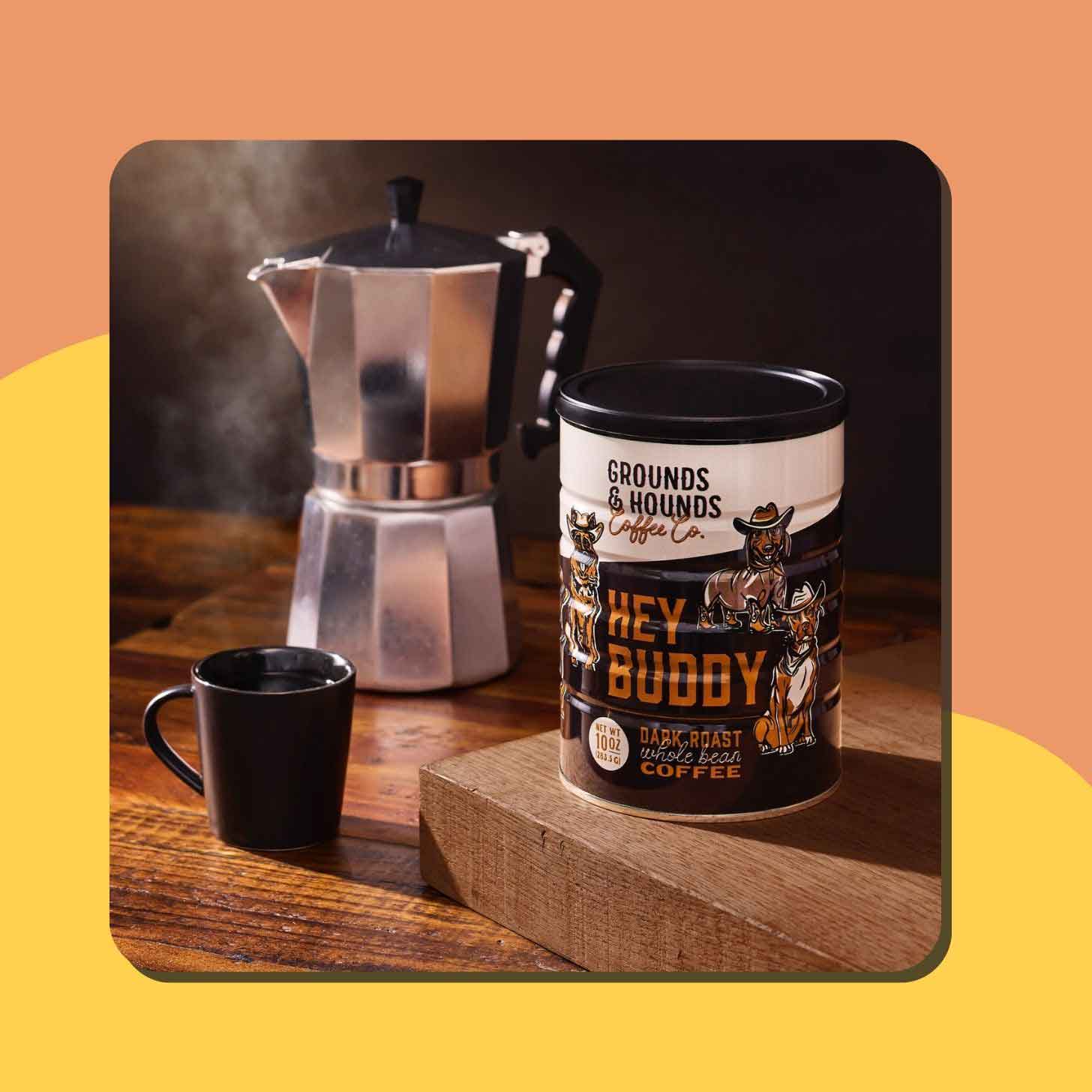
The best stuff for a stocking is anything that can be used up! Consumable gifts can be anything from fair trade chocolates or bars of soap, to a gift certificate for a pottery class, or even audiobook credits. Find something your loved one will truly enjoy and experience.
Need some help getting started?
→ Check out our full list of consumable gift ideas
Conscious Step Socks
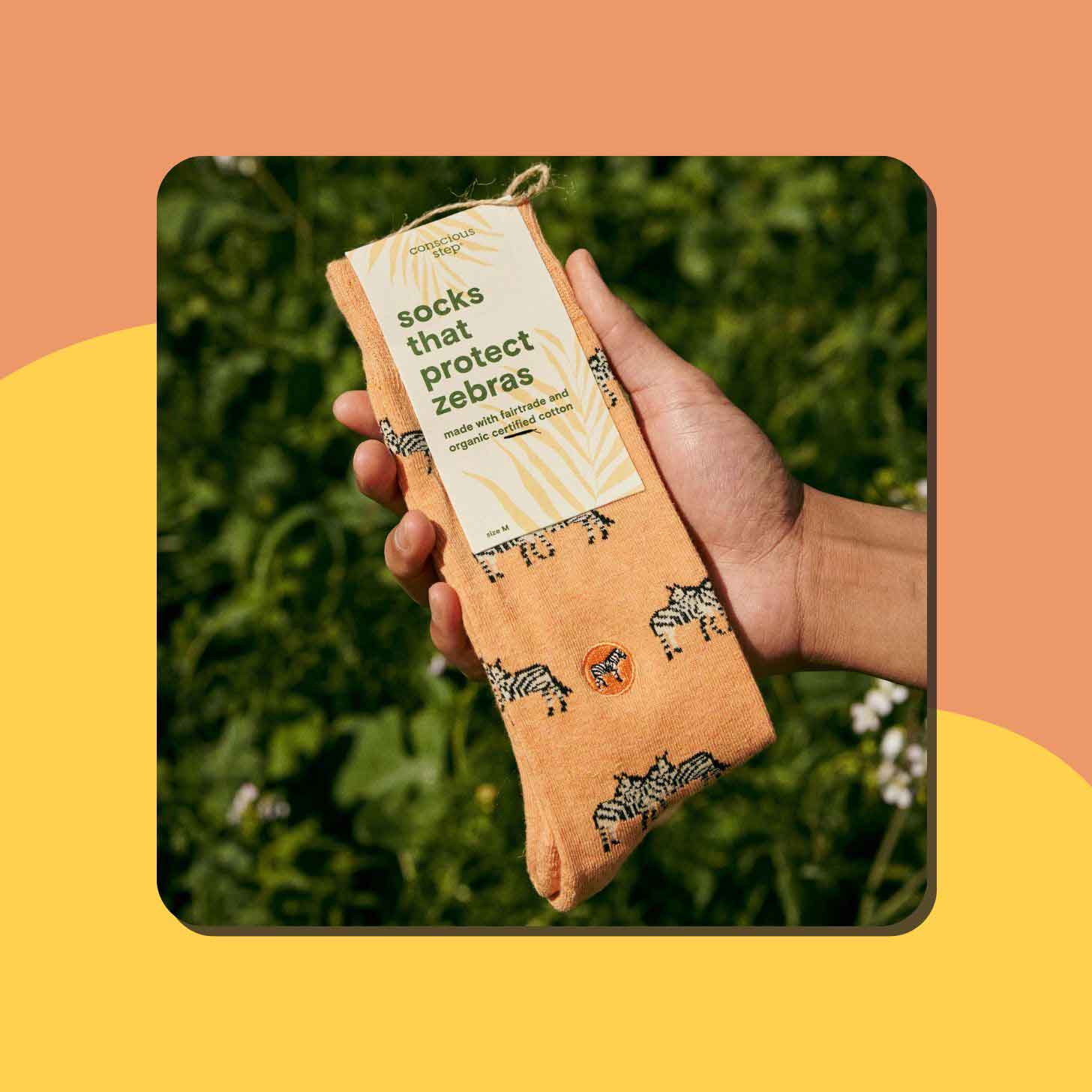
Conscious Step creates stylish, sustainable, and 100% organic cotton socks that support independent farmers while also giving back to over 20 different organizations doing good in the world.
Support a cause close to your gift recipient’s heart, and keep their tootsies toasty all at once.
What’s good:
- Conscious Step is part of 1% for the Planet
- Some of their socks give back to rainforests, plant trees, restore oceans, and protect animals
- Every pair of socks is made with GOTS Organic and fair-trade certified cotton, as well as recycled polyester. These socks are also vegan-certified!
Check out our full list of socks that give back to explore other options, too!
Shop: Conscious Step
RONXS Rechargeable Electric Lighter
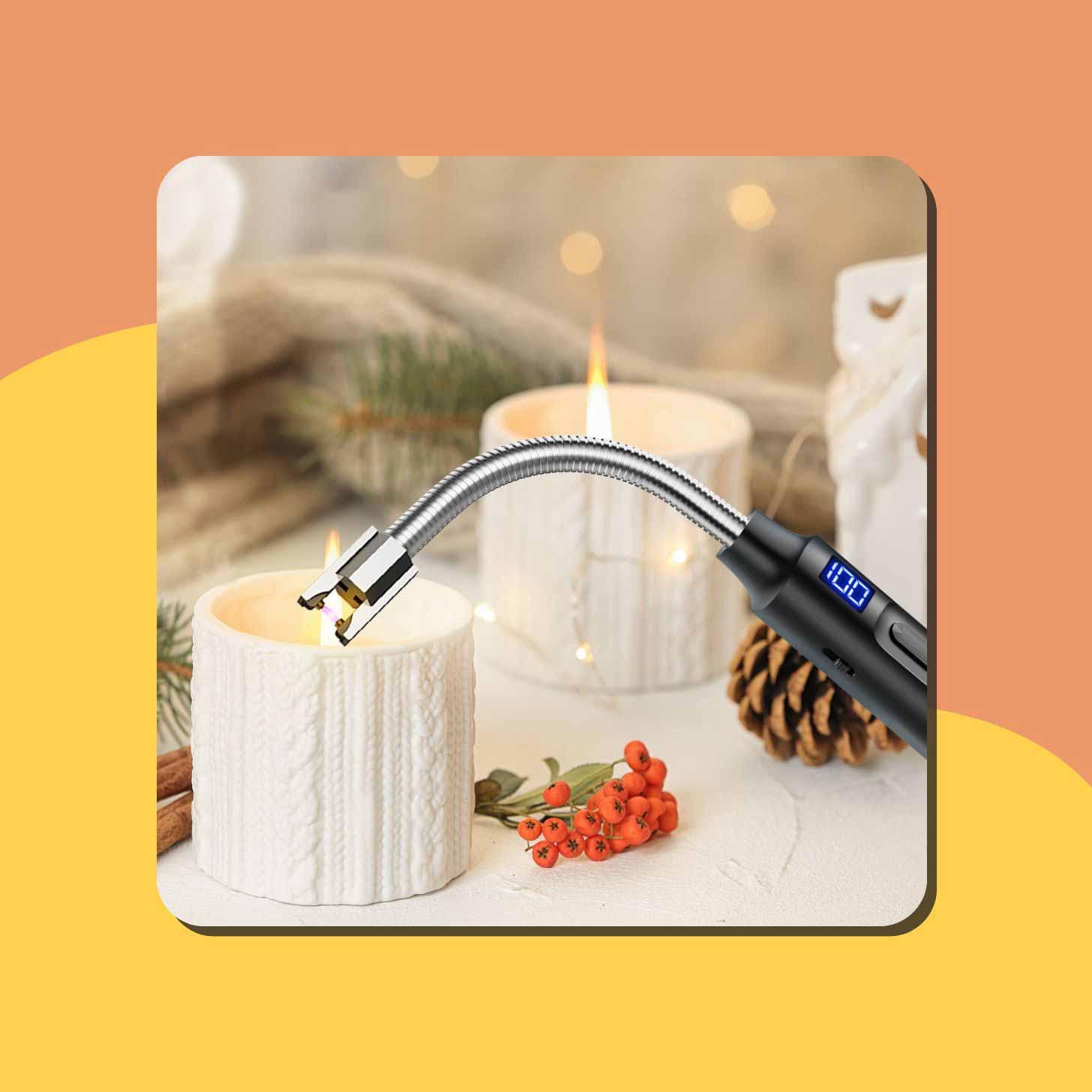
If your gift recipient is a big candle fan, this rechargeable lighter is a great alternative to unnecessary fuel-based disposable lighters. This particular lighter is our favorite — and is ideal for bending into a candle vessel.
What’s good:
- Alternative to single-use plastic lighters that end up in landfills every year (95% of the annual 600 million lighters sold to U.S. consumers every year)
- Fully rechargeable and made to last
Shop: Amazon
Check out our full list of rechargeable electric lighters to explore other options, too!
Eco-Friendly Pens
Is there anything more frustrating than furiously taking notes (or doodling) during a meeting and your pen runs out of ink? You toss yet another plastic item into the trash, and off it goes to the landfill.
These pens are here to save the day! Gift these refillable writing utensils to the doodler of your dreams.
What’s good:
- Made from recyclable and biodegradable materials
- Packaged with 100% recyclable materials
Shop: Amazon
Reusable Produce Bags

Make your gift recipient’s next grocery trip a breeze with these handy reusable produce bags.
What’s good:
- A simple alternative to grocery store plastic produce bags
- Made to last and use over and over again
Goodnewspaper Subscription
We’ll admit our bias on this one: Every month Good Good Good creates a beautiful print newspaper filled with good news.
You can join thousands of subscribers who receive positivity on their doorstep — with themed issues like The Animals Edition, The Environment Edition, and The National Parks Edition.
What’s good:
- Printed on recycled paper using soy-based inks
- Certified 100% carbon neutral
- Helps your gift recipient do more good for people and the planet!
→ Subscribe to the Goodnewspaper
→ Gift the Goodnewspaper
Eco-Friendly Photo Prints from Artifact Uprising

Who doesn’t love a good family photo? Artifact Uprising creates photo prints and goods with recycled materials, so you can cherish your favorite memories — and not at the cost of the planet.
Great for anyone’s desk, a little collage wall, or to frame around the house!
PS: Artifact Uprising is also a great place to purchase eco-friendly stationery and cards, too!
What’s good:
- Artifact Uprising’s recycled paper contains 100% post-consumer fiber
- All of the electricity used to manufacture the paper is matched with renewable wind-generated electricity
Shop: Artifact Uprising
The Capsule from Cadence

If this stocking belongs to someone who is often on the go or traveling for work, they likely have a big collection of mini travel-size toiletries that just barely get used up.
The Capsule will make their lives easier — and help reduce the waste of plastic. These containers are customizable, magnetic, leak-proof — and TSA-compliant! You can build a whole system, or just add to your loved one’s existing set.
What’s good:
- Made with 20% recycled ocean-bound plastic and 30% excess manufacturing material
- Constructed with BPA-free and non-leaching plastics
- Shipped in recycled packaging
- No more single-use drugstore travel shampoos!
Standard Baggu Bag
Join the swaths of stylish girlies who frequent the market with their reusable Baggu totes!
With a huge library of patterns to choose from, there’s bound to be a style fit for the gift recipient you’re thinking about.
What’s good:
- Aims to eliminate plastic bag waste
- Made with recycled nylon
Silicone Food Huggers

We’re all guilty of it: food waste. Help your friends and family keep their refrigerator innards from rotting — starting with those lemons and limes.
What’s good:
- Vegan and made with 100% BPA-free, FDA food-grade silicone
- Easy to toss in the dishwasher and reuse over and over
- Stored in recycled packaging
Swedish Dishcloths

This is the quicker-picker-upper your green gift recipient has been dreaming of. Swedish dishcloths are reusable cloths that are super absorbent and quick to dry.
What’s good:
- Made from cellulose and cotton
- Made to be used and reused and can be composted at the end of their lifespan
Shop: Amazon | Who Gives A Crap
Reusable Utensil Kit

Similarly to glass straws, it’s an eco-friendly necessity to have a reusable utensil kit on hand!
Help everyone bring their lunch on the go with these bamboo utensils (which include a fork, knife, spoon, chopsticks, a straw and cleaning brush in one convenient holder).
What’s good:
- Made with heat and stain-resistant bamboo and food-safe wood oil
- Durable, convenient, and washable for a long life cycle
$30 and under
Non-Toxic Wax Melts from Happy Wax
Is there anything better than cozying up on the couch with a good book, a delightful scent wafting from the other side of the room?
While you might be imagining a classic candle, wax melts are a great alternative without the waste of a jar or vessel (and they’re a little lighter to add to a stocking!)
Happy Wax has all sorts of natural fragrances to create the perfect vibe for your gift recipient.
What’s good:
- Made with natural soy wax and essential oils — free of phthalates!
- A great alternative to pesky candle jars that need to be discarded responsibly. Just don’t forget a wax warmer.
If your gift recipient is more of a candle person, you can check out our full list of eco-friendly candles, too!
Fresh Cut Flower Tote from Uncommon Goods

This one is for the Trader Joe’s flower bouquet girlies! Help keep their groceries dry and reduce their plastic waste with this adorable reusable flower tote.
Easy to fold up and bring along to the farmer’s market, this bouquet tote will get folks from the farm and back to the arranging table with no stress.
What’s good:
- A go-to way to reduce single-use plastic
- Made with durable cotton for a long lifespan
Shop: Uncommon Goods
Girlfriend Collective Undies

Keep up the holiday tradition of gifting a pair of undies to everyone in the fam!
Girlfriend Collective underwear have become an easy hit online, thanks to their well-made quality — and you don’t have to have buyer’s remorse while covering your family’s butts.
What’s good:
- Made with 80% recycled plastic bottles (RPET)
- Recyclable with Girlfriend’s ReGirlfriend program
Shop: Girlfriend Collective
Organic Boxer Briefs from Pact Apparel

You didn’t think we’d forget about the boxer brief lovers in the crew, right? Pact makes clothing essentials with sustainability and ethics in mind, so your giftee will be comfortable and confident updating their underwear drawer.
What’s good:
- Made with 95% GOTS-certified organic cotton and 5% elastane
- Manufactured in a Fair Trade-certified factory
- Saves 11 gallons of water by using organic cotton
- This product’s carbon offset is 4.4 pounds
Shop: Pact Apparel
Recycled Plastic Dog Poop Bags from Who Gives A Crap

Does your giftee have a dog? Well, the stinky truth is that there will always be dog ‘doo, and we’ll always need poop bags for that dog ‘doo. You might as well give them some sustainable options!
These dog poop bags from Who Gives A Crap are the real deal.
What’s good:
- Made from 100% recycled plastic and packaged in recyclable cardboard dispenser
- Who Gives A Crap donates 50% of profits to clean water and sanitation initiatives around the globe
Shop: Who Gives A Crap
Check out our full list of eco-friendly dog poop bags to explore other options, too!
Books

Books are the gift that keeps on giving! Knowledge is never in short supply and can be enjoyed and shared for years to come. We’ve got some great book recommendations to get you started, too.
Shop: Amazon | Bookshop | Libro.fm
Glass Straws

Save the turtles… but make it fashion. Give everyone in your crew some new glass straws this season. Lots of colors, sizes and shapes to choose from, everyone can sip their iced lattes or boba orders in peace.
What’s good:
- Long-term alternative to single-use plastic straws
- Durable and dishwasher-safe for a long lifespan
Bamboo Toothbrush

Don’t take our word for it, but we assume that 10 out of 10 doctors recommend we all find a sustainable way to brush our teeth.
An easy way to get the whole family started? This four-pack of bamboo brushes.
What’s good:
- Made with plant-based materials
- Helps reduce the 1 billion plastic toothbrushes thrown out every year in the U.S.
Shop: Amazon | Package Free Shop | EarthHero
Bee’s Wrap Roll

Bee’s Wrap is a reusable food wrap that can be used again and again for all those lunchbox meals, bodega bites, and more.
By purchasing a roll of Bee’s Wrap instead of a specific wrap or bag style, you give your gift recipient the freedom to cut and shape their wraps in whatever ways they need!
What’s good:
- Made with a blend of organic cotton, beeswax, plant oil, and tree resin
- Bee’s Wrap is a certified B Corp and a member of 1% for the Planet
Shop: Amazon | Bee’s Wrap
Ethical Coffee Beans
The coffee connoisseurs on your to-gift list need some love, too! Give the gift of ethically (and sustainably) sourced coffee beans this year.
While some coffee roasters are certified as Fair Trade, the process can be expensive and inaccessible, so just be sure to confirm that the company you’re shopping from is transparent about its labor and sourcing practices!
Coffee sold through Fair Trade brands or brands with high labor standards is often priced higher than the commodity price of coffee to help pay coffee growers and producers a better wage.
While it might be a little more expensive than a direct trade brand, we’re sure your gift recipient will be thrilled by the intention behind this gift.
What’s good:
- Ethical coffee brands practice environmental stewardship
- Supports a better life for farming families and laborers
Shop: Keats & Co Coffee | BLK & Bold
Carter Slide Mug from Fellow
Now that we’ve got the coffee taken care of, everyone needs a solid travel mug to rely on!
The Carter Slide Mug is specifically made for ideal coffee drinking. Designed to amplify the senses and fit with most manual coffee brewing devices, this makes taking coffee on the go easy and dependable.
What’s good:
- Made with stainless steel, ceramic interior coating, and a BPA-free plastic lid for durability
- The perfect tool to decrease that collection of single-use coffee cups
Shop: Fellow
Trashie Take Back Bag
The Take Back Bag can be filled with old clothes your gift recipient no longer wears, and Trashie will do the work of recycling their pre-loved items and turning them into something useful.
Plus, purchasing a bag will give you credits to use toward a new sustainable clothing item or other reward. Plus, it’s foldable and easy to fit in anyone’s stocking!
What’s good:
- Keeps old clothes out of landfills
- Contributes to a circular economy
Shop: Trashie
Washable Cotton Facial Pads

We all create a lot of waste in the bathroom (come on, get your head out of the gutter), so let’s try and make that garbage pail a little lighter!
Help your loved ones switch from makeup wipes to some reusable cotton facial rounds. These bad boys are super soft and easy to toss in the washer with all the other linens and towels.
What’s good:
- Made with 100% cotton fabrics
- A set of 20 cloths will last about two weeks before needing a wash
Shop: Amazon | Package Free Shop | Earth Hero
Bath Soak from Maude
This hydrating coconut milk bath soak is the perfect symbol of “you deserve some peace and quiet alone in the tub.”
Made with a mixture of coconut milk powder and hand-harvested salts from the Southern Dead Sea, this soak also contains vitamins and minerals like magnesium, potassium, sulfur, and zinc.
What’s good:
- Vegan and cruelty-free
- Glass is curbside recyclable
→ Read our full review of Maude’s self-care products
$60 and under
Klean Kanteen Insulated Canister
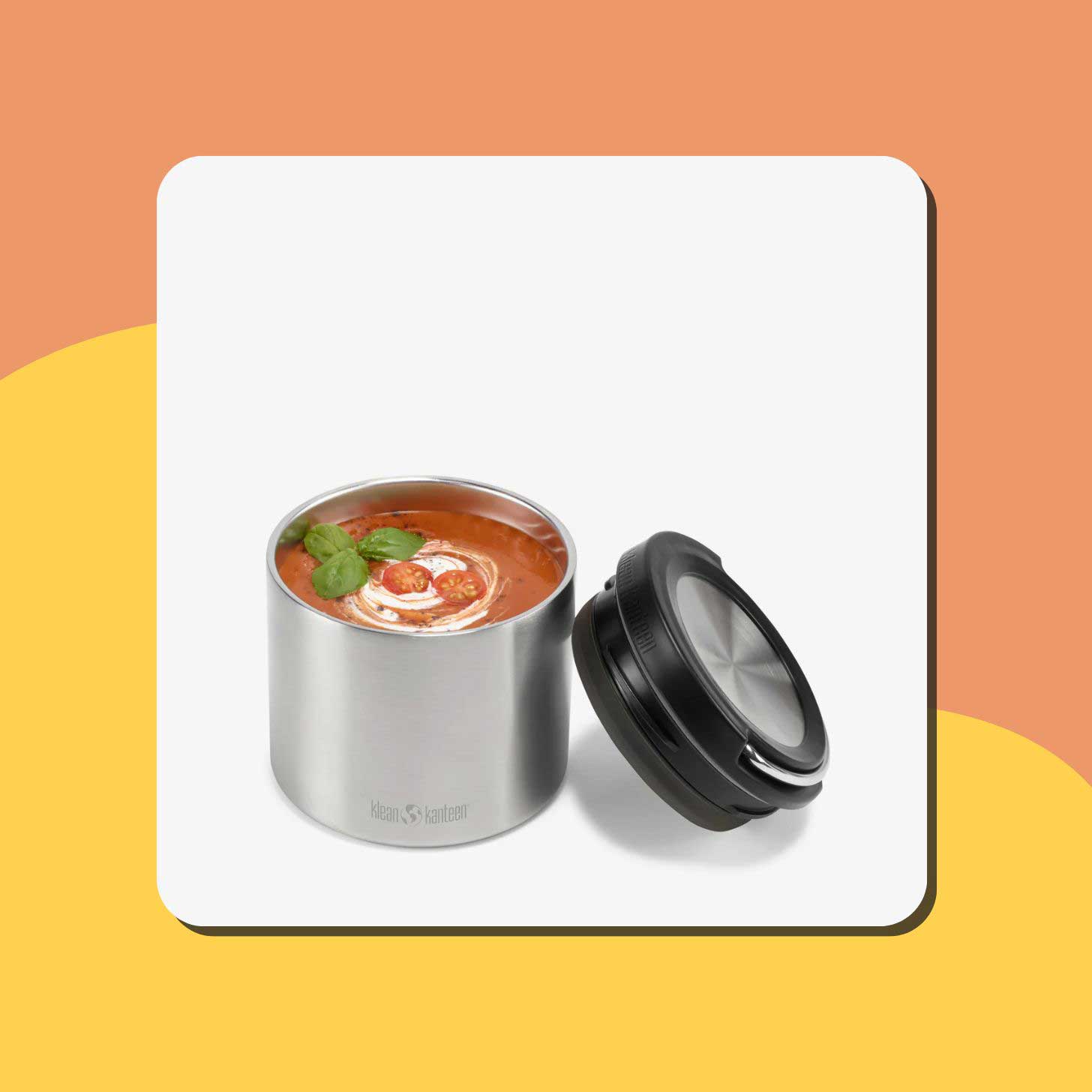
Soup squad, it’s your time to shine! Grab a Klean Kanteen insulated canister for the folks in your life who need a high-quality thermos.
These have a Climate-Lock with vacuum insulation that keeps contents hot for 5 hours and cold for 20 hours. Dishwasher-safe and easily stackable, this is a great, durable addition to the pantry.
What’s good:
- Made with food-grade stainless steel for durability
- Backed by Klean Kanteen’s Strong as Steel guarantee (sustainability means investing in items that last!)
- Klean Kanteen is a certified B Corp
Shop: Amazon | Klean Kanteen
Tech Accessories from Pela

Pela makes compostable phone cases, mini wallets, phone grips, and other tech accessories that are stylish and sustainable. Plus, they’re smooth to the touch and keep your expensive tech safe and sound.
Cases come in dozens of clear, engraved, solid, abstract, animal, and landscape designs (and more!), with options available for pretty much every type of phone.
Plus, each case comes with an extra envelope to send back your old phone case, which can then be recycled properly.
What’s good:
- Products are made from flax shive and plant-based biopolymer materials
- Donates a percentage of every sale to ocean cleanup and preservation initiatives
- Certified B Corp and Climate Neutral certified
- All products free of lead, cadmium, BPA, and phthalates
Shop: Pela
Virtual Gift Cards

Perhaps the most universal holiday gifting option is to snag a few $50 gift cards for everyone on your list. But if you go that route, keep it digital this year and kiss those unnecessary plastic cards goodbye!
What’s good:
- No more single-use plastic gift cards
- A classic consumable gift that won’t go to waste
Shop: Amazon | GiftCards.com
Bombas Gripper Slippers

Bombas, while known for its cozy give-back socks, also makes slippers for every member of the family.
The Gripper Slippers are a half slipper-half sock hybrid with a soft brushed lining and special non-slip grippers.
What’s good:
- Certified B corp
- One essential clothing item donated with every purchase
- All products designed with durability in mind, with a “happiness guarantee” to keep items lasting longer
Shop: Bombas
Reusable Silicone Bags from Stasher

It’s time to part ways with those unreliable and wasteful plastic Ziplocs. Grab a pack of reusable silicone bags from Stasher and distribute them among the whole family (or keep them all to yourself — we won’t tell!)
What’s good:
- One Stasher bag replaces 260 single-use plastic bags every year
- Made with the patented Pinch-Loc® seal and food-grade platinum silicone, these are the gold standard for reusable bags and are extremely durable
- Stasher is part of 1% for the Planet
Tentree Wool Kurt Beanie

Cold ears, be gone! Help keep your loved ones warm this winter with a responsibly-made wool beanie from Tentree.
What’s good:
- Made from a comfortable blend of responsibly sourced wool and recycled polyester
- Tentree is a certified B Corp- and Climate Neutral-certified
Shop: Tentree
Cork Wallet from Corkor

Help protect your loved one’s precious items with a new vegan wallet. This Corkor billfold wallet has a minimalist design that protects cards with RFID-blocking technology.
What’s good:
- Approved animal-free by PETA
- Made with cork fabric from a sustainably managed cork oak forest
Personalized Stationery Made from Recycled Paper

A personal touch goes a long way when it comes to presents. Minted uses FSC-certified recycled paper with designs by independent artists to offer a wide range of personalizable stationery for all those business and personal letter-writing needs.
What’s good:
- Recycled paper options made with 100% post-consumer waste in a factory using wind power
- 100% recyclable packaging made from over 80% recycled waste or plant-based materials
Check out our full list of eco-friendly stationery brands to explore other options, too!
Unpaper Towels

Washable “paper” towels are the future of kitchen spills! Here’s another great swap for single-use items.
What’s good:
- Made with 100% organic cotton
- Easily machine washable to use again and again
LARQ Filtered Water Bottle
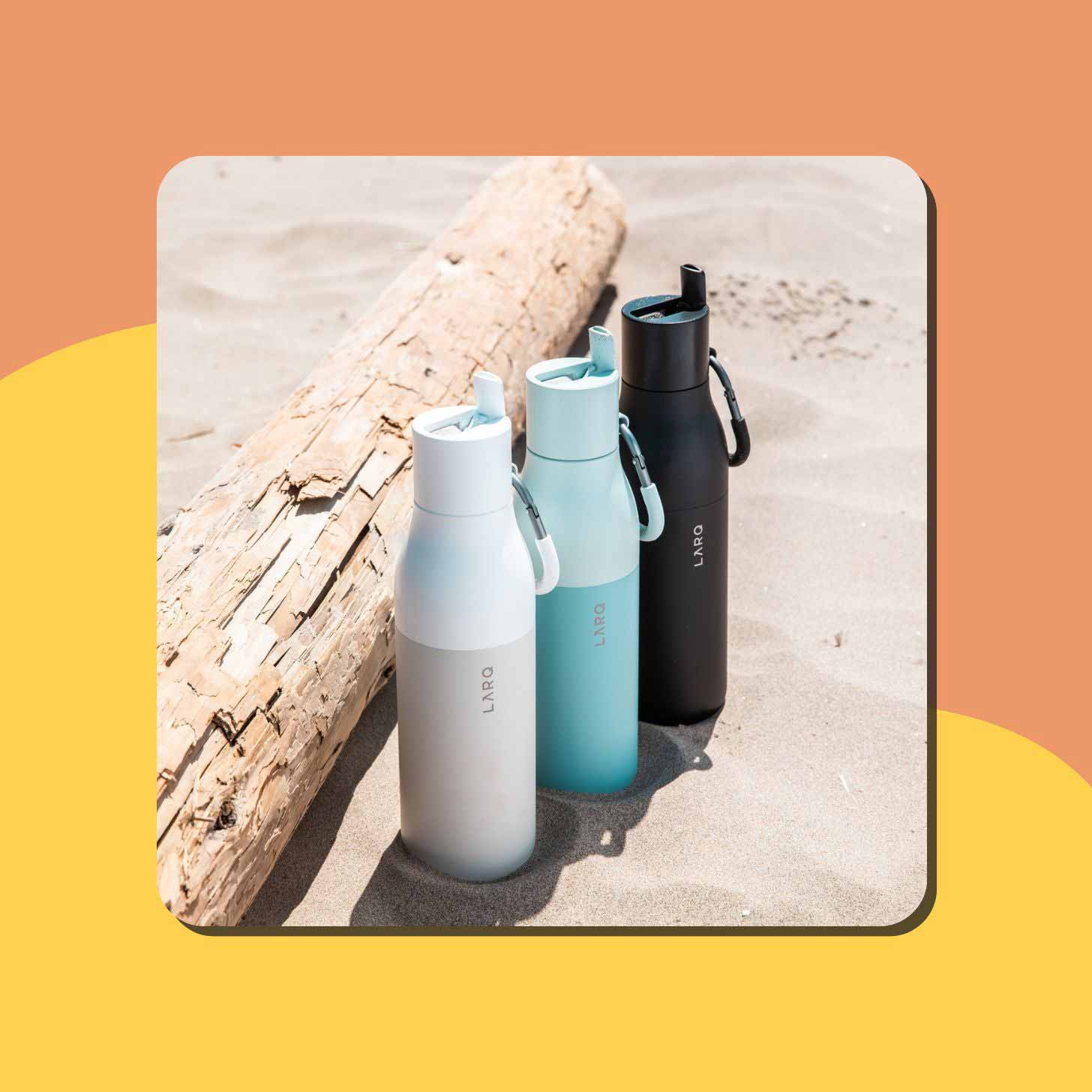
Now, normally we would tell you to stray away from yet another reusable water bottle (some of us already have excessive Emotional Support Water Bottle collections), but this one is special.
With a fancy portable water filtration system, this bottle improves taste and removes any lead, heavy metals, chlorine, and particulates from tap water.
What’s good:
- One LARQ filter can filter up to 40 gallons of water (or 2 months of use). These equals about 300 single-use plastic bottles.
- Cleaner water keeps both people and the planet happy and healthy
Room Service Sateen Pillowcases from Pact

Provide your gift recipient with guilt-free rest. A two-pack of sateen pillowcases from Pact will transport them to a luxury hotel in no time.
What’s good:
- Made with 100% pure organic cotton sateen
- Includes a reusable laundry bag
- Manufactured in a Fair Trade-certified factory
- Saves 86 gallons of water in production
- This product’s carbon offset is 18 pounds
Shop: Pact
A Donation To A Climate Justice Organization
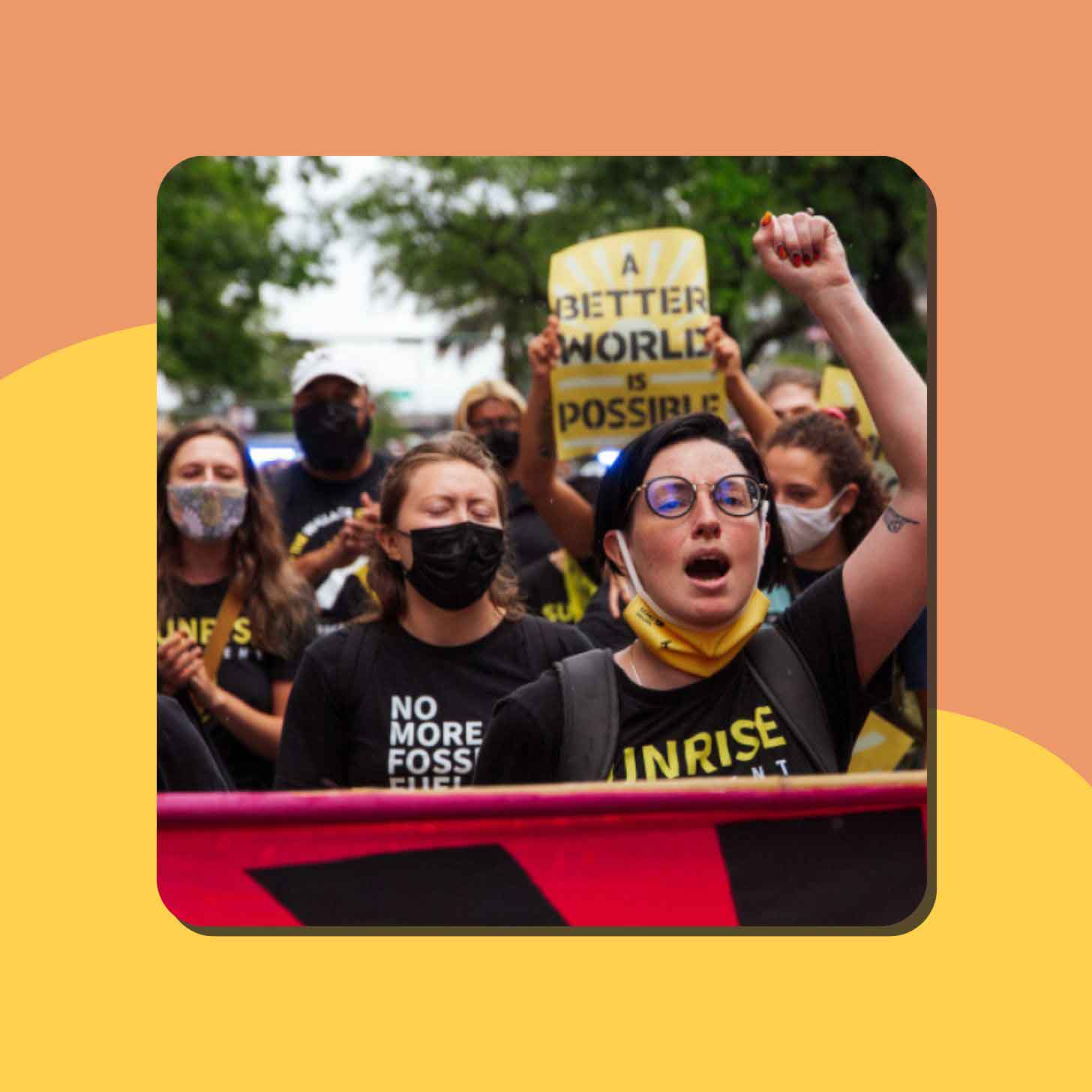
Swap a bunch of little stocking stuffers for one big action: a donation to a climate justice nonprofit doing the work on the ground to save our planet.
→ Donate to Intersectional Environmentalist
→ Donate to 350.org
→ Donate to Sunrise Movement
Note: While we normally recommend shopping from independent marketplaces with ethical and sustainable track records instead of shopping with Amazon — we’ve also included Amazon links in this article to ensure that these gifts are accessible to more people. Consider Amazon alternatives when you can.
KC Davis has a system for everything. On her TikTok account (@domesticblisters), boasting over 1.4 million followers, she demonstrates no-fold laundry routines, visual aids for tidying up, and most notably, life-changing, honest pep talks that remind us all to remove the morality from homemaking.
Davis, a licensed professional therapist, speaker, and author, started her TikTok account like many of us did: at the height of the pandemic. Caring for her two little kids, she was experiencing postpartum depression and felt her home “falling apart” around her.
She took to the Internet to share her quirky, individualized housekeeping methods, albeit worried about the judgment she might receive. The judgment came — but so did the gratitude.
KC Davis and the birth of “morally neutral”
Commenters flocked to delight in seeing a “real home,” and shared their stories about how “traditional” care task hacks never worked for them.
“I started honing in on the dialogue around why we all feel shame about this,” Davis said. “And I started talking about how shame is really an enemy of functioning, and it actually prevents us from finding solutions in our home care and self-care.”
When Davis responded to a commenter about how neglecting the laundry is not a moral failing, a lightbulb went off. Her phraseology of cleaning being “morally neutral,” created a movement.
“I wish that we could all unlearn that advice for home care is one size fits all. I wish we could unlearn that the way you keep your house is a reflection of your character or your work ethic,” Davis said.
Her tools are catered to people who are disabled, overwhelmed by childcare, experience executive dysfunction — and those who are just plain exhausted by the demands of taking care of their homes, their families, and themselves.
“The basis of my whole platform is that you don’t exist to serve your house; your house exists to serve you,” Davis said. “It’s giving people that radical permission to see their barriers as legitimate barriers, and instead of trying to bulldoze through them by sheer force of will and good character, they could just grant themselves the permission to seek accessibility in their environment.”
Self-care for everyone
Davis takes a lot of inspiration from the anti-diet movement, as well as community care work in BIPOC and disability communities, to confront and dismantle “traditional” commercialized white wellness.
In her book “How To Keep House While Drowning,” Davis examines and guides readers to first embrace the moral neutrality piece, followed by embodying one’s worthiness of functioning, and then finally introducing adaptive strategies.
“Good enough is perfect. Everything worth doing is worth doing half-assed,” she said. “Once you embrace that, it frees you to get creative with breaking down tasks and picking things that fit with your lifestyle.”
But what about the aesthetic Pinterest boards we all covet? The Target aisles that call our name and invite us to imagine a living room without dog toys, storybooks, and dust bunnies littering the floor?
“A house is a home because you live in it,” Davis said. “That’s literally it. There’s no magical domestic skill that turns a house into a home — something women are often socialized to be responsible for creating. Is it the fresh-baked pie on the window sill? Is it that the pantry has all the glass jars? Is it the stain-free couch? That ambiance is still something someone has to work to create. I think that home is an environment that serves you.”
She reasons that Starbucks is not set up to serve her deeply unique personal preferences or boundaries, and neither is her friend’s place or her parent’s house.
No other environment is set up specifically for her lifestyle, desires, and needs, but her own home — and that’s the feeling of security and freedom she wants everyone to have.
Whether it’s making guests feel welcome based on their experience, rather than the aesthetic appeal of your home, stopping the apologies, using paper plates when you don’t have the capacity for dishes (no, you’re not a bad environmentalist, we promise), or any number of other rejected housekeeping norms, Davis is thrilled to usher in a new way of care for her followers.
“This is catching fire,” she said. “I’m hoping that is starting a revolution in self-care, that we can sort of wrestle this toxic positivity and white wellness culture and provide a different milieu of compassionate and practical help. We're listening to people who know what it's like to have barriers other than just not believing in yourself. And I think that is producing real help for people.”
To learn more, visit strugglecare.com.
You might also like:
- The best podcasts, newsletters, and TikToks for and by people with ADHD
- The best quotes about self care
- The best self care ideas
- The best good news about houses and housing
A version of this article was first published in the Goodnewspaper — Good Good Good’s monthly print newspaper filled with good news and ways to make a difference.
You can also find more good news in the Goodnewsletter — the free daily email filled with reasons to feel hopeful.
Header image illustrated by Johnathan Huang for Good Good Good.