Every month, there are hundreds of national and international celebrations dedicated to raising awareness and support for meaningful causes.
For those working to bring attention to important topics, it can be challenging to keep track of the next relevant awareness event. We’re here to help.
At Good Good Good, we aim to help people feel more hopeful and do more good. For years we’ve privately curated a comprehensive list of important cause-themed holidays that we’ve used for creating content on our good news Instagram, our Goodnewsletter, our Goodnewspaper, and on this very website.
We’ve organized this list of observances and events by month — and are making them public for the first time. Our hope is that this will help you or your organization bring attention to important issues.
Where applicable, we’ve included resources (usually good news around particular topics, action steps on how to make a difference, or relevant quotes) — and encourage you to share them if you find them helpful.
The main days and months you should know about for January are:
| National Blood Donor Month | January 1 |
| Poverty Awareness Month | January 1 |
| Dolly Parton’s Birthday | January 19 |
| International Holocaust Remembrance Day | January 27 |
| Martin Luther King Jr. Day | 3rd Monday of January |
| World Leprosy Day | Last Sunday of January |
January is the first month of the year and has 31 days. It marks the continuation of winter in the Northern Hemisphere and summer in the Southern Hemisphere. January is known for New Year’s Day, symbolizing fresh starts and resolutions. It’s a time for reflection and setting intentions for the year ahead.
Explore our comprehensive list of national and international months, weeks, days, and birthdays for the month of January:
January Celebrations:
Awareness Months
There are several awareness months celebrated in January — though the five that often get the most attention include National Blood Donor Month, Cervical Health Awareness Month, Mental Wellness Month, Poverty Awareness Month, and Veganuary.
Cervical Health Awareness Month
Learn about the women fighting in court for access to HPV vaccines
Dry January
Glaucoma Awareness Month
Mental Wellness Month
Read and share quotes about mental health
National Adopt a Rescued Bird Month
National Blood Donor Month
National Codependency Awareness Month
National Eye Care Month
National Hobby Month
Explore the ultimate list of hobbies — and our guide to hobbies for women
National Mentoring Month
National Slavery and Human Trafficking Prevention Month
National Stalking Awareness Month
Poverty Awareness Month
Read and share quotes about poverty
Self-Love Month
Explore the best quotes about self-care, quotes about self-love, and the 101 ideas for self-care
Veganuary
Walk Your Dog Month
The dog poop bag industry is full of greenwashing, but fortunately, we’ve put together a guide on compostable and sustainable dog poop bags and alternatives
Awareness Weeks
No Name-Calling Week - 3rd week of January
Awareness Days
New Year’s Day - January 1
Read our guide on thoughtful New Year's resolutions or explore ideas for your “word of the year”
World Braille Day - January 4
National Bird Day - January 5
National Electricity Day - January 9
National Save the Eagles Day - January 10
National Human Trafficking Awareness Day - January 11
Paget’s Awareness Day - January 11
World Religion Day - January 15
Read our collection of good news stories about people of faith
National Penguin Day - January 20
National Squirrel Appreciation Day - January 21
Trans Prisoner Day of Action and Solidarity - January 22
Moebius Syndrome Awareness Day - January 24
International Holocaust Remembrance Day - January 27
Use and share this guide on how to fight antisemitism in your community and around the world
National Geographic Day - January 27
NASA Day of Remembrance - January 27
Martin Luther King Jr. Day - 3rd Monday in January
Get to know how best to celebrate Martin Luther King Jr. Day — and read (non-cliché) quotes from MLK and expand with quotes from his wife, Coretta Scott King, and his daughter, Bernice King.
World Leprosy Day - Last Sunday of January
International Zebra Day - January 31
Notable Birthdays
Birthdays of leading activists, nonprofit leaders, and other world-changers:
Greta Thunberg’s Birthday - January 3
Read and share the best quotes from Greta Thunberg
Dr. Gladys Kalema-Zikusoka’s Birthday - January 8
Learn about Dr. Gladys’ inspiring conservation efforts
Alice Nkom’s Birthday - January 14
Martin Luther King Jr.’s Birthday - January 15
Read Martin Luther King’s lesser-known quotes
Dian Fossey’s Birthday - January 16
Read about how the endangered mountain gorilla population has grown by 71% in 10 years
Michelle Obama’s Birthday - January 17
Read and share the best Michelle Obama quotes
Muhammad Ali’s Birthday - January 17
Eartha Kitt’s Birthday - January 17
Betty White’s Birthday - January 17
Read about Betty White’s legacy of caring for animals
Rev. James Lewis Stoll’s Birthday - January 18
Dolly Parton’s Birthday - January 19
Celebrate the day by reading Dolly Parton’s best inspirational quotes about making the world a better place
Volodymyr Zelenskyy’s Birthday - January 25
You might also like: The Best January Quotes
Explore More Events:
Main Awareness Calendars: All Awareness Holidays | Heritage Months | International Days
More Awareness Calendars: Animals | Pets | Environment & Sustainability | LGBTQ+ | Black & African American | Mental Health | Disability | Cancer | HIV/AIDS
Awareness Days & Months: January | February | March | April | May | June | July | August | September | October | November | December
Is this list missing a holiday or awareness week/month? Let us know. We want to ensure this list is comprehensive and inclusive.
Every month at Good Good Good, we plan upcoming good news content for our Instagram, Goodnewsletter, Goodnewspaper, podcast, website, and more. Our work is always centered on hopeful stories about people making a difference in the world — and action steps on how each of us can join in with that good work.
With so many holidays, awareness days, education weeks, and activism months happening all year long, we’ve been slowly collecting all of these events in a private internal calendar for years.
We made our Monthly Cause Awareness Calendar publicly available earlier this year. We’ve also published:
- The Ultimate Calendar of Heritage Months
- Disability Awareness Days Calendar
- LGBTQ+ Pride Days, Weeks, & Months Calendar
- Animal & Pet Awareness Calendar
- Mental Health Days & Awareness Months Calendar
- Environmental & Sustainability Holidays Calendar
- Cancer Awareness Months Calendar
And now we’re publishing our guide to HIV/AIDS holidays.
The HIV/AIDS crisis — in the United States and globally — is heartbreaking. But thanks to medical breakthroughs, increased funding, a boom in awareness, and the sacrificial activism of countless people around the world — we are making progress in the fight against HIV/AIDS. Our hope is this resource will help you or your organization bring attention to this important issue — not just around World AIDS Day — but all year long.
Where applicable, we've included resources around highlighted holidays — usually in the form of good news around particular topics, relevant quotes or recommendations, or action steps on how to make a difference. We encourage you to share them if you find them helpful.
We've worked hard to make this the most comprehensive collection of HIV- and AIDS-related days and months on the internet. Always double-check dates, as organizers may occasionally change dates.
Bookmark this page and revisit it as often as you need. We'll continue to update it and add to it over time.
The Good Good Good Calendar of AIDS Awareness Days, Weeks, Months, and Anniversaries —
Days, Weeks, and Months:
National Black HIV/AIDS Awareness Day - February 7
HIV Is Not A Crime Awareness Day - February 28
National Women and Girls HIV/AIDS Awareness Day - March 10
National Native HIV/AIDS Awareness Day - March 20
World Health Day - April 7
Explore our list of the best quotes about public health
National Youth HIV/AIDS Awareness Day - April 10
National Transgender HIV Testing Day - April 18
HIV Vaccine Awareness Day - May 18
Hepatitis Testing Day - May 19
National Asian & Pacific Islander HIV/AIDS Awareness Day - May 19
HIV Long-Term Survivors Awareness Day - June 5
Anniversary of MMWR: The first cases of HIV - June 5
National HIV Testing Day - June 27
Zero HIV Stigma Day - July 21
Southern HIV/AIDS Awareness Day - August 20
National Faith HIV/AIDS Awareness Day - August 28
National HIV/AIDS and Aging Awareness Day - September 18
National Gay Men’s HIV/AIDS Awareness Day - September 27
National Latinx AIDS Awareness Day - October 14
Giving Tuesday - First Tuesday after Thanksgiving
Learn how to volunteer with or donate to HIV/AIDS organizations for Giving Tuesday (and explore more ideas to make a difference) and share these Giving Tuesday quotes
World AIDS Day - December 1
Read all of Good Good Good’s good news stories of progress in the fight against HIV/AIDS
International Day of Epidemic Preparedness - December 27
AIDS Awareness Week - First week of December
HIV/AIDS Awareness Month - December 1 through December 31
Birthdays of People with HIV and AIDS
Pedro Zamora - February 29, 1972
Jonathan Van Ness - March 28, 1987
Mykki Blanco - April 2, 1986
Keith Haring - May 4, 1958
Arthur Ashe - July 10, 1943
Alexis Arquette - July 28, 1969
Magic Johnson - August 14, 1959
Freddie Mercury - September 5, 1946
Chuck Panozzo - September 20, 1948
Billy Porter - September 21, 1969
Rock Hudson - November 17, 1925
Ryan White - December 6, 1971
HIV/AIDS in Pop Culture & Activism
Rock Hudson announced he has AIDS - July 25, 1985
Attendees wear red awareness ribbons to the Tony Awards - June 2, 1991
Learn more about colored awareness ribbons and their history
The film “Philadelphia” released in theaters - December 14, 1993
Pulitzer Prize- and Tony Award-winning musical “Rent” debuted on Broadway - April 29, 1996
Paul Monette’s book “Borrowed Time: An AIDS Memoir” released - June 1, 1998
Bono co-founded the nonprofit (PRODUCT)RED - January 20, 2006
Explore our top recommendations for products from (RED)
The documentary film “How To Survive a Plague” released - September 21, 2012
Is this list missing a holiday or awareness week/month? Let us know. We want to ensure this list is comprehensive and inclusive.
Faye Combs used to enter the voting booth with trepidation. Unable to read until she was in her 40s, she would struggle to decipher the words on the ballot, intimidated by how quickly the people around her finished and departed.
“When the election was over, I didn’t even realize what I had voted for because it was just so much reading,” she said.
Combs’ feelings of insecurity and disorientation when faced with a ballot are not unusual. Voters with low literacy skills are more likely to take what they read literally and act on each word, sometimes without considering context, literacy experts say. Distractions can more easily derail them, causing them to stop reading too soon.
“I’ve seen people try to read [the ballot] left to right and end up skipping entire contests,” said Kathryn Summers, a University of Baltimore professor who has spent decades studying how information can be made more accessible.
She has found that voters who struggle to read are also more likely to make mistakes on their registration applications, such as writing their birth date incorrectly or forgetting to fill in the check box that indicates they are a citizen, either of which could lead to their vote being rejected.
As a ProPublica investigation found, today’s election system remains a modern-day literacy test — a convoluted obstacle course for people who struggle to read.
Though many people may require assistance with registration or at the ballot box, some counties and states have made it more challenging to secure help.
Experts say that redesigning both the registration and election processes to be more accessible will allow more people to vote without assistance and participate more robustly in democracy.
Ballots and forms should be simply written and logically laid out, jargon should be stripped from instructions and ballot amendments and, if possible, new forms should be tested on a diverse group of constituents.
Such reforms can be expensive and time-consuming, which stops some states and municipalities from taking on the task, said Dana Chisnell, who co-founded the nonprofit Center for Civic Design to help states and counties develop accessible voter materials.
“They may have old voting systems that they’re holding together with duct tape and baling twine because they can’t afford to replace them or there were other priorities in the county,” she said.
But numerous examples show that when such changes are made, more votes get counted. “If we make it better for people with low literacy, it will actually be better for everyone,” Summers said.
Improving Ballot Design
As ProPublica has written, bad ballot design can sabotage up to hundreds of thousands of votes each election year. After the confusing butterfly ballot infamously wreaked havoc in the 2000 presidential election in Florida, the federal government increased its oversight and regulation of local election administration, including by issuing voluntary guidelines for how ballots and election materials should look. But states and counties continue to wind up with miscast or uncast votes as a result of design failures.
In 2018, for example, Florida’s Broward County used a ballot where the names of Senate candidates were listed at the bottom of a column, under a long list of instructions.
In most of the state, where other ballot designs were used, the Senate race drew about the same number of votes as the governor’s race. But in Broward County, a Democratic stronghold, fewer people voted for Senate than for governor, which was the race listed at the top of the second column.
It’s likely that many people simply missed the Senate race at the bottom of the page. This discrepancy amounted to around 25,000 votes that were never cast. Republican Rick Scott won the race by about 10,000 votes.
Improving design has resulted in fewer skipped races and rejected ballots. The Center for Civic Design has created free online guides for designing accessible forms, which are intended to help local election officials short on resources.
If the essence of democracy is making sure that everyone who is eligible can vote, the election process should lean toward inclusion and accessibility, said Whitney Quesenbery, co-founder and executive director of the center.
“Someone who has decided to vote ought to have a fair shot at getting their ballot counted,” she said. “The way you make sure that it gets honored is by telling people what they have to do in a clear way.”
Accessibility experts like Quesenbery say that these changes can improve the voting process for everyone, but especially for voters with limited reading abilities.
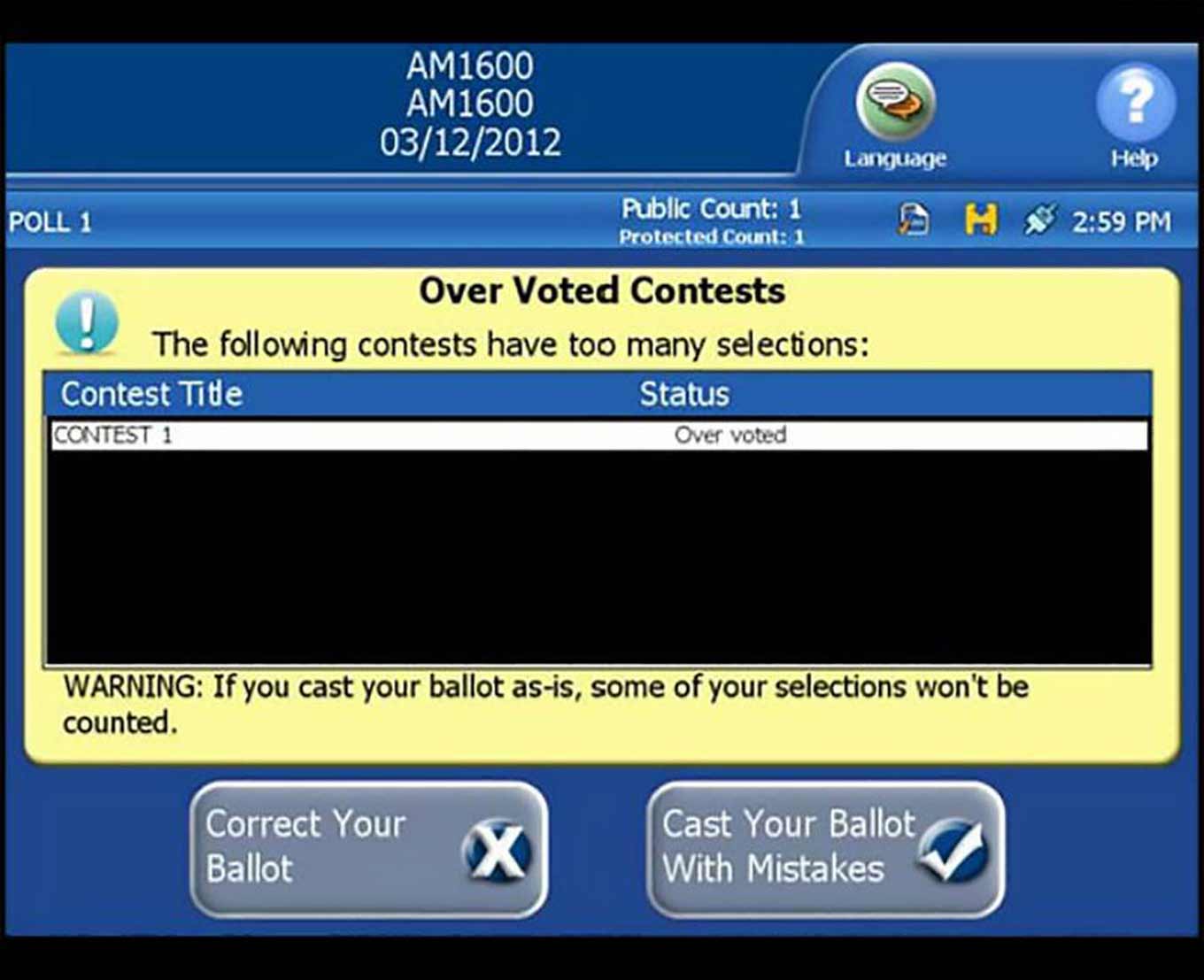
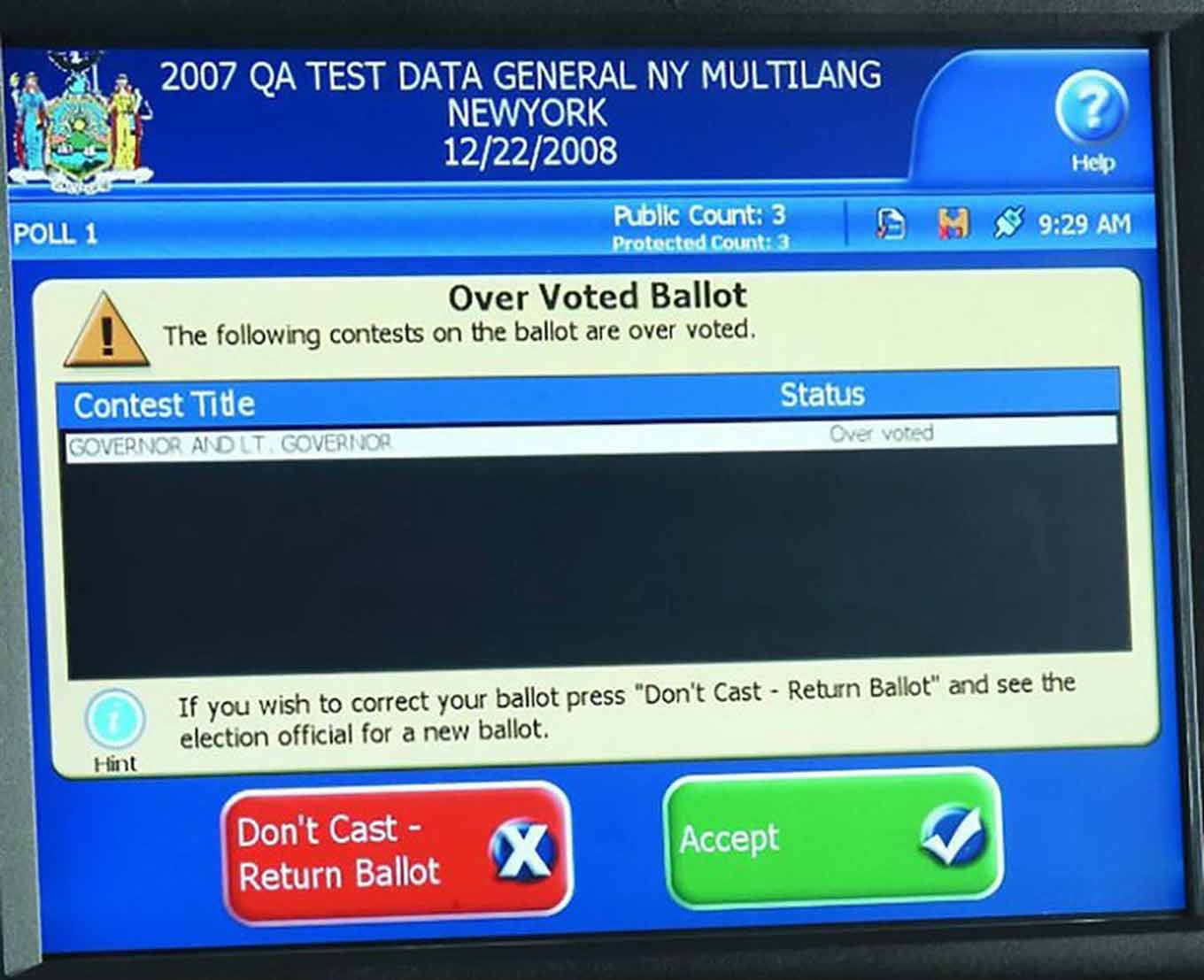
In 2010, New York voters got confusing messages if they accidentally overvoted — that is, voted for too many candidates — using machines made by two companies, Election Systems and Software and Dominion.
The electronic screen on ES&S machines featured a red button saying “Don’t Cast — Return Ballot” and a green button saying “Accept.” Similarly, the Dominion machines featured a red button labeled “Return” and a green button labeled “Cast.”
It was unclear which button would actually allow voters to fix the problem and many pressed the green button, which submitted their incorrectly filled-out ballot and meant that their vote was not counted at all.
As a result of a lawsuit that the Brennan Center for Justice and other groups filed against New York election officials, ES&S changed the messages on its buttons before the 2012 election, but Dominion did not get final permission for similar changes in time.
The new buttons on ES&S machines gave voters the option to either “correct your ballot” or “cast your ballot with mistakes” — a much easier choice to understand than the previous options.
That election year, rates of overvoting declined on both machines, but ES&S machines saw twice as big a drop as Dominion machines.
ES&S spokesperson Katina Granger said the accessibility changes for that election show “the need to continually obtain real world feedback from both customers and usability experts.” Dominion did not respond to ProPublica’s emailed questions.
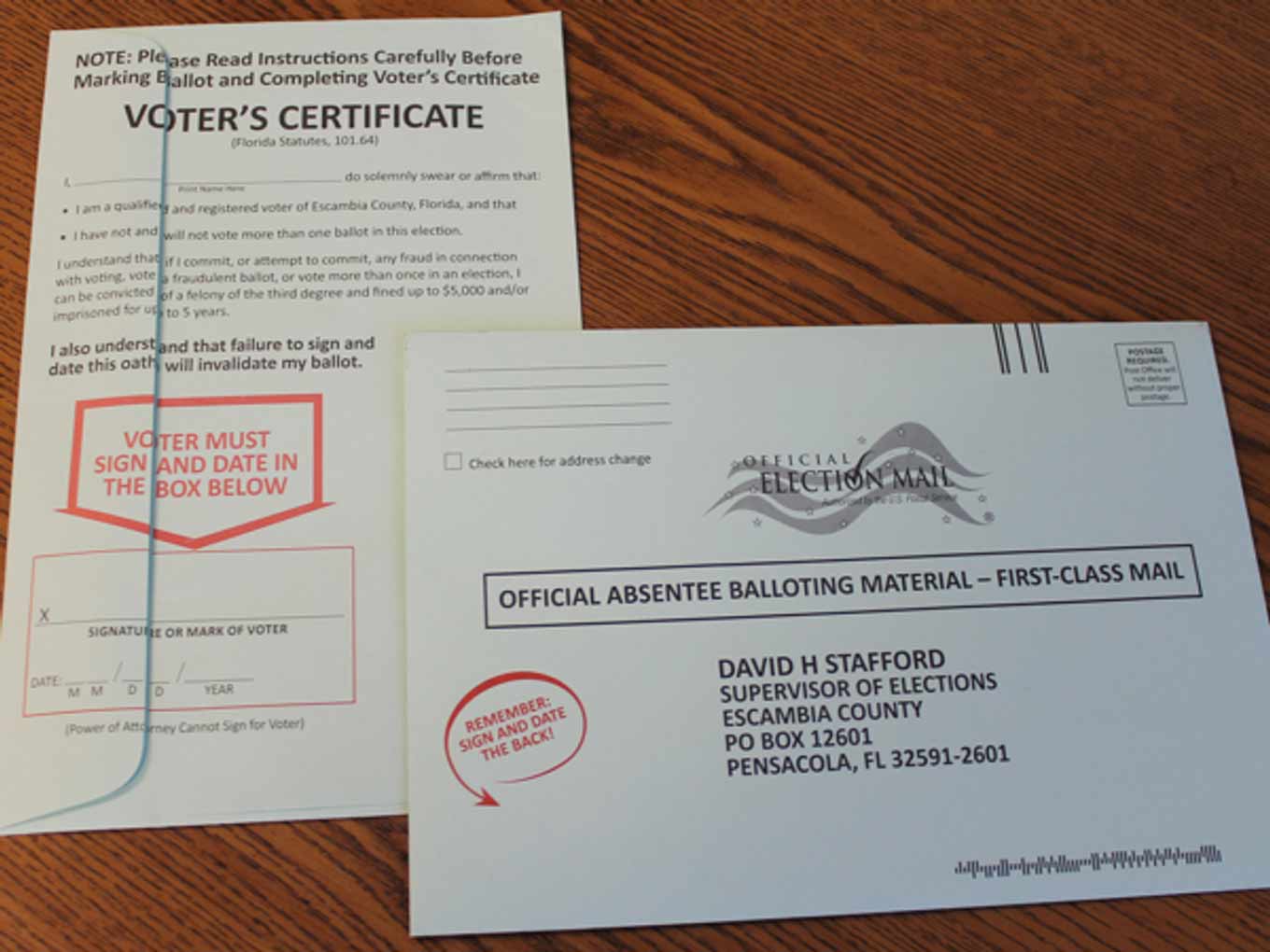
In advance of the 2014 election, Florida’s Escambia County redesigned its absentee ballot forms to format instructions as a checklist on the outside of the envelope, add simple illustrations and place a colored highlight over the spot where voters were supposed to sign.
Many states, including Florida, require absentee ballots to be rejected if a signature is missing or doesn’t match other records. The new design’s emphasis on providing a signature reduced the share of ballots that were missing a signature by 42% between 2014 and 2016, and reduced by 53% the share of ballots that were rejected even after voters were offered a chance to add their signatures.
Similarly, New York redesigned its statewide absentee ballot template in 2020. The number of rejected absentee ballots in New York City decreased from around 22% in that year’s primary to just 4% by the general election.

Fixing Voter Registration
Many states have redesigned their voter registration forms, making the very first step in the election process more accessible for voters with low literacy skills.
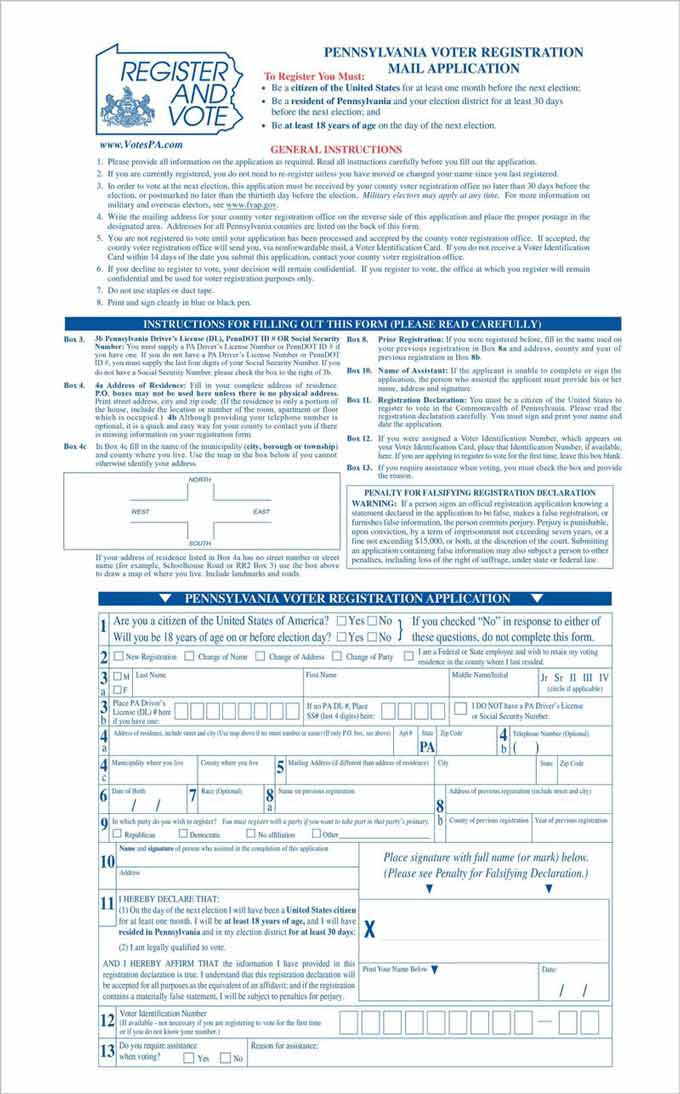
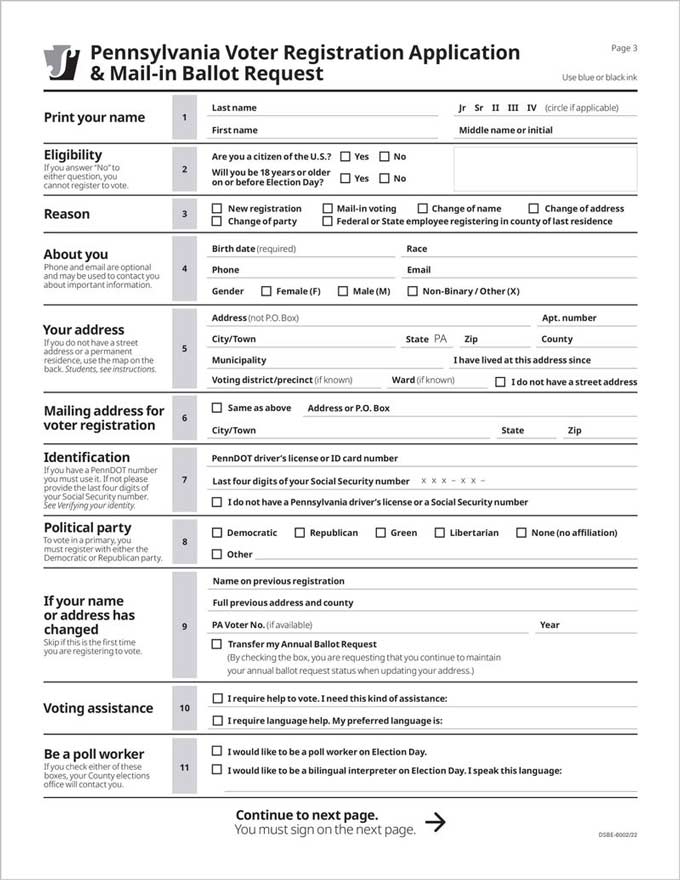
In 2015, when Pennsylvania launched online voter registration for the first time, state elections officials worked with the Center for Civic Design to test early versions with residents of the state. Their input helped officials design final versions of both online and paper forms with simplified language and minimal text on the page. The sections on the paper application are more clearly defined, with the instructions on the left and the voter tasks on the right.
Pennsylvania noticed a decrease in rejected voter registration forms since the launch of the new forms, according to Department of State spokesperson Grace Griffaton, but could not separate the effect of the simpler design from the launch of online registration.
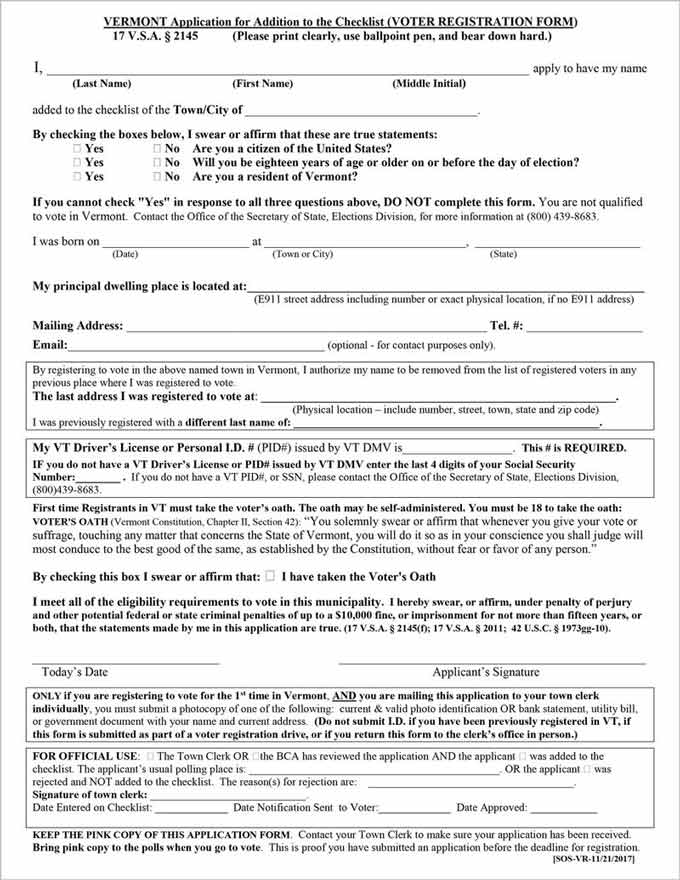
States like Colorado, Vermont and New York have created similar designs.
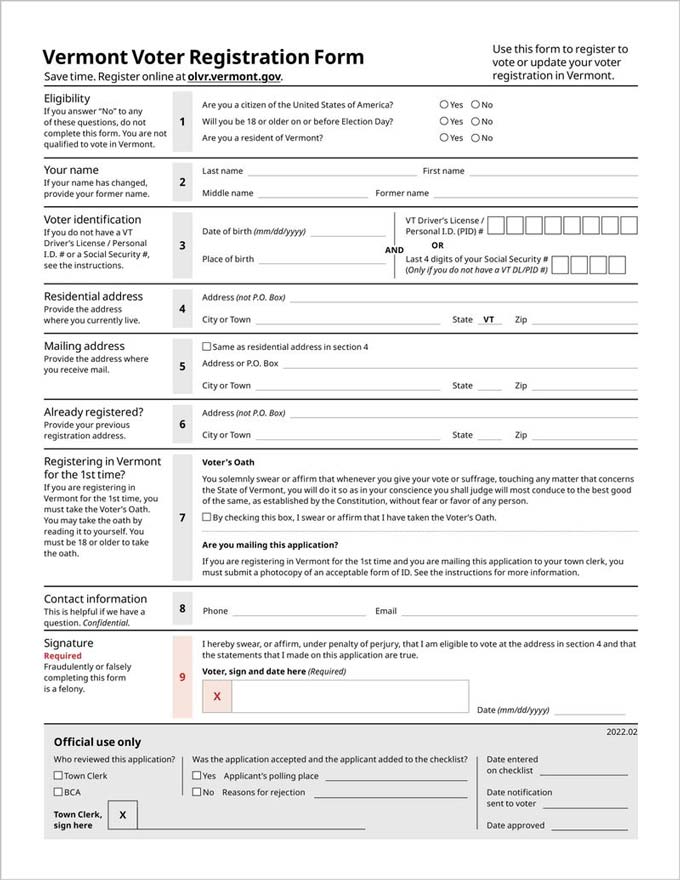
This year, Vermont debuted its new online registration form, completed with assistance from the Center for Civic Design, according to Secretary of State Jim Condos. Election workers had struggled to read voters’ handwriting on the previous form, which featured cramped spaces where residents had to fill in their information.
The new form is much easier to fill out and read. “It’s really about making sure the language is simple enough but to the point,” Condos said.
Learning From Other Countries
The United States has some of the lowest voter registration and turnout rates among its international peers. It also stands out for its relatively burdensome voting process. Many experts believe these two things are related.
Other industrialized countries with comparable or even lower literacy rates to the United States tend to have higher levels of voter turnout.
One simple reason for their increased participation is that they make it easier to vote. Most of them have some form of compulsory or automatic voter registration in place, according to research from the Pew Research Center and the ACE Electoral Knowledge Network.
Countries allow citizens to vote on Election Day without having to actively sign up beforehand, or they automatically register citizens who interact with government organizations, like motor vehicle departments or social service agencies.
Other countries, like Australia, have gone further and made voting mandatory, and citizens who do not cast ballots may be subject to penalties.
In nations with automatic registration programs in place, the percentage of people who are signed up to vote is substantially higher than in the United States, where only 67% of the voting-age population is registered.
By comparison, in Canada, 93% of the voting-age population is registered to vote, and similarly, that number is 94% in Sweden and 99% in Slovakia, according to Pew. In the United Kingdom, where government officials seek out voters every year through nationwide canvassing, the registration rate is 92%.
Barry Burden, a professor and the director of the Elections Research Center at the University of Wisconsin, Madison, believes that in the United States, the registration step “is probably more of a deterrent to voter participation than we realize,” he said.
“It’s a little challenging for most voters, but if a person doesn’t have the literacy skills or language skills to navigate that bureaucratic process, it could be a deterrent to even getting registered or getting a ballot in the first place.”
The United States is starting to shift its registration policies. Some states have initiated automatic voter registration programs, which use information from other government agencies to complete registration electronically unless people opt out.
Since 2015, at least 15 states and Washington, D.C., have launched automatic registration programs, and the impact has been extraordinary — with new systems in place, registrations increased by 16% in Oregon, 27% in California and 94% in Georgia.
Allowing people to register on the same day they vote could increase participation, too. Voters who made errors earlier in the process would have another opportunity to register or fill out their ballots alongside election officials who could ensure their accuracy.
As of 2012, states with same-day registration had, on average, 10% higher turnout than states without, according to the Center for American Progress.
Empowering Voters
Combs, who is now 78, no longer feels intimidated in the voting booth. She understands that there are many people like her, who have figured out ways to navigate the world without being able to read well enough to handle routine civic duties like voting.
At the age of 7, Combs was sexually abused by a stranger, a trauma that shadowed her childhood, she said, making it harder for her to remember the lessons she had learned in school. She pressured classmates for the answers to homework and exams, and her teachers passed her on from grade to grade.
When she graduated from high school in Bakersfield, California, she said, she left with the secret that she couldn’t read. She was too ashamed to tell her husband until seven years into their marriage. She often brought him into the polling booth because she didn’t even know where to sign her name on the election forms.
Working as a manager of Berkeley’s Meals on Wheels program, Combs thought she was hiding her inability to read from her coworkers — until one day her secretary left a flyer on her desk about a local literacy program.
She began learning with a tutor, strengthening both her ability to read and her desire to be more politically engaged. Since then, Combs has made it her mission to empower people to learn how to read and participate in democracy.
She now works with the Key to Community Project, which guides struggling readers through the voting process, helping them develop skills to research candidates and understand how elections work.
The nonpartisan project, led by people who learned to read as adults, is an extension of California Library Literacy Services, the country’s first statewide library-based literacy program.
Literacy advocates argue that states should contribute more to adult education in order to increase workforce skills and democratic participation.
Combs counsels participants in the California program not to worry about taking as much time as they need to understand the ballot.
“I know what the shame is, but you have to move beyond that shame,” Combs said. “That attitude about ‘My vote doesn’t count’ needs to be banished.”
A repurposed work boat, known as a buoy tender, is making its way north on New York’s East River on a recent August afternoon.
As the Statue of Liberty and Staten Island Ferry recede from view, the vessel’s blue hull bobs in the gray-green waters off Lower Manhattan. A light rain falls, bringing relief from the heat. The deck is piled high with porous plastic crates, leaving little room for the dozen passengers and crew. Most stand for the hourlong journey to Soundview Park, in the Bronx.
Along the way, the compact boat cuts a curving path between the numerous ferries, pleasure craft, barges and tugboats that ply the river.
Since larger boats always have the right of way, Captain Weston steers clear of almost everything in his path. Early in the trip, there is an incessant buzz of helicopters overhead, on their way to and from a helipad at the base of Wall Street.
Upriver, the sky belongs to commercial jets. In between, the vessel and its cargo pass beneath a series of iconic bridges and around several city islands. As the hour passes, so do the clouds.
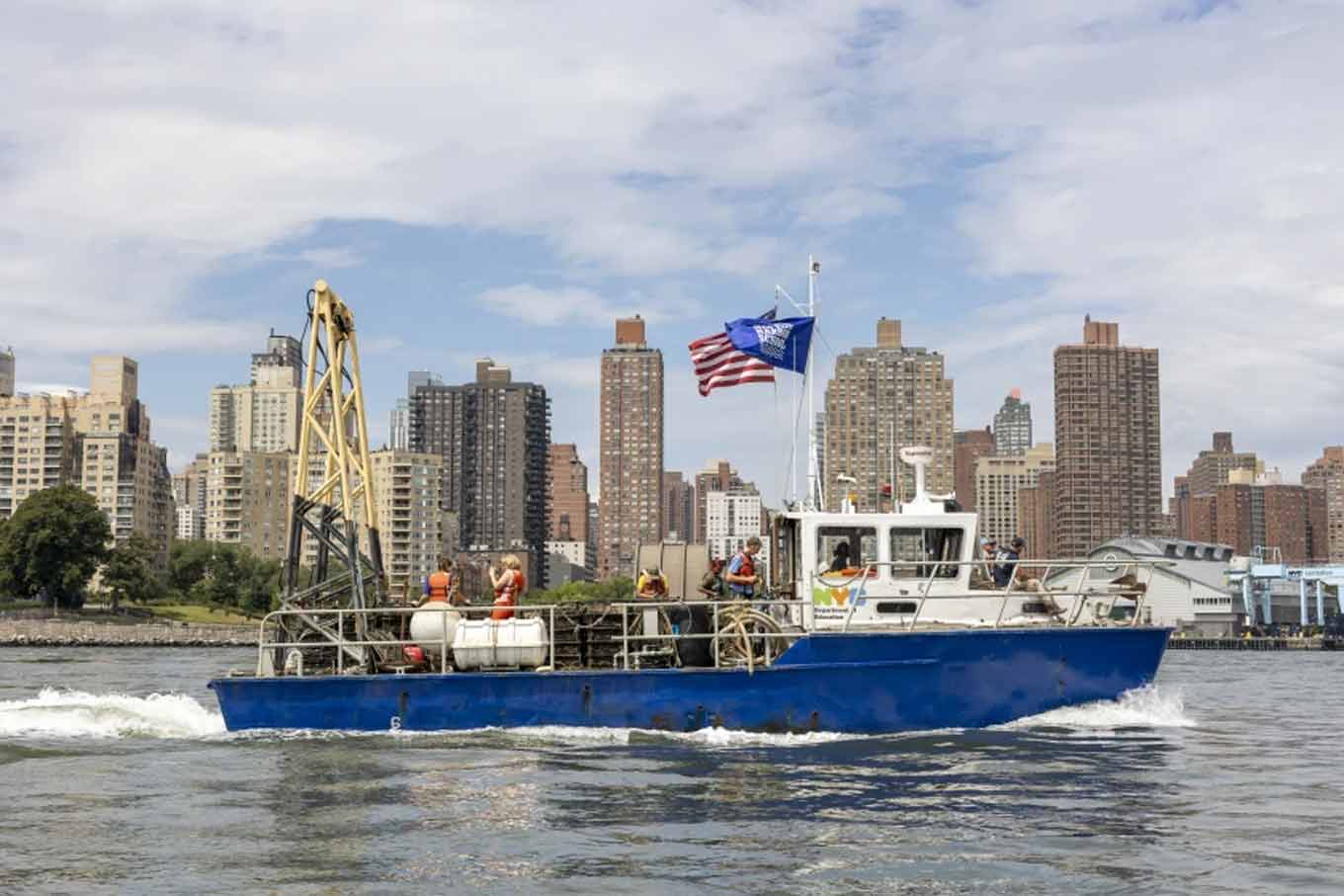
The boat belongs to the Billion Oyster Project, an organization dedicated to restoring the long-depleted oyster beds that once flourished in the waters around New York City.
The crates contain young oysters that have attached themselves to discarded shells collected from area restaurants. There are 120 crates of larvae-laden shells on board.
A second, identical boat, carrying an identical load, will rendezvous upriver where the contents of the crates will be ceremoniously dumped into shallow waters just off the Bronx shoreline.
The young oysters will be piled atop Soundview Reef, an existing five-acre reef made from shells dropped into the water on previous trips to the site.
This is just one of several locations around the city where new oyster reefs are being established by the Billion Oyster project with the help of an army of volunteers and area students.
The renewed population of oysters will not be suitable as food. But they are expected to serve a more important purpose: naturally filtering the water, attracting other underwater life and protecting shorelines from future storms.
As its name implies, the Billion Oyster Project aims to replenish the once-plentiful bivalve in and around New York Harbor. But the lofty goal represents only a fraction of what once was.
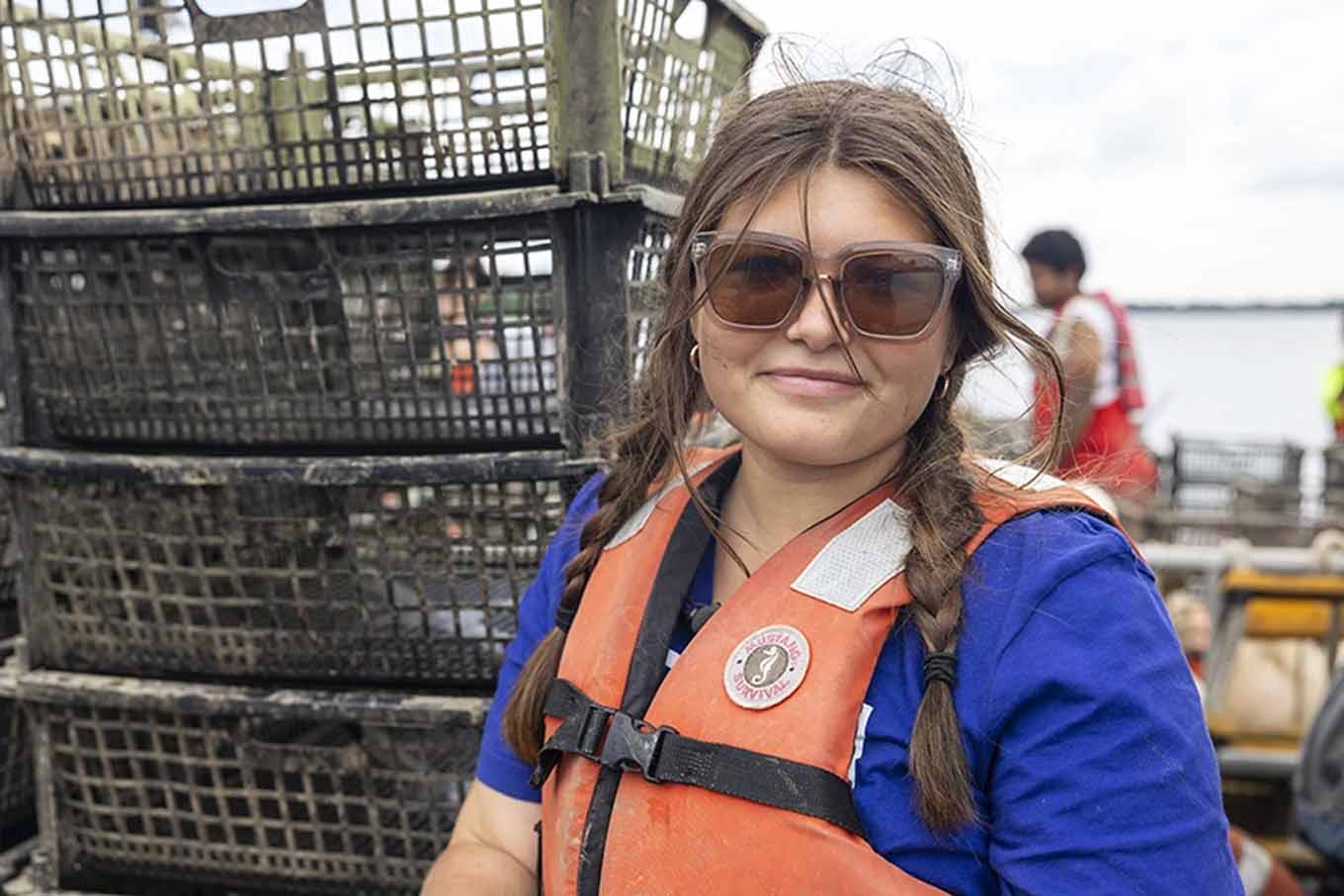
A Legacy of Pollution
When English explorer Henry Hudson arrived more than 400 years ago, there were 220,000 acres of oyster beds in the harbor, constituting nearly half of all the oysters in the world.
As the city’s population grew, so too did its appetite for oysters, a favorite of the well-to-do, the down-and-out and everyone in between.
By 1820, the oyster beds around Staten Island had been depleted. Even so, harvesting continued until the turn of the last century when over a billion oysters a year were taken from the water, something that proved to be unsustainable. The last New York oyster bed was closed by the city in 1927.
But over-harvesting was not the only cause of the oyster’s demise.
The Manhattan shoreline was once naturally hospitable to oyster beds. But now nearly all of it has been altered by landfill and innumerable piers and pylons.
Until the 1970s, the city was dumping millions of gallons of untreated sewage into its waterways every day.
Because of an aging combined sewer system, raw sewage is still discharged into the water during heavy storm events. But the harbor is cleaner today than it’s been in over 100 years.
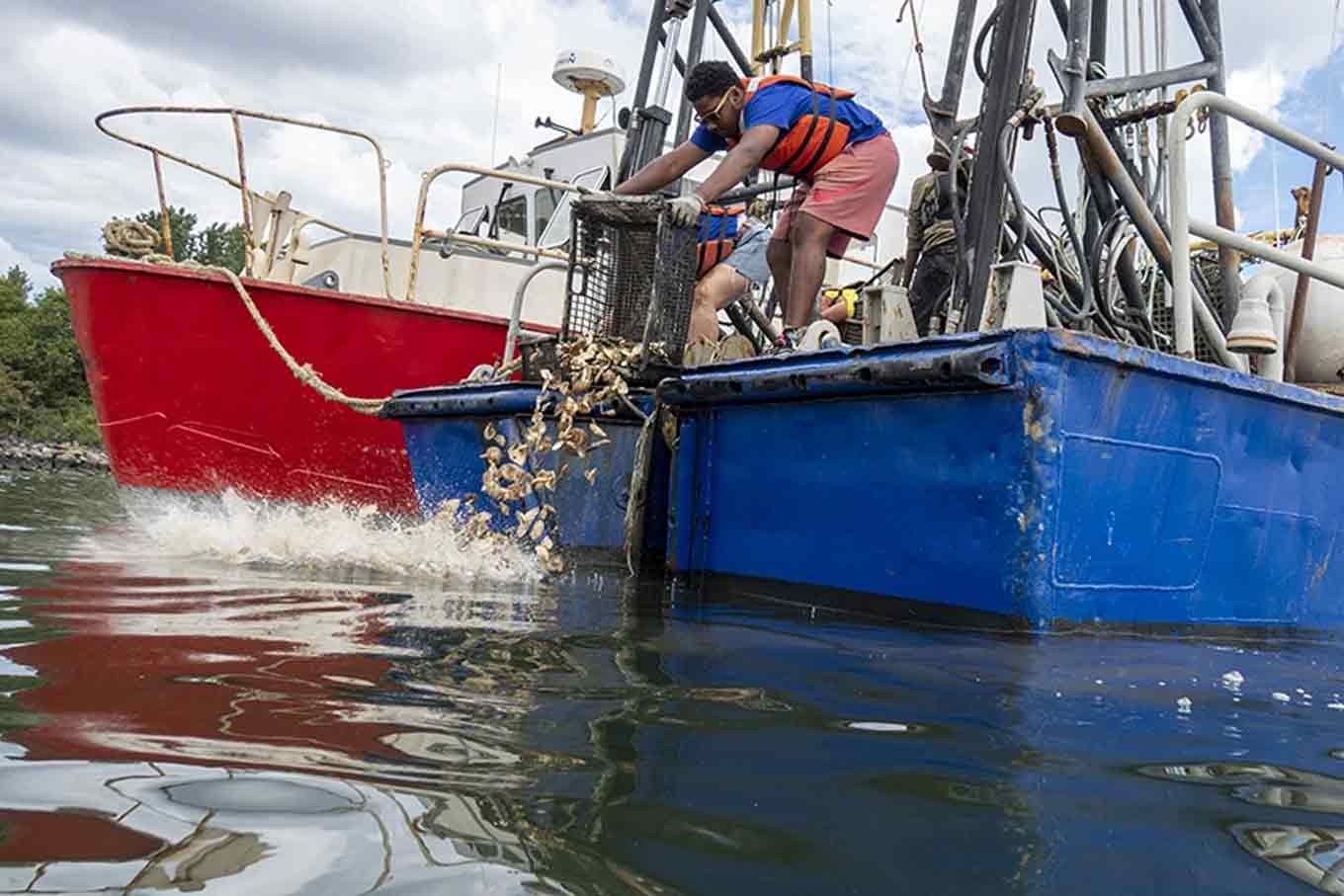
Oysters have returned to New York Harbor, on their own and with the help of organizations like the Billion Oyster Project. But they are not edible and won’t be for many years to come. In the meantime, they continue to play an important role in mitigating the mistakes of the past.
An adult oyster can filter 50 gallons of water a day, cleaning the harbor of pollutants, including nitrogen, which causes oxygen-depleting algae blooms.
As they grow, oyster reefs provide habitat for fish, crabs and other marine wildlife, re-establishing the harbor’s underwater ecosystem.
By dissipating wave energy, established reefs can benefit the land as well, acting as a defense against storm surges, flooding and shoreline erosion.

Students on the Front Lines
The Billion Oyster Project began in 2014 with the goal of restoring one billion oysters to New York Harbor by 2035.
“That’s our best guess as to when the harbor could begin to rejuvenate itself, without human intervention,” says the project’s communications director Helene Hetrick. “It’s not to say that our work will be completely done by then, but we think we will have reached a turning point for the harbor.”
The organization’s co-founder and director, Pete Malinowski, used to teach aquaculture at the Harbor School, a public maritime high school located on Governors Island, just off the southern tip of Manhattan and home base for the Billion Oyster Project.
In concert with their studies, the school’s students are involved in all aspects of the day-to-day work necessary to re-establish oysters in New York’s waterways.

But student outreach is not limited to the Harbor School.
Since it began eight years ago, the Billion Oyster Project has worked with more than 100 schools in New York City, “The dual mandate of restoration and education gives us the best chance at long-term sustainable change,” Hetrick says. “Bringing in the next generation of stewards is what makes the project even more challenging, but also more exciting.”
Much, if not most of the reef construction and monitoring, as well as water quality monitoring, is done by students from all parts of the city.

Where Oysters Come From
In nature, young oysters, known as spat, need a hard surface to settle on and grow their own shell. In order to speed up the process, the Billion Oyster Project matches oyster larvae with shells donated from 55 area restaurants, down slightly from pre-pandemic numbers.
To date, 2 million pounds of oyster, clam and scallop shells have been collected for reuse and diverted from landfill.
Before they can be used, the shells spend up to a year curing outside in piles on Governors Island. They must be free of any pathogens or bacteria before re-entering the harbor.
After they have cured, the shells are cleaned and placed inside a “gabion,” a container of metal bar and mesh welded and assembled by Harbor School students and staff. The gabion full of shells is then lowered into a tank of water.
Free swimming oyster larvae are released into the tank and attach themselves to the shells. Not much larger than a grain of sand, as many as 20-30 spat can find a spot on one shell.
Once they are set on their new home, the entire structure is lowered into New York’s waterways. But not all of them will make it.
“Twenty oysters can’t grow on one shell,” says Hetrick. “They’ll compete for space. We hope at least half of them will survive.”

The goal of a billion new oysters in New York Harbor seems within reach.
“Since our start in 2014, we’ve restored 100 million oysters,” Hetrick says. “In the next two years, we are confident we can scale to 100 million oysters every year. A major increase.”
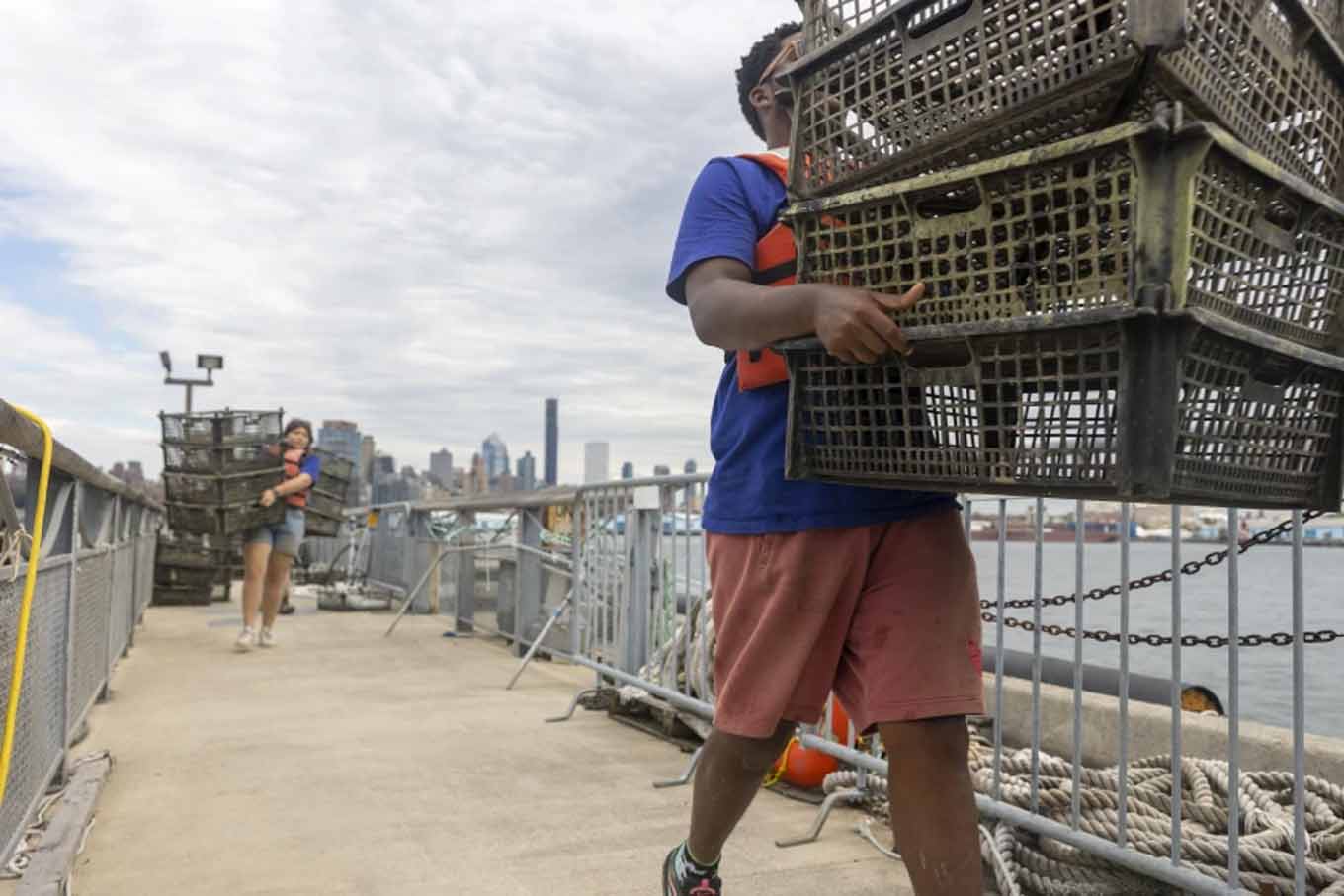
The fledgling oysters dumped overboard today off the Bronx will drift down and settle upon 200 gabions waiting at the bottom. After the crews have stacked the empty crates, the two buoy tenders untie themselves, lift anchor and turn toward home.
Some of those on board are graduates of the Harbor School. Others will be starting classes in a few weeks.
All will continue working toward their common purpose: restoring New York Harbor, one batch of oysters at a time.
Scientists believe dangerous climate change "tipping points" are approaching — from surging sea levels as polar ice melts to fast-spiking temperatures as methane escapes thawing permafrost.
A study published this month in the journal Science found that four dangerous planetary tipping points are likely if global warming reaches more than 1.5 degrees Celsius (2.7 degrees Fahrenheit) above preindustrial temperatures.
That limit — which governments are striving to keep to under the 2015 Paris Agreement — could be passed within a decade, scientists have warned.
Tipping points happen when a small change — such as an incremental increase in global temperature — sparks a rapid and often irreversible transformation.
But they may not all be bad. "Positive" tipping points for the climate are also possible, as solar and wind power grows cheaper than fossil fuels, electric vehicles take off, meat substitutes become tastier and social norms shift.
"I think our best, and possibly last, hope of avoiding the bad tipping points is finding and triggering some good tipping points," said Tim Lenton, director of the Global Systems Institute at the University of Exeter.
Here's a look at some of the potential positive shifts and ways they might be triggered:
Electric vehicles
In Norway, 84% of new cars sold in January 2022 were electric, part of an accelerating move away from fossil fuel-run vehicles. It is also happening in other places, if more slowly.
Why is the swap occurring? In Norway, a combination of rising taxes on fossil fuel vehicles and subsidies to buy electric ones has made the latter the cheaper choice.
In a growing number of countries, rising vehicle efficiency standards, investments in charging infrastructure, higher fees on more polluting cars or limits on where they can be driven are all helping more drivers to view electric as the smart next buy.
In industries such as the automotive sector, getting "keystone actors" — including CEOs of major companies — educated about potential climate risks and the profits to be made from an electric switch can also drive change, said Johan Rockström, director of the Potsdam Institute for Climate Impact Research.
The leading climate scientist now sits on an advisory board for Daimler — the parent company of Mercedes-Benz — one of a growing tide of major manufacturers now planning to stop selling fossil fuel vehicles in the 2030s.
Similar green shifts among major corporate players are happening in other sectors, including the seafood industry, he said.
"Business has changed from its focus on corporate social responsibility, which is about perceptions," Rockström said.
"Now it's about a strategy for competitiveness."
Meat eating
Feeding livestock is a massive strain on the world's tightening food supplies and the expansion of farm fields and pastures for fodder is one of the largest global factors behind deforestation, a major contributor to climate change.
While overall meat consumption is rising, as the world's population grows and some poorer nations become more affluent, a surge in tastier and more appealing meat substitutes is helping drive a shift from meat-eating in some countries.
Scarlett Benson, who works on tipping points for the Food and Land Use Coalition, said a faster switch to meat alternatives — like many green shifts — is becoming possible as five "enabling" conditions are increasingly met.
Those include: price (is it cheaper?), performance (does it taste good?), accessibility (can you get it at the local shop?), culture (are your friends and family also doing it?) and capability (do you know how to cook it?).
Other changes accelerating the move away from meat range from investment in innovations — such as lab-grown meat — to use of public procurement — including buying meat substitutes for school lunches — to help create economies of scale, Benson said.
Additional measures could include setting national dietary guidelines, banning marketing of unhealthy products and, eventually, putting in place a carbon tax, she added.
Clean energy
Renewable power — solar and wind — is rapidly becoming the cheapest form of energy in much of the world, a reality that means even those who do not care about climate change are likely to find themselves using it, said Doyne Farmer, director of the complexity economics program at the Oxford Martin School.
But economic nudges are, in some places, speeding the shift.
Britain, for instance, slashed climate-changing emissions from its electricity supply at eight times the global rate over the last decade by using a small carbon tax that made coal energy uncompetitive with gas, said Simon Sharpe, a senior fellow at the World Resources Institute.
Significant investments in offshore wind power — Britain now has more capacity than any other country — and a pioneering government pledge to become net-zero by 2050 also have driven advances in green electricity.
What can help drive smart decisions, Sharpe said, is a switch from weighing up costs and benefits, often in the short term, to analyzing risks and opportunities instead.
That could help speed decarbonization, will needs to happen five times faster than current levels globally, Lenton said.
"We need some ways of accelerating an agreed-upon change — and creating systems that then self-accelerate is the crux of a positive tipping point," he said.
Peer pressure
Social tipping points may also be emerging, from graduates shunning jobs at unsustainable companies to families investing in solar panels, eating less meat or joining climate change protests when friends and neighbors do those same things.
"Tipping happens not because all see the light at once but because we're influenced by opinions of others," said W. Brian Arthur, a California economist who works on complexity theory.
"When a sufficient number change their ideas... it becomes more likely you'll change your ideas," he said, citing how smoking saw a rapid and swift decline starting in the 1970s as its health impacts became clear and restrictions were enacted.
In almost all cases, politicians act on a problem only once they see there is social backing, he said — one reason taking individual action on climate change matters.
The coronavirus pandemic has shown that societal change — and finance to deal with threats — are possible "at a speed and scale we thought previously unimaginable", said Andrew Simms, founder of the Rapid Transition Alliance, a network of international organizations working to speed up climate action.
Now, he said, it is time to apply that approach to dealing with climate threats, and improving lives in the process.
"What's not to love about insulated homes? Jobs created insulating homes? Investing pensions in renewables? Some of these solutions are in front of us – we just need to roll them out," he added.
This article was originally published by Thomson Reuters Foundation, the charitable arm of Thomson Reuters, that covers the lives of people around the world who struggle to live freely or fairly.
On the June solstice of 2022, Cory Hinton traveled by boat across Big Lake to Pine Island in Maine and set foot on his ancestral land for the first time.
Since time immemorial, the island was Passamaquoddy ancestral land, relied on as a village settlement and food storage site. But despite the Passamaquoddy claim to the land, both as stewards and under the legal framework of the federal law, Maine voided the treaty and stole the land shortly after becoming a state in 1820.
Eventually Maine sold the land to another entity in the 1820s, said Hinton, a Passamaquoddy citizen and lead attorney of the Tribal Nations Practice Group at Drummond Woodsum.
“People had been living on this island right up until the island was sold away.” By 1855, he added, “all of the tribal families had been forced off the island.”

When Hinton and others arrived on the island, they held a traditional pipe ceremony and later walked around the island, which was dense with pine and other conifer trees.
After some time, he reached a section of the island that had been thinned out and noticed scattered holes in the ground. Hinton realized he had come across an old Passamaquoddy village site.
“We were really reconnecting with our ancestors in that moment,” Hinton said. “I think that reconnection is going to kick off an amazing opportunity for the tribe to reengage and to learn about itself. I mean, this is a place where ancestors lived and died, and there’s a lot to be said about reconnecting with a place like that.”
The return of the stolen land, known in English as Pine Island, to the Passamaquoddy was set in motion two years ago when the Passamaquoddy Tribe Chief William Nicholas saw an advertisement for the sale of the land.
First Light, an organization that facilitates collaboration between Wabanaki tribes and conservation groups, offered to place a bid for the land with funds donated by The Nature Conservancy in Maine.
The purchase was ultimately completed in March 2021 and is just one example of how the LANDBACK movement is working in practice to return stolen lands to Native peoples.
This year, along with other Passamaquoddy citizens and tribal leaders, Hinton was able to set foot on his ancestral land for the first time.
The logistics of LANDBACK
The LANDBACK movement is the newest iteration of an old demand. It’s a movement that’s growing in reach as non-Native individuals, conservation organizations, and government entities reckon with what it means to live on lands taken from tribal nations.
Native leaders and LANDBACK organizers say that the theft of Native lands, stolen to create the U.S. and generate private wealth for white people, is the root of systemic injustices propelled by extraction and capitalism, like climate change.
In this sense, returning stolen Native lands isn’t just a matter of legality or morality but underlies the health and survival of the planet.
“When we say LANDBACK we’re talking about the land that was promised to us through treaties,” said Shaun Little Horn, a social media and marketing specialist for the Lakota People’s Law Project, who lives on the Pine Ridge Reservation with his family.
According to Article 6 of the U.S. Constitution, treaties signed with foreign nations are the supreme law of the land.
“Let’s start there, and let’s just return all the land that is promised in your own Constitution, in your own government, back to the people of this land — that there is a foundation that we can all build off of and begin to see where the real healing comes from,” Little Horn said.
In practice, land returns are executed through partnerships with conservation organizations, through local, state, and federal legislation, and by individuals who may pay a form of land tax to descendants of a land’s historical peoples.
Some non-Native landowners are even turning over their homes to Native peoples and tribes. But as Little Horn explained, the workings of a land return relationship differ depending on how the Native land was stolen and who, in the end, retains the legal rights to it.
LANDBACK can bring a kind of justice to a historical and ongoing harm, as well as address the crisis of climate change.
The different models for what that land return looks like, however, illuminate conflicts caused by a land-based system of racial capitalism that now defines everyone’s legal relationship to land, raising questions of what return of land can look like for tribes without federal recognition and how to reconcile the historical fissures between land conservation and land stewardship.
Stewardship or conservation?
The land returns executed in partnership with conservation organizations are anomalies in the history of conservation work.
The very word “conservation” — which means to protect land from humans — is in contrast with how Indigenous teachings guide relationships with land and with the ethos of stewardship recognizing that humans are a keystone species. As stewards, humans need to act on the land to help create ecological balance.
Throughout U.S. history, conservationist prioritization of land protection has brought devastation for Native peoples. Take the creation of national parks, for instance. The country’s oldest national parks are its earliest experiments with forced removal of Native peoples under the guise of wildlife preservation and guardianship of pristine landscapes.
Native peoples who stewarded what are now the jewels of the American outdoors — Yellowstone, Yosemite, and Glacier national parks — were seen as threats to the landscape because of their hunting, gathering, and use of fire.
Professor and author Mark David Spence discusses the fallacy of untouched land in his 2000 book, “Dispossessing the Wilderness.”
“The American preservationist ideal is predicated on Indian dispossession,” Spence wrote.
Essentially, the formation of the National Park Service codified the removal of Indigenous peoples and locked in the idea that land untouched by human civilization exists and such “wilderness” must be kept in this pristine state, erasing Indigenous peoples’ history of stewardship and effect on the land.
While land is not inherently vulnerable, it is objectified and commodified through colonization, often by the hands of the U.S. military and by way of Congressional or other federal action.
For instance, a 1872 executive order forcibly moved the Confederated Tribes of the Colville Reservation west of the Columbia River in Washington state to a territory of less than 3 million acres — which was devastating for the nomadic peoples, who had, since time immemorial, moved through the landscape as the seasons changed to fish and gather food and medicine.
Twenty years later an Act of Congress would halve the reservation’s landmass. The Figlenski ranching family purchased the land in 1904 after the northern portion of the reservation was dissolved.
Another 120 years after that, some of the land was returned; not by Congress or a federal agency, but by way of a habitat conservation organization.
In 2021, the Seattle-based conservation organization purchased 10,000 acres of the land from the Figlenski ranching family so that the title could then be transferred to the Confederated Tribes of the Colville Reservation.
When she first learned that the land was for sale, Amelia Marchand, an enrolled tribal member of the Confederated Tribes of the Colville Reservation, was worried about the destruction of shrub-steppe — a native plant that plays a critical role in soil ecology — and other habitats.
She and other tribal members relied on the land for traditional hunting, food, and medicine gathering, and she wanted to ensure that this relationship with the land would remain intact.
So Marchand and her husband joined the board of Conservation Northwest.
“We were very vocal and protective of not just the lands currently held by our tribal government, but also the traditional territories that are outside of what’s now the reservation boundary,” Marchand said.
The origins of conservation and the ethos of land stewardship push against each other, and Marchand wanted to help her colleagues “see the landscape as more than just habitat for shrub-steppe.”
The landscape is and provides access to culture, food, storytelling, and language. “It’s just a completely different heritage of a relationship,” Marchand said.
In late October 2021, tribal leaders, Conservation Northwest staff, and Figlenski family members took part in a land return ceremony. Videos from the day reveal a gray sky. It’s raining, and shrub-steppe retreats in every direction.
It was the first time that Conservation Northwest, founded by executive director Mitch Friedman in 1989, had been a part of a land return to a local tribe.
The organization had worked closely with the Colville tribes for nearly two decades to collaborate on public land protection outside of the reservation’s boundaries for the restoration of endangered species, like the sharp-tailed grouse, which is also spiritually and culturally important to the Colville tribes.
The Figlenski ranch, or the historical and ancestral land of the Colville tribes, was the “keystone” landscape to “protect a corridor that links the Cascade Range to the Rocky Mountains,” Friedman said.
Protecting the land was the first priority of the organization, Friedman said, and that they were able to facilitate the return of Native lands was “an added reward. You know, it’s even better.”
In some state-run land return programs, conservation is the end goal. Take California Gov. Gavin Newsom’s proposed budget for 2023, which would offer $100 million for tribes to buy back ancestral lands to meet “climate and conservation goals.”
The program proposal was born out of conversations with Native leaders from 70 tribes, some federally recognized and some not, said Geneva E.B. Thompson, the assistant secretary for tribal affairs in the California Natural Resources Agency and a citizen of the Cherokee Nation.
“[Tribal] knowledge is key for us to address the climate crisis, the biodiversity crisis, all of these issues that we’re really grappling with at this time,” Thompson said.
“Partnering with tribes on these crises and identifying solutions is a way we can move forward and address those historical wrongs that have been suffered by tribes.”
California state policy is founded on the advocacy of genocide of Native peoples; the state’s first governor, Peter Burnett, encouraged local police and private citizens to kill Native peoples. The state’s first economy in gold propelled an even more extractive economy and justified the forced removal of tribes.
In 2019, Newsom issued an executive order apologizing for this history. It was this executive order that established the Truth and Healing Council, where discussions of a land buyback program were first heard.
Thompson explains that many of the details of what the program will look like are still in the works — which tribes will be eligible for funding, how land will be appraised, if private and public lands will be available for purchase, and if the land will be stewarded or conserved are still unclear.
Thompson said that ongoing conversations with tribal leaders will help determine the specifics of the program.
Other elements of land buyback, such as who or which entitles will retain the deed to land, will be decided on a case-by-case basis, Thompson said.
Federal recognition and LANDBACK
Land theft isn’t always the outright denial of treaty obligations, as is the case with the Black Hills, nor is it stagnant and solely situated in the past, said Paul Benz, a faith leader and organizer with the Seattle-based organization Coalition of Anti-Racist Whites.
He said that another way of looking at land theft, and what the return of that land might look like, is through attending to the ongoing marginalization of tribes that lack federal recognition.
The 574 tribes with federal recognition are entitled to a government-to-government relationship with the U.S., a right to self-government, and control over their reservation lands.
Those without federal recognition, about 400, according to the Government Accountability Office, aren’t entitled to most funding and often lack access to land, either in the form of reservations or land held in trust by the federal government.
While having a federal treaty on the books legitimates a tribe’s land claims to the federal government, those without a treaty to point to often rely on grassroots and relational solutions for getting back their land, as is the case with the Duwamish Tribe.
The city of Seattle is even named for the chief of the Duwamish Tribe, Chief Seattle, who signed the Point Elliott Treaty of 1855 with European settlers that guaranteed fishing rights and reservation land.
Shortly after its signing, settlers broke the terms of the treaty, and to this day the Duwamish Tribe still doesn’t have legal rights to their rightful land.
However, many still live in the area stewarded by Duwamish ancestors since time immemorial and have developed a program whereby settlers or non-Native residents of the greater Seattle area can pay rent to the Duwamish Tribe.
The program, called “Real Rent Duwamish,” acknowledges the tribe’s rightful claim to the land and also provides “a revenue source that an unrecognized historic treaty tribe doesn’t have,” said Benz.
With his peers from the Coalition of Anti-Racist Whites, the Seattle chapter of Showing Up for Racial Justice, Benz remembers sitting at the kitchen table of Duwamish Tribal Chair Cecile Hansen and asking what he and others could do to support the Duwamish Tribe, which had been subject to a variety of legal land denials.
Hansen suggested that they each could pay $1 a month to the Duwamish Tribe as rent. Benz felt the rent concept was right as they were, after all, on Duwamish land. Now, over 21,000 people offer monthly or annual rent to the Duwamish Tribe.
A similar effort is at work in the Bay Area, where non-Indigenous residents can pay what Ohlone leaders call a Shuumi Land Tax, an annual donation to support the work of the Sogorea Te’ Land Trust, a land rematration, cultural revitalization, and land restoration organization.
Prior to the gold rush, the Ohlone people stewarded and lived on 4.3 million acres of land, and now — according to the federal government — they have none.
The Ohlone people have been waiting for federal recognition since 1995, when a petition was first filed.
Along with the Duwamish Tribe and the Ohlone people, there are dozens of tribes on the Bureau of Indian Affairs waiting list for federal recognition. Even the federal government’s own Government Accountability Office has criticized the seemingly random process by which tribes are afforded recognition, writing,
“The basis for BIA’s tribal recognition decisions is not always clear.” And federal recognition isn’t always permanent: mid-20th century legislation dissolved the tribal recognition of 109 tribes in an attempt to assimilate Native peoples into white American culture.
While the Ohlone people wait for the federal government’s say-so, the Sogorea Te’ Land Trust is building relationships with non-Indigenous people in other ways.
Deborah Apple, a lifelong Bay Area-resident, has decided that when she dies, the land that she owns will be returned to the historical Native stewards of the land where that property is located.
For now, though, she pays Shuumi to the Sogorea Te’ Land Trust annually and donates to a 501c3 run by the Nisenan Tribe because she owns 27 acres of land in Nevada City, California.
While grassroots efforts like Real Rent Duwamish and Sogorea Te’ Land Trust don’t see thousands of acres of land rematriated with a single return agreement, as is the case with conservation organizations and government programs, the form of return the organizations advocate for allows for deeper community building and political awareness among Native peoples and guests on the land. In some ways, that’s how movements are made: individually, from one person to the next.
“I think over the past 10 years I’ve expanded my understanding of what reparations are and what a person who’s white can do,” Apple said.
“Even though I don’t have ancestors who are colonizers who actually directly took specific lands from specific Native peoples in this country, my family was able to come here and have a safe place to be in the world because that had already been done before. I benefit, so I still owe.”
Graham Biyáál will never forget the taste of his mother’s traditional blue corn mush. An earthy, hearty dish made with ground-up blue cornmeal, water and juniper ash, its recipe has been passed down for generations, from his great-grandmother to his grandmother to his mother, and now at last to his own bowl and spoon.
Biyáál doesn’t claim to have mastered the recipe quite as well as his mother did. But each time Biyáál — a traditional farmer who tends his family’s farm in the San Juan River Valley near Shiprock on the Navajo Nation — scoops up another mouthful of corn mush, he pays homage not only to those who came before him, who kept this line of corn seeds alive, but also to a broader movement taking root in Indian Country.
Food sovereignty is the right to access meals like this — healthy and culturally appropriate meals produced locally using sustainable methods and agricultural practices.
In myriad tribal communities, food sovereignty has blossomed from a concept into a full-blown movement.
Biyáál is just one of many farmers in this part of northern New Mexico who recognize the importance of growing, harvesting and cooking as their ancestors did.
For them, food sovereignty is not just about maintaining good relations with the natural world, it’s about doing so with a rising generation of traditional farmers.
The path to food sovereignty, however, is not always easy — at least not initially. Tiana Suazo, of Taos Pueblo, remembers when she started farming. She was 8 or 9, working under an unrelenting sun with her father, planting seeds for a relative’s initiation later that year.
“I remember it being hot, and I hated it,” she said. “But our people — Pueblo people — are farming people. Growing these traditional crops means you’re being part of something greater than yourself.”
As much as she loathed being out in that summer sun as a child, the experience stuck with her— so much so that Suazo currently serves as the executive director of the Red Willow Center, a year-round vegetable farm based out of Taos.
Started as a tribal council initiative in 2002, the center now boasts four greenhouses and a one-and-a-half-acre field for crops, all of which is overseen by Suazo.
More than just a place to raise food for the community, Red Willow is a space to foster the food sovereignty movement at its roots.
“Growing these traditional crops means you’re being part of something greater than yourself.”
Suazo and her team work with the Taos Pueblo community’s youth, teaching them the ins and outs of farming and paying them above minimum wage for their labor.
Suazo makes sure the young ones learn to see the greater good in the work they’re doing, just as she did as a child, and that they learn how to provide healthy traditional foods for their own families.
She sees the continuation of these age-old practices as part of a nourishing cycle, much like Biyáál's blue corn mush.
Like the plants the farmers work with, this cycle is far from new. For millennia, Suazo said, children have watched their parents go out to the farm, and they have learned which plants should be planted in spring, how to harvest them and, most importantly, how to access a rich and healthy diet.
And, as Suazo was quick to point out, knowing the life cycle of the crops is necessary for young tribal members; it’s the way they learn about how and why certain plants are used during ceremonies and why there are different dances for various crops.
“The life cycle of these plants goes hand-in-hand with our traditions, and it’s so important to see these cycles and understand the importance of why we farm,” Suazo said.
“We need to get the children involved, because without them, we won’t have a way to connect back. If we lose this information, it’s difficult to come back.”
On the Navajo Nation, Biyáál is likewise ensuring that future generations will have access to the same plants and crops as their predecessors. Biyáál identifies as a seedkeeper — one who maintains the seeds of plants from the traditional diet of their community and nation.
He has gained a following on social media, where he shares his life as an Indigenous organic farmer, with the hope of inspiring other Indigenous people to reconnect with tribal foodways, reclaim their diets and prepare traditional recipes like blue corn mush, blue corn cookies, vegetable stews and hearty wild meats like elk and venison.
His online store carries seeds grown on the Navajo Nation, so that people can easily send a jar of Navajo blue corn to other Indigenous farmers looking to add to their seed banks.
Some seeds and unique plants were lost when the U.S. military forced the Diné from their homelands in the 19th century. But the corn used in Biyáál's mother’s recipe endured.
Grown using seeds from the previous year’s crop, this corn, which dates back hundreds of years, has helped nourish Biyáál's family for generation after generation.
With his seeds, Biyáál is able to provide the crops necessary for traditional ceremonies, Diné foodways and diets, as well as for current and future farmers who are looking to reconnect with old ways and traditions.
“We have to look at what the land already provides and align it with our diet. Like our ancestors did.”
The spreading and preservation of seeds, much like Suazo’s mission to spread the knowledge needed to grow them, is something Biyáál’s ancestors practiced regularly.
Varieties of chilis, sunflowers and corn that were raised and perfected by Diné hands have since spread throughout the Southwest, out to the East Coast and even up to Canada, making the Navajo Nation’s unique strains and hybrids all the more culturally significant.
The importance of preserving these extends beyond the symbolic. Biyáál has seen and lived with the limited store-bought options he and other Diné citizens have had access to, which too often contain high levels of sodium, fats and added sugars.
His goal is to free the Navajo Nation’s health, diet and traditional foods from the grip of colonialism. On his farm, he grows vegetables that his people have enjoyed for centuries, such as squash, beans, tomatoes, corn and melons.
“We have to look at what the land already provides and align it with our diet,” he said, “like our ancestors did.”
In his tent, Biyáál has already laid out the plans for his next harvest, carefully deciding which crops to plant next to each other based on how each will affect its neighbor — details he said his ancestors had figured out long before him.
Each time he walks his family’s land — the land of his ancestors — he can’t help seeing a positive version of the future, one filled with Diné farmers and seedkeepers. Before long, he hopes to see an Indigenous-owned and operated organic grocery store flourish on the Navajo Nation.
“I really think we can get there,” he said. “It’s something I want to do to provide people with healthy choices, because our reservations lack that. But I want it to be traditional food.”

As the holiday season invites cooler weather, warm peppermint drinks, and festive parties, so too does it invite the annual tradition of sending out holiday cards. But, if you’re mindful of the resources used to keep this tradition alive, you know that it requires a large amount of precious resources.
In fact, Stanford researchers found that Americans throw away 25% more trash during the Thanksgiving to New Year's holiday period than any other time of year. The 2.65 billion Christmas cards reportedly sold each year in the U.S. could fill a football field 10 stories high.
So, how can we balance a beloved tradition and eco-conscious values?
If you’re eager to send out some holiday cards, stationery, or even wedding invitations (without the added guilt of your paper or energy usage), there are plenty of great sustainable options out there.
We’ve put together some helpful information and narrowed down your search for the most eco-friendly holiday cards on the market — hopefully making it a little easier for you to send your most thoughtful and sustainable holiday cards ever.
By the way, some of the links in this article are affiliate links, which means if you make a purchase after clicking a link, we may earn a commission at no extra cost to you. Thank you!
Short on time? Here are our top 3 picks for eco-friendly holiday cards:
- Minted: Uses FSC-certified recycled paper with versatile designs by independent artists, and powered by renewable wind energy.
- Artifact Uprising: Uses high-quality 100% recycled paper and powered by renewable wind energy.
- Paper Culture: Each card and envelope is made with 100% post-consumer recycled paper; for every order made, the company plants a tree.
Are paper products actually bad for the environment?
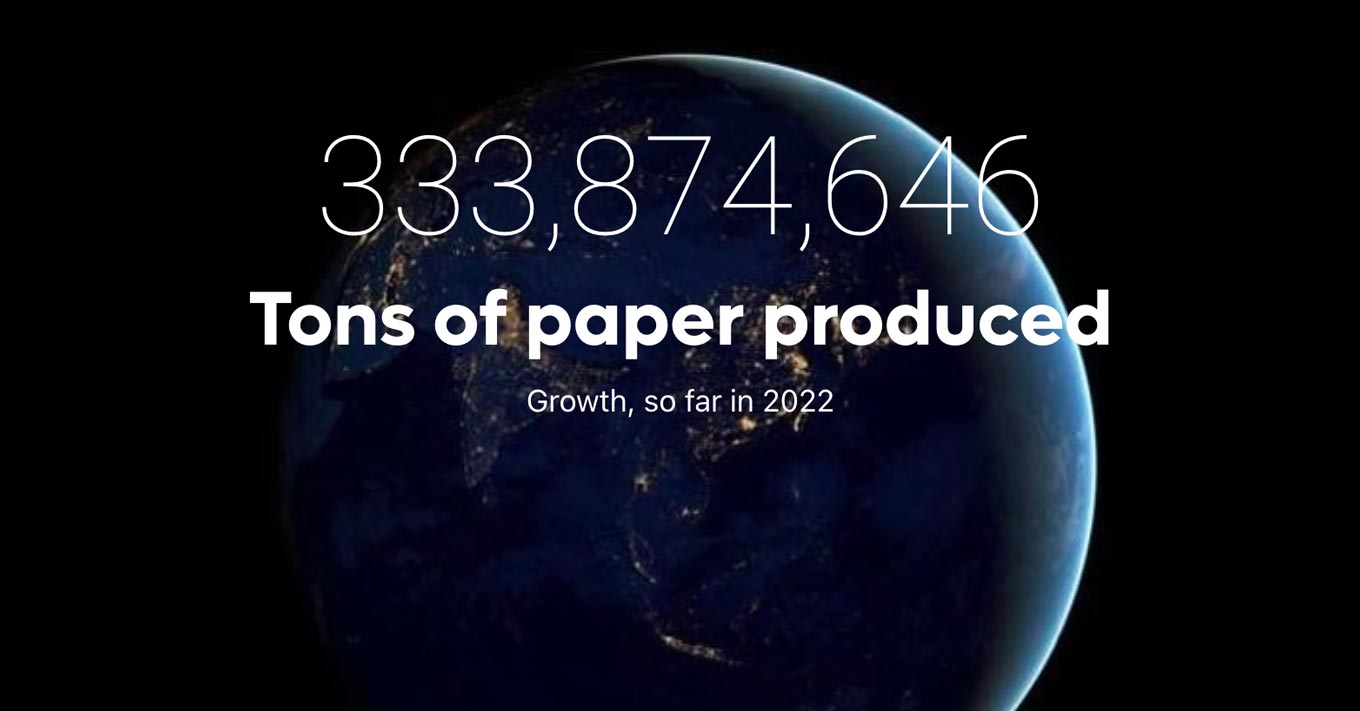
We’re willing to bet that it’s not the first time you’ve heard someone equate paper use with “killing trees.” While many have made the eco-conscious decision to opt for digital alternatives, how bad are paper products (like holiday cards), really?
According to The World Counts, globally, we produce 420,000,000 tons of paper and cardboard annually — that’s two pieces of paper for everyone on earth every single hour. That’s a lot of paper. Like, a lot.
Unfortunately, our paper usage does indeed kill trees — but it impacts a lot more than that. Paper production contributes to environmental issues, like air and water pollution, agricultural waste and greenhouse gas emissions, and the (often overlooked) displacement of rural and Indigenous communities.
In fact, the paper industry accounts for about 26% of total waste in landfills and is the largest single industrial consumer of water in Western countries.
We’re not trying to convince you to ditch paper, though! (We love when paper is printed responsibly … I mean, our team works hard to sustainably produce a monthly physical good news newspaper after all!)
The good news is that paper is recyclable and can be responsibly sourced and produced.
According to The World Counts, each ton of recycled paper can avoid the use of:
- 17 trees
- 1,440 liters of oil
- 2.3 cubic meters of landfill space
- 4,000 kilowatts of energy
- 26,500 liters of water
So, can we all agree that opting for recycled paper when shopping for the perfect fridge-worthy holiday card is a must if we’re trying to be environmentally conscious this year!
What makes a card environmentally friendly?
First and foremost, the most eco-friendly option is the one you already own! Look around your place, take inventory of what you have (like construction and scrapbook papers), and get crafty with it to make a new card of your own.
But, if you’re looking to send out physical cards this year, here are a few things to consider:
Tree-free

Look out for holiday cards made out of 100% post-consumer paper (aka recycled paper). Alternative materials such as seed paper, cotton, sugar cane, hemp, or linen are also popping up as alternative tree-free options. Though bamboo is another popular choice you might come across, many debate its sustainability.
Embellishment-free

The most eco-friendly holiday cards are printed on 100% recycled paper without any embellishments (aka all of the fancy finishes like foiling and embossing). Opting for the least amount of embellishments makes it easier to recycle your cards when you, or your loved ones, are ready to toss them out.
Responsible production process

You’ll likely see “FSC-certified” throughout your eco-friendly holiday card search; that’s a good starting point. Forest Stewardship Council certifications (or FSC-Certified) paper products have less impact on the environment by using sustainable sourcing or post-consumer waste.
The FSC is a global network of over 1,000 individuals and member organizations that work in a democratic system to find solutions to safeguard healthy, resilient forests around the globe.
Though it has faced valid criticism, we find its certification process helpful for understanding brands’ thoughtfulness regarding their paper sourcing.
Company background and initiatives

While this isn’t a requirement for companies, it’s an added bonus when a brand not only provides its customers with earth-friendly options but also supports organizations focused on addressing climate change.
Some greeting card companies do a great job of pointing out their commitment to sustainability through their use of solar or wind energy, recycling programs, or labor practices. If all of this is important to you, dive into a company’s policies — often found in its website's “About” or “FAQs” pages.
Using our holiday card purchases as an excuse to support businesses and organizations caring for people and our planet is definitely good, good, good.
Low-impact ink

Another factor to consider is the type of ink used to make your cards. Many companies have now been offering algae-, soy-, and other vegetable-based inks — which are less harmful to the environment than the standard petroleum-based inks.
Best eco-friendly holiday card options this season
Minted
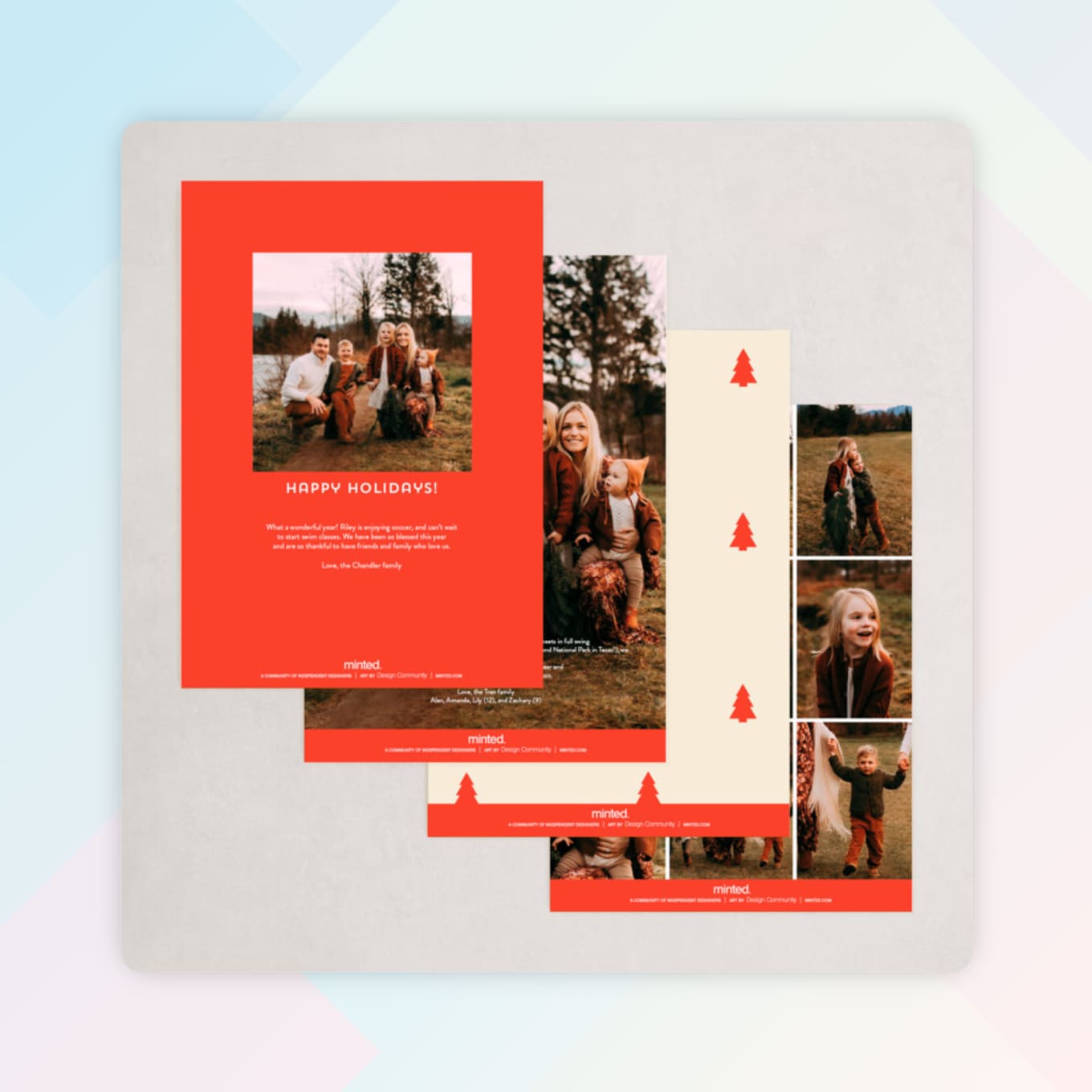
This article is presented and supported by Minted — and as a part of that, we were able to test out the Minted shopping experience and holiday cards to add a brief review to this particular section. Everything in this article was independently and honestly written by the Good Good Good team. Thank you!
What’s good: Minted is a marketplace with unique designs by independent artists. The company uses 100% recyclable packaging that is made from over 80% recycled, post-consumer waste or plant-based materials.
Minted’s holiday cards are available with recycled paper options, made with FCS-certified 100% post-consumer waste for a smooth matte finish, and are all manufactured with wind power! It’s the coolest thing to know that something as simple as an annual card hanging on our refrigerators can be solely produced with sustainable resources.
Whether you’re in the market for holiday cards, professional stationery for your own business, or invitations for an upcoming Holiday party, you can choose recycled options from Minted and mail them mindfully.
In fact, all recycled paper options are optimized for the highest photo print quality, so you can feel good about the visual aspect of your purchase, no matter what you pick.
If you’re into some premium options, Minted also offers wax seals, custom foil for personalized names, and real foil envelopes and envelope liners. You can also take things digital and use Minted’s app to address your envelopes with ease or even create a holiday card website to share videos, letters, and more photos with a free QR code on the back of your cards.
Holiday card options:
- Holiday Photo Cards
- Christmas Photo Cards
- Foil-Pressed Holiday Cards
- Non-Photo Holiday Cards
- Business Holiday Cards
- Thanksgiving Cards
- Newlywed Holiday Cards
- Holiday Birth Announcements
- Holiday Moving Announcements
- Vacation Holiday Cards
- Pet Holiday Cards
Price: Check current prices

Amanda’s thoughts: I have to admit, I’ve never been a holiday card kind of gal. But I was genuinely so surprised by how simple and fun it was to go through this process.
The template I chose was “THIS” by Lauren Chism — which allowed color and font customizations. I loved that this card was designed by an independent artist, offered an eco-friendly option, and did the tedious work of addressing my envelopes for me (for free)!
If you’re indecisive (like I am), Minted offers a “Find it Fast” feature that allows you to simultaneously see your photo in every holiday card design. You can also text your photo to CARDS (22737) and a Minted Design Associate will text you back with five card options!
Artifact Uprising

What’s good: What makes Artifact Uprising so exciting is that the same company that creates Pinterest-worthy, high-quality prints, and photo books, is also the same one creating beautifully designed eco-friendly paper goods (like holiday cards).
Each card is printed on premium quality, 100% recycled paper, with a recycled kraft envelope option. All the electricity used to manufacture the paper is matched with renewable wind-generated electricity. I guess you could say that these cards will… blow your loved ones away (sorry).
Holiday card options:
Price: Check current prices
→ Shop Artifact Uprising’s Holiday Cards
Paper Culture

What’s good: Paper Culture is your one-stop shop for modern, eco-friendly paper goods that also give back. Each card and envelope is made with 100% post-consumer recycled paper; for every order made, the company plants a tree on your behalf. So far, Paper Culture has planted over 1 million trees (and counting).
Paper Culture also works with domestic and international organizations to aid in reforestation and offset its carbon footprint through carbon credits. The Environmental Protection Agency has recognized the company’s environmental efforts as a Top 10 Climate Leader and Certified California Green Business.
Also, it takes mailing your holiday cards off your plate!
Holiday card options:
- Holiday Cards & Invitations
- Christmas Cards
- Business Holiday Cards
- New Year Cards
- COVID Holiday & Christmas Cards
- Hanukkah Cards
- Lunar New Year Cards
Price: Check current prices
→ Shop Paper Culture’s Holiday Cards
Botanical Paperworks

What’s good: Sure, recycling is great, but what if your annual holiday cards could help your loved ones grow their own gardens? Botanical Paperworks, a woman-owned business, offers a collection of holiday card seed paper that grows into wildflowers, herbs, or vegetables — all tested to make sure it’s free of weeds and invasive species.
The company’s products (which also include wedding invitations, favors, and confetti) are approved by the Canadian Food Inspection Agency and the United States Department of Agriculture for planting in the U.S., Canada, European Union, and other places around the world.
Holiday card options:
Price: Check current prices
→ Shop Botanical Paperworks’ Holiday Cards
Tree-Free

What’s good: Tree-Free’s idea of good tidings? Being good to the planet. Every card is made from 100% post-consumer recycled paper, printed free of volatile organic compounds (also known as VOC-free) inks, 100% powered by solar energy, and made in the U.S.
Annual Tree-Free purchases save over 3,000 mature trees, 1.5 million gallons of water, and 210,000 pounds of greenhouse gasses. The company also donates 25% of its revenue to causes protecting our planet.
Choose your favorite card, personalize your message, and leave the mailing part to them!
Holiday card options:
- Christmas and Holiday Cards
- Thanksgiving Cards
- Hanukkah Cards
- Rosh Hashanah Cards
- Kwanzaa Cards
- New Year Cards
- Holiday Box Card Sets
Price: Check current prices
→ Shop Tree Free’s Holiday Cards
ForeverFiances

What’s good: ForeverFiances offers a selection of premium, plantable, seed-embedded holiday greeting cards and 100% recycled paper. The company is FSC-certified which is a good indicator that its products are responsibly sourced from forests that provide environmental, social, and economic benefits.
ForeverFiances has also pledged 1% of its revenues to nonprofit organizations supporting environmental causes, including Sea Shepherd Conservation Society and charity: water.
Holiday card options:
Price: Check current prices
→ Shop ForeverFiances’ Holiday Cards
Paperless Post
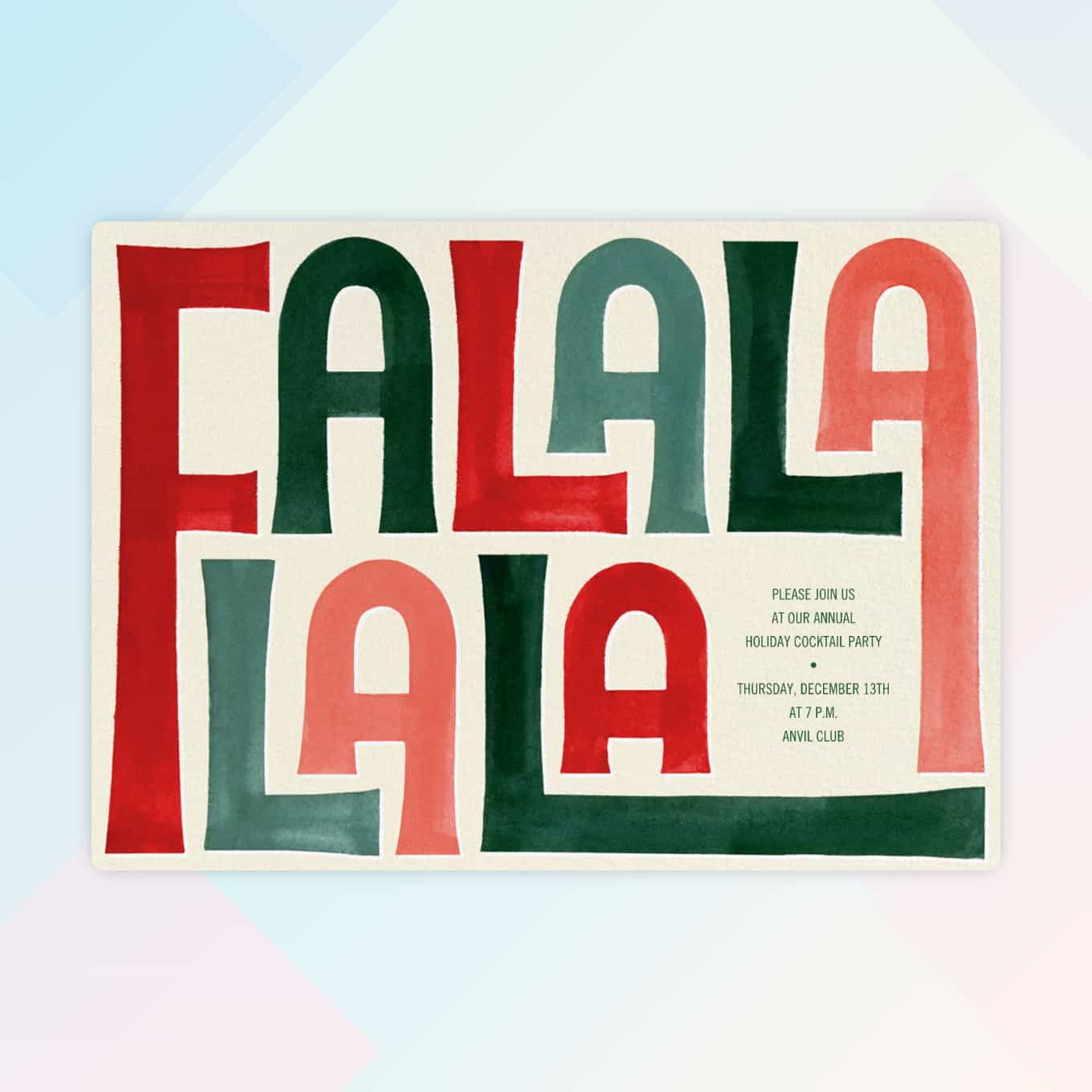
What’s good: We can’t talk about earth-friendly options without mentioning the elephant in the room: paperless digital invitations! Paperless Post was one of the early pioneers in this space that saw the value in reimagining invitations and cards — aka finding ways to make our lives a little easier.
Today, it offers two distinct digital options: cards and flyers. Its cards are inspired by the classic stationary design that we’re familiar with — except customers can send them in minutes via email, text, or a shareable link. Its flyers are more casual (animated!) invitations that you can also send in a matter of minutes — with hundreds of free designs.
To eliminate the need for paper altogether, Paperless Post gives those who love a good traditional card or invite a modern way to reach their loved ones — not to mention it's a great way to track those pesky RSVPs!
Holiday card options:
- Holiday Cards
- Thanksgiving Cards
- Luncheon Holiday Invitations
- Holiday Party Invitations
- Kwanzaa Invitations
- Christmas Party Invitations
- New Year's Eve Invitations
- Día de Reyes Invitations
- Lunar New Year Invitations
- Rosh Hashanah Invitations
Price: Check current prices
→ Shop Paperless Post’s Holiday Cards
Greenvelope

Greenvelope is a Seattle-based company on a mission to save paper and preserve the beauty of the Pacific Northwest. Eco-friendly at its core, Greenvelope was founded to create digital invitations that would provide all of the fun of traditional cards without any of the waste that comes with them.
The company’s online stationery templates are handpicked by its in-house design team, who work with the global Greenvelope community of stationers, illustrators, calligraphers, graphic artists, and painters.
Through partnerships with the National Forest Foundation, Mountains to Sound, the National Park Foundation, and 1% for the Planet, this online card and invitation service does more than save paper.
(Explore more products that give back to our national parks in our National Parks Gift Guide)
Holiday card options:
Price: Check current prices
→ Shop Greenvelope’s Holiday Cards
Other Christmas card and greeting card ideas
If you haven’t already started to pick up on all of the amazing options we have today, we thought we’d throw in a few others that can easily be overlooked or under-utilized.
Etsy
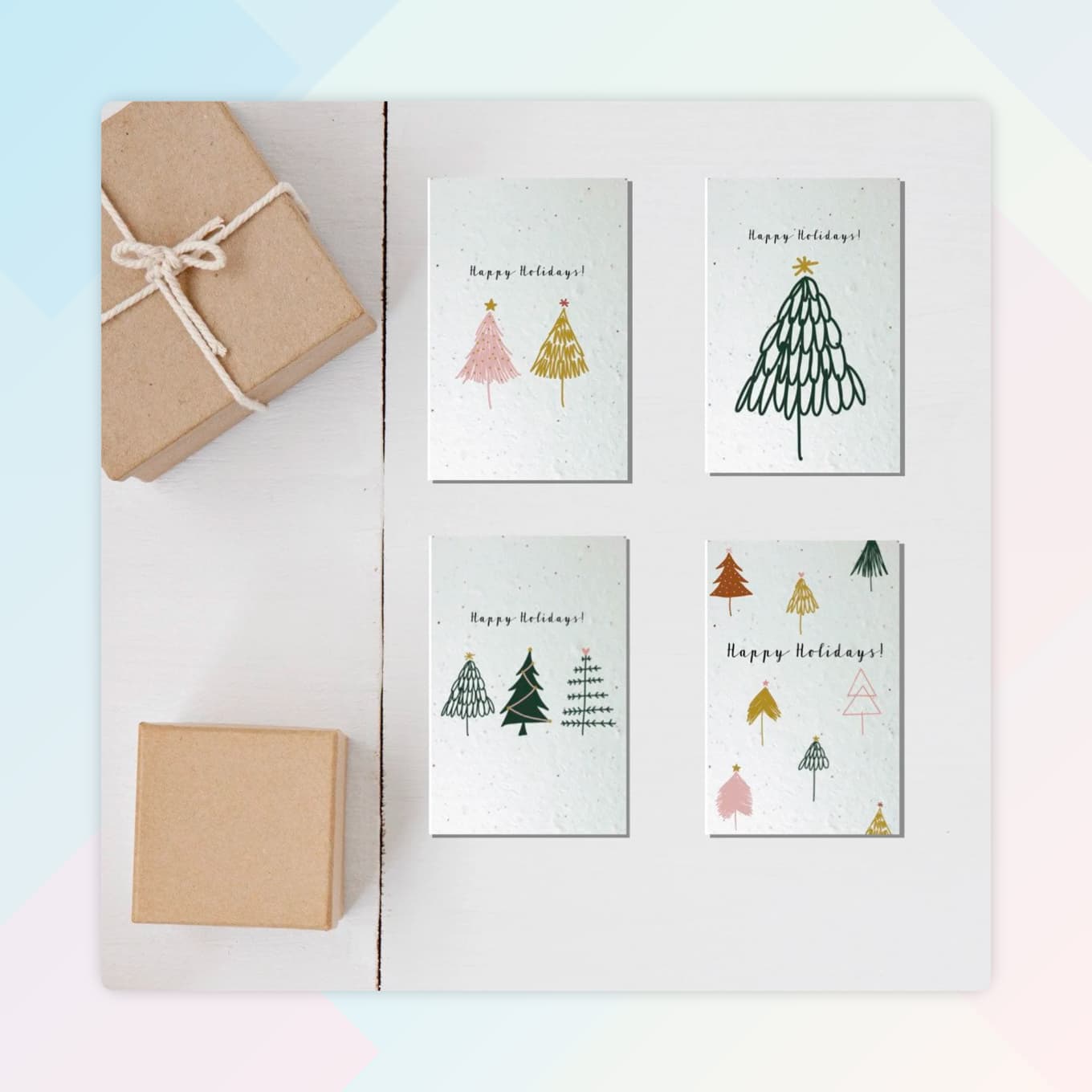
If you enjoy your fair share of online small business shopping, you’ve more than likely turned to Etsy for a bit of guidance in the past. With its seemingly endless amount of small businesses, you can find some of the most beautiful and creative eco-friendly holiday cards and e-cards.
It's also a great place to find niche cards like this pack made out of recycled material and produced using wind power and this Sasquatch holiday postcard that plants a tree for every 10 postcards sold.
The advantage of shopping through this marketplace is the wide variety of designs and value-specific options each individual seller focuses on.
Don’t send a card
Yep, you read that right: don’t send a card this year! Even though we love to support incredible businesses and designers pushing the envelope when it comes to providing consumers with sustainable options, another option you can also consider is simply not sending a holiday card out.
There’s a lot of internal and external pressure tied to sending out these annual updates, but if you don’t have the capacity to send them out, give yourself permission to skip the tradition. (This goes without saying, this option will save you the most amount of time, money, and paper.)
Post on social media
Channeling your holiday card spirit into a social media post might be an obvious idea, but we often overlook it (or don’t give it enough weight). Save yourself the stress and get your loved ones in the festive mood by sharing fun photos and a sweet message through your social media account.
Buy secondhand
Oh, you’d be surprised by the amount of unopened (or opened but never used) boxes of holiday cards sitting on thrift store shelves or secondhand online marketplaces (like Facebook and eBay). Regardless of what kind of paper, ink, or production processes were used, you can feel at ease that your decision to purchase secondhand diverted them from going into a landfill.
Every month at Good Good Good, we plan upcoming good news content for our Instagram, Goodnewsletter, Goodnewspaper, podcast, website, and more. Our work is always centered on hopeful stories about people making a difference in the world — and action steps on how each of us can join in with that good work.
With so many holidays, awareness days, education weeks, and activism months happening all year long, we’ve been slowly collecting all of these events in a private internal calendar for years.
We made our Monthly Cause Awareness Calendar publicly available earlier this year. We’ve also published:
- The Ultimate Calendar of Heritage Months
- Disability Awareness Days Calendar
- LGBTQ+ Pride Days, Weeks, & Months Calendar
- Animal & Pet Awareness Calendar
- Mental Health Days & Awareness Months Calendar
- Environmental & Sustainability Holidays Calendar
- HIV/AIDS Awareness Days & Months Calendar
And now we’re publishing our guide to cancer awareness holidays.
Our hope is this resource will help you or your organization bring attention to these important issues — not just around World Cancer Day — but all year long.
Where applicable, we've included resources around highlighted holidays — usually in the form of good news around particular topics, relevant quotes or recommendations, or action steps on how to make a difference. We encourage you to share them if you find them helpful.
We've worked hard to make this the most comprehensive collection of cancer-related days and months on the internet. Always double-check dates, as organizers may occasionally change dates.
Bookmark this page and revisit it as often as you need. We'll continue to update it and add to it over time.
Cancer Awareness Months & Dates
January
Days
No specific cancer awareness days in January
Take this opportunity to explore all cancer awareness ribbons and their meanings
Month
Cervical Health Awareness Month
February
Days
World Cancer Day - February 4th
World Cholangiocarcinoma Day - February 12th
National Donor Day - February 14th
International Childhood Cancer Day - February 15th
Rare Disease Day - February 28th
Months
National Cancer Prevention Month
American Heart Month
Gallbladder and Bile Duct Cancer Awareness Month
March
Days
Triple Negative Breast Cancer Day - March 3rd
International HPV Awareness Day - March 4th
Read this good news story about women fighting for access to the HPV vaccine
Anal Cancer Awareness Day - March 21st
Months
National Colorectal Cancer Awareness Month
Myeloma Action Month
Kidney Cancer Awareness Month
April
Days
Acute Myeloid Leukemia (AML) Awareness Day - April 21st
Weeks
National Young Adult Cancer Awareness Week - First Week of April
National Oral, Head, and Neck Cancer Awareness Week - First Full Week of April
National Minority Cancer Awareness Week - Third Week of April
Months
Esophageal Cancer Awareness Month
National Cancer Control Month
National Oral, Head, and Neck Cancer Awareness Month
Testicular Cancer Awareness Month
May
Days
Melanoma Monday - First Monday of May
World Ovarian Cancer Day - May 8th
Women’s Check-Up Day - Second Monday of May
World No Tobacco Day - May 31st
Months
Bladder Cancer Awareness Month
Brain Cancer Awareness Month
National Cancer Research Month
National Melanoma / Skin Cancer Detection and Prevention Month
National NF (Neurofibromatosis) Month
Oncology Nursing Month
National Clean Air Month
Learn about the WHO air pollution guidelines aiming to improve health
June
Days
National Cancer Survivors Day - First Sunday of June
World Brain Tumor Awareness Day - June 8th
Listen to our podcast interview with cancer survivor and Olympic figure skater, Scott Hamiltonpet
World Kidney Cancer Day - Third Thursday of June
Week
National Black Family Cancer Awareness Week - Week-long event in June
Months
Cancer Immunotherapy Awareness Month
Cancer Survivors Month
Read about how cancer deaths are rapidly decreasing
July
Days
GIST Awareness Day - July 13th
National Leimyosarcoma Day - July 15th
Glioblastama Awareness Day - Third Wednesday of July
Months
UV Safety Awareness Month
Sarcoma and Bone Cancer Awareness Month
August
Days
World Lung Cancer Day - August 1st
Esther Day - August 3rd
Read and share this guide about how to celebrate Esther Day
National Surgical Oncologist Day - August 22nd
Read about other inspiring frontline heroes
Months
Appendix Cancer Awareness Month
National Immunization Awareness Month
World Cancer Support Month
September
Days
World Lymphoma Awareness Day - September 15th
World Cancer Research Day - September 24th
World Lung Day - September 25th
National Previvor Day - Last Wednesday of September
Listen to our podcast interview with Paige More, founder of The Breasties
Weeks
National Hereditary Breast and Ovarian Cancer Week - Last Week of September
Months
Blood Cancer Awareness Month
Childhood Cancer Awareness Month
Read this good news story about how Instagram-famous “Doug the Pug” gives back to kids with cancer
Gynecologic Cancer Awareness Month
Leukemia, Lymphoma, and Hodgkin’s Lymphoma Awareness Month
National Ovarian Cancer Awareness Month
Pain Awareness Month
Prostate Cancer Awareness Month
Thyroid Cancer Awareness Month
Microplastic Awareness Month
October
Days
World Hospice and Palliative Care Day - Second Saturday of October
Metastatic Breast Cancer Awareness Day - October 13th
National Mammography Day - Third Friday of October
Read about Senator Amy Klobuchar’s mission to ensure women don’t skip their mammograms (like she did)
Weeks
Male Breast Cancer Awareness Week - Third Week of October
Months
National Breast Cancer Awareness Month
Liver Cancer Awareness Month
November
Days
World Neuroendocrine Cancer Awareness Day (NET Cancer Day) - November 10th
World Pancreatic Cancer Day - Third Thursday of November
Giving Tuesday - First Tuesday after Thanksgiving
Consider giving to cancer-related nonprofits on Giving Tuesday (and explore more ideas) and share these Giving Tuesday quotes
Months
National Carcinoid Cancer Month
Lung Cancer Awareness Month
National Family Caregivers Month
National Hospice and Palliative Care Month
National Marrow Awareness Month
National Pancreatic Cancer Awareness Month
National Stomach Cancer Awareness Month
National Pet Cancer Awareness Month
Read about famous veterinarians making a difference
December
Days
World AIDS Day - December 1st
Explore good news about HIV/AIDS progress and ways to make a difference
Weeks
National Influenza Vaccination Week - First Week of December
Is this list missing a holiday or awareness week/month? Let us know. We want to ensure this list is comprehensive and inclusive.
While I love a good kitchen gadget or some versatile, eco-friendly home goods, in my mid-twenties, the gifts on the top of my wish list always relate back to my dog. A gift for my 5-year-old Shiba Inu is as good as any gift for me. Isn’t that what it means to be a parent?!
I know I’m not the only one. Cat people, bird watchers, and whale conservationists alike all deserve a special and thoughtful gift this holiday season. Because the truth is, making a pet’s life better often makes our lives better, too.
To help you shop the perfect gift for the animal lovers in your life, we’ve broken this article down into the following sections:
- Gifts for Dog Lovers
- Gifts for Cat Lovers
- Gifts for Wildlife Lovers of All Kinds
And because we’re Good Good Good — 100% of the products we recommend in this article are sustainably made, ethically produced, or give back to charity.
By the way, some of the links in this article are affiliate links, which means if you make a purchase after clicking a link, we may earn a commission at no extra cost to you. Everything in this article was independently and honestly written by the Good Good Good team. Thank you!
Explore these gifts for animal lovers that are sustainably made, ethically produced, or donate to charity
Gifts For Dog Lovers
Matching Pet and Parent Outfits

Pet parent influencers are the new mommy bloggers, and even if your gift recipients don’t have millions of followers, they and their dogs definitely deserve matching outfits.
Whether it’s a stylish sweater combo, or a colorful sweat set, Sunbean has a wide array of matching sets so you can ensure your loved one and their pet will be strutting in style.
What’s good:
- Everything the brand makes is 100% cotton
- Sunbean is Asian-woman owned and operated
- The brand regularly runs fundraiser campaigns to help dogs in need find their forever homes
Shop: Sunbean
Colorful & Sustainable Dog Sweaters

If you don’t necessarily need to twin with your pup, Verloop Knits makes some adorable dog sweaters that’ll keep your pooch warm this winter — and turn heads on your next walk.
The company’s belief is that sustainable goods don’t need to be boring, emphasizing good and resourceful design.
What’s good:
- Items are created with deadstock yarn to reduce textile waste
- Created in an ethical, family-owned factory in the Philippines
Shop: Verloop Knits
Reusable Pet Hair Remover

Gone are the days of single-use lint roller sheets! All your gift recipient has to do is clean off that dog hair from their furniture and linens, open the lid, and clean the dustbin to use this device over and over again.
What’s good:
- Alternative to single-use lint rollers
- Saves money on refills
Shop: Amazon
Grounds & Hounds Coffee

Do good with something as simple as a morning coffee! Meet Grounds & Hounds Coffee Co, whose tagline is that “every cup helps a pup.”
Help your gift recipient savor their morning routine and enjoy an extra 15 minutes with their best friend, all while making a difference.
What’s good:
- 20% of all Grounds & Hounds profits go directly to rescue organizations that provide a second chance for pups
- Since its inception, Grounds & Hounds has helped provide 4.2 million meals, 24,000 toys, and 22,250 vaccines to shelter dogs
Shop: Grounds & Hounds Coffee Co. | Amazon
Durable Dog Walking Set

All the rage with beautiful jewel toned dog accessories and minimalist designs, Wild One’s walking sets definitely take the cake (or… the biscuit).
Made with durable and easy-to-wash materials, these leashes and harnesses are built to last — and look good.
What’s good:
- With each purchase, Wild One sponsors the rescue of a pet. Partnering with 12 rescues across the country, they hope to save a dog a day.
Customized Dog Bandana from The Foggy Dog

Step out in style with one of The Foggy Dog’s darling accessories. Featuring a line of sweater-knit bandanas, a collab with Rifle Paper Co., and offering custom embroidery, your dog is sure to slay.
What’s good:
- The Foggy Dog is woman-owned
- Manufacturers are USA-based, family-owned businesses, where skilled craftspeople are paid fair wages
- Every order provides a pound of food to shelter dogs. To date, over 400,000 pounds of food have been donated
Shop: The Foggy Dog
Doggy Parton Toys & Accessories

Dolly Parton, absolute angel, country music legend, and incredible philanthropist, has wowed us yet again by releasing a line of dog toys, apparel and accessories, aptly named: Doggy Parton.
The collection features fun Dolly-themed toys (like a VIP backstage pass!), a darling gingham bandana, and even a blonde bombshell wig. Share the puppy love and help their dog look good while you do it!
What’s good:
- Every purchase supports animal rescue Willa B Farms
Shop: Amazon
By the way: Here are some dog-related good news stories to enjoy while you shop:
- 10 Heartwarming Stories About Dogs Saving Humans’ Lives
- This Man Has Saved 20k+ Animals with Custom-Made Prosthetics
- Doug the Pug Raises Thousands, Supports Kids with Cancer
- Popular ‘WeRateDogs’ Twitter Raises Millions For Pets
- ‘Marley’s Mutts’ Prison Program Pairs Dogs With Inmates – Healing Both
Gifts for Cat Lovers
Hemp Cat Collar

Although you might assume that indoor cats don’t need a collar, these brightly colored signifiers are a great way to find that sneaky kitty when they’re off being mischievous (add a bell for the real DIY GPS!).
What’s good:
- Made with a blend of hemp and certified organic cotton
- Features a break-away Kitty Klip feature for safety.
Shop: Amazon
Conscious Step Socks That Save Cats

Conscious Step creates stylish, sustainable, and cause-centered socks. Every pair gives back to a dedicated nonprofit organization.
But, for the pet parents in your life, you’ll probably want to opt for the Socks That Save Cats, which supports Best Friends Animal Society.
What’s good:
- Conscious Step is part of 1% for the Planet
- Socks give back to rescue animals
- Every pair of socks is made with GOTS Organic and fair-trade certified cotton, as well as recycled polyester. These socks are also vegan-certified!
Shop: Conscious Step
Explore loads of other socks that give back!
Cat Compression Box
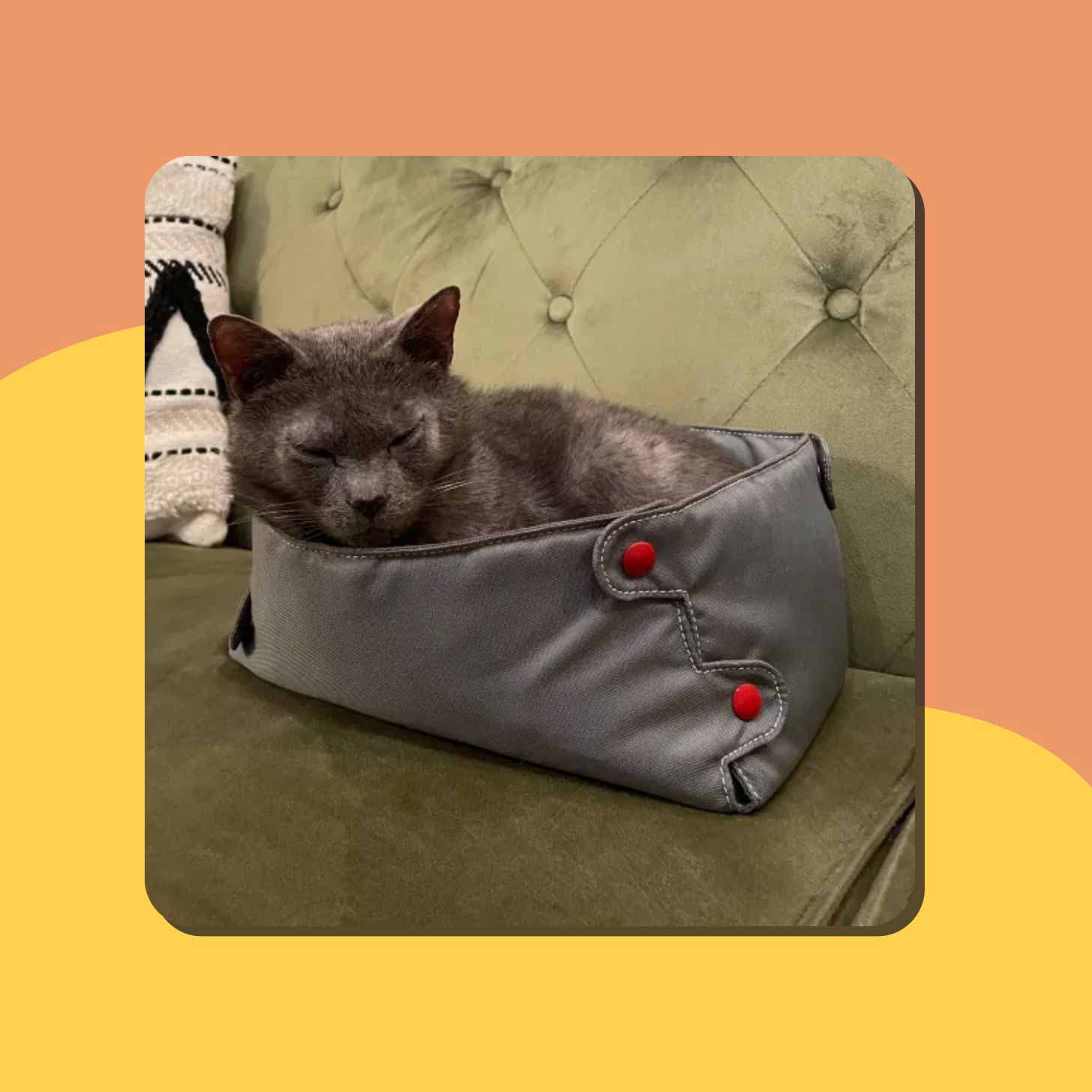
As we all know, the best gift any pet could receive is the box it came in. Level up their cat’s comfort with this smart compression box!
What’s good:
- Made with recycled wool felt and antimicrobial, washable canvas
Shop: Uncommon Goods
Recycled Ripple Rug Play Mat

The ultimate task of any pet parent: Keeping the gremlins occupied. Cats in particular love to explore and get enrichment around the house, and this play mat might just be their new favorite find.
Plus, it has lots of space for all the activities: scratching, grooming, pouncing, or even hiding and sleeping inside the tunnels.
What’s good:
- The Ripple Rug is made from recycled plastic water bottles
Shop: Chewy
Gifts for Wildlife Lovers
Fahlo Animal Tracking Bracelets

Keep your eyes on the conservation prize! Fahlo is a brand that partners with nonprofits to create bracelets that come with a real animal to track.
Combining a beautiful tangible bracelet with an interactive experience, customers (and your gift recipient) are educated about wildlife and excited about conservation.
What’s good:
- A portion of profits from every bracelet is donated to save wildlife
- Fahlo works with organizations like Sea Turtle Conservancy, Save the Elephants, Polar Bears International, Global Penguin Society, Ewaso Lions, and Saving the Blue.
Shop: Fahlo
Books

One of the best ways to protect and honor wildlife? Learning more about the world around us! For the bookworm (and worm protector) in your world, here are a few titles we’d recommend:
- “The Accidental Ecosystem: People and Wildlife in American Cities” by Peter S. Alagona | Amazon | Bookshop
- “Rewilding: Bringing Wildlife Back Where it Belongs” by Neon Squid & David A. Steen | Amazon | Bookshop
- “National Geographic Illustrated Guide to Wildlife: From Your Back Door to the Great Outdoors” | Amazon | Bookshop
Wildlife-Friendly Outdoor Light Bulbs

Animals are greatly impacted by light pollution, which can affect migration patterns, sleep habits, and habitat formation. Sea turtles and birds guided by moonlight often get confused and lose their way, which can even lead to death.
What’s good:
- Energy-efficient
- Have a soothing colored hue
- Certified to provide safe lighting to wildlife
Shop: Amazon
Bee Hotel

Make their backyard the new holiday destination for pollinators. Gifting this bamboo bee house will attract bees to a safe habitat and provide your loved one with beautiful blooming flowers.
With 60 nesting tubes and hanging rope, this bee hotel does a world of good for the bees in the area.
What’s good:
- Enhances native pollinator habitats
Shop: Amazon
Pollinator Wildflower Seed Mix

Speaking of native pollinators, help them create a healthy ecosystem with the perfect pollinator seed mix. With different seed blends for various areas in the United States, you can choose the perfect fit based on state, region, or even deer resistance.
What’s good:
- Helps attract native pollinators like birds, bees, insects, and butterflies to an area
- All seeds made and shipped in the U.S.
Shop: Eden Brothers
Endangered Species Chocolate

We all deserve a little treat, and what better way to enjoy the sweet treats of a special holiday than with chocolate that helps endangered animals?!
Be a part of this delicious do-good moment, and add a bar of chocolate (the ultimate consumable gift, in our opinion) to the shopping list.
What’s good:
- Endangered Species Chocolate is made with Fair Trade-certified, vegan ingredients
- The company donates 10% of its annual net profits to conservation organizations
- Since its inception in 2016, Endangered Species Chocolate has donated $2.6 million to its conservation partners.
Shop: Amazon
Adopt an Animal with World Wildlife Fund

If your gift recipient loves wild animals and loves to do their part to care for them, a symbolic animal adoption from the World Wildlife Fund is the perfect fit!
Choose from over 130 endangered animal species, and with a donation of $60 or more, your gift recipient will receive a soft plushie, adoption certificate, photo card, and gift bag.
What’s good:
- A symbolic animal adoption is a donation that protects the future of wildlife
Shop: World Wildlife Fund
Note: While we normally recommend shopping from independent marketplaces with ethical and sustainable track records instead of shopping with Amazon — we’ve also included Amazon links in this article to ensure that these gifts are accessible to more people. Consider Amazon alternatives when you can.
We fell in love with newspapers in 2017. We launched the Goodnewspaper (a print newspaper filled with good news) right as the rest of the news industry was scaling back its print operations in favor of a more digital approach.
It was a bold risk for our small team. Good news already had a poor track record, with readership numbers always dragging far behind traditional (non-solutions-focused) news. And as the only millennial-run print publication to launch in the United States, it would have been valid to question whether we had any idea what we were doing.
We launched a successful Kickstarter campaign to fund our first print run and we had our debut edition arriving on doorsteps around the world by the end of the year.
More than five years later, we're still producing a beautiful monthly Goodnewspaper filled with hopeful stories, art, and guides on how to take action and make a difference.
While we love sharing articles and resources online (especially our Instagram, newsletter, and this very website) we've created a special connection with our print readers and feel incredibly proud of what we're able to create with newsprint and ink.
We think there's something special about physically holding and reading a print newspaper. The fact that you somehow came across this article tells us that you might feel the same way.
Over the last few years, we've slowly collected the best quotes about newspapers (and sometimes the news) and we're publishing them here today. Some quotes celebrate newspapers and some take a critical perspective. We hope you find these quotes helpful and insightful. And we also hope you'll try our Goodnewspaper. We've worked hard to make it helpful, affordable, and something you'll be proud to gift as well. Try a (risk-free) subscription today.
The Best Newspaper Quotes
Quotes Celebrating Newspapers and Journalism
“Newspapers cannot be defined by the second word — paper. They’ve got to be defined by the first word — news.”
— Arthur Sulzberger, Jr.

“Were it left to me to decide if we should have a government without newspapers, or newspapers without a government, I should not hesitate a moment to prefer the latter.”
— Thomas Jefferson
“A good newspaper is a nation talking to itself.”
— Arthur Miller
“Most of us probably feel we couldn’t be free without newspapers, and that is the real reason we want newspapers to be free.”
— Edward R. Murrow
“Every time a newspaper dies, even a bad one, the country moves a little closer to authoritarianism…”
— Richard Kluger
“I don't believe newspaper reporters can substitute for a district attorney, but a newspaper has a very valid investigative role. Newspaper reports on corruption in government, racketeering and organized crime conditions can be very helpful to your communities and the whole country.”
— Robert Kennedy
“It is usually known that newspapers do not say the truth, but it is also known that they cannot tell whoppers.”
— George Orwell
“People don’t actually read newspapers. They step into them every morning like a hot bath.”
— Marshall McLuhan
“I’d love to rise from the grave every ten years or so and go buy a few newspapers.”
— Luis Bunuel
“Newspapers are tutors as well as informers.”
— Neil Kinnock
“The newspaper is a greater treasure to the people than uncounted millions of gold.”
— Henry Ward Beecher
“What a newspaper needs in its news, in its headlines, and on its editorial page is terseness, humor, descriptive power, satire, originality, good literary style, clever condensation, and accuracy, accuracy, accuracy!”
— Joseph Pulitzer

Quotes Critiquing Toxicity in the News
“If you don't read the newspaper, you're uninformed. If you read the newspaper, you're mis-informed.”
— Mark Twain
“Read not the Times, read the Eternities.”
— Thoreau Henry David
“To look at the paper is to raise a seashell to one's ear and to be overwhelmed by the roar of humanity.”
— Alain de Botton, The Pleasures and Sorrows of Work
“Newspapers are a bad habit, the reading equivalent of junk food. What happens to me is that I seize upon an issue in the news — the issue is the moral/philosophical, political/intellectual equivalent of a cheeseburger with everything on it; but for the duration of my interest in it, all my other interests are consumed by it, and whatever appetites and capacities I may have had for detachment and reflection are suddenly subordinate to this cheeseburger in my life! I offer this as self-criticism; but what it means to be "political" is that you welcome these obsessions with cheeseburgers — at great cost to the rest of your life.”
— John Irving
“If the newspapers begin to publish stories about wars, and the people begin to think and talk of war in their daily conversations, they soon find themselves at war. People get that which their minds dwell upon, and this applies to a group or community or a nation of people, the same as to an individual”
― Andrew Carnegie
“Newspapers are horror happening to other people.”
— Nadine Gordimer
“Good newspapers believe in giving a balanced view of the world. Fine. Some people then exploit that belief and use it to balance truth with falsehood.”
— Nick Davies
“Newspaper: A device unable to distinguish between a bicycle accident and the collapse of civilization.”
— George Bernard Shaw
Funny Newspaper Quotes
“Newspapers abound, and though they have endured decades of decline in readership and influence, they can still form impressive piles if no one takes them out to the trash.”
— Jon Stewart
“It’s amazing that the amount of news that happens in the world every day always just exactly fits the newspaper.”
— Jerry Seinfeld
“We read the weird tales in newspapers to crowd out the even weirder stuff inside us.”
— Alain de Botton
“A good newspaper is never nearly good enough but a lousy newspaper is a joy forever.”
— Garrison Keillor
More Famous Newspaper Quotations
“Newspapers should be read for the study of facts. They should not be allowed to kill the habit of independent thinking.”
— Mahatma Gandhi
The Morning Paper by Mary Oliver:
“Read one newspaper daily (the morning edition
is the best
for by evening you now that you at least
have lived through another day)
and let the disasters, the unbelievable
yet approved decisions
soak in.
I don't need to name the countries,
ours among them.
What keeps us from falling down, our faces
to the ground; ashamed, ashamed?”
— Mary Oliver, A Thousand Mornings: Poems
“The best fiction is far more true than any journalism.”
― William Faulkner
“If anything, I get most upset because I wanna read a good paper first thing in the morning. And if I see a lie about myself flash across the front of the cover, I don't think much of the rest of the newspaper.”
— Angelina Jolie
“After one has been in prison, it is the small things that one appreciates: being able to take a walk whenever one wants, going into a shop and buying a newspaper, speaking or choosing to remain silent. The simple act of being able to control one's person.”
— Nelson Mandela
“A newspaper is a mirror reflecting the public, a mirror more or less defective, but still a mirror.”
— Arthur Brisbane
By the way, you might also like:
Every day the Good Good Good team collects the best good news in the world and shares it with our community. Here are the highlights for this week!
If you want to get good news in your inbox every day, join the Goodnewsletter — the free daily newsletter designed to leave you feeling hopeful.
The Best Positive News We're Celebrating This Week —
A shower bus is helping provide basic needs and dignity to people experiencing homelessness in Brooklyn
For people experiencing homelessness in the Flatbush neighborhood of Brooklyn, a Brooklyn Community Services mobile care unit shower bus has been bringing equitable access to a hot shower and other resources.
Advocates in the area say some people are wary of shelters, another place where they can access resources like a shower — and the mobile shower bus helps fill that gap.
In addition to offering showers, restrooms, food, socks, clothes, and more, the mobile unit also has support services for mental health, housing, employment, and other social services available.
Chicago just reported the lowest number of new HIV and AIDS cases since the 1980s
According to a new report from the Chicago Department of Health, the number of Chicago residents with new HIV and AIDS diagnoses in 2020 was at the lowest level in four decades.
The report found a total of 627 people were newly diagnosed with HIV in 2020 in Chicago — the lowest number since 1987, and a 29% decrease compared to the last report in 2016 (886 new diagnoses). There were also 269 new AIDS diagnoses in 202, the fewest since 1985.
The largest drop in the number of new cases was seen in gay and bisexual men — from 550 new cases in 2016 to 337 in 2020.
The report also found that 85% of people with new HIV diagnoses in Chicago were connected to medical care within one month, meeting the National HIV/AIDS Strategy goal. And in an improvement over the previous year, 95% of newly diagnosed individuals were connected to care within 12 months.
This positive progress in Chicago is aligned with decreasing HIV/AIDS death worldwide, thanks to advocacy, better treatment plans, earlier diagnoses, and more.
Thanks to added protections, a record number of endangered ringed seal pups were born this year in Finland
Between 2012 and 2017, an average of seven Saimaa ringed seals died in fishing nets. The species is one of the rarest in the world, and seeing its population dwindle, organizations worked to secure stronger protections for them to both replenish and protect the seals.
They were successful, and thanks to tighter restrictions on net fishing in the Saimaa lake region, their numbers have grown by an average 5.6 percent every year between 2015 and 2020.
This year, a record 92 seal pups were born— beating last year’s record of 90 pups. It’s so encouraging to see conservation efforts (even for not-so-adorable animals) have successful results like this — and should inspire us to keep working to protect endangered species around the world.
Community colleges are training people recovering from substance abuse disorders to join treatment teams
Research shows about 14.5 percent of Americans older than 12 have alcohol or drug use disorders, and only 6.5 percent of them have received any type of care in the last year. More than a million peer support specialists are needed — there are currently 23,507.
Community college training programs are working to help meet that need. A growing number of people who themselves have recovered or are recovering from substance abuse disorders are being trained through community colleges to become certified recovery peer advocates for others.
The success of the programs and those who complete them shows that with the right financial and other kinds of support, even some of the most vulnerable can succeed at college-level training — and colleges at graduating them into good jobs.
Anna May Wong will be the first Asian American to be featured on U.S. currency
The fifth and final woman to be featured as part of a U.S. Mint program to include notable women in history on American quarters will enter circulation on Monday.
Anna May Wong is considered the first Chinese American film star in Hollywood and will be the first Asian American to ever be featured on U.S. currency.
Ventris C. Gibson, director of the U.S. Mint, said Wong was "a courageous advocate who championed for increased representation and more multi-dimensional roles for Asian American actors."
By planting more native plants, the city of Melbourne successfully reintroduced bees, butterflies, birds, and more
As the city of Melbourne expanded, native plants were pushed out — and with it, the rich biodiversity of insects and wildlife that come along with them. To bring these essential pollinators back to the city, they took a pretty simple approach: plant more plants.
After discovering the critical midway point between grass and trees, the city and the University of Melbourne came up with a list of about 100 mostly native species that not only tolerated the environment — but were beneficial for biodiversity, too.
The list, which was distributed for free to the community, included plants with lots of nectar and pollen for bees, food sources for butterflies, seeds and fruits for birds, grasses for nest-making, and more. Within two years, the project proved incredibly successful — and it’s been sustained in subsequent years.
A 33-year-old British physicist has written more than 1,600 Wikipedia bios for unknown women scientists
When she was in her 20s, Jessica Wade noticed a lack of biographies on women scientists on Wikipedia — women who had contributed significantly to the industry but weren’t being recognized for those contributions. So, she got to work writing their biographies.
As she started publishing more biographies, she started writing and speaking more on gender equality in science, winning awards and even getting recognition from Wikipedia’s founder. The site’s “Wikimedians” deleted some of her entries because the scientists were, ironically, not well-known enough.
For example, Clarice Phelps was a young African American nuclear chemist who worked on a team that discovered a new element on the periodic table. Wikimedians tried deleting it, but Wade won and it’s now a permanent entry.
In addition to highlighting women’s contributions to science, Wade also works to ensure the next generation of women scientists is supported, too.
More good news of the week —
The largest nuclear reactor in Europe reached full capacity for the first time. It’s helping bring much-needed electricity to the region.
MacKenzie Scott just donated $15 million to give glasses to farmers in developing countries. The billionaire philanthropist’s donation is believed to be the largest single donation toward helping solve the problem of uncorrected blurry vision.
The University of Oregon will pay the tuition and fees for all eligible Native American students. The program will be immediately available to about 150 to 175 students on campus.
A new mental health hotline is helping provide specialized support for farmers and ranchers. The AgriStress Helpline is staffed 24/7 by professionals trained to work with members of agricultural communities.
A rare plant thought to be extinct was just discovered near a school in Hawaii. The “Delissea argutidentata” plant was discovered by a staff member who was collecting seeds for another restoration project nearby.
Scientists in Singapore created a device that can turn even the slightest breeze into electricity. The device is small, lightweight, can store unused electricity in a battery, and could be ideal in urban environments.
Community members and local officials are working to restore Chicago's polluted southeast side. The city is working on converting 2,000 acres of former manufacturing waste dumping grounds into marsh and grasslands.
NASA invented a “breakthrough” high-performance battery that could be used to power fully electric airplanes. The batteries eliminate much of a traditional lithium-ion battery’s weight and can store up to triple the energy.
Thanks to Dolly Parton, millions of children in California will start receiving free books in July. The state’s governor signed a new bill to fund Parton’s “Imagination Library” program which mails books directly to children at no cost.
After just two days of early voting, Georgia voters shattered voter turnout records. On day one, almost twice as many people cast their ballot compared to the 2018 midterms, and more people had voted than did at this point in the 2020 presidential election.
The New Zealand Zoo more than doubled its population of endangered ring-tailed lemurs. The zoo’s four female lemurs just each had twins.
The founders of BioNTech say vaccines to treat cancer could be ready by 2030. Scientists say the mRNA Covid-19 vaccine technology can be repurposed to destroy cancer cells.
Australian researchers found a cost-effective way to recycle solar panels. The breakthrough will help manage the increased volume of retired solar panels expected at the end of the decade.
Five million LGBTQ+ fiction books were sold in 2021 — double the sales of 2020. LGBTQ+ fiction book sales are surging across adult, children’s, and young adult categories.
Thanks to a new VA policy change, more same-sex couples are eligible for survivor benefits. Spouses who were not legally able to marry their long-term partner before 2015 may now qualify for the benefits.
When Jack Kloppenburg looks out over his sprawling vegetable garden in rural Wisconsin, he sees half a dozen arm-thick green-striped squash called Candystick Dessert Delicata, and a gaggle of bright yellow Goldini squash among the lush green.
“These are so delicious!” he exclaims with all the enthusiasm only a lifelong gardener can muster. But what’s special about the vegetables is not just their taste: They have all been grown from open source seeds developed by Oregon farmer Carol Deppe, a Harvard-trained geneticist and board chair of the Open Source Seed Initiative (OSSI).
Most people have heard of open source software, maybe also of open source beer (Free beer for all!) or open source pharmaceutical research.
The principle is the same: Someone developed the seeds — for cowpeas, corn, rye and more — and now offers the resource for everybody to share.
Just like software development has been co-opted by a few global companies like Microsoft and Apple, the international seed development and trade, too, is controlled by a few big giants like Bayer (Monsanto), Corteva (DuPont) and ChemChina (Syngenta).
A 2012 Oxfam study found that four companies dominate more than 60 percent of the global trade with grains.
When we buy cereal or bread, few pay attention to the fact that most grains are protected or even patented. Most farmers don’t own the seeds they sow on their fields. “They are renting them,” Kloppenburg, professor emeritus at the University of Wisconsin-Madison and co-founder of OSSI says with disgust.
The problem with that? “A few global companies have the monopolies on global seed trade, and they breed cash crops like corn and soy, purely for money. They don’t care about biodiversity, world hunger or about the small farmer.”
What sounds like a business problem impacts everybody, Kloppenburg insists. “These few gene giants on top of the food chain decide what ends up on our plates.”
In 2012, Kloppenburg and half a dozen like-minded agriculture experts founded OSSI as an alternative to the monopolies. OSSI’s aim is the “free flow and exchange of genetic resources, of plant breeding and variety development,” Kloppenburg says.
With global warming, disease and changing climatic patterns, “we need novel plant varieties that are capable of responding to the changes. Farm to table is popular, but we really need to talk about seed to table.”
The movement faces an uphill battle, particularly in the US where most farmers plant seeds that are patented by the big corporations.
Still, about 50 seed breeders have already signed on with OSSI in the US to offer nearly 500 seed varieties. And other open source seed organizations are making their own way in Europe, Argentina, India and more.
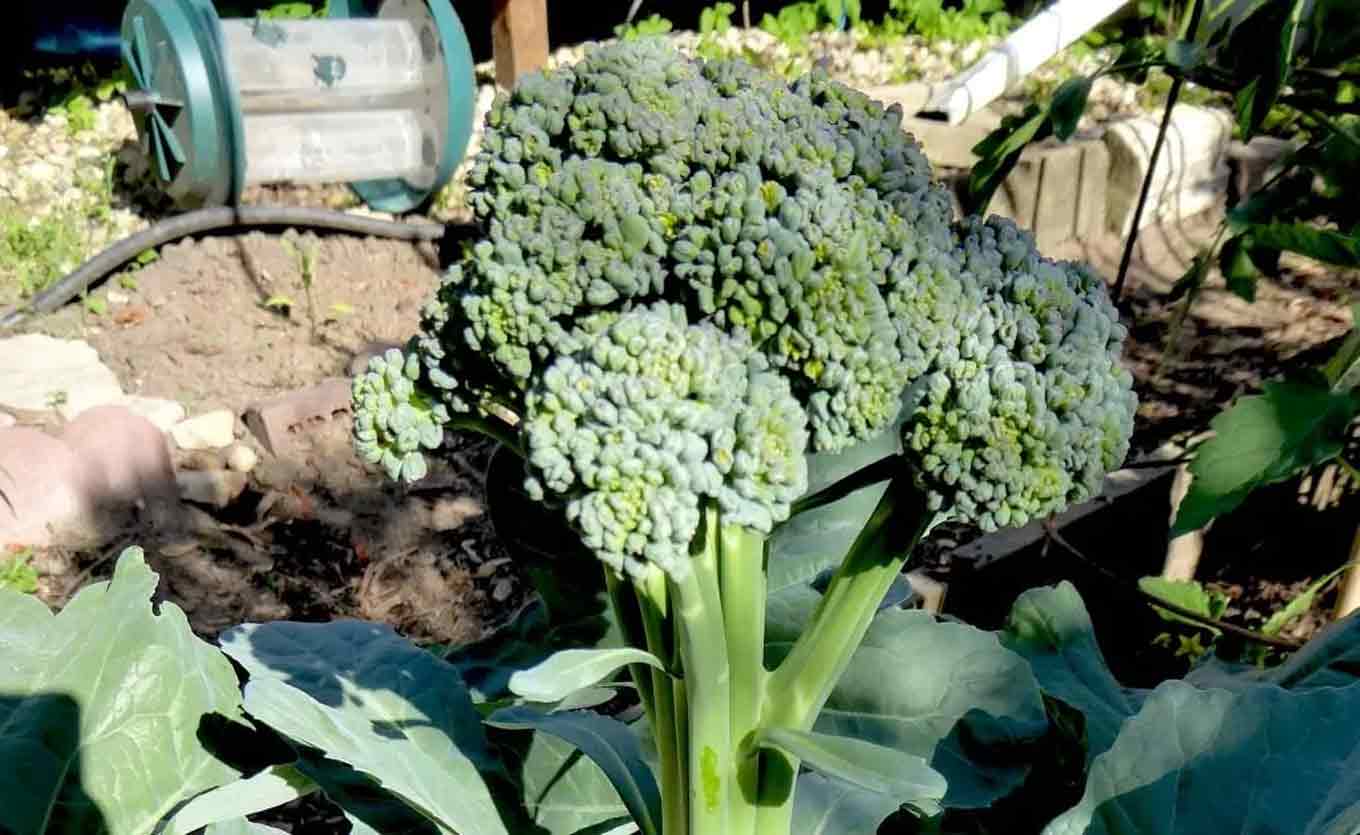
From pledge to plant
In many ways, OSSI’s principles were the principles of farming for centuries. Farmers and seed breeders worked together to produce seeds that flourished under local conditions.
The farmers saved a percentage of the seeds and sowed them again the next spring.
However, this is not a lucrative model for profit-oriented multinational companies, since the seed breeders only earn a profit during the first sale and not again every year.
Of course, salad is no software, and the work of plant breeders has to be protected. Otherwise they might fare like plant breeder Jim Baggett in Oregon, who in 1966 started breeding broccoli with an extra-long stem so it could be harvested more easily.
He shared his novel broccoli with researchers and other breeders — until Monsanto-offspring Seminis patented a broccoli with exactly that trait in 2011. Baggett could trace more than a third of the plant material to his work.
Similarly, University of Wisconsin professor Irwin Goldman developed a particularly red carrot only to learn in 2013 that Seminis had applied for a patent for a particularly red carrot.
Or take Frank Morton, an independent breeder in Oregon, who developed a deeply red salad, only to realize that a Dutch seed company then got the patent for the red salad.
“We believe that ecological plant breeding has to go beyond developing increasingly profitable cash crops,” plant breeder Kathrin Neubeck, head of an ecological farm in Germany, says about her reasons for participating in the open source seed movement.
A global version, GOSSI, now exists in a dozen countries, including Argentina, Thailand, Germany, Italy and India. “We also have to advocate for the ecological breeding of rare varieties and protecting genetic resources.”
Kloppenberg is especially concerned about the global south. “With the saturation of most commercial seed markets in the USA, Canada, the European Union and Australia, the big players are looking to the global south for new customers.
Their target is the tens of millions of peasants and small farmers who still save, replant, share, exchange and even sell seed.” Kloppenburg is currently working with farmers in Kenya to help empower them by registering their seeds under OSSI principles.
Seed breeders who commit to the OSSI pledge allow buyers to use what they have developed however they like.
The pledge reads: “In return, you pledge not to restrict others’ use of these seeds or their derivatives by patents or other means, and to include this Pledge with any transfer of these seeds or their derivatives.”
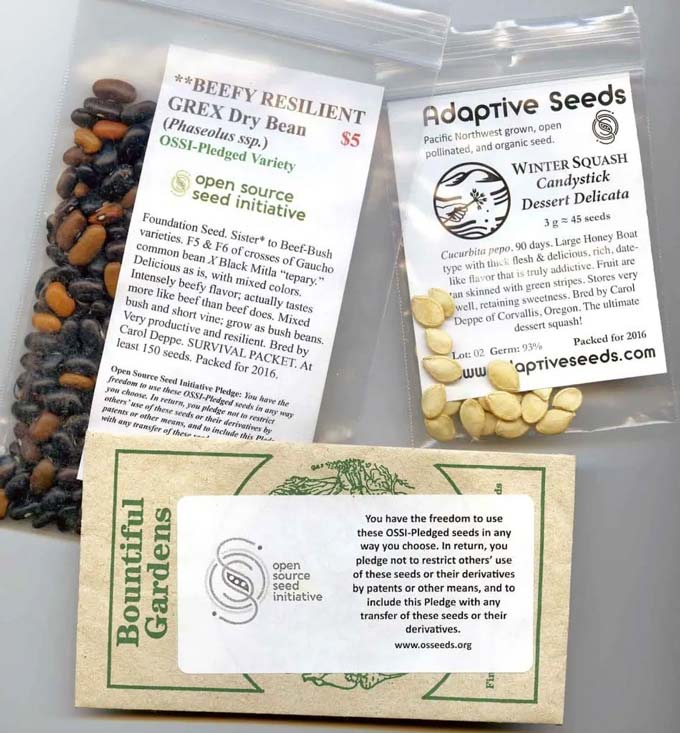
Examples of OSSI varieties include dwarf tomatoes, bred for people with little space by small farmers in North Carolina and Australia who worked together and exchanged information across continents.
A new rye, called Baldachin, has been developed with the help of crowdfunding in Germany specifically for the sandy soil in East Germany and is for the first time available in bakeries this fall.
Also potatoes, corn, wheat and nearly everything else you need to cook dinner.
Nurturing an idea
Legally, Open Source Seeds (OSS) in Europe works slightly differently because of EU seed protection laws. While in the US the OSSI pledge would be hard to enforce if challenged in court, Johannes Kotschi, the founder of OSS Germany, went with an open source licensing model.
The license is printed on every OSS seed package in Europe. Whoever opens an OSS package agrees to never patent these seeds or future breeding of them. OSS cooperates with bakeries such as Le Brot in Cologne that offer bread baked with OSS wheat and rye, not least to raise awareness.
Just like software, “we want to go viral,” Kotschi says. In North America, he notes, cannabis breeders are interested in the OSSI strategy. “Cannabis is going to be a multibillion dollar market,” he says.
“The small breeders fear for their seeds. They are interested in using the open source license to protect themselves while making the seeds available to others.”
Also similarly to computer software, where initially only a few users developed open source software like Linux, the market share of open source seeds is currently too small to be measured.
But just like Linux, they fulfill more than a side role. They spur innovation and creativity, and make room for local and regional interests.
“It’s a delicate seedling,” Kotschi says about OSS. But with the right support, it can grow into a mighty tree.
We’ll let you in on a little secret: Environmentalists don’t want you to gift them unnecessary crap that will end up in a landfill.
And wile it might initially feel intimidating, shopping for the environmentalists in your life is actually quite easy.
And it’s not just about the gift! Here are a few more key tips:
- Be mindful of packaging. There are so many companies that do a great job with reducing unnecessary plastic in their packaging — choose to shop with them. (The most mindful companies usually communicate their packaging upfront.)
- Double check if your recipient already has a similar product — or if they actually want this. A spoiled gift is better than a wasteful surprise.
- If something isn’t a need-to-have, then skip it.
- Sure, a product might be eco-friendly, but is it ethically made too? Are the people who created the product treated and compensated fairly?
- Think about the entire product lifecycle. When your recipient is done with the gift, what will happen to it? Will someone else be able to enjoy it? Will it decompose so it doesn’t end up in a landfill? Or maybe it will be totally consumed so there’s no waste left?
Fortunately, our team of earth-lovers put together some recommendations for you to make your shopping easy.
By the way, some of the links in this article are affiliate links, which means if you make a purchase after clicking a link, we may earn a commission at no extra cost to you. Everything in this article was independently and honestly written by the Good Good Good team. Thank you!
The absolute best gifts for environmentalists:
Pela Compostable Phone Case

Few of us are brave enough to use a gorgeous new phone without a case — and even if you have AppleCare or insurance, replacing a broken phone all the time isn’t very sustainable.
While a lot of phone cases are boring, ugly, or made with wasteful plastic, Pela has gone out of its way to create sustainable phone cases that you feel proud to show off!
The brand makes compostable phone cases made from flax shive and plant-based polymer. Plus, each case comes with an extra envelope to send back your old phone case, which can then be recycled properly.
What’s good:
- Donates a percentage of every sale to ocean cleanup and preservation initiatives
- Certified B Corp and Climate Neutral certified
- All products free of lead, cadmium, BPA, and phthalates
Shop: Pela
Lomi 3 Countertop Composter

For people who want to reduce waste in a thoughtful way, composting is surely the answer. But instead of a stinky bucket of dirt on their apartment balcony or hidden away in their backyard, there’s the Lomi 3.
Lomi is a smart waste system that turns food scraps into odorless, bin-ready waste at the push of a button.
What’s good:
- Makes home composting easy and odorless
- In 2024, Lomi users processed more than 54,306,000 pounds of food scraps, helping to keep a total of 146,929,639 pounds of food out of landfills
- Certified B Corp
- Zero-waste packaging
- Lomi upcycles and donates Lomis to schools, with over 1,000 donated to date
Shop: Lomi
Chocolate from Tony’s Chocolonely
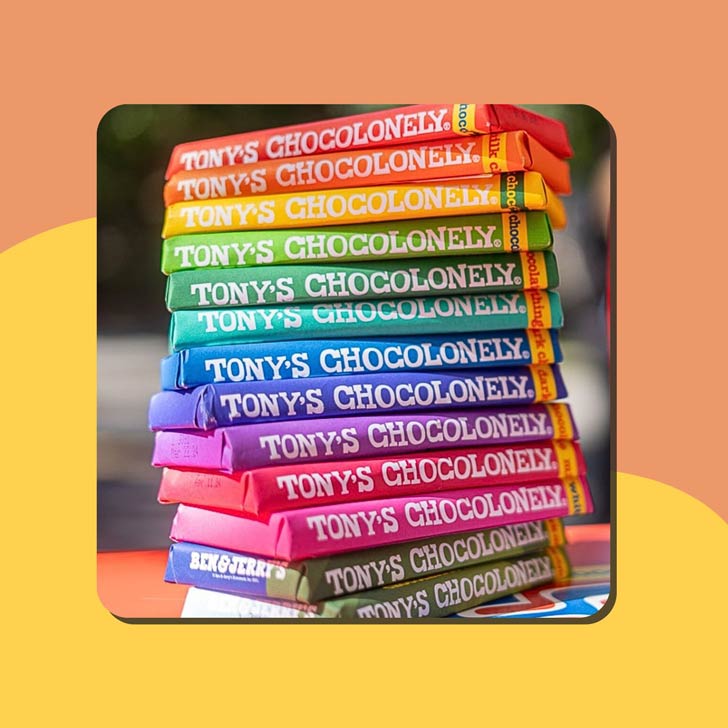
We wanted to start off this list by highlighting a “consumable gift.” The environmentalist in your life doesn’t want stuff that will end up in a landfill one day; they want gifts that they truly need, or gifts that they can completely use up. And what’s better than savoring something delicious?!
Bars of ethically produced chocolate are a perfect gift. Whether your loved one starts snacking right after they open their gift, or save it for a special occasion — you can rest assured that no crumb will go to waste.
What’s good:
- Tony’s Chocolonely was named the most sustainable brand in the Netherlands (four times!)
- The brand has a mission to bring awareness to modern slavery, produce only slave-free chocolate and pushes the entire chocolate industry to follow its example
Shop: Amazon | Tony’s Chocolonely
Explore Good Good Good’s guide to the best consumable gifts
Apparel from Toad&Co
Not to shatter the illusion, but it’s time you knew: when an environmentalist receives clothes as a gift, they always secretly look up the company’s sustainability efforts later. We’re going for cuteness, comfort, and conscious consumerism, folks!
Toad & Co is an apparel company you can feel good about.
The brand has a whole range of apparel (from cute sweater vests made with recycled fibers, super comfy hemp loungewear, and organic cotton plaid shackets, to cozy beanies and scarves made with OEKO-TEX certified yarn — all of which is thoughtfully produced with people and planet in mind.
(We especially love all of the incredibly helpful resources about eco-friendly fabrics.)
What’s good:
- Member of 1% for the Planet
- Made of organic cotton and recycled fibers
- Its use of eco-friendly materials limits the number of chemicals, water, and wastewater used in production
Shop: Toad&Co
Sustainable Watch

A beautiful watch is an incredibly memorable gift that will go everywhere with your loved one. And by opting for a sustainable watch, you show that you understand their values — and have great taste.
Solios makes those watches.
What’s good:
- Solios was the first watch company to become B Corp-certified
- All watches are powered by solar energy
- Solios uses an innovative cork approach to vegan leather, making all vegan leather watch bands free of rubbers and plastics
Shop: Solios
→ Explore Good Good Good’s guide to the best eco-friendly watches
Hip Pack from Cotopaxi
Whether the environmentalist in your life loves to hike — or just needs a place to keep their phone and wallet while they bop around town — a crossbody bag or hip pack is a must-have accessory.
Cotopaxi’s Del Día hip packs collection uses scrap fabric from excess production, significantly reducing waste that would have otherwise ended up in landfills.
Each bag is one-of-a-kind, comes in various fun colorways, and is made of durable, lightweight, 100% repurposed fabric.
What’s good:
- Made from repurposed nylon scraps
- Lifetime warranty and repairs
- B Corp and Climate Neutral certified
- Through 1% for the Planet and other foundation efforts, Cotopaxi donates and provides grants to do more good
National Park Socks

Sure, socks are a bit of a holiday cliché, but that’s only if you gift boring socks. These playful, comfy, and symbolic socks from Parks Project are a wearable reminder of the beauty of U.S. national parks, all while keeping our public lands safe and clean.
What’s good:
- Certified B Corp
- Every purchase benefits national parks and public lands
- Has donated over $2.7 million to parklands since 2014, including building habitat and wildlife restoration, advocacy and education, and volunteer programs
Shop: Parks Project
Explore Good Good Good’s ultimate guide to the best socks that give back and our guide to the best national park-related gifts!
Cariuma Sneakers
Whether your gift recipient is a wave rider, skater, or just needs a stylish and comfy pair of shoes to brave the ups and downs of every day, Cariuma sneakers will be the perfect fit.
With high-top styles, fun collaborations, and more, snagging a pair of Cariuma sneaks is a step in the right direction.
What’s good:
- Every pair of sneakers plants two trees
- B corp certified
- Shoes made in ethical factories
- Responsibly sourced materials
Shop: Cariuma
Terra Threads Earth Backpack
Work, school, travel, adventure: Everyone needs a solid backpack. If your gift recipient is in the market for a sustainably and ethically made backpack, Terra Thread offers a beautiful, spacious everyday backpack to depend on.
What’s good:
- Made with certified organic cotton canvas in a Fair Trade-certified factory.
- Your purchase supports Feeding America’s work to end hunger and donates meals to kids and families in need
- Terra Threads is carbon neutral and B Corp-certified
Shop: Terra Threads
Jade Yoga Mat

Yoga mats from Jade Yoga are eco-friendly and made with natural rubber tapped from rubber trees. The mats are free of PVC, EVA, or other synthetic rubbers, and are all made in the U.S.
Try the best-selling Harmony mat, or a “Yoga Starter Kit,” which includes a natural rubber yoga mat, a cork yoga block, a yoga strap, and 30 days of free online yoga classes from Yoga International.
What’s good:
- Plants a tree for every mat sold
- “Color cause” program donates to causes for each color bought
- Runs a community partner program to bring yoga to those who might benefit from it, such as people in prisons, hospitals, and shelters
Shop: Jade Yoga
Glassware from Our Place

Help your loved one elevate their happy hours by adding this beautiful set of colorful recycled glassware from Our Place.
What’s good:
- Each glass is sustainably made from recycled glass and sand, as well as naturally dyed
- Mailed in plastic-free packaging
- BIPOC-owned
- Offers a recycling program to keep cookware out of landfills
Shop: Our Place
Check out our full list of the best recycled glassware brands to explore other options, too!
Bombas Gripper Slippers

Bombas, while known for its cozy give-back socks, also makes slippers! The Gripper Slippers are a half slipper-half sock hybrid with a soft brushed lining and special non-slip grippers.
What’s good:
- Certified B corp
- One essential clothing item donated with every purchase
- All products designed with durability in mind, with a “happiness guarantee” to keep items lasting longer
Shop: Bombas
Eco-Friendly Candle from Siblings
Candles are always a great gift — but you can go above and beyond by gifting a unique and sustainable candle.
Siblings is an eco-friendly candle brand that meshes its commitment to the planet with a DIY element.
With non-toxic scents, clean coconut wax blends, and 100% compostable packaging, your gift recipient can create their own candle completely guilt-free.
What’s good:
- Vessels are endlessly reusable
- Trees are planted with every 3-pack purchase, and the brand dedicates a portion of its Black Friday sales to reforestation every year
- Siblings is certified Carbon Neutral
- Eco-luxury candles produce 86% less waste and 50% fewer carbon emissions than traditional candles
Shop: Siblings
Hemp Sheets from Tuft & Needle

Adulthood means transitioning away from the cheap department store bed sheets and into uber-comfortable, well-made sheets.
Tuft & Needle has cozy, eco-friendly bedding on lock, from down alternative pillows, to a hemp duvet cover, and hemp sheets.
(Which would all pair wonderfully with an eco-friendly mattress or bed frame, we might add).
What’s good:
- Hemp is grown with less water than cotton and is a biodegradable fiber that dries faster than cotton (and therefore uses less energy!)
Shop: Tuft & Needle
Non-Toxic Cookware

Everyone can appreciate a beautiful and reliable set of pots and pans. Caraway’s cookware sets are made with kitchens and the planet in mind and feature stunning colors.
With non-stick and non-toxic surfaces, this is a great gift for the home chef in your life.
What’s good:
- All of Caraway’s ceramic-coated aluminum cookware is free of harmful chemicals like Teflon, lead, and cadmium
- This cookware releases up to 60% less carbon into the environment compared to traditional non-stick coatings.
- Shipped in packaging made from recycled cardboard and biodegradable cork trivets
- Caraway helps customers find local recycling options for their metal cookware.
Trashie Take-Back Bag
There are few things more stressful than the quarterly closet clean-out. Give the gift of making it easier.
The Take Back Bag can be filled with old clothes your gift recipient no longer wears, and Trashie will do the work of recycling their pre-loved items and turning them into something useful.
Plus, purchasing a bag will give you credits to use toward a new sustainable clothing item or other reward.
What’s good:
- Keeps old clothes out of landfills
- Contributes to a circular economy
Shop: Trashie
Zero Waste Bite Toothpaste
Toothpaste tubes are notoriously hard to recycle (and nearly impossible to get all of the paste out of). In recent years, companies like Bite have created more sustainable alternatives.
These toothpaste alternatives eliminate waste from your loved one’s daily (hopefully twice daily!) routine.
What’s good:
- Fully recyclable packaging
- Bite is a woman-owned B Corp that is certified cruelty-free
→ Explore Good Good Good’s ultimate guide to sustainable stocking stuffers
Rechargeable Electric Lighter
Everybody loves a cool gadget that feels like the future — and it’s even better when that gadget reduces waste and helps you light a favorite candle.
What’s good:
- Alternative to single-use plastic lighters that end up in landfills every year (95% of the annual 600 million lighters sold to U.S. consumers every year)
- Fully rechargeable and made to last
Shop: Amazon
Explore Good Good Good’s ultimate guide to the best rechargeable electric lighters
The Intersectional Environmentalist by Leah Thomas

In “The Intersectional Environmentalist: How to Dismantle Systems of Oppression to Protect People + Planet,” activist Leah Thomas offers a primer on intersectional environmentalism for the next generation of activists looking to create meaningful, inclusive, and sustainable change.
What’s good:
- This book can be read chapter by chapter or kept nearby as an easy-to-flip index for exploring the complexities of looking at environmentalism through an intersectional lens.
Shop: Amazon | Bookshop.org | Libro.fm
The Goodnewspaper
Every month, our team of optimists, journalists, and artists makes a beautiful print newspaper filled with good news. There’s something special about holding a physical newspaper — and our readers continue to report that it helps them absorb the positive news better than reading from a screen.
We offer gift subscriptions for three, six, or 12 months — and we also recommend just picking up a subscription for yourself.
What’s good:
- Printed on recycled paper using soy-based inks
- Climate Neutral Certified
- Gives back to environmental nonprofits with 1% for the Planet
Shop: Good Good Good
MasterClass

By now, most of us have heard of (or experienced) MasterClass — the platform where the world’s greatest teach next-level classes to help you learn new skills and see the world differently.
We love that MasterClass has expanded its classes to include topics like activism, conservation, gardening, vegetarian cooking, and more.
We’ve been especially excited about the launch of classes with Jane Goodall (on conservation), Melinda Gates (on impactful giving), Amanda Gorman (on poetry), and Ron Finley (on gardening). And of course there are hundreds more classes to choose from.
One fun trick we recommend: Check out the Duo or Family memberships as a way to save while gifting for the whole family.
What’s good:
- MasterClass hires diverse instructors to teach classes
- The company donates annual memberships to accredited charitable organizations serving communities in need
Subscribe: MasterClass
Gift Card to a Sustainable Shop

Oftentimes, the most sustainable thing you can do is let your loved one pick out their own gift. They know exactly what they need — and they’ll appreciate that you gave them that opportunity.
Even more, they’ll love that you chose a gift card to somewhere that aligns with their values — instead of, say, Amazon.
We recommend gift cards from:
Explore more eco-friendly gift guides: Best Eco Friendly Gifts | Inexpensive | For Him | For Her | For Mom | For Kids | For Coworkers
“Be kind, for everyone you meet is fighting a hard battle.” This iconic quote feels more true now than ever.
The world could do with a little bit more kindness. And perhaps that kindness should begin with me and you.
Of course, we all see particular opportunities for kindness in our everyday lives: Someone drops something and we pick it up for them, the person in front of us in line is short a few dollars and you offer to cover the difference, someone asks for directions and you pull out the map on your phone to show them the way.
But also, sometimes, we want to create our own opportunities for kindness: Going beyond the opportunities that naturally present themselves by intentionally working to make someone’s day.
At Good Good Good, we’re all about celebrating good news — and then joining in and becoming good news. Intentionally going out into the world to make a difference is our jam.
We’ve curated a list of the best ideas for random acts of kindness — whether you're celebrating World Kindness Day or Random Acts of Kindness Day or just choosing to be kind.
Some ideas may serve as simple reminders (like “hold the door open for someone.”) — and others may be fresh new ideas (like “take time to leave a positive review for a local restaurant you love.”)
Some of our recommended random acts of kindness will help one person or family — and others will create systemic change that will leave positive ripple effects throughout your neighborhood, community, and world.
And of course, you’re not limited to the items in this list. As you’re reading through, you will no doubt have new ideas come to mind. Try something new and follow your intuition on how you want to create positive change in the world.
Be the kindness you wish to see in the world!
Explore random (and not-so-random) acts of kindness:
- Sign up to donate blood.
- Hold a door open for someone.
- Donate $10 to a charity you believe in.
- Take time to leave a positive review for a local restaurant you love.
- Take a bystander intervention training.
- Write a thank you note to someone who has inspired you to make a positive difference.
- Donate household items to your local refugee support organization.
- Put a ‘Don’t Give Up’ sign in your yard.
- Find a Little Free Pantry or Free Fridge in your community and drop off some food.
- Give an extra generous tip.
- Pick up one piece of litter and throw it away.
- Create care packages for your houseless neighbors.
- Donate to a local mutual aid fund.
- Let someone go first in line.
- Give a teacher a thank you gift.
- Call a local homeless shelter to ask how you can best support them in the next month.
- Go on a litter walk to clean up your neighborhood. (And buy yourself a simple litter pickup kit so you can do it even more often!)
- Give out flowers to strangers on the street.
- Tell an author you loved reading their book. They’ll be easy to get in touch with via Twitter or Instagram, and it’ll make their day!
- Give a Goodnewspaper as a gift.
- Pay off a student’s lunch debt via GoFundMe or by calling a local school.
- Leave short poems or uplifting notes on people’s cars.
- Find a Little Free Library in your community and drop off some books.
- Sign up to become an organ donor.
- Offer to buy coffee for the person behind you in line.
- Sign a petition to help support garment workers.
- Pay off someone’s medical debts. (We recommend RIP Medical Debt!)
- Install ‘Tab for a Cause’ to make a difference every time you open a new browser tab.
- Choose to shop from underrepresented business owners. (Check out our guide to supporting Black-owned businesses.)
- Ride your bike or public transit to work or school.
- Give a compliment to a stranger.
- Cook a double portion of your next meal and offer it to a neighbor or a friend so they don’t have to cook.
- Join a peaceful protest to support human rights.
- Read the news, find a story that breaks your heart, and make a small donation to a nonprofit responding to that issue.
- Start a note in your Notes app with your friends’ favorite coffee orders so it’s easier for you to surprise them.
- Find an ethical and sustainable way to recycle your old shoes.
- Sign up as a volunteer at a local animal shelter.
- Choose to shop with a small business instead of a big box store or Amazon.
- Give up your seat on the bus or train so someone else can have a seat.
- Donate your unused frequent flyer miles to an organization that helps reunite refugee families. (We recommend Miles4Migrants.)
- Be like Mister Rogers and look for the helpers. (And become a helper, too.)
- Find a random GoFundMe to donate to.
- Recycle your old clothes via a Take Back Bag from For Days.
- Buy a compost bin to reduce food waste as an act of kindness to the earth.
- Participate in Meatless Monday once per week to reduce your carbon footprint and your impact on animals.
- Offer to return someone’s cart for them.
- Donate your hair. (Either for wigs or oil spill cleanup)
- Find an extra coat in your closet and keep it in your car to give to a stranger.
- Plant a tree.
- Tell a friend you’d love to babysit for them for free.
- Run (or walk) in a charity 5k.
- Learn to say hello and thank you in different languages.
- Send a kind and encouraging text message to a friend.
- Shovel your neighbor’s snow or rake your neighbor’s leaves.
- Reduce food waste by picking up a meal from Too Good To Go.
- Introduce yourself to your neighbors.
- Volunteer as a poll worker.
- Research what can and can’t be recycled in your community so you can make sure you’re recycling correctly.
- Use social media for good.
- Be kind to yourself by finding a therapist. (You can’t pour from an empty bucket.)
- Donate an old cell phone, computer, or other electronics to a nonprofit that could use it.
- Buy lemonade from a kid’s lemonade stand.
- Volunteer remotely for a crisis line like Crisis Text Line or The Trevor Project.
- Forgive someone.
- Donate to make a difference for an ugly animal. (Not just cute ones!)
- Support local farmers by buying from a local farmers’ market, joining a CSA, using the Farmstand app, or even visiting a local farm.
- Buy and display a Pride flag to show your allyship.
- Make energy-efficient swaps at your home, so you can show kindness to Mother Earth.
- Donate to, support, or volunteer at national parks.
- Call your elected officials to advocate for your neighbors (not just yourself and people with a similar life experience to you).
- Reach out to an old teacher and tell them that you appreciate them.
- Buy ‘Empathy Cards’ for the next time you want to show care to someone going through a hard time.
- Call an old friend out of the blue.
- Buy a warm meal for someone in need.
- Attend or host heritage or pride events.
- Choose to buy eco-friendly products next time you go shopping.
- Give someone a gift card that you think you won’t get around to using.
- Switch your default search engine to Ecosia — and try out other do-good apps.
- Buy groceries for the person behind you.
- Lend out your favorite book.
- Buy socks that give back.
- Sign up for the bone marrow registry.
- Order some Goodnewspapers and leave them at coffee shops around town for strangers to find.
- Offer to let your neighbor borrow your lawnmower or other yard tools.
- Research an important issue in the news and commit to learning more about it (so you can become better informed and make a bigger difference for those affected). Try subscribing to newsletters or podcasts as an easy way to learn more over time.
- Volunteer with a refugee agency in your state to help a family learn to use public transit.
- Learn CPR.
- Adopt (and commit to caring for) a pet from a shelter.
- Consume the news thoughtfully, so you can be more intentional about getting more involved and making a difference.
- Share a positive quote online.
- Go out of your way to buy ethically-sourced coffee, as a way to show care for coffee farmers.
- Go out of your way to remind someone that everything will be okay.
- Set up a recurring monthly donation at your favorite nonprofit. It will help them plan ahead and make a bigger difference.
- Write a thank you note to someone who has helped your career.
- Practice introducing yourself with your pronouns.
- Commit to buying gifts that make a difference or consumable gifts for future birthdays, anniversaries, and holidays.
- Find a small local nonprofit to volunteer with.
- Go out of your way to post good news on social media.
- Keep an extra umbrella in your car to give to someone caught in the rain.
- Forward someone a good news newsletter.
- Pick an awareness day to learn about and celebrate.
- Remember to practice self-care. (Here are some self-care ideas!)
You might also like: The best quotes about kindness
On September 16, Mahsa (Zhina) Amini, a 22-year-old Kurdish-Iranian woman, died in Tehran while in the custody of Iran’s morality police. Her death set off a massive wave of demonstrations that have spread across the country.
While the protests started with anger over the enforcement of the hijab, they represent a much wider movement that now poses the greatest threat the theocratic regime has faced since the 1979 revolution.
Controlling women’s bodies
As initial news of Amini’s hospitalization spread, angry citizens began demonstrating against the morality police. This coercive force has compelled women to comply with the mandatory hijab law through physical and verbal violence and humiliation — all part of a systematic effort to suppress and control their bodies.
The first spark of the growing protest movement came when Kurdish women attending Amini’s funeral in her hometown of Saqqez bravely took off their headscarves and chanted the slogan “death to the dictator” at great risk to their own safety.
These women in #Iran’s northern city of Sari are dancing and burning their headscarves… anti-regime protests have now spread to dozens of cities from north to south, east to west… all triggered by the death of #MahsaAmini while in the custody of Iran’s morality police. pic.twitter.com/BBDvgC5L1w
— Rana Rahimpour (@ranarahimpour) September 20, 2022
After Amini’s death, the outrage and desperation of women came roaring through, targeting the dictatorial and patriarchal regime by demanding the liberation of female bodies.
History of resistance
On Oct. 16 an Iranian sport climber, Elnaz Rekabi, competed without a hijab at a competition in South Korea while representing Iran. Rekabi later said her hijab had “inadvertently” fallen off. However, many remained skeptical of her explanation, believing Iranian officials had pressured her to make the statement. Large crowds cheered Rekabi when she arrived back in Tehran days later.
While the current uprising may seem new, it follows decades of women’s resistance. Feminist activism in Iran goes back to women participating in the Constitutional Revolution in 1906. Women played a critical role and engaged in political actions by establishing women’s associations, joining protests and supporting strikes.
One month after the Islamic Revolution in 1979, Iranian women launched massive demonstrations after hearing whispers about a hijab mandate. Although those protests were able to postpone the mandate, it was eventually instated in 1983.
Iranian women never stopped fighting. They turned their bodies into arenas of resistance against the ideology and intervention of the state. Acts of civil disobedience and campaigns like My Stealthy Freedom, White Wednesdays, The Girls of Revolution Street and the Iranian #MeToo movement were designed to sustain momentum in the fight against oppressive bodily regulation.

In Iran, women’s bodies have always been at the forefront of the political agenda. Mandatory dress codes are a central feature of the regime’s policy towards women. They function as a policing apparatus to control women’s sexuality and regulate their bodies.
While women face aggression on a daily basis for not following the state’s gender and sexual proscriptions, stubborn forms of female bodily presence on social media are an important part of the way women are able to fight the regime’s hegemonic narratives.
Under Iran’s authoritarian governments, collective action organized under strong leadership with effective networks of solidarity has been challenging, especially in the post-Islamic revolution era.
However, digital spaces and social media is providing more room for Iranian women and sexual minorities to keep up their resistance and pose critical challenges to the restrictive gender politics of the regime.
Alliance of marginalized groups
The long struggle for women’s rights has taken more radical forms since Amini’s death. The protests against the mandatory hijab law have expanded and targeted the very foundations of the regime and its ideological taboos. By linking the protests to broader discussions of gender, ethnic, social, economic and political protests, demonstrators have elevated it to a protest against the Islamic regime itself.
Amini’s identity as a Kurdish woman has made gender and ethnicity integral facets of the recent uprisings. It has created an inclusive alliance among religious, sexual and gender minorities, as well as suppressed ethnicities such as Kurds, Arabs, Turks, Balochs, Lors and others.
It is as if this intersection of oppressed identities has targeted the position of the Persian, Shia and heterosexual man as the hegemonic representative of the nation. Amini’s death has become the rallying cry for all the other subaltern counterpublics against the socio-political ideologies of the clerical regime.
Iranian women are de-ideologizing their bodies with anger (cutting off their hair and burning their hijabs) and joy (dancing). The female body, having been an object and symbol of a theocratic ideology, is now emerging as the most serious threat to the legitimacy of the regime. The ongoing uprising makes it clearer than ever that the liberated female body is the regime’s Achilles heel.
There’s a chance you’ve heard the phrase “voting with your dollars.” Essentially, it means that all of us have the power to make the world a better place and make our voices heard by where and how we spend our money.
In this complicated capitalist society, those of us passionate about social and environmental justice often struggle with shopping for others during the holidays. And chances are, the people we want to shower with gifts also care a whole lot about making the world a better place.
We know the feeling of balancing those “oh that’s so cute, I gotta buy it” impulses with our “I don’t want to contribute to unethical and unsustainable cultural norms” values. So, we took the guesswork out of it for you!
In this article we’re highlighting our top 10 recommendations for gifts that do good.
We hope this serves as a roadmap to help you find the perfect tokens of your love and appreciation for the special people in your life, all while making a difference for causes they believe in.
We’ve also compiled a number of specific gift guides to help you shop intentionally, too!
- Gifts for Animal Lovers (That Give Back)
- Sustainable Stocking Stuffers
- Gifts for Environmentalists
- Gifts that Give Back to National Parks & Public Lands
- Sustainable Gifts for Him
- Consumable Gifts
By the way, some of the products and links in this article are partners and affiliates, which means if you make a purchase after clicking a link, we may earn a commission at no extra cost to you. Everything in this article was independently and honestly written by the Good Good Good team. Thank you!
Top 10 Gifts That Give Back
Conscious Step Socks
Supports over 20 various causes

Conscious Step creates stylish, sustainable, and 100% organic cotton socks that support independent farmers while also giving back to over 20 different nonprofit organizations doing good in the world.
Whether your gift recipient cares about protecting the rainforests, educating kids, fighting food insecurity, or saving LGBTQ+ lives, there’s bound to be a pair for them.
Made with GOTS organic and Fair Trade-certified cotton and recycled polyester, these cute socks are ethical, sustainable, and oh-so-giftable! Conscious Step’s gift boxes are the perfect, hassle-free way to give — and to give back.
→ Shop socks that give back from Conscious Step
Check out our full list of socks that give back to explore other options, too!
Calyan Wax Co. Candles
Supports human trafficking survivors

Give the gift of dignity — and a darn good candle. Calyan Wax Co’s mission is to support human trafficking survivors through the sale of natural candles. Five percent of the brand’s revenue is donated to trusted and vetted nonprofits that uplift human trafficking survivors. Calyan has donated over $226,000 to date.
→ Shop Calyan Wax Co candles on Amazon
Grounds & Hounds Coffee
Supports rescue animals

Grounds & Hounds Coffee Co’s tagline is: “Every cup helps a pup.”
The brand creates organic and eco-friendly specialty coffees that support animal rescue initiatives. 20% of all Grounds & Hounds profits go directly to rescue organizations that provide a second chance for pups in need of a helping hand.
Since its inception, Grounds & Hounds has helped provide 4.2 million meals, 24,000 toys, and 22,250 vaccines to shelter dogs.
→ Shop Grounds & Hounds coffee blends
Check out some of our other favorite gifts for animal lovers!
BLK & Bold Tea
Supports at-risk youth
BLK & Bold is a certified B Corp that makes high-quality coffees and teas that impact the community.
The brand donates 5% of its profits to support at-risk youth both locally and nationally, including efforts to sustain youth programming, enhance workforce development, and eradicate homelessness.
Gift some high-quality, flavorful loose-leaf tea or matcha to the do-gooder in your community this holiday season.
→ Shop BLK & Bold tea from Amazon
World Central Kitchen Cookbook
Supports humanitarian aid

Shopping for a chef? Look no further than “The World Central Kitchen Cookbook: Feeding Humanity, Feeding Hope.”
This cookbook is full of recipes inspired by the many places in which World Central Kitchen — and its founder, Chef José Andrés — have served following disasters. It also contains gorgeous photos and narratives that tell inspiring stories about chefs, volunteers, and communities on the front lines of crisis.
And of course, all author proceeds from the book support WCK’s emergency response efforts.
→ Shop from Bookshop or Amazon
Terra Threads Backpack
Supports meals for community members facing food insecurity
We all have stuff, and we all need a place to put that stuff when we’re on the go. Terra Threads offers a beautiful, spacious everyday backpack to depend on — and they’re all sustainably and ethically made!
Better yet, your purchase helps end food insecurity. Terra Threads supports Feeding America and its work to end hunger by donating meals to kids and families in need.
→ Shop the Everyday Backpack from Terra Threads
“Defend the Parks” Merch Bundle
Supports national parks and public lands
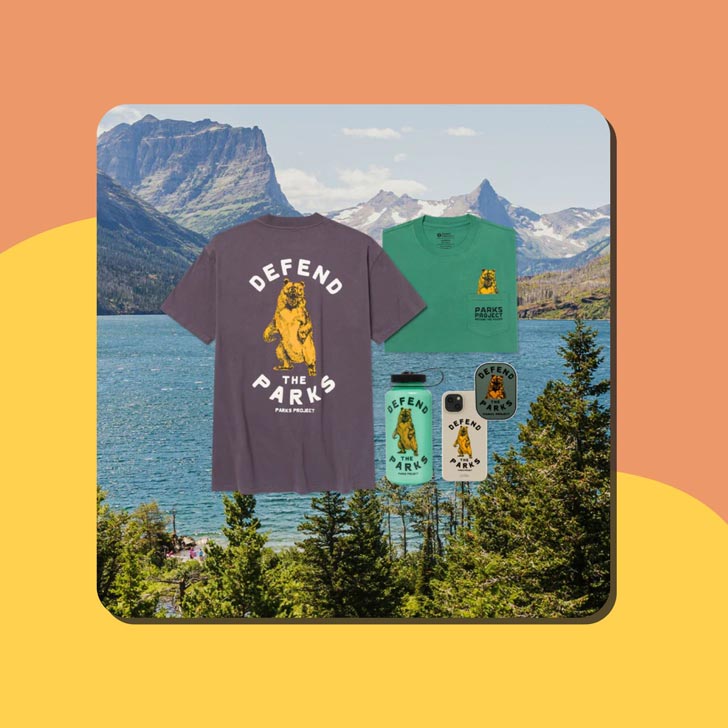
Ensure your national park-loving gift recipient can spread the word unapologetically: Our parks and public lands need defending.
This pocket tee and water bottle combo from Parks Project should do the trick.
Plus, every purchase from Parks Project benefits national parks and public lands. Since 2014, Parks Project has donated over $2.7 million to parklands, which has helped support wildlife restoration, advocacy and education, and volunteer programs.
→ Shop the bundle from Parks Project
Explore more gifts that give back to national parks!
Pottery With a Purpose Beginner Clay Kit
Supports mental health
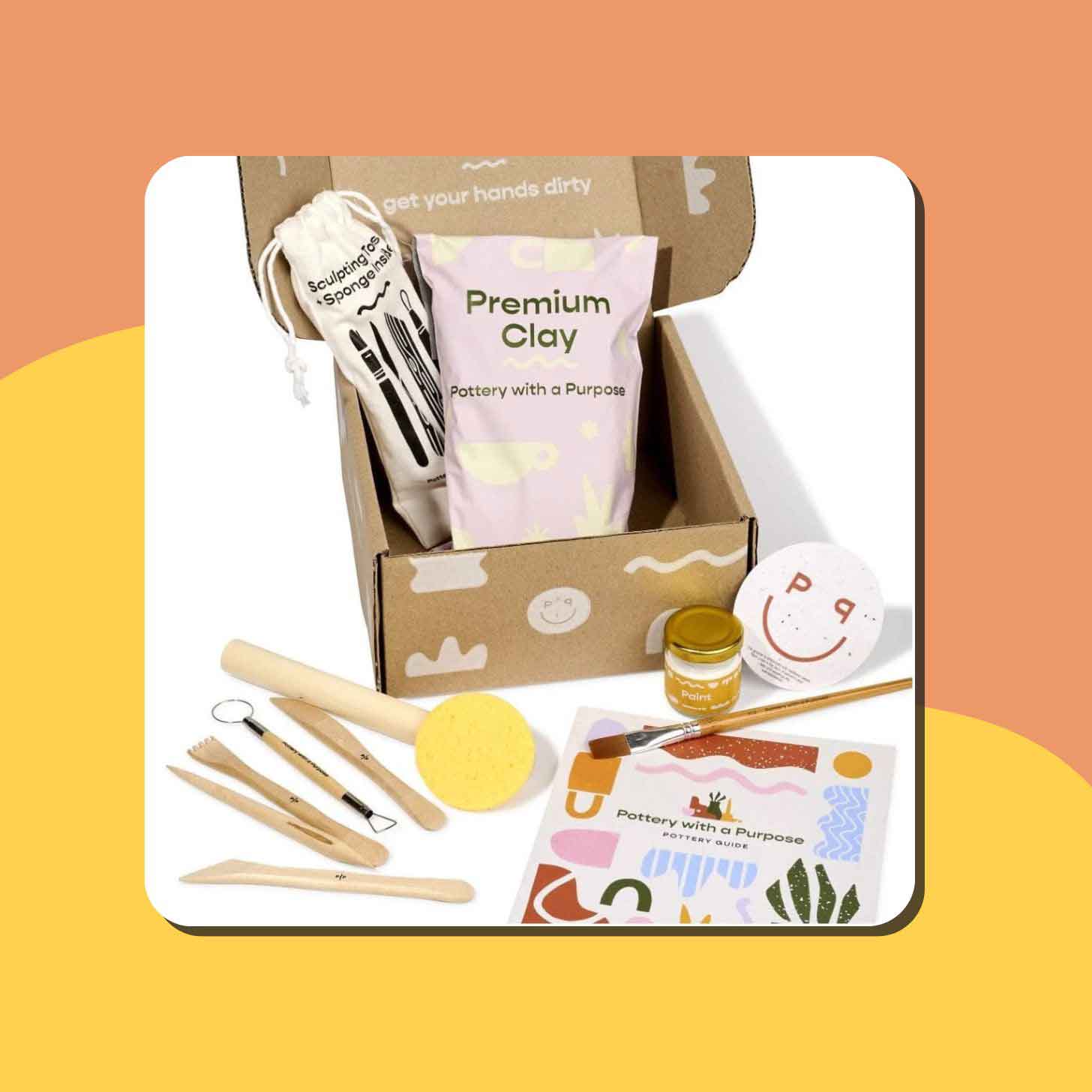
Does your gift recipient already seemingly have everything? Then, the gift of an experience is a no-brainer.
Pottery With Purpose is a woman-owned brand that offers vegan, USA-made crafting kits that help people tap into their creativity and let go of their need for perfection.
This Beginner Kit is perfect for folks to design, sculpt, and decorate and original piece with simple instructions. Founder Sam Hoff calls it a “hands-on, tech-free pause button.”
Plus, your purchase helps fund mental health organizations like Active Minds, Mental Health America, The Trevor Project, and more.
→ Shop the kit from Pottery With a Purpose
Explore other experience gifts!
CARIUMA Shoes
Supports reforestation
CARIUMA is a certified B Corp that creates skate shoes and sneakers in a low-impact way. Every time you purchase a pair of shoes, two trees are planted in the Brazilian rainforest. Plus, they’re super stylish.
Need to get rid of an old pair of sneaks that are no longer useful? Check out our guide to recycling your old shoes.
→ Shop a pair of CARIUMA shoes
Material Kitchen reBoard Cutting Board
Supports food justice
The Material reBoard is a BPA-free cutting board is made entirely from upcycled and renewable materials (75% repurposed kitchenware plastic scraps, 25% renewable sugarcane) and donates to food justice organizations like Heart of Dinner, Apex for Youth, City Harvest, and more.
Together with shoppers, Material has donated over $190,000 to organizations feeding underserved communities in the U.S.
→ Shop the Material Kitchen reBoard
You might also like: 15 Best Amazon Alternatives for Ethical Online Shopping | 12 Places to Find Black-Owned Businesses to Support | How to Sustainably Shop for Christmas Trees | 7 Good News Stories About Small Businesses
With holiday gift purchases reaching up to an estimated $900 billion in 2024 (and that doesn’t count birthdays and anniversaries!), imagine the level of environmental impact that can be made if we all opted for the more sustainable options on the market.
We’ve rounded up a pretty cool gift guide of thoughtfully-made products to help you narrow down your search.
We’ve also included details on why each gift is sustainable, as well as details about companies producing their products ethically and giving back to nonprofits.
Whether you’re on a tight budget this year or looking for a special investment gift for the guy in your life, you can feel a little more confident about selecting a gift that helps protect people and our planet.
By the way, some of the links in this article are affiliate links, which means if you make a purchase after clicking a link, we may earn a commission at no extra cost to you. Everything in this article was independently and honestly written by the Good Good Good team. Thank you!
To help you shop sustainably regardless of your budget, we’ve broken this article down into the following sections:
- $30 and Under
- $50 and Under
- $60-$95
- Over $100
Your guide to the best eco-friendly gifts for him
$30 and under
Consumable Gifts

While we’re searching to find the ultimate gift for the man (or men) in our life, maybe the way to his heart (as the old saying goes) is through his stomach.
Enter: Consumable gifts. From fair trade chocolates to a gift certificate for a pottery class, or even audiobook credits, finding something your loved one will truly enjoy and experience is a great gift any time of the year.
→ Check out our full list of consumable gift ideas
RONXS Electric Lighter

Whether the person you’re shopping for can be found lighting up the grill, a campfire, or an ambient candle, they might be turning to disposable plastic lighters, matches, or fuel-powered lighters.
But we’ve got an alternative, long-lasting, and environmentally-friendly option for them!
The rechargeable RONXS electric lighter is a great budget-friendly lighter that not only has a helpful flexible neck, but it’s also wind and splash-proof, which protects the electric pulse from being blown out by strong wind or wet weather.
What’s good:
- The lighter’s torch uses clean, butane-free ignition and is rechargeable through a USB battery
- Packaged with recycled paper.
- Made out of aluminum
Shop: Amazon
Check out our full list of the best electric lighters to explore other options, too!
Recycled Pocket Sketchbook

If you’re on the hunt for the most meaningful gift for the artist in your life, consider purchasing a sketchbook and adding a personal handwritten note inside the cover.
The Pentalic recycled pocket sketchbook is designed for the artist on the go. Its flexible, water-resistant cover with heavy-duty sewn binding contains 160 pages of acid-free paper. It also includes an elastic enclosure, ribbon marker, and back page pocket.
Perfect for sketching, notes, and fieldwork!
What’s good:
- Made with recycled paper
Shop: Amazon
Organic Coffee Beans from Larry’s Coffee

To satisfy the coffee snob in your life, Larry's Coffee is a great option that combines its love of coffee with the belief that business can be a force for good.
What’s good:
- B Corp-certified
- All the beans are 100% organic, Fair Trade, & shade grown.
- Use natural daylight to power its facility
- Harvest rainwater in four tanks that hold a total of 2,500 gallons that are collected and used to run bathrooms and water gardens
- Use solar panels on the roof to heat water that heats floors in the winter
- To help propagate pollinators, Larry’s turns old whiskey barrels (used to age coffee beans) into bee hives
- A founding member of Cooperative Coffees, a group of independent coffee roasters that work equitably with small-scale farmers
Shop: Amazon | Larry’s Coffee
Carter Slide Mug from Fellow

Pair that fair trade coffee with a travel mug for your guy!
The Carter Slide Mug is specifically made for ideal coffee drinking. Designed to amplify the senses and fit with most manual coffee brewing devices, this makes taking coffee on the go easy and dependable.
What’s good:
- Made with stainless steel, ceramic interior coating, and a BPA-free plastic lid for durability
- The perfect tool to decrease that collection of single-use coffee cups
Shop: Fellow
Dr. Squatch Cold Brew Cleanse Bar Soap
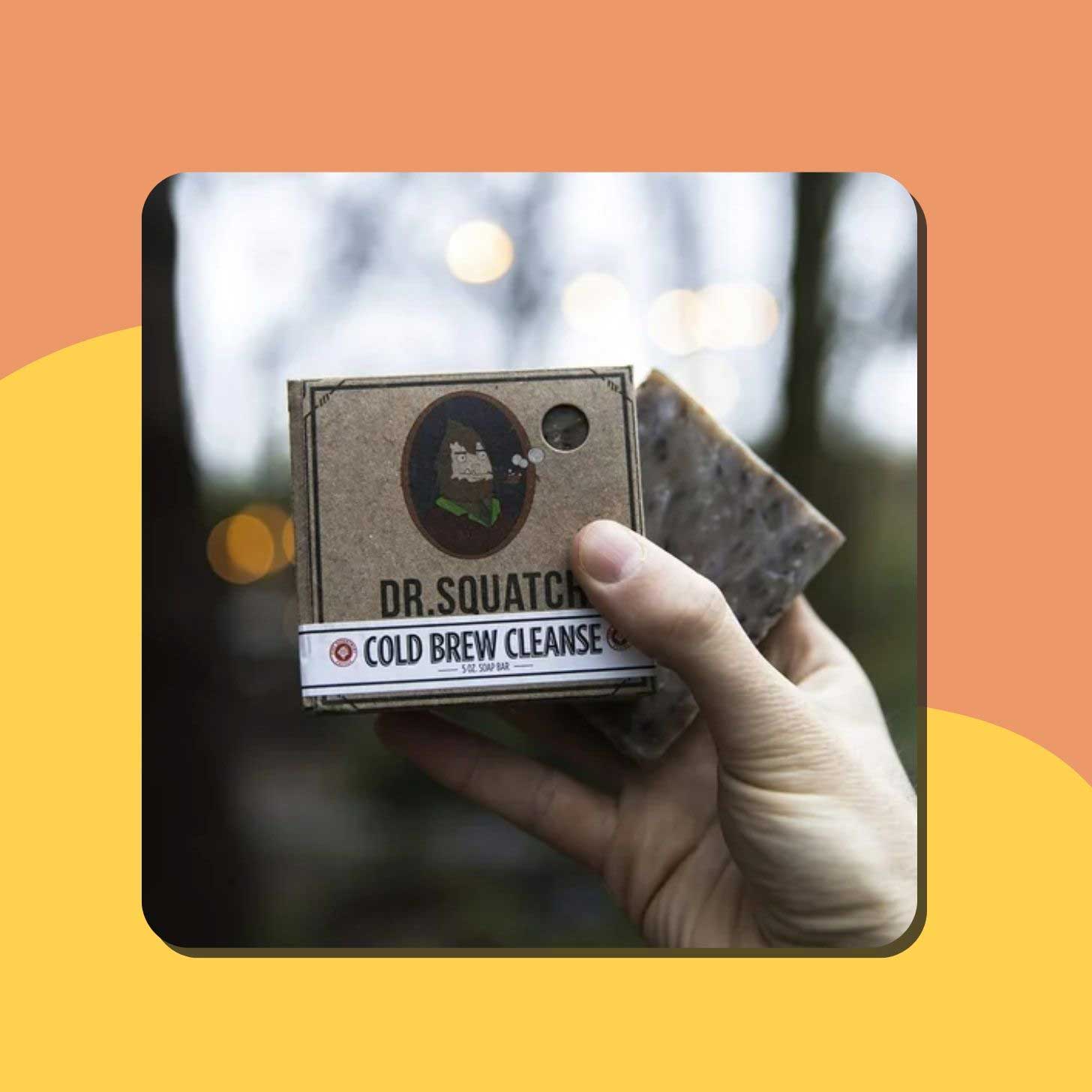
Dr. Squatch’s Cold Brew Cleanse bar (one of many delicious options to choose from) is made with a blend of shea butter, salt, kaolin clay, and coffee beans.
And they’re not just any beans. They are sourced from Fire Dept. Coffee, a roaster run by firefighters that donates a portion of its proceeds to provide support for ill or injured firefighters and first responders.
What’s good:
- Products are 98-100% natural and never use harsh chemicals or synthetics like parabens, sulfates, phthalates, or silicones
- Plastic-free packaging
- All personal care products are made in the U.S. The company has pledged to keep all production within the U.S. to ensure the quality of products and a fair work environment
- Certified B Corp
Shop: Amazon | Dr. Squatch
Check out our full list of the best sustainable home products to explore other ideas, too!
Conscious Step Socks
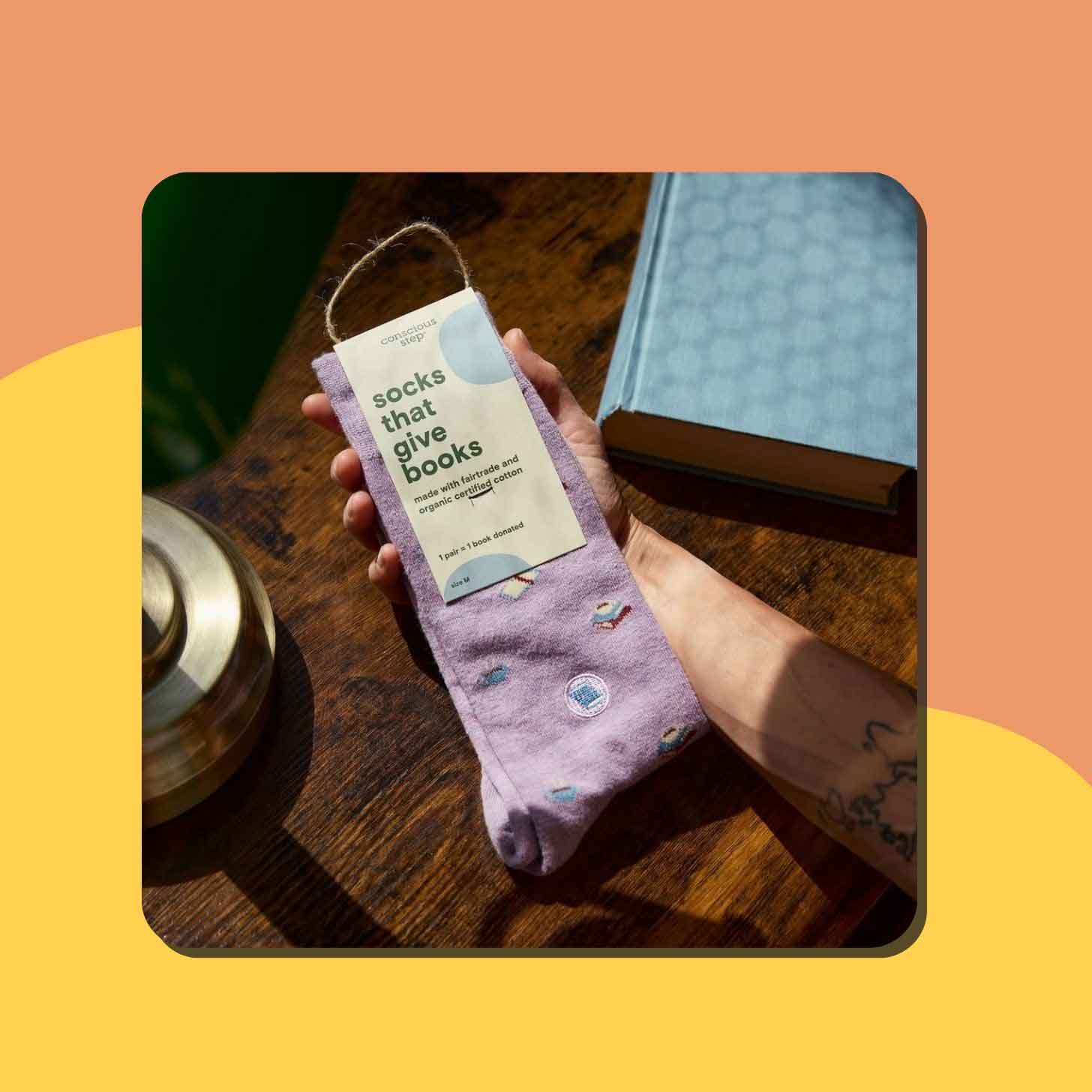
Conscious Step creates stylish, sustainable, and 100% organic cotton socks that support independent farmers while also giving back to over 20 different organizations doing good in the world.
Support a cause close to your gift recipient’s heart, all while keeping their feet warm and toasty this winter.
What’s good:
- Conscious Step is part of 1% for the Planet
- Some of their socks give back to rainforests, plant trees, restore oceans, and protect animals
- Every pair of socks is made with GOTS Organic and fair-trade certified cotton, as well as recycled polyester. These socks are also vegan-certified!
Shop: Conscious Step
Check out our full list of socks that give back to explore other options, too!
BamBaw Razor

If the person you’re shopping for cares about their personal hygiene and the planet, consider surprising them with a sustainable razor.
Bambaw’s double-edged safety razors are designed to last a lifetime, are made from high-quality materials, have a 100% bamboo handle, and stainless-steel parts.
The company even provides a user manual to help increase the lifespan of the blades, responsible recycling practices, and bonus homemade shaving recipes.
What’s good:
- Less waste than disposable plastic razors
- Plastic-free packaging
- Bambaw funds research and has partnerships with 5gyres and the Plastic Soup Foundation, advocacy groups helping address climate change
Shop: Amazon
The Goodnewspaper

We’re not trying to be biased here, but every month, our team of optimists, journalists, and artists makes a beautiful print newspaper filled with good news that we feel would bring a ton of hope and inspiration to your loved one.
We offer gift subscriptions for three, six, or 12 months — and we also recommend just picking up a subscription for yourself.
What’s good:
- Every issue is printed on recycled paper using soy-based inks
- We’ve minimized our packaging to reduce waste
- Proud to be certified 100% carbon neutral as a company — thanks to Climate Neutral.
- We’re also members of 1% for the Planet, which means we donate 1% of all Goodnewspaper revenue to environmental nonprofits
→ Subscribe to the Goodnewspaper from Good Good Good
→ Gift a subscription to the Goodnewspaper
Wooden Beard Comb

Looking for personal hair-care products for the bearded man in your life?
Jungle Culture’s pocket-sized combs are convenient gifts that can be used and carried around anywhere and are gentle on any type of facial hair.
What’s good:
- Jungle Culture designs and creates products in collaboration with small farms, craft workshops, and ethical factories
- Made with sustainable, ethically sourced wood and packaged in a reusable faux leather pouch
Shop: Jungle Culture
Non-Toxic Wax Melts from Happy Wax

Is there anything better than cozying up on the couch with a good book, a delightful scent wafting from the other side of the room?
While you might be imagining a classic candle, wax melts are a great alternative without the waste of a jar or vessel. Plus, these ones are adorably bear-shaped and make for a great stocking stuffer.
Happy Wax has all sorts of natural fragrances to create the perfect vibe for your gift recipient.
What’s good:
- Made with natural soy wax and essential oils — free of phthalates!
- A great alternative to pesky candle jars that need to be discarded responsibly. Just don’t forget a wax warmer.
If your gift recipient is more of a candle person, you can check out our full list of eco-friendly candles, too!
Full Circle Kind Organic Cotton Plant-Dyed Apron

The resident baker or cook in your life deserves to serve looks in the kitchen.
Full Circle’s Kind Organic Cotton Plant-Dyed apron is made with 100% organic cotton and colored with plant-based dyes. It's designed to be durable, functional, and eco-friendly while (of course) making the cook look damn good in it.
What’s good:
- B Corp-certified
- Use low-impact, plant-based dyes, and inks
- Organic terry cotton
- Ships in packaging made from recycled content
Shop: Full Circle
$50 and under
Cotopaxi Hip Pack

We think we’ve found the solution to overly stuffed pockets and “can I toss this in your purse” moments: Buying a fun hip pack!
Cotopaxi is an outdoor gear brand with a mission to create functional products that lift and empower communities around the world.
Its Del Día hip packs collection uses scrap fabric from excess production, significantly reducing waste that would have otherwise ended up in landfills.
Each bag is one-of-a-kind, comes in various fun colorways, and is made of durable, lightweight, 100% repurposed fabric.
What’s good:
- Made from repurposed nylon scraps
- Lifetime warranty and repairs
- B Corp and Climate Neutral certified
- Through 1% for the Planet and other foundation efforts, Cotopaxi donates and provides grants to do more good
Rechargeable Tactical LED Flashlight
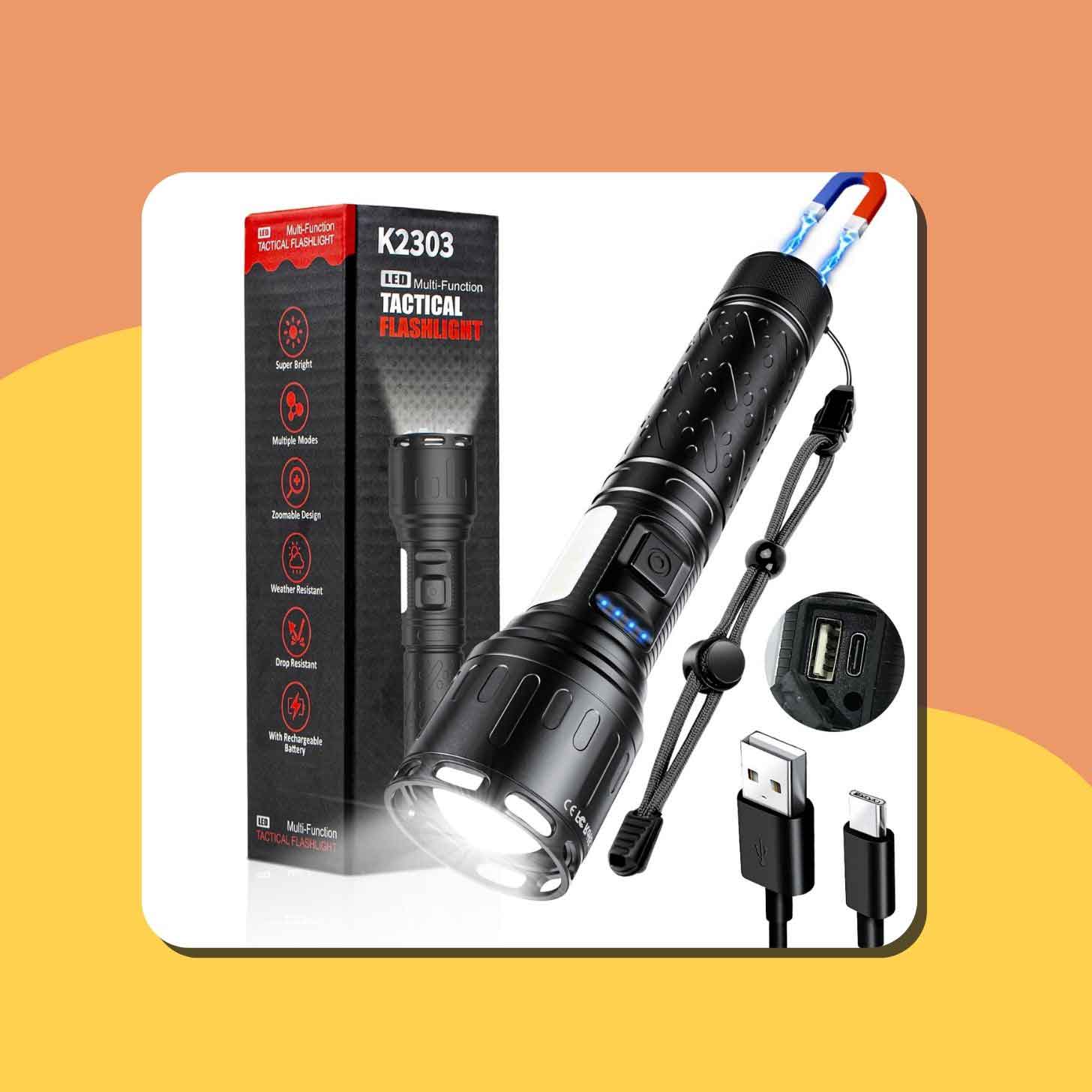
No other gift can be as handy as a tactical flashlight. From busting it out during an unexpected power outage, having it handy in your car for emergencies, or toting it along during your next camping trip, flashlights (especially rechargeable ones) are a great sustainable gift.
The DanByte rechargeable flashlight is waterproof and can switch between seven light modes. Plus, it comes in a pack of two!
What’s good:
- Made of aluminum, an infinitely recyclable material
- Rechargeable USB battery
- LED light
Shop: Amazon
Books

Speaking of curling up on your couch with a lovely scented candle and a book…
Books are the ultimate gift that keeps on giving. A good book can even inspire the bookworm in your life to create positive change! We’ve got some great book recommendations to get you started.
But before you get to shopping, consider going to a secondhand bookstore, or supporting any of these retailers:
→ Buy our favorite books from Amazon (but definitely consider our Audible alternatives and Amazon alternatives, too)
→ Buy our favorite books from Bookshop.org
→ Buy our favorite audiobooks from Libro.fm
Pact Apparel Boxer Briefs

Let’s keep the holiday underwear gifting tradition alive — but make it sustainable!
Pact makes clothing essentials with sustainability and ethics in mind, so your giftee will be comfortable and confident updating their underwear drawer.
What’s good:
- Made with 95% GOTS-certified organic cotton and 5% elastane
- Manufactured in a Fair Trade-certified factory
- Saves 11 gallons of water by using organic cotton
- This product’s carbon offset is 4.4 pounds
Shop: Pact Apparel
Cork Wallet from Corkor

Help protect your loved one’s precious items with a new vegan wallet. This Corkor billfold wallet has a minimalist design that protects cards with RFID-blocking technology.
What’s good:
- Approved animal-free by PETA
- Made with cork fabric from a sustainably managed cork oak forest
Eco Sports Vegan Leather Basketball

Sporting goods manufacturing uses a massive amount of leather and toxic materials (like PVC) that can harm people and the planet.
In an effort to provide the sporting goods world with a non-animal product, Eco Sports uses a biodegradable, recyclable, vegan material called TPU.
The company makes basketballs, footballs, soccer balls, and volleyballs for players of all ages. It even donates 10% of the profits to plant trees across the U.S.
What’s good:
- Produced entirely of eco-friendly and vegan material
- Made from a chemical-free material that is non-toxic for the planet, the ball maker, and the user
- Long-lasting and durable
- Cruelty-free
- Uses recyclable, plastic-free packaging for its products
- Donates 10% of its profits to plant trees across the U.S.
Shop: Amazon
$60 to $95
Tech Accessories from Pela

Pela makes compostable phone cases, mini wallets, phone grips, and other tech accessories that are stylish and sustainable. Not to mention the fact that they’re smooth to the touch and keep your expensive tech safe and sound.
What’s good:
- Made from flax shive and plant-based biopolymer materials
- A percentage of each sale is donated to the Ocean Cleanup and Preservation Initiatives
- The unique Pela production process uses 34% less water and creates 30% fewer carbon emissions and 80% less waste compared to plastic phone case companies
Shop: Pela
Bombas Sunday Slippers

Bombas, while known for its cozy give-back socks, also makes slippers! The Sunday Slippers are a super-soft yet sturdy slipper that keeps feet warm without sacrificing stability. No slipping and falling here!
What’s good:
- Certified B corp
- One essential clothing item donated with every purchase
- All products designed with durability in mind, with a “happiness guarantee” to keep items lasting longer
Shop: Bombas
Our Place Night & Day Glasses

Help your loved one elevate their happy hours by adding this beautiful set of colorful recycled glassware from Our Place.
What’s good:
- Each glass is sustainably made from recycled glass and sand, as well as naturally dyed
- Mailed in plastic-free packaging
- BIPOC-owned
- Offers a recycling program to keep cookware out of landfills
Shop: Our Place
Check out our full list of the best recycled glassware brands to explore other options, too!
CARIUMA Canvas Shoes

Truly, the answer to sustainability is buying quality over quantity. Seeking out companies that put attention to the entire production process is a great way to ensure that your gift will last for years to come.
CARIUMA’s canvas shoes are an example of a great staple piece to add to any closet.
What’s good:
- B Corp-certified
- For every pair purchased, two trees are planted in the Brazilian rainforest
- Soles made from natural rubber ethically gathered from the Hevea brasiliensis tree (or commonly known as the rubber tree)
- GOTS-certified cotton, grown without harmful pesticides and chemicals
- Lining, laces, threads, and labels are made from recycled plastic water bottles
- 100% vegan insole
- Recyclable packaging material
Shop: CARIUMA
$100 and more
Oakywood Laptop Stand

With the rise of remote work — especially within the last few years — chances are the person you’re shopping for has, at one time or another, browsed the internet for laptop stands as a solution to reduce eye and neck strain.
Oakywood is a small-batch woodworking workshop based out of Poland. Its wooden laptop stand is beautifully handcrafted with solid wood and steel by woodworking professionals. For every item purchased, a tree is planted.
What’s good:
- Wood used to create its products is sustainably sourced in Europe and the U.S.
- Oakywood products are Forest Stewardship Council (FSC) certified, a third-party certification that ensures its products come from responsibly managed forests that provide environmental, social, and economic benefits
- For every purchase, one tree is planted
Rumpl Blanket

For the dude who’s always camping or secretly gets chilly from the bleachers at sporting events, there’s Rumpl.
These blankets are as sleek as they are sustainable.
What’s good:
- Made with recycled plastic bottles
- Rumpl is a certified B Corp with partnerships with Climate Neutral and 1% for the Planet
Shirt Jacket from Toad&Co
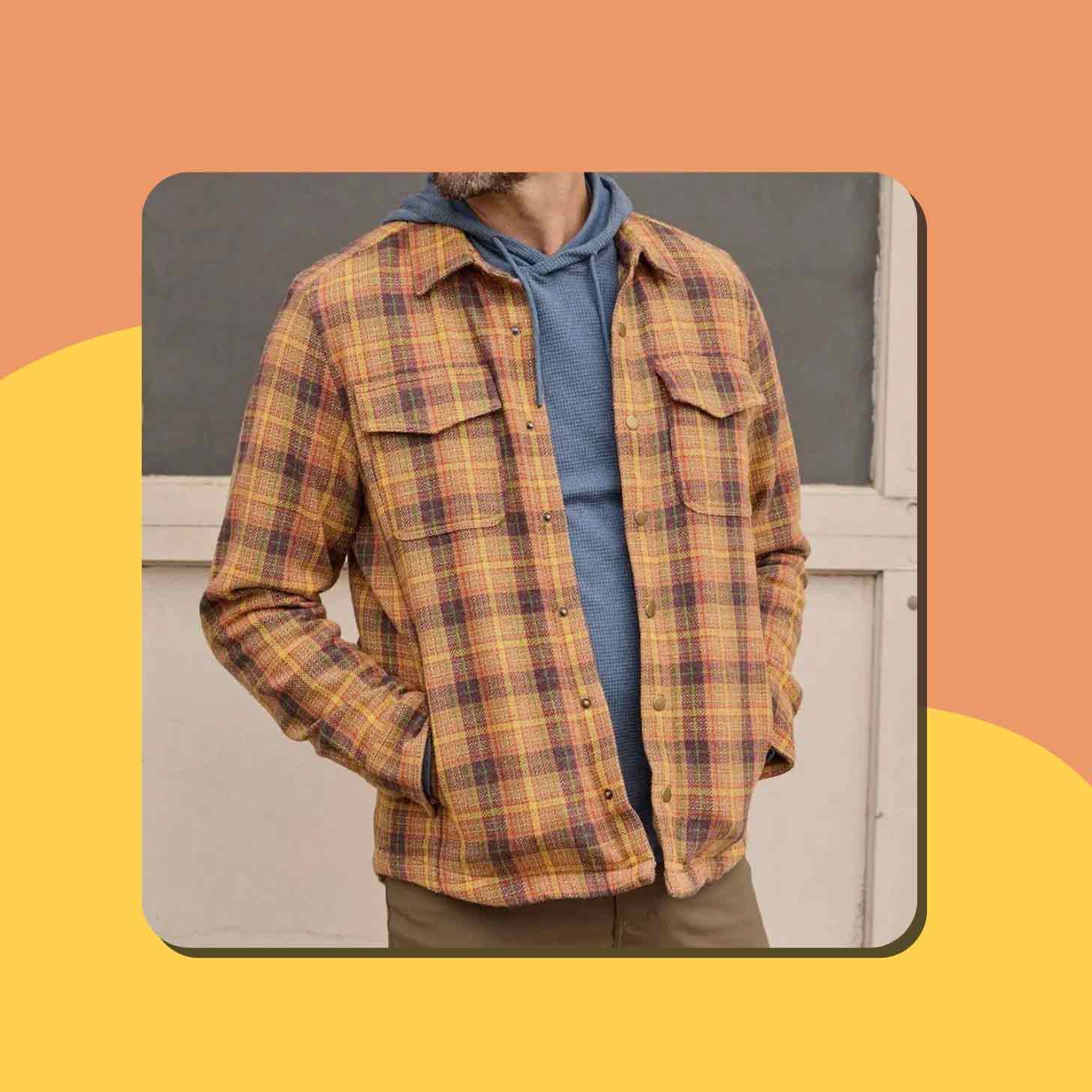
Toad&Co is a sustainable apparel company that uses renewable energy in its supply chain to reduce its climate impact.
This flannel shirt jacket is a great option for someone who likes to stay warm, cozy, and effortless all year long.
What’s good:
- Member of 1% for the Planet
- Made of organic cotton and recycled fibers
- Its use of eco-friendly materials limits the number of chemicals, water, and wastewater used in production
Shop: Toad&Co
Solgaard Carry-On Closet Suitcase
This is just us manifesting a future filled with fun weekend getaway trips for your loved one. Meet the award-winning Carry-On Closet suitcase by Solgaard, a company that uses ocean-bound plastic to make modern and practical suitcases to satisfy the avid traveler.
This carry-on luggage has a built-in shelving system to keep everything nice and organized, a USB charging port, and an indestructible shell.
What’s good:
- Climate Neutral-certified
- Certified B Corp
- 100% of products are made with sustainable materials like ocean-bound plastic and recycled aluminum
- For every item sold, 6 pounds of plastic are saved from entering the ocean
- Solgaard has partnered with organizations in The Philippines, Indonesia, and China that work with local teams in creating jobs for communities to collect ocean-bound plastic that can be upcycled. So far, these partnering organizations have collected over 3 million pounds of ocean-bound plastic
Shop: Solgaard
Lo and Sons Weekender Bag

Perhaps you’re looking for a gift for someone who loves to travel, but you don’t have it in your budget to purchase eco-friendly luggage quite yet. That’s where the very handy weekender bag comes in.
Lo and Sons’ Weekender Bag is a great gift for those who love to take short weekend vacations, extended trips, and even visits to the gym!
Extremely versatile and durable, it includes a button compartment for shoes or dirty clothes, multiple zippers and pockets for our organized-obsessed friends, and a suitcase handle sleeve for those who intend on using it to travel.
What’s good:
- Made of recycled polyester or organic and recycled cotton material (depending on the style chosen)
- Sustainably packaged and shipped
Shop: Lo & Sons
Garrison Hines would spend all of his time growing food if he could. The ironworker from Philadelphia developed a passion for farming in 2018 when an urban gardener showed him a mulberry tree, which produces fruit similar to blackberries.
Although Hines had visited an apple orchard as a kid, that mulberry was the first tree he realized could be harvested near his home.
They’re all around the city, the gardener told him. Hines had no idea.
Working on various urban greening projects through a job-training program helped Hines “see the city in a way I’d never seen Philadelphia before.”
To him, it became a place that could produce a bounty of food, particularly in neighborhoods like North Philly, where he grew up.
After volunteering at Philadelphia Orchard Project, Hines planted his own orchard in 2021.
“I already had the site that I wanted to use in mind,” he says. “[It] has been an empty lot my entire life.”
Today, he and community volunteers tend to 14 different fruit trees — from apple to elderberry — on that transformed piece of land.
North Philly isn’t the only place where land is coming alive. In cities across the United States, people struggling with food insecurity and lack of green space are looking to urban food production to tackle both.
Covering more surfaces in vegetation can mitigate the heat island effect that disproportionately affects low-income communities and will only become more dangerous as the world warms. It can also provide a much needed source of fresh produce.
While many are familiar with growing vegetables in backyards, rooftops, and urban farms, there’s another approach gaining popularity among policymakers, nonprofits, and residents: planting food-bearing trees.
With fruit trees in almost every neighborhood, Philadelphia provides a roadmap for others to follow. A residential tree-giveaway program, a community-informed strategic plan for tree cover, and collaboration with the nonprofit Philadelphia Orchard Project (POP) are just a few ways the city is working to bring food-bearing trees to neighborhoods most in need.
In addition, residents, joined by community gardens, schools, and hospitals, are driving the trend.
In just 15 years, POP has helped 67 sites grow stands of anywhere from three to a couple hundred food-bearing trees, bushes, vines, and other plants.
In that time, many tons of fruit and nuts have made their way into people’s mouths, often at no cost to them.
While research about the potential of this urban food source is limited, a 2012 analysis of Burlington, Vermont, which has a strong local-food movement, found that even in a colder climate, fruit trees could have a significant impact on food security.
Dotting just 5 percent of open space with apple trees could help as much as 20 percent of Burlington’s food-insecure population reach its daily fruit requirements.
Hines, through North Roots Orchards and his volunteer work, is among those helping this movement grow in Philadelphia. “I quickly realized that this is something that more people in my area needed access to,” he says. “So I’m just trying to find ways to create more.”
In Philadelphia, roughly one in six households are food insecure. That’s higher than the national average of 12 percent and has been for years.
According to a 2019 report by the city’s health department, the lowest-income census tracts have about 28 percent fewer “high-produce” stores than wealthier areas. “Since I’ve been working in urban agriculture, [my family] has really been clamoring to get more fresh produce,” says Hines. “They always ask me.”
Neighborhoods most impacted by a lack of fresh food are under-resourced in other ways, too. An analysis of Philadelphia’s tree cover in 2008 found that while some wealthy areas had as much as 83 percent coverage, there were low-income neighborhoods with almost none, leaving them with hotter summers and poorer air quality.
In an effort to mitigate that inequity, the parks and recreation department and Fairmount Park Conservancy spearheaded TreePhilly, a yard tree-giveaway program to help reach then-Mayor Michael Nutter’s goal of at least 30 percent coverage in every neighborhood by 2025.
(The city’s forthcoming tree plan will direct even more resources toward this ambitious goal, including recommendations for foresting public areas.)
Although the program didn’t initially target food insecurity directly, its staff noticed a trend: People wanted trees they could eat from.
“We really did hear from residents that food-bearing trees are important,” says Marisa Wilson, the urban forestry community organizer with Philadelphia’s parks and recreation department.
Wilson learned from residents that the trees were more than a source of calories — they provided people with an opportunity to grow and harvest culturally significant foods, a process some had been divorced from as a result of migration.
TreePhilly has given away over 25,000 trees in the last decade. In recent years, roughly 40 percent have been food-producing trees.
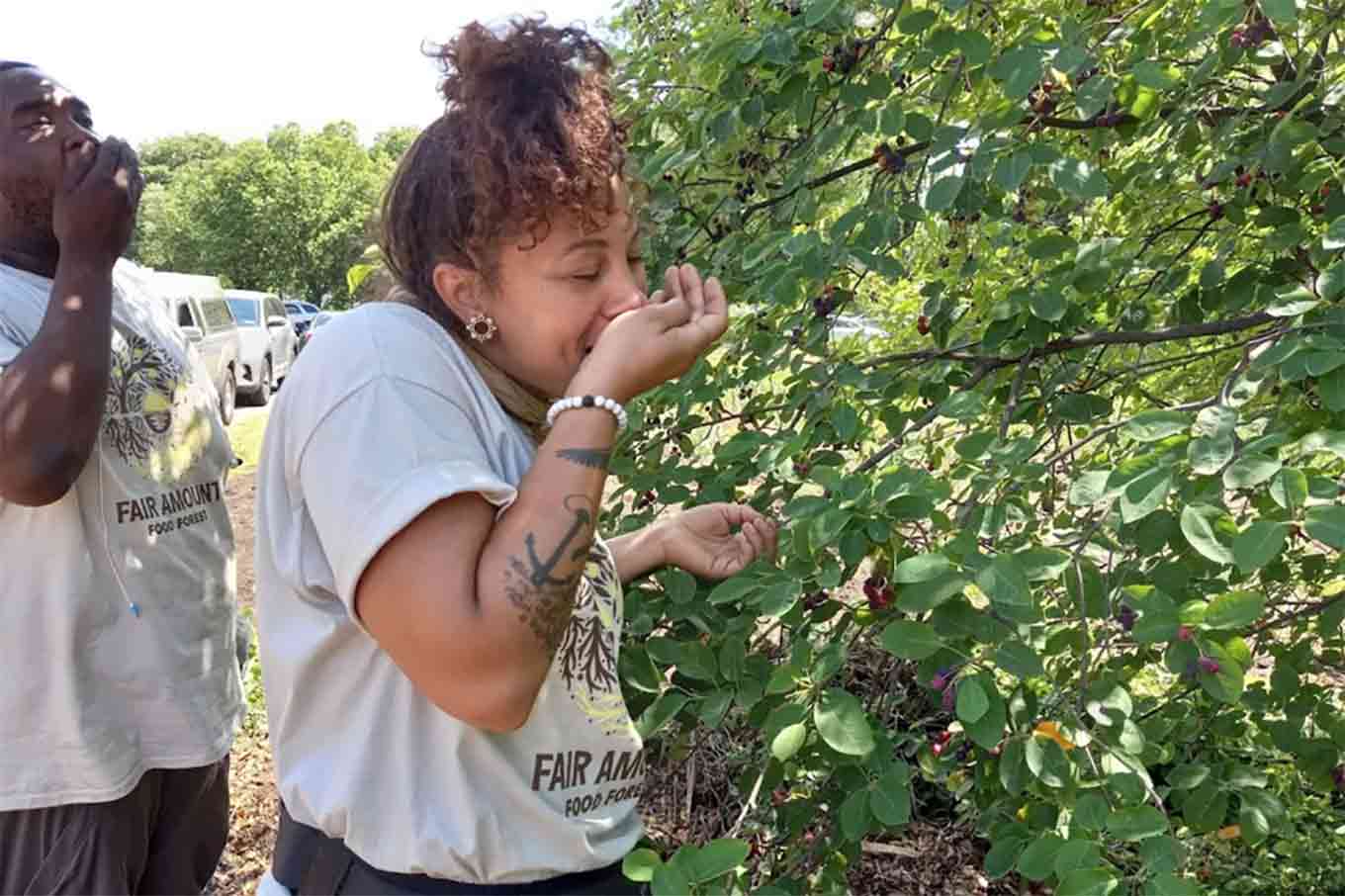
Philadelphia isn’t the only city with a hunger for apples, plums, and figs. In Baltimore, urban forester Ted Martello sees similar trends in the TreeBaltimore program, which has given away thousands of food-bearing trees in the past decade.
“I like to joke that people are foaming at the mouth to plant these trees,” says Martello, who works at the city’s recreation and parks department. “We’re committed to simply expanding the tree canopy. Fruit trees tie into that.”
Roughly half of the bounty harvested from POP’s 67 partner sites — a few tons each year — is given to food pantries, sold at affordable prices at farmers markets, or simply picked by passersby looking for a snack.
An estimated 6,532 Philadelphians tasted something grown in one of these orchards in 2019.
Hines, who volunteers with POP, helps harvest produce from Fair Amount Food Forest, which grows vegetables as well as fruit in Philadelphia’s Fairmount Park.
“We are producing anywhere from 200 to 300 pounds of produce a week, which is given out weekly and is gone within minutes,” Hines says.
And with saplings and berry bushes that will start bearing fruit in the coming years, that will only increase.
“So in the future, it’s going to be way more abundant. A lot of people can eat off a small plot of land.”
Part of what makes trees so impactful is that a healthy one can give generously for decades, if not longer.
While vegetable farming requires planting anew every season, trees do not, says Nina Beth Cardin, rabbi and founder of the Baltimore Orchard Project, which works with TreeBaltimore.
“They’re … for people who will come five years from now, 10 years from now, people who are in the next generation,” she says.
Trees also don’t require much space. Baltimore is planting them on sidewalks and other areas currently covered in concrete. Martello says there are thousands of open spaces between existing trees or on streets with minimal tree cover.
To populate a city with so many trees and keep them bearing fruit requires a know-how for pruning, applying compost, and dealing with pests. “One of our goals is to really help our partners increase their productivity,” says Kim Jordan, POP’s co-executive director.
Such care will be even more important as climate change brings warmer weather, more rain, and greater susceptibility to disease. POP is experimenting with varietals that will be heartiest in these conditions, like Asian pears, pawpaws, figs, and persimmons.
In Baltimore, Martello says that white swamp oak, which provides acorns that can be ground into flour, will do much better than the standard white oaks that are struggling under too much rainfall in the area.
Maximizing the potential of urban fruit trees also includes exposing people to less common foods and preparations. For example, most people don’t think to harvest acorns, but Martello points out that they have long been a key ingredient in Indigenous diets.
Others may not be familiar with pawpaw, which tastes like a banana. Norris Square, an orchard site in a primarily Latino neighborhood in Philadelphia, is offering a pawpaw hot sauce-making workshop to inspire people to use new ingredients in traditional dishes.
“My dream is that residents have the resources they need to pursue food production in the ways that best benefit them and connect them to their neighbors, culture, and ancestors,” says Wilson.
She and others doing this work believe in a future where trees are abundant and where everyday people steward them.
They see residents filling backyards, parks, and vacant lots with berries, bushes, and vines — tapping into their lineages to find points of connection to the process of tending, harvesting, and preparing the abundance.
If their vision becomes reality, cities will be lined with food-bearing trees, children will pick pawpaws and apples on their way to school, and all will thrive beneath a canopy of green.
“It really is a miracle watching fruit develop on trees,” Cardin says, “and to have communities witness that season after season.”
When Katie Lopes set out to create a women’s underwear brand, she wanted her products to be comfortable and hip — and eventually disappear into a pile of coffee grounds, eggshells and potato peels in her garden.
“I was beginning to become more aware of the damage the fashion industry was doing to the planet, so it would have been irresponsible not to take this information into account,” said Lopes, who founded Stripe & Stare, an intimate apparel brand, in 2017.
Lopes said she chose to focus on underwear because so few people feel comfortable buying it second-hand.
“Producing it right and avoiding the landfill was very important,” she said.
Stripe & Stare is among a growing number of clothing brands, including H&M and Stella McCartney, marketing biodegradable clothing that they say can be disposed of in a compost bin.
The fashion industry accounts for up to 8% of global carbon dioxide emissions, according to the United Nations Environment Programme.
That’s more than global shipping and air travel combined. Most of those clothes — about 84% — end up in landfills or incinerators.
In the United States alone, more than 11 million tons of textile waste ended up in landfills in 2018, according to the Environmental Protection Agency’s most recent data.
It doesn’t have to be that way, said Natalie Patricia, the founder of Harvest & Mill, whose clothes are made entirely from U.S.-sourced organic cotton.
“Organic cotton is a plant grown on a farm just like our food is. And so it can and should be composted and returned to the soil,” Patricia said.
Composting refers to the process of recycling organic matter — in most households, that means food scraps and yard waste, like leaves — into fertilizer.
Because composting is an aerobic process, it does not produce methane, a potent greenhouse gas that organic materials emit when they decompose in oxygen-starved landfills.
However, it’s not enough for the fabric to simply be made from natural fibers, such as cotton, silk and wool, to compost it. Many brands treat their clothing with so-called forever chemicals to make them waterproof or stain- or wrinkle-resistant.
“There are a lot of brands out there who say they’re compostable, but they just mean they’re using cotton or linen or hemp. Their dyes, the seams of every piece aren’t [compostable],” said Katherine Quigley, whose company, Sustain, uses all plant-based dyes.
In order to make her line fully compostable, she had to work with manufacturers who agreed to use cotton sewing thread. “They all want to use polyester, which just means – unless you’re cutting out every seam – it’s not compostable,” she said.
But even if every last seam is made from organic material, few composting facilities take textile waste. It is difficult to verify the fabric content and they can’t risk contamination, said Paul Foulkes-Arellano, founder of Circuthon, a management consultancy that helps businesses transition to circular economies.
“They do not want fabrics. They do not want compostable footwear. They don’t want anything to do with the fashion industry because they are set up for packaging and food,” he said.
Foulkes-Arellano, who is based in London and has studied textile disposal systems in Europe, said for composting to make a meaningful difference, it would need to be at a large scale, like at the government level — not at a brand level.
“Unless a brand guarantees to collect all its own garments it’s wishful thinking,” he said.
Patricia, of Harvest & Mill, said her company is working with the nonprofit Fibershed to test composting conditions with municipal and private facilities in California.
If they’re able to get those facilities on board, Patricia said it would allow Harvest & Mill to create a composting “take-back” program.
“[Composting] is one of those big problems that, at least right now, must be solved by fashion brands and waste stream systems and not just left to individual consumers because most individual consumers don’t have their own personal compost bin pile,” said Patricia.
Even if you compost in your backyard, there’s still the question of if you want to risk composting fabric, and whether it would help your flowers bloom or your lettuce grow.
“There are very few pieces of clothing that can be safely composted,” said Alden Wicker, author of the forthcoming book To Dye For: How Toxic Fashion is Making Us Sick. She said that when clothing decomposes, it risks leaching toxic dyes and finishes into the soil.
Adopting universal compost standards for textile waste could be one way to help consumers safely dispose of old clothes, she said, but until then, “I would never recommend someone put it in their backyard compost, especially for amending soil to grow food.”
Foulkes-Arellano said he sees more promise in textile recycling. “I believe in keeping things going around the loop, and we now know cotton can be recycled,” said Foulkes-Arellano.
In Sweden, a textile recycling company recently adapted a massive paper factory to process clothing. “We can now put jeans, cotton t-shirts, cotton socks into this converted paper factory and out the other side comes new cotton textile,” he said.
Only about 15% of clothing in the U.S. is recycled, according to the EPA, but Foulkes-Arellano said the factory in Sweden might portend wider-spread adoption of textile recycling.
Of course, the amount of clothing being recycled, composted or, more often, sent to the landfill points to the bigger problem: there’s simply too much of it being produced.
A 2016 World Economic Forum report estimated 150 billion new garments are created each year. The number of clothing items produced each year doubled between 2000 and 2014, according to the consulting firm McKinsey.
And it’s not just harmful to the environment: All that clothing production requires cheap, mostly unregulated labor. It’s estimated that 98% of fast fashion factory workers don’t make a living wage.
“What we need to do is just get away from this idea that clothing is disposable,” said Quigley. “If you look back, even to the first half of the 20th century, wardrobes were a fifth of our size, but they were paying more,” and the items lasted much longer.
A cotton t-shirt from Sustain costs around $48, or about twice as much as a similar shirt from the Gap. Quigley said she believes new government policies could even the playing field between fast-fashion brands and companies like hers.
She said supports higher taxes on high-polluting fast fashion companies or incentives for companies to manufacture domestically.
“One thing that could really help is if the government started making clothing companies responsible for the full life cycle of their clothing,” Quigley said. “If a piece of polyester clothing actually incorporated the cost of what it takes to recycle or clean up the end-life of that clothing, it would inevitably cost more.”
When consumers pay $56 for a t-shirt from Stripe & Stare, Lopes’ brand, they’re paying for carbon offsets, high labor standards and state-of-the-art, biodegradable materials, she said.
Consumers might not like paying more, Lopes conceded.
But, she added, “We try really hard to support the idea of buying less and buying it better.”