The Kino Bay Turtle Group is made up of a family of former fishers from the state of Sonora in northwestern Mexico.
— The group keeps a close watch on sea turtles in the La Cruz Lagoon, a Ramsar site spanning 6,665 hectares (about 16,470 acres), monitoring the animals, rescuing any that become entangled and educating the public about their importance.
— The group has captured and logged data on more than 800 sea turtles.
— It is now training a team of Indigenous Comcáac youth to form their own turtle group and begin monitoring and conservation work along a 10-kilometer (6-mile) stretch of coast in Sonora.

For several years, Cosme Becerra was tasked with sacrificing a sea turtle to be eaten at a festival. In the mid-1990s, the fisherman received a large live turtle several days before one of these events.
He kept the turtle in his family’s bathroom, waiting for the day of the festival. “But it wouldn’t stop making a noise … ‘hoooo’… ‘hoooo,’” said Becerra, imitating the animal’s wheeze that he heard night after night.
“That sigh — that noise — wouldn’t let me sleep,” said Becerra. “On one side, I was hearing it, and on the other side, Moni, my wife, would not let me sleep, saying to me: ‘Poor little thing, she looks like a woman; look at how she’s crying. Did you see her tears? They’re all over the floor. … Let her go, please.’”
Although he did not want to, because the turtle “belonged” to somebody else, Mónica’s insistence made Becerra return the turtle to the sea the following day.
“We released her, and since then, we have not gone back to consuming turtles or killing them,” Becerra said of that moment, which is seared in his memory.
Before a Mexican law prohibited the practice in 1990, fishers saw turtles they occasionally caught by accident as a source of extra income that could help in the event of an economic emergency, like when one of the children in the Becerra family was hospitalized.
For that reason, years later, in 2010, Cosme Becerra wanted to return the favor: He decided to formally dedicate his time to the conservation of turtles in Kino Bay (or Bahía de Kino), a small fishing community with just over 6,400 residents located in the state of Sonora in northwestern Mexico.

Cosme Becerra left the fishing industry, and since 2007 he has worked as a boat captain for marine mammal-monitoring efforts run by the Prescott Center, an Arizona-based educational institution with facilities in Kino Bay that focuses on social and environmental studies.
Through this work, Becerra convinced his family that the future was in wildlife conservation.
Now, the Becerra family — made up of about 15 relatives, including spouses, parents, siblings, cousins, children and grandchildren — practices sustainable fishing.
They combine this with other professions and dedicate part of their time to conservation work.
In order to fund this conservation work, they turn to programs offered by nongovernmental organizations or environmental institutions within the Mexican government.
However, the group has not always managed to obtain what they need to go out to sea and monitor sea turtles.
In any case, the family invested their savings and income to buy a boat, which they named “La Tortuguera” after the Spanish word for turtle. They now use this boat to monitor turtles and rescue them from abandoned fishing gear.
Together, the family formed the Kino Bay Turtle Group (or Grupo Tortuguero de Bahía de Kino).
“Now we are trying to flip the coin over and — with our work — thank these species. It is satisfying to feel highlighted by the community, by the people, by the children,” said Becerra.
Today, with their 12 years of work, the family has captured, documented and released 814 green sea turtles (Chelonia mydas) and olive ridley sea turtles (Lepidochelys olivacea).

The La Cruz Lagoon: a wetland of international importance
The Becerra family’s monitoring work focuses on the La Cruz Lagoon (known as the Laguna La Cruz or Estero Santa Cruz in Spanish).
The lagoon, a Ramsar site that spans 6,665 hectares (about 16,470 acres), is home to numerous species, some of them protected by national and international laws.
Among them are 11 species of birds at some level of risk according to the IUCN, like the near-threatened elegant tern (Thalasseus elegans). Two species of plants are listed as threatened by Mexico: the black mangrove (Avicennia germinans) and the red mangrove (Rhizophora mangle).
The endangered green sea turtle is the Kino Bay Turtle Group‘s main research subject because it is the most common turtle species in the wetland, which is an important feeding area for them.

The La Cruz Lagoon is a silent place, its calmness only broken by the occasional passage of a motorboat. Its still waters, which are no more than 5 meters (about 16 feet) deep in some areas, are threatened by shrimp farms.
According to its Ramsar document, published in 2013, the lagoon’s 16 shrimp farms include more than 4,507 hectares (about 11,137 acres) of ponds. Four of these ponds extract water from a channel that connects to the lagoon and then discharge their effluent into another channel located less than 500 meters (1,640 feet) from the lagoon.
This has caused significantly elevated saline levels, and even though the lagoon has the ability to dilute the salinity, “it [shows] changes generated by these effluents due to the accumulation of solids, organic material, primary productivity, and bacterial biomass, which affects biogeochemical processes and environmental conditions,” according to the document.
The Kino Bay Turtle Group began working formally in this area in 2010, when it received funding for sea turtle conservation from the Conservation Program for Sustainable Development of the National Commission of Protected Natural Areas (CONANP).
The group used the funding to bring in instructors from the Las Californias Turtle Group, a network based in La Paz, Baja California Sur, to train the team both in theory and in practice, with a first monitoring of turtles on San Pedro Mártir Island.
“From there, we have been monitoring turtles [and] doing surveillance and sanitation in the lagoon, which then became a Ramsar site between 2013 and 2014,” said Becerra.

Karen Oceguera, a marine biologist and representative of the Las Californias Turtle Group, said the work of the Kino Bay team has been instrumental in determining the population status of the turtles that visit this feeding and development area.
“This team, led by Cosme Becerra, has been an example of perseverance and commitment to continue moving forward,” said Oceguera.
“The data generated by the capture, tagging and release [of the turtles] have been the basis for having a broader knowledge of sea turtles in feeding areas. Thanks to the tagging [that they do] with metal plates that are placed on each captured turtle, when they are captured again — or recaptured — it provides very valuable information about their growth and, on occasion, turtles are captured that have been tagged in other areas [of the country] where this monitoring is done, and that indicates the movement of the turtles in different areas,” said Oceguera.
Over the years, the Kino Bay Turtle Group completed several government trainings from CONANP and received a certification from the Federal Attorney for Environmental Protection, in addition to working with academic institutions like the National Polytechnic Institute of Mexico and the Las Californias Turtle Group.
The group is also constantly searching for resources through federal programs to help maintain the project. At the same time, they made important allies, like the Prescott Center, which has managed to receive international funding for the monitoring sessions.
For the group’s work, in late 2020, Cosme Becerra received the Recognition for the Conservation of Nature, an award granted every year by CONANP.

Rodrigo Trejo, coordinator of the Prescott Center’s Wetland Conservation and Community Projects Program , said the information generated by the Kino Bay Turtle Group in the La Cruz Lagoon and through community science is very valuable. He added that this work is generally carried out by universities or research centers, and local knowledge is not always recognized.
“But here, those who are generating the information are the community [members], and that is more important and more interesting,” Trejo said.
“At some point, Cosme Becerra sold or consumed turtles, so it is these same people who have had a paradigm shift — a deconstruction of the practices that their community had — [and] these are the same ones who are generating research and scientific databases. I believe this speaks to empowerment [and] to community development at a local level that is worth encouraging,” he said.
Today, in addition to monitoring turtles, the Kino Bay Turtle Group is dedicated to environmental education in elementary schools and with groups of high schoolers interested in ecology.
The group also works with students from the U.S. who visit the Prescott Center and with fishers, whom they have educated to turn in any sea turtles that they encounter entangled in ghost fishing gear.

A new turtle group in Comcáac territory
The Becerra family is now leading an important effort: training a team of Indigenous Comcáac youth between the ages of 14 and 22 to form their own turtle group and begin monitoring and conservation work along a 10-kilometer (6-mile) stretch of coast from the neighboring community of Punta Chueca — where the Comcáac live — north to the Infiernillo Channel.
The Infiernillo Channel is a Ramsar site characterized by seagrass beds, mangrove estuaries and small coral reefs.
These reefs are home to hawksbill (Eretmochelys imbricata), loggerhead (Caretta caretta), leatherback (Dermochelys coriacea), olive ridley (Lepidochelys olivacea) and green sea turtles, among many other marine species.
One morning in May 2022, five of the 10 young people who make up the new group climbed aboard La Tortuguera with Cosme Becerra and two of his relatives to complete their second training session.
There, they were trained to capture turtles using a 130-meter (427-foot) nylon net that they stretch out just past the beach and to sharpen their gaze so they could identify the moment when a turtle is caught.
When this happens, the attached buoys sink and the turtle comes out to breathe, wanting to free itself.
At that moment, the boat heads toward the turtle to take the animal on board and prevent it from experiencing stress.
During this particular training session, this process occurred seven times.

These turtles were then taken to the beach to be measured, weighed, tagged with plates on their hind flippers, recorded and released.
There, girls, boys and adults approached out of curiosity to see the animals.
Members of the Kino Bay Turtle Group explained the importance of their work, step by step, as they often do in order to raise awareness.
The team also works to identify abnormalities in the turtles. In a few, they detected fibropapillomatosis, a disease that causes wart-like tumors, which Becerra attributes to heavy metal pollution in the ocean.
All of this information is collected and sent by the Las Californias Turtle Group to be fed into a database that contributes to scientific research and conservation.

Becerra added that the number of turtles observed in the lagoon has increased over the years, but this is not necessarily due to these migratory species visiting the area more, because the team also increased its monitoring efforts with more trips to the area per month.
“There are years when we have no support and there are years when we have twice as much [as normal],” said Becerra.
“Before, we only used to catch between 40 and a maximum of 80 turtles per year. … Now, we are catching between 130 and 140. For 2022, I believe we will surpass that mark, because every year we are working more than the year before, but that is because of our effort and because we have more support,” said Becerra.

Aarón Barnett is a 28-year-old Comcáac conservationist and leader of the new turtle group due to his experience with environmental topics in his ancestral territory since he was very young.
He said his culture is closely linked to marine life, as a fishing community. However, they have a special appreciation for sea turtles because they are part of the community’s worldview.
According to the Comcáac people, it was a sea turtle that helped Hant Caai, their creator, to form the Earth using sand that it brought from the bottom of the sea between its claws.
“There is an exchange of knowledge, which is important, because in some way, we also contribute to conservation in a natural way,” said Barnett.
“We are always on the lookout for the well-being of all the species in the region because we depend on this; we are fishers; we are a community that depends on the sea. So, both in the sea and on land, we are always watching. For this reason, we are ready to share this information so that more people know about it and become interested in caring for the land,” he said.

In the past, sea turtles also served as food for the ancestors of the Comcáac people. The turtles helped them survive in difficult times, so Barnett agrees with Becerra that it is time to return the favor to the animals.
“Thanks to this species, our tribe managed to survive,” said Barnett.
“Because of them we are still here, and the commitment that we have as a new generation is to take care of them. We want more people to be conscious of the consumption of this species because even today, there are people who do not acknowledge all of this and they promote these illegal sales. We are a new, more conscious generation, and joining this cause is everyone’s commitment — not only here in this region, but all over the world, because this is a very beautiful species that has given us so many things.”

According to Cosme Becerra, having a partner team working in the Infiernillo Channel is important because many helping hands will always be needed — here and throughout the world.
“We are in a lagoon that only measures 6,000 hectares [about 14,826 acres]and it is very important, because we are capturing turtles,” said Becerra.
“But they have a channel of 29,000 hectares [about 71,661 acres] and 32 kilometers [about 20 miles] in length. They have the best-conserved seagrass beds, the turtles’ favorite; for that reason, it’s super important. These are the youth of the future who are teaching and raising awareness in their community to help stop consumption,” said Becerra.
Advocacy is the lifeblood of change, the driving force behind many of the positive shifts we’ve seen in society.
Whether it’s advocating for social justice, environmental sustainability, or human rights, advocacy is about standing up and making your voice heard for the causes that matter.
It’s about uniting with others to create a ripple effect of positive change — one that transcends borders and demographics.
Advocates come from all walks of life — activists, artists, journalists, educators, and everyday people who decide to make a stand.
People like Malala Yousafzai, Nelson Mandela, and Ruth Bader Ginsburg have left indelible marks on the world through their advocacy, proving that one voice can indeed make a difference. But you don’t have to be famous to be an advocate; even small actions, when multiplied by millions, can lead to transformative change.
In this collection, we’ve curated some of the most impactful quotes about advocacy to inspire you to take action.
These words encapsulate the power of standing up for what you believe in and provide valuable perspectives on how advocacy shapes the world we live in.
Whether you’re a seasoned advocate or just getting started, these quotes will fuel your passion and remind you of the critical role advocacy plays in creating a better world for all.
Read on to become inspired and motivated to make your own positive difference:
You might also like: Best Quotes About Activism | Best Quotes About Making a Difference | Best Social Justice Quotes | Types of Activism
Explore These Advocacy Quotes
Famous Quotes
“I am no longer accepting the things I cannot change. I am changing the things I cannot accept.”
— Angela Davis

“We’re all citizens of this country, and we all have to use whatever platform we have to speak to the values that we believe in and things that we feel must happen.”
— Jane Fonda
“Never be afraid to raise your voice for honesty and truth and compassion against injustice and lying and greed. If people all over the world… would do this, it would change the earth.”
— William Faulkner
“You can not protect the environment unless you empower people, you inform them, and you help them understand that these resources are their own, that they MUST protect them.”
— Wangari Maathai
“When the world is silent, even one voice becomes powerful.”
— Malala Yousafzai

“One of the most crucial kinds of intervention is in advocacy. We can think about charities in the context of delivering services, and indeed that is part of their job, but advocacy is also getting governments to step up to the plate. They can also give more voice to those who don’t have one.”
— Nicholas Kristof
“If you believe you can make a difference, not just in politics, in public service, in advocacy around all these important issues, then you have to be prepared to accept that you are not going to get 100 percent approval.”
— Hillary Clinton
“Saving our planet, lifting people out of poverty, advancing economic growth… These are one and the same fight. We must connect the dots between climate change, water scarcity, energy shortages, global health, food security, and women’s empowerment. Solutions to one problem must be solutions for all.”
— Emma Watson

“We must always take sides. Neutrality helps the oppressor, never the victim. Silence encourages the tormentor, never the tormented.”
— Elie Wiesel
“To be an activist is to speak. To be an advocate is to listen. Society can’t move forward without both.”
— Eva Lewis
Self-Advocacy Quotes
“I learned a long time ago the wisest thing I can do is be on my own side, be an advocate for myself and others like me.”
— Maya Angelou

“When you doubt your power, you give power to your doubt.”
— Honore de Balzac
“In any given moment, we have two options: to step forward into growth or to step back into safety.”
— Abraham Maslow
“They always say time changes things, but you actually have to change them yourself.”
— Andy Warhol

Environmental Advocacy Quotes
“My advocacy is based on the understanding that our environment is our inheritance, and we have to protect it or we face the consequences. We’d rather act now, as we can’t keep watching more people die as a result of climate change.”
— Nyombi Morris
“Personal action changes who we are, it changes people around us, and it can help us change the world. Greta Thunberg is the epitome of what I’m saying. She was, as many young people are, very anxious about climate change — and who wouldn’t be? So, she convinced her family to stop flying and they changed their diets. But if that was all they had done, nobody would ever know her name and the Fridays for Future strikes would not exist. She took a piece of cardboard, wrote on it, sat outside parliament, and changed the world.”
— Dolly Parton
“A very Faustian choice is upon us: whether to accept our corrosive and risky behavior as the unavoidable price of population and economic growth, or to take stock of ourselves and search for a new environmental ethic.”
— E. O. Wilson
“For children and young people, climate change is the single greatest threat to our futures. We are the ones who will have to clean up the mess you adults have made, and we are the ones who are more likely to suffer now.”
— Greta Thunberg, Adriana Calderon, Farzana Faruk Jhuma, and Eric Njuguna, in an article in The New York Times
“Raising awareness on the most pressing environmental issues of our time is more important than ever.”
— Leonardo DiCaprio
“Each of us can contribute, though. With our votes, our voices, our food choices, our skills and our dollars. We must overhaul both corporate practices and government policies. We must transform culture. Building community around solutions is the most important thing. I am never going to give up working to protect and restore this magnificent planet. Every bit of habitat we preserve, every tenth of a degree of warming we prevent, really does matter. Thankfully, I’m not motivated by hope, but rather a desire to be useful.”
— Dr. Ayana Elizabeth Johnson, in a TED Talk
“You cannot protect the environment unless you empower people, you inform them, and you help them understand that these resources are their own that they must protect.”
— Wangari Maathai
Mental Health Advocacy Quotes
“The experience I have had is that once you start talking about [experiencing a mental health struggle], you realize that actually you’re part of quite a big club.”
— Prince Harry

“Anyone can be affected, despite their level of success or their place on the food chain. In fact, there is a good chance you know someone who is struggling with it since nearly 20% of American adults face some form of mental illness in their lifetime. So why aren’t we talking about it?”
— Kristen Bell
“Be dedicated to change the way in which people see mental illness at all levels of society. If not for yourself, advocate for those who are struggling in silence.”
— Germany Kent

LGBTQ+ Advocacy Quotes
“LGBT people are some of the bravest and most potent change agents and leaders I have encountered, and the most forceful defenders of the vulnerable and voiceless because they know what it’s like to be there.”
— Ronan Farrow

“There are sharply different, competing models of what trans advocacy looks like — those that seek to follow the path laid out by the most visible and well-funded lesbian and gay rights organizations in the US and those that seek to use grassroots strategies, center issues of race and poverty, and aim to dismantle harmful institutions and conditions to redistribute life chances.”
— Dean Spade
“It takes no compromise to give people their rights... it takes no money to respect the individual. It takes no political deal to give people freedom. It takes no survey to remove repression.”
— Harvey Milk
“This community has fought and continues to fight a war of acceptance, a war of tolerance and the most relentless bravery. You are the definition of courage, do you know that?”
— Lady Gaga

Disability Advocacy Quotes
“We must be treated as equals — and communication is the way we can bring this about.”
— Louis Braille
“The ADA was a wonderful achievement. But it was only the tip of the iceberg. You can pass a law but until you can change society’s attitudes, that law won’t mean much.”
— Denise Sherer Jacobson
“Silence is the last thing the world will ever hear from me.”
— Marlee Matlin
“We need to make every single thing accessible to every single person with a disability.”
— Stevie Wonder
“People with disabilities are the largest minority in the world, and we are the most underrepresented in entertainment.”
— Maysoon Zayid
“If we are to achieve a richer culture, we must weave one in which each diverse human gift will find a fitting place.”
— Margaret Mead
“We, the ones who are challenged, need to be heard. To be seen not as a disability, but as a person who has and will continue to bloom. To be seen not only as a handicap, but as a well intact human being.”
— Robert M. Hensel
“Part of the problem is that we tend to think that equality is about treating everyone the same, when it’s not. It’s about fairness. It’s about equity of access.”
— Judy Heumann
Inspiring Advocacy Quotes
“When enough people come together, then change will come and we can achieve almost anything. So instead of looking for hope — start creating it.”
— Greta Thunberg

“Capitalism does not permit an even flow of economic resources. With this system, a small privileged few are rich beyond conscious, and almost all others are doomed to be poor at some level. That’s the way the system works. And since we know that the system will not change the rules, we are going to have to change the system.”
— Martin Luther King Jr.
“I believe that just as racism is systemic, because of centuries of oppression, sexism is systemic. A construct of the system. But the good news is that what has been constructed can be deconstructed. But to do that, you have to learn to recognize it, to question it, and to accept that the system must change.”
— Freida Pinto
“Unless someone truly has the power to say no, they never truly have the power to say yes.”
— Dan Millman
“Obviously these are some exceptional young people, but what they have in common is that they were ordinary people who cared. They wanted to act, to do something, to make life better for other people — and they have.”
— Morgan Carroll, Take Back Your Government: A Citizen’s Guide to Grassroots Change
“I’d like to provide information, inspiration, and access to whatever goods and services are needed to make it super easy for everyone to change their lifestyle to a sustainable one.”
— Daryl Hannah
“Every important change in our society, for the good, at least, has taken place because of popular pressure — pressure from below, from the great mass of people.”
— Edward Abbey

“The level of advocacy on behalf of others is a rarity — and sorely needed. The work of equality is the labor not of the few but the many, including those who have benefited and continue to benefit the most from an unequal system. Change that must take place on a broad social scale must be just that — broadly social. Everyone has their part to play. But it is not for advocates to occupy spaces intended for the very people they are fighting for.”
— Esi Edugyan, Out of the Sun: On Race and Storytelling
“If you want to become an instrument of change, gather people in your community and host a regular conversation. The only way to succeed is to connect people, share inspiration and support one another.”
— Deepak Chopra
Short Quotes
“Change what you can, manage what you can’t.”
— Raymond McCauley
“Our lives begin to end the day we become silent about the things that really matter.”
— Martin Luther King Jr.
“My silences had not protected me. Your silence will not protect you.”
— Audre Lorde
“Struggle is a never-ending process. Freedom is never really won, you earn it and win it in every generation.”
— Coretta Scott King
“Sometimes it falls upon a generation to be great, you can be that generation.”
— Nelson Mandela
“Openness may not completely disarm prejudice, but it’s a good place to start.”
— Jason Collins
“I don’t need easy. I just need possible.”
― Bethany Hamilton
More Quotes
“There must exist a paradigm, a practical model for social change that includes an understanding of ways to transform consciousness that are linked to efforts to transform structures.”
— bell hooks, Killing Rage: Ending Racism
“Our leaders should certainly engage passionate advocacy of needed reforms, and equally strong criticism of policies they believe are destructive to America. But, from the school boards to the White House, let’s elect more candidates who are committed to constructive dialogue and reasonable compromises.”
— Martin Luther King III
“By writing articles, opinion pieces, and letters to the editor, your reasonable, science-based arguments and personal stories can reach a massive audience and help counter misinformation.”
— Al Gore, An Inconvenient Sequel: Truth to Power
“When you get these jobs you have been so brilliantly trained for, just remember that your real job is that if you are free, you need to free somebody else. If you have some power, then your job is to empower somebody else. This is not just a grab-bag candy game.”
— Toni Morrison
“Social networks are more than just repositories for trivial, snap judgments; they are more than merely convenient outlets for mindless joy and outrage. They offer more than the common ground and the solace we may find during culturally significant moments. Social networks also provide us with something of a flawed but necessary conscience, a constant reminder that commitment, compassion, and advocacy neither can nor ever should be finite.”
— Roxane Gay, Bad Feminist
“When an individual is protesting society’s refusal to acknowledge his dignity as a human being, his very act of protest confers dignity on him.”
— Bayard Rustin
“We have a right to protest for what is right. That’s all we can do. There are people hurting, there are people suffering, so we have an obligation, a mandate, to do something.”
— John Lewis
Although the Merriam-Webster dictionary defines feminism as “the advocacy of the political, economic, and social equality of the sexes,” this single sentence doesn’t necessarily give us the full picture.
Feminism is a movement far beyond equality of the sexes, calling upon intersectionality to seek liberation for people of all genders and races.
Feminism demands equal access to healthcare, economic and educational opportunities, and social power, as well as the elimination of harm, violence, and discrimination based on gender.
The goal? To bring the most marginalized of communities to a level playing field, and thus, an equitable future.
The storied history of feminism requires us to learn from so many figures in history to better fight for equality and justice.
By actively supporting and learning from feminists and leaders in the movement for gender equality, we can better work together to create a world where everyone is treated with respect and dignity, regardless of their gender.
We’ve compiled a list of impactful quotes from feminists across history. Please share and utilize these quotes to promote support for intersectional feminism and create a safer, more just world for all.
You might also like: Quotes To Empower Women | Independent Women Quotes | Women’s History Month Quotes | News About Inspiring Women
Explore These Quotes About Feminism
Famous Feminist Quotes
“I raise up my voice — not so that I can shout, but so that those without a voice can be heard… We cannot all succeed when half of us are held back.”
— Malala Yousafzai
“Each time a woman stands up for herself, without knowing it possibly, without claiming it, she stands up for all women.”
— Maya Angelou
“Women, if the soul of the nation is to be saved, I believe that you must become its soul.”
— Coretta Scott King
“They’ll tell you you’re too loud, that you need to wait your turn and ask the right people for permission. Do it anyway.”
— Alexandria Ocasio-Cortez

“Women belong in all places where decisions are being made. It shouldn’t be that women are the exception.”
— Ruth Bader Ginsburg

“Young feminists are a thrilling phenomenon: smart, bold, funny defenders of rights and claimers of space — and changers of the conversation.”
— Rebecca Solnit

“I write for those women who do not speak, for those who do not have a voice because they were so terrified, because we are taught to respect fear more than ourselves. We’ve been taught that silence would save us, but it won’t.”
— Audre Lorde
“A huge part of being a feminist is giving other women the freedom to make choices you might not necessarily make yourself.”
— Lena Dunham
“I believe that it is as much a right and duty for women to do something with their lives as for men and we are not going to be satisfied with such frivolous parts as you give us.”
— Louisa May Alcott
Empowering Quotes
“I am convinced that the women of the world, united without any regard for national or racial dimensions, can become a most powerful force for international peace and brotherhood.”
— Coretta Scott King
“When women lose themselves, the world loses its way. We do not need more selfless women. What we need right now is more women who have detoxed themselves so completely from the world’s expectations that they are full of nothing but themselves. What we need are women who are full of themselves. A woman who is full of herself knows and trusts herself enough to say and do what must be done. She lets the rest burn.”
— Glennon Doyle
“Women are leaders everywhere you look — from the CEO who runs a Fortune 500 company to the housewife who raises her children and heads her household. Our country was built by strong women, and we will continue to break down walls and defy stereotypes.”
— Nancy Pelosi
“I’m not going to continue knocking that old door that doesn’t open for me. I’m going to create my own door and walk through that.”
— Ava Duvernay
“I think transwomen, and trans people in general, show everyone that you can define what it means to be a man or woman on your own terms. A lot of what feminism is about is moving outside of roles and moving outside of expectations of who and what you’re supposed to be to live a more authentic life.”
— Laverne Cox
“I want to build a community where women of all races can communicate and... continue to support and take care of each other. I want to give women a space to feel their own strength and tell their stories. That is power.”
— Beyoncé
“Whether I am meant to or not, I challenge assumptions about women. I do make some people uncomfortable, which I’m well aware of, but that’s just part of coming to grips with what I believe is still one of the most important pieces of unfinished business in human history — empowering women to be able to stand up for themselves.”
— Hillary Clinton
“I’m not going to limit myself just because people won’t accept the fact that I can do something else.”
— Dolly Parton
“More and more women are realizing that only collective strength and action will allow us to be free to fight for the kind of society that meets basic human needs.”
— Roxanne Dunbar
“It took me quite a long time to develop a voice, and now that I have it, I am not going to be silent.”
— Madeleine Albright
“We need women at all levels, including the top, to change the dynamic, reshape the conversation, to make sure women’s voices are heard and heeded, not overlooked and ignored.”
— Sheryl Sandberg
“You’ve got to rattle your cage door. You’ve got to let them know that you’re in there, and that you want out. Make noise.”
— Florynce Kennedy
“I am no bird; and no net ensnares me: I am a free human being with an independent will.”
— Charlotte Brontë
Related: Read the best quotes to empower women
Inspirational Quotes
“I can promise you that women working together — linked, informed, and educated — can bring peace and prosperity to this forsaken planet.”
— Isabelle Allende
“Do not live someone else’s life and someone else’s idea of what womanhood is. Womanhood is everything that is inside of you.”
— Viola Davis
“Feminism isn’t a cloak that I put on in the morning and take off at certain times. It’s who I am. I look at the world through eyes that are very alert to gender injustice, and I always will.”
— Chimamanda Ngozi Adichie
“When we invest in women and girls, we are investing in the people who invest in everyone else.”
— Melinda Gates
“It’s important to teach our female youth that it’s OK to say, ‘Yes, I am good at this,’ and you don’t hold back.”
— Simone Biles
“I want history to remember me... not as the first black woman to have made a bid for the presidency of the United States, but as a black woman who lived in the 20th century and who dared to be herself. I want to be remembered as a catalyst for change in America.”
— Shirley Chisholm
“I want women’s rights to be equally honored, and uplifted, and heard… but I want to see us fighting the fight for all women — women of color, our LGBTQ sisters, our Muslim sisters. I want to see millions of us marching out there for our rights, and I want to see us out there marching for the rights of women like Dajerria Becton, who was body slammed by a cop while she was in her swimsuit for simply existing as a young, vocal, Black girl. I think we are inching closer and closer there, and for that, I am very proud.”
— Solange Knowles
“When girls are educated, their countries become stronger and more prosperous.”
— Michelle Obama
“You could make a case that, along with the technological revolution, the most provocative upending destabilizing thrilling change in the course of human history is that we’re finally in it… We’re here now, women are in the world, and we will not be bullied.”
— Meryl Streep
“That’s one of the things I have dysphoria around as a trans woman. “So what if I’m not a model?”... But I was just like, ‘This is me. This is what I look like. This is who I love. This is who I fight for.’”
— Raquel Willis
“The only thing required to be a woman is to identify as one. Period. End of story.”
— Amanda Lovelace
“No struggle can ever succeed without women participating side by side with men. There are two powers in the world; one is the sword and the other is the pen. There is a third power stronger than both, that of women.”
— Malala Yousafzai, I Am Malala: The Story of the Girl Who Stood Up for Education and Was Shot by the Taliban

Feminist Quotes From Literature
“Give a girl an education and introduce her properly into the world, and ten to one she has the means of settling well, without further expense to anybody.”
— Jane Austen, Mansfield Park

“Hear me as a woman
Have me as your sister
On purpled battlefield breaking day,
So I might say our victory is just beginning,
See me as change,
Say I am movement,
That I am the year
And I am the era
Of the women.”
— Amanda Gorman, Won’t You Be My Sister
“A woman’s passion is like the tide, it stays for no man when the hour is come.”
— Aphra Behn, The Lucky Chance, Or, the Alderman’s Bargain
“A girl should not expect special privileges because of her sex, but neither should she ‘adjust’ to prejudice and discrimination.”
— Betty Friedan, The Feminine Mystique
“The way a culture treats women in birth is a good indicator of how well women and their contributions to society are valued and honored.”
— Ina May Gaskin, Birth Matters: A Midwife's Manifesta
“I earnestly wish to point out in what true dignity and human happiness consists — I wish to persuade women to endeavour to acquire strength, both of mind and body, and to convince them that the soft phrases, susceptibility of heart, delicacy of sentiment, and refinement of taste, are almost synonymous with epithets of weakness, and that those beings who are only the objects of pity and that kind of love, which has been termed its sister, will soon become objects of contempt.”
— Mary Wollstonecraft, A Vindication of the Rights of Woman
“We can’t all be happy, we can’t all be rich, we can’t all be lucky — and it would be so much less fun if we were… There must be the dark background to show up the bright colours.”
— Jean Rhys, Good Morning, Midnight
“I will have my serpent’s tongue — my woman’s voice, my sexual voice, my poet’s voice.”
— Gloria E. Anzaldúa, Borderlands/La Frontera: The New Mestiza
“I don’t really want to become normal, average, standard. I want merely to gain in strength, in the courage to live out my life more fully, enjoy more, experience more. I want to develop even more original and more unconventional traits”
— Anaïs Nin, The Diary of Anaïs Nin, Vol. 1: 1931-1934
“In future feminist movement we need to work harder to show parents the ways ending sexism positively changes family life. Feminist movement is pro-family.”
— bell hooks, Feminism is for Everybody
“Just like any woman… we weave our stories out of our bodies. Some of us through our children, or our art; some do it just by living. It’s all the same.”
— Francesca Lia Block, Necklace of Kisses

Short Feminist Quotes
“Women have discovered that they cannot rely on men’s chivalry to give them justice.”
— Hellen Keller
“I am a woman and a warrior. If you think I can’t be both, you’ve been lied to.”
— Jennifer Zeynab Joukhadar
“Feminism is an entire world view or gestalt, not just a laundry list of women’s issues.”
— Charlotte Bunch
“Where there is woman, there is magic.”
— Ntozake Shange
“Feminism is layered and its power comes from its diversity.”
— Scarlett Curtis
“Women’s freedom is the sign of social freedom.”
— Rosa Luxemburg
“Think like a queen. A queen is not afraid to fail. Failure is another stepping stone to greatness.”
— Oprah Winfrey
“Feminism is not just about women; it’s about letting all people lead fuller lives.”
— Jane Fonda
By Simone de Beauvoir
“The point is not for women simply to take power out of men’s hands, since that wouldn’t change anything about the world. It’s a question precisely of destroying that notion of power.”
— Simone De Beauvoir

“On the day when it will be possible for woman to love not in her weakness but in strength, not to escape herself but to find herself, not to abase herself but to assert herself — on that day love will become for her, as for man, a source of life and not of mortal danger. In the meantime, love represents in its most touching form the curse that lies heavily upon woman confined in the feminine universe, woman mutilated, insufficient unto herself.”
— Simone de Beauvoir, The Second Sex
“Being poorly integrated in the universe of humanity and hardly able to adapt herself therein, she, like the child, is able to see it objectively; instead of being interested solely in her grasp on things, she looks for their significance; she catches their special outlines, their unexpected metamorphoses. She rarely feels a bold creativeness, and usually she lacks the technique of self-expression; but in her conversation, her letters, her literary essays, her sketches, she manifests an original sensitivity. The young girl throws herself into things with ardor, because she is not yet deprived of her transcendence; and the fact that she accomplishes nothing, that she is nothing, will make her impulses only the more passionate. Empty and unlimited, she seeks from within her nothingness to attain All.”
— Simone de Beauvoir, The Second Sex
“Representation of the world, like the world itself, is the work of men; they describe it from their own point of view, which they confuse with absolute truth.”
— Simone de Beauvoir, The Second Sex
“We will not let ourselves be intimidated by the number and violence of attacks against women; nor be fooled by the self-serving praise showered on the “real woman”; nor be won over by men’s enthusiasm for her destiny, a destiny they would not for the world want to share.”
— Simone de Beauvoir, The Second Sex
“One is not born, but rather becomes, a woman.”
— Simone de Beauvoir, The Second Sex

More Quotes & Captions
“Feminism is not a dirty word. It does not mean you hate men. It does not mean you hate girls that have nice legs and a tan, and it does not mean you are a bitch or a dyke, it means you believe in equality.”
— Kate Nash
“Though we have the courage to raise our daughters more like our sons, we’ve rarely had the courage to raise our sons like our daughters.”
— Gloria Steinem
“I have certainly met much more discrimination in terms of being a woman than being black, in the field of politics.”
— Shirley Chisholm
“The battle for the individual rights of women is one of long standing and none of us should countenance anything which undermines it.”
— Eleanor Roosevelt
“My movement is my movement. When all the dust has settled on the groundbreaking-ness, I’m going to still be doing this. I’m not going to suddenly change. I’m going to still be telling my life story through music. And if that’s body-positive to you, amen. If that’s feminist to you, amen. If that’s pro-Black to you, amen. Because ma’am, I’m all of those things.”
— Lizzo
“Because I am a woman, I must make unusual efforts to succeed. If I fail, no one will say, ‘she doesn’t have what it takes.’ They will say, ‘Women don’t have what it takes.’”
— Clare Boothe Luce
“No woman should be told she can’t make decisions about her own body. When women’s rights are under attack, we fight back.”
— Kamala Harris
“When things get tough just keep on going because if you keep on going, you get a better chance of getting there. Most obstacles you can actually overcome, but you won’t if you just stop. So be ambitious, go for the big goal and try and change something that’s really meaningful.”
— Anne Boden
“My idea of feminism is self-determination, and it’s very open-ended: every woman has the right to become herself, and do whatever she needs to do.”
— Ani DiFranco
“Women need a seat at the table, they need an invitation to be seated there, and in some cases, where this is not available, they need to create their own table. We need a global understanding that we cannot implement change effectively without women’s political participation.”
— Meghan Markle
“The more I have spoken about feminism the more I have realized that fighting for women’s rights has too often become synonymous with man-hating. If there is one thing I know for certain, it is that this has to stop.”
— Emma Watson
“They cannot stand that a refugee, a black woman, an immigrant, a Muslim, shows up in Congress thinking she’s equal to them. But I say to them, ‘How else did you expect me to show up?’”
— Ilhan Omar
“Embracing failure is the most important trait I’ve developed in my career… It has made me stronger, more confident and more resilient.”
— Reshma Saujani
“More than ever, I am aware of the need to support and celebrate each other. I like to believe I am part of a global support group network of 3.4 billion. Imagine: if you can fall back on the 3.5 billion sisters, and the many good men who are with us, what could we possibly not achieve?”
— Nicole Kidman
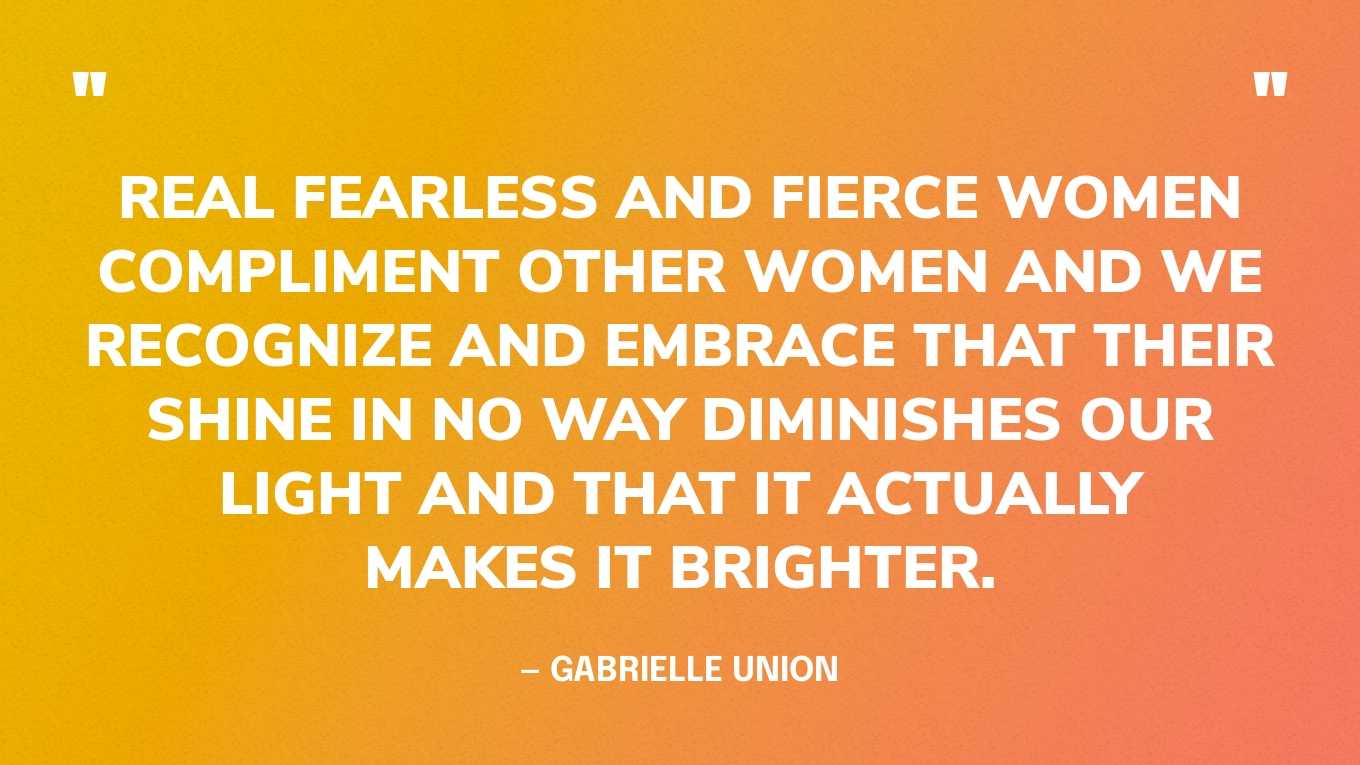
“Real fearless and fierce women compliment other women and we recognize and embrace that their shine in no way diminishes our light and that it actually makes it brighter.”
— Gabrielle Union
In an effort to better understand the misunderstood continent of Antarctica, we sat down with Ariel Waldman — an explorer and artist whose imaginative projects explore the world below our feet and beyond our atmosphere.
In addition to visiting Antarctica twice, she’s a TED speaker, a NASA advisor, and a National Geographic Explorer who collaborates with research teams. An art school graduate who pivoted to science, Ariel was recognized by the Obama White House as a Champion of Change in Citizen Science.
Ariel’s newest book, “Out There: The Science Behind Sci-Fi Film and TV” is now available. You can also get to know her at arielwaldman.com and on Instagram and YouTube.
This conversation has been edited for length and clarity.
In Conversation with Artist & Explorer Ariel Waldman
Branden Harvey, Good Good Good: When I think of Antarctica, I think of all of the clichés: a big, vast, white empty space, one building full of a dozen scientists, and maybe some penguins. I’ve never been there, so it’s just this abstract idea to me.
But you have spent a good amount of time there, and you are really good at helping make inaccessible places and ideas and making them accessible.
So, how would you describe Antarctica? Paint a picture so that folks like me can go a little bit beyond the clichés.
Ariel Waldman: The first thing is that Antarctica is often underestimated in size. So it’s larger than the U.S. and Mexico combined. I think the first thing that people overlook is how huge and diverse it is. And yeah, lots of it is just snow and ice, up to three miles thick in some locations.
But also take, for example, the Dry Valleys, which is the largest area of Antarctica that’s not fully covered in snow and ice. It’s a place where you can actually walk on the continent itself. You could see the mountains. They’re not buried in ice. And it is otherworldly. It’s one of the most Mars-like places on Earth.
But what’s fascinating about that is that even though it’s this place that’s very close to being like Mars, there’s actually tons of microscopic life there having a great time.
So, the thing that I like about Antarctica is that it feels so different and yet, it’s still on Earth. It can give us hope for both understanding the history of our planet — but also hope for finding life elsewhere on planets and moons that look as if they’re lifeless.
Branden: You’ve been to Antarctica twice. Tell me about that first time stepping off of the plane. What was your first reaction? What did that moment feel like?
Ariel: For me, it was like, “Holy shit, I actually made it” — because it was five years of effort to get to Antarctica. You’re simultaneously nervous and in awe because it’s like arriving in any other new place on the planet. You don’t know what you’re doing. You’re a little scared because you don’t know what the new situation is going to be like.
But also, you’re just in this place that is, for most people, the farthest away that you can get from home without going into space.
Branden: You were there for five weeks. Tell me about the work that you were doing there.
Ariel: I went down on the National Science Foundation Antarctic Artists and Writers Program, and I wanted to do a project that would benefit both scientists and people outside of science.
I sought to film the microscopic creatures that live under the ice in different areas because I had learned about there being a lot of life that biologists study there, but they’re not often supported in filming or taking good photographs of the creatures they study.
The science grants don’t typically support that. And yet by filming those creatures, you can make new discoveries about their behaviors and showcase them to the world — to those who don’t usually get to see them.
I was there to film life under the ice and create an interactive website where anyone can explore these microscopic creatures as if they’re looking through a microscope in Antarctica.
Branden: Based on your experience there, what are the problems that Antarctica is facing? I think of melting ice and loss of biodiversity. But what do you see as the major problems that are facing that continent?
Ariel: Yeah, I mean, I think you hit on it. A lot of people mistakenly conflate what’s going on in the Arctic with what’s going on in the Antarctic. And there are some similarities.
But Antarctica is a massive continent, so you can’t really say, “Oh, it’s glaciers melting into the ocean. That’s the story of Antarctica and climate change.” It is for portions of it. But other portions, the story of climate change is about increased habitability of Antarctica and what that means for the creatures that currently live there.
For a lot of the microscopic organisms that I film, they’ve had a great time in Antarctica with just them and the ecosystem that they know. But over a period where the climate is warming, different organisms are going to be able to survive in Antarctica.
The story of climate change isn’t necessarily that you get die-off due to heat. It’s that you might get die-off because they have increased competition, new neighbors, a total change of ecosystem dynamics. Each place in Antarctica has a different story.
Branden: Okay, so maybe I also need to ask: Why are the existing creatures that have been living in Antarctica for a long time important? I’m sure they are — but they’re not creatures that I know about already. What purpose do they serve in the greater world?
Ariel: A lot of them are extremophiles (animals that can live in extreme conditions). They teach us a lot about where the boundaries of life are on Earth, which again teaches us about the history of life on Earth and also about finding life elsewhere.
When people think of microorganisms, they often think of bacteria. A lot of these are actually microscopic animals. They actually belong to the animal kingdom. You have the tiniest animals on Earth in Antarctica.

I think people often don’t have a lot of compassion for bacteria, which is fine. But these are actually tiny animals that live there. They should be, I feel, given the same compassion that penguins are given.
When you get to see them — and I hope that I share this through my work — they are actually charismatic and cute and do all these amazing things. They hold an important scientific importance, but, I think, generally they also deserve our compassion.
Branden: At Good Good Good, we focus on celebrating good news. We always want to acknowledge problems that exist in the world, but we never want to leave it there. Whether in regard to the problem of habitability or other problems, where are you seeing progress or reasons for hope?
Ariel: Off the top of my head, I think of the science being done there, because in some areas of Antarctica, the story of climate change has never been more clear.
But for some areas, like the Dry Valleys I mentioned earlier, there have only been a few stories that have really come into focus in recent years. So the work that scientists do — going to Antarctica every year, taking measurements, dedicating themselves toward observation and witnessing the world — that work and dedication gives us a more complete story.
That’s, in part, what I hope to do through my work. By making these observations and bearing witness to these things, we can make better informed decisions and also be a lot more excited about what there is to protect.
Branden: What’s a practical action step that any of us can take to show some care for Antarctica?
Ariel: Figuring out how you can lend your skills and background to science is a really creative and rewarding process. Science institutions aren’t always going to say, “Oh, we need a writer or a designer, or what have you.” But that doesn’t mean that your skills are less valuable. Creating website resources, creating videos, writing articles.
You don’t have to be an expert in this stuff. Everyone has access to the web, and there are so many things that need to exist in the world in order to get people excited about what’s out there. That’s how I got my start in science — my background is in art school and graphic design. I came at this as a complete outsider.
Being a curator of knowledge to help other people understand new topic areas is a really valuable thing you can do to contribute to science.
You can learn more and explore Ariel Waldman’s work in Antarctica at arielwaldman.com/antarctica and lifeundertheice.org. Check out her new book, “Out There: The Science Behind Sci-Fi Film and TV,” wherever books are sold.
At first glance, consignment and thrift shops are one and the same. However, these two secondhand retail experiences cater to slightly different preferences and needs (here’s a good breakdown).
As the resell market grows in popularity, it’s no surprise that we’re seeing even more opportunities for people to easily (and sustainably) give their unwanted things a second home.
It’s never been easier to shop and sell secondhand pieces (we love celebrating this type of good news — if you couldn’t already tell)!
With over a decade of experience in buying and selling vintage treasures — and as the proud owner of my very own online thrift shop — I’ve got some insight into the world of selling secondhand goods online.
I’ve gathered some of the best online consignment shops out there, hoping that it brings you closer to finding your go-to secondhand shop and discovering the joy of participating in the circular economy!
Short on time? Here’s a quick breakdown of our top picks:
Top Picks: Online Consignment Stores
| 1 | Poshmark | Shop now |
| 2 | thredUp | Shop now |
| 3 | Depop | Shop now |
| 4 | The Plus Bus | Shop now |
| 5 | BLK MKT Vintage | Shop now |
Plus 18 more…
By the way, some of the links in this article are affiliate links, which means if you make a purchase after clicking a link, we may earn a commission at no extra cost to you. Thank you!
Elevate Your Style with Online Consignment Shops: Our Top Picks
Poshmark
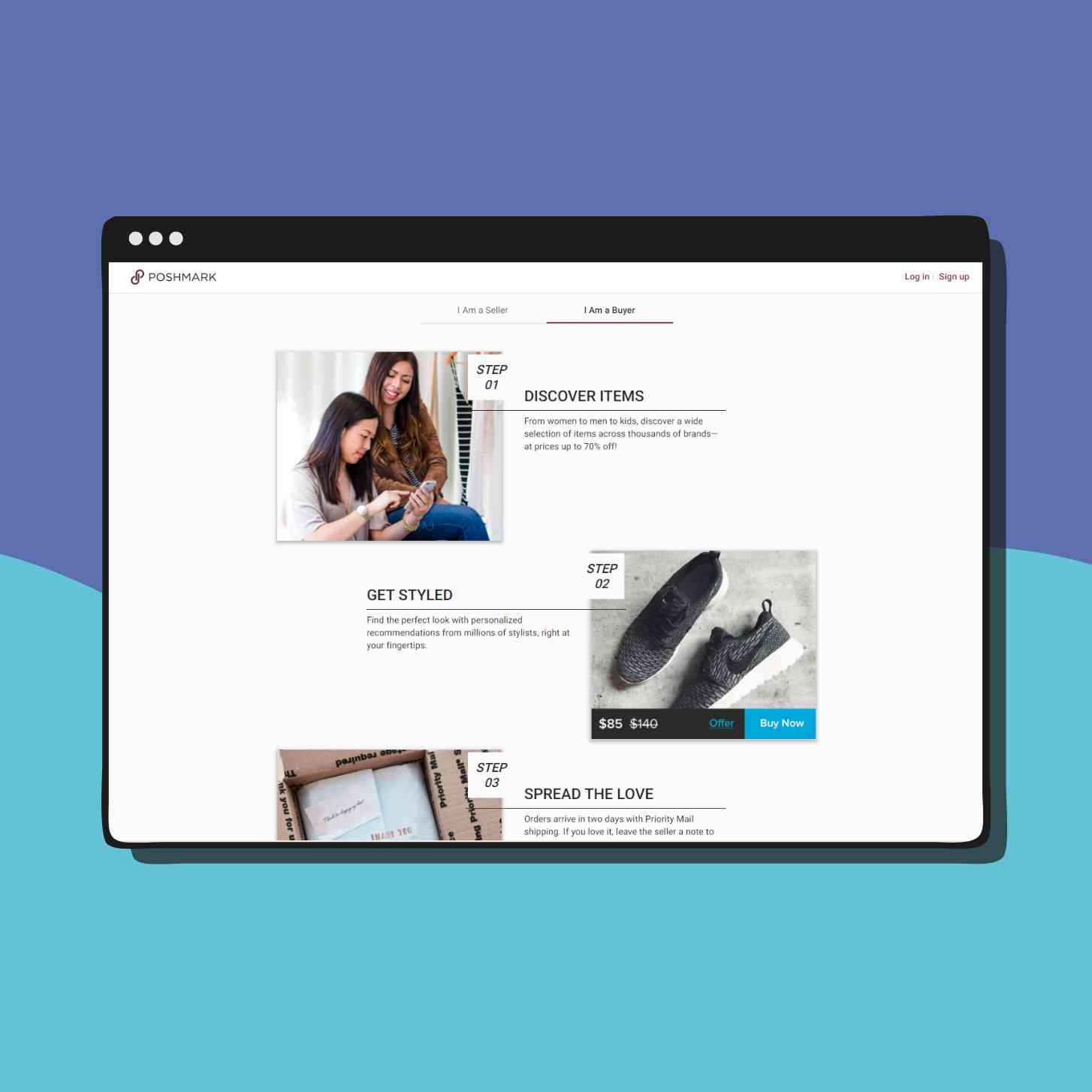
Poshmark, with over 80 million registered users, is a leading social e-commerce platform for buying and selling clothes, accessories, and household goods. This user-friendly platform not only makes the consignment process really easy to navigate, but it also helps folks create compelling listings and manage orders, shipping, and customer communication. (It’s one of my go-to resell platforms!)
Its emphasis on curated recommendations and personalized shopping experiences benefits consignors by aligning their inventory with relevant categories, brands, and styles (looking to sell or buy an outfit for Taylor Swift’s Eras tour? They’ve got you covered). This targeted exposure increases the odds of connecting with the right audience and selling your pieces quickly!
A reason why Poshmark is one of my go-to secondhand marketplaces is because of its community of sellers who share tips, advice, and success stories. (I can’t tell you how encouraging some of these resellers were to me while I was first navigating the resale landscape!)
Vinted

Vinted is a global online secondhand marketplace powered by a massive community of over 45 million members. Consignors can easily create listings, upload product photos, and provide detailed descriptions for adult and kid’s clothing, accessories, homeware, and pet care items.
The platform provides consignors with a safe, user-friendly app, visibility, seller protection, and transparent fee structures.
The RealReal
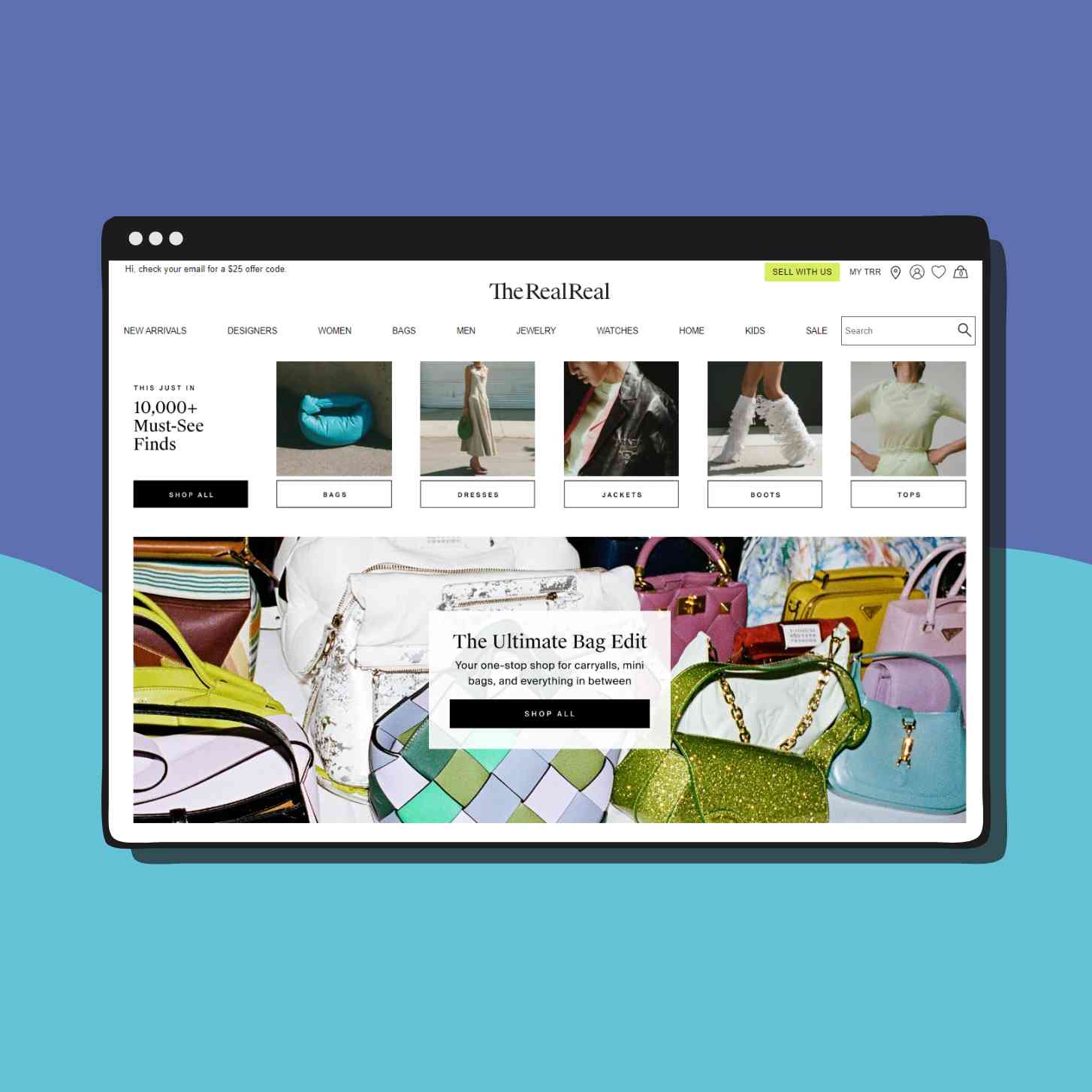
The RealReal is one of the leaders in the online luxury resale market. Its mission is to help reduce the luxury industry’s impact on our planet by offering a global community of people access to certified luxury consignments.
Consignors can easily submit their luxury items through the platform (direct mailing or scheduling a free at-home pickup in select cities). The RealReal’s streamlined process takes care of the logistics, including authentication, pricing, and listing the items for sale.
With in-house experts — horologists, gemologists, art curators, and luxury fashion authenticators — that curate and inspect each piece, The RealReal has established itself as a trusted marketplace for buyers looking for authentic luxury pieces.
thredUp
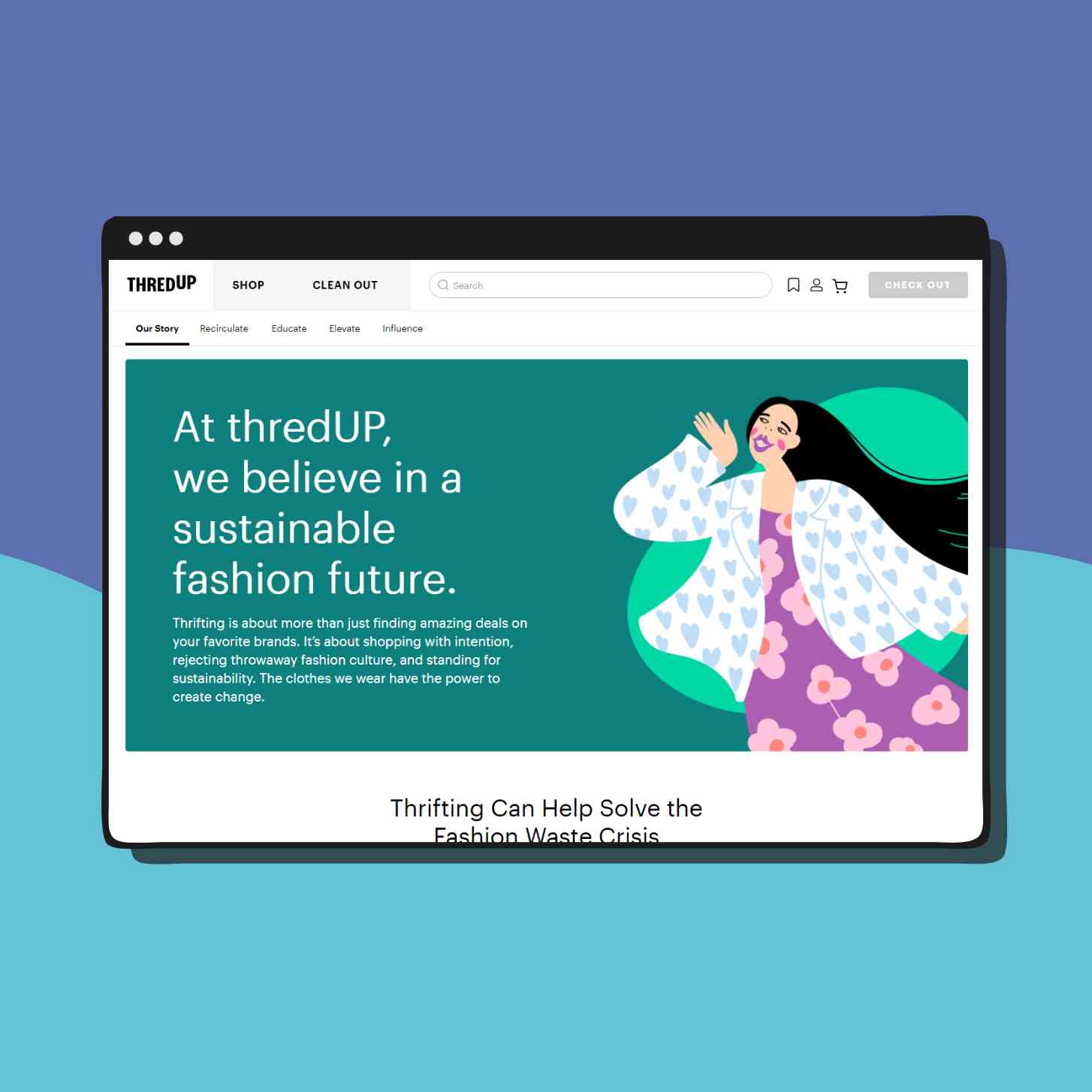
thredUp offers women’s and kids’ secondhand clothing. As one of the biggest online thrift stores for clothes, this platform caters to people looking for anything “from Gap to Gucci.”
Consignors can request a Clean Out Kit, which includes a prepaid shipping bag, to easily send their items to thredUp for inspection. The platform handles the entire process, from sorting and pricing to photographing and listing the items for sale. This is the perfect option for consignors seeking a quick and effortless way to rehome their clothes.
Stillwhite

Stillwhite is specifically dedicated to those seeking to consign their wedding dresses. Since wedding dresses are traditionally a single-use product, Stillwhite is looking to change that by offering an online marketplace for buyers and sellers to give their beautiful dresses a second (or third, or fourth!) life.
Sellers simply list their wedding dresses by providing details and photos, while shoppers filter through designers, sizes, and styles. This niche focus attracts a targeted audience of brides-to-be who are actively searching for affordable and sustainable wedding gown options.
Designer Revival
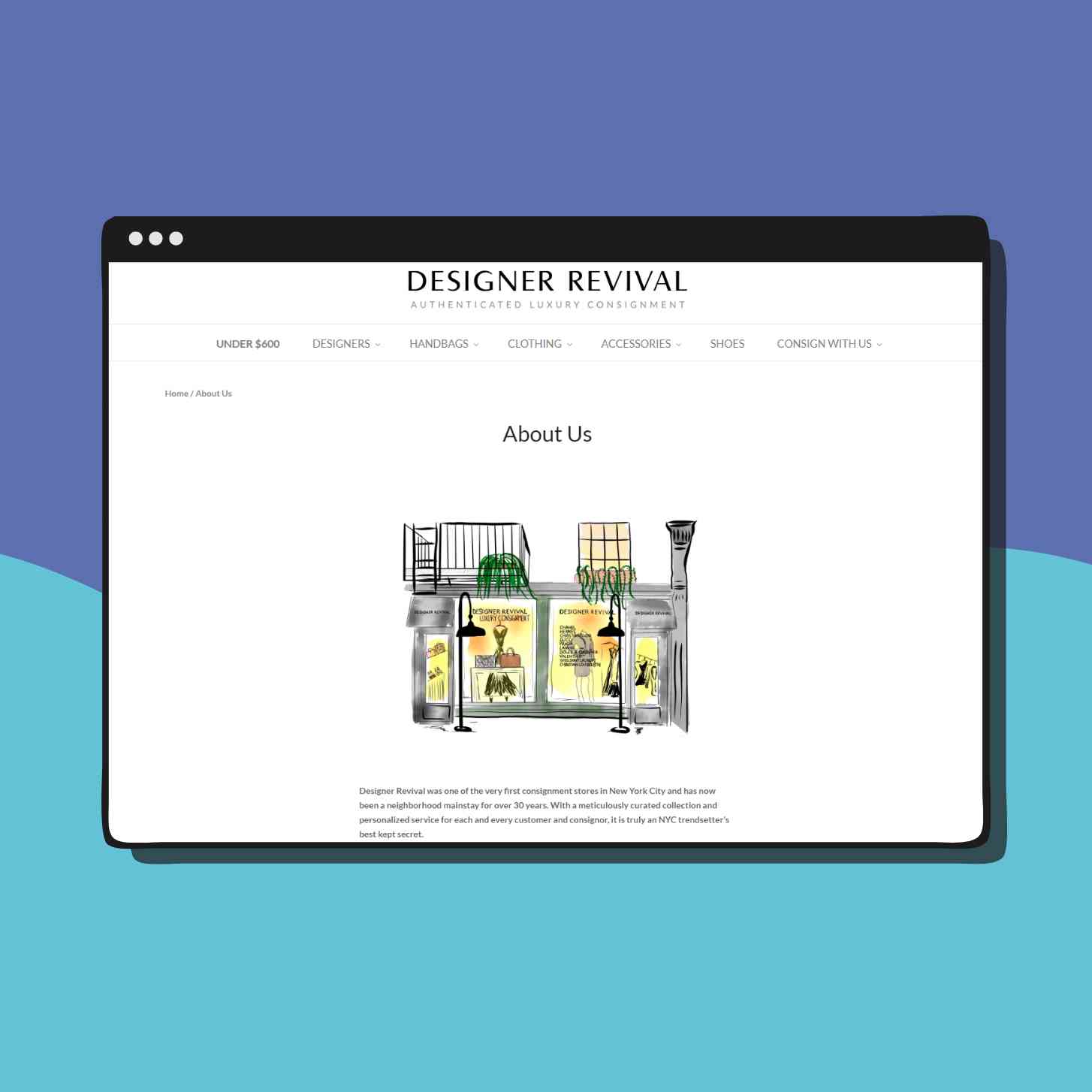
Designer Revival specializes in high-end pre-owned designer, vintage, and contemporary clothing, handbags, jewelry, shoes, and accessories. This online consignment marketplace is a proud woman-owned business that employs a diverse team of creatives, and is a part of the Female Founder Collective — a nonprofit supporting women-led organizations.
All products featured on the platform are inspected for brand-specific guidelines and are put through a rigorous authenticity testing process before being sold — shoppers typically tend to trust this platform!
For consignors, Designer Revival offers free at-home pickups for select locations, as well as takes care of all aspects of the consignment process, including pricing, marketing, and customer service. This is a great option for those consignors who don’t want to put in much effort into the consigning process!
BLK MKT Vintage
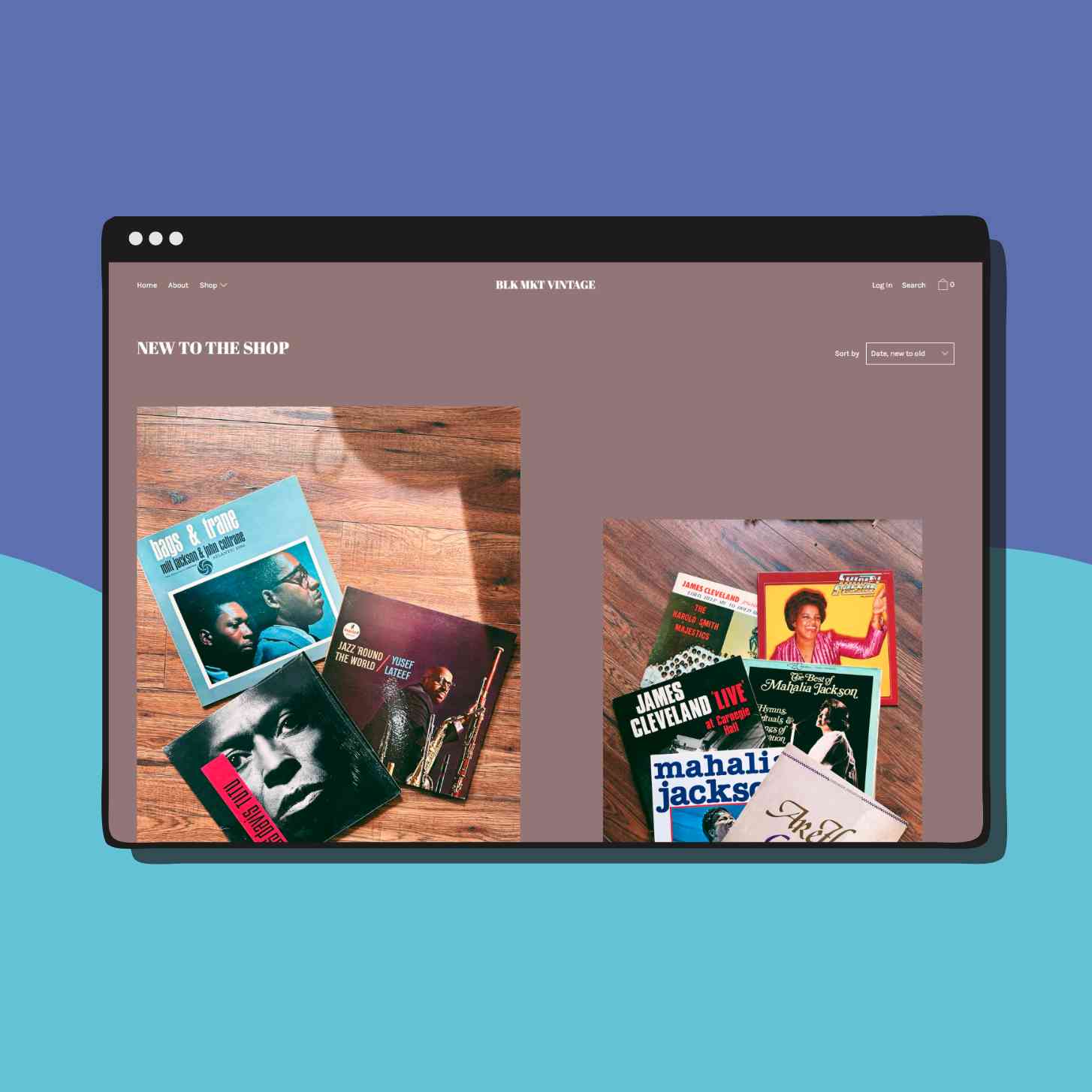
BLK MKT Vintage is a unique concept shop based in Brooklyn, NY, offering a curated collection of antique and vintage items that celebrate Black history and lived experiences.
The shop, founded by Jannah Handy and Kiyanna Stewart, specializes in collectibles, cast-offs, and curiosities that center Black cultural artifacts. Their collection includes vintage literature, vinyl records, clothing, art, housewares, decor, furniture, and more.
BLK MKT Vintage offers multiple ways for folks to engage with their collection.
Luxury Garage Sale

Luxury Garage Sale is a highly curated online consignment boutique that specializes in luxury designer clothing, accessories, and handbags. It offers authentic, pre-owned pieces from the world’s top luxury brands.
Each product undergoes a rigorous authentication process conducted by experts in the field. Not only does the company tout an effortless selling experience for consignors, but it also offers at-home pickups for those in select cities, as well as cash upfront.
Vestiaire Collective
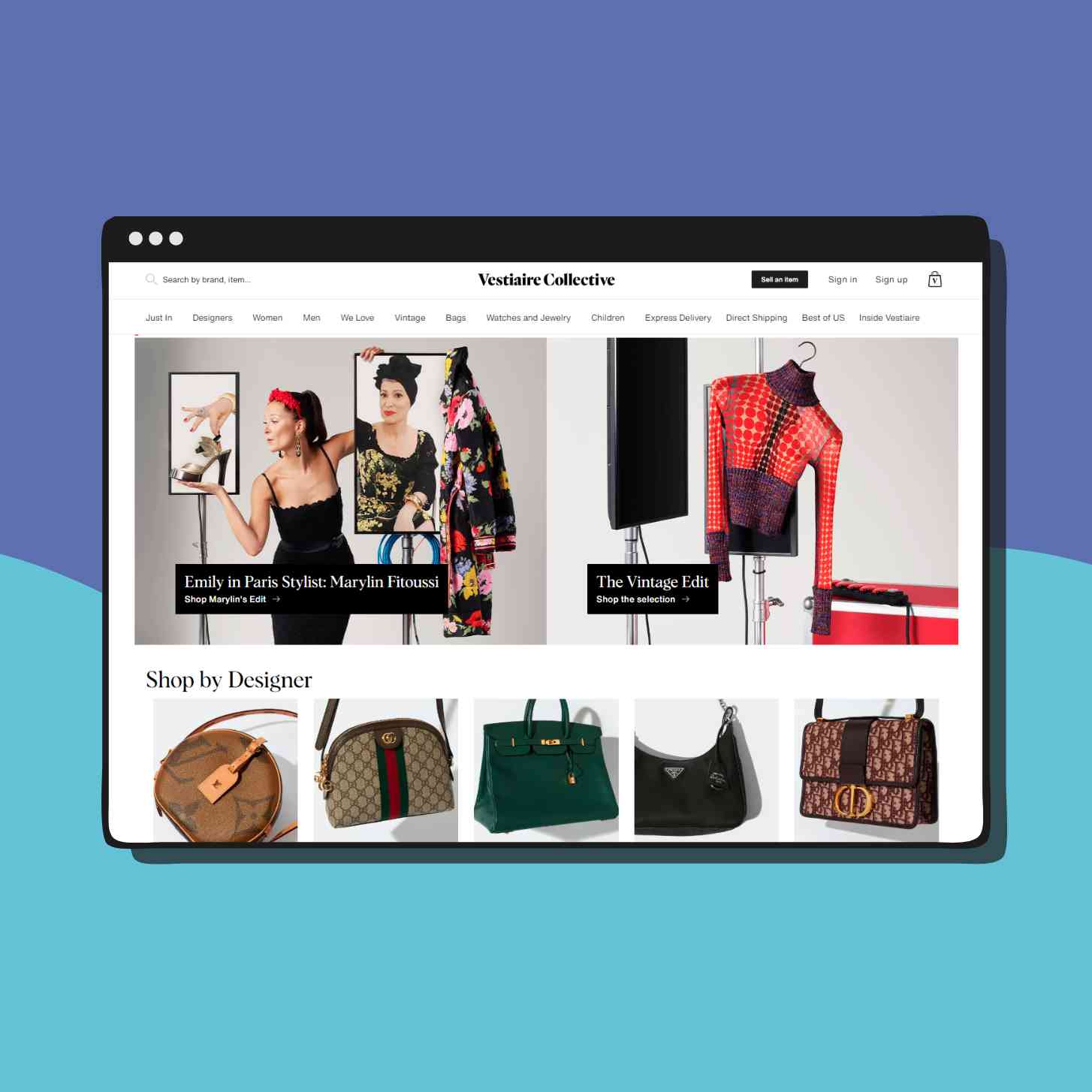
Vestiaire Collective is a B Corp-certified thrift store available to conscious consumers all over the world. The company is also an active member of groups pushing for a more sustainable fashion system, like, the Ellen MacArthur Foundation, UN Fashion Alliance, and ParisGoodFashion.
With a team of counterfeit experts that checks product authenticity (very important when shopping luxury), Vestiaire Collective’s team provides pricing guidance to professional photo editing in order to help consignors present their items in the best possible light. They also offer consignors up to 85% of their sales (which is way more than others).
Tradesy
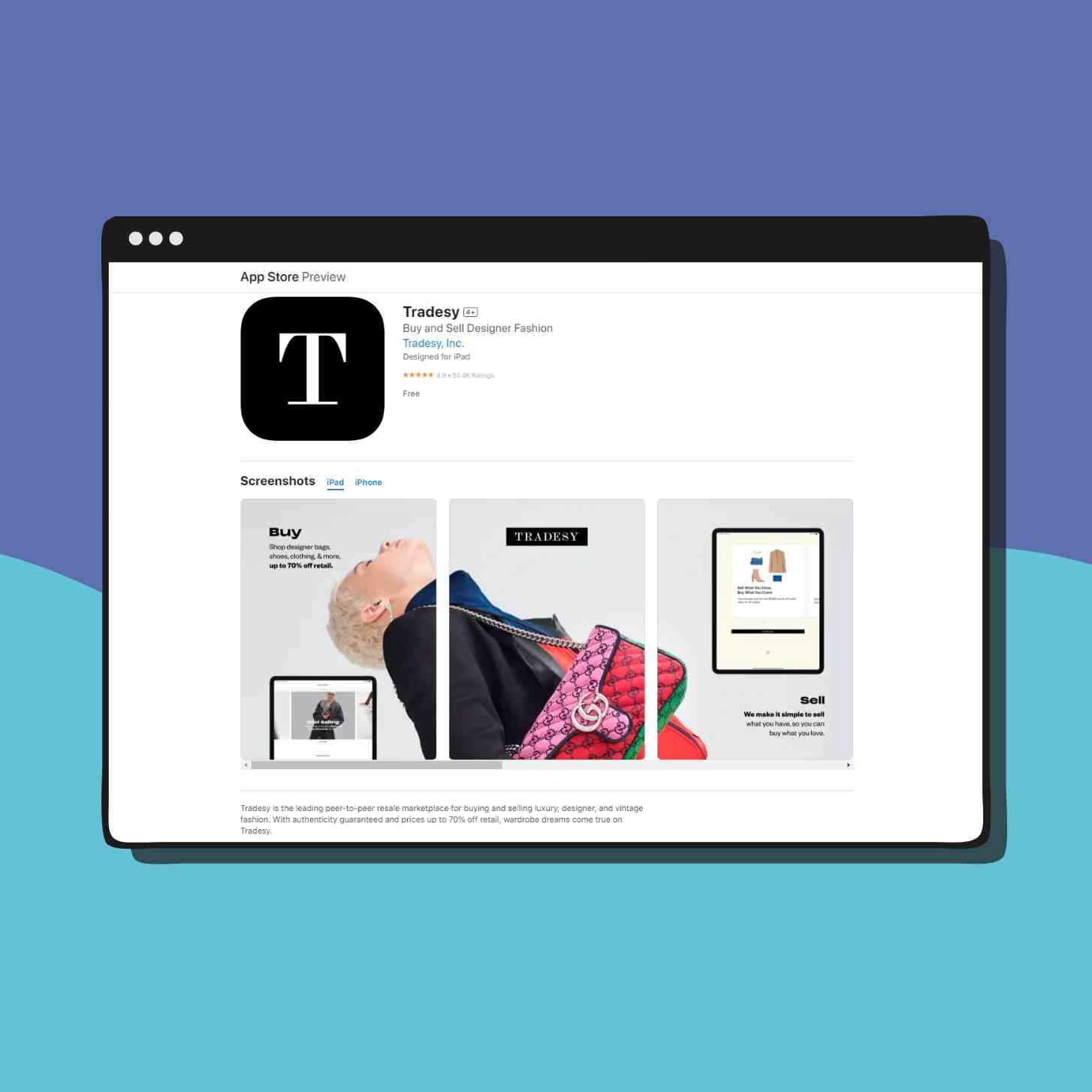
Tradesy is an online marketplace for buying and selling luxury secondhand fashion, like clothing, handbags, shoes, and accessories. Tradesy developed smart technology that automatically detects and removes fakes listed on its site with 99.7% accuracy, according to its site.
Consignors list their items on Tradesy, set their own prices, and when an item sells, Tradesy handles the payment processing, shipping, and returns. The platform verifies the authenticity of the items and provides a trusted marketplace for people to engage in consignment.
Mercari
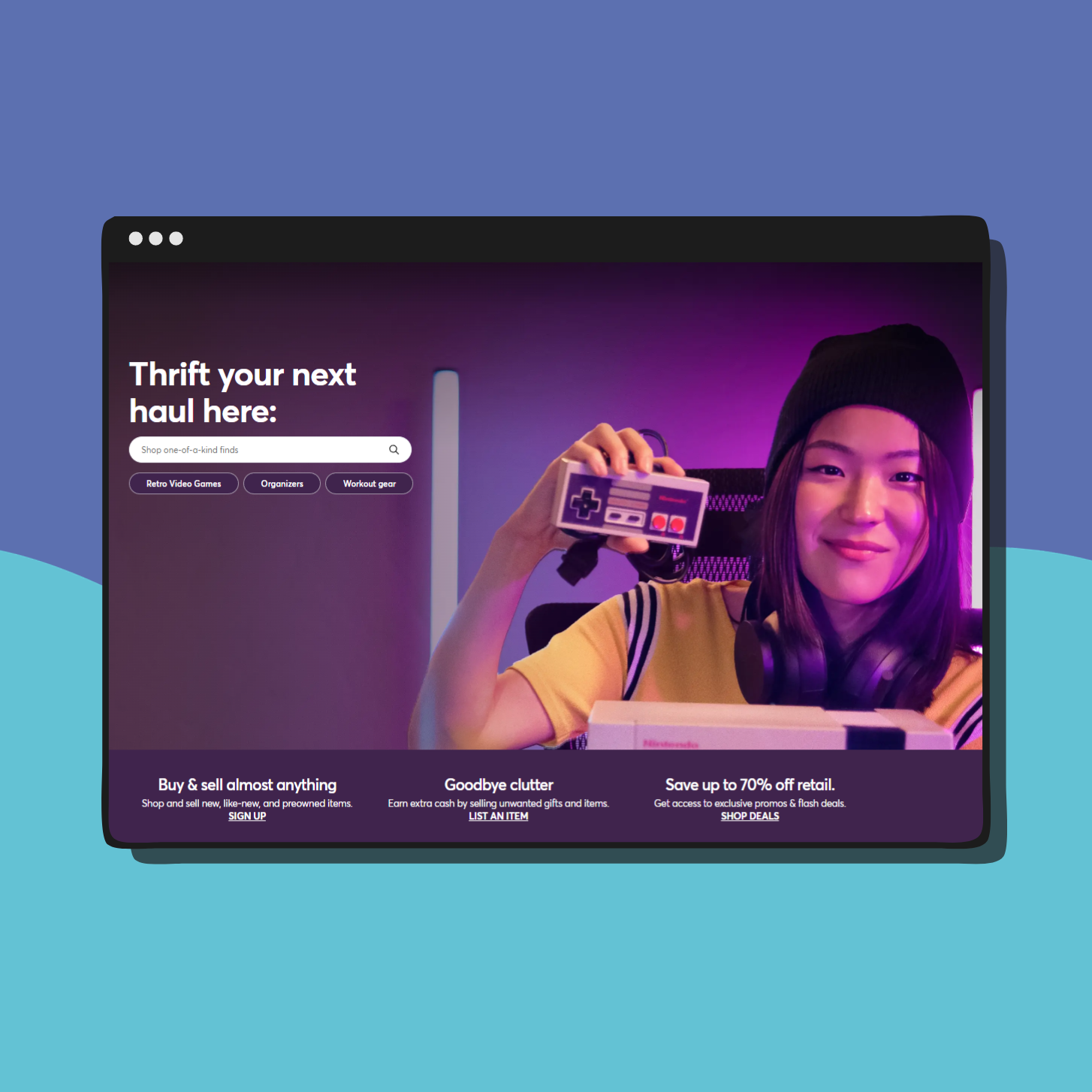
Mercari, like Poshmark and Depop, makes it really easy for people to buy and sell items online (in my opinion, one of the most straightforward platforms out there). With millions of buyers actively on the hunt for secondhand goods, consignors have more visibility and access to a wide audience of potential customers.
Where Mercari differs from similar marketplaces is in its Mercari Local feature — a contactless way of buying and selling products under 50 pounds that are local to you. This platform tries to take away the sketchiness that tends to be associated with local marketplace meetups and instead offers scheduled pickups and door deliveries by its trusted local partners.
The Plus Bus
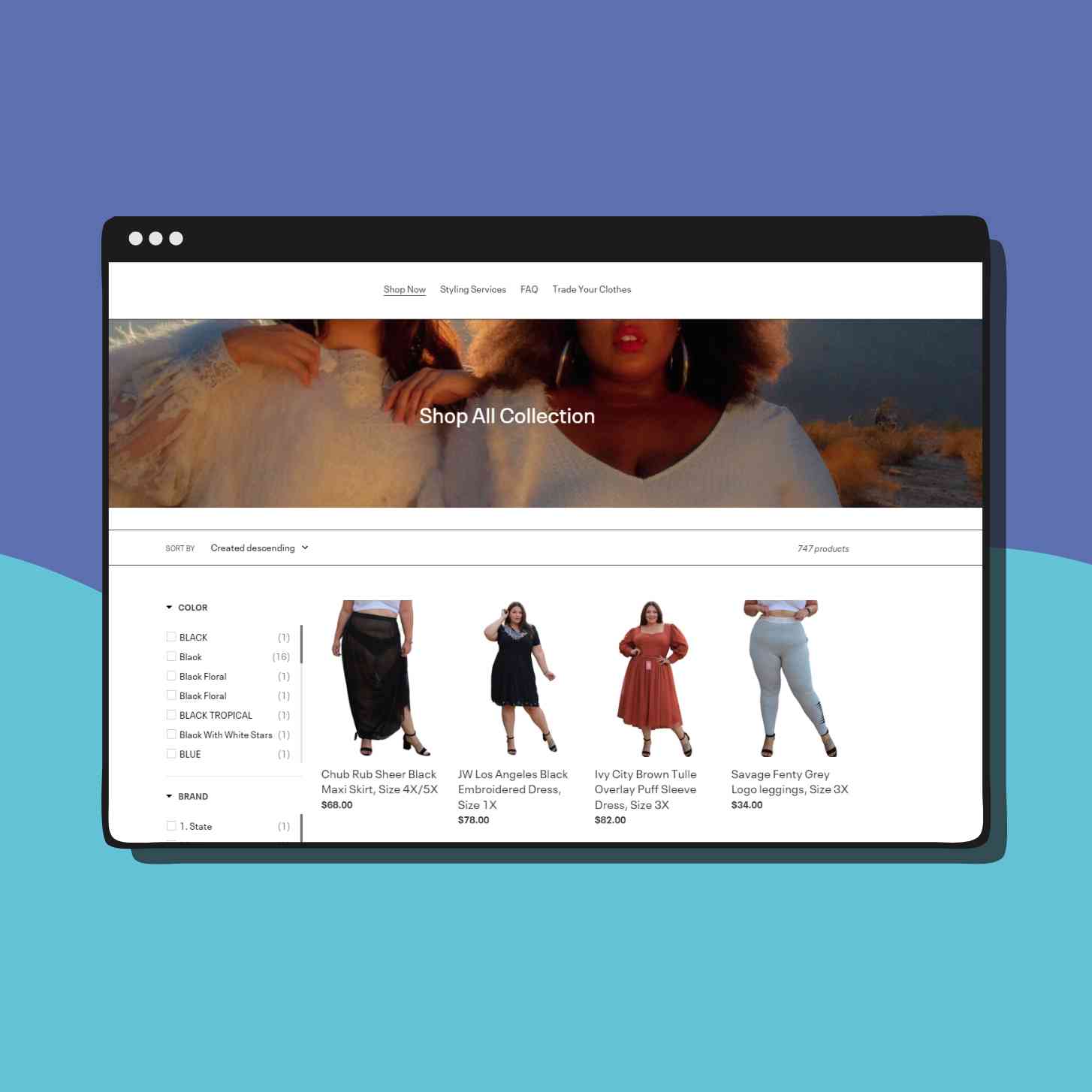
The Plus Bus is a curated plus-size consignment store for shoppers looking for trendy clothing and accessories. They provide a supportive and inclusive environment for consignors to celebrate every body shape.
What sets The Plus Bus apart from the rest is its commitment to body positivity — providing a safe and supportive environment where consignors can confidently embrace their unique style and connect with shoppers. The company’s in-house buyers carefully select inventory that’s updated weekly on its site and daily through Instagram Live.
Kaiyo

Kaiyo specializes in pre-owned furniture and home decor items. Whether you’re looking to buy or sell, this platform allows those living within the greater New York City, Los Angeles, San Diego, Philadelphia, Baltimore, and Washington D.C. metro areas a chance to shop for good-quality furniture while keeping our planet in mind.
Consignors can sell their furniture to Kaiyo, and the company handles the listing, marketing, and sale of the items on their online platform. Once the item is sold, the seller receives a portion of the proceeds. Kaiyo takes care of the logistics, such as pickup and delivery, making it convenient for both buyers and sellers.
SWOP
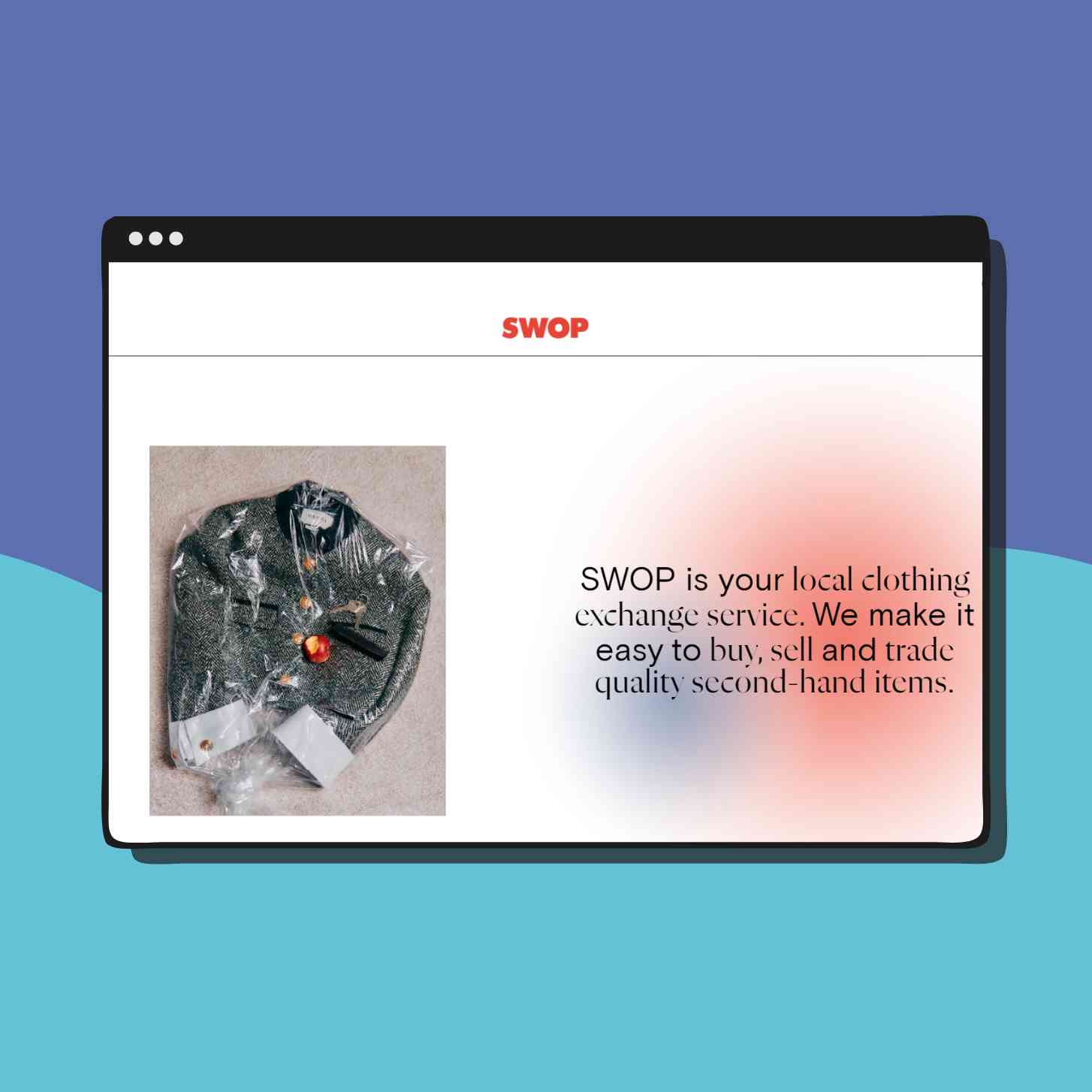
SWOP is an Australia-based female-founded clothing consignment store that buys, sells, and trades quality vintage and on-trend clothing. The shop aims to disrupt the wasteful practices of the current fashion industry at large by offering an alternative way to shop.
It offers same-day buying and exchange services, emphasizing high-quality items. SWOP’s qualified buyers purchase clothing and accessories based on current and seasonal trends — considering the cut, color, fabric, and condition.
Grailed
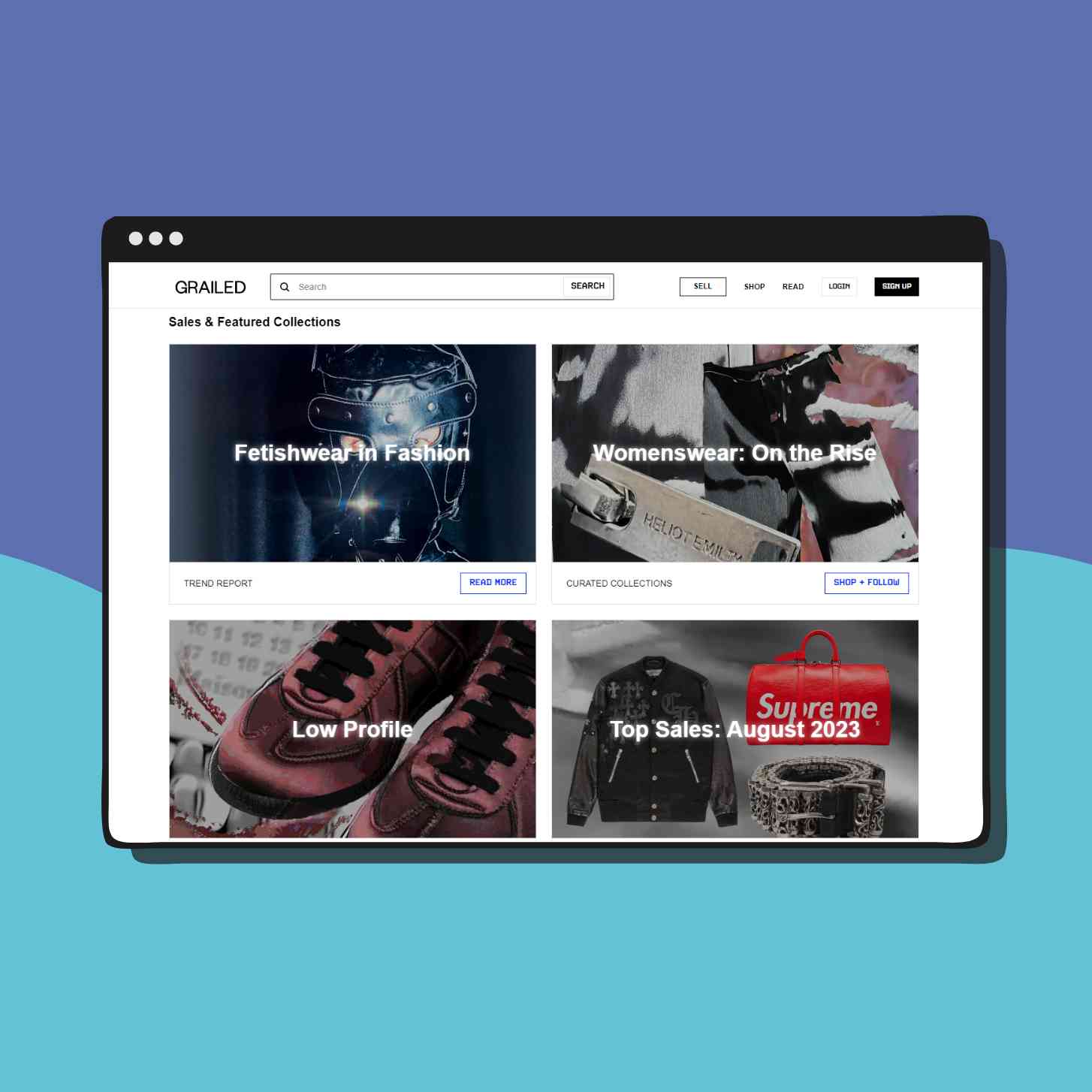
Grailed is a specialized online marketplace for men’s clothing and streetwear. With its niche focus on men’s fashion, the platform offers consignors with an uber-targeted audience of passionate buyers.
Sellers looking to get rid of high-end designer clothing, sneakers, accessories, or vintage pieces gain access to a dedicated community of fashion-savvy folks ready to give their unwanted items a second go.
Kidizen
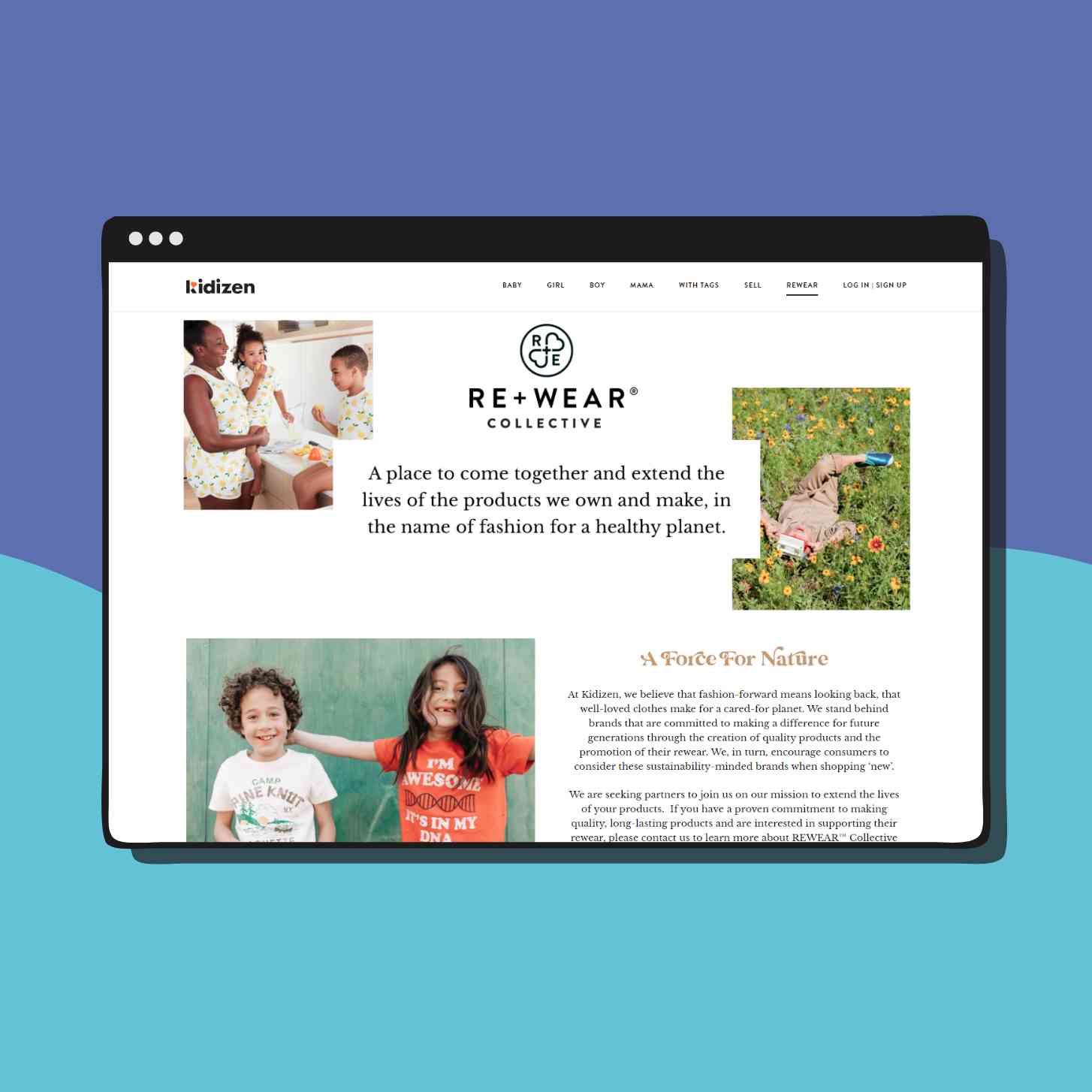
Kidizen is for parents and caregivers looking to consign their kids gently used clothing, accessories, toys, and gear. It offers a convenient and user-friendly marketplace specifically designed for parents, making it a go-to choice for consignors in the kids’ fashion industry.
While I don’t have kids or sell kid’s clothes, Kidizen app reviews are overwhelmingly positive and highlight its great online community of eco-conscious, supportive parents. Aside from that, the company offers a user-friendly app where you can effortlessly upload photos and descriptions of your items! (So no complicated processes or technical skills are required)
LXRandCo
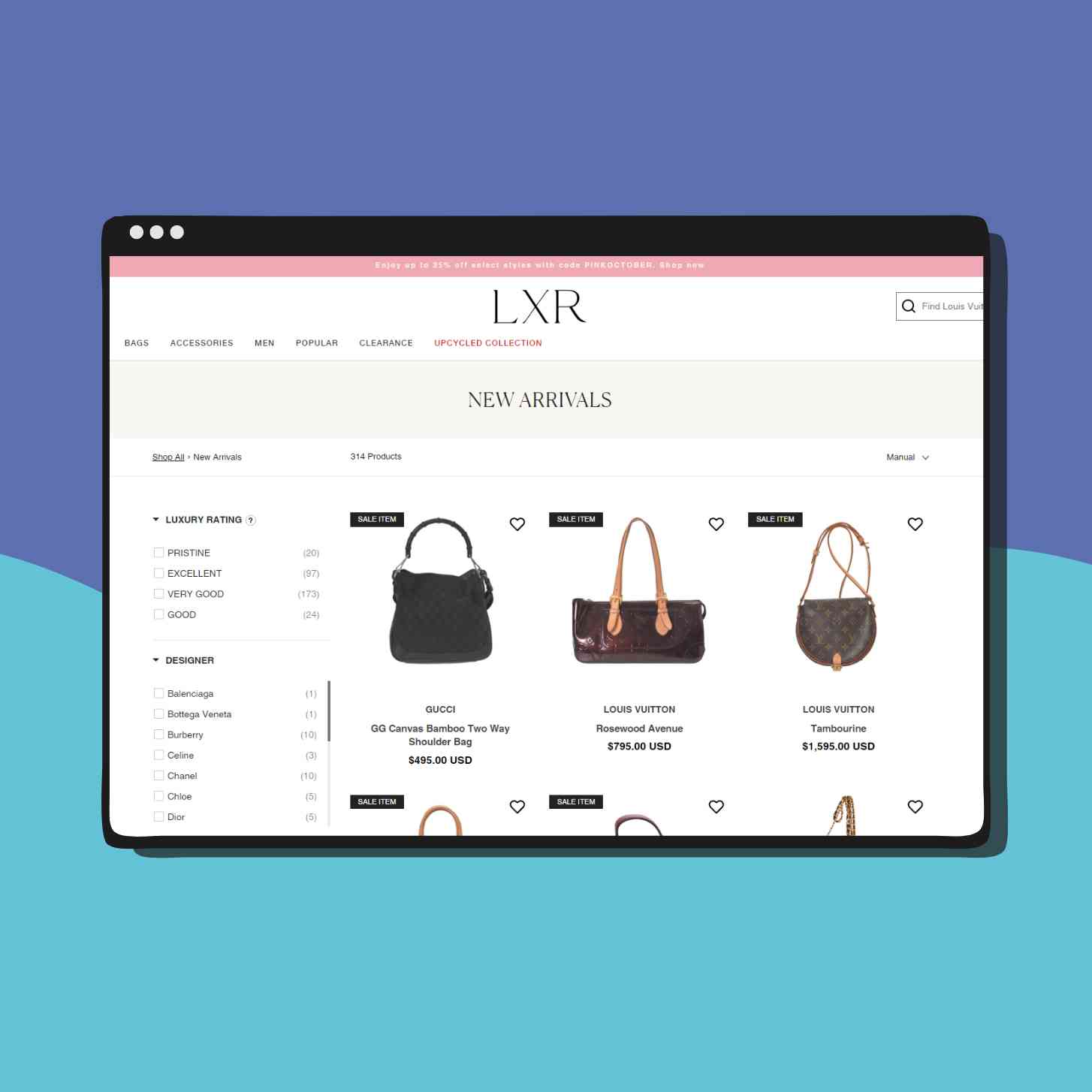
LXRandCo is another great luxury vintage consignment option that specializes in secondhand designer handbags and accessories. With physical shops scattered throughout the U.S., Canada, Germany, Belgium, and Dubai, this retail shop also has a great online presence. For online shoppers, LXRandCo offers a constantly updated selection of inventory on its site, like watches, handbags, and other high-quality staple pieces.
Each item is carefully inspected and authenticated before being listed for sale — meaning customers feel a little more confident in their online purchase. Whether consignors prefer the in-store experience or online convenience, LXRandCo offers options for both! Sellers can either choose to have their items appraised in one of its locations or submit images online.
Fashionphile
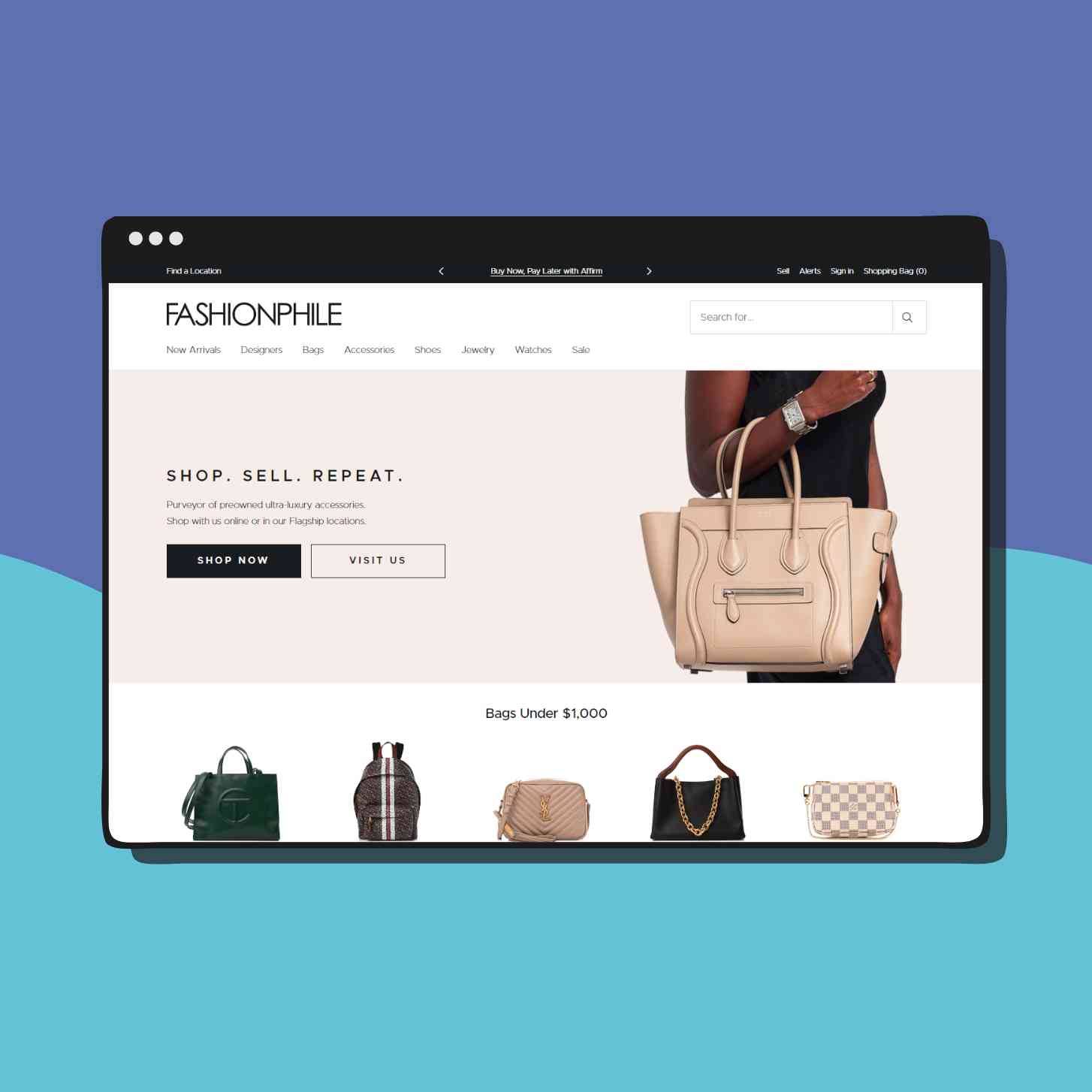
Fashionphile is focused on designer and luxury handbags, offering a wide range of preowned vintage, rare, and limited-edition pieces from top luxury brands. Launched in 1999, the brand has since gained a reputation for its great customer service and its jaw-dropping collection of high-end accessories — including Dior, Bottega Veneta, Loewe, and Old Céline.
When it comes to consignment, sellers receive one of the highest payouts in the industry while simultaneously benefiting from the company’s nicely-packaged presentation and exposure.
While Fashionphile does have boutique locations in Beverly Hills, San Francisco, San Diego, and New York City, its user-friendly app is a standout for customers. Consignors can also track the progress of their consigned items from the moment they arrive until the sale is finalized and payment is issued.
Neutral Ground

Neutral Ground is a carefully curated collection of women’s vintage and designer pieces, offering a unique consignment option for those who specifically love neutral color palettes. Each garment in the collection is thoughtfully selected, ensuring quality and maintaining a modern color palette with neutral tones and the occasional metallic accents.
Although some items may be less than 20 years old (which would not be considered vintage), they are chosen for their rarity, collectibility, or one-of-a-kind nature. This ensures that customers can discover special finds that truly stand out and contribute to the preservation of timeless styles.
Rebag
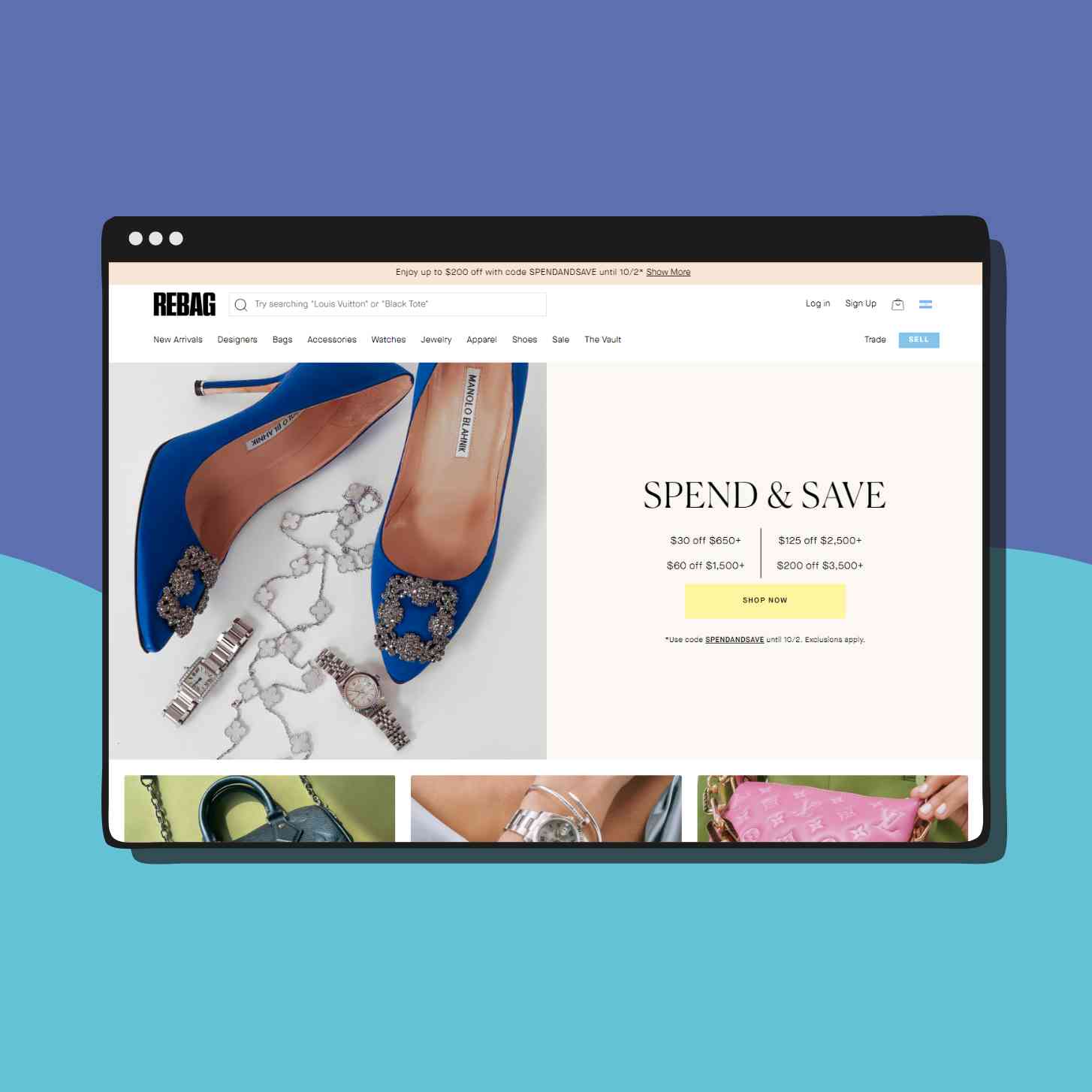
Rebag is a consignment platform for buying, selling, and trading luxury accessories. Their expertise extends beyond bags to include jewelry, watches, and small leather goods.
Rebag specialists thoroughly inspect and certify each item to ensure quality and authenticity before listing it on its site. Whether you're looking to consign your beloved designer pieces or discover your next treasured accessory, Rebag offers an easy-to-use platform to find authentic luxury pieces at a fraction of their original prices.

Poverty and homelessness are not personal or moral failures on the part of those experiencing homelessness — but rather a failure of our systems and government.
According to the National Library of Medicine, homelessness first became a national issue in the United States during the 1870s, mainly facilitated by the national railroad system, urbanization, and industrialization.
However, the “modern” era of homelessness most Americans are now familiar with began in the early 1980s, during the Reagan Administration.
Factors that impacted this shift include the gentrification of cities, high unemployment rates, the emergence of the HIV/AIDS epidemic, inadequate affordable housing, and deep budget cuts to federal housing agencies and social services, in what was, at the time, the country’s worst recession since the Great Depression.
All of these things are systemic issues that require robust public health, housing, and social safety nets from those at the top to confront. And it can be done!
All around the world, countries have created policies that ensure nobody has to live on the streets. From Finland’s “Housing First” approach, to creative affordable housing projects giving us hope across the U.S, we have proof that changing policies helps end homelessness.
It’s important that we play a role in supporting people experiencing homelessness today — but it’s also important that we work toward systemic change that ensures nobody has to fall through the cracks in the future.
Here are some ways you can make a difference when it comes to making safe, affordable housing a reality for all.
By the way, some of the links in this article are affiliate links, which means if you make a purchase after clicking a link, we may earn a commission at no extra cost to you. Thank you!
How To Make a Difference for People Experiencing Homelessness
Learn.
One of the best ways to help unhoused folks is to get a better understanding of their lived experiences, as well as the systems that have led to their circumstances.
Whether that’s listening to podcasts about homelessness, reading good news about housing, visiting Atlanta’s Museum of Homelessness, or reading books about the housing crisis (in America and beyond), you will be better equipped to help when you are better educated.
Here are a few quick learning recommendations for your journey into housing advocacy:
- Read “Evicted: Poverty and Profit in the American City” by Matthew Desmond
- Read “What is the Correct Term for Homeless” by Good Good Good
- Explore the National Alliance to End Homelessness resources page for data, reports, and training materials
- Check out Housing Narrative Lab to better understand how to talk about homelessness
Donate to local nonprofits.
Every community has its helpers, and when it comes to homelessness, there are a wide range of services that need more financial support to continue providing vital resources to those in need.
First, we’d recommend checking out the National Low Income Housing Coalition to learn more about housing needs by state — and to find local nonprofits to support.
You can also search online to find area organizations like:
- Homeless shelters
- Food pantries
- Shower services
- Laundry services
- Medical support
- Employment programs
- Affordable housing programs
- Transitional housing programs
- Street medics
- Food distribution groups
- Mutual aid networks
Donate to national nonprofits.
Although your donations often make the most impact in your own communities, homelessness is a nationwide (and global) issue that needs major attention from every direction.
Luckily, there are countless nonprofits that are dedicated to eradicating homelessness that you can support.
- National Alliance to End Homelessness
- City Relief
- Healthcare for the Homeless
- Streetwise
- Coalition for the Homeless
- Habitat for Humanity
- Family Promise
- Covenant House
- Abode Services
- DePaul USA
- Partnership with Native Americans
- Back on My Feet
Donate to global nonprofits.
While rates of homelessness are high in the United States, there are many other countries struggling with homelessness, too. Here are a few organizations you can support as they work to end homelessness and displacement around the globe:
- International Rescue Committee
- CARE
- Project HOPE
- International Refugee Assistance Program
- Refugees International
- Ruff Institute of Global Homelessness
- New Story
- The Shift
- Homeless World Cup
Support LGBTQ+ youth.
One demographic that is consistently at risk of homelessness is LGBTQ+ youth — especially trans youth of color.
Whether you financially support organizations like the National Network for Youth, True Colors United, or The Trevor Project, or you simply own the role of a loud, proud, accepting and affirming adult in the lives of LGBTQ+ young people, you are doing your part to keep youth safe, housed, and loved.
Volunteer beyond the holidays.
Go beyond the cliché of doing a shift at the soup kitchen by calling a nonprofit or shelter in your community and asking how you can help year-round. Yes, making a real-life phone call isn’t always fun — but the person on the other end of the line will be grateful for your support.
They may ask you to join group volunteer activities where you’ll interface with the communities they serve — or they may ask you to play a behind-the-scenes role.
If you have unique talents for marketing, communications, organizing, or using technology, offer up your assistance with those services. You may be able to make a uniquely meaningful contribution that way!
Have conversations with unhoused community members.
Bill Swartz (@rideshareredemption on TikTok), who was formerly unhoused, shared with his online community that a simple, free way to help a homeless community member is by sitting with them in a safe space and having a conversation about their story.
This, Swartz comments, allows people to simply feel “normal” and like they have a real community.
Help provide laundry services.
Offering someone experiencing homelessness access to laundry facilities can reduce experiences of stigma and aid in the transition out of homelessness, increasing the likelihood of job placement.
Consider driving someone to a laundromat or donating to organizations that are actively providing these services across the country, such as Laundry Love, The Laundry Track LA, and Austin’s Mission Accomplished Laundry Angels program.
Create and distribute literature about local community resources.
Create and print out a community resource sheet that includes the contact information of nearby shelters or housing organizations. Hand them out to anyone you cross paths with who may need them.
You can even take it a step further by offering to call a specific organization for them, acting as a liaison to help people access the resources they need.
Create and give care packages.
Providing essential care kits is a way to help provide immediate assistance to strangers you encounter in your day-to-day life. These care kits often include essential items like toiletries, nutritious food, first aid supplies, clean socks and clothing, and more.
Not sure what to put in your care package? We’ve created an article that lays out everything you need.
→ Check out this full guide on how to create a homeless care kit!
Donate products to shelters.
You can also collect necessities for shelters in your area (this is a great idea if you’re shopping in bulk or with a team of volunteers from your workplace or organization!)
Dr. Robin Dickinson (who prefers to go by Dr. Robin) is a family physician who founded the first and only free clinic in Englewood, Colorado, which primarily serves people who are experiencing homelessness or housing insecurity.
“If we were preparing gifts for a shelter, we’d ask the shelter specifically what’s needed because they typically know what their clients are most lacking,” Dr. Robin said. “While shelters will often try to make it fun by encouraging people to put together a gift bag, I like to ask what it is that people really need but isn’t being provided by donations currently.”
She continued to outline what many shelters might be looking for.
“That might be diapers, detergent, pads, tampons, etc. Those kinds of needs also make for good projects for neighborhoods, schools, and churches,” she added. “I’ve known a teen girl who collected [menstrual] hygiene supplies from the girls [sports] teams at her school and a mom who collected diapers at her church.”
Buy from good companies.
We already know that making ethical shopping choices is a great way to turn purchases you’d already be making into an act of good.
When it comes to helping those experiencing homelessness, there are a number of brands you can shop that provide essentials to unhoused communities.
- Bombas: Donates essential clothing items with every purchase
- Sackcloth & Ashes: Donates a blanket to a homeless shelter with every blanket you purchase
- Leesa: Donates one mattress to a family in need for every 10 sold
- Twice As Warm: Donates a winter clothing item for every one sold
- The Company Store: Donates a comforter to a homeless child for every one sold
Support organizations and businesses that employ people experiencing homelessness.
While unhoused folks should have the same kind of opportunity and access to well-paying and enriching jobs as everyone else, they often do not.
Besides the stigma that comes with experiencing homelessness, it is also hard to find work — or be deemed “employable” without essentials like shelter, hygiene, and access to technology. These are a few companies and organizations that not only hire unhoused folks but make them a core priority in their work.
- Street Roots: This Portland-based nonprofit media organization publishes a weekly social justice newspaper that is sold by people experiencing homelessness and poverty to earn an income. Besides selling newspapers, folks are also paid to do additional work, including public health outreach, surveys, and trainings.
- Empowerment Plan: This innovative organization produces a durable coat that transforms into a sleeping bag. Its manufacturers are unhoused folks who are given employment opportunities, while giving back with this additional layer of safety.
- Well House: Based in Grand Rapids, Michigan, Well House has a simple model: Purchase vacant, boarded-up houses, bring them back to life by hiring unhoused community members to renovate them, and then move in neighbors who need housing the most. Well House now owns 16 houses and has helped over 5,000 people find work and transitional housing since 2013.
- Greyston Bakery: This New York bakery makes tasty brownies and blondies by hiring bakers through an Open Hiring policy, which provides meaningful employment to folks with barriers to hiring (like being incarcerated or unhoused). This means no resumes or background checks! “We don’t hire people to bake brownies,” the company’s website reads. “We bake brownies to hire people.”
Speak out against hostile architecture.
Hostile architecture, or anti-homeless architecture, is an urban design concept that purposely guides or restricts behavior. This is especially impactful for people who commonly rely on public architecture like benches, sidewalks, or bus stops, like youth, older community members, disabled folks, or unhoused individuals.
You have likely seen hostile architecture at play with bench dividers that restrict people from lying down; studs, bricks, or rocks needlessly cemented to curbs or ledges designed to keep people from sitting; or even shops installing sprinklers or alarms under awnings to keep people from gathering beneath them.
These design elements have one purpose: cruelty. They keep folks from resting, finding shade, or even just existing in their cities.
Speak out in city council or planning meetings, encourage the use of accessible design, and help people using these public spaces by sharing comfortable items like blankets, pillows, or camping chairs.
Reject NIMBYism — and become a YIMBY instead.
For decades, affluent homeowners opposing development —and ultimately leading to housing segregation in communities across the country — have been referred to as NIMBYs (an acronym for “Not In My Backyard”).
Although the NIMBY attitude began from a desire to keep property values up, it has since contributed to the housing crisis that keeps low-income and minority families from high-quality housing, schools, jobs, and opportunities.
Flip the coin, however, and you’ll find a growing movement of YIMBYs (the “Yes In My Backyard” camp), who welcome inclusive, intentional neighborhood development to provide more housing nationwide.
Though YIMBY communities have coalitions in cities across the U.S., YIMBY Action is its own umbrella nonprofit organization with a vision to make abundant, affordable housing a reality for all.
Help create policy change.
As we explored earlier, housing-first policy change really does make a difference in ending homelessness.
The good news? Attempts to implement this approach have become more and more popular across the country, including in major cities like Houston.
The bad news? These approaches are under attack and often lack funding to make them a success.
You can step in by calling your elected officials and advocating for the investment in humane and helpful solutions to the housing crisis.
Even if you don’t have all the answers, you can always vote with your unhoused neighbors (and other marginalized people) in mind, prioritizing candidates that present strong solutions, work to make essential necessities more affordable, and understand the failures (and successes!) of a very complex system.
In accordance with Suicide Prevention Month in September, mental health nonprofit To Write Love on Her Arms (TWLOHA) has announced its 12th annual campaign.
From its start in 2006, the nonprofit has donated over $3.5 million directly into treatment and recovery so folks can access mental healthcare when they need it most.
By presenting hope and help for people struggling with depression, addiction, self-injury, and suicide, TWLOHA exists to remind people: The world is not better without you.
In fact, that’s the theme of this year’s Suicide Prevention Month campaign, which aims to raise $300,000 and make it possible to sponsor 4,000 counseling sessions and group therapy sessions.
“We've seen a 72% increase in the number of applications for our Treatment & Recovery Scholarship — funds to help people pay for the mental health care they need and deserve,” TWLOHA director of communications, Katie Mumper, told Good Good Good in an email.
“That increase means we have a waitlist of 80 people, and $62,000 will help us get those folks into therapy. The rest will allow us to help even more people. All together, the $300,000 we're hoping to raise equals 4,000+ hours of therapy.”
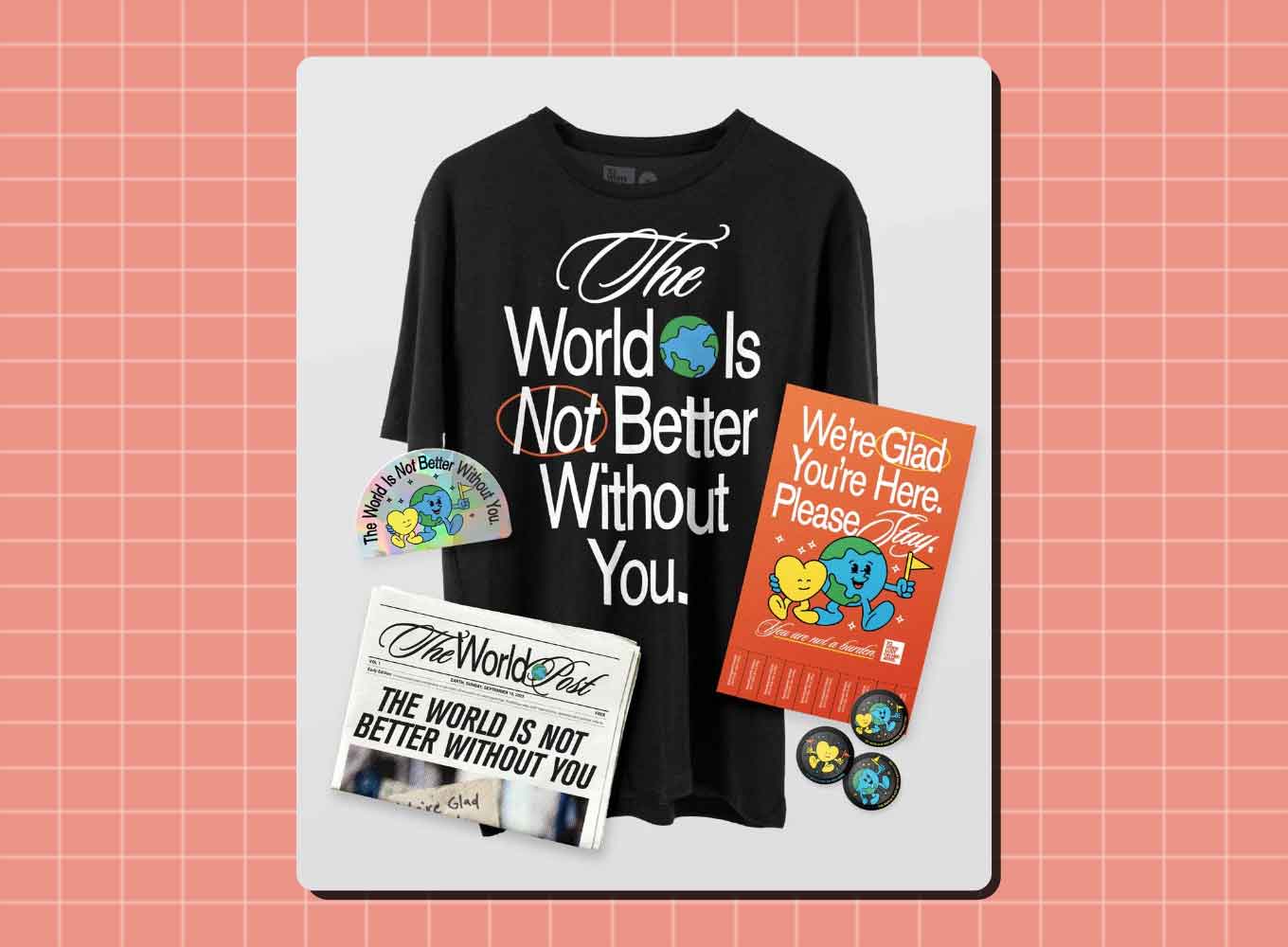
This will be done through the sale of apparel and other merch items, like a Suicide Prevention Pack, as well as online conversations under the hashtag #NotBetterWithoutYou. Folks can also simply donate to the organization during this campaign.
The organization will also share action steps and valuable resources throughout the month of September.
“Suicide prevention isn’t just crisis intervention. It isn’t reduced to knowing what to say or do in the last possible moment. It is prevention for a reason,” a press release from the organization states.
“It is everyday steps and conversations that can help us stop the thoughts and isolation before it goes too far… We all have a role we can play in carrying this truth: The world is not better without you.”
To TWLOHA, these mental health shirts are not just a new item in your closet. They represent an investment in community care, in vital services that reach people who need care most — and helps reduce TWLOHA’s lengthy waiting list.
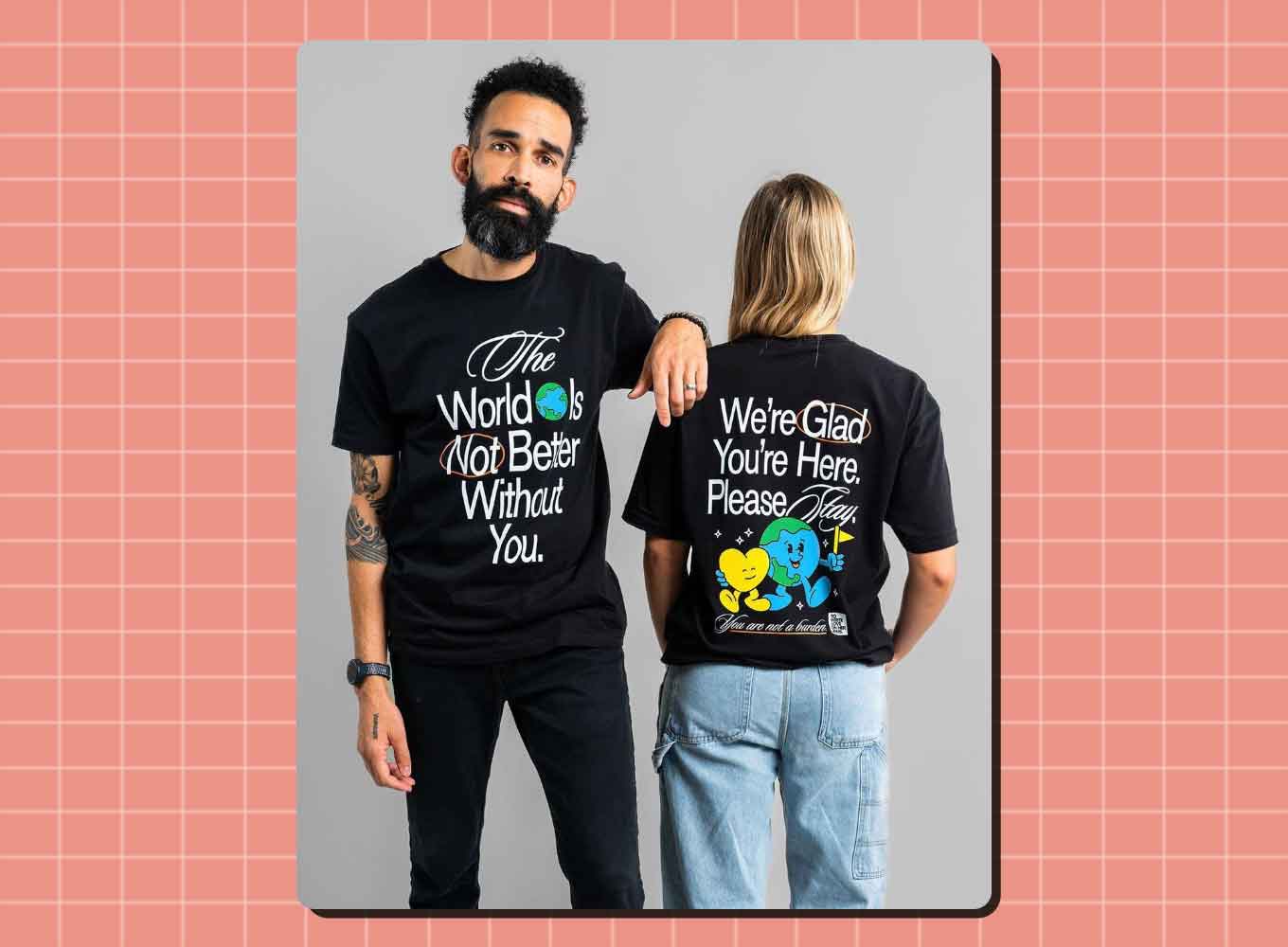
Aside from the annual campaign, TWLOHA does important suicide prevention work year-round. Each month, the organization creates more than 9.5 million “moments of hope” through its online and social media presence for an audience spanning over 100 countries.
This leads to millions accessing mental health resources like crisis lines, support groups, and other local resources through the organization’s FIND HELP Tool.
Mumper said TWLOHA is also celebrating its Between the Bells program, which launched in 2019 and now reaches over 127,000 high school students in nearly 180 high schools across the U.S.
“We know that young people have been highly impacted by the Covid pandemic, so we’re grateful to provide resources to help schools support their students’ mental health,” she said. “We just launched resources for middle schoolers, and we’re looking forward to seeing how they can help create opportunities for important mental health conversations.”
Regardless of the specific program or initiative — of which TWLOHA has many — at the end of the day, the organization simply wants to change the conversation around, and ultimately eliminate, suicide.

“Suicide impacts every community on the planet. Globally, we lose 700,000 people to suicide each year, and it claimed more than 50,000 lives in the U.S. in 2022,” a press release from TWLOHA shares.
“The ripple effect of grief and confusion from these losses can be felt around the world. There is work to be done.”
This campaign, like all of TWLOHA’s work, wonders what would happen if we made a different ripple effect: one that reminds each person how valuable they are.
“We know that when someone is experiencing heavy thoughts, they can begin to believe that they are a burden to the people around them. Those thoughts can solidify into a belief that the world is better without them,” Mumper said.
“We want to speak directly to that moment and that thought, and remind them that it isn’t true. The truth is: We’re glad you’re here.”
We know that when you’re struggling with your mental health, it can be hard to find the help, support, and community you need.
If you are in immediate need of safety, please contact the following:
Emergency Medical Services
911
National Suicide Prevention Lifeline
suicidepreventionlifeline.org
988
Crisis Text Line
Text CRISIS to 741-741
crisistextline.org
And if you are not in immediate crisis and would still like access to more resources, visit our list of Mental Health Resources for more information.
Header image courtesy of TWLOHA

Cholera, a digestive infection caused by contaminated food or water, is on the rise.
According to the World Health Organization, every year, there are 1.3 to 4 million cases of cholera that led to 143,000 deaths, occurring mainly in South Asia and Sub-Saharan Africa. Right now, outbreaks are the worst they’ve seen in over 20 years.
Places like Syria, Haiti, Lebanon, and Malawi are among over 20 countries currently facing devastating cholera outbreaks.
“The number of countries with these large outbreaks occurring at the same time, we have not seen it in at least 20 years,” Dr. Philippe Barboza, the WHO lead for cholera emergencies, told the Telegraph.
Despite the myriad of reasons why these outbreaks are occurring — economic turmoil, climate change, and social unrest, to name a few — global health leaders have one goal: to mitigate disease.
Luckily, scientists have a new tool at their disposal: a cholera vaccine in capsule form.
While a number of cholera vaccines already exist, the current vaccination system is not working for outbreaks of this size, due to high costs and complicated delivery systems. The high demand for immunizations has also drained vaccine supplies, forcing experts to get creative.
What is DuoChol?
The new cholera vaccine capsules are called DuoChol and have been developed in partnership with the International Vaccine Institute (IVI), Gotovax AB, a biopharmaceutical company connected to the University of Gothenburg, and the Valneva Sweden AB pharmaceutical company.
The Wellcome Trust and Swedish government have also provided funding assistance.
“There has been a growing effort … for countries to identify populations at risk and do preventive campaigns,” Dr. Julia Lynch, director of IVI’s cholera program, told The Telegraph.
“But that’s been stymied by the shortage of vaccines. Over the last year-and-a-half, essentially all the vaccines in the stockpile went to outbreaks.”
That stockpile was created by the WHO in 2013 and deploys around 40 million doses per year — but more than 100 million are currently needed, according to Jan Holmgren, the man behind Dukoral, a drinkable cholera vaccine that makes up much of those 40 million doses.
According to the Telegraph, the drug is low-cost and has a similar composition to Dukoral. The capsule form, however, makes the treatment last longer by improving its thermostability (the duration of time during which active ingredients can remain stable at higher temperatures).
Putting the vaccine in capsule form also reduces its weight and volume, making it easier to deliver around the globe.
“This makes a big difference in mass vaccination campaigns when you are delivering hundreds of thousands of doses to one village or town,” Lynch told the Telegraph. “Those are really substantial, potential advantages on the logistics end.”
The new vaccine would only contain the two most relevant cholera strains. This will lower the cost of production while helping the drug deliver treatment as quickly as possible. A phase 1 clinical trial will launch next year.
Scientists are racing to meet the Global Task Force on Cholera Control’s target: to reduce cholera deaths by 90% by 2030.
This capsule is a dose of renewed hope.
Holmgren, the inventor of Dukoral, is a lead researcher on the DuoChol trials. He hopes phase 1 studies will be completed in 2024 and that the drug will go to market by 2027.
Holmgren writes for Wellcome: “With these new vaccine manufacturers, I think the global cholera vaccine supply will look much better and soon meet the demand for 100 million doses per year, if there is enough financial and political support.”
“Supporting IVI to take a new, low-cost oral cholera vaccine into a Phase I trial is an important step towards potentially expanding our global toolkit for this escalating disease and making these lifesaving products more accessible to those who need them most,” Dr. Charlie Weller, head of infectious disease prevention at Wellcome, said in a statement.
“This will be vital for helping to prevent and respond to future cholera outbreaks and save more lives.”
Header image courtesy of James Buck/Project HOPE
There is something to be said for a sweet treat.
Whether you skedaddle into town for an iced latte, grab a pastry from your local bakery, or simply reach for a chocolate bar in your pantry, everyone deserves to have a little delicacy in their life.
However, eating a vegan or plant-based diet can make it a little more difficult to find a treat that meets your dietary needs — and is made well.
Regardless of whether you’re trying to find the perfect consumable gift for your plant-based pals, or you’re just trying to satisfy your sweet tooth without buying yet another pack of Oreos, we’ve got your back.
First, we’ll share a little bit more about plant-based chocolate, and then you can continue to explore our list of some of the best vegan chocolate on the market. It’s time you snag your next sweet treat with ease.
By the way, some of the products and links in this article are affiliates, which means we may earn a commission at no extra cost to you. Everything in this article was independently and honestly written by the Good Good Good team. Thank you for your support!
What is plant-based chocolate?
Plant-based chocolate — or vegan chocolate — is chocolate that doesn’t contain any animal products. Since many popular chocolate confections are made with cow’s milk, vegan chocolate uses plant-based alternatives like oat milk, coconut milk, or other nut milks.
Dark chocolate is also commonly animal-free, but make sure you read labels to avoid traces of milk or other animal products like honey, whey, or some caramels.
Some chocolate is “accidentally vegan” which means that while the manufacturer didn’t necessarily intend to create a plant-based product, the end result is still completely free of animal products.
The best vegan chocolate brands for your next sweet treat
TCHO Chocolate
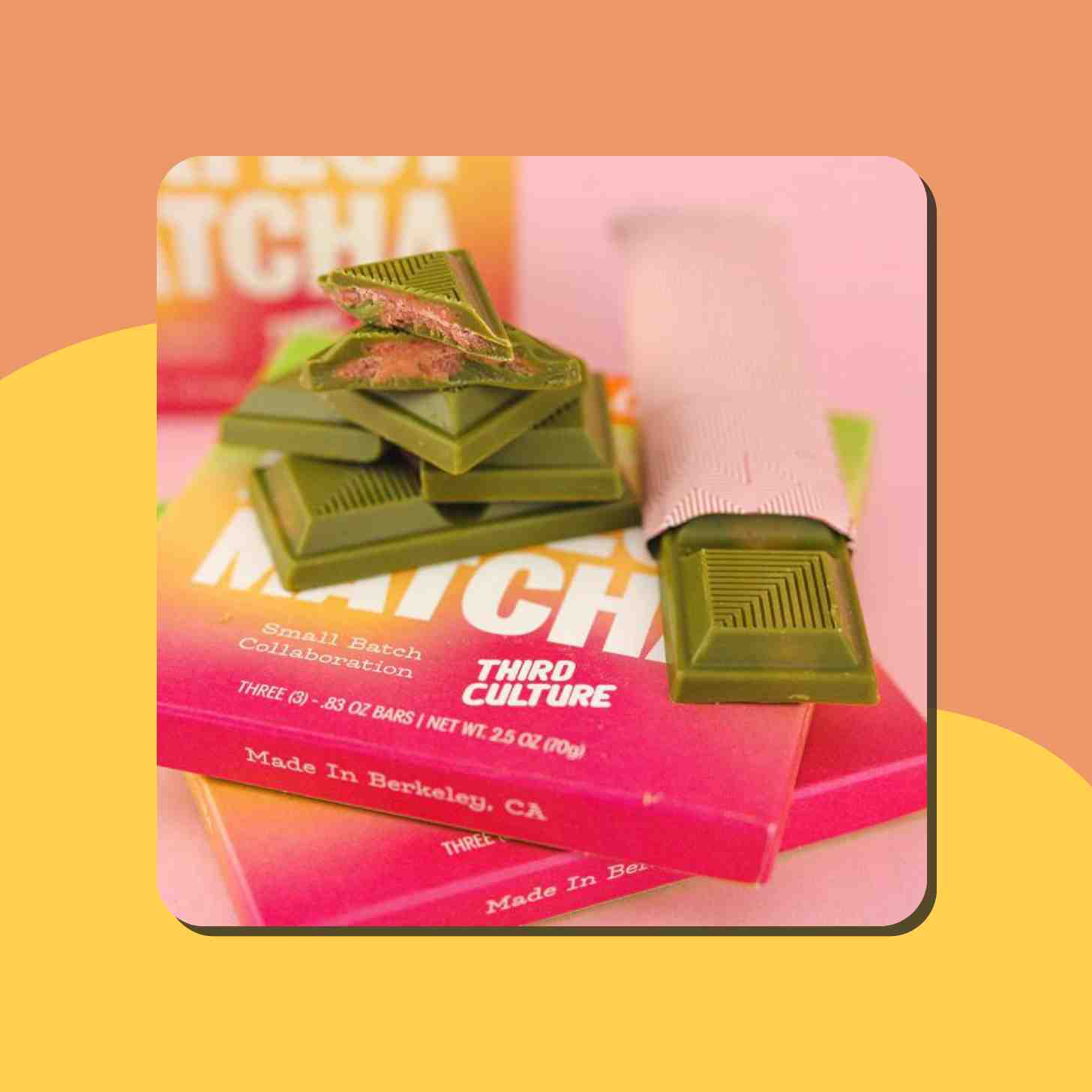
TCHO is a certified B Corp dedicated to making better chocolate. Its initiative, TCHO Source, was built to co-create better cacao by working directly with farming partners around the globe, including infrastructure investments, improved fermentation centers, and more.
TCHO’s chocolates are either vegan dark chocolate, or oat, cashew, and coconut-sugar plant-based milk chocolate. Additionally, all of the brand’s products use non-GMO and Fair Trade-certified ingredients.
Varieties in flavor, thanks to varieties in cocoa beans, include tasty chocolate bars like Toffee Time, Born Fruity, and Choco Latte.
Lovo Chocolate
Lovo Chocolate makes 100% vegan chocolate from ethically sourced beans and plant milks, including almond milk, coconut milk, hazelnut milk, and oat milk.
All of the brand’s chocolates are manufactured in Switzerland, and its packaging is 100% recyclable.
Lovo is suitable for vegans, plant-based people, and anyone who is looking for a dairy-free sweet treat. The brand is currently in the process of finalizing its vegan certification.
Shop: Amazon | Lovo Chocolate
Taza Chocolate

Taza makes vegan, stone-ground chocolate that elevates cacao flavors through the grinding of organic beans into unrefined, minimally processed products.
Whether you’re looking for dark chocolate or creamy almond milk chocolate, you’ll be impressed with flavors like Wicked Dark With Toasted Coconut, Chocolate Cookie Crunch, or a classic Dark Sea Salt & Almond.
Shop: Amazon | Taza Chocolate
7th Heaven Chocolate

7th Heaven is home to “delicious, dairy-free indulgence.”
All treats are vegan, and the brand uses oat milk and Fair Trade-certified cocoa beans. With flavors like Peanut Butter Cream, Hazelnut Cream, White & Cookies, and more, you’re sure to find a tasty treat in no time.
Shop: Amazon | 7th Heaven
Unreal Chocolate
Unreal Chocolate was created to answer the question “why do the foods we love most have to be so bad for us?” The brand uses simple, organic, sustainable, and non-GMO-certified ingredients, as well as up to 51% less sugar than other leading brands.
Unreal’s line of vegan chocolates includes tasty treats like peanut and almond butter cups, coconut bars, and crispy quinoa “gems” that are all made with dark chocolate.
Enjoy Life Chocolate Bars
Enjoy Life makes allergy-friendly foods, including dairy-free chocolate!
All of the brand’s products are dairy- and egg-free, including dairy sugars and dairy proteins, like casein and whey. Whether you adhere to a vegan lifestyle or have allergies or intolerances, you can enjoy these candy bars.
Check out Enjoy Life’s rice milk chocolate and dark chocolate options for all the vegan-approved goodness.
By the way, Enjoy Life Chocolate Bars are our favorite option for vegan s’mores!
Shop: Amazon | Enjoy Life
Beyond Good
Beyond Good makes its chocolate bars with single-origin Madagascar and Uganda cocoa, and since they’re all dark chocolate, they’re all vegan! This includes flavors like salted caramel, orange zest, and toasted hazelnut.
The brand notes that it makes some chocolates with a co-manufacturer that uses milk chocolate, so some bars’ packaging states “may contain traces of milk.”
Shop: Amazon | Beyond Good
Whims Peanut Butter Cups
While Reese’s has recently announced a plant-based peanut butter cup option, Whims might still be the way to go. The delectable dairy-free peanut butter cups only contain one gram of sugar and no palm oil.
Whims’s oat milk chocolate peanut butter cups are available in bags of five.
Alter Eco
Alter Eco offers a variety of plant-based dark chocolate bars that are sure to make your mouth water — while also doing better for the environment.
The brand uses fully recyclable or compostable packaging, grows its ingredients in small-scale, Fair Trade farms, and founded the Alter Eco Foundation to help combat climate change and inequality through regenerative agriculture.
Do keep in mind that Alter Eco’s caramel, malt, and toffee chocolate varieties are not vegan, but definitely bite into plant-based favorites like the Classic Blackout, Quinoa Crunch, or Raspberry Blackout!
Raaka
Raaka makes unroasted dark chocolate from scratch — known for its fruit-forward flavor. All of Raaka’s chocolate is certified organic, kosher, and non-GMO, as well as gluten- and soy-free. Plus, all of its dark chocolate bars are vegan.
Check out the oat milk or coconut milk-based bars (or get a vegan chocolate sampler pack!), or snag one of Raaka’s many dark chocolate options like the Bourbon Cask Aged or the Strawberry & Coconut dark chocolate bars.
Lake Champlain Chocolates
A small chocolate factory based in Burlington, Vermont, Lake Champlain carries a wide assortment of chocolate goodies but has recently improved its vegan varieties.
On its website, the brand has a dedicated menu for vegan options, including items like dark chocolate-covered orange peels, vegan chocolate truffles, and even organic hot cocoa mix. Its plant-based truffle bars are also all the rage.
Shop: Amazon | Lake Champlain Chocolates
Chocolove
Chocolove’s assortment of dark chocolates (minus those with nut butter fillings, caramel, or toffee) are a delightful — and often, different — vegan flavor.
With options like a Chili Mole Strong Dark Chocolate, or Elderberries and Blueberries Dark Chocolate, you’ll get to explore some iconic tastes without the dairy additives.
Hu Kitchen
Hu Kitchen was founded on the belief that simple, healthy ingredients can be at the center of even the most delightful of treats. When the brand’s founders couldn’t find a chocolate that met their standards, they made their own.
All of Hu’s dark chocolate products are vegan. Sample a variety pack, stick with a Simple Dark Chocolate, or try chocolate bars with flavors like Crunchy Mint or Hazelnut Coffee.
Shop: Amazon | Hu Kitchen
Theo
Theo, known for its organic and Fair Trade chocolate bars and its interactive Seattle factory and confection kitchen, has a variety of vegan options.
With over 18 flavors — all made with dark chocolate — in its plant-based collection, enjoy favorites like Vanilla Cocoa Nib, Mint Chocolate, or Cherry Almond.
Lily’s
Lily’s makes lower-sugar options for all the sweet tooth owners out there. All of its products are “botanically sweetened,” and there are no refined or processed sugars. Many of the bars contain stevia, but that’s only to balance out the overpowering cacao taste.
All of the items in Lily’s Extra Dark Chocolate line are vegan (any bars that have cacao content of 70% and up). Reach for the classic Extra Dark Chocolate with Sea Salt or the Blood Orange Extra Dark Chocolate, if you’re feeling adventurous.
Shop: Amazon
Divine Chocolate
Divine Chocolate is co-owned by cocoa farmers and certified Fair Trade. Plus, the brand’s dark chocolate varieties are vegan-friendly.
Snack on a bar of Dark Chocolate with Hazelnut Truffle or go wild with a Dark Chocolate, Turmeric & Ginger delicacy.
Shop: Amazon | Divine Chocolate
EVOLVED Chocolate
All EVOLVED chocolate bars, chocolate chips, and chocolate cups are plant-based and contain no animal products. Plus, if you’re ready to hit the gym, one of the brand’s protein bar flavors (Dark Chocolate & Quinoa) is vegan, too, and made with plant-based proteins.
Enjoy a pack of Hazelnut Butter Chocolate Cups, or opt for a classic Signature Dark chocolate bar instead.
Tony’s Chocolonely

We’ve been long-time fans of Tony’s Chocolonely, especially for its massive, yet ethically-sourced chocolate bars. Excuse us, bricks.
The brand’s dark chocolate varieties (minus the Dark Milk Pretzel Toffee) get the vegan seal of approval, so feel free to fulfill that craving with either a Dark Almond Sea Salt bar or a timeless Dark Chocolate classic.
Shop: Amazon | Tony’s Chocolonely
Endangered Species Chocolate
Endangered Species Chocolate donates 10% of its annual profits to wildlife conservation efforts, so you can feel even better when you take a bite of chocolate.
The company’s dark chocolate bars are all vegan (except for the Hazelnut Toffee and Caramel Sea Salt options), and it has begun venturing into oat milk-based chocolates for a creamier experience.
Since 2016, Endangered Species Chocolate has donated over $3.1 million to its global partners, and you can do your part by snacking on something as tasty as a Rice Crisp Oat Milk Chocolate bar, or an Espresso Bean and Dark Chocolate blend.
Shop: Amazon | Endangered Species Chocolate
VGAN Chocolate
VGAN Chocolate, which started as an operation in Norway, is now spreading to the U.S. with its premium plant-based chocolate, treats, and sweets.
All products are organic and GMO-free as well, and the brand’s cocoa beans are sourced from small family-owned cooperatives in Nicaragua, Colombia, Ecuador, and the Dominican Republic.
Check out flavors like Coconut Cream or Grapefruit & Chia!
Shop: VGAN Chocolate
Equal Exchange Chocolate
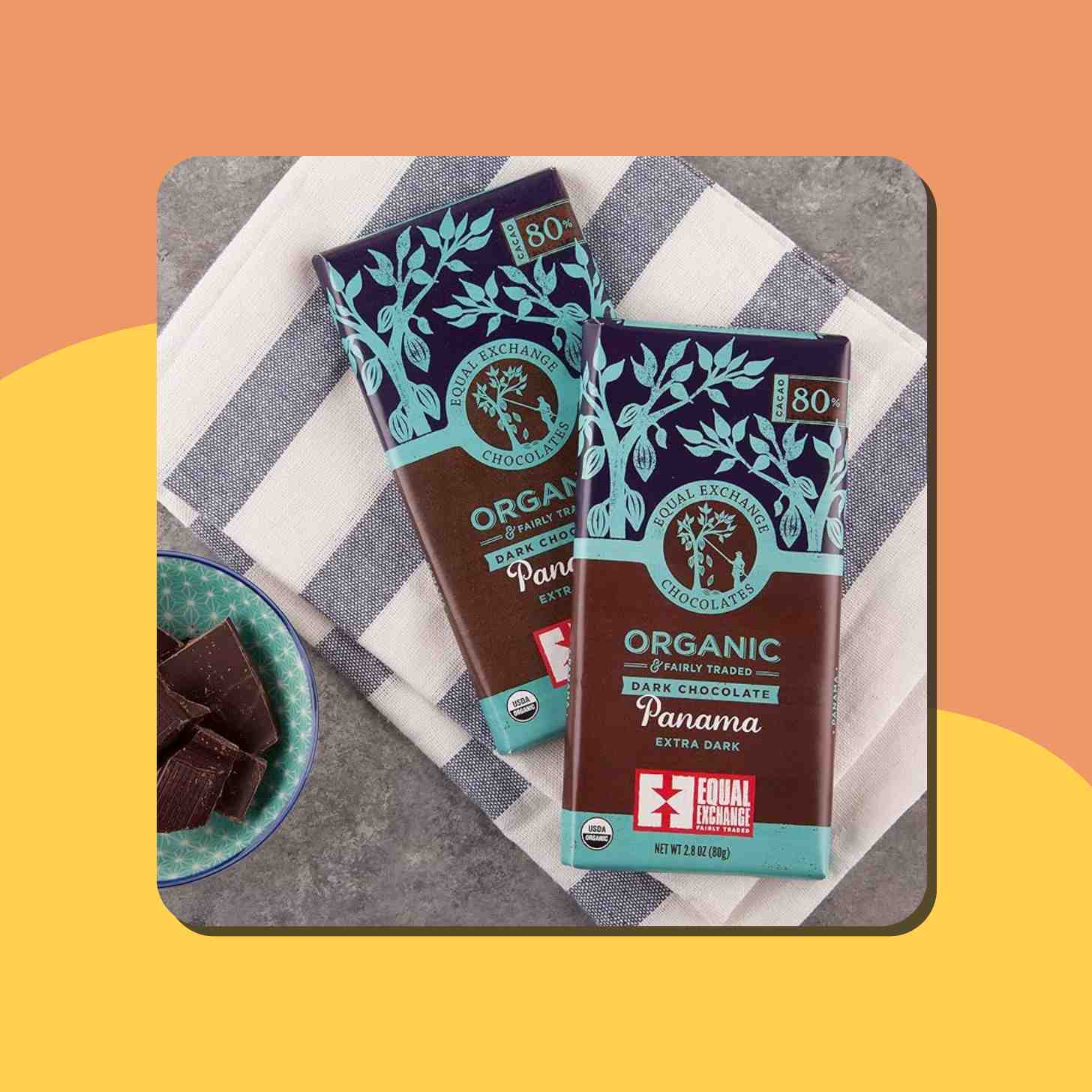
Equal Exchange started with a simple question: “What if food could be traded in a way that is honest and fair, a way that empowers both farmers and consumers?”
We can get behind that! And of course, empowering all of those stakeholders also means taking care of the earth. Equal Exchange offers a variety of vegan-friendly items like dark chocolate and coconut milk chocolate bars.
Try the Lemon Ginger Dark Chocolate bar or the Mint Crunch Dark Chocolate option!
Shop: Amazon | Equal Exchange
No Whey! Milkless Chocolate Bars

No Whey! Foods makes vegan and Kosher foods that are free of nine of the most common allergens.
The brand’s Milkless chocolate bars are the dairy-free alternative to the classic chocolate bar. Made with vegan cane sugar, cocoa butter, and rice syrup powder, among other natural ingredients, you can enjoy a delightful chocolate taste without worrying about the milk products.
Shop: Amazon | No Whey! Foods
Ghirardelli
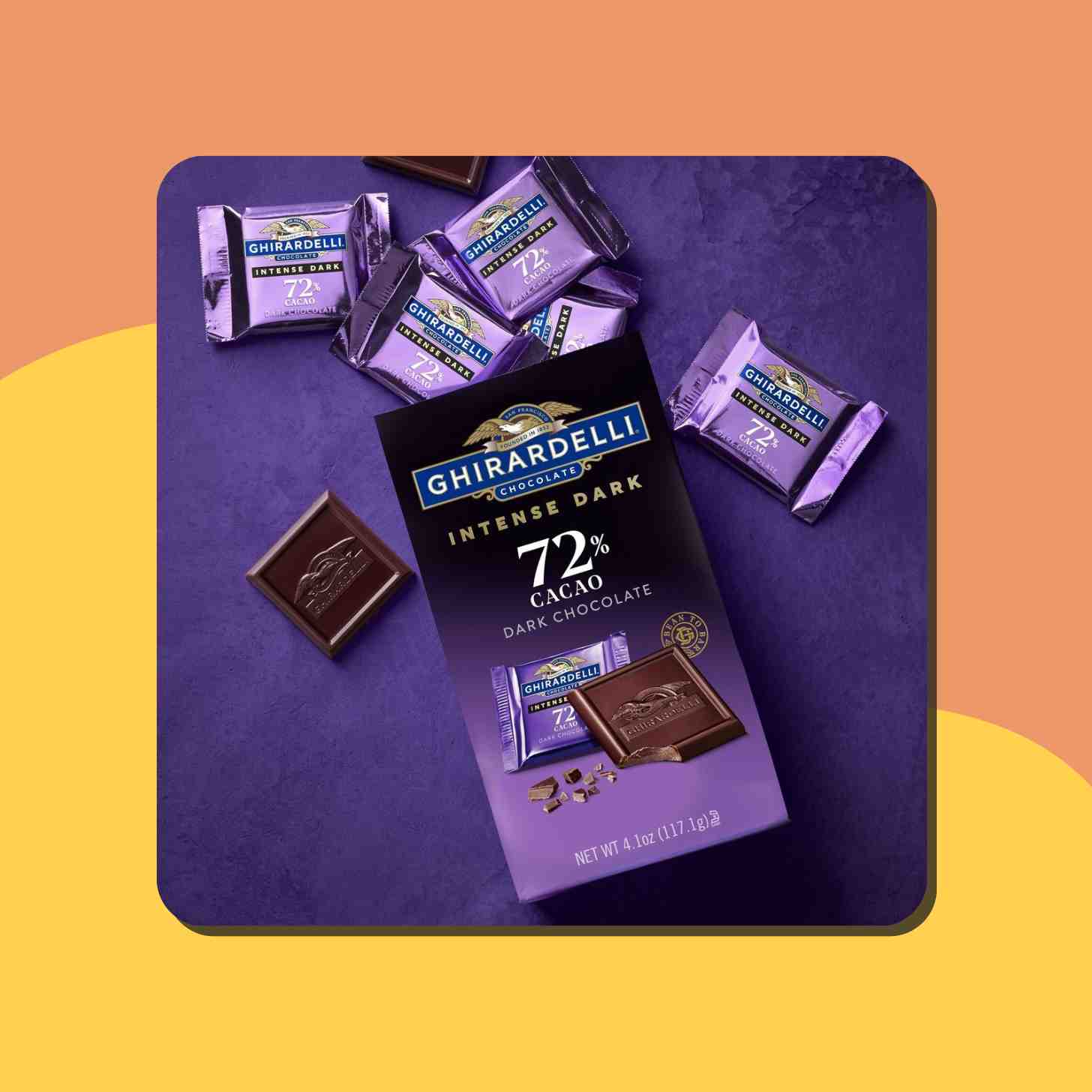
While Ghirardelli is known for its creamy milk chocolates, you can still enjoy some vegan options!
The brand’s Intense Dark 72% Cacao Twilight squares are a safe, dairy-free bet, as well as its 72% and 100% Cacao Premium Baking Chips.
If you’re looking to sip on something sweet, the Double Chocolate Premium Hot Cocoa Mix is also vegan-friendly.
Shop: Amazon | Ghirardelli
Lindt Chocolatier
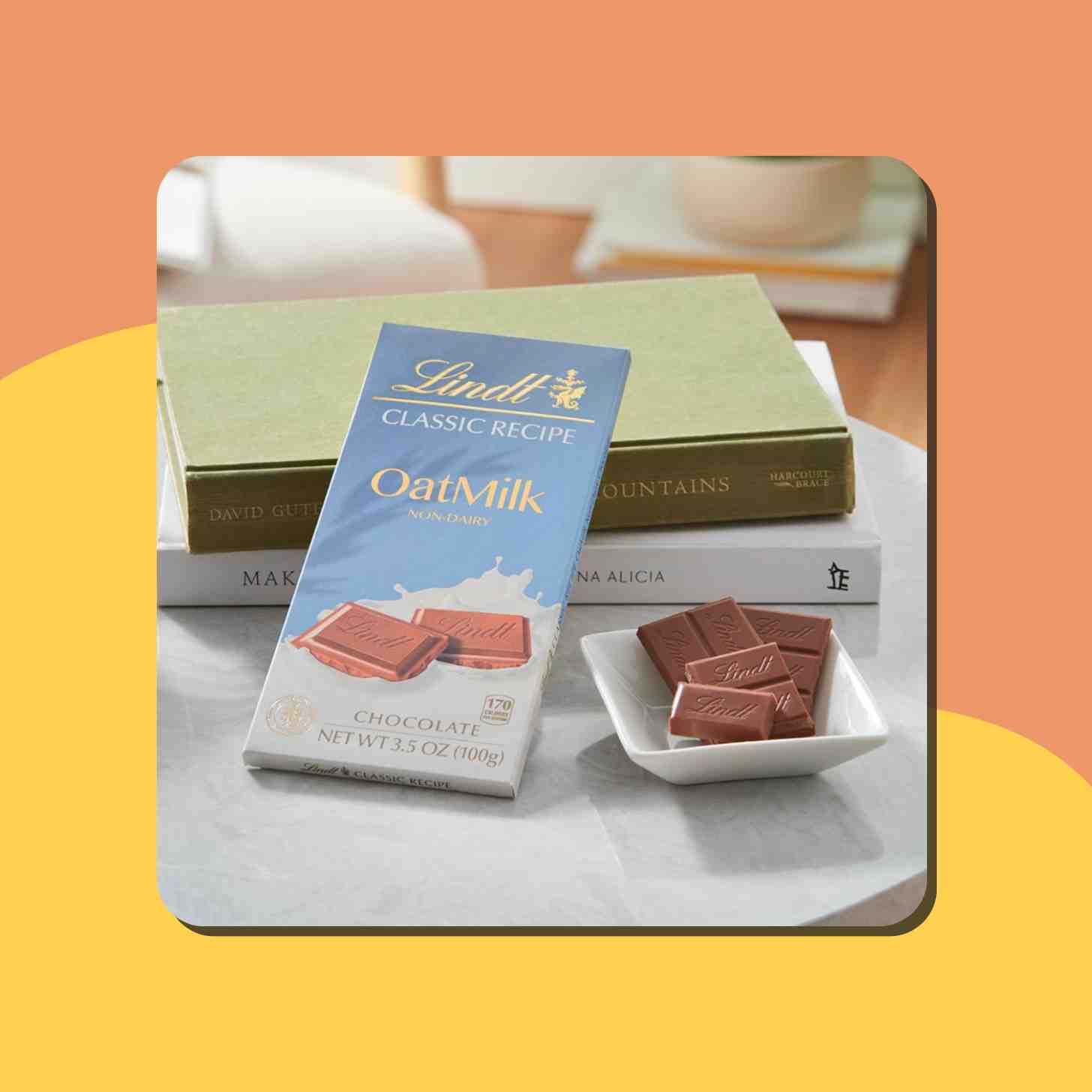
None of us are above popping one-too-many Lindt truffles until we develop a tummy ache. Bad news? Those truffles aren’t plant-based. Good news? The brand still makes lots of tasty vegan-friendly dark chocolate bars.
Any of Lindt’s Cocoa Excellence bars or Oat Milk Chocolate bars are perfect for plant-based bliss.
Frequently Asked Questions
Is oat milk-based chocolate healthy?
Sometimes, people are drawn to vegan or plant-based labels because they assume an item is healthier. That said, oat milk-based chocolate typically isn’t going to be free of the sugars and fats you’re used to with sweet treats. But oat milk does offer some fiber and iron, as opposed to other dairy-free milk alternatives.
Cocoa is also known to contain micronutrients like magnesium and copper that are good for heart health. So, when you opt for dark chocolate with a higher cocoa percentage, you’ll be choosing a slightly healthier option than a dairy-milk chocolate bar you might get trick-or-treating rather than on the shelves of your nearest Whole Foods.
We all know someone who deserves a little pampering. Actually, we all are someone who deserves a little pampering.
Meaningful self-care goes beyond a simple bubble bath or at-home facial (though, those are really nice, too), and we all need support and resources to maintain self-care routines that truly benefit us.
If you’re looking to be that support for someone else, self-care gifts can make a major impact.
It can be as simple as a cash transaction to spend on those weekly essentials, or as elaborate as a personalized self-care kit to rely on during those big mental health crises.
Regardless of how you show your support, this is one of those instances where the thought really does count.
Check out this list of gift ideas that you can get yourself — or anyone you love — to enrich your self-care savvy.
By the way, some of the products and links in this article are affiliates, which means we may earn a commission at no extra cost to you. Everything in this article was independently and honestly written by the Good Good Good team. Thank you for your support!
You might also like these self-care resources: 101 Self-Care Ideas | The Best Self-Care Apps | Self-Care Quotes | How To Practice Proactive Self-Care | How To Cheer Yourself Up | How To Build a Self-Care Kit | Self-Care Journals & Planners | Self-Care Affirmations | International Self-Care Day
The Best Self-Care Gifts For Yourself & Others
Health & Beauty
Tootilab Starter Pack

For the curly-haired cuties, managing that wild mane has probably been one of the biggest stressors throughout life. Fortunately, Tootilab has the solution.
The certified B-Corp, Leaping Bunny, and 1% for the Planet brand makes vegan, scientifically-backed hair care products that make managing curls easy, sustainable, and luxurious.
It’s time to rinse, repeat, and relax.
Shop: Tootilab
Vacation Sunscreen

If there’s one thing we know to be true: None of us are using enough sunscreen.
Get that SPF goodness and protect yourself from harmful UV rays! Vacation’s classic sunscreen is one of our favorites, since it’s made with vegan, cruelty-free, and Hawaii Reef Compliant ingredients.
Shop: Amazon | Ulta | Vacation
Quip Electric Toothbrush

Quip makes sleek electric toothbrushes that make teeth-brushing easier. With a timed vibration and auto-refills on new brush heads and toothpaste, even the most irritating daily hygiene task will become a no-brainer.
Jade Facial Roller

Jade Facial Roller
Most skincare experts will tell you to use a jade roller to increase circulation in your face to reduce puffiness and enhance your beauty.
But we’re telling you to use one because it simply feels good.
Whether you want to loop it into your daily skincare routine, love the cooling and calming effects of a facial roller, or reserve this for your next stress headache, jade rollers provide a moment of mindful luxury you won’t regret.
Maude Vibe

One of the most fun forms of self-care? Self-pleasure!
Maude’s aptly-named “vibe” toy is an internal and external vibrator with a sleek, minimal design. USB-chargeable, made with body-safe materials, and shipped in eco-friendly packaging, this toy is a direct line to feeling good.
→ Explore more eco-friendly sex and intimacy products!
→ Explore our full review of maude sex toys
Plant-Based Milk Mask

Have a classic spa-centric self-care moment with this set of milk masks made entirely from plant-based ingredients. The compostable sheet masks soften skin and provide a natural respite for your skin.
Shop: Amazon
Journals & Planners
The Self-Care Planner

Start with the quintessential Self-Care Planner. Each agenda contains six months’ worth of prompts for things like meal planning, gratitude, fitness, mood, sleep tracking, and more.
Shop: Amazon
Start Where You Are: A Journal for Self Exploration

Made by author and artist Meera Lee Patel, “Start Where You Are” is full of drawing prompts, reflective questions, and beautiful hand-lettering and watercolor illustrations.
Journal of Radical Permission: A Daily Guide for Following Your Soul’s Calling

This journal full of daily prompts was co-created by adrienne marie brown and Sonya Renee Taylor. Acting as an invitation to embrace who you are (and ditch the self-criticism), the Journal of Radical Permission takes you on a radical self-love journey.
Self-Care Master Plan
The Self-Care Master Plan is a compact workbook with a set of topics and prompts to help users create a set of “operating instructions” for life’s ups and downs.
Each page is postcard-sized and is easy to tear out and display.
→ Check out our full guide to guided journals and self-care planners!
Cleaning & Home Goods
Levoit Core 300 Air Purifier
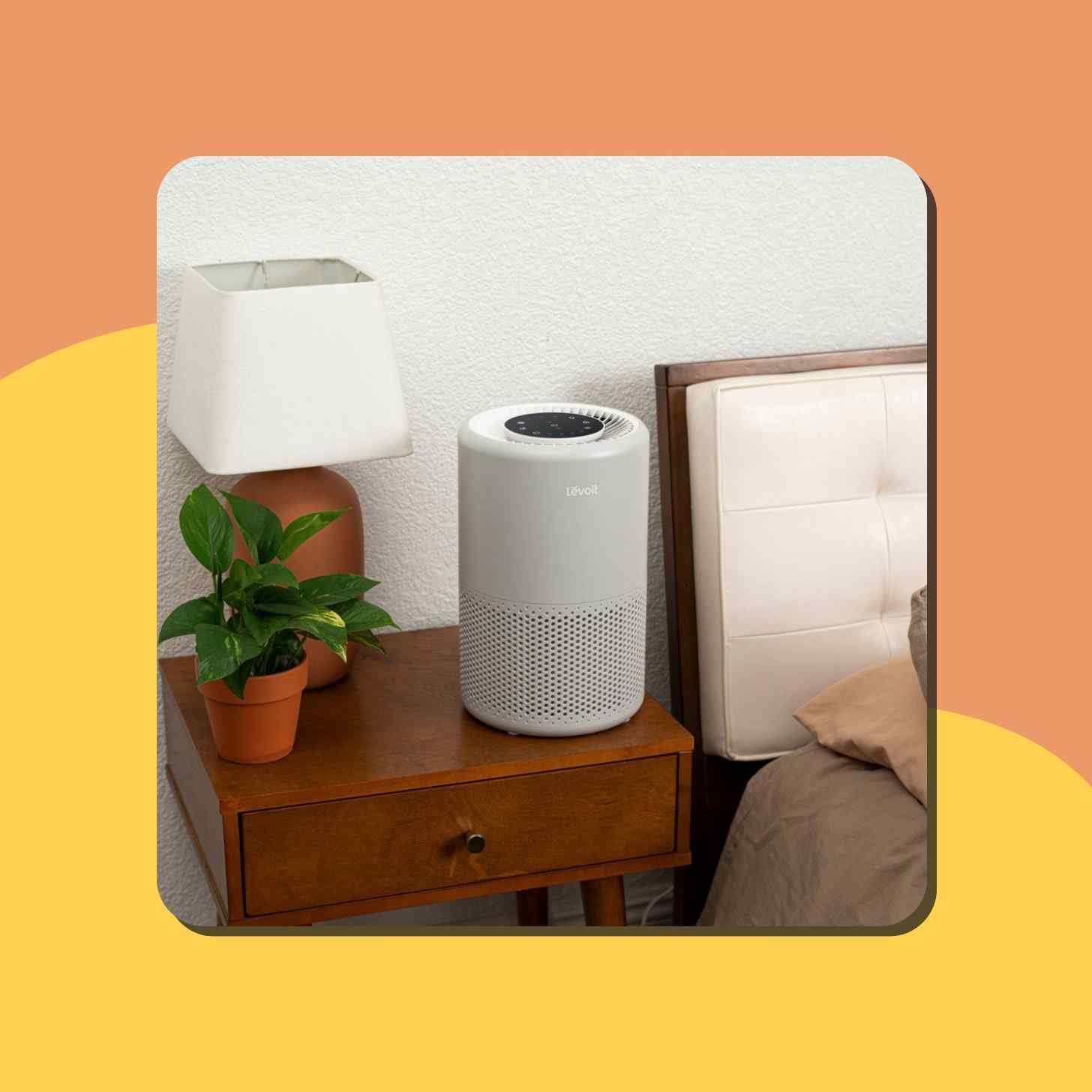
While an air purifier is more of an investment compared to other self-care goodies, it’s one of the most essential. A solid air purifier can help capture nearly all airborne allergens, like pollen and mold spores, as well as bacteria, viruses, and smoke — and pet hair.
The Levoit Core 300 is a great model for a small space at a relatively affordable price. There are also loads of mini air purifiers, or bigger models for larger spaces that are worth looking into.
Shop: Amazon | Chewy (we told you it was good for pet hair)
Phone Sanitizer Box
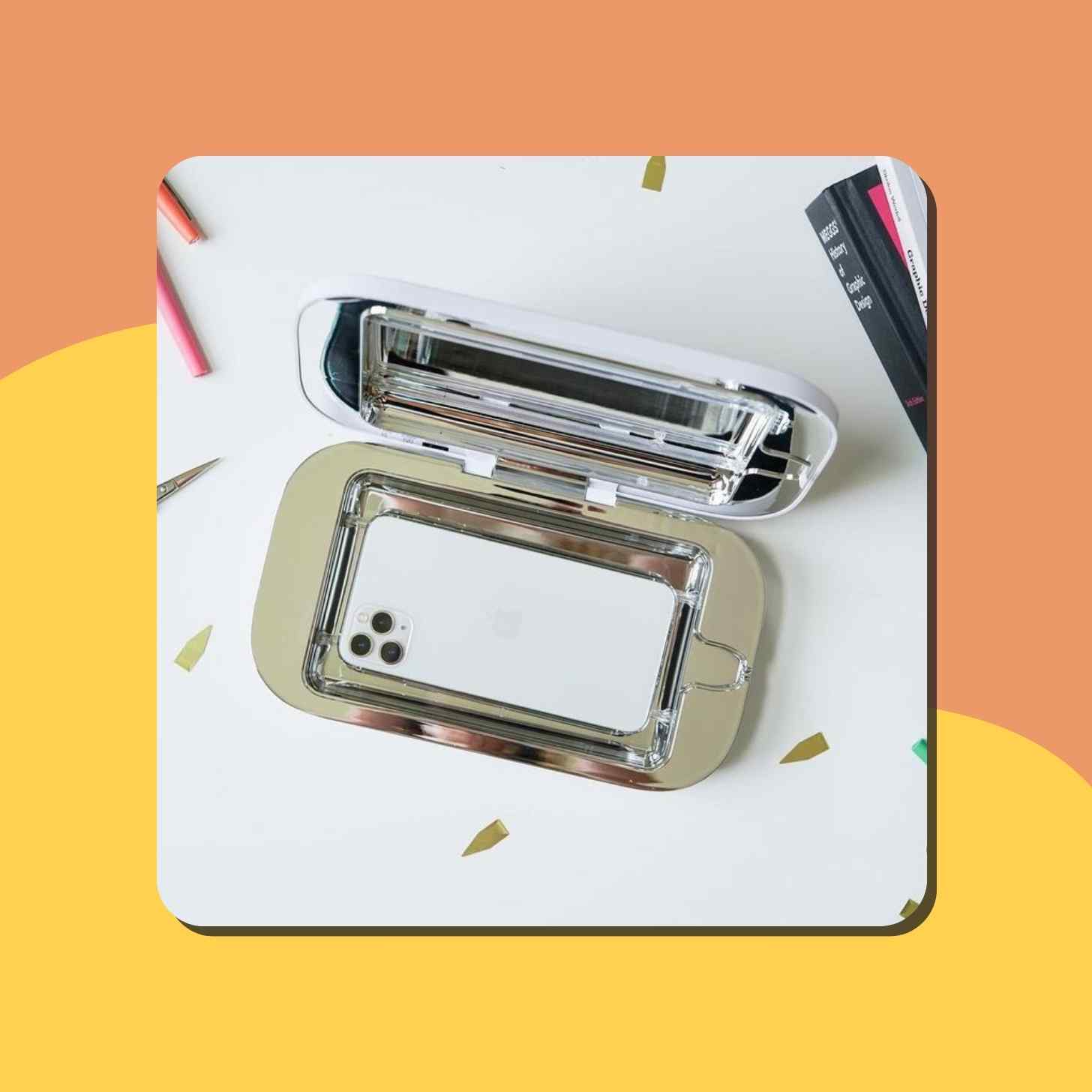
While it’s not something you might always think about, your phone carries lots of harmful bacteria; upwards of 17,000 bacteria per square inch, to be exact.
Rather than taking a disinfectant wipe to your trusty sidekick once every few months, consider getting a phone sanitizer box. These UV-filled boxes sanitize your phone, while you take a tiny screen break — or, hey — even wash your hands, too.
Consider phone sanitizing an easy addition to your daily hygiene ritual.
Shop: Amazon | Simplehuman
Handheld Vacuum

As a certified crumb creator, I know a thing or two about cleaning up after myself at my desk or table. A handheld, cordless vacuum has been my saving grace many times, and I believe it to be an essential when it comes to the regular maintenance of my space.
Shop: Amazon | Black & Decker
Organizational Bins
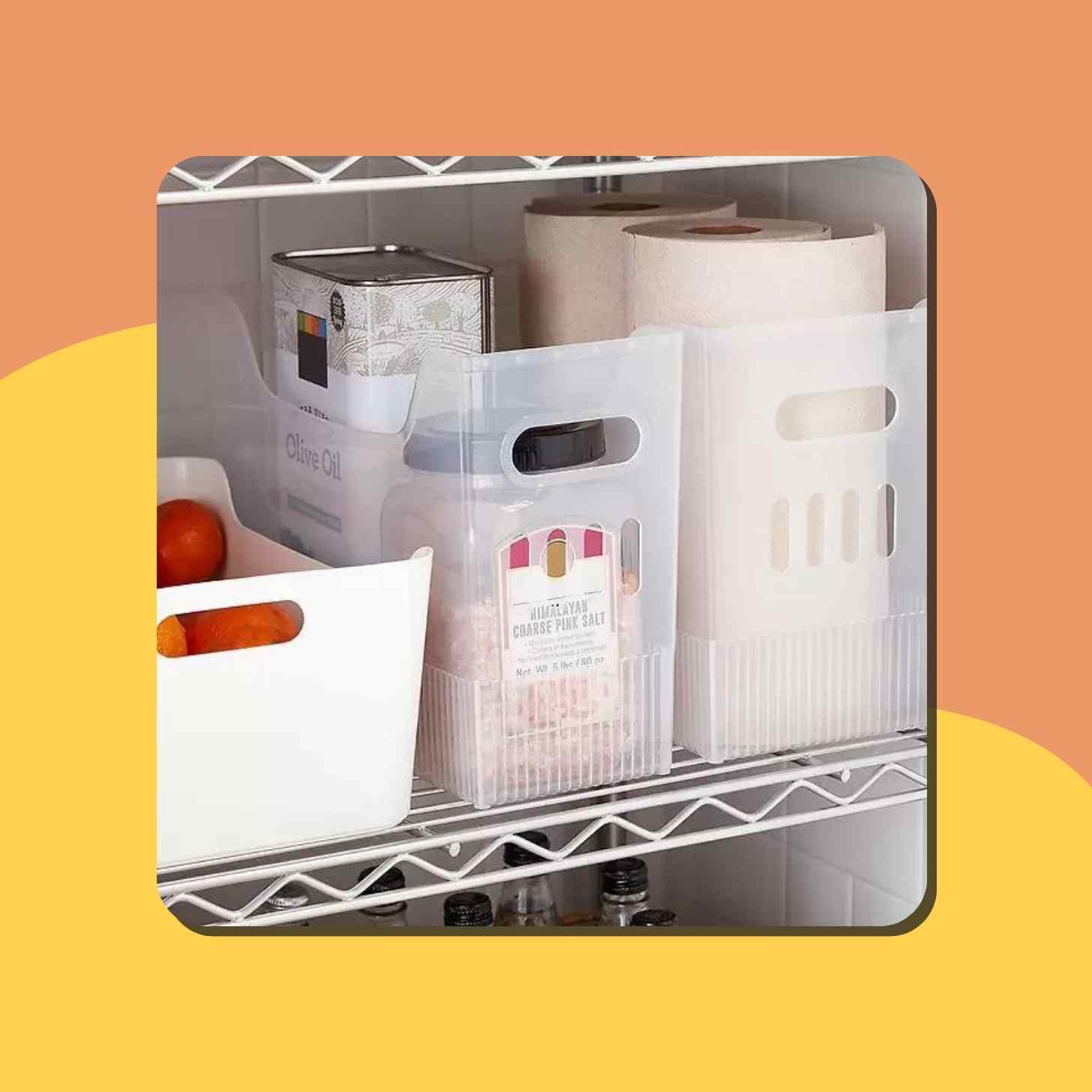
Need a place to organize the snacks in your pantry? A place to store your craft supplies? A spot to dump your daily essentials when you walk in the door? There are never enough bins!
Shop: Amazon | The Container Store
Divided Laundry Sorter

KC Davis has taught us a number of care task hacks on TikTok, but one of our favorites is the use of a giant laundry hamper (on wheels!) to sort and carry items through the house while cleaning.
Her DIY version is great, but you can also find divided laundry sorters to use, too.
Plus, you know, you can use it for actual laundry sorting, as well.
Shop: Amazon | The Container Store
Relaxation
Calyan Wax Co. Candle

Is there any better reset than taking a deep breath and lighting a soothing candle? Calyan Wax Co. is a great option for all your soothing candle needs, since it also does good in the process!
Shop: Calyan Wax Co. | Amazon
→ Check out our other eco-friendly candle recommendations!
Heated Neck Wrap

Seamlessly transition from a stressful day to a restful break with a heated neck wrap. Pop one of these babies in the microwave, embrace some natural lavender scents, and find comfort in the little joys.
Shop: Amazon | Uncommon Goods
Bombas Gripper Slippers

Bombas, while known for its cozy give-back socks, also makes slippers! The Gripper Slippers are a half slipper-half sock hybrid with a soft brushed lining and special non-slip grippers. Plus, every pair comes with a little travel bag.
Shop: Bombas
Parachute Cloud Cotton Robe

Lounge like you really mean it. Parachute’s Cloud Cotton Robe is made with 100% Turkish cotton and woven into a fluffy four-ply gauze for a light and comfortable fit.
Shop: Parachute
Bath Tray

Take the tablet, the snack, or the glass of wine to the tub! Life is too short to keep your self-care on dry land.
With the help of a bath tray, you can steep in a relaxing bath, while keeping all of your favorite items handy.
Shop: Amazon | Uncommon Goods
Therapy Dough

Squeeze out all your frustrations with some soothing scents and tactile playdough. Modeled after clay used by art therapists, Therapy Dough will help you knead through your feelings.
Shop: Amazon | Uncommon Goods
Sleep
Baloo Living Weighted Blanket

Weighted blankets are an amazing deep pressure stimulation tool to help give you a little extra support in high-stress times. Or… just make you feel snug as a bug when you climb into bed.
Baloo Living makes weighted blankets and weighted comforters with natural and chemical-free materials.
Shop: Amazon | Baloo Living
→ Check out our full guide to eco-friendly weighted blankets!
Nodpod Sleep Mask

Get the restful sleep you deserve by covering your eyes with a weighted sleep mask. Nodpod’s strap-free design helps equally distribute weight across key pressure points on the head and face.
Cozy Earth Pajamas

Change into something a little more comfortable. Cozy Earth’s bamboo pajamas are super-soft and made with breathable, earth-friendly materials.
Shop: Cozy Earth
Savvy Rest Sustainable Bedding

Whether you’re in the market for new silky sheets, a fluffy duvet, or even a pillow or mattress topper, Savvy Rest has eco-friendly options that are as comfortable as they are sustainable.
Shop: Savvy Rest
→ Check out our other favorite sustainable bedding brands!
Soothing Noise Machine

Whether you’re a fan of white noise — or the more nature-centric green noise — soothing sounds can help us sleep better and reduce our stress.
Hatch Restore Alarm Clock

As opposed to the aggressive phone alarm, start your day with the relaxing and gentle wake-up call from the Hatch Restore alarm clock.
The device is built with a sunrise alarm, soothing sounds, and an accompanying app with mindfulness exercises.
Pillow Mist Spray

Make your bed even more of a relaxing oasis by spritzing your linens with a freshening pillow mist. With aromas of lavender, chrysanthemum, rosemary and lemon, you’ll find natural relaxation in no time.
Shop: Amazon | Baloo Living
Movement
Oko Living Yoga Rug

With the popularity of yoga, you can find a cheap, plastic mat almost anywhere. Alternatively, Oko Living makes organic cotton, herbal dyed and ethically hand-loomed yoga rugs.
These yoga rugs are sturdy and supportive, all while being gentle to the touch — and the planet.
Shop: Oko Living
Adjustable Dumbbells

Want to incorporate a little extra workout into your TV time? These small adjustable dumbbells are perfect for getting some muscle movement into your day without working too hard.
Shop: Amazon
LARQ Filtered Water Bottle

You and everyone you know probably already has plenty of reusable water bottles in their collection, but if you’re looking for something fancy that might help you stay hydrated, the LARQ is a great option.
This filtered water bottle has a portable water filtration system that improves taste and removes any lead, heavy metals, chlorine, and particulates from tap water.
Books
“A Pity Party Is Still a Party: A Feel-Good Guide to Feeling Bad” by Chelsea Harvey Garner

While most of us try to avoid feeling sad as much as we can, therapist Chelsea Harvey Garner takes us on a candid and comical adventure to tolerate — and embrace — the unenjoyable.
Explore solo exercises, group activities, and journal prompts, alongside the author’s deeply-felt personal essays.
Shop: Amazon | Bookshop | Libro.fm
“Reasons to Stay Alive” by Matt Haig

Matt Haig’s profound mental health journey has made for some incredible writing. “Reasons to Stay Alive” is a moving exploration of living, loving, and feeling better, through the lens of Haig’s own healing experiences.
Shop: Amazon | Bookshop | Libro.fm
“I Thought It Was Just Me (But It Isn’t)” by Brené Brown

Fan-favorite Brené Brown offers a liberating study on the importance of our imperfections and how we can embrace vulnerability, and ultimately, our humanity.
“You Are Here (For Now): A Guide to Finding Your Way” by Adam J. Kurtz

“You Are Here (For Now)” is a candid collection of essays and illustrations that explore mental health, identity, setbacks, and finding humor in the unknown. Written by artist and author Adam J. Kurtz, this read is full of hope, humor — and a touch of darkness.
Shop: Amazon | Bookshop | Libro.fm
→ Check out our other favorite books about hope!
Food & Consumables
Tony’s Chocolonely
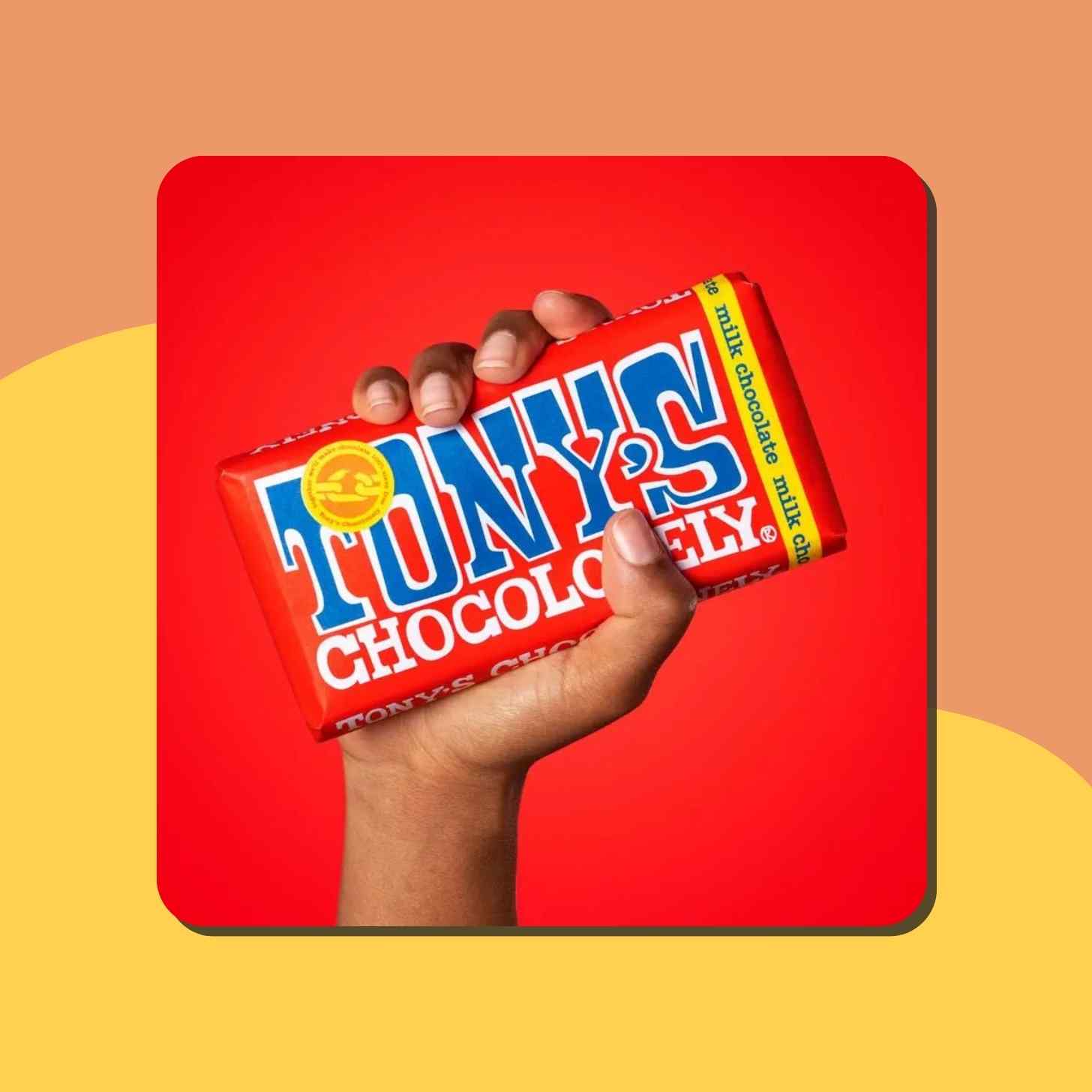
Tony’s Chocolonely is one of the most ethical in the biz. Aside from tasting delicious, the brand is dedicated to making 100% exploitation-free chocolate the industry norm.
Shop: Amazon | Thrive Market
DoorDash Gift Card

The best gift you could ever receive? Not having to worry about what to eat — or cook! Covering the cost of a meal (or a few!) can truly be a game-changer.
Misfits Market Grocery Delivery

Another great way to help mitigate the stress of mealtime? By having groceries delivered!
While there are plenty of options for grocery or meal kit deliveries out there, we definitely love Misfits Market for its commitment to reducing food waste.
Shop: Misfits Market
The Sill House Plant

Help grow that indoor garden with a new plant! While some may see a plant as yet another thing to take care of, others love the opportunity to add some new greenery to the fold.
Shop: The Sill
Hot Cocoa
Not to do the whole “chocolate fixes everything” thing, but it definitely does. And there’s nothing worse than opening the pantry, ready to steam up a mug of hot cocoa, only to find that you’re all out.
Help your loved ones stock up on all their hot cocoa needs.
Shop: Amazon | The Spice House | Thrive Market
→ Check out our other consumable gift suggestions!
Mental Health Support
Meditation Cushion

Of course, when it comes to meditation, all you really need is a spot to sit and breathe, but sometimes that spot feels uncomfy, and then you can’t focus on your breath. So a meditation cushion is the perfect antidote!
Shop: Amazon | Avocado Mattress
Light Therapy Lamp

Whether it’s seasonal affective disorder, shifts in daylight hours, or even travel, light can impact us in a number of ways. According to Harvard researchers, sitting in front of the right kind of light can be immensely helpful to treat negative mental health symptoms.
Headspace Subscription

A favorite among the wide array of meditation apps, Headspace is designed to help users “relax, manage stress, find your focus, and release tension in both the mind and body.”
Uh, yeah, we need some of that.
Helping to cover the subscription cost of an app like this makes a great gift!
Shop: Headspace
→ Explore some other (free and paid) self-care apps!
Activities
Affirmation Cards

Sometimes you just need a little note from the universe. Drawing an affirmation card (or two… or three) can be a great way to reset and find some support during a tough time.
Shop: Amazon | Barnes & Noble | Uncommon Goods
→ Explore our guide to conversation cards for more ideas!
Jigsaw Puzzles

Keep that brain busy with a soothing — yet fun — puzzle. The options are truly endless, so find one that feels challenging enough, while also providing a creative outlet to unwind.
Shop: Amazon | Uncommon Goods
Coloring & Activity Books

There is perhaps nothing more luxurious than cracking open a new coloring book and breaking out the fancy markers.
An affordable gifting option that provides hours of fun, a coloring or activity book may just be the way to go.
Shop: Amazon | Barnes & Noble | Uncommon Goods
Tabletop Zen Garden

Take the meditative sand gardens of Japan and put them on your desk! These fun and engaging kits allow you to explore satisfying textures and soothing patterns right from your home office.
Shop: Amazon | Uncommon Goods
Buddha Board

A Buddha Board is a meditative water painting setup. Using water and a bamboo brush, draw on the board and watch the “ink” evaporate in just a few minutes.
This grounding practice will help you embrace the temporary beauty of the world around you.
Shop: Amazon | Barnes & Noble
Luxury
Bose QuietComfort Headphones

Although a larger investment, Bluetooth headphones (especially noise-canceling headphones) are one of those items that folks use all the time and truly rely on day-to-day.
Ember Mug

We’ve all been there: One minute your coffee is way too hot to drink; the next, it’s nearly ice cold after going unnoticed for three hours. The Ember Mug is a temperature-controlled mug you can even control with your smartphone!
While our ancestors are probably rolling their eyes at this invention, it’s a luxury that any forgetful multi-drink-enjoyer deserves.
Dyson Airwrap

One of the most high-end hair care products on the market, the Dyson Airwrap has become all the rage on TikTok, making styling speedy while protecting your hair from heat damage.
For the person who hates spending time getting dolled up in front of the mirror, this is an investment piece that will make hair-dos hair-done.
Theragun Massager

For the athletes, gym rats — or every day anxious bodies — who have achy muscles, a handheld massager makes for the ultimate relief.
The most reputable is the Theragun line, which is known for being quiet, portable, and perfect for beating back and muscle tension with ease.
Postcard Carbins Gift Card

Give the gift of a getaway. Postcard Cabins is a company that has outposts in 25 cities across the U.S, designed to distance guests from technology, work, schedules, and all the stress of modern life.
With unscheduled, unstructured, and uninterrupted free time, visitors can take a real break and come back refreshed and energized.
Shop: Postcard Cabins
The movement toward zero waste has gained incredible momentum in recent years, as more people recognize the importance of protecting our environment and taking action toward a sustainable future for all.
As we continue to see the effects of climate change, more community leaders and online influencers are embracing the zero waste lifestyle and making it easier for others to do the same.
The benefits of zero waste are vast, from reducing our carbon footprint to creating jobs and supporting local economies.
Let’s be honest, though, the idea of even getting started can seem overwhelming and unrealistic.
It’s important to remember that zero waste is not (I repeat: not) about being perfect (or having the most aesthetic-looking bamboo cutlery set), but rather a lifestyle shift that takes time and effort — and probably won’t leave you with exactly “zero” waste. Still, your efforts to minimize your environmental impact are meaningful, and you’ll need support as you venture toward more sustainable living.
This is where the power of zero waste blogs comes in.
Zero waste blogs offer an archive of helpful information, tips, and advice to inspire and motivate us to make small but meaningful changes to our existing routines.
From DIY recipes for seasoned zero wasters to helpful beginner tips for those just starting out, these blogs provide valuable resources (and fun online communities) to support you and our planet.
We’ve compiled some of the best zero waste blogs to bring you a little closer to finding what you need. (We may have gone down way too many zero waste rabbit holes and watched hours of DIY videos in the process.)
These bloggers have the most helpful content to guide you to take action in and out of the home while promoting sustainable consumption, supporting circularity, and raising awareness about today’s most pressing issues.
Best Zero Waste Blogs for Tips, Recipes, and DIY Projects
Zero Waste Home
Bea Johnson — the mastermind behind Zero Waste Home — is regarded as “the mother of the zero waste movement.” She turned her at-home lifestyle into a global movement in 2008 when she introduced the trash jar, a pint-sized container she uses to fit her family’s annual garbage. (Check out what her trash jars have looked like throughout the years!)
Johnson’s blog, Zero Waste Home, is a simple yet informative platform that has inspired a global community of zero waste enthusiasts. She covers topics from tips on zero waste kitchen hacks to plastic-free traveling and sustainable fashion choices.
What’s good:
- 100 Tips To Get To Zero Waste: A free starter guide to waste-free living with over 100 tips on how to slowly begin eliminating waste in your home.
- “Zero Waste Home” by Bea Johnson: One of the most comprehensive resources on all things zero waste. It’s been translated into 28 languages!
- Bulk Finder app: Making package-free locations easy to share and find worldwide with 10,000 locations in 100 countries … and growing daily!
Trash is for Tossers
In 2012, environmental activist, blogger, and entrepreneur Lauren Singer was inspired by Bea Johnson’s Trash Jar and decided to incorporate it into her lifestyle. Singer shocked the internet with this challenge and soon inspired even more environmentally conscious consumers to do the same.
In 2014 she launched Trash is for Tossers, a now-popular zero waste lifestyle blog and online resource that educates folks on how to live a waste-free life.
You’ll find tips, tricks, and tools for reducing waste, insight into environmental issues (and what can be done to solve them) as well as cost-effective recipes, guides, and DIYs.
What’s good:
- Zero Waste Natural Cold Remedy: Singer shares her natural (low waste) medicine recipe that helps prevent colds — and helps you through the duration of one if you’re already feeling under the weather.
- Why I live a zero waste life - TEDxTeen: Singer brought the concept of Zero Waste to millions through her inspiring 2015 TedxTeen talk.
- Reducing Your Waste In College: This is a great guide for students seeking ways to reduce their waste and save money!
Going Zero Waste
After Kathryn Kellogg received a shocking health scare in 2015, she was inspired to educate others on improving their health while helping the planet.
Her blog, Going Zero Waste, provides straightforward, practical tips on how to start and maintain a zero waste household and lifestyle (including travel, beauty, and food tips).
Kellogg is also a spokesperson for plastic-free living for National Geographic, Chief Sustainability Officer at the The One Movement, and author of “101 Ways to Go Zero Waste.”
What’s good:
- 8 Things You Should Know BEFORE Going Zero Waste: Don’t say someone didn’t warn ya! Kellogg breaks down some common misconceptions and lessons learned to help you get started on your own journey.
- Life without Bulk Options: Some of us don’t have access to bulk bins in our area. Here’s how you can work around it.
- 31-Day Zero Waste Challenge: If you’re just dipping your toes into the world of zero waste living, this challenge is a great stepping stone!
Zero-Waste Chef
Anne-Marie Bonneau is an environmental activist, award-winning writer, and blogger who has become a leading voice in the zero waste movement.
Her blog, Zero-Waste Chef, is a great resource for practical tips and solutions on reducing kitchen waste, such as shopping in bulk, composting food scraps, and using cloth instead of paper towels.
Her recipes for homemade staples like bread, nut milk, and condiments not only help reduce waste but also promote healthier eating habits.
What’s good:
- 7-Day Menus: Don’t know where to start? No sweat! Zero-Waste Chef has prepared an entire week’s worth of menus to help get you started on your low or zero waste journeys.
- How to Prevent Food From Spoiling During a Power Outage: Something we might not think about (until it happens) is preventing food from going bad during a power outage — this blog post breaks everything down for you so that you feel prepared if or when it might happen to you.
- “The Zero-Waste Chef” by Anne-Marie Bonneau: If her blog leaves you wanting more, there’s Bonneau’s book: A use-what-you-have and a spend-less-money book filled with recipes and tips for a zero waste kitchen.
Dr. Anita Vandyke
Dr. Anita Vandyke is a bestselling author, blogger, and rocket scientist (yes, you read that right: She’s a rocket scientist!) based in San Francisco, California.
Her blog offers practical zero waste tips on skincare, at-home cleaning (like, what to do with fruit that’s gone soft), and decluttering. She advocates for second-hand purchases, raising a zero waste family, and low-waste travel.
What’s good:
- Bulk Shopping 101: If you’re looking for the least intimidating checklist to get you started on your first (or next) bulk shopping trip, Dr. Vandyke created a little cheat sheet for you!
- Zero Waste Nappies (Diapers): For parents looking for zero waste diaper options, we recommend starting with this “non-perfect guide” to navigating zero waste diapers.
- “A Zero Waste Family: In Thirty Days” by Dr. Anita Vandyke: A practical guide filled with lessons learned on how to sustainably reduce your family's waste by 80% in just thirty days.
Rob Greenfield
Rob Greenfield is an adventurer, environmental activist, author, and blogger on a mission to show people that living a low-impact lifestyle can be both fun and fulfilling.
You might remember him from our delightful podcast interview with him about some of his most iconic projects.
You’ll find advice on cutting back on plastic and reducing your trash, information on his experience growing and foraging for food, and insightful conversations with leaders within Indigenous and BIPOC communities.
What’s good:
- “Dude Making a Difference” by Rob Greenfield: Greenfield’s memoir cataloging his zero waste journeys across the U.S. on a bamboo bicycle.
- Watch Greenfield’s “Trash Me” series: Greenfield is also passionate about raising public awareness around food waste, plastic pollution, and climate change. So much so that he’s known by many as “The Trash Man.” His series — recorded over a month — is a visual representation of what the average American consumes in 30 days. He wears every piece of trash that’s typically consumed, creating a shocking visual of how much garbage just one person generates.
- 50 People to Pay Attention to: Greenfield offers an extensive list of 50 activists fighting to create a safe, regenerative planet.
Max La Manna
Max La Manna is a low-waste chef and digital creator passionate about plant-based cooking. His focus on simple, affordable dishes that use every part of each ingredient has made him a viral sensation, with recipe videos racking up over 1 billion views.
His casual approach to cooking shows that reduce food waste can be delicious and enjoyable, and his commitment to eco-friendly practices makes his content an invaluable resource for anyone looking for zero waste kitchen inspiration.
What’s good:
- No Waste Recipe Section: La Manna has an archive of delicious meals on his blog, but he makes it easy for his zero waste community to quickly find meals that produce no added waste.
- “Regeneration Food” series: Check out La Manna’s series on food waste and the consequences of wasting food on our planet.
- Download La Manna’s book, “You Can Cook This!”: Learn how to turn 30 most commonly wasted foods into 135 delicious plant-based meals.
Permacrafters
Permacrafters is an online platform run by Christelle Siohan and Cristina Rojas — two zero waste queens — who provide courses on environmental topics to encourage creative permaculture thinking and self-reliance skills for a sustainable life.
They offer English, French, and Spanish courses, making their content accessible to a broader audience.
From zero waste menstruation, composting, and sustainable gardening, they provide easy-to-adopt practices to encourage folks to reduce their consumption, embrace secondhand items, and repurpose materials to live a more sustainable life.
What’s good:
- Intro to Zero Waste Living: A free resource to help you learn about the zero waste movement and the 5 Rs (refuse, reduce, reuse, recycle, rot). This class also touches on perfection and privilege in the zero waste space.
- Green Cleaning Challenge: A free 3-day green cleaning challenge to make your own DIY products.
- Secondhand Living: An in-depth course on the environmental and financial benefits of buying (or receiving) secondhand goods. It explores the best places and ways to easily find secondhand goods and delves into furnishing homes secondhand, raising babies with secondhand goods, and keeping a secondhand wardrobe.
Wasteland Rebel
Wasteland Rebel is a fun and no-nonsense zero waste blog run by Shia, who describes herself as a “hot mess” and insubordinate cookie monster. Despite her playful nature, Shia is serious about reducing waste and living a sustainable lifestyle.
What sets Wasteland Rebel apart is its focus on simplicity. Shia and her partner, Hanno, don’t like spending much time on household chores or errands, so all the DIY recipes on the blog are straightforward and easy.
What’s good:
- 3 Truly Sustainable New Year's Resolutions: While some of us might not be fans of New Year’s resolutions, Shia provides readers with more of an intentional guide to help get you going on your zero waste goals. She gives loads of ideas, motivation, and lessons learned.
- 7 tips for reducing waste outside your home: A super helpful resource for those who want to take their zero waste lifestyle outside of their homes.
- 8 quick and easy hacks for a plastic-free July (or any other time of the year): This blog post, as Shia puts it, is for the #LazyAssZeroWaster. Learn easy ways to become plastic-free without breaking a sweat!
Almost Zero Waste
Almost Zero Waste is dedicated to sharing tips and tricks for living a more sustainable life and reducing waste. The blog recognizes that being 100% zero waste is challenging but offers advice on how to get as close as possible.
The blog includes delicious recipe options, minimalism lifestyle tips, and zero waste guides.
What’s good:
- 53 Non-Materialistic Gifts For Any Budget: A zero waste gift-giver? Yes, honey, she exists! Almost Zero Waste offers her list of non-materialistic gift ideas for you to run with.
- DIY your own deodorant: If you’ve got smelly armpits (don’t worry, everyone stinks!) and are too afraid to dive into natural deodorants, this might be the recipe for you.
- 90 Zero Waste Tips For Beginners (Impactful & Easy Habits): While we don’t recommend incorporating all of these tips into your routine overnight, this blog post shares some great tips that you can slowly begin adding to your routine.
Sustainable Jungle
Sustainable Jungle is a mission-driven blog that covers topics like zero waste living, eco-friendly travel, sustainable fashion, and green beauty. They provide practical tips and advice for reducing our environmental impact, as well as reviews of sustainable products and companies.
The website also features personal stories and interviews with people who have made significant changes to live more sustainably.
What’s good:
- Sustainable Jungle is a 1% for the Planet member: This means they committed to giving away 1% of any revenue earned to highly vetted environmental nonprofit organizations.
- They also have a podcast: If you’re hungry for more information, Sustainable Jungle also has a podcast that you can dive into. They cover all things sustainability and green living and interview a diverse group of professionals.
- What Not To Compost: 33 Things You Shouldn't Put In Your Compost Bin: If you’re thinking about adding a compost bin to your home, this article is a helpful guide as to what not to put into your new bin.
Every day the Good Good Good team collects the best good news in the world and shares it with our community. Here are the highlights for this week!
If you want to get good news in your inbox every day, join the Goodnewsletter — the free daily newsletter designed to leave you feeling hopeful.
The Best Positive News We’re Celebrating This Week —
Debunking stereotypes, a new study found that people experiencing homelessness spend cash on food, shelter, and clothing
In a previous U.S. survey that tracked “public mistrust” in the ability of unhoused people to manage their money, respondents said that recipients of $7,500 no-strings-attached cash would spend most of it on “temptation goods” like drugs and alcohol.
That prediction — and the harmful biases that they’re based on — has just been proven incorrect by a study in Canada. Canadian researchers gave 50 people experiencing homelessness a one-time, lump sum of $7,500 (“to enable maximum purchasing freedom and choice”), and the recipients spent it mostly on rent, food, housing, transit, and clothing.
They also spent an average of 99 fewer days homeless than a control group, increased their savings, and spent less time in shelters — “costing” society less by doing so.
Why is this good news? Often, our biases and stereotypes about unhoused folks get in the way of developing policies that actually help reduce homelessness and support people experiencing it. In reality, unhoused people spend money, much like anyone would — to meet their basic needs.
Studies like this are important to help us change our biases and find better, evidence-based solutions.
The U.S. is on track to close half of its coal-fired power generation capacity by 2026
Just 15 years after its coal generation capacity peaked in 2011, the U.S. is now on track to close 50% of that capacity by 2026, according to reported coal plant closures. It will take the country’s coal generation capacity to 159 gigawatts (GW), down from 318GW in 2011 — and it is set to fall even more, to 116GW by 2030.
The plant closures are a result of lower demand for coal-generated power, higher costs of plant operation and maintenance, and the continually lowering costs of and investment in renewable energy sources like solar and wind.
While generation capacity is indeed falling, actual energy generation by the existing coal plants is falling even faster. In both 2020 and 2022, the U.S. produced less than half of coal’s 2011 power level.
As the country’s shift to a renewable energy future continues to come into clearer view, it’s important that that the transition is just — that workers are taken care of, plants are safely closed, and more.
New results from an 18-year study in Costa Rica show that small farms with “natural landscape” features help protect tropical birds
For nearly two decades, ornithologist James Zook has been studying and collecting records for around 430 tropical bird species in Costa Rica. He’s looked at their populations in undisturbed forests and on small farms.
While his findings show that the birds thrive best in undisturbed forests — they also do comparatively well on “diversivied farms” that mimic a natural forest environment in their landscapes. These farms include features like shade trees, hedgerows, and tracts of forest.
And with 18 years of data to back up his theory, Zook says it shows that the birds aren’t just passing through — but persisting and thriving in these types of farming environments, too.
Why is this good news? Plants, birds, and other animals that are native to an area are critical for its survival — and by extension, the survival of humans. Data like this further proves that we need to not only implement conservation efforts in untouched, protected parts of the planet — but in the land we use for agriculture, housing, and other forms of development, too.
The Biden administration just canceled all remaining oil and gas drilling leases in Alaska’s Arctic National Wildlife Refuge
In a significant move for both climate action and protecting biodiversity, the U.S. Interior Department just announced it is officially canceling all remaining oil and gas leases in the Arctic National Wildlife Refuge in Alaska.
The cancellation of the seven remaining leases in the refuge will protect 1.5 million acres of coastal plain — both a critical ecosystem for wildlife and an area seen as sacred to the Indigenous Gwich’in since it's where caribou they rely on migrate to give birth.
The leases were part of a sale held in the remaining days of the Trump administration, but shortly after taking office, President Biden placed a moratorium on the leasing program so that the Interior Department could review it. It found there were “multiple legal deficiencies” with the leases.
Why is this good news? The overwhelming consensus in the scientific community is that we need to urgently and rapidly phase out the use of fossil fuels in our energy systems in order to avoid the most catastrophic impacts of the climate crisis.
This decision will ensure that these lands aren’t opened to new oil and gas drilling — protecting the future health of people, animals, and the planet, in this immediate region and beyond.
A crew of mostly women are building a state-of-the-art maternal health hospital in Sierra Leone — challenging gender norms in the process
In Koidu, the capital of Kono District in Eastern Sierra Leone, a construction crew is busy building a new legacy for the region: a state-of-the-art maternal health hospital called the Maternal Center of Excellence.
Around 60% of the team that’s building it are women, and are not only benefiting from the safe, fair work environment and growth of their skills — they will likely also personally benefit from the health care services offered at the hospital once it’s open.
The construction crew grew to be mostly women after news that they were treated well and fairly spread through word of mouth in Kono. One worker said they hope that the construction project gives other women the courage to come work there, too.
Why is this good news? Women around the world often lack equitable access to jobs that help them earn money to support their families, which can lead to more, compounding issues. The women building this hospital are changing minds about what they’re capable of — and a writing a new, better story for Sierra Leone’s high maternal and infant mortality rates in the process.
A family in Mexico gave up fishing to monitor, protect, and rescue sea turtles
Before a Mexican law prohibited the practice in 1990, fishers saw turtles they occasionally caught by accident as a source of extra income that could help in the event of an economic emergency.
That was true for Cosme Becerra, but in 2010, he decided to chart a different course and formally dedicated his time to the conservation of turtles in Kino Bay, a small fishing community with just over 6,400 residents located in the state of Sonora in northwestern Mexico.
He began working as a boat captain for marine mammal-monitoring and through this work, Becerra convinced his family that the future was in wildlife conservation.
Now, the whole Becerra family practices sustainable fishing. They even invested their savings and income to buy a boat to monitor turtles and rescue them from abandoned fishing gear.
More good news of the week —
The latest release of “Call of Duty” will feature real-time, AI-powered hate speech moderation. The ToxMod technology will supplement the game’s existing anti-toxicity measures, which have already proven to help reduce behavior that violates the game’s code of conduct.
The Fort Worth Zoo just announced the “groundbreaking” births of critically endangered gharial crocodiles. In a “historic conservation success,” four hatchlings were born at the zoo, which is the only one in the U.S. to have produced offspring.
A new blood test could help diagnose Parkinson’s disease before symptoms appear. Earlier diagnosis of the disease could help with treatments, since it would have been caught before significant neurological damage has already been done.
Following Hurricane Hilary, most of California is now officially drought-free. Experts in the state say there’s still lots of room for progress in capturing rainwater, as much of the water that Hilary brought ran off into the ocean.
Thanks to the country’s “war on pollution,” people in China are now living two years longer. A new report found that China’s pollution levels in 2021 had fallen 42% from 2013, and praised China’s “staggering success in combating pollution.”
Major British retailers just lowered the cost of period underwear, and are calling on the government to eliminate the tax, too. Brands John Lewis and Waitrose joined supermarkets Tesco and Marks & Spencer in the “Say Pants to the Tax” campaign to make the popular period product more affordable.
A Texas school created book clubs that have helped to massively improve reading scores in school. In the clubs, students can talk about what they’re reading with friends, aiding with reading comprehension and enjoyment, and test scores have brought the school from an F to a B campus.
A conservation organization just purchased the world’s largest herd of privately-owned white rhinos to rewild them. Africa Parks aquired the herd of 2,000 rhinos after the farm they’re living on was put up for auction — and received no bids.
California just became the largest economy in the world to support a Fossil Fuel Non-Proliferation Treaty. The treaty explicitly stop the expansion of fossil fuels and manage a just, equitable transition away from coal, oil and gas to clean energy.
Fossil fuel burning in the European Union fell to the lowest level on record in the first half of 2023. Driven by lower demand and new clean energy sources, the 27 member states burned 17% less fossil fuel to make electricity than the same period the year before.
Making history, Ava DuVernay is the first Black woman to have film compete in the Venice Film Festival. DuVernay’s new film “Origin” will be the first by a Black woman to compete for the Golden Lion in the festival’s 80-year history.
A Texas judge temporarily blocked a law that could have put drag performers in the state in jail. A group of performers and advocates said the new law threatened their livelihoods and would censor their freedom of expression — and the judge agreed.
National Suicide Prevention Week is honored for one full week in September every year — with this year’s event taking place from September 10 through September 16.
This important awareness week has been recognized for more than a decade — as mental health activists and practitioners across the country work to reduce the prevalence of suicide and provide support to those who struggle.
With events, screenings, activities, and more, Suicide Prevention Week serves as a catalyst for us to learn more, seek help, offer support, and open our hearts and minds to vulnerable conversations.
Suicide Prevention Week takes place within Suicide Prevention Month. Suicide Prevention Day is also honored on September 10, during Suicide Prevention Week.
We’ve collected ideas for action steps on how each of us can use this annual event as an opportunity to educate ourselves, support the people in our lives, and take action to reduce suicide rates on a massive scale.
Scroll through our guide and find a few action steps you can take — and then share this guide with others so they can join in as well.
Please know that asking for help is a sign of strength — not weakness. If you’re in a crisis, please dial 988 to reach the Suicide & Crisis Lifeline. If you’re looking for professional help or looking for specific support, we encourage you to use Good Good Good’s Mental Health Resources Guide. You can also text HOME to 741-741 to instantly connect with a trained crisis counselor, 24/7, for free.
Activities To Honor & Celebrate Suicide Prevention Week —
Learn
Learn the warning signs of suicide.
Suicide is a deeply complex and personal issue, and it’s important to remember that not everyone who has a mental health condition or experiences risk factors contemplates or plans suicide. Nevertheless, it is vital to know the warning signs that someone might be at immediate risk for a suicide attempt.
Thanks to the National Institute of Mental Health for this helpful information— check out the organization’s suicide prevention guide for more helpful resources.
- Talking about wanting to die or wanting to kill oneself
- Talking about feeling empty, hopeless, or having no reason to live
- Talking about feeling trapped or that one has no solutions
- Feeling unbearable emotional or physical pain
- Talking about being a burden to others
- Withdrawing from family and friends
- Giving away important possessions
- Saying goodbye to family and friends
- Putting affairs in order, such as making a will or arranging home and financial logistics
- Taking great risks that could lead to death, such as driving extremely fast or using drugs and alcohol more often
- Displaying extreme mood swings
- Making a plan or looking for ways to acquire lethal weapons, stockpiling pills, or purchasing a gun
- Showing rage or talking about seeking revenge
Learn the facts about suicide.
The statistics about suicide are very overwhelming and disheartening, but they help us get a better picture of the issue at hand. Here’s what you need to know:
- In 2020, suicide was the twelfth leading cause of death overall in the U.S., claiming the lives of over 45,900 people.
- Rates of suicide are highest among male Native Americans, at 37.4% per 100,000 according to the CDC in 2020.
- The use of firearms is the number one method of suicide, followed by suffocating and poisoning. For 57.9% of males and 33% of females, firearms are the chosen method, while 7.8% of males and 28.6% of females select poisoning.
- In 2020, the prevalence of serious suicidal thoughts was highest among young adults aged 18-25 at 11.3%
- LGBTQ youth are more than four times as likely to attempt suicide than their peers.
- Between 2007 and 2018 the suicide rate among those age 10 to 24 increased nearly 60%, according to the CDC.
- Suicide is the number one cause of gun deaths in the U.S., factoring at 60.3% of the number of gun deaths by intent in 2019.
Learn the correct terminology.
In order to break through and have difficult, life-saving conversations, we need to know what language to use. Here are a few helpful words to add to your vocabulary and help you dive a bit deeper into suicide prevention work. Again, these insights are from the National Institute of Mental Health. You can check out the organization’s suicide prevention guide for additional information and resources.
- Suicide: when people harm themselves with the goal of ending their life, and they die as a result.
- Suicide attempt: a non-fatal, self-directed, potentially injurious behavior with intent to die as a result of the behavior. A suicide attempt might not result in injury. (Experts suggest avoiding terms like “failed suicide” or “successful suicide,” which perpetuate negative stigmas.)
- Suicidal ideation: refers to thinking about, considering, or planning suicide.
Another helpful language tip is to use the phrase “died by suicide,” instead of “committed suicide” when talking about someone who lost their life. Suicide is not a crime that one commits, but rather a complex outcome of illness and risk factors.
Learn about effective ways to reduce suicide.
Suicide is a culmination of a number of nuanced factors, and preventing suicide includes loads of different people and institutions. From psychologists, clinicians, social workers, and public health experts, to first responders, policymakers, community members, and law enforcement — suicide prevention starts with basic science.
Diverse expertise and widespread education efforts are necessary to prioritize funding and resources for suicide prevention. Experts are advocating for greater funding for research to do their jobs and create effective policies for combatting suicide.
One of the key ways to reduce suicide is to enact stricter gun laws. By making guns more difficult to acquire, or by putting more time between gun licensing and purchasing, or simply by improving gun safety practices, firearm suicide will become less pervasive.
Additionally, suicide prevention efforts can be greatly supported by more accessible healthcare, allowing people to access help for their mental health as a preventative measure, rather than a reactionary one.
Developing mobile crisis services, peer crisis services, and crisis warmlines can also support people in crisis. This is often presented as an alternative to law enforcement intervention, removing the threat of institutionalization and allowing people to have agency over their suicide prevention care.
Another deeply important suicide prevention measure is by creating a world that is safer and more accepting of LGBTQ+ youth, who are highly at risk of suicide, due to social isolation, conversion therapy, and stress.
Though these are certainly not the only ways to reduce suicide, and we could spend hours writing about and researching each of these topics, these are a great starting point to learn more about suicide prevention in an intersectional and intentional way.
“The field of psychology is unique in our ability to move science from the lab to providers’ offices, and even into legislative efforts,” Mitch Prinstein, Ph.D. shared with the American Psychological Association. “Psychology can make an enormous difference by working together across science, practice, and policy. Together, our work can truly save lives.”
Learn how to ask hard questions.
While most of us assume that asking a loved one about suicidality can increase suicidal tendencies, several studies have found that questions about suicide do not increase potential suicidality.
In fact, doing so could actually save a life.
Becka Ross, LCSW, is the Chief Program Officer at Crisis Text Line — and wrote a helpful article for Good Good Good about why and how to ask about suicide.
Learn how to help someone struggling with suicide.
If someone shares their suicidal thoughts with you, you may feel a lot of pressure to respond “correctly”, but first and foremost remember: the fact that they shared this with you is a positive thing, and you now have the opportunity to help.
We put together a guide so you can preemptively learn how to provide support if the opportunity arises in the future.
Read quotes about suicide prevention.
Sometimes you just need to hear (or share) the right words. We collected some of the best quotes about suicide (and more mental health quotes) that speak to the ideas of hope, story, and strength.
Take Action
Make a donation.
Donating directly to organizations helping to prevent suicide allows them to continue doing their work all year long.
We recommend the following nonprofit organizations:
- To Write Love On Her Arms
- American Foundation for Suicide Prevention
- The Jed Foundation
- The Trevor Project
- Crisis Text Line
- Your local crisis call center
Volunteer at a crisis hotline (or text line).
It’s incredibly valuable and important for people to have somewhere safe and accessible to turn to when they’re experiencing a crisis. Fortunately, thousands of volunteers continually and eagerly show up to provide support.
Crisis centers offer training and support to help empathetic volunteers get started helping people. Many volunteer positions can be done remotely at times convenient for you.
Here’s a brief list of volunteer opportunities available to folks who aren’t mental health professionals:
- Crisis Text Line
- The Trevor Project
- Trans Lifeline
- Your local crisis center (This is the best way to get involved in supporting the 988 Suicide & Crisis Lifeline)
(You can read some of the behind-the-scenes of how Crisis Text Lines makes volunteering “stick”.)
Join a community walk.
The American Foundation for Suicide Prevention (AFSP) hosts National Suicide Prevention Week Walks all across the country! This is a fundraising event that allows people to walk in memory of loved ones, walk in support of those struggling, walk for themselves, or to connect with others who understand.
Visit their website, search your state, and find a walk in your area.
Attend an event.
The AFSP will host a variety of digital events throughout National Suicide Prevention Week that you can add to your calendar.
Additionally, you can search the organization’s main website to locate an in-person event supporting suicide prevention near you.
Leadership organization Key Club is also encouraging folks to participate in events throughout Suicide Prevention Week, including digital storytelling efforts and seeking help through mental health screenings.
On Social Media
Share resources.
Whether it’s a hotline, a shareable graphic, or a comprehensive guide (feel free to share this one!), you can use your social media platforms to share resources with your community.
The AFSP has a number of helpful shareables to help you get started.
Share your story.
If you are comfortable and feel ready to share your story, it can be a beacon of hope for those who may be struggling. Whether you create your own post or share your story through ASFP or the National Alliance on Mental Illness, know that somewhere, someone will feel more understood and more compelled to seek help because of your vulnerability.
More Ways To Make a Difference
Wear mental health apparel.
When we struggle with our mental health, it’s easy to feel like we’re alone and that we’re the only ones who feel this way. That’s why it’s important to be able to talk about mental health openly and honestly — because you never know who is struggling in silence.
While we can’t strike up a conversation about depression or suicide with every person we pass on the street, we can find other ways to remind people they’re not alone: through the clothes we wear.
There are some incredible brands creating shirts and apparel that creatively represent mental health awareness with the goal to end the stigma of mental illness. We rounded up the best mental health shirts that also give back to nonprofits (and, of course, look good).
Shop around for some new clothes and make a small difference in the lives of strangers everywhere you go.
Put up a sign.
Just like you can wear a shirt that reminds people they are not alone — your yard can spread a message of hope to all who pass it.
In 2017, a woman in Oregon decided to stake yard signs around her neighborhood with messages like “You Matter”, “Don’t Give Up”, and “You Are Not Alone”.
The meaningful messages, which were created in response to a number of suicides in her community, began to go viral — with thousands of people asking how they could put similar signs up in their own neighborhoods.
She started a nonprofit called Don’t Give Up and has now shipped signs (and stickers and more) to every state.
You can learn more about the Don’t Give Up movement and get your own sign to fill your community with more hope.
Listen to mental health podcasts.
Podcasts can be a simple way to learn from experts and learn about anything from self-care tips and guided meditations — to people’s specific life experiences and stories of overcoming mental health challenges. Plus, research has shown that narrative audio storytelling (like podcasts) can have a positive effect on our brains.
While podcasts don’t take the place of therapy, they can be a helpful addition to therapy and can aid in the therapeutic process.
We rounded up the best mental health podcasts to subscribe to during Suicide Prevention Week — and to keep listening to all year long.
Watch mental health documentaries.
Similarly, documentaries are a great way to learn about important ideas and mental health is no exception. Whether you want to learn about systemic issues or hear individual stories of someone’s mental health journey, there is a documentary for you.
We curated a list of the best mental health documentaries to stream and watch during Suicide Prevention Week.
Read mental health books.
And, of course, you can buy (or borrow from your library) books about mental health to read during Suicide Prevention Week and all year long.
We curated a list that offers a balance between educational, inspirational, entertaining, and emotional themes. Check out our guide to books about mental health.
Frequently Asked Questions
When is Suicide Prevention Week?
Generally, Suicide Prevention Week takes 3place a week after Labor Day. In 2023, Suicide Prevention Week takes place from September 10th through 16th.
When is World Suicide Prevention Day?
World Suicide Prevention Day takes place on September 10th every year.
What is the theme for Suicide Prevention Week?
According to the World Health Organization, the triennial theme for Suicide Prevention Week 2021-2023 is “Creating Hope Through Action.” Other organizations have their own themes for the week, which change every year. For example, the nonprofit To Write Love On Her Arms’ theme for 2023 is “The World Is Not Better Without You.”
Is it called Suicide Prevention Week or Suicide Awareness Week?
While the annual weeklong event used to be commonly known as “Suicide Awareness Week”, in recent years the focus has been centered on prevention instead, with most organizations calling it “Suicide Prevention Week”. Some organizations, like NAMI, use the term “Suicide Prevention Awareness”, emphasizing both.
P.S. Hispanic Heritage Month begins on September 15th. Learn how to celebrate via our guide! … and World Mental Health Day is next month. We created an activity guide as well!
- The suburbs are responsible for half of America's carbon emissions, according to recent research.
- This is mainly due to car culture, but there are many other factors such as suburban homes conserving less energy, reports EcoWatch.
- This article outlines ways to reduce environmental impact at home, including the use of lawn alternatives and planting wildflower meadows.
When trying to be environmentally sustainable, living in suburbia can make it pretty difficult.
The suburbs have been responsible for 50% of carbon emissions in the United States, mainly due to a reliance on automobiles. Suburban homes also conserve far less energy due to the heating and cooling of larger houses, which also contributes to emissions.
Then there’s the American lawn. Using 3 trillion gallons of water a year across 40 million acres across the U.S., lawns are one of the nation’s largest sources of pollution due to chemical runoff from pesticides and fertilizers into waterways, as well as the 200 million gallons of gas annually to mow.
According to the U.S. Environmental Protection Agency (EPA), gas-powered mowers contribute 5% of the total U.S. air pollution, and right now about 50% of surveyed waterways are too polluted to swim, fish or drink from with one of the major contributors being suburban lawns.
While the statistics can be daunting, if you’re wanting to live a more sustainable suburban life, there are many ways to make an impact locally that starts with you at home.
Here are some ideas:
Eco-friendly yard alternatives
There are several eco-friendly lawn alternatives being adopted that require far less effort to maintain, as well as save natural resources, money and the health of the ecosystem.
Wildflower meadows

Wildflower meadows not only produce lush, aesthetic results, but provide biodiversity for pollinators like bees, butterflies and birds, who are critical to our ecosystem.
Though they are a little labor intensive at first, you only have to mow once a year. Many varieties of plants repel mosquitos, help soil absorb more water so little to no watering is required — particularly as roots grow longer and stronger — and no fertilizer is necessary. They can also grow in poor soil conditions.
The key is to choose species that are native to where you live, so over time they will best adapt to the site and thrive. Make observations of the area’s habitats, such as wet, shady or open areas and determine which might be best where.
Also, make sure the plants you’re choosing aren’t on your state’s noxious weed list.
Native plants

Native plants are trees, shrubs, flowers and grasses which occur naturally to a particular region and are healthier and stronger because of it. Having evolved over thousands of years, they grow in harmony with the water supply, the environment and the soil, can sustain themselves through various weather, and grow roots sometimes 15 feet deep, which increases the soil’s ability to hold water.
Native plants have similar ecological benefits to wildflower meadows, with less need for water, pesticides or mowing.
To find what plants suit your location, the National Wildlife Federation has this native plant finder to plug in information and find options.
Ground covers
These are low-growing plants that fill in your lawn and require no mowing and little to no fertilizer or water. Once again, finding the right selection that isn’t invasive, and is native to your region and climate zone, will give you the best outcome. Many also attract pollinators.
Some examples of groundcovers are creeping thyme, corsican mint, clovers and blue star creepers. Those are just a handful of options that suit different regions.
While it can take time to grow, it can be used as a full lawn replacement.
Rain Gardens

A little more expensive and labor intensive are rain gardens which are built on a downhill slope and filled with plants, and native grasses that collect stormwater runoff from roofs, driveways and streets, and is a way to protect the aquatic ecosystem that also creates a wildlife habitat.
As rainwater gradually soaks into the ground soil nourishes the garden, while the plants then filter pollutants, which protects groundwater and other waterways.
The setbacks are it requires some upkeep and gets clogged if the surrounding landscape isn’t maintained. Since they also take 24 hours to drain, they also can attract mosquitos.
A large suburban rain garden. Image: Ecowatch/Seattle Public Utilities
Foodscaping
Replacing lawns with sustainable edible landscapes not only creates an ecosystem for wildlife, but helps out in terms of food security.
Many people have been placing these not just in their backyards but front yards, too.
The design of edible plants and ornamentals can provide a functional and aesthetically pleasing landscape with a little planning.
Those who started the Grow Food Not Lawns movement back in the 1990s, recommend starting slow with fruit trees and expanding from there. It also advocates collaborating with neighbors to grow and share different foods.

Harvest rainwater
Another way to be more sustainable is building catchment systems that collect, divert and store rainwater that runs off surfaces for a variety of uses including free landscape irrigation, toilet flushing and other uses.
Harvesting rainwater also has a slew of benefits: It reduces energy use and carbon emissions used by water treatment industries who treat and transfer water. It also reduces runoff that can cause ground contamination from pesticides and other chemicals.
Collecting rainwater for use in the garden replenishes groundwater supplies and creates healthy plants and soil with its balanced pH levels, while also reducing the need to overdraw groundwater resources.
In the suburbs, rainwater collects in gutters and can be collected with downspouts that extend directly into the ground for irrigation or into a storage vessel for later use.

Energy conservation
Using too much energy not only increases utility bills, but strains the power grid. The power grid isn’t where the electricity is stored, but it conveys where there is the demand. Power plants then work to meet that demand.
When demand exceeds what can be produced, that can lead to blackouts and brownouts.
More importantly, power plants are also powered by natural gas, which is considered a fossil fuel, and produces large quantities of carbon dioxide when burned for usage.
In 2022, this accounted for 31% of total energy-related carbon dioxide emissions in the U.S. According to the EPA, however, as much as 17 percent of that comes from private homes in the form of electricity usage, heating and waste.
Conserving energy will not just save money in utility bills, but lower carbon emissions. Easy ways you can conserve energy are:
- Turning things off when you’re not using them.
- Buy more energy efficient light bulbs, like LEDs which use 85% less energy than regular light bulbs. Don’t wash clothes or run the dishwasher unless you have full loads.
- Measure your electricity with a Kill A Watt Meter (which can be found for around $30 at home improvement stores) which gauges how much energy even appliances that are turned off use when still plugged in.
- Install insulation and storm windows, and seal up cracks to keep hot or cool air from escaping.
- When shopping for new appliances look for the Energy Star label, which uses 10-40% less energy than other appliances.
- Choose renewable energy if you can, through solar, wind, low-impact hydroelectric or geothermal energy options. Also see if there might be a community solar project that allows homeowners to buy into a collectively owned energy project.

Zero Waste challenge
Back in 2013, author Bea Johnson published her popular Zero Waste Home guide to simplifying life by reducing waste. She went from the three Rs (Reduce, Reuse and Recycle) and expanded it to five (Refuse, Reduce, Reuse, Recycle, Rot).
- Refusing means assessing what you already have in your control to dismiss, like using single use plastics, disposable cups, utensils and straws.
- Reducing asks you to take a look at your consumption by assessing the true use and need for everything in the home and to let go of what isn’t necessary by paring down, which might help inform better shopping habits.
- Reusing a product several times to its maximum usage helps to save resources, eliminate wasteful consumption, and extend the life of products. This includes shopping with reusables to reduce consumer packaging and bags and buying refillable products for the home. It also includes buying used products, and buying smart, which involves looking for products that are refillable, rechargeable and repairable. Check out Blueland for reusable cleaning supplies and Net Zero Company for a variety of other reusable products.
- Recycling and making sure that you know what can and cannot be recycled, considering local materials recovery facilities, finding collection sites for hard to recycle items, like clothes and shoes, batteries and computers.
- Rot means to compost the rest. Composting converts organic waste into a nutrient-rich fertilizer or mulch through natural decomposition, which can be used for your garden or houseplants, while keeping this type of waste out of the landfills where it emits methane as it rots.
Methane is one of the leading contributors to global warming, and over 17% of U.S. emissions come from landfills.
If you don’t want to do your own composting, see if your location offers a curbside pickup service that will transport the waste, otherwise you can compost at home in a variety of ways.

Some of the options include: composting tumblers that are sealed from critters. To work, all that has to be done is add organic waste and brown matter like leaves or cardboard to be tumbled and rotated periodically.
There are also standing containers where finished compost can be accessed by a side door.
Another, more costly option is indoor composters, like the Lomi, where you can make compost in as little as five hours. Other indoor composters can be seen here.
The EPA advises against trying to compost these items at home: meat, fish, bones, cheese and other dairy products, pet waste and cat litter.
While it can be difficult to go entirely to zero waste, particularly with kids, starting off with small steps to reduce your consumption is still impactful.
Eat local and seasonal
Besides growing your own food, eating organic, local and seasonal foods not only supports the local economy, it helps preserve farms, which leads to increased food security. It also helps the environment by not having as big a carbon footprint from food that’s being shipped long distance.
To eat more locally, track down restaurants that serve local food, look for local foods in the supermarket, shop at a co-op, farmers market or natural food store that has locally grown food and see if you can join a CSA (Community Supported Agriculture) project, to pay for locally grown vegetables, meats and flowers from local farmers you pay directly.
The website Local Harvest has this search engine to locate CSAs in your area.
Food preservation

Preserving seasonal foods you grow yourself or buy from markets during other seasons can reduce food waste and reduce your carbon footprint.
Food preservation involves canning, drying or freezing foods that can be used for later.
Other benefits of preserving your own food, besides saving money, include having control over what you’re eating and what’s in it and enabling more food self-reliance.
With canning and drying, finished goods don’t need to be refrigerated and can be stored in the pantry or the basement.
There are specific methods for preserving certain foods to keep them safe to eat, but nutritious fresh summer produce can be turned into jams, applesauce, pickles and other food items.
This article was originally published by the World Economic Forum
Tuberculosis is the world’s deadliest disease — and it is entirely curable.
The airborne disease has plagued human history, and the World Health Organization estimates that 10 million people across the globe are infected by TB every year. Of those millions, 1.6 million still die each year, despite the existence of life-saving technology and medicine.
These are facts that enrage many — but especially author and philanthropist John Green.
“Why am I passionate about TB? It’s the deadliest disease in human history, but for most of human history we couldn’t do much about it. However, since the mid-1950s, TB has been curable — yet we still allow TB to kill over 1.6 million people per year,” Green told Good Good Good.
“This is horrifying to me. I don’t want to accept a world where we know how to cure Tuberculosis but deny millions of people access to that cure.”
This passion was put on display in July of this year.
Through the social media campaign #PatientsNotPatents, Green and his fanbase — called Nerdfighters, or Nerdfighteria in collective form — followed the lead of TB advocates to call on drug company Johnson & Johnson to allow the sale of generic bedaquiline — a life-saving TB drug that had been inaccessible under the company’s patent for over a decade.
Nerdfighteria — as well as longtime TB organizations such as the Stop TB Partnership and TB-survivors Phumeza Tisile and Nandita Venkatesan — was successful, and Johnson & Johnson ended its reign on bedaquiline (though advocates are still working to ensure that all low- and middle-income countries receive access to the generic drug).
To end the TB epidemic by 2030 — a goal shared by both the WHO and the United Nations — more pharmaceutical companies need to do their part to make healthcare more accessible, especially in countries with a high TB burden.
So, in their effort to end TB, Nerdfighteria has taken on a new company: Danaher.
The Issue
Danaher is a multinational corporation, founded by brothers Steven and Mitchell Rales, that owns a number of other large companies, such as Cepheid, Pantone, and X-Rite. (Steven Rales also founded Indian Paintbrush Films, which has financed many of Wes Anderson’s movies.)
Most relevant to this campaign, however, is that in 2006, Danaher and molecular diagnostics company Cepheid created the most helpful diagnostic resource for TB: The GeneXpert machine.
This rapid molecular testing machine is able to test for a number of infectious diseases, including COVID, HIV, TB, and multidrug-resistant TB. In fact, the WHO recommends Xpert tests as the initial test for all people with signs and symptoms of TB.

The GeneXpert machine itself is cost-effective, but its testing cartridges are more costly. The company charges about $10 per regular TB testing cartridge and about $15 per multidrug-resistant TB testing cartridge (though both tests cost the same to manufacture).
According to a 2019 brief from Doctors Without Borders, Danaher and Cepheid could reduce the cost of these cartridges to just $5 each — or lower — based on continuous increases in volume. The brief said a “20-30% reduction in price may be overdue” thanks to expansion in volume.
“These pricing packages serve to expand Cepheid’s footprint … and do nothing to address the urgent need to scale up affordable testing for COVID-19, TB, and other diseases, or to address the longstanding lack of affordability and unfair pricing of Xpert tests,” David Branigan, of activist organization Treatment Action Group, said in a statement in 2021, when Cepheid last updated the pricing of its testing cartridges.
“This is a clear attempt by Cepheid to increase profits without meeting countries’ immediate needs for affordable test cartridges.”
Green helps contextualize what dropping the cost of the testing cartridges could mean for countries with a high TB burden.
“For countries with high levels of TB, the price of these cartridges is a huge barrier. As one Sierra Leonean lab technician explained to me, ‘These machines are great; if only we could afford the tests,’” Green told Good Good Good.
“Lowering the price of cartridges to $5 would result in millions more people being able to learn they have TB and begin treatment promptly. Hundreds of thousands of lives would be saved over the next decade if Danaher lowered their prices. They know they are overcharging. But it’s essential to put people over profits.”
The Call To Action
Stemming from HIV medication and research efforts since the 1980s and ‘90s, organizations such as Treatment Action Group and Doctors Without Borders have been working on a campaign called Time For $5 since 2019, attempting to convince Danaher to reduce the cost of its Xpert cartridges.
To increase pressure, Nerdfighteria — which has shown a long-time commitment to philanthropy and global health — is now in on the campaign, too.
“After seeing what Nerdfighteria helped TB fighters accomplish with Johnson & Johnson, I think we can help [move] the needle with this project,” Nerdfighter community organizer Jessica Dirks told Good Good Good.
“TB fighters and activists have been working tirelessly to end TB for decades. They understand the problem and what’s needed to address it. What they haven’t had is the support they need behind them, and I hope that we can loudly support their efforts enough to help them succeed.”
Their call to action? Tell Danher to put people over profit.
Coinciding with a new video from John Green about the Time For $5 campaign, Nerdfighteria has organized online to get this message to the very top.
Here’s what they’re asking supporters to do:
- Watch John’s video and visit the community’s website, tbfighters.org, to learn about the issue and what activists can do to help.
- Call +1-202-828-0850 and respectfully demand that Danaher and Cepheid reduce the cost of TB testing cartridges to $5 each.
- Respectfully email sustainability@danaher.com with the same request.
- Post on social media with the hashtags #PeopleOverProfits and #TimeFor5 to spread awareness. (Organizers also encourage users to tag Danaher and Cepheid in their posts and link to research on the campaign)
- For the more offline folks, Nerdfighter organizers have drafted a letter and other scripts that can be sent to the company, as well.
Just as they did during the Johnson & Johnson campaign, Nerdfighteria has stockpiled custom-made memes for the occasion, spamming Danaher with witty cracks about the company’s practices.
“Danaher’s website says they are a company trying to ‘make the world a healthier, happier place,’” Nerdfighter organizer Nichole Ezell told Good Good Good. “We know they need to make money to stay in business. But we know that they will still make a profit at a $5 price point. We also know people in poverty-stricken countries will die because of this pricing.”
At the end of the day, Ezell said, Nerdfighteria knows that while corporations can make inhumane choices, they are still made of humans — who hopefully want to do right by others.
“We absolutely want Danaher to be successful and turn a profit so they can continue to manufacture these life-saving machines and components for them,” Ezell said. “We just want as many people to have access to them as possible. That makes the world a healthier, happier place.”
The Organizers
Nerdfighteria — and John Green himself — have made it clear that this campaign is the work of Treatment Action Group and Doctors Without Borders, and that the years of advocacy by organizations such as the Global Coalition of TB Activists, the Stop TB Partnership, and Global Drug Facility are at the heart of this newly invigorated movement.
But they also seem to know their own power, which includes bringing more passionate advocates into the fold.
Take Elianne, a 22-year-old Nerdfighter in the Netherlands, who has a degree in medicine and will soon wrap up her master’s degree in global health. A longtime Nerdfighter, she has been heavily involved in the organizing of this campaign.
“I think the power of Nerdfighteria is that all of us — including John and Hank — understand that nothing great like this is ever really a one-person achievement,” Elianne told Good Good Good. “In my experience, being a Nerdfighter has always been about community and using the collective power and talent of that community to make the world a better place.”
Along with Elianne, countless Nerdfighter organizers worked behind the scenes for weeks leading up to Green’s video to launch a coordinated effort to persuade Danaher to end its over-priced practices.
“I have tried to use the little expertise I have in the field of global health and medicine to help out where I can. I think that is also why this campaign has worked so well within the community; there are so many people with such a wide range of interests and expertise that we were able to cover all our bases in an incredibly short amount of time,” Elianne continued.
Leaders in the fanbase have turned from everyday Green devotees to health and business researchers — volunteering hours upon hours to assemble documents, compile research, create visuals, and articulate the perfect wording of their message.
“These are people with real knowledge and experience who are giving it freely and willingly because they want to see this succeed. They want to live in a world without TB,” Dirks said. “If Danaher and Cepheid’s leadership could put the same kind of effort toward making their TB tests affordable to those who need them most, we wouldn’t have to be here right now.”
But Nerdfighteria is here — thousands of motivated online organizers, following in the footsteps of lifelong TB activists. Together, they unite under the mantra: “We lead by following, and we act with compassion.”
“I am immensely proud of Nerdfighteria’s passion and activism. It’s easy to portray Hank and I as leaders of the community, but the truth is, they’ve led us. They’ve encouraged us to think about how we can use our shared enthusiasm and resources to bring about a better world,” Green told Good Good Good.
“Our community recognizes that when we listen carefully and work together, we can change the world.”
It’s that togetherness that fuels their entirely volunteer-led hive.
“Studying global health can sometimes make you feel a little hopeless about the world and powerless to change it. However, this project has been incredibly uplifting: If enough people pay attention and work together, things can change,” Elianne said.
“Progress is not inevitable, but neither is inequity. We will be paying attention and working together until real change is achieved.”
As of the time of publication, Danaher has not responded to repeated requests from Good Good Good for comment.
Header montage photo credits — from left to right: USAID Asia/Flickr (CC BY-NC 2.0); vlogbrothers/YouTube (courtesy); Centers for Disease Control and Prevention (Public Domain); corelens/Canva (licensed)
Last week, a 6.8-magnitude earthquake struck Morocco, killing over 2,600 people and injuring more than 2,500.
The earthquake struck near Adassil, Morocco, about 50 miles south of Marrakech.
Casualty numbers are expected to rise as rescue workers continue their work, especially seeing the destruction of historic walls and buildings that collapsed in ancient neighborhoods in Marrakech, where structures made from stone and masonry are not fit to withstand earthquakes.
Thousands of people are without essentials like shelter, food, water, or healthcare. According to medical humanitarian aid organization Project HOPE, The United Nations has estimated that approximately 300,000 people have been affected by the earthquake.
Despite the overwhelming heartbreak of the situation, humanitarian aid groups have mobilized quickly to provide relief to those most affected by the earthquake, which is the strongest to hit Morocco in over a century.
One of those groups is SAMU, a Spain-based emergency response organization that drove through the night to get a team of 19 people — and two search and rescue dogs — on the ground in Morocco.
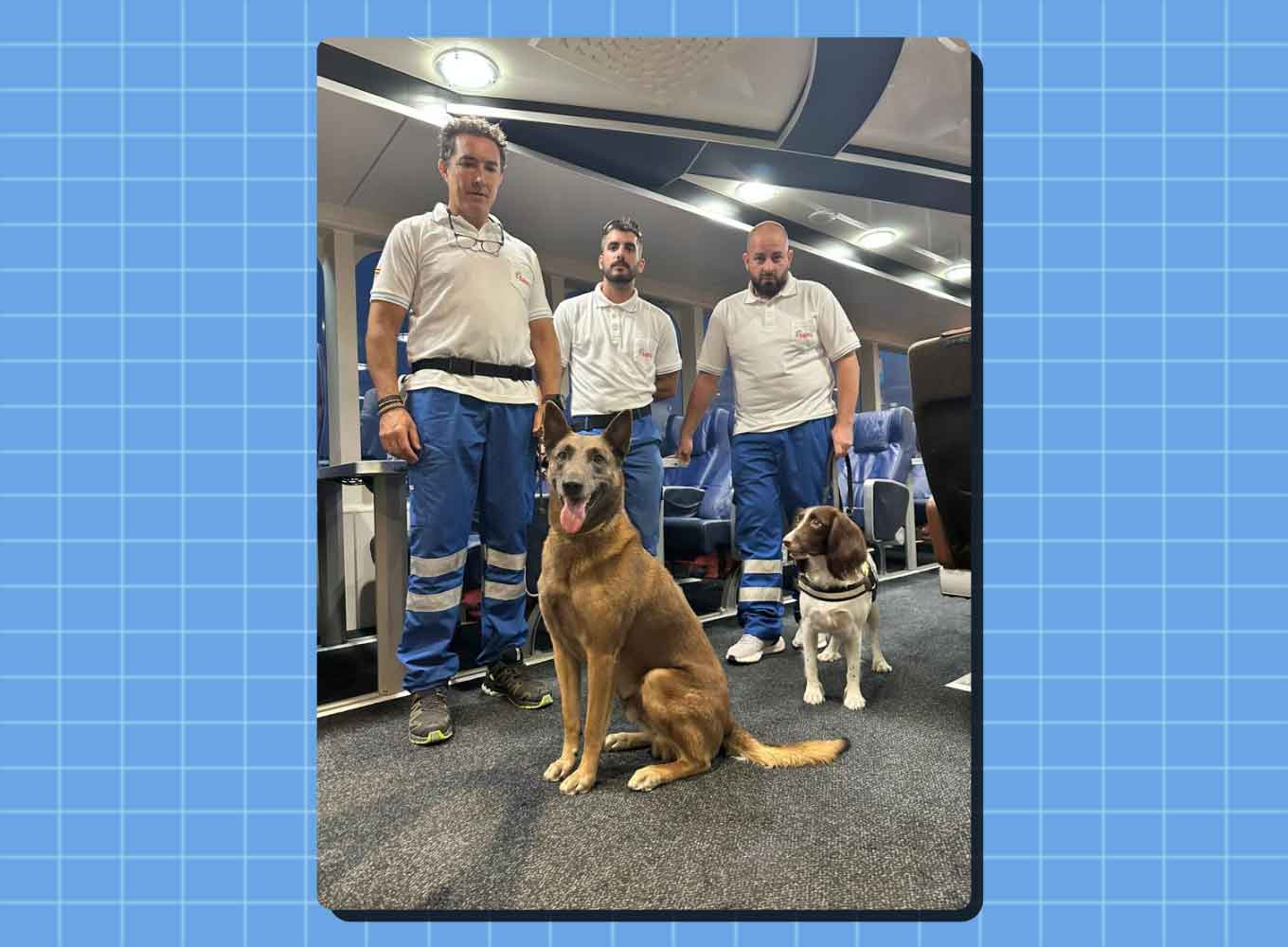
Upon their arrival, the team immediately began searching for survivors of the quake and providing medical care to communities closest to the earthquake’s epicenter. They are primarily working in remote villages that have been heavily damaged by the quake.
Search dogs — like SAMU’s Homero and Birka — have been flown in from around the globe (especially the UK and Spain) to help find survivors who are stuck or buried in the rubble.
“The search dogs can smell and locate people that are buried and alive,” SAMU co-founder Borja González de Escalada told Good Good Good in an email.
Along with their working dogs, Borja González de Escalada and SAMU’s other co-founder, Carlos González de Escalada, are leading the team in Morocco.
Their convoy includes two ambulances, as well as a surgical rescue unit, three all-terrain vehicles, five doctors, two nurses, eight health emergency technicians, and four rescue specialists.
As of Tuesday, September 12, SAMU’s team has rescued 19 people, but they will soon dismiss their dogs, since construction and rubble have made it difficult to find other survivors.
Their other focus continues to be providing urgent medical care in the area.
“SAMU is providing medical care to affected communities. The situation is changing rapidly, and we are pre-positioning resources to respond to immediate health needs, including medical care, primary care, and mental health and psychosocial support,” Borja González de Escalada said.
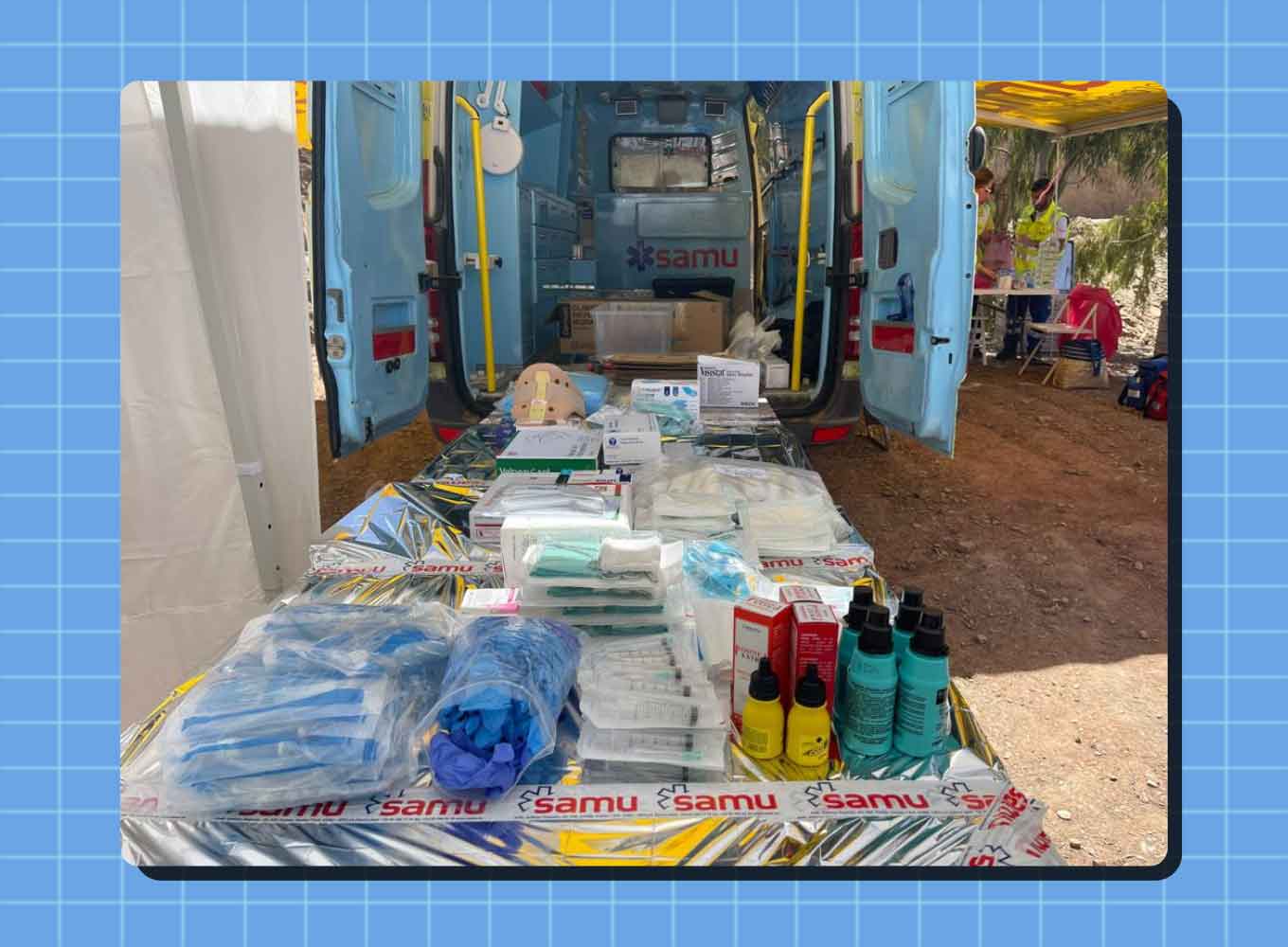
While their patient load is not extreme, the cases SAMU’s team treats are severe, including folks in need of oxygen, or injured children.
“We’re not seeing a lot of people, but the cases that are arriving need attention,” Borja González de Escalada said in a dispatch to Project HOPE. “That is why we have the two ambulances and we are moving them to get the patients into the main hospitals in Marrakech a few hours away. The post is open 24 hours. If the patients cannot move and we’re available to go to their location, we go.”
Project HOPE is also working with SAMU to coordinate response efforts, similar to the work both organizations did in response to earthquakes in Turkey and Syria earlier this year.
“People are basically in need of housing, tents, and rebuilding materials,” Borja González de Escalada continued in the dispatch. “These people … can survive through anything amazingly.”
While people around the world continue to donate to organizations providing relief and seek out ways to help those in need in Morocco — both SAMU and Project HOPE keep up the good work, assessing the situation as it evolves.
“Right now, we know there is a need for blood donations, as well as more mental health and psychosocial support to help people process the trauma and loss involved in this disaster,” Borja González de Escalada told Good Good Good.
“We also anticipate people will continue to need clean water, food, and shelter as they rebuild their homes and communities. Organizations and humanitarians, frankly, need funding to continue.”
In times of crisis, people turn to the work of humanitarians to find hope — and those in the field, with boots on the ground, find that same hope in their peers.
Borja González de Escalada said: “The SAMU team finds inspiration from other people and organizations who have been doing medical aid and this type of work for years.”
A positive mindset can be the driving force that helps us navigate life’s daily challenges with grace and ease. And in a world where we are constantly bombarded with news and information, it can sometimes be a challenge to maintain that sense of optimism.
Good Good Good is most well-known for the way we share good news and ways to make a difference. Our philosophy is that each of us can feel more hopeful when we’re able to recognize the many ways that people around the world are working on creating solutions to the planet’s greatest challenges.
(If you want to set yourself up for more good days, we highly recommend you subscribe to our daily Goodnewsletter — which offers a daily email with the day’s top good news stories. It’s free!)
In addition to reporting on good news — our team also collects positive quotes on topics we care about — like hope, optimism, and activism. And from that collection, we’ve compiled this article of quotes that remind us to have a good day.
Quotes that are grounded in positivity have the power to reshape our day, helping to refocus our mind on the good that surrounds us, encouraging us to be the best versions of ourselves. They serve as a reminder that every day holds new opportunities and potentials for joy and growth.
Over the years, many thinkers, authors, and public figures have shared words of wisdom that can brighten our day and shift our perspective to one of hope and happiness.
Their insights remind us to appreciate the simple joys of life, to stay hopeful, and to foster positivity in our own lives and in the lives of others.
If you’re in need of a boost to start your day on a happy note, or seeking to lift someone else’s spirits, you’ll find the perfect quote in the collection below.
Read on — and have a good day…
You might also like: The Best ‘Good Morning’ Quotes To Start Your Day
Quotes To Remind You (and Others) To Have a Good Day:
Famous Quotes
“When you arise in the morning, think of what a precious privilege it is to be alive, to breathe, to think, to enjoy, to love.”
— Marcus Aurelius

“Smile in the mirror. Do that every morning and you’ll start to see a big difference in your life.”
— Yoko Ono

“Waking up this morning, I smile. 24 brand new hours are before me. I vow to live fully in each moment.”
— Thich Nhat Hanh

“Every day brings you a chance to draw in a breath, kick off your shoes and dance.”
— Oprah Winfrey

“Today is a new day. Even if you were wrong yesterday, you can get it right today.”
— Dwight Howard

“It’s a beautiful day, the sun is shining, I feel good, and no one’s gonna stop me now.”
— Freddie Mercury

“I hope everyone that is reading this is having a really good day. And if you are not, just know that in every new minute that passes you have an opportunity to change that.”
— Gillian Anderson
“Give every day the chance to become the most beautiful day of your life.”
— Mark Twain

“With the new day comes new strength and new thoughts.”
— Eleanor Roosevelt

“This time, like all times, is a very good one, if we know what to do with it.”
— Ralph Waldo Emerson

“Ask not what tomorrow may bring, but count as a blessing every day that fate allows you.”
— Horace

“Every day I feel is a blessing from God. And I consider it a new beginning. Yeah, everything is beautiful.”
— Prince

“Yesterday’s the past, tomorrow’s the future, but today is a gift. That’s why it’s called the present.”
— Bil Keane

Inspirational Quotes
“Don’t judge each day by the harvest you reap but by the seeds that you plant.”
— Robert Louis Stevenson

“Morning is an important time of day, because how you spend your morning can often tell you what kind of day you are going to have.”
— Lemony Snicket
“Today is your day, your mountain is waiting. So get on your way.”
— Dr. Seuss
“Every day is a good day. There is something to learn, care and celebrate.”
— Amit Ray

“None of us know what will happen. Don’t spend time worrying about it. Make the most beautiful thing you can. Try to do that every day. That’s it.”
— Laurie Anderson
“My advice to anybody, including myself, is if you’re going through a bad period, and you just can’t see the world’s on your shoulders and no day is a good day, you’re missing the whole point of the experience. And that’s something dogs know from the moment they come bounding up to you as a puppy.”
— W. Bruce Cameron
“I’m not sure what the future holds but I do know that I’m going to be positive and not wake up feeling desperate. As my dad said ‘Nic, it is what it is, it’s not what it should have been, not what it could have been, it is what it is.’”
— Nicole Kidman
“Any day above ground is a good day. Before you complain about anything, be thankful for your life and the things that are still going well.”
— Germany Kent
“You have to remember that the hard days are what make you stronger. The bad days make you realize what a good day is. If you never had any bad days, you would never have that sense of accomplishment!”
— Aly Raisman

Funny Quotes
“Someday is not a day of the week.”
— Denise Brennan-Nelson

“A good day is a good day. A bad day is a good story.”
— Glennon Doyle
“Have a great day. Note: does not apply to my enemies.”
— Demetri Martin
“I love the phrase, ‘Somebody’s going to have a good day today, so it might as well be me.’ I feel like you bring everything to the character, I hope.”
— Josh Peck
“Good morning is a contradiction of terms.”
— Jim Davis
“A day without laughter is a day wasted.”
— Charlie Chaplin
Short ‘Have a Good Day’ Quotes
“It’s a good day to have a good day.”
— Hoda Kotb

“Opportunities are like sunrises. If you wait too long, you miss them.”
— William Arthur Ward
“As you wait for better days, don’t forget to enjoy today, in case they’ve already started.”
— Robert Breault
“It’s time to start living the life you’ve imagined.”
— Henry James
“With the new day comes new strength and new thoughts.”
— Eleanor Roosevelt
“Learn from yesterday, live for today, hope for tomorrow.”
— Albert Einstein, Letters to Solovine
“Anyone can strive to be happy for a day and to spread happiness around.”
— Wilferd Peterson
“What you do today can improve all your tomorrows.”
— Ralph Marston
“The secret of getting ahead is getting started.”
— Mark Twain
“The way I see it, if you want the rainbow, you gotta put up with the rain.”
— Dolly Parton
“Don’t count the days. Make the days count.”
— Muhammad Ali

More Positive Quotes for a Good Day
“In one minute you can change your attitude, and in that minute you can change your entire day.”
— Spencer Johnson

“I have always been delighted at the prospect of a new day, a fresh try, one more start, with perhaps a bit of magic waiting somewhere behind the morning.”
— J. B. Priestley
“Every morning, I wake up saying, “I’m still alive, a miracle.” And so I keep on pushing.”
— Jim Carrey
“Some days are just bad days, that’s all. You have to experience sadness to know happiness, and I remind myself that not every day is going to be a good day, that’s just the way it is!”
— Dita Von Teese
“Try to have a good day today, wherever you are, whatever you do, whoever is near, if no one is near. Try to be happy, because you may not see tomorrow. There is someone this morning, who didn’t wake up, who will never see this day. Try to feel lucky that this is not you.”
— Margaret Cho
“The day you catch an idea you fall in love with, even a small one, is a beautiful day.”
— David Lynch

“I do the very best I can to look upon life with optimism and hope and looking forward to a better day, but I don’t think there is anything such as complete happiness. It pains me that there is still a lot of Klan activity and racism. I think when you say you’re happy, you have everything that you need and everything that you want, and nothing more to wish for. I haven’t reached that stage yet.”
— Rosa Parks
“When you’re wide awake, say it for goodness sake, it’s gonna be a great day.”
— Paul McCartney
“I’m always thinking about creating. My future starts when I wake up every morning. Every day I find something creative to do with my life.”
— Miles Davis
“You cry and you scream and you stomp your feet and you shout. You say, “You know what? I’m giving up, I don’t care.” And then you go to bed and you wake up and it’s a brand new day, and you pick yourself back up again.”
— Nicole Scherzinger
“You’ve got to get up every morning with determination if you’re going to bed with satisfaction.”
— George Lorimer
“On a bad day, I’ll still have a conscious thing in my mind reminding me that what I think of as a bad day is still a very good day in probably 90% of the world’s population’s eyes.”
— Daniel Ricciardo
“Starting my day with exercise gives me a big mood and energy boost throughout the day and makes me feel like I’ve accomplished something right off the bat.”
— Jake Knapp
“You know that feeling when you wake up in the morning and you’re excited for the day? That’s one of my main goals in life.”
— Kirsten Dunst
“I arise in the morning torn between a desire to improve the world and a desire to enjoy the world.”
— E. B. White

October is here — welcoming the heart of fall and gracing us with a cozy energy that makes us want to savor every moment of amber foliage and crisp, clear skies!
It’s a month of festive pumpkin patches, hot apple cider, and the comforting embrace of oversized sweaters.
To help you delight in the splendor of October, we’ve curated a selection of positive and inspiring quotes (and poems) about the tenth month of the year.
And because we’re Good Good Good — we’ve also highlighted the best quotes around October’s awareness days and significant events — like World Teachers Day, World Homeless Day, LGBTQ+ History Month, International Day of the Girl, and World Hunger Day.
Plus, quotes from inspirational celebrities and leaders with October birthdays.
Whether you’re embracing the autumnal spirit, celebrating an October birthday, or just looking to infuse a little warmth and positivity into the start of your month, these quotes are for you. Scroll all the way through to find some hidden gems.
Here’s to making the most of October!
Explore more monthly quotes: January | February | March | April | May | June | July | August | September | October | November | December
The Best Quotes About October
Famous Quotes About October
“October is the month of painted leaves.
Their rich glow now flashes round the world.”
— Henry David Thoreau, Autumnal Tints

“The end of the summer is not the end of the world. Here’s to October…”
— A. A. Milne

“October was always the least dependable of months… full of ghosts and shadows.”
— Joy Fielding

“After the keen still days of September, the October sun filled the earth with mellow warmth.”
— Elizabeth George Speare

“Listen! The wind is rising, and the air is wild with leaves. We have had our summer evenings, now for October eves!”
— Humbert Wolfe
Motivational October Quotes
“October is a fallen leaf, but it is also the wider horizon more clearly seen. It is the distant hill once more in sight, and the enduring constellations above that hill once again.”
— Hal Borland, This Hill, This Valley: A Memoir

“There is no season when such pleasant and sunny spots may be lighted on, and produce so pleasant an effect on the feelings, as now in October.”
— Nathaniel Hawthorne
“Ah, Lovely October, as you usher in the season that awakens my soul, your awesome beauty compels my spirit to soar like a leaf caught in an autumn breeze and my heart to sing like a heavenly choir.”
— Peggy Toney Horton
“May the start of October remind you: you are worthy of new beginnings. You are worthy of finding joy in this season, no matter what is still unknown.”
— Morgan Harper Nichols
“October is a symphony of permanence and change.”
— Bonaro W. Overstreet

Funny October Quotes
“Chicago is an October sort of city, even in spring.”
— Nelson Algren

“If you’re ever wondering what to wear, just dress like a pumpkin, you’re good to go.”
— Devendra Banhart
“I have been younger in October than in all the months of spring.”
— W. S. Merwin
“October is the treasure of the year and all the months pay bounty to her store.”
— Paul Laurence Dunbar
“I long for the days of pumpkins and ghosts; when the dead use homes and people as hosts.”
— E. Reyes
“I’m so glad I live in a world where there are Octobers!”
— Lucy Maud Montgomery, Ann of Green Gables
“Anyone could see that the wind was a special wind this night, and the darkness took on a special feel because it was All Hallows’ Eve.”
— Ray Bradbury
October Poems
“O suns and skies and clouds of June,
And flowers of June together,
Ye cannot rival for one hour
October’s bright blue weather”
— Helen Hunt Jackson, Poems

“O hushed October morning mild,
Begin the hours of this day slow,
Make the day seem to us less brief.
Hearts not averse to being beguiled,
Beguile us in the way you know;
Release one leaf at break of day;
At noon release another leaf;
One from our trees, one far away…”
— Robert Frost
“A springful of larks in a rolling
Cloud and the roadside bushes brimming with whistling
Blackbirds and the sun of October
Summery
On the hill’s shoulder,
Here were fond climates and sweet singers suddenly
Come in the morning where I wandered and listened
To the rain wringing
Wind blow cold
In the wood faraway under me.”
— Dylan Thomas, Collected Poems
“October is the treasurer of the year,
And all the months pay bounty to her store;
The fields and orchards still their tribute bear,
And fill her brimming coffers more and more.”
— Paul Laurence Dunbar, Lyrics of Lowly Life
“The sweet calm sunshine of October, now warms the low spot; upon its grassy mold the purple oak-leaf falls; the birchen bough drops its bright spoil like arrow-heads, and the needled pine-leaf turf is carpeted with rosemary and juniper, and the dark ground overgrown with dewberry and creeping bramble, twiners and runners loving the dark.”
— Henry David Thoreau
“Let the first October sunrise remind you: you are worthy of new beginnings in this new season, no matter your uncertainties.
You are free to start over.
Today is brand new,
and so are you.
You do not have to fix everything
and make everything right
before you lean into morning Light
and embrace what now lies before you.
Even if it means you have to leave old things behind,
not everything has to be solved
before you find a peace of mind.
You are free to start over.
Even here, in the wild of things,
there is room for new beginnings.”
— Morgan Harper Nichols
Autumn Quotes
“Autumn… the year’s last, loveliest smile.”
— William Cullen Bryant

“Life starts all over again when it gets crisp in the fall.”
— F. Scott Fitzgerald, The Great Gatsby
“Live in each season as it passes: breathe the air, drink the drink, taste the fruit.”
— Henry David Thoreau
“The trees are in their autumn beauty, The woodland paths are dry, Under the October twilight the water Mirrors a still sky.”
— William Butler Yeats
“October, baptize me with leaves! Swaddle me in corduroy and nurse me with split pea soup. October, tuck tiny candy bars in my pockets and carve my smile into a thousand pumpkins. O autumn! O teakettle! O grace!”
— Rainbow Rowell, Attachments
“Autumn… the year’s last, loveliest smile.”
— William Cullen Bryant
“In October, a maple tree before your window lights up your room like a great lamp. Even on cloudy days, its presence helps to dispel the gloom.”
— John Burroughs
“Every leaf speaks bliss to me, fluttering from the autumn tree.”
— Emily Brontë
“Autumn carries more gold in its pocket than all the other seasons.”
— Jim Bishop
“Autumn colors remind us we are all one dancing in the wind.”
— Lorin Morgan-Richards
Short October Quotes
“I’m so glad I live in a world where there are Octobers.”
— L. M. Montgomery
“October, crisp, misty, golden October, when the light is sweet and heavy.”
— Angela Carter
“You don’t waste October sunshine.”
— Katherine Arden
“The trees are in their autumn beauty, The woodland paths are dry, Under the October twilight the water Mirrors a still sky.”
— W. B. Yeats
“In October any wonderful unexpected thing might be possible.”
— Elizabeth George Speare, The Witch of Blackbird Pond
Quotes for Awareness Holidays in October
A collection of quotes to celebrate October’s awareness months and national days.
→ Explore more of this month’s awareness days in our October calendar
Hispanic Heritage Month
September 15 - October 15
“Preservation of one’s own culture does not require contempt or disrespect for other cultures.”
— Cesar Chavez
“When I was growing up, my parents insisted that we speak Spanish and read Spanish. I’m so happy they did that, because we developed their culture and their roots.”
— Tito Puente
“As an immigrant, I appreciate, far more than the average American, the liberties we have in this country. Silence is a big enemy of morality. I don’t want our blunders in history to get repeated.”
— Gloria Estefan
→ Explore more quotes about Hispanic Heritage Month
→ Read about how to celebrate Hispanic Heritage Month
Banned Books Week
October 1-7
“Banning books is just another form of bullying. It’s all about fear and an assumption of power. The key is to address the fear and deny the power.”
— James Howe
“Let children read whatever they want and then talk about it with them. If parents and kids can talk together, we won’t have as much censorship because we won’t have as much fear.”
— Judy Blume
“The books that the world calls immoral are the books that show the world its own shame.”
— Oscar Wilde
“All censorships exist to prevent anyone from challenging current conceptions and existing institutions. All progress is initiated by challenging current conceptions, and executed by supplanting existing institutions. Consequently, the first condition of progress is the removal of censorship.”
— George Bernard Shaw, Mrs. Warren’s Profession
→ Read more quotes about banned books
→ Read about how to celebrate Banned Books Week
LGBTQ+ History Month
October 1 - October 31
“Rights are won only by those who make their voices heard.”
— Harvey Milk
“All of us who are openly gay are living and writing the history of our movement. We are no more — and no less — heroic than the suffragists and abolitionists of the 19th century; and the labor organizers, Freedom Riders, Stonewall demonstrators, and environmentalists of the 20th century.”
— Tammy Baldwin
“We should celebrate who we are every day and never forget those who struggled and sacrificed so that we could live freely.”
— Karl Heinrich Ulrichs
World Teachers Day
October 5
“Teaching is the greatest act of optimism.”
— Colleen Wilcox
“Education is the most powerful weapon which you can use to change the world.”
— Nelson Mandela
“The greatest sign of success for a teacher… is to be able to say, “The children are now working as if I did not exist.”
— Maria Montessori
→ Read more quotes about teachers
→ Read more quotes about teacher appreciation
World Homeless Day
October 10
“Making it so you don’t have to look at homeless people isn’t a solution to homelessness.”
— Sara Luterman
“Having an open mind means learning to add more to our already existing beliefs about affirming dignity of those who are impoverished.”
— Terence Lester, I See You“
“Support for shelters and transitional living and housing programs is necessary if we are going to change the landscape for homeless boys and girls in America.”
— Jewel
→ Read more quotes about homelessness
→ Read about how to help people experiencing homelessness
International Day of the Girl
October 11
“Girls should never be afraid to be smart.”
— Emma Watson
“Courage, sacrifice, determination, commitment, toughness, heart, talent, guts. That’s what little girls are made of; the heck with sugar and spice.”
— Bethany Hamilton
“Be that strong girl that everyone knew would make it through the worst, be that fearless girl, the one who would dare to do anything, be that independent girl who didn’t need a man; be that girl who never backed down.”
— Taylor Swift
World Hunger Day
October 16
“If you cannot feed a hundred people, then feed just one.”
— Mother Teresa
“It is an eternal obligation toward the human being not to let him suffer from hunger when one has a chance of coming to his assistance.”
— Simone Weil
“Food is national security. Food is economy. It is employment, energy, history. Food is everything.”
— Chef José Andrés
→ Read more quotes about hunger
Quotes from Inspiring People with October Birthdays
Jimmy Carter
October 1
“The bond of our common humanity is stronger than the divisiveness of our fears and prejudices.”
— Jimmy Carter
“My position has always been, along with many other people, that any differences be resolved in a nonviolent way.”
— Jimmy Carter
“It is good to realize that if love and peace can prevail on earth, and if we can teach our children to honor nature’s gifts, the joys and beauties of the outdoors will be here forever.”
— Jimmy Carter
→ Read more quotes from Jimmy Carter
Desmond Tutu
October 7
“Do your little bit of good where you are; it is those little bits of good put together that overwhelm the world.”
— Desmond Tutu
“If you want peace, you don’t talk to your friends. You talk to your enemies.”
— Desmond Tutu
“We are each made for goodness, love, and compassion. Our lives are transformed as much as the world is when we live with these truths.”
— Desmond Tutu
→ Read more quotes from Desmond Tutu
Eleanor Roosevelt
October 11
“You have to accept whatever comes, and the only important thing is that you meet it with the best you have to give.”
— Eleanor Roosevelt
“Life was meant to be lived, and curiosity must be kept alive. One must never, for whatever reason, turn his back on life.”
— Eleanor Roosevelt
“When will our consciences grow so tender that we will act to prevent human misery rather than avenge it?”
— Eleanor Roosevelt
→ Read more quotes from Eleanor Roosevelt
Paul Farmer
October 26
“For me, an area of moral clarity is: you’re in front of someone who’s suffering and you have the tools at your disposal to alleviate that suffering or even eradicate it, and you act.”
— Paul Farmer
“With rare exceptions, all of your most important achievements on this planet will come from working with others — or, in a word, partnership.”
— Paul Farmer, To Repair the World: Paul Farmer Speaks to the Next Generation
“There is an enormous difference between seeing people as the victims of innate shortcomings and seeing them as the victims of structural violence. Indeed, it is likely that the struggle for rights is undermined whenever the history of unequal chances, and of oppression, is erased or distorted.”
— Paul Farmer, Pathologies of Power: Health, Human Rights and the New War on the Poor
→ Read more quotes from Paul Farmer
Bob Ross
October 29
“It’s hard to see things when you are too close. Take a step back and look.”
— Bob Ross
“Talent is a pursued interest. Anything you’re willing to practice, you can do.”
— Bob Ross
“We don’t laugh because we feel good, we feel good because we laugh.”
— Bob Ross
More October Quotes & Sayings
“He loved October. Had always loved it. There was something sad and beautiful about it — the ending and beginning of things.”
— Jacqueline Woodson, If You Come Softly

“What the light looks like in the pear trees, in October, is a hundred teardrops of gold, the whole orchard weeping.”
— Carole Maso, The Art Lover
“October proved a riot to the senses and climaxed those giddy last weeks before Halloween.”
— Keith Donohue
“First of all, it was October, a rare month for boys.”
— Ray Bradbury
“October sunshine bathed the park with such a melting light that it had the dimmed impressive look of a landscape by an old master.”
— Elizabeth Enright
“All things on earth point home in old October; sailors to sea, travellers to walls and fences, hunters to field and hollow and the long voice of the hounds, the lover to the love he has forsaken.”
— Thomas Wolfe, Look Homeward, Angel
“October air, complete with dancing leaves and sighing winds greeted him as he stepped from the bus onto the dusty highway. Coolness embraced. The scent of burning wood hung crisp in the air from somewhere far in the distance.”
— Jaime Allison Parker, The Delta Highway
“I remember it as October days are always remembered, cloudless, maple-flavored, the air gold and so clean it quivers.”
— Leif Enger
“October made the leaves on Main Street fit for a crown. They dripped from the trees in jewel-toned shades: yellow and orange and fiery red. The cool wind sent a confetti-cluster of leaves down around us.”
— Natalie Lloyd, Over the Moon
On Tuesday, September 12, author, philanthropist, and content creator John Green mobilized his fanbase — Nerdfighteria — in a video about overpriced tuberculosis test materials.
He called upon Danaher, a multinational corporation, and its molecular diagnostics company Cepheid, to reduce the price of their GeneXpert testing cartridges, which are the most highly recommended TB test option by the World Health Organization, but are too costly for many middle- and low-income countries.
Green has long shared his frustrations with TB; the world’s deadliest disease kills 1.6 million people per year, though it is entirely curable.
“Tuberculosis has killed over a billion people in the last 200 years, and we’ve made very little progress in ending it because both testing and treatment remain out of reach for millions,” Green explained in his video.
“This year, of the 10 million people who will get sick with TB, about 4 million people will go undiagnosed, often dying before they can get an accurate test.”
His call to action? To convince Danaher and Cepheid to reduce the cost of their testing cartridges to $5 a pop, following in the footsteps of the Time For $5 campaign, initially created by Doctors Without Borders and Treatment Action Group.
So, Green and his army of activists took to the internet to engage with Danaher and Cepheid — and they did so in the way they do best: With memes.
Though this community organizing is designed to confront a deeply heartbreaking and rage-inducing reality about infectious disease, Nerdfighteria reminds us that activism comes in many forms — and engaging respectfully and with levity can inspire people to get involved and make a difference.
The communications advisor at Doctors Without Borders, Shailly Gupta, tweeted to express her gratitude for Nerdfighteria, too.
“So glad to see [the] fight for TB tests and medicines taken up [by] @johngreen and nerdfighters!” she said. “Thanks for posting these super cool messages/videos/memes.”
These messages, videos, and memes are at the heart of John’s call to action.
“I am disappointed that Danaher is currently choosing profits over people, but I don’t think it’s inevitable. I think that most people, most of the time, want to do what is right,” Green said in his video. “They just sometimes need polite but impassioned reminders of what’s right.”
Here are some of the most bold and iconic memes from Nerdfighteria & John Green about the fight to pressure Danaher to drop tuberculosis test prices —
The language and content included in the memes below are those of the original poster and do not necessarily reflect the opinions of Good Good Good or its staff.
The Wild Goose Chase
It seems that Nerdfighteria has no problem squawking after Danaher shareholders in the name of global health.
I have some questions for @CepheidNews and @DanaherCorp… #PeopleOverProfits #Timefor5 pic.twitter.com/jzh0nf2T1b
— Hanna (@hannamaytweet) September 12, 2023
Hard-To-Swallow Pills
Sometimes it can be uncomfortable to face reality, but activists are committed to ensuring that Danher — and its employees and supporters — know the truth.
Hey @DanaherCorp did you take your meds this morning? #PeopleOverProfits #TimeFor5 pic.twitter.com/DfVplVVkYH
— kimmy kimmie 🧡 (@kimmykimmie4) September 12, 2023
The Jealous Partner
Actually, thinking about the implications of corporations on global health seems like a green flag.
#PeopleOverProfits Nerdfighteria is on out Vigilante Sh-- again. Hey @DanaherCorp , its time for 5 pic.twitter.com/8HcLBbhvgH
— Vanessa (@Vnessag_22) September 12, 2023
Disgruntled Bus Driver
Don’t make Nerdfighteria touch the sign.
It continues to be ridiculous that the world's deadliest infectious disease is CURABLE, yet six people died from it in the time it took me to write this tweet. @DanaherCorp denying millions access to affordable, accurate TB tests is unacceptable. #PeopleOverProfits https://t.co/qtjxDNueip pic.twitter.com/RgZDmJQFRo
— Maayan 🍅 (@AgentMaayan) September 12, 2023
TB Barbenheimer
Nerdfighteria says it’s time to get serious.
#peopleoverprofits #timefor5 pic.twitter.com/Aaj4zuY9qw
— kimmy kimmie 🧡 (@kimmykimmie4) September 12, 2023
An Optimistic Approach
Nerdfighteria dares Danher to hit the big blue button.
— Jackson wants $5 TB tests (@JDBigham99) September 12, 2023
The Nail-Biter Of A Decision
Nerdfighter Danny replied to Danaher, saying “tough one, guys.”
Tough one guys pic.twitter.com/HGNkj9X8mz
— Danny Westerman (@danimalkingdom8) September 12, 2023
Everyone’s Least Favorite UNO Player
Advocates are curious… what if Danaher just didn’t draw 25?
#PeopleOverProfits #TimeFor5 pic.twitter.com/YlWDD2TORW
— kimmy kimmie 🧡 (@kimmykimmie4) September 12, 2023
A Quick Apology To The Social Media Team
While grassroots activists are unapologetic about their mission, they do feel bad about spamming social media and admin teams in their pursuits.
#PeopleOverProfits pic.twitter.com/btqH1QsSKR
— Barbie Takes on Danaher (Taylor’s Version) (@taaddisbinz) September 12, 2023
A Match Made In Heaven
Nerdfighteria is dreaming up what it could be like if Danaher decreased prices.
— Sarah 🦋 (@sarahrohrersy) September 12, 2023
A Novel By John Green
A play on Green’s best-selling novel “The Fault in Our Stars,” advocates put the blame somewhere else.
We have a responsibility to create a world where limited funds don't mean limited treatment. @DanaherCorp and @CepheidNews, it's time to play your part and reduce the cost of TB test cartridges. Let's make $5 tests a reality and save lives! #Timefor5 #peopleoverprofits pic.twitter.com/meW89T8tGe
— Shelby (@shebambulator) September 12, 2023
Taking The Minion Approach
In an effort to reach the generation most likely to hold Danaher stock or have decision-making power within the corporation, Nerdfighter Payton kicked things off with a series of Minion memes.
i’ll go first #PeopleOverProfits @DanaherCorp https://t.co/I6rgZqhQqg pic.twitter.com/26LJ8InypE
— payton mitchell (@paytmitch) September 12, 2023
Reverting To 2011 To Get The Point Across
Okay, maybe some Nerdfighters didn’t have minions on deck, but what about some of the most ancient relics of Internet culture?
well I don't do minion memes, but I can do 2011 memes https://t.co/5KS2PHsYiE pic.twitter.com/FA7aZXLssI
— Delta Protogen🟦 (@WolfPackGames9) September 12, 2023
Finally, A Reminder That Activists Have Had "Kenough"
Because if John Green can connect tuberculosis to “Barbie,” he definitely deserves a new job title, too.
Today when @johngreen woke up, prepared for another normal day at work: #PeopleOverProfits pic.twitter.com/Tszj5OovZT
— JD | #PeopleOverProfits (@itme_jd) September 12, 2023
Like many community service projects and social good enterprises, Free Lunch ATX was born out of the COVID-19 pandemic.
The program, which blends creativity, compassion, and community support, helps feed an unhoused community in Austin, Texas.
Founder and director of operations, Jazz Mills, was an event producer in 2020, and when that work came to a halt, she decided to use her free time to help those in need.
“I started by distributing homemade food from my car and developed a plan called ‘moon rocks,’” she told Good Good Good.
“I sold my popular Rice Krispie treats, with the profits going toward providing meals for the unhoused community. For every dozen ‘moon rocks’ sold, I prepared five meals, which I then delivered to buyers’ porches, considering the safety precautions during the pandemic.”

Well, in the past three years, things have evolved beyond snap, crackle, and pop.
Around that time, Mills teamed up with her friend, musician Carrie Fussell Bickley, to provide balanced meals, instead of snacks with low-nutritional value, to the folks living in Camp Esperanza, a makeshift homeless camp in Southeast Austin.
With the art and music scene rallying behind them in support, Mills and Fussell Bickley started sharing regular updates on social media. The initiative continued to expand, but once they realized the magnitude of food insecurity in Camp Esperanza, they shifted their focus to a different approach: creating a zine.
Using creativity to confront food insecurity
Free Lunch evolved into a quarterly magazine that now funds the distribution of daily meals to Austin’s homeless community.
“We wanted to avoid the common issues where programs suffer due to unreliable funding or premature expansion, followed by loss of funding. We also understood that maintaining trust within the unhoused community was crucial. Many have experienced broken promises from support systems due to funding issues,” Mills said.
“So, we sought a solution that would address both these challenges and allow us to leverage our creativity.”
Zines have long been a tool for creative activists to combine their interests in art, writing, and community organizing. For Mills and Fussell Bickley, this opportunity to create was no different.

Mills called up some other talented friends, including photographer Jade Skye Hammer, and partner organizations like The Other Ones Foundation, Our Shared Kitchen, Walking By Faith Prison Ministry, and ATX Free Fridge.
“With a background in music, we recognized the importance of presenting our mission in a fresh way to tackle a long-standing issue. Our zine was born from these discussions,” Mills said.
“It’s not just a fundraising tool; it’s a way to showcase Jade’s photography, feature local musicians, and even share recipes from local chefs. It serves as tangible proof of our work for our $10-a-month subscribers.”
Free Lunch is a business — not a nonprofit — but this, according to Mills, allows flexibility to move quickly to make the maximum impact.
“We hope to inspire the next generation to create profitable businesses that pay the bills, support their staff, and make a positive impact on their communities,” she added. “It’s something we’re incredibly proud of at Free Lunch.”
More than a magazine
Free Lunch doesn’t just offer, well, free lunch. Mills and her team have used their connections with other community organizations to launch other projects, including an edible garden, developed through a grant with the Texas Food and Wine Alliance.
While space constraints make it difficult to farm enough food for the entire camp, the group currently grows peaches, persimmons, and herbs — and shares seasonal gardening tips from another previous partner, Wild Heart Dirt.
Part of Mills’s interest in food stems from her background working for four years at Leroy and Lewis Barbecue, which led to connections with other major food icons in Austin that have evolved into regular in-kind donations.
These include establishments like Franklin Barbecue, which provides high-quality chopped beef, or OMG Squee, which shares donuts and pastries (which Mills calls “essential for boosting morale among Esperanza community residents”).
“These partnerships strengthen our ability to provide nutritious and delicious meals to those in need,” Mills said. “It’s incredible how Austin’s food scene and supportive community has rallied behind our cause, and we’re incredibly grateful for their ongoing support.”
Outside of large partnerships, many individual community members have responded to Free Lunch ATX as volunteers and contributors, too.
One way this happens is through weekly meal contributions to the ATX Free Fridge, where anyone in the community can drop off prepared meals, dried goods, and groceries, to maintain these community fridges.
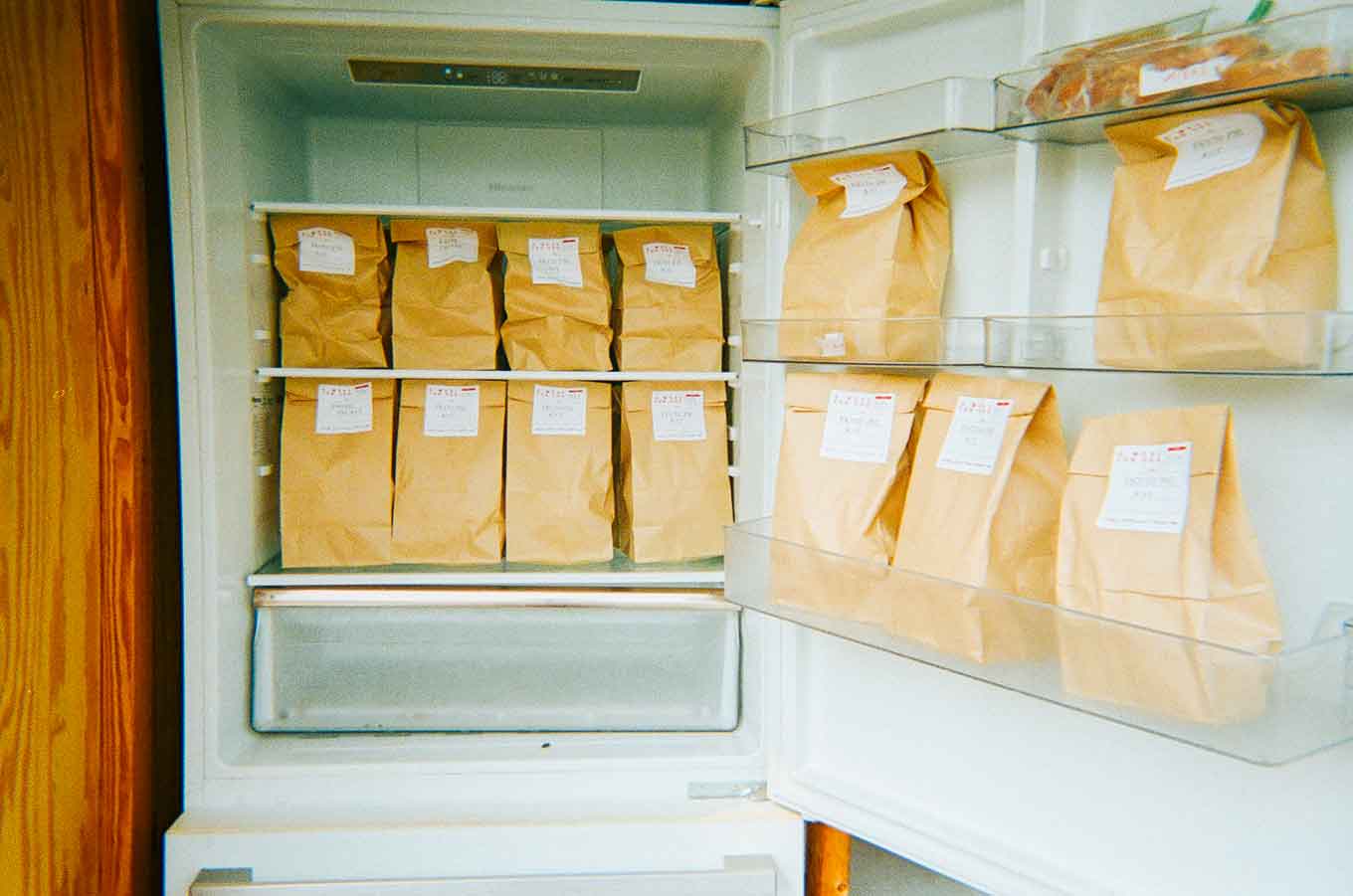
Others may simply team up to prepare meals, support Free Lunch’s work by subscribing to the monthly zine, or help at regular distributions.
“The response to our work has been both heartwarming and complex. We’ve witnessed positive reactions, particularly from younger generations who find it easier to connect with our mission,because they see everyday people, like us, making a difference,” Mills said.
“We’re not affiliated with religious organizations or government bodies, and we don’t hold advanced degrees in this field. In fact, on paper, we might not seem qualified for the work we’re doing, and that relatability resonates with many young individuals.”
Above all, Free Lunch is a home for anyone who is open to making a difference in Austin — who understands the importance of centering dignity and integrity for the community they serve.
“It’s about offering choices that resonate with individuals. By offering such options, we acknowledge their preferences and make them feel seen,” Mills said. “This, in turn, boosts their confidence and mental well-being, which is a significant part of the journey for everyone.”
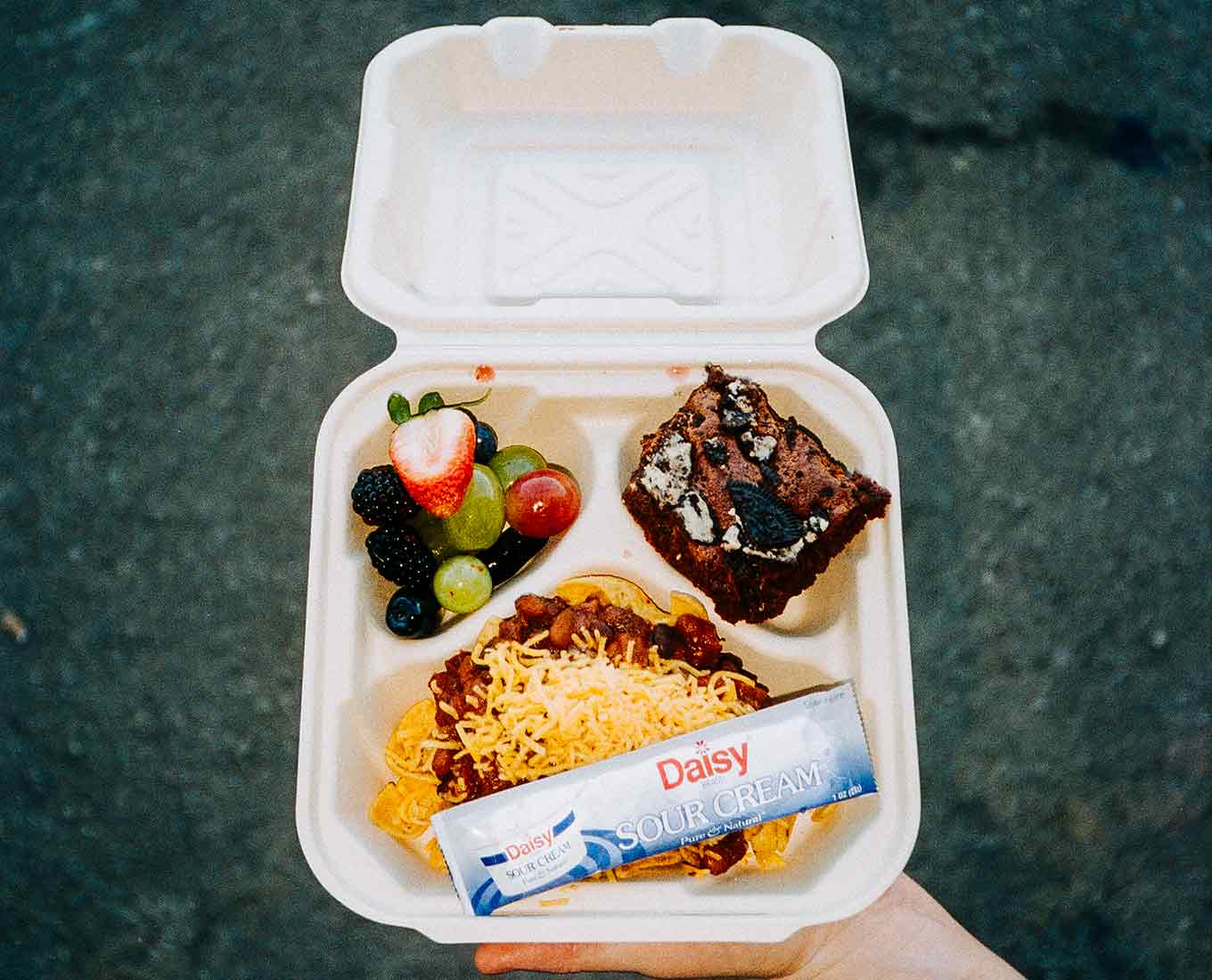
Free Lunch has a monthly meal calendar that is distributed in the community, including a wide variety of options that folks can choose from.
A recent calendar includes five different kinds of sandwiches, six various sides, 11 entree options, and 10 “entree sides,” along with tasty extras, like popsicles, donuts, and side salads, that rotate throughout the month.
The team is also working on building out diet plans for diabetic community members, a recipe book for folks transitioning into stable housing, and providing refreshments and snacks for other community gatherings outside of mealtimes.
“In essence, we recognize that even the smallest wins, like enjoying their favorite foods, can have a big impact on the lives of the residents in our community,” Mills said. “It's about more than just sustenance; it's about nourishing their spirits and fostering a sense of dignity and autonomy.”
Header courtesy of Jade Skye Hammer