Vegetables are commonly defined as the edible parts of plants — which can include roots, stems, leaves, flowers, and sometimes immature fruits. They’re nature’s nourishment — offering us a rich source of nutrients, ready to be incorporated into a myriad of dishes.
We’ve collected the ultimate list of vegetable names that start with Z — all the way from Zebra Tomato to Zucchini.
Why did we write this article?
- Eating a plant-based diet is better for animals and the planet.
- Choosing to eat seasonal fruits and vegetables can make a world of difference.
- It’s valuable to know about the beautiful range of (yummy) plants on planet Earth so we can fight to protect their biodiversity.
We hope you discover something new — and maybe even share your newfound favorite vegetable with a friend. (Don’t forget to check out our ultimate list of fruits, too!)
You might also like: Good news articles about food
More vegetables that start with: A | B | C | D | E | F | G | H | I | J | K | L | M | N | O | P | Q | R | S | T | U | V | W | X | Y | Z
A quick note before you bite into a new-found veggie: Some of these vegetables cannot be consumed raw — and others could easily be confused with non-edible plants. Please use caution and care.
Vegetables That Start with the Letter Z —
- Zebra Tomato
- Zhe Fruit
- Zigzag Vine Fruit
- Ziziphus
- Zucca Melon
- Zucchetta
- Zucchini
- Zuni Bean
Plus, explore more vegetable name articles:
- Vegetables That Start with A
- Vegetables That Start with B
- Vegetables That Start with C
- Vegetables That Start with D
- Vegetables That Start with E
- Vegetables That Start with F
- Vegetables That Start with G
- Vegetables That Start with H
- Vegetables That Start with I
- Vegetables That Start with J
- Vegetables That Start with K
- Vegetables That Start with L
- Vegetables That Start with M
- Vegetables That Start with N
- Vegetables That Start with O
- Vegetables That Start with P
- Vegetables That Start with Q
- Vegetables That Start with R
- Vegetables That Start with S
- Vegetables That Start with T
- Vegetables That Start with U
- Vegetables That Start with V
- Vegetables That Start with W
- Vegetables That Start with X
- Vegetables That Start with Y
- Vegetables That Start with Z
- Complete List of All Vegetables from A-Z
- Complete List of All Fruits from A-Z
- Complete List of Vegan Groceries
You might also like: Ultimate List of Positive Words | Ultimate List of Mood Words | Ultimate List of Emotions | Ultimate List of Personality Traits | Ultimate List of Good Character Traits
Cody Two Bears, a member of the Sioux tribe in North Dakota, founded Indigenized Energy, a native-led energy company with a unique mission — installing solar farms for tribal nations in the United States.
This initiative arises from the historical reliance of Native Americans on the U.S. government for power, a paradigm that is gradually shifting.
The spark for Two Bears' vision ignited during the Standing Rock protests in 2016, where he witnessed the arrest of a fellow protester during efforts to prevent the construction of the Dakota Access Pipeline on sacred tribal land.
Disturbed by the status quo, Two Bears decided to channel his activism into action and create tangible change.
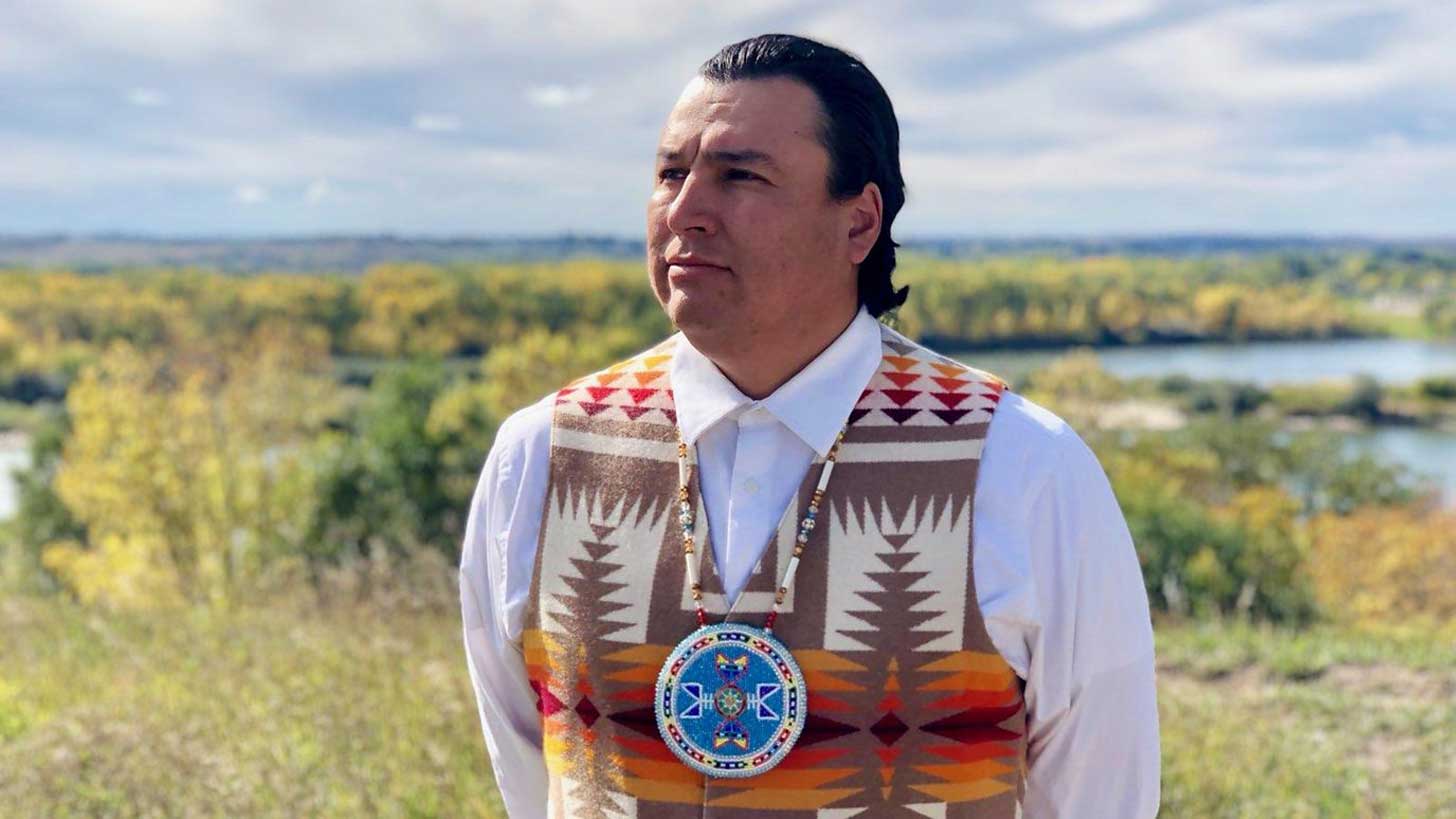
His company, Indigenized Energy, addresses a critical issue faced by many reservations: poverty and lack of access to basic power.
Reservations are among the poorest communities in the country, and in some, like the Navajo Nation, many homes lack electricity.
Even in regions where the land has been exploited for coal and uranium, residents face obstacles to accessing power.
Renewable energy, specifically solar power, is a beacon of hope for tribes seeking to overcome these challenges.
Not only does it present an environmentally sustainable option, but it has become the most cost-effective form of energy globally, thanks in part to incentives like the Inflation Reduction Act of 2022.
Tribal nations can receive tax subsidies of up to 30% for solar and wind farms, along with grants for electrification, climate resiliency, and energy generation.
And Indigenized Energy is not focused solely on installing solar farms — it also emphasizes community empowerment through education and skill development.
In collaboration with organizations like Red Cloud Renewable, efforts are underway to train Indigenous tribal members for jobs in the renewable energy sector.
The program provides free training to individuals, with a focus on solar installation skills.
Graduates, ranging from late teens to late 50s, receive pre-apprenticeship certification, and the organization is planning to launch additional programs to support graduates with career services such as resume building and interview coaching.
Why is this good news?
The adoption of solar power by Native communities signifies progress toward sustainable development, cultural preservation, and economic self-determination, contributing to a more equitable and environmentally conscious future.
These initiatives are part of a broader movement toward "energy sovereignty," wherein tribes strive to have control over their own power sources.
This movement represents not only an economic opportunity and a source of jobs for these communities but also a means of reclaiming control over their land and resources, signifying a departure from historical exploitation and an embrace of sustainable practices deeply rooted in Indigenous cultures.
This article originally appeared in the Goodnewsletter — Good Good Good’s daily newsletter filled with positive news. Join tens of thousands of other do-gooders by subscribing to the Goodnewsletter today!
Sesame Workshop, the nonprofit organization behind Sesame Street, is taking a proactive approach to address the emotional challenges faced by young children whose parents misuse opioids.
With more than 4% of children in the United States living in households where a parent misuses opioids, the need to provide resources for understanding and coping with addiction is crucial.
Many of these children experience confusion and anxiety, unsure of how to navigate the complexities of their parents' struggles with addiction.

Sesame Workshop has developed a series of materials specifically tailored for children aged 1 to 6 whose parents may be affected by addiction.
These resources include videos, storybooks, and coloring books featuring beloved Muppets such as Elmo and Karli. Karli, a Muppet whose mother is undergoing treatment for addiction, serves as a relatable character for children going through similar experiences.
The materials aim to facilitate conversations between parents, caregivers, social workers, and therapists, offering developmentally appropriate tools to guide children through the emotional aspects of addiction.
Early intervention is a key focus, recognizing that addressing trauma in early childhood can positively impact cognitive, emotional, and social development.
A recent grant from the Foundation for Opioid Response Efforts allows Sesame Workshop to expand these resources further, providing additional videos, stories, and materials centered around addiction, treatment, and healing.
The free materials are accessible online, offering a valuable support system for families navigating the complexities of addiction.
Why is this good news?
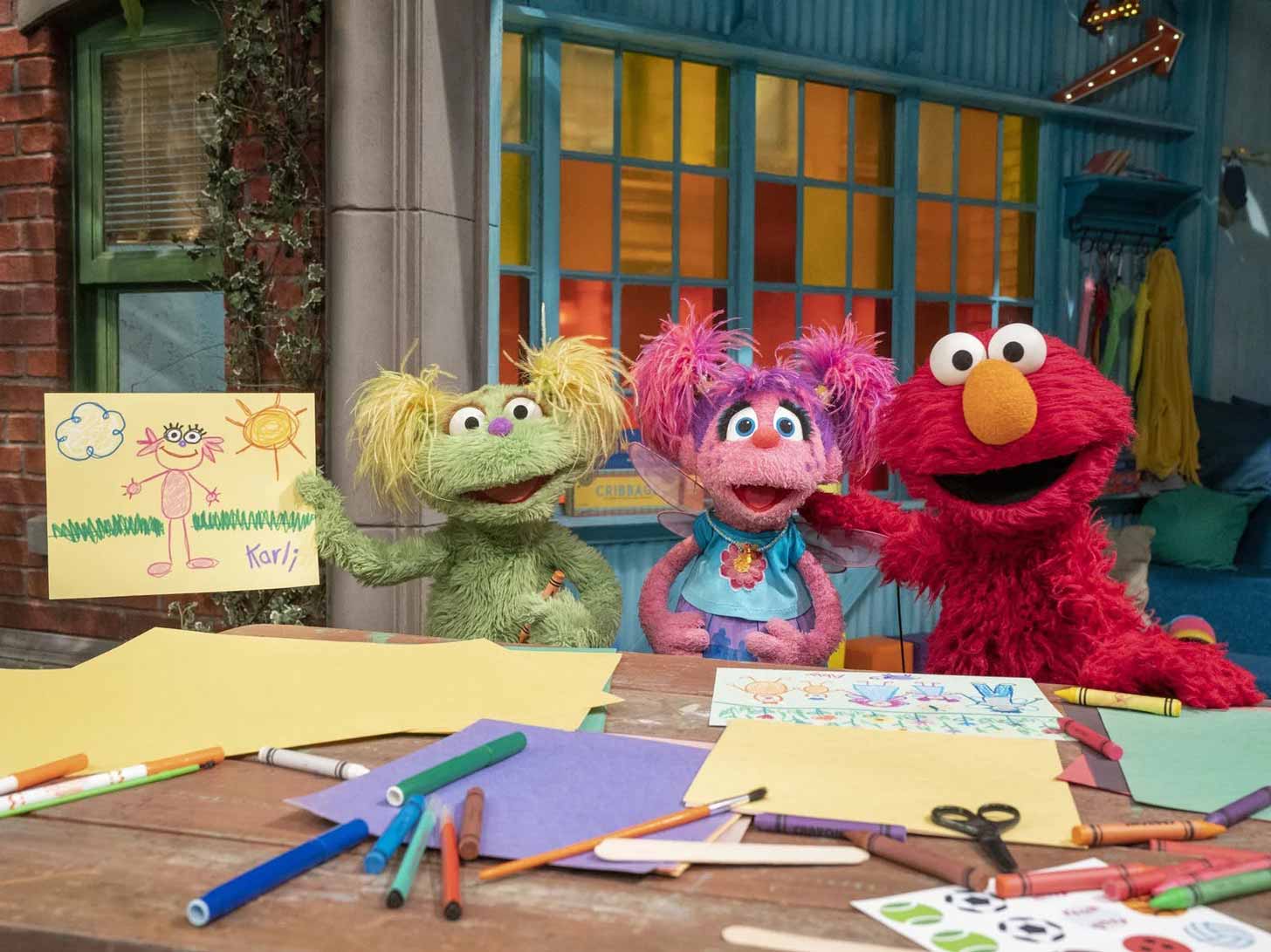
By personifying the challenges faced by children through characters like Karli, Sesame Workshop hopes to reduce the stigma associated with addiction, foster empathy and understanding, and empower children to express their emotions.
The initiative aligns with Sesame Workshop's commitment to addressing tough topics for young audiences, having previously tackled issues such as death, grief, divorce, bullying, and military deployment.
Through this new focus on addiction, Sesame Workshop aims to create a supportive environment for children, helping them build emotional resilience both in the present and for their future well-being.
This article originally appeared in the Goodnewsletter — Good Good Good’s daily newsletter filled with positive news. Join tens of thousands of other do-gooders by subscribing to the Goodnewsletter today!
The Bluemind Foundation has launched an innovative initiative to address the severe lack of accessible mental health care in West and Central Africa by training hairdressers as mental health ambassadors.
In countries where mental health therapy is scarce and awareness is limited, the program has empowered hairdressers to provide much-needed support.
This initiative is particularly significant in the World Health Organization's Africa region, which has the highest suicide rate globally and some of the lowest public expenditures on mental health.

Marie-Alix de Putter, the founder of the Bluemind Foundation, designed the program in 2018 based on the observation that African women spend a significant amount of time in hair salons.
By training hairdressers, the initiative reaches women in spaces where they are comfortable.
And the informal and affordable setting of the salon provides a safe space for clients to share their struggles, allowing stylists to offer gentle guidance and support during the hairstyling process.
Hairdressers undergo three days of training, learning how to ask open-ended questions, spot nonverbal signs of distress, and avoid gossip or detrimental advice.
These "mental health ambassadors" play a crucial role as they often become confidantes for clients who share their financial struggles, emotional pain, or experiences of domestic violence during salon visits.
Recognizing the impact of their role, hairdressers refer clients to professional therapists when necessary.
The Bluemind Foundation has trained approximately 150 women in mental health counseling across West and Central African cities, recognizing the critical need for mental health care in one of the world's poorest regions.
Why is this good news?
In many African countries, the shortage of mental health workers is alarming, with an average of only 1.6 mental health workers per 100,000 people, compared to the global median of 13, according to the World Health Organization.
The Bluemind Foundation's program not only addresses the mental health gap by training hairdressers — it also seeks to destigmatize mental health issues in communities where such topics remain foreign concepts, and its unique approach represents a step toward addressing the mental health crisis in West and Central Africa, recognizing the importance of community engagement and culturally sensitive interventions.
This article originally appeared in the Goodnewsletter — Good Good Good’s daily newsletter filled with positive news. Join tens of thousands of other do-gooders by subscribing to the Goodnewsletter today!
New virtual reality devices, such as Smileyscope, have emerged as innovative tools to alleviate pain during medical procedures, particularly benefiting children undergoing blood draws or IV insertions.
Recently FDA-cleared, Smileyscope provides an immersive underwater adventure, significantly reducing self-reported pain levels (up to 60%) and anxiety levels (up to 40%) in clinical trials with over 200 children aged 4 to 11.
Smileyscope's efficacy transcends mere distraction; it leverages VR to engage the brain with diverse stimuli, effectively closing the "gates" through which pain signals travel.
Going beyond conventional approaches, Smileyscope offers immersive encounters directly linked to medical procedures, offering a positive reframing of the stimuli.

In the realm of chronic pain management, pioneering efforts like RelieVRx, FDA-authorized in 2021, introduce VR therapies to address the intricate challenges of persistent pain.
RelieVRx is designed to teach chronic pain sufferers various strategies, including mindfulness, cognitive behavioral therapy, and relaxation.
Going beyond distraction, the device focuses on imparting skills that address both the physiological and psychological aspects of chronic pain.
With a home-use design, RelieVRx enhances accessibility by enabling patients to access behavioral pain treatment without scheduled therapist appointments.
Why is this good news?
By providing an immersive and positive environment, these technologies alleviate anxiety and reduce self-reported pain levels, making medical interventions less distressing and influencing their future interactions with the health care system.
This is particularly crucial in childhood, as negative experiences can lead to avoidance behaviors that may impact seeking health care in the future.
By providing an engaging escape during medical procedures, VR interventions like Smileyscope and RelieVRx offer new possibilities for improving pain management and patient outcomes.
Jenna Boitano, co-founder of Seattle ReCreative, views materials differently than most.
“I think there’s a connection between how we treat materials and how we treat people,” Boitano said. “I think there are no throwaway people.”
American landfills illustrate how little most people share this ideology. In 2018, 292.4 million tons of solid waste was disposed of in the U.S., according to the Environmental Protection Agency. In 2021, the city of Seattle reported 735,182 tons of waste generated.
Although Seattleites generate less waste than the national average, the city that prides itself on environmental leanings produces a lot more trash than other countries. High-income countries including the U.S. account for just 16% of the global population but produce more than a third of the world’s waste, according to the World Bank.
Americans and residents of other high-income countries consume a lot of stuff and throw away a lot of stuff.
Creative-reuse centers in Washington are finding new ways to keep things out of landfills by turning it into art. Seattle ReCreative, a nonprofit which opened in the Greenwood neighborhood in 2015, challenges its consumers to reevaluate their relationship with stuff and use materials in new and more sustainable ways.
“Our mission is really to promote creativity, community and environmental stewardship through creative reuse and art education,” said Boitano.
Seattle ReCreative operates like a thrift store for art supplies. The nonprofit receives donations from fine-art supplies to plastic straws, cutlery and beaded necklaces, all of which would otherwise end up in landfills. All materials are priced at 60% off retail value, with some marked free for teachers and BIPOC artists, according to Boitano.
“What we really believe in is more art and less trash,” she said. “If we can help people make great stuff and support artists to keep more of the money they make on a piece, that’s what we want to do.”

Boitano, who has roots in The Scrap Exchange, a creative-reuse center located in Durham, N.C., says this work challenged her to think differently about materials and how we use them.
“It was a thing where I was like, ‘Oh, this cork is not just a cork, it can be used for many other things,’” Boitano said.
Upon moving to Seattle, Boitano noticed the city lacked creative-reuse centers, and wanted to create a space that fostered new ways of thinking about materials and where kids and adults could create art together. Seattle ReCreative received its 501(c)(3) status in 2014 and opened in January 2015.
Although neither of the store’s founders have an environmental background, Boitano says they came from the notion that there is a tremendous amount of waste in the U.S. In an average month, Boitano says, Seattle ReCreative diverts 4,500 pounds of materials from landfills.
Other Washington creative-reuse centers, such as Olympia’s Lost and Found Crafts, are operating with a similar mission. Founder Michelle Isaacson was first introduced to creative reuse when her own crafting materials started to rack up a hefty cost. Surprised to learn Olympia didn’t have any creative-reuse centers, she opened Lost and Found Crafts in 2019.
“I want people to be able to create,” Isaacson said. “We’re so focused on staring at our phones and our screens, and I think that using the creative sides of our brains is so important.”
Isaacson listens when people tell her they can’t afford to craft because materials are too expensive, and says she used to wait for sales at big-box stores to try to find affordable materials. But with a store and a storage unit packed to the brim with discounted donated materials, Isaacson is on a mission to show people that art can be both affordable and sustainable.
“Just the amount of waste that is out there is absolutely unbelievable,” said Jamie Bartalamay, board chair of Seattle ReCreative. “If I have this thing and I might not use it anymore, there must be somebody that can.”

One person’s waste is another’s art, as these creative business people know. Some Seattle artists are going straight to the landfill to pick up their materials. The Recology CleanScapes recycling facility even has an artist-in-residence program that has resulted in gallery shows and large art installations, from woven tapestries made of discarded plastic bags to bowls made of shredded office paper.
Kristi Straus, associate teaching professor in the UW’s environmental studies program, believes high-income countries like the U.S. overvalue consumption and convenience.
“Our culture in the U.S. is pretty driven by stuff; I think a lot of our identity is wrapped up in what we have and can buy,” Straus said. “We have been taught to really privilege convenience, which ends up with a lot of waste.”
UW research professor Sally Brown says the biggest offenders in landfills are decomposable materials like food scraps and yard waste, which emit potent climate gases like nitrous oxide and methane and are supposed to be composted in yard-waste containers. However, plastic-based products like cutlery, straws and pens pose a different problem: their inability to decompose.
“It typically just gets into smaller and smaller pieces,” said Brown. “It’s nasty stuff that doesn’t go away.”
Creative-reuse centers across Washington
Seattle ReCreative in Seattle
Lost and Found Crafts in Olympia
Ragfinery in Bellingham
Tinkertopia in Tacoma
Art Salvage in Spokane
Microplastics, plastic particles less than five millimeters in length, are a growing concern in the environmental community due to our society’s increased reliance on these materials. Research suggests that microplastics in landfills can potentially leach into the nearby environment and disrupt ecosystems.
One method of reducing the waste stream going to landfills is recycling, a movement that in the U.S. dates back to the 1970s. But recycling isn’t perfect; for one thing, most plastic waste in the United States still isn’t recyclable, according to a Greenpeace study. While recycling saves raw materials for future use, when usable materials are recycled, their life cycle is cut unnecessarily short.
“Recycling is a good end-of-life option,” Straus said. ““I still feel like recycling is not ideal; the ideal is using less and reusing what you have.”
Although donating unwanted items is better than throwing them away, Boitano wants people to reexamine their consumption habits on a larger scale.
“I really wish that sometimes people would think through their consumption,” Boitano said. “I think one of the challenges is sometimes people think ‘Oh well, I can just give this away’ without that moment of thinking ‘Do I even need to be buying this thing in the first place?’”
Boitano notes that consumption is a tricky issue, though, given that so many people rely for their living on other people purchasing products. In the U.S., consumer spending is a catalyst for job creation and a large share of the country’s gross domestic product, the total monetary value of all goods and services produced in a country.
“It’s kind of a weird position to be in,” Boitano said. “We still sell stuff too. Without people buying things we also wouldn’t be in existence.”
By encouraging people to rethink materials as more than just “stuff,” Washington’s creative-reuse centers are challenging the status quo of American consumption, which supremely values convenience.
“It’s [convenience] not making us happier, and we are really damaging each others’ well-being and planetary well-being in the process,” Straus said. “Faster doesn’t necessarily mean happier and healthier, so why are we choosing faster?”
This article by Scarlet Hansen was originally published on Crosscut.com. Visit crosscut.com/donate to support nonprofit, freely distributed, local journalism.
Open an American history textbook from the last 50 years to the women's suffrage chapter, and you will likely find a summary that places Susan B. Anthony and Elizabeth Cady Stanton at the forefront of the movement and Seneca Falls as a key location for women's right to vote.
The 1848 Seneca Falls convention has become the de facto point of origin for feminist activism in the U.S.
In mainstream retellings of the suffrage movement, Anthony and Stanton are heralded not only as the primary leaders of the movement but as devoted abolitionists who dedicated themselves as intently to fighting for racial equality as they did to the struggle for the vote.
Until recently, few accounts of the movement acknowledged that many white suffragists, including Anthony and Stanton, started as abolitionists but ultimately turned against Black Americans when Black men obtained the right to vote in 1869.
While more attention has been brought to the racism within the suffrage movement over the past several years, classroom narratives often perpetuate a sanitized version of events — one that also leaves out the contributions of Black suffragists.
Even the fact that Black women did not fully secure voting rights until 1965 and that Latina, Asian American, and Indigenous women fought for enfranchisement for decades after the 19th Amendment passed is frequently omitted from accounts of the movement.
Yet Black women played a crucial role in the movement — both in advocating for the vote for all women prior to the passage of the 19th Amendment in 1920 and fighting for its equal enforcement after 1920, as Jim Crow laws kept Black women and other women of color from the polls.
Black suffragists fought not only for the vote but also for the life and livelihood of all Black Americans, campaigning hard for anti-lynching legislation and opportunities for advancement after the Emancipation Proclamation.
They also created broad, diverse bases for change, bringing together people across races, genders, and classes.
As historians uncover a more complete picture of the suffrage movement, the contributions of underrecognized figures can be more clearly contextualized and celebrated.
Our partners at Stacker sifted through news articles, historical documents, and critical analyses of the U.S. to commemorate the legacies of a small fraction of Black suffragists often omitted from the women's suffrage movement narrative.
These Black Suffragists Fought for the Right To Vote

Mary Church Terrell
Mary Church Terrell was born in 1863 in Memphis, Tennessee, entering the world the same year as the Emancipation Proclamation.
Her parents, who had formerly been enslaved, were both businesspeople, and her father later became one of the first Black millionaires in the South.
Always an engaged student, Terrell obtained bachelor's and master's degrees from Oberlin College and became a teacher in Washington D.C. She married lawyer Robert Terrell in 1891.
Her political activism was sparked in 1892 by the lynching of her childhood friend Thomas Moss back in Memphis.
She quickly joined in anti-lynching efforts alongside peers like Ida B. Wells and became an advocate for racial uplift, the idea that Black people could help end racial discrimination through their social advancement, including education and activism.
She also co-founded the National Association of Colored Women in 1896 and was one of the founding members of the NAACP.
A committed suffragist who advocated for Black women's right to vote, Terrell was just as much an active anti-segregation advocate until her death in 1954, two months after segregation laws were ruled unconstitutional by the Supreme Court in Brown v. Board of Education.
Frances Ellen Watkins Harper
Frances Ellen Watkins Harper was born in Baltimore in 1825 to free Black parents. Orphaned at 3 years old, she was raised by her aunt and an uncle, an outspoken abolitionist.
Harper fell in love with reading and literature at an early age and began writing poetry and fiction, a passion that would later blossom into a barrier-breaking career.
At around 20 years old, she published her first book of poetry. She moved to Ohio and then Pennsylvania to teach.
In 1853, Maryland passed a law forbidding free Black Northerners from entering the state, an offense that would be punishable by enslavement — a law that made it impossible for her to return home.
Catalyzed into action, Harper threw herself into the abolition of slavery, moving in with her uncle's friends, William and Leticia Still — one of whom (William) was a stationmaster for the Underground Railroad.
Harper became a writer and speaker for the cause and was well-known for her writing. Her short story was the first to be published by a Black woman.
She also became an active member of the suffrage movement, advocating for Black women's right to vote and ultimately splitting off from the likes of Susan B. Anthony and Elizabeth Cady Stanton over their lack of support for the 15th Amendment.
Alongside Frederick Douglass and others, she helped co-found the American Woman Suffrage Association.
Fannie Lou Hamer
Born to sharecroppers in 1917 in Mississippi, Fannie Lou Hamer entered the world just three years before the passage of the 19th Amendment gave white women the vote.
Forced to work in cotton fields by age 6, she attended a few years of school, where she learned to read and write. In 1944, she married Perry Hamer, and the two worked on a plantation for over a decade.
In 1961, Hamer was forcibly sterilized without her knowledge while getting a procedure done at a hospital — forced sterilization of Black women was so common that it was known colloquially as a "Mississippi appendectomy." Hamer became active in the Civil Rights Movement shortly after this experience and was particularly involved in securing voting rights for Black Mississippians.
After finishing a voter registration program in 1963, she and other Black women were arrested for being at a "whites-only" restaurant in Mississippi. She was beaten in jail so severely that her injuries would cause her chronic problems for the rest of her life.
In 1964, she helped found the Mississippi Freedom Democratic Party. She was also one of the organizers of the Freedom Summer Project, which brought college students to the South to work on civil rights efforts. Hamer died in 1977.
Ida B. Wells
Ida B. Wells was born enslaved in Mississippi in 1862, with the Civil War raging around her.
After the war, her parents became politically active and helped found a school, which Wells, her siblings, and her mother all attended.
After her parents died of yellow fever in 1878, Wells left school to care for her siblings.
She became a journalist and, in 1892, was active in anti-lynching efforts after three of her acquaintances were lynched.
Her writings and field work investigated the causes and numbers of lynchings in the South, and she ultimately concluded that lynching was being used as a tool of economic retaliation against Black men who were financially successful.
Wells got involved with the suffrage movement, believing Black women's ability to vote was a key part of advancing civil rights. She co-founded the National Association of Colored Women with Mary Church Terrell and others, as well as the NAACP.
She remained a vocal proponent of suffrage for Black women after being shut out by white women's suffrage organizations that refused to take a real stand against racism. Wells died in 1931.
Alice Dunbar-Nelson
Born in 1875 in New Orleans, Alice Dunbar-Nelson was among the first generation of Black Americans born after the Emancipation Proclamation.
She graduated college in 1892 after studying teaching and nursing and began a successful writing career. She published her first book of poems and short stories in 1895.
Soon after, she began a letter correspondence with Harlem Renaissance poet Paul Laurence Dunbar, and after she moved up north, the two married. The two divorced after years of abuse.
Dunbar-Nelson married and divorced again until she settled down with civil rights activist Robert J. Nelson.
Dunbar-Nelson got involved with politics and activism a few years before her final marriage, becoming a suffrage movement organizer.
She traveled widely, speaking to large audiences about how Black women's right to vote would help Black communities and arguing for federal anti-lynching legislation. Dunbar-Nelson died in 1935.
Fannie Barrier Williams
Frances "Fannie" Barrier Williams was born in Brockport, New York, in 1855 to one of the only Black families in the area.
She became the first Black graduate of the present-day State University of New York Brockport's teacher training program in 1870.
After graduation, Barrier Williams moved South to teach and experienced intense racial discrimination and violence, prompting her to move back North.
After attempting to study piano at the New England Conservatory, white Southern students there forced her to leave.
After meeting and marrying Samuel Laing Williams, the two moved to Chicago, where Barrier Williams became involved in suffrage and civil rights work.
She gave lectures on Black women's suffrage and was a founder of the National League of Colored Women, which would later merge with the National Association of Colored Women.
She also became a journalist focused particularly on issues relevant to Black women. Barrier Williams died in 1944.
Sojourner Truth
Sojourner Truth was born around 1797 to enslaved parents in a Dutch-speaking community in New York State.
She was enslaved until she was almost 30 years old, at which point she and her infant daughter escaped and found refuge with an abolitionist family nearby.
She later sued her enslaver, who had illegally sold her son into slavery to farmers in Alabama; she won the case. This marked one of the first times a Black woman prevailed in court over a white man.
Truth became a Methodist and began traveling as a preacher. During her travels, she met abolitionists Frederick Douglass and William Lloyd Garrison and soon became heavily involved in civil rights and abolitionist work.
She also joined the women's suffrage movement alongside Elizabeth Cady Stanton and Susan B. Anthony.
However, she later split from the white women's suffrage movement over racism within the movement and the unwillingness of many to support Black male suffrage.
She was a brilliant orator whose work earned her an audience with President Abraham Lincoln.
After the Emancipation Proclamation, her work continued. She spoke out for women's rights, prison reform, and universal suffrage. Truth died in 1883.
Lugenia Burns Hope
Born in St. Louis in 1871, Lugenia Burns Hope grew up in Chicago and had early jobs at settlement houses, including Hull House (pictured), where students and others would reside alongside less privileged community members to help them overcome their personal obstacles.
These experiences helped spark Burns Hope's activism.
In the 1890s, she studied at design, art, and business schools. She married John Hope in 1897.
The two moved to the South, where Burns Hope became the president of Atlanta Baptist College (present-day Morehouse College).
At the time, she got involved in community work even as she became a mother to two sons.
She helped create and lead a welfare agency called Neighborhood Union in 1908 and was involved in the Young Women's Christian Association.
Later, she helped found the Atlanta chapters of both the National Association of Colored Women and the NAACP. She died in 1947.
Mary McLeod Bethune
Mary McLeod Bethune was born in 1875 in South Carolina. She was one of the last of 17 children born to formerly enslaved parents.
Bethune's mother worked for her former enslaver after the Civil War in order to eventually buy the land, and Bethune worked as a child to help out.
She attended school and became a teacher, marrying Albertus Bethune and having a son in 1899.
In 1907, Albertus left Mary, though they would stay legally married until his death in 1918.
To support herself and her son, she opened a girls' school, which would later become the co-ed Bethune-Cookman College.
By 1941, a year before ending her presidency of the four-year college, the campus sat on 32 acres and had 14 buildings supporting 600 students. Bethune became involved in activist work during this time.
After the passage of the 19th Amendment, she worked at voter registration drives, helping Black women register in the face of racist violence.
She took on leadership roles within Black women's suffrage and civil rights organizations. She was eventually appointed director of Negro Affairs of the National Youth Administration by President Franklin Roosevelt.
She also served as vice president of the NAACP. Bethune died in 1955.
Nannie Helen Burroughs
Born in 1879 in Virginia, Nannie Helen Burroughs attended high school in Washington D.C., where she was taught by suffragists like Mary Church Terrell and Anna Julia Cooper.
After her application to teach at a D.C. public school was rejected, likely because of colorism — as the school seemingly preferred a lighter-skinned staff — she started working for the National Baptist Convention in Louisville, Kentucky.
By 1909, Burroughs (at age 26) opened the National Training School for Women and Girls in D.C. with the support of NBC.
The school was unusual in that it emphasized both vocational and professional training, teaching women literature and history alongside practice skills that would help them earn wages.
The school's motto was: "Work. Support thyself. To thine own powers appeal."
At the end of the first year, the school had 31 students. After 25 years, it welcomed over 2,000 women.
In addition to advocating for Black women's education, desegregation, and anti-lynching legislation, Burroughs was an active suffragist who later worked with Martin Luther King Jr.
Three years after she died in 1961, the institution she founded was renamed the Nannie Burroughs School. The school is now a National Historic Landmark.
This story was originally published by Stacker and republished with permission pursuant to a CC BY-NC 4.0 License.
As cities grow, more people need food. However, space for farming is limited in cities. Building facades can offer a solution for growing food. We asked landscape architect Karen Botes to tell us about her research — cultivating traditional African vegetables on walls.
What are ‘living wall systems’ and why did you study them?
Living wall systems are vertical growing platforms which usually form part of a building façade. Some are continuous, others modular.
Continuous systems are lightweight screens with pockets that can contain wet felted substrate layers, or rock wool, for the plants to grow in, or the plants’ exposed roots are kept wet with nutrient-rich fluids. An example of a continuous system is hydroponics.
Modular living wall systems are irrigated plant trays or pots containing soil and fixed onto a supporting structure on the building’s vertical surface. Modular systems are widely used because they make an immediate aesthetic impact. The plants are pre-grown offsite and individual plants are easily replaced.
To learn more about which modular living wall systems work best, I compared two during the 2021/2022 growing season in Pretoria, South Africa. My six-month study also compared traditional African vegetable crops with a mainstream crop.
What are the benefits of living walls?
Benefits of living walls include food production, biodiversity, cooling, air purification and noise reduction. They also have aesthetic value and are known to reduce stress and improve productivity and wellbeing.
When households grow edible crops in living walls, it reduces the environmental impact of food because it doesn’t have to come from far away. And it reduces waste. Growing vegetables has also been found to encourage urban gardeners to eat a more balanced diet in Honduras, Japan, Australia and elsewhere.
I’m interested in whether living walls with traditional African vegetables could improve local household food production and contribute to dealing with climate change, urban heat islands and urban microclimates.
What did you discover in your study in Pretoria?
The study compared the performance of traditional African vegetable crops in two types of living wall system, the Vicinity wall and the Eco Green Wall, in terms of crop yields and health.
The Vicinity wall is an all-in-one system, with water tanks at the bottom, a pump and a filter. The top row of pots is drip irrigated and the water gravitates into each row, before circulating back to the top row. The Vicinity pots are clipped onto an aluminum rail fixed to the building.
The Eco Green Wall comprises interlocking, lightweight blocks made out of recycled polystyrene aggregate-and-cement mixture, and plant pots with a soil volume of roughly 1.5 liters. It is designed with economic feasibility and sustainability in mind.
I compared the living wall systems’ performance to traditional soil-based agriculture. Variables included minimum and maximum daily temperatures, relative humidity, precipitation, soil temperature, water content and electrical conductivity, leaf biomass yield and plant stress.
The study found that local production of the living wall components reduced their cost and carbon footprint.
Low technology that requires basic assembly, and a basic irrigation system to limit dependency on electricity and water, can enhance performance.
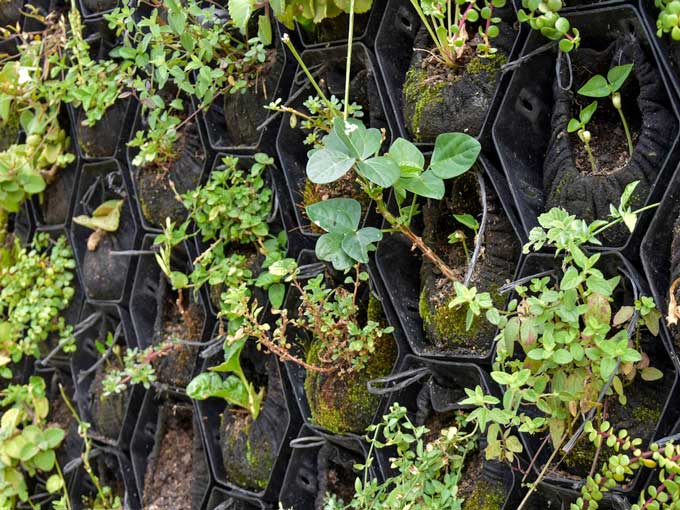
An appropriate plant selection can further improve the living wall’s resilience, feasibility and sustainability. The study identified seven traditional African vegetable species suitable for household food production in living wall systems: creeping foxglove, Indian borage, jute plant, pink ribbons, water mint, dwarf elephant’s food and black-eyed pea.
How feasible is it? What are the biggest barriers?
Building facades make up roughly double the area of building footprints in urban areas. This means that walls have more potential for local food production than traditional soil-based urban agriculture. They also have environmental benefits.
But the efficiency, resilience and sustainability of current living wall systems have been questioned globally and need improvement.
- They are costly to install and maintain.
- They seldom provide optimal conditions for plants to flourish.
- They rely on electricity and water.
- Some systems require specialized skills and technology.
What could make it work for cities on the continent?
Sun exposure of plant pots should be limited so that the soil doesn’t get too hot. The Eco Green Wall system is an example where sun exposure is limited and the structure protects the crops.
Pots need to have at least three liters of soil with a depth of 200mm. This increases yield and reduces plant stress. The soil must be lightweight and meet the plant’s requirements. Aeration, texture and drainage must be right. The pots’ drainage holes must limit blockages.
A drip or wick irrigation system for each plant level reduces maintenance and increases resilience.
Selecting traditional African vegetables increases the feasibility and resilience of crop performance. These crops can tolerate sub-Saharan Africa’s harsh climate conditions.
Traditional African vegetables also have a high nutritional value, don’t need much irrigation or chemicals, and are resistant to disease.
These vegetables prefer full sun and no frost. Well-drained, aerated potting soil that allows for movement of air, water and nutrients works well for them. They require moderate irrigation.
The system should be positioned to avoid possible contamination of crops by polluted environments. It must be orientated to provide efficient sun exposure for the selected plants.
So, are living wall systems worth considering to grow vegetables?
I concluded from my research that growing traditional African vegetables in modular living walls saves space compared to standard soil-based food production on a household scale. Considering the horizontal footprint area occupied in terms of yield per square meter, living wall systems with larger pot volumes produced over four times the yield of conventional soil-based agriculture. And they use space that would otherwise not have been used productively.
I also concluded that outdoor modular living wall systems with selected traditional African vegetable crops might be one way of improving food security and urban environments in sub-Saharan Africa.
This article was republished with permission from the original publisher.
Streets were empty and shops were closed across the West Bank on Monday as people in the occupied territory held a general strike to protest Israel's assault on the Gaza Strip, part of a broader day of action that included work stoppages in Lebanon, Jordan, and elsewhere around the world.
Since Israel's latest war on Gaza began following a deadly Hamas-led attack in early October, violence by settlers and occupying forces in the West Bank has surged, making 2023 the deadliest year in the Palestinian territory in nearly two decades.
According to the humanitarian group Save the Children, Israeli soldiers or settlers have killed more than 100 kids in the West Bank so far this year—three times the number killed in 2022.
In the Gaza Strip, Israeli forces have killed more than 7,000 children in less than two months, and more than a million kids are currently at grave risk as Israel expands its ground operation to include areas of southern Gaza that were previously seen as relative safe havens.
"The situation is extremely difficult," Hussein al-Sayyed, who is staying with relatives in the southern city of Khan Younis after fleeing Gaza City earlier in the war, told The Associated Press. "I have children and I don't know where to go. No place is safe."
The West Bank's general strike kicked off what's expected to be an international day of strikes and other protests around the world demanding an end to Israel's bombardment of Gaza.
Amman-based Roya News reported that the United Nations Relief and Works Agency for Palestinian Refugees (UNRWA) in Jordan took part in the protests, "closing all its facilities, including its schools, and urging all employees and students to stay at home."
The city of Aqaba in Jordan heeds the calls for a global strike in protest of the ongoing Israeli genocide campaign in Gaza.#StrikeForGaza pic.twitter.com/eBgUkSNDCN
— Quds News Network (@QudsNen) December 11, 2023
The protests come days after the United States vetoed a U.N. Security Council resolution calling for an immediate humanitarian cease-fire in the Gaza Strip.
The move drew immediate and widespread backlash from humanitarian groups and lawmakers around the world, including some in U.S. President Joe Biden's party.
"Shameful," Democratic Rep. Alexandria Ocasio-Cortez (D-N.Y.) wrote Sunday in response to the veto.
"The Biden admin can no longer reconcile their professed concern for Palestinians and human rights while also singlehandedly vetoing the U.N.'s call for a cease-fire and sidestepping the entire U.S. Congress to unconditionally back the indiscriminate bombing of Gaza."
Muwafaq Sahwil, secretary of the Palestinian political party Fatah in Ramallah and el-Bireh, told Al Jazeera that Monday's strikes are "a message to the U.S. administration that stands against the aspirations of our people."
"It is also a message from people around the world to their politicians and the international community to stand up for the Palestinian people who have been suffering from occupation for 75 years," said Sahwil.
"We hope the strike will push the international community to help stop the war and to respond to Palestinians' aspirations to achieve self-determination."
This article was originally published by Common Dreams (CC BY NC-ND 3.0) — and was republished with permission.
Representational header image — in Bethlehem, West Bank in 2011 — by Montecruz Foto. Courtesy of CC BY-SA 2.0 DEED
Judge John Phillips, motivated by the realization that he was sending young people to prison for life, founded Rancho Cielo in Salinas, California, to provide an alternative path for at-risk youth.
The program, launched in 2003, aims to help students overcome challenges related to poverty, dysfunction, trauma, and pain by offering a supportive, therapeutic environment.
Rancho Cielo provides vocational programs in construction, auto and diesel repair, welding, culinary arts, and agricultural technology, along with academic and career pathways.
The success of the program is evident: 84.8% of its graduates do not re-offend, compared to 40% of youth in the county's juvenile justice system who have another encounter with the law.
The Rancho Cielo campus looks like a high-end private school, with colorful and well-equipped buildings, providing a positive and enriching atmosphere for students.
The program goes beyond traditional education by offering comprehensive support, including clothing, transportation, and assistance with various subjects.
The school's unique funding model, combining public and private partnerships, allows for additional resources and training opportunities not typically available in public schools.
The success of vocational programs, such as the automotive and diesel mechanic program, has led to innovative expansions like focusing on vintage auto repair to meet local needs.
Why is this good news?
Rancho Cielo's impact extends beyond providing education; it transforms students' lives by offering practical skills, emotional support, and opportunities for personal growth.
The school's commitment to "at-promise" students, reaching them before they become entangled in the legal system, demonstrates a proactive approach to addressing socio-economic challenges.
Rancho Cielo's success in reducing recidivism, providing vocational training, and preparing students for college or well-paying jobs makes it a model that could be replicated in other communities, addressing the broader issue of education and support for at-risk youth across the nation.
This article originally appeared in the Goodnewsletter — Good Good Good’s daily newsletter filled with positive news. Join tens of thousands of other do-gooders by subscribing to the Goodnewsletter today!
Header photo courtesy of Rancho Cielo Youth Campus/Facebook
If the average American saw Irina Karamanos Adrian walking down the street, they’d probably make some innocuous assumptions about her.
They might think she’s got good taste in lipstick, or that she has Latin heritage. They’d likely categorize her as a millennial, and maybe they’d even go as far as to assume she had progressive political views, like many other 34-year-old women.
The average Chilean, however, would immediately clock her as the long-term domestic partner to President Gabriel Boric.
They would know her as the woman who became First Lady, only to completely dissolve the title less than a year later.
The First Lady Who Stepped Down
Boric took office in March of 2022 as the youngest-ever president in the nation’s history, and one of several leftist politicians who rose to power in the region. He gained prominence as a student activist while studying law at the University of Chile and became a member of Congress.
He and Karamanos had been dating for about two years when the Social Convergence Party — which they both had a hand in forming, with goals of broadening social justice — pointed to Boric as their future president.
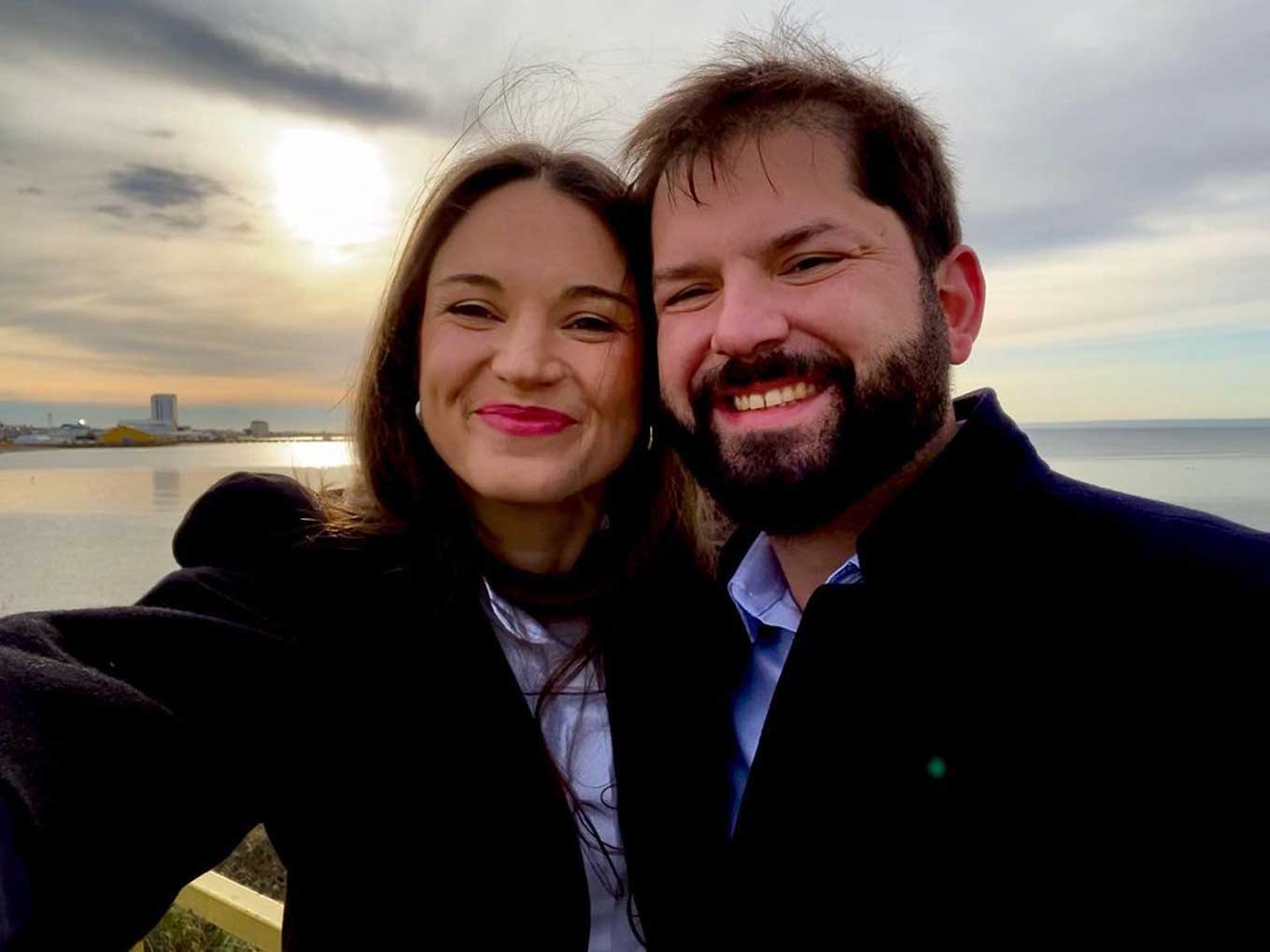
With her own zest for political action, Karamanos was quick to support her partner, helping him collect the more than 30,000 signatures he needed to qualify for the ballot. By the time of the election, she was leading the feminist front of the campaign.
Karamanos studied anthropology and political science, and her knack for organizing came naturally. But the old institutions by which politics are often shaped weren’t for her.
When Boric was elected, she immediately resisted the title of First Lady, though she reluctantly agreed to serve in the role — but with one caveat: She’d leave as soon as she transformed the position.
It only took about nine months.
“We all know how traditions work. They repeat in time until something or someone interrupts it,” Karamanos said on stage at TEDWomen this past October.
Dissolving an Institution
It wasn’t necessarily that she didn’t want the role or didn’t think she had what it took to help progress the country. Simply put, she just didn’t think the position should exist.
“Whatever your partner does, do you picture yourself getting up in the morning and accompanying him or her to his or her job? Now picture that job being to rule over a country,” Karamanos positioned the TED crowd.
“As much as it comes as a surprise to you, imagine what a surprise it comes as to the voters, who didn’t elect you. They elected the president, and the president chose me, but surely not thinking about me becoming an authority one day.”
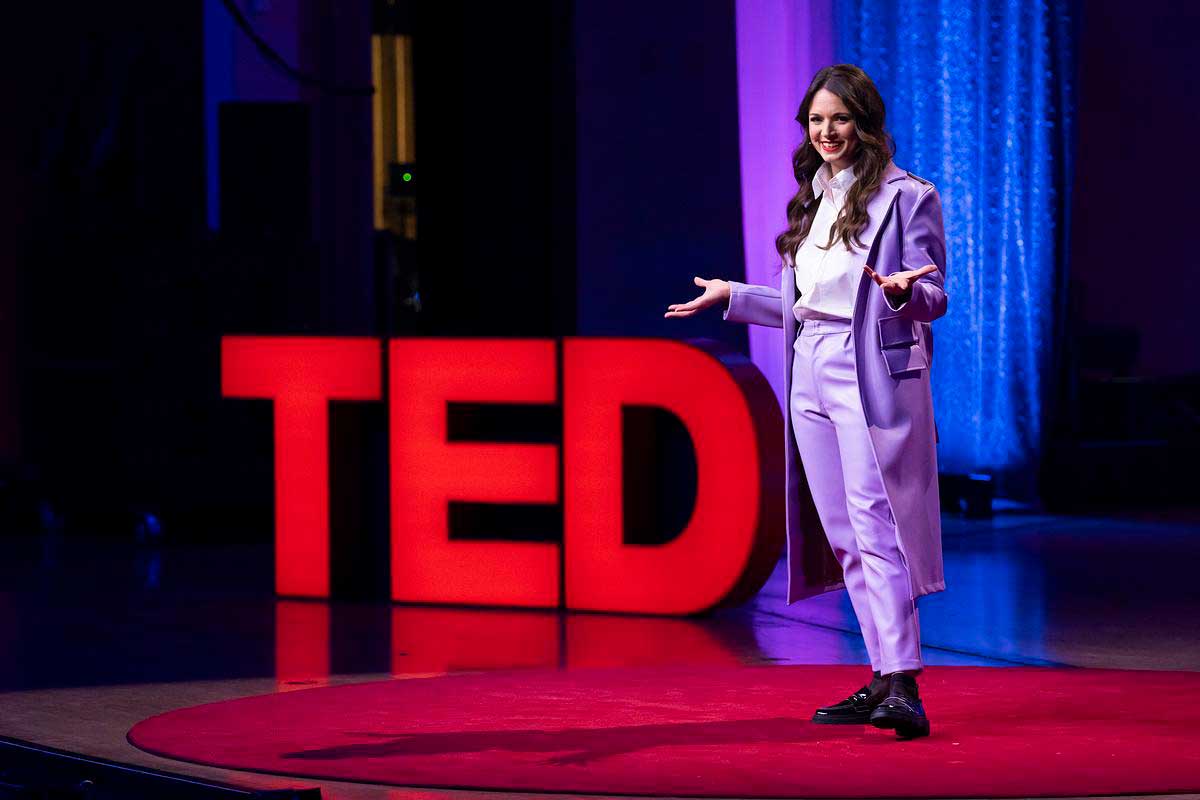
While she has similar beliefs as her partner and was eager to advance his campaign, Karamanos refused to have her own identity eclipsed by the office of the president — or the office of the First Lady.
“Suddenly, you become a very special kind of woman: another half,” she said. “My approach would be to tackle both issues: the democratic illegitimacy of having the institution of marriage so embedded in the state … and the gender bias imagined around this figure.”
Karamanos explained the institutional role of the First Lady in Chile: She was given a team, an office (“not just any office,” she clarified in her TED Talk, “the most beautiful one.”), and authority over six foundations that were created by past First Ladies.
“You get to preside [over] all of these foundations regardless of your professional background,” she explained.
These foundations, which focused on things like childhood education, women’s empowerment, and the arts, were moved under the jurisdiction of existing ministries (like the Ministry of Education or the Ministry of Women and Gender Equity), allowing designated officials to elect leaders to govern them — not the First Lady.
But before this, Karamanos worked to ensure that the foundations themselves were still relevant and meaningful.
“I talked to unions and workers,” she said in her TED Talk. “I improved salaries, made job listings public, made processes more transparent, and tried to make standards higher in general.”
She also consulted former First Ladies and influential feminists to guide her decisions, acknowledging that the work done in the past was instrumental to contemporary women’s leadership.

“The reasons why these foundations were created, the reasons why First Ladies existed and got institutionalized — how that started — is not really the problem. There were times where, of course, there was no formal position for women in politics. But the thing is that we haven’t updated anything about that,” Karamanos told Good Good Good in a sit-down interview in Atlanta.
“When it comes to women in power, when it comes to women in politics, of course, we want as many as possible,” she said in her TED Talk. “But the good news is: We can vote for them.”
Still, the months-long plan to absolve the First Lady of influence was met with skepticism. Why wouldn’t someone want to be given unequivocal privilege and resources to spend on her interests?
“My goal for taking on the institutional side of the First Lady was … to take away power from a position that is a result of affection and not of democratic process,” Karamanos said in her TED Talk.
“Some people may think that this is a personal rejection of a privilege. Instead, it is a political rejection of power from where it doesn’t belong. I am not to have power that people have not given me.”
Legitimizing Power, Regardless of Gender
Karamanos started publicly questioning power relations and why exactly spouses of presidents should have such high-ranked positions in government — and what that means about her relationship, too.
The other element of being a First Lady, Karamanos explained, is protocol — or being a public companion to the president.
“It turns out, we still look at masculine authorities as people who need to be complimented by a feminine other,” she said in her Talk. “But if you think about a woman that has just been elected, or a woman in power, we expect her to have both male and female qualities.”
The gender stereotypes at the core of the position of First Lady speak to two things, she said: “That relationships in such high-ranking, visible platforms are expected to be heteronormative and traditional,” and “how embedded marriage is in state.”
Plus, it’s just condescending.
“Women accompanying presidents are still seen as assets, seen as giving the president an image of more stability, of completeness, of balance,” she said. “I say we remove marriage out of the presidential must-haves and legitimize the person we vote for and assume he or she will have enough personal agency.”
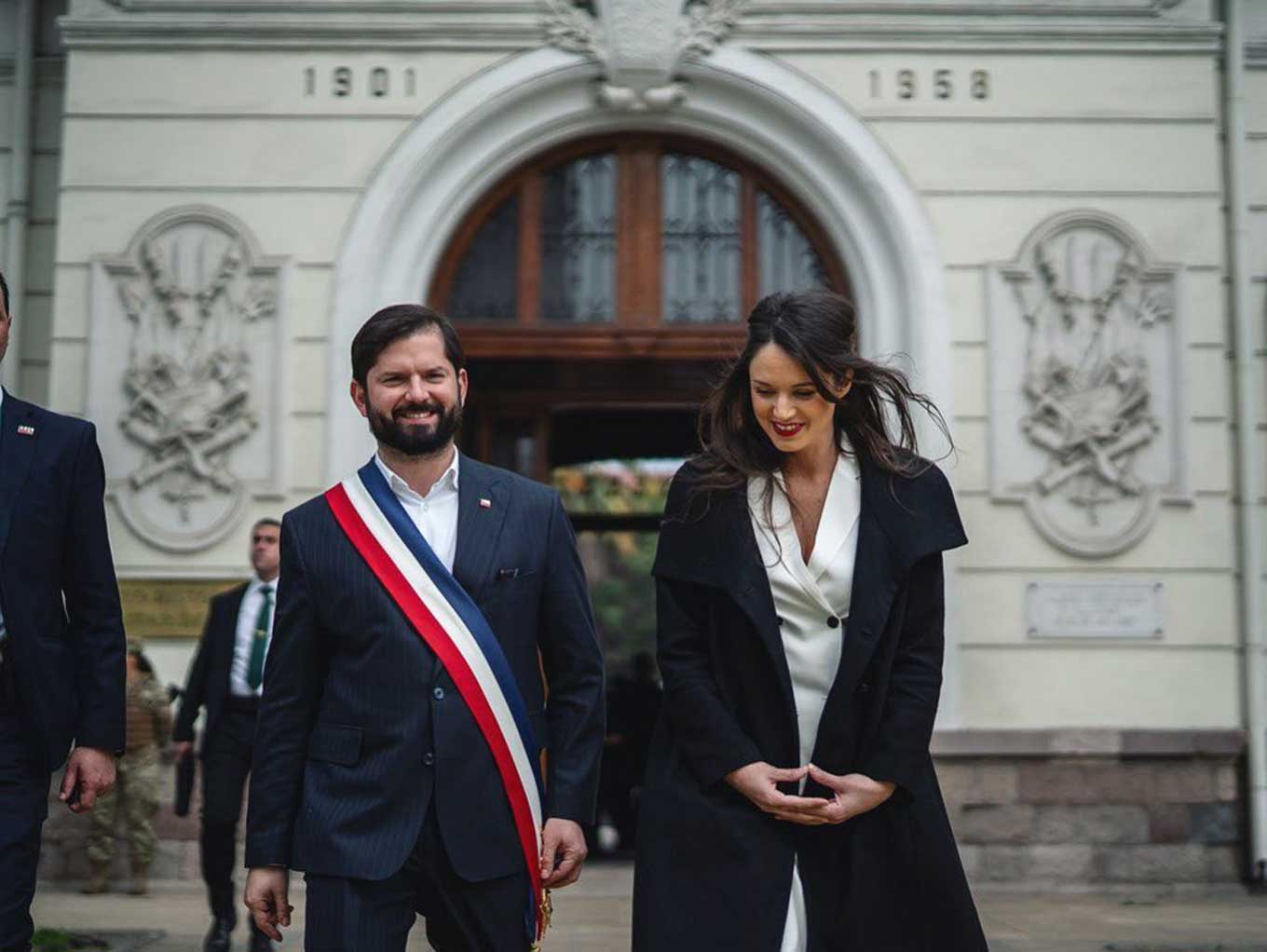
Karamanos is still happily supportive of Boric and active in his life — but now, as a loving partner and not an ornamental official.
“Now I’m just me. I have no team, no office, no official role. I don’t take any resources from the state,” she said in her TED Talk. “I still have a lot of public exposure, and I still attend meaningful events with my partner.”
At the core of Karamanos’s historic choice to abandon her post is not her partner or her own ambitions — but an unrelenting desire for stronger democracies.
“Making changes in governmental institutions, updating them, making them more legitimate, and taking away parts that don’t represent contemporary needs anymore … might make people feel [closer], more reflected in the instrument of democracies,” she said.
“If making symbolic cultural and institutional changes increases our attachment to democratic values, then I say it’s worth a try.”
Read our full interview with former First Lady of Chile, Irina Karamanos Adrian.
A version of this article was originally published in The 2024 Gender Edition of the Goodnewspaper.
Get your own Goodnewspaper by becoming a good news subscriber today.
Whether you’re interested in discovering new animals, you’re an educator looking for a valuable teaching resource, you’re passionate about protecting animal species across the globe, or you’re simply gearing up for an animal-themed trivia night — we’ve got you covered with the ultimate animal resource.
Animals encompass a vast array of species — from mammals and birds to reptiles and insects. We’ve got them all! They offer an incredible diversity of forms, behaviors, and habitats. Animals are an integral part of Earth’s ecosystem, playing various roles in maintaining the balance of nature.
And sure, we’ve all heard of lions, tigers, and bears — but what about axolotls, quokkas, and narwhals?
We’ve collected the ultimate list (truly, it might just be the largest on the internet) of animal names — from A to Z — so you can explore every kind of animal imaginable.
Why did we write this article?
- We share the Earth with animals — and we each can benefit from understanding and appreciating the entire animal kingdom
- Recognizing the importance of all creatures, big and small, can inspire us to make choices that benefit them and our planet.
- As a good news website — we have reported hundreds of good news stories about animals and we want it to be easier for you to enjoy them. Throughout this article, you’ll find links to good news stories about various animal species! We hope you get a chance to read a few and enjoy!
We hope you discover something new — and maybe even share a good news story about your favorite animal with a friend.
You might also like: Animal Rights Quotes | Animal Holidays | Pet Holidays | Nature Documentaries | Animal Group Names
Complete List of All Animals — In Alphabetical Order
This current list contains more than 1100 animals — but our database includes the names of more than 3000 animals. We’re in the process of uploading the remaining animals in an accessible format. Bookmark this page and come back soon!
Animals That Start with A
- Aardvark
- Aardwolf
- Acorn Woodpecker
- Adderfish
- Adélie Penguin
- Admiral Butterfly
- African Bullfrog
- African Bush Elephant
- Africanized Bee
- Akita
- ‘Alalā
- Albacore Tuna
- Albatross
- Aldabra Giant Tortoise
- Alder Flycatcher
- Alligator
- Alpaca
- Alver
- American Bison
- American Sparrow
- Amphipod
- Amur Leopard
- Amur Tiger
- Anaconda
- Andean Condor
- Andean Goose
- Angelfish
- Angelshark
- Anglerfish
- Ant
- Antarctic Krill
- Anteater
- Antelope
- Ape
- Arapaima
- Araucana
- Arctic Fox
- Asian Elephant
- Asp
- Attenborough’s Long-Beaked Echidna
- Australian Shepherd
- Australian Snake-Necked Turtle
- Axolotl
- Aye-Aye
- Azawakh
→ Explore even more animals that start with A
Animals That Start with B
- Baboon
- Badger
- Bald Eagle
- Banana Eel
- Barn Owl
- Barn Spider
- Bass
- Basset Hound
- Bat
- Bear
- Bearded Dragon
- Bee
- Belgian Malinois
- Beluga Whale
- Bengal Tiger
- Betta Fish
- Bigeye
- Bighorn Sheep
- Bindweed
- Bird
- Bison
- Black Bear
- Black Labrador
- Black Mamba
- Black Rain Frog
- Black Rhinoceros
- Black Swan
- Black-Footed Ferret
- Blobfish
- Blue Whale
- Boa Constrictor
- Boar
- Bobcat
- Bonefish
- Border Collie
- Bottlenose Dolphin
- Buffalo
- Bull
- Bull Shark
- Bulldog
- Bullfrog
- Butterfly
- Butterfly Fish
- Buzzard
→ Explore even more animals that start with B
Animals That Start with C
- California Condor
- California Kingsnake
- Camel
- Canada Goose
- Cane Rat
- Cane Spider
- Canebrake Rattlesnake
- Canine
- Caracara
- Caraval
- Cardinal
- Caribou
- Caspian Tiger
- Cat
- Caterpillar
- Catfish
- Cattle
- Cetacean
- Chaffinch
- Chameleon
- Cheetah
- Chickadee
- Chicken
- Chihuahua
- Chimpanzee
- Chipmunk
- Clownfish
- Cobra
- Codfish
- Condor
- Copperhead Snake
- Coral
- Coral Snake
- Corgie
- Cougar
- Cow
- Coyote
- Crab
- Crabeater Seal
- Crocodile
- Cuttlefish
- Czechoslovakian Wolfdog
→ Explore even more animals that start with C
Animals That Start with D
- Dachshund
- Darwin’s Frog
- Deer
- Deer Tick
- Diamond Python
- Diamondback Moth
- Dik-Dik
- Dingo
- Dodo
- Dog
- Dolphin
- Donkey
- Dove
- Dragonfly
- Duck
- Duck-Billed Platypus
- Dungeness Crab
- Dutch Rabbit
- Dzo
→ Explore even more animals that start with D
Animals That Start with E
- Eagle
- Earthworm
- Earwig
- Eastern Coral Snake
- Eastern Cottontail
- Eastern Diamondback Rattlesnake
- Eastern Lowland Gorilla
- Eel
- Egret
- Elephant
- Elephant Seal
- Elk
- Emperor Penguin
- Emu
- English Shepherd
- English Sparrow
- Exmoor Ponies
- Extremophiles
→ Explore even more animals that start with E
Animals That Start with F
- Fainting Goat
- Falcon
- Fallow Deer
- Fender’s Blue Butterfly
- Fin Whale
- Finch
- Finger Monkey
- Firefly
- Fish
- Flamingo
- Flea
- Flounder
- Flying Squirrel
- Fox
- French Bulldog
- Frog
- Fruit Bat
- Fur Seal
→ Explore even more animals that start with F
Animals That Start with G
- Gaboon Viper
- Galapagos Barn Owls
- Galapagos Giant Tortois
- Galapagos Yellow Warbler
- Gazelle
- Geoduck
- German Shepherd
- Gharial Crocodiles
- Giant Squid
- Giant Tortoise
- Gibbon
- Giraffe
- Goat
- Golden Masked Owl
- Golden Mole
- Golden Retriever
- Goldfish
- Goose
- Gorilla
- Grackle
- Great Blue Heron
- Great Bustard
- Great Dane
- Great Pyrenees
- Greater One-Horned Rhino
- Green Frog
- Green Sea Turtle
- Greenback Cutthroat Trout
- Grey Wolf
- Greyhound
- Ground Squirrel
- Groundhog
- Guanaco
- Guinea Pig
- Guppy
→ Explore even more animals that start with G
Animals That Start with H
- Haast’s Eagle
- Habu Snake
- Haddock
- Hagfish
- Halibut
- Hamster
- Hare
- Hawk
- Hawksbill Sea Turtle
- Heron
- Herring
- Highland Cattle
- Hogfish
- Honey Badger
- Honey Bee
- Hornet
- Horse
- Howler Monkey
- Hummingbird
- Humpback Whale
- Husky
- Hyacinth Macaw
- Hyaenodon
- Hydrozoan Jellyfish
- Hyena
- Hyrax
→ Explore even more animals that start with H
Animals That Start with I
- Iberian Lynx
- Ibex
- Ibis
- Ibisbill Bird
- Ibizan Hound
- Icadyptes
- Icelandic Sheepdog
- Iguana
- Inchworm
- Indian Cobra
- Indian Cuckoo Bird
- Indian Elephant
- Irish Elk
- Irish Setter
- Irrawaddy Dolphin
- Irukandji Jellyfish
- Italian Greyhound
- Italian Wolf
- Ivory Gull
- Ivory-Billed Woodpecker
- Ivy Bee
→ Explore even more animals that start with I
Animals That Start with J
- Jabiru
- Jacamar
- Jacana
- Jack
- Jack Crevalle
- Jackal
- Jackdaw
- Jackrabbit
- Jaguar
- Japanese Rat Snake
- Japanese Spider Crab
- Jellyfish
- Jerboa
- Jerdon’s Courser
- Jewel Beetle
- John Dory
- Jonah Crab
- Joro Spider
- Josephoartigasia Monesi
- Jumping Spider
- Jungle Carpet Python
- Jungle Cat
- Junglefowl
→ Explore even more animals that start with J
Animals That Start with K
- Kagu
- Kai Ken
- Kakapo
- Kaluga Sturgeon
- Kamehameha Butterfly
- Kangal Shepard Dog
- Kangal Shepherd Dog
- Kangaroo
- Kangaroo Mouse
- Kangaroo Rat
- Kangolf
- Katipo Spider
- Katydid
- Kaua’i ‘ō‘ō
- Kea
- Kea Parrot
- Kentucky Warbler
- Killer Clown Ball Python
- Killer Whale
- Killifish
- Kinabalu Giant Red Leech
- Kinder Goat
- King Cobra
- King Cobra Snake
- King Crab
- King Eider
- King Mackerel
- King Penguin
- King Quail
- King Rat Snake
- King Salmon
- King Shepherd
- King Snake
- King Vulture
- Kingbird
- Kingfisher
- Kitefin Shark
- Kitten
- Kiwi
- Klipspringer
- Knifefish
- Knight Anole
- Koala
- Kodiak Bear
- Kodkod
- Koi
- Koi Fish
- Kokanee Salmon
- Komodo Dragon
- Krill
- Kudu
- Kudzu Bug
- Kultarr
- Kuvasz
→ Explore even more animals that start with K
Animals That Start with L
- Labahoula
- Labmaraner
- Labout’s Fairy Wrasse
- Labrabull
- Labradane
- Labradoodle
- Labrador
- Labrador Mix
- Ladybug
- Lamb
- Lamprey
- Lancashire Heeler
- Lancetfish
- Landseer Newfoundland
- Lappet-Faced Vulture
- Lapponian Herder
- Lapwing
- Leafcutter Ant
- Leafcutter Bee
- Leafy Seadragon
- Least Flycatcher
- Leatherback Sea Turtle
- Leech
- Lemming
- Lemon Blast Ball Python
- Lemon Cuckoo Bumblebee
- Lemon Shark
- Lemur
- Leonberger
- Leopard
- Leopard Cat
- Leopard Frog
- Leopard Gecko
- Leopard Lizard
- Leopard Seal
- Leopard Shark
- Leopard Tortoise
- Leopliguar
- Liger
- Lion
- Little Owl
- Little Penguin
- Livestock
- Lizard
- Lizardfish
- Llama
- Loach
- Lobster
- Locust
- Loon
- Luna Moth
- Luna Moth Caterpillar
- Lungfish
- Lurcher
- Lykoi Cat
- Lynx
- Lyrebird
→ Explore even more animals that start with L
Animals That Start with M
- Macaque
- Macaque Monkey
- Macaroni Penguin
- Macaw
- Macgillivray’s Warbler
- Machaeroides
- Mackenzie Valley Wolf
- Mackenzie Wolf
- Macrauchenia
- Madagascar Hissing Cockroach
- Madagascar Jacana
- Madagascar Red Owl
- Madagascar Tree Boa
- Magpie
- Malchi
- Mallard
- Malteagle
- Maltese
- Manatee
- Manta Ray
- Map Turtles
- Mara
- Marabou Stork
- Marine Angelfish
- Marine Hatchetfish
- Marine Iguana
- Marine Toad
- Markhor
- Marlin
- Marmoset
- Marmot
- Masked Angelfish
- Mealybug
- Meerkat
- Mexican Alligator Lizard
- Mexican Black Kingsnake
- Mexican Eagle
- Mexican Fireleg Tarantula
- Mexican Free-Tailed Bat
- Mexican Grey Wolf
- Millipede
- Mini Labradoodle
- Mini Lop
- Miniature Bull Terrier
- Miniature Horse
- Mole
- Mole Rat
- Mole Snake
- Mollusk
- Molly
- Monarch Butterfly
- Mongoose
- Mongrel
- Monitor Lizard
- Monkey
- Monkfish
- Moose
- Mosquito
- Moth
- Mottled Owl
- Mountain Feist
- Mountain Goat
- Mountain Gorilla
- Mountain Lion
- Mouse
- Mouse Deer
- Mouse Spider
- Mozambique Spitting Cobra
- Mud Dauber Wasp
- Mud Snake
- Mulard
- Mule
- Mule Deer
- Mulga Snake
- Musk Deer
- Musk Ox
- Muskrat
- Mussurana Snake
- Myna Bird
→ Explore even more animals that start with M
Animals That Start with N
- Nabarlek
- Naegleria
- Naked Mole Rat
- Narluga
- Narwhal
- Natterjack
- Natterjack Toad
- Nautilus
- Neanderthal
- Neapolitan Mastiff
- Nebelung
- Needlefish
- Nelore Cattle
- Nematode
- Nene
- Neon Tetra
- Neptune Grouper
- Netherland Dwarf Rabbit
- New Hampshire Red Chicken
- New World Monkey
- New World Tarantula Spider
- Newfoundland
- Newfypoo
- Newt
- Nguni Cattle
- Nicobar Pigeon
- Nigerian Goat
- Night Adder
- Night Heron
- Night Lizard
- Night Snake
- Nighthawk
- Nightingale
- Nightjar
- Nile Crocodile
- Nile Monitor
- Nile Perch
- Nilgai
- No See Ums
- Norfolk Terrier
- Norrbottenspet
- North American Beaver
- North American Black Bear
- North Atlantic Right Whale
- Northern Alligator Lizard
- Northern Bobwhite
- Northern Cardinal
- Northern Crested Caracara
- Northern Flicker
- Northern Fur Seal
- Northern Harrier
- Northern Inuit Dog
- Northern Jacana
- Northern Mockingbird
- Northern Parula
- Northern Pintail
- Northern Potoo
- Northern Screamer
- Northern Short-Tailed Shrew
- Northern Water Snake
- Norway Rat
- Norwegian Buhund
- Norwegian Elkhound
- Norwegian Forest
- Norwegian Lundehund
- Norwich Terrier
- Nose-Horned Viper
- Nova Scotia Duck Tolling Retriever
- Nubian Goat
- Nudibranch
- Numbat
- Nuralagus
- Nurse Shark
- Nut Weevil
- Nuthatch
- Nutria
- Nyala
→ Explore even more animals that start with N
Animals That Start with O
- Oak Toad
- Oarfish
- Ocean Perch
- Ocean Pout
- Ocean Sunfish
- Ocean Whitefish
- Oceanic Whitetip Shark
- Ocellated Turkey
- Ocelot
- Octopus
- Oenpelli Python
- Oilfish
- Okapi
- Old English Sheepdog
- Old House Borer
- Old World Monkey
- Old World Tarantula Spider
- Oleander Hawk Moth
- Olingo
- Olive Baboon
- Olive Python
- Olive Ridley Sea Turtle
- Olive Sea Snake
- Olm
- Olympic Marmot
- Onagadori Chicken
- Onager
- Opabinia
- Opah
- Opaleye
- Opossum
- Oranda Goldfish
- Orange Baboon Tarantula
- Orange Dream Ball Python
- Orange Roughy
- Orange Spider
- Orange Tanager
- Orange-Crowned Warbler
- Orange-Headed Tanager
- Orangutan
- Orb Weaver
- Orb Weaver Spider
- Orca
- Orchard Oriole
- Orchid Dottyback
- Oregon Spotted Frog
- Ori-Pei
- Oribi
- Oriental Cockroach
- Oriental Dwarf Kingfisher
- Orinoco Crocodile
- Ornate Bichir
- Ornate Black-Tailed Rattlesnake
- Ornate Box Turtle
- Ornithocheirus
- Ornithomimus
- Ortolan Bunting
- Oryx
- Oscar Fish
- Osprey
- Ostracod
- Ostrich
- Otter
- Otterhound
- Ovenbird
- Oviraptor
- Owl
- Owl Butterfly
- Owlfly
- Ox
- Oxpecker
- Oyster
- Oyster Toadfish
- Ozark Bass
→ Explore even more animals that start with O
Animals That Start with P
- Pacific Coast Tick
- Pacific Herring
- Pacific Shrew
- Pacific Sleeper Shark
- Pacific Spaghetti Eel
- Paddlefish
- Palm Rat
- Palo Verde Beetle
- Panda
- Parrot
- Parrot Snake
- Parrotfish
- Partridge
- Passenger Pigeon
- Peacock
- Pelican
- Penguin
- Penis Fish
- Peppermint Angelfish
- Perch
- Père David’s Deer
- Peregrine Falcon
- Pheasant
- Pig
- Pig-Nosed Turtle
- Pigeon
- Pika
- Pike
- Pileated Woodpecker
- Pink Salmon
- Pipevine Swallowtail Butterfly
- Piranha
- Piranha Fish
- Pirarucu
- Pit Bull
- Platypus
- Polar Bear
- Polecat
- Polish Chicken
- Polynesian Tree Snail
- Pomeranian
- Poodle
- Possum
- Prairie Dog
- Prawn
- Praying Mantis
- Preuss’s Monkey
- Proboscis Monkey
- Procoptodon
- Pronghorn
- Pronghorn Antelope
- Puff Adder
- Pufferfish
- Puffin
- Pug
- Puma
- Purple Emperor Butterfly
- Purple Finch
- Purple Gallinule
- Purple Tarantula
- Pygora Goat
- Pyjama Shark
- Pyrador
- Pyrosome
- Python
→ Explore even more animals that start with P
Animals That Start with Q
- Quagga
- Quagga Zebra
- Quahog
- Quahog Clam
- Quail
- Quaker Parrot
- Queen Alexandra’s Birdwing
- Queen Angelfish
- Queen Snake
- Quetzal
- Quetzalcoatlus Northropi
- Quokka
- Quoll
- Quoll
→ Explore even more animals that start with Q
Animals That Start with R
- Rabbit
- Raccoon
- Rainbow Boa
- Rainbow Shark
- Rat
- Rat Snake
- Rat Terrier
- Ratel
- Rattlesnake
- Red Fox
- Red Kangaroo
- Red Panda
- Red Wolf
- Red-Backed Shrike
- Red-Bellied Black Snake
- Red-Bellied Woodpecker
- Redstart
- Redtail Catfish
- Reef Fish
- Reef Shark
- Regal Jumping Spider
- Reindeer
- Rhino Beetle
- Rhino Viper
- Rhinoceros
- Rhinoceros Beetle
- Rhode Island Red Chicken
- Ribbon Eel
- Ribbon Snake
- Right Whale
- Rim Rock Crowned Snake
- Ring-Billed Gull
- Ringed Kingfisher
- Ringed Seal
- Ringtail
- Ringtailed Lemur
- Rinkhals Snake
- Rockfish
- Rockhopper Penguin
- Rodent
- Rose-Breasted Grosbeak
- Roseate Spoonbill
- Rosy Boa
- Roti Island Snake-Necked Turtle
- Rottweiler
- Rottweiler Mix
- Royal Penguin
- Rubber Boa
- Ruby-Crowned Kinglet
- Ruby-Throated Hummingbird
- Rudd
- Rudderfish
- Ruddy Duck
- Ruddy Turnstone
- Rufous Hummingbird
- Russel’s Viper
- Russell Terrier
- Russian Bear Dog
→ Explore even more animals that start with R
Animals That Start with S
- Saarloos Wolfdog
- Sabine’s Gull
- Sable Antelope
- Salamander
- Sawfish
- Scorpion
- Sea Snake
- Sea Turtle
- Sea Urchin
- Seagull
- Seahorse
- Seal
- Shark
- Sharp-Shinned Hawk
- Sharp-Tailed Snake
- Sheep
- Sheepadoodle
- Sheepshead Fish
- Shellfish
- Shelter Dog
- Shelter Cat
- Shelter Pet
- Shepadoodle
- Shepkita
- Shetland Sheepdog
- Shiba Inu
- Shiba Inu Mix
- Shichi
- Shih Tzu
- Shrimp
- Siamese
- Siamese Fighting Fish
- Siberian
- Siberian Husky
- Siberian Ibex
- Siberian Retriever
- Siberian Tiger
- Skunk
- Skye Terrier
- Skylark
- Sloth
- Sloth Bear
- Slovak Cuvac
- Slow Worm
- Slug
- Snail
- Snailfish
- Snake
- Snapping Turtle
- Snowy Owl
- Sockeye Salmon
- Sparrow
- Spectacled Owl
- Sperm Whale
- Sphynx
- Spider
- Spider Ball Python
- Spider Beetle
- Spider Monkey
- Spider Wasp
- Squid
- Squirrel
- Squirrel Monkey
- Staghorn Coral
- Star-Nosed Mole
- Starfish
- Stingless Bee
- Stingray
- Stink Bug
- Stone Crab
- Stone Curlew
- Stonefish
- Sturgeon
- Suckerfish
- Sugar Glider
- Sumatran Tiger
- Sun Bear
- Swallow
- Swan
- Swedish Elkhound
- Sweeper
- Swordfish
→ Explore even more animals that start with S
Animals That Start with T
- Taco Terrier
- Tailless Whip Scorpion
- Taimen Fish
- Tamarin Monkey
- Tamaskan
- Tarantula Hawk
- Tarantula Spider
- Tarpon
- Tasmanian Devil
- Tasmanian Masked Owl
- Tasmanian Tiger
- Tawny Eagle
- Tawny Frogmouth
- Tawny Mining Bee
- Tawny Owl
- Teacup Poodle
- Teddy Bear Hamster
- Teddy Guinea Pig
- Teddy Roosevelt Terrier
- Teira Batfish
- Telescope Fish
- Tenrec
- Tent Caterpillar
- Termite
- Terrier
- Tetra
- Texas Blind Snake
- Texas Brown Tarantula
- Texas Coral Snake
- Texas Garter Snake
- Texas Indigo Snake
- Texas Night Snake
- Therapy Dog
- Theropod
- Thomson’s Gazelle
- Thornback Ray
- Tibetan Fox
- Tibetan Mastiff
- Tibetan Spaniel
- Tibetan Terrier
- Tick
- Tiffany Cat
- Tiger
- Tiger Beetle
- Tiger Moth
- Tiger Muskellunge
- Tiger Rattlesnake
- Tiger Salamander
- Tiger Shark
- Tigon
- Tiktaalik
- Tilapia
- Timber Rattlesnake
- Timber Wolf
- Titi Monkey
- Titicaca Water Frog
- Toad
- Tortoise
- Toucan
- Trout
- Tuatara
- Tufted Coquette
- Tuna
- Tundra Swan
- Tundra Wolf
- Turaco
- Turkey
- Turkey Vulture
- Turkish Angora
- Turnspit
- Turquoise Killifish
- Turtle
- Turtle Dove
- Turtle Frog
- Tusoteuthis
- Tussock Moth
- Tussock Moth Caterpillar
- Twig Snake
→ Explore even more animals that start with T
Animals That Start with U
- Uakari
- Uaru Cichlid
- Uguisu
- Uguisu
- Uinta Ground Squirrel
- Uintatherium
- Ulysses Butterfly
- Umbrella Cockatoo
- Umbrella Squid
- Umbrellabird
- Unau
- Underwing Moth
- Upland Sandpiper
- Ural Owl
- Urechis Unicinctus
- Urial
- Urial Sheep
- Uromastyx
- Urutu Snake
- Utah Prairie Dog
- Utonagan
→ Explore even more animals that start with U
Animals That Start with V
- Valley Bulldog
- Vampire Bat
- Vampire Crab
- Vampire Squid
- Vanga
- Vaquita
- Veery
- Vegavis
- Velociraptor
- Velvet Asity
- Vendace Fish
- Venus Flytrap
- Vermilion Flycatcher
- Vervet Monkey
- Vesper Bat
- Vestal Cuckoo Bumblebee
- Vicugna
- Vicuna
- Vicuña
- Vine Snake
- Vinegaroon
- Viper
- Viper Boa
- Viper Shark
- Viperfish
- Vireo
- Virgin Islands Dwarf Gecko
- Vizsla
- Volcano Snail
- Vole
- Volpino Italiano
- Vulture
→ Explore even more animals that start with V
Animals That Start with W
- Wahoo Fish
- Waimanu
- Walking Catfish
- Wallaby
- Walleye Fish
- Walrus
- Warbler
- Warthog
- Wasp
- Water Beetle
- Water Buffalo
- Water Bug
- Water Dragon
- Water Spider
- Water Vole
- Weasel
- Weevil
- Weimaraner
- Weimardoodle
- Wels Catfish
- West African Manatee
- West Highland Terrier
- West Siberian Laika
- Western Black Rhinoceros
- Western Blacklegged Tick
- Western Blind Snake
- Western Gorilla
- Western Green Mamba
- Western Hognose Snake
- Western Kingbird
- Western Lowland Gorilla
- Western Rat Snake
- Whale Shark
- Whale
- Wheaten Terrier
- Whimbrel
- Whinchat
- Whippet
- Whiptail Lizard
- White Bass
- White Bengal Tiger
- White Butterfly
- White Rhinoceros
- White Shark
- White Stork Bird
- White Sturgeon
- White Tiger
- White-Tail Deer
- Whitefish
- Whitetail Deer
- Whooping Crane
- Wild Boar
- Wild Rabbit
- Wild Turkey
- Wildcat
- Wildebeest
- Wolf
- Wolf Eel
- Wolf Snake
- Wolf Spider
- Wolverine
- Woma Python
- Wombat
- Wood Bison
- Wood Duck
- Wood Frog
- Wood Turtle
- Woodchuck
- Woolly Bear Caterpillar
- Woolly Mammoth
- Woolly Monkey
- Woolly Rhinoceros
- Worm
- Worm Snake
- Wryneck
- Wyoming Toad
→ Explore even more animals that start with W
Animals That Start with X
- X-Ray Fish
- X-Ray Tetra
- Xantus’s Hummingbird
- Xantusia
- Xeme
- Xenacanthus
- Xenarthra
- Xenoceratops
- Xenoposeidon
- Xenops
- Xenopus
- Xenotarsosaurus
- Xerus
- Xerus Inauris
- Xiaosaurus
- Xiaotingia
- Xingu River Ray
- Xiongguanlong
- Xiphactinus
- Xoloitzcuintli
→ Explore even more animals that start with X
Animals That Start with Y
- Yabby
- Yacare Caiman
- Yak
- Yakalo
- Yakutian Laika
- Yarara
- Yellow Anaconda
- Yellow Aphid
- Yellow Bass
- Yellow Bellied Sapsucker
- Yellow Belly Ball Python
- Yellow Bullhead Catfish
- Yellow Cobra
- Yellow Crazy Ant
- Yellow Jacket Wasp
- Yellow Labrador Retriever
- Yellow Mongoose
- Yellow Perch
- Yellow Sac Spider
- Yellow Spotted Lizard
- Yellow Tanager
- Yellow Tang
- Yellow-Bellied Marmot
- Yellow-Bellied Sea Snake
- Yellow-Billed Hornbill
- Yellow-Eyed Penguin
- Yellow-Faced Bee
- Yellowfin Tuna
- Yellowhammer
- Yellowish Cuckoo Bumblebee
- Yellowjacket
- Yellowtail Snapper
- Yellowthroat
- Yeti Crab
- Yokohama Chicken
- Yoranian
- Yorkie Bichon
- Yorkie-Poo
- Yorkshire Terrier
→ Explore even more animals that start with Y
Animals That Start with Z
- Zander
- Zanzibar Leopard
- Zanzibar Red Colobus
- Zarudny’s Jird
- Zebra
- Zebra Duiker
- Zebra Finch
- Zebra Mussels
- Zebra Pleco
- Zebra Shark
- Zebra Snake
- Zebra Spitting Cobra
- Zebra Tarantula
- Zebrafish
- Zebu
- Zenaida Dove
- Zigzag Salamander
- Zokor
- Zonkey
- Zoo Animal
- Zooplankton
- Zorilla
- Zorro
- Zorse
- Żubroń
- Zuchon
Courage is often defined not as the absence of fear — but the ability to confront fear head-on. It’s about facing uncertainty, danger, or adversity with strength and resolve, whether it’s in the form of small, everyday acts or significant, life-changing decisions.
Throughout history, the concept of courage has been a focal point for philosophers, leaders, activists, and writers — each bringing their unique perspective to this essential virtue.
Their reflections on courage offer us insights into its various forms: from the bravery required in extraordinary circumstances to the quiet strength needed to overcome personal challenges.
As you explore these quotes about courage, let them inspire you to embrace your fears, step out of your comfort zone, and take bold steps toward your goals…
The Best Courage Quotes
Famous Quotes
“You will never do anything in this world without courage. It is the greatest quality of the mind next to honor.”
— T.S. Elliot
“Mistakes are always forgivable, if one has the courage to admit them.”
— Bruce Lee

“Courage is the price that life exacts for granting peace.”
— Amelia Earhart

“We must build dikes of courage to hold back the flood of fear.”
— Martin Luther King Jr.
“You have to accept whatever comes and the only important thing is that you meet it with courage and with the best that you have to give.”
— Eleanor Roosevelt

“Being vulnerable is the ultimate act of courage.”
— Brené Brown, Daring Greatly

“Failure is unimportant. It takes courage to make a fool of yourself.”
— Charlie Chaplin

“He who loses wealth loses much; he who loses a friend loses more; but he that loses his courage loses all.”
— Miguel de Cervantes

“There is always light. If only we’re brave enough to see it. If only we’re brave enough to be it.”
— Amanda Gorman

“How few there are who have courage enough to own their faults, or resolution enough to mend them.”
— Benjamin Franklin

“Courage is what it takes to stand up and speak; courage is also what it takes to sit down and listen.”
— Winston Churchill

Inspirational Quotes
“Man cannot discover new oceans unless he has the courage to lose sight of the shore.”
— Andre Gide

“Courage, the original definition of courage, when it first came into the English language — it’s from the Latin word ‘cor’ meaning ‘heart’. And the original definition was to tell the story of who you are with your whole heart.”
— Brené Brown, The Power of Vulnerability TED Talk
“You’ve got to follow your passion. You’ve got to figure out what it is you love — who you really are. And have the courage to do that. I believe that the only courage anybody ever needs is the courage to follow your own dreams.”
— Oprah Winfrey
“Courage doesn’t always roar. Sometimes courage is the little voice at the end of the day that says I’ll try again tomorrow.”
― Mary Anne Radmacher, Courage Doesn't Always Roar: And Sometimes It Does, Re-Defining Courage with Daily Inspirations
“Inaction breeds doubt and fear. Action breeds confidence and courage. If you want to conquer fear, do not sit home and think about it. Go out and get busy.”
— Dale Carnegie
“You gain strength, courage, and confidence by every experience in which you really stop to look fear in the face. You must do the thing which you think you cannot do.”
— Eleanor Roosevelt

“Have courage for the great sorrows of life and patience for the small ones; and when you have laboriously accomplished your daily task, go to sleep in peace. God is awake.”
— Victor Hugo
“It is from numberless diverse acts of courage and belief that human history is shaped. Each time a man stands up for an ideal, or acts to improve the lot of others, or strikes out against injustice, he sends forth a tiny ripple of hope, and crossing each other from a million different centers of energy and daring those ripples build a current which can sweep down the mightiest walls of oppression and resistance.”
— Robert F. Kennedy
“One isn’t necessarily born with courage, but one is born with potential. Without courage, we cannot practice any other virtue with consistency. We can’t be kind, true, merciful, generous or honest.”
— Maya Angelou
“I beg you take courage; the brave soul can mend even disaster.”
— Catherine the Great
“I learned that courage was not the absence of fear, but the triumph over it. The brave man is not he who does not feel afraid, but he who conquers that fear.”
— Nelson Mandela
“The greatest test of courage on the earth is to bear defeat without losing heart.”
— R.G. Ingersoll

About Life
“What would life be if we had no courage to attempt anything?”
— Vincent van Gogh

“It is courage, courage, courage, that raises the blood of life to crimson splendor. Live bravely and present a brave front to adversity.”
— Horace
“The courage to imagine the otherwise is our greatest resource, adding color and suspense to all our life.”
— Daniel J. Boorstin
“Either life entails courage, or it ceases to be life.”
— E.M. Forster
“You may not always have a comfortable life. And you will not always be able to solve all the world’s problems at once. But don’t ever underestimate the impact you can have, because history has shown us that courage can be contagious, and hope can take on a life of its own.”
— Michelle Obama
“There’s only one requirement of any of us, and that is to be courageous. Because courage, as you might know, defines all other human behavior.”
— David Letterman
“Living a life of daring greatly means cultivating the courage to be vulnerable, to set boundaries, and to let ourselves be seen.”
— Brené Brown, Daring Greatly

“Courage is almost a contradiction in terms. It means a strong desire to live taking the form of readiness to die.”
— Gilbert K Chesterton
“Your time is limited, so don’t waste it living someone else’s life. Don’t be trapped by dogma — which is living with the results of other people’s thinking. Don’t let the noise of others’ opinions drown out your own inner voice. And most importantly, have the courage to follow your heart and intuition.”
— Steve Jobs
“He who is not courageous enough to take risks will accomplish nothing in life.”
— Muhammad Ali

→ Read more quotes about life
About Strength and Courage
“Courage isn’t having the strength to go on — it is going on when you don’t have strength.”
— Napoleon Bonaparte
“Being deeply loved by someone gives you strength, while loving someone deeply gives you courage.”
— Lao Tzu
“Courage consists not in hazarding without fear, but being resolutely minded in a just cause.”
— Plutarch
“Develop enough courage so that you can stand up for yourself and then stand up for somebody else. I not only have the right to stand up for myself, but I have the responsibility. I can’t ask somebody else to stand up for me if I won’t stand up for myself. And once you stand up for yourself, you’d be surprised that people say, ‘Can I be of help?’”
— Maya Angelou
“It takes more courage to reveal insecurities than to hide them, more strength to relate to people than to dominate them, more “manhood” to abide by thought-out principles rather than blind reflex. Toughness is in the soul and spirit, not in muscles and an immature mind.”
— Alex Karras
“Anyone can give up; it is the easiest thing in the world to do. But to hold it together when everyone would expect you to fall apart, now that is true strength.”
— Chris Bradford
“Have the courage to take your own thoughts seriously, for they will shape you.”
— Albert Einstein
→ Read more quotes about courage
For Women
“Let me be myself and then I am satisfied. I know that I’m a woman, a woman with inward strength and plenty of courage.”
— Anne Frank

“Though we have the courage to raise our daughters more like our sons, we’ve rarely had the courage to raise our sons like our daughters.”
— Gloria Steinem
“The best protection any woman can have… is courage.”
— Elizabeth Cady Stanton
“She was powerful not because she wasn’t scared, but because she went on so strongly, despite the fear.”
— Atticus
“I don’t really want to become normal, average, standard. I want merely to gain in strength, in the courage to live out my life more fully, enjoy more, experience more. I want to develop even more original and more unconventional traits.”
— Anais Nin, The Diary of Anaïs Nin, Vol. 1: 1931-1934
“A strong, independent woman has the confidence to be her best self. Yes, it requires courage and strength, but it is well worth it.”
— Sheryl Sandberg
“There is a stubbornness about me that never can bear to be frightened at the will of others. My courage always rises at every attempt to intimidate me.”
— Jane Austen, Pride and Prejudice
“Though we tremble before uncertain futures, may we meet illness, death and adversity with strength. May we dance in the face of our fears.”
— Gloria Anzaldúa

→ Read more quotes about women by women
For Kids
“Courage is like a muscle. We strengthen it by use.”
— Ruth Gordon

“It takes courage to be kind.”
— Maya Angelou
“Courage is doing what you are afraid to do. There can be no courage unless you are scared.”
— Eddie Rickenbacker
“Courage is the hallmark of spirituality. Courage comes when you love yourself for who you are.”
— Amit Ray
“The braver I am, the luckier I get.”
— Glennon Doyle

Short Quotes
“Courage is grace under pressure.”
— Ernest Hemingway
“We were scared, but our fear was not as strong as our courage.”
— Malala Yousafzai
“Courage is the commitment to begin without any guarantee of success.”
— Johann Wolfgang von Goethe
“We ought to face our destiny with courage.”
— Friedrich Nietzsche
“From caring comes courage.”
— Lao Tzu
“We don’t even know how strong we are until we are forced to bring that hidden strength forward.”
— Isabel Allende, Island Beneath the Sea
“All happiness depends on courage and work.”
— Honoré de Balzac
“Courage is knowing what not to fear.”
— Plato
“Clear thinking requires courage rather than intelligence.”
— Thomas Stephen Szasz
“Knowledge without courage is sterile.”
— Baltasar Gracián
“A man of courage is also full of faith.”
— Cicero
“Life shrinks or expands in proportion to one’s courage.”
— Anaïs Nin
“It requires more courage to suffer than to die.”
— Napoleon Bonaparte
“Nothing gives a fearful man more courage than another’s fear.”
— Umberto Eco
“People with courage and character always seem sinister to the rest.”
— Herman Hesse
“Courage is adversity’s lamp.”
— Luc de Clapiers
“Creativity requires the courage to let go of certainties.”
— Erich Fromm
“Courage is found in unlikely places.”
— J. R. R. Tolkien

“You cannot swim for new horizons until you have courage to lose sight of the shore.”
— William Faulkner
“Creativity requires the courage to let go of certainties.”
— Erich Fromm
“Keep your fears to yourself but share your courage with others.”
— Robert Louis Stevenson
“Courage is being scared to death… and saddling up anyway.”
— John Wayne
“Courage is resistance to fear, mastery of fear, not absence of fear.”
— Mark Twain
“Courage is the only virtue you can’t fake.”
— Nassim Nicholas Taleb
→ Read more short quotes
More Courage Quotes and Captions
“There is nothing in the world so much admired as a man who knows how to bear unhappiness with courage.”
— Seneca

“Everyone has talent. What is rare is the courage to follow the talent to the dark place where it leads.”
— Erica Jong
“Hope lies in dreams, in imagination, and in the courage of those who dare to make dreams into reality.”
— Jonas Salk
“Courage is a love affair with the unknown.”
— Osho
“My courage and my bravery at a young age was the thing I was bullied for, a kind of ‘Who do you think you are?’”
— Lady Gaga
“Courage is the first of human qualities because it is the quality which guarantees the others.”
— Aristotle
“Have the courage to follow your heart and intuition. They somehow already know what you truly want to become.”
— Steve Jobs
“When we tackle obstacles, we find hidden reserves of courage and resilience we did not know we had. And it is only when we are faced with failure do we realize that these resources were always there within us. We only need to find them and move on with our lives.”
— A. P. J. Abdul Kalam
“To look at something as though we had never seen it before requires great courage.”
— Henri Matisse
December 13 is, famously, a big day in pop princess history. On this day in 1989, Taylor Allison Swift, global pop-star and notorious cat lover, was born.
While the date of her birth has become central to Swift’s personality — her lucky number is 13, and you may have heard of a little album called ‘1989 (Taylor’s Version)’ in recent months — another fundamental characteristic of of the now-34-year-old is her love of cats.
Swift’s three cats, who are named after beloved fictional characters — Meredith Grey, Olivia Benson, and Benjamin Button — have become so iconic in the world of famous pets that animal shelters are using their feline ferocity on social media to take advantage of their owner’s special day.
Shelters across the country are tailoring (or should we say… Tayloring) their content to the Swifties, asking for $13 donations for the singer’s birthday. They’re calling it the “Taylor Swift Challenge.”
One such shelter is Paws Cat Shelter in Woodstock, Connecticut.
“Whether you’re a Swiftie or not, we all agree that she is an animal lover,” the shelter wrote on Facebook. “We are asking fans and animal advocates to donate $13 in celebration of her birthday. … It has been a tough year for Paws and many local rescues in our state.”
The shelter features a photo of Swift’s TIME Person of the Year magazine cover, which features her blue-eyed youngest child, Benjamin Button.
And it’s not the only rescue using this tactic.
The Stratford Animal Rescue Society in Connecticut reenacted Swift’s magazine cover in a playful video, asking for its own $13 donations.
The Humane Society of North Texas even brought the star’s love life into the equation, referencing her beau, Kansas City Chiefs tight end Travis Kelce.
“By donating $13, $87 (for Travis Kelce fans), or $100 (for Swift-Travis fans) to HSNT, you can make a significant difference in the lives of countless cats, just like Taylor and Benjamin,” the organization writes on Facebook.
The shelter’s post also includes a gallery of cats and dogs in their best ‘Tay-vis’ cosplays, featuring felines in blond wigs and golden retrievers dressed in football jerseys.
“Your donation will bring comfort and joy while also securing a brighter future for these furry friends,” HSNT continues. “Let’s make Taylor proud and show her the impact of her love for animals!”
HSNT also announced early Wednesday that it received a $2,000 matching donation for the singer’s birthday.
And if the power of Swifties is any indication, it should be a very successful celebration for all organizations participating in the Taylor Swift Challenge.
“Love this! My daughter has been counting down to Taylor Swift’s birthday and asking me ‘what should we get her?’ and I’ve been at a total loss,” Facebook user Andrienne Sullivan commented on HSNT’s post.
“This is the answer I’ve been waiting for.”
Header images courtesy of Eva Rinaldi Photography (CC BY 2.0) and Humane Society of North Texas
“Foo Fighters” frontman Dave Grohl is the hero we need in times like these.
In between his band’s tour dates in Australia, Grohl spent a rare day off in Melbourne volunteering for The Big Umbrella Foundation, a food rescue charity that helps feed unhoused and food-insecure individuals.
In the midst of a heat wave, the charity said that Grohl spent “18 hours preparing and lovingly smoking 120kgs (44 lbs) of pork ribs, pork butt, and beef brisket.” By the end of the day, Grohl and his fellow volunteers had served over 430 meals to locals in need.
“It will be a day 'our friends on the streets' will never forget as they brushed up against a rock legend and one of the nicest guys on the planet, who genuinely cares for people in need,” read a caption on Big Umbrella Foundation’s Instagram page. “No words can fully capture the impact of this positive experience.”
This isn’t the first time the former Nirvana drummer has broken out the meat smoker to help people. Through his catering service, Backbeat BBQ, Grohl provided meals for displaced community members and firefighters when fires hit Malibu in 2018.
And just this past year on February 22, Grohl volunteered for over 24 hours at Hope the Mission’s Trebek Center in Northridge. As a storm raged on overhead, the grill master cooked and served barbecue to 450 community members experiencing homelessness and food insecurity.
Outside of a few quick naps in the parking lot, Grohl worked nonstop. He even found time to feed the 50 staffers who worked the event.
In an interview with Today, Hope the Mission’s director of development Grace Ancheta said that Grohl “wanted no glory” for his good deeds.
“He was like, ‘I just want to do this for you guys and give back in that way,’” Ancheta recalled.
Header images courtesy of The Big Umbrella Foundation
After being rescued from the frigid waters of Cape Cod, 52 Kemp’s ridley sea turtles were flown down to Florida in early December 2023 for a mandated holiday vacation.
Fresh off a private plane coordinated by the nonprofit Turtles Fly Too, the sea turtles were divided among four Florida aquariums: Clearwater Marine Aquarium in Clearwater, the Florida Aquarium in Tampa, the Loggerhead Marinelife Center in Juno Beach, and the Mote Marine Laboratory and Aquarium in Sarasota.
“Up in the New England Aquarium, they’ve had over 200 sea turtles stranded so far this year,” Marika Weber — a vet technician at the Loggerhead Marinelife Center — told the Associated Press. “What happens when the water temperature drops, the weather changes, is alot of these turtles don’t make it out in time and they become cold-stunned.”
When turtles become “cold-stunned” in rapidly cooling waters, they float at the water’s surface, unable to eat, swim, or dive. After they wash ashore, turtles have a narrow time window to receive warmth and rehabilitation or risk dying from pneumonia and dehydration.
“This is a regular occurrence each winter, and we’ve participated in the continued care of these turtles since 2016,” Clearwater Marine vet Shelly Marquardt said in a statement. “We know that their time in rehabilitation here makes a difference for the future of this endangered species, and we are proud to be able to contribute to their conservation efforts.”
Kemp’s ridley sea turtles are the smallest and most critically endangered species of sea turtles. Conservationists estimate that only 7,000 to 9,000 nesting females remain in the wild, a slim number compared to other turtle species like the green sea turtle, whose population is 10 times bigger.
As the turtles recover in warm water tanks and eat special diets to rebuild their strength, the Loggerhead Marinelife Center dubbed them with new names for their stay.
“They always come around the holiday times — it’s either going to be around Thanksgiving or later in December — so we did a holiday theme this year,” Weber said. “We have some of the reindeer, we have Grinch, we have Elf, and we also have Dreidel and Zawadi for all the holidays.”
After rehabilitation and recovery, the juvenile Kemp’s sea turtles will return to their natural habitat to thrive and reproduce on their own.
“It’s important to get them back in the wild where they can help future generations of sea turtles,” Weber said.
Header images courtesy of Jeremy Burke/Oregon Coast Aquarium
January 1 rolls around every year, typically with streamers, silly glasses, champagne, and other celebratory artifacts. But it also brings with it the pressure to do something.
Do something differently. Do something better. Do something to keep your new year’s resolutions.
But between the ads convincing you to lose weight (we won’t be doing that here), and the TikTok trends trying to get you to create the perfect 50-step skincare routine, the reality is only about 9% of Americans actually keep their new year’s resolutions, according to researchers.
So, what if, instead of the unattainable, pressure-filled resolutions, you opted for some attainable goals that don’t make you question your worth as a human?
It could even be as simple as setting an intention with a predetermined word of the year, or finding some daily affirmations you want to practice.
To keep things realistic, encouraging, and actually centered around self-care, we’ve got some ideas you can keep in mind for your new year’s resolutions.
The Best Realistic New Year’s Resolutions
Try new foods.
OK, maybe you already have a sophisticated palate, but if you’re a picky eater, or you want to try your hand at some new recipes this year, make it a goal to get adventurous with your meals.
Or, you can make some fun goals for yourself, like only eating produce that is in-season; using a meal or grocery-delivery service for a handful of meals a week; or getting crafty with pantry staples before ordering in.
Read more good news.
We’re never going to tell you to stop reading the news, but we are going to remind you to consume the news with intention. One way to do that is to balance your daily media diet with real, good news.
Our best advice? Subscribe to the Goodnewspaper and/or the daily Goodnewsletter.
Be more present with your friends and family.
In what ways can you better show up for the people you love? Maybe you can break out the conversation cards every once in a while, take more breaks from work or chores to focus on the good memories, or even just pick a favorite show to watch every week with your crew.
Find a cause you care about — and really care about it.
There are a lot of problems in the world, and it’s really easy to get overwhelmed by how much you care about each of them.
But if you can find a cause — or a few causes — that you are most passionate about, we’re confident you’ll have a bit more energy to spare for volunteering, organizing, and change-making.
Find an issue that you feel connected to, find your community, and take action this year.
Schedule volunteer hours into your calendar.
Similarly to our social lives, we’re all probably guilty of promising to volunteer or show up for someone — and then not holding up our end of the bargain.
Before your year fills up with new appointments and commitments, find a day each month (or week — you can find a cadence that works for you!) to volunteer in your community.
Dedicate a set amount of your monthly income to donations or mutual aid funds.
When you go to sort out your monthly budget for the year, see what you can spare for others.
Whether you donate to a handful of nonprofits you care about, or you redistribute your funds toward mutual aid funds or individuals in your community, we challenge you to be a tiny bit more generous this year.
Move your body (in a fun way).
We’re talking about dance parties, people. We’re talking about listening to your body when it moans and groans about spending another hour on the couch watching TikToks.
If you’re a runner or cyclist already, great — you’ve got this taken care of. But if exercising feels like a chore, find some movement that doesn’t.
Take your dog for more walks. Do a Taylor Swift-themed “treadmill strut.” Grab a couple of dumbbells for your evening TV time. Play pickleball with a group of friends. It doesn’t have to suck; we promise!
Perform a random act of kindness every day.
No matter how big (taking a bystander intervention training) or small (holding a door open for a stranger), challenge yourself to fit a new random act of kindness into your day all year long.
Try to keep a journal (and be OK with failing).
Those of us who need to make journaling a new year’s resolution likely haven’t found a way to stick to the habit (I am one of you).
So, maybe the key is journaling with no strings attached. Do it when it feels right. Maybe try a guided journal or planner that gives you specific, engaging prompts. Alternatively, you could try craft-journaling or scrapbooking with funky supplies.
Give it a shot — and try to enjoy it instead of white-knuckling your way through.
Say a new positive affirmation every day.
This one only requires you, your mouth — and maybe a mirror.
Whether you’re looking for self-care-specific affirmations, or you want to set a good example by repeating affirmations with your kids, there are so many out there just waiting for you to explore!
Pick up a new hobby.
Beekeeping? Foraging? Snowshoeing? Knitting? No matter what you’re interested in, make this the year you took on a new hobby.
Read (or listen to) more books.
We’ve all seen our friends post their reading goals on social media; now it’s time to get in on the fun! Make your reading goal small and attainable and pick books that you’ll be excited to read.
Declutter your space.
The best motivator for taking care of the clutter in your space? The truth that cleaning or decluttering doesn’t make you a superior human, but that you deserve to have a space that serves you.
Make a self-care kit.
Do future you a solid and create a self-care kit to help with the inevitable challenges of the year ahead. Don’t forget the weighted blanket and tasty chocolates!
Create and share care packages with unhoused community members.
Getting the hang of these care packages? Make some to distribute to unhoused folks in your community!
This makes for a great project with kiddos or friend groups and is always easy to have on hand in your vehicle or backpack as you move around town.
Cut down on food waste.
Did you know that a third of the world’s food supply is wasted every year? It’s a lot bigger of a problem than the wilted bag of lettuce in your fridge.
To prevent food waste, you can do things like planning your meals, storing your food correctly, learning about mold and expiration dates, composting, and more.
Create a more efficient recycling system.
Even if you’re a recycling aficionado, there’s always room for improvement. This year, challenge yourself to be better at reading recycling labels, reusing materials, or repairing things that don’t need to go to the dump just yet.
Need a little help? We’ve got you! Check out our guide to The 5 R’s.
Use transportation other than your car at least one day a week.
There are tons of ways to move through the world without a car. One day a week, commit to an alternative mode of transportation, like carpooling, taking public transportation, walking, biking — or even skateboarding!
Incorporate plant-based foods into your weekly menu.
Whether you give Meatless Monday a go, or you swap some of your regular proteins with “impossible” or plant-based options, you’re committing to help save the planet.
Overwhelmed? We get it. Start with this handy, dandy vegan grocery list.
Drink more water.
Womp-womp. You knew it was coming.
Unless you’re chugging a gallon before noon, we all need more water. It’s just self-care, baby!
Follow social media influencers that have a positive impact on your life — not a negative one.
Social media can be a beautiful place — but it’s very easy to get sucked down a rabbit hole of not-so-beautiful things. It’s easy to compare ourselves to others and feel inundated by ads.
A good solution? Making conscious choices about who you follow. Whether it’s animal shelters with cute and comedic animal content, LGBTQ+ creators who keep us educated, or even teachers on TikTok, you’re sure to find a digital community you love.
And unfollow, mute, or block people on social media who are no longer “sparking joy.”
Bonus: Unfollow any of those content creators or influencers that make you feel bad about yourself, your body, or what you’re doing with your life.
We’re big advocates of leaving your comfort zone and learning from diverse voices, but if you’re feeling more shame than encouragement, it’s probably time to go.
Improve your media literacy.
As much as we don’t care to admit it, we all need to be better at practicing our media literacy skills.
Whether you work to find more unbiased reporting in the news, read books from a wide range of authors, or think more critically about the content you consume, this is a great area of improvement we can all focus on in the new year.
Cut back on the doom-scrolling.
From climate anxiety to global crises, logging on to social media can induce a panic attack in mere minutes these days. It’s important to use these digital tools to stay informed and take action, but doing so at the expense of your well-being doesn’t actually help anyone.
Strike a balance between staying informed and doing your part without doom-scrolling. We promise: It’s possible.
See what energy efficient swaps you can make in your home or garden.
Switching to LED light bulbs, air-drying clothes, and electric lawn-mowers — oh my!
If you can afford to make some energy efficient changes in your home, yard, or garden, now’s your time.
Ditch the traditional lawn this year.
Speaking of lawns and gardens, it might be time to let the water-guzzling yard go. Consider making over your yard with an eco-friendly alternative, like wildflower meadows or rain gardens.
Plant some native pollinators.
Even if you don’t have a lawn or garden, you can still plant native pollinators to help support your local wildlife.
Send more thank-you cards.
Science tells us that gratitude is a game-changer. Break out the fancy stationery and spend some of your free time sharing the love with those you’re most thankful for.
Take note of awareness holidays — and celebrate them!
Of course, you’re already familiar with Black History Month or International Women’s Day, but think about other awareness holidays and heritage months that pop up throughout the year, and learn more about how you can celebrate them.
Go ahead and put them in your calendar now; we’ll wait here.
Sleep more.
No matter if you need longer, deeper sleep; or you just want to incorporate more naps into your life, we’re all in favor of you resting more — and with more intention.
Plan your annual health screenings in advance.
This one is a doozy, but it’s one you’ll be glad you took care of. Do the “eat the frog” method, sit down with your phone and planner, and make all your scary appointments at the top of the year.
You can always reschedule them if something comes up, but you’ll be glad you took care of it.
Find a therapist.
If you’ve been thinking about seeking help for your mental health, now is a great time to find a therapist. We know it can be intimidating, but what better message to tell yourself at the beginning of the new year than one that says “you deserve to feel good?”
Audit your home and find places to make sustainable swaps.
Are you in desperate need of a new mattress but you want to make a thoughtful, eco-friendly purchase? We’ve been there.
While you certainly don’t need to run around your home replacing every item with something “more sustainable” off the bat, if you have some furniture or home goods that need an upgrade, look for where you can make a purchasing decision that feels more true to your values.
Here are a few recommendations for the best eco-friendly products for every room in the house.
Lean into dopamine dressing.
Dopamine dressing is the idea of curating your wardrobe to look and feel as good as it possibly can. That could look like lots of bright colors, or lots of soft, comfortable textures.
Now is a great time to consider what stays and goes when it comes to your closet.
Donate or upcycle old clothes and shoes.
Once you’ve had your final judgment of all the items in your closet, you can donate all the clothes, shoes, and accessories that are no longer serving you.
Better yet, you can also make a pile of projects to mend or upcycle!
Listen to green noise.
We’re not telling you to do away with Olivia Rodrigo’s discography, but consider carving some time out of your day (say, before bed) to listen to some soothing sounds.
Green noise is a particular subset of white noise, and sounds similar to the sound of running water, or wind, which can be quite soothing, and does occur naturally outdoors.
Spend more time in nature.
Better yet, embrace the real thing and spend more time in nature! You don’t have to hit the slopes or take on any extreme adventures; all you have to do is enjoy the wonder of the world around you.
Plus, America’s national parks offer a number of fee-free days every year! Check them out — and add them to your calendar now.
Give more compliments.
Is there anything more affirming than an enthusiastic compliment? The world needs more of them. You can be part of that.
Light more candles.
Light more candles. Spend the gift card. Eat the fancy bread. This is simply a reminder to enjoy the little luxuries even more than you did last year.
Wear sunscreen.
Another womp-womp. We all know our skin needs more SPF protection. Lather up, y’all!
Do something creative — even if it isn’t pretty.
Art is a deeply therapeutic medium — just like music, dance, or cooking! How can you tap in your creativity without the pressure of perfection?
Do more of that.
Subscribe to newsletters that make your inbox more fun.
Trudging through your inbox every day has turned into one of the most painful experiences of the 21st century; we all know it.
So, level up! Subscribe to some newsletters that make life a little better, and open up some joy next time you have to answer to clients, coworkers, and the like.
Dedicate one day a week or month to picking up trash in your neighborhood.
Tuesdays for Trash is a youth-led global organization that started when a couple of friends started picking up trash around their community every Tuesday.
Take a page out of their book!
Call your parents more regularly.
Reaching adulthood usually means you’re busier and busier — and less likely to call up your parents and check in.
If you have a good relationship and feel comfortable, what’s stopping you from connecting with them more? If you need to, start by coming in with some fun conversation starters, or simply get into a weekly routine to call and check in.
Do a better job of appreciating teachers.
Whether you are still in school, or you have a child in school, we are almost certain your teachers aren’t appreciated enough.
Join a committee, offer your services, share some pick-me-up treats, or just go the extra mile to say thank you more regularly than you did last year.
Adopt a pet.
This is a major commitment, but if you’re ready to take the leap, maybe this is the year you adopt a dog or cat from your local shelter.
Stop working on time every day.
Another major commitment. If at all possible, when the clock strikes 5 p.m. (or whatever time of day you’re supposed to stop working), you should resolve to actually stop working at that time.
This is especially salient for our remote work crowd, who have probably gotten used to having very few work-life boundaries from the comfort of their home offices.
Quit or cut back on things that don’t make you feel good (like alcohol or smoking).
If you’ve been thinking about changing your habits as they relate to drinking and smoking, this is a great time to try it out! Why? Lots of other people are in the same boat as you, with trends like Dry January or resources like tobacco quit lines.
Shop from more local markets for your groceries.
Supporting local farmer’s markets is a great way to shop for your groceries in a way that is better for the planet, your local economy — and probably your wallet!
Try composting.
If you haven’t yet, consider this your sign to start composting. A great resource to get started is the book “Compost This Book” by Cassandra Marketos — which can actually be added to your compost heap when you’re done reading!
Shop more sustainably.
Shopping with sustainability and ethics in mind is a huge action item in our current reality. Your purchasing decisions have power — which you have the privilege to yield with great responsibility.
Shop from more women-owned businesses.
Still empowered from the “Barbie” movie in the summer of 2023? Continue to drive our women-led economy with shopping choices that prioritize women-owned businesses.
Shop from more Black-owned businesses.
Another community that needs your financial support? Black business owners! By stimulating economic activity in marginalized communities, your dollar makes your action go further.
Shop local.
Supporting small businesses is a great way to invest in your local community. Outside of all the fun artisan boutiques, look for local businesses like pharmacies, bookstores, coffee shops, and convenience stores to spend your dollars this year.
Thrift or rent all of your “new” clothes this year.
A fun (and definitely difficult) challenge for this year could be to thrift or rent any and all “new” clothes for the entire year.
The good news is that it’s easier than ever to shop secondhand online, sell your gently-used items through online consignment shops, or rent a dress for a formal event.
Go plastic-free in at least one area in your life.
OK, it’s December 31, and you just finished a tube of toothpaste. Instead of buying another, what if you opted for some plastic-free toothpaste tabs instead?
Or… what if, after your plastic dish soap bottle oozes its last drop, you opt for a glass dispenser that can be refilled at your local refill station instead?
Pick at least one daily-use item or area in your life that can be made just a wee bit more sustainable. You can do this!
Visit new places.
As much as we’d love you to travel to far-away countries this year, we also know that traveling is expensive. What if you made a goal to just visit new places in general?
Try a new restaurant in your city. Stop into a museum exhibit you’ve never seen before. Take a different route on a walk or bike ride. How many new places can you find in your own city (or neighboring cities) this year?
Work on your budgeting and financial goals.
If you’re anything like me, the mere idea of a spreadsheet makes you want to cry. But you owe it to yourself to start the year on a strong foot.
Our best advice? Follow some financial planners that speak to your own experience and can help you stay motivated — like Berna Anat (who makes finance fun for BIPOC folks) or Ellyce Fulmore (who makes finance a little easier for neurodivergent peeps).
Get into a habit of de-influencing yourself from buying new things.
Deinfluencing might be an emerging trend online, but you still have to do a little bit of the work yourself — sorry!
Set yourself up for success by creating a list of questions or a small script to run through in your head every time you see a new “must-have” product online. Some examples include:
- Why do I want this? Am I trying to solve a problem I didn’t know I had until right now?
- Do I have anything else similar to this already?
- Can I wait to see if I still want this in a few weeks?
Switch to an Amazon alternative — or two, or three.
Amazon has a significant negative impact on the environment and has a history of treating its workers poorly — among other concerns. While we know it’s a really accessible and convenient platform, making intentional swaps when we can is a great step in the right direction!
Check out our list of Amazon alternatives, which includes alternatives to Goodreads and alternatives to Kindle, as well.
Add one thing into your routine that makes your life a little easier.
Put your bills on auto-pay. Set aside some money to pay for a home-cleaning service every quarter. Get a basket for your nightstand clutter instead of trying to keep it neat and tidy all the time.
Whatever makes your life a wee bit easier without breaking the bank — do that.
Do more learning for fun.
While it’s always fun to read more books, “learning for fun” can also include things like going on vineyard tours to learn more about local agriculture, taking a painting class, learning a new language, and more.
Watch more documentaries.
Listen, if you’re turning on “Love Island,” we’re right there on the couch with you — and we already made the popcorn.
But if you’re getting tired of the same reality TV drama or want to get more engaged with certain topics, documentaries are a great way to go, too.
Check out some of our recommendations for the best mental health documentaries and climate documentaries to get started.
Watch more TED Talks.
We’re suckers for a good TED Talk. Learning from brilliant world leaders, authors, and researchers? There might not be a better way to spend your time.
Use your passions to do more good.
Whether you’re a “Harry Potter” fan leveraging your community to help LGBTQ+ youth, a quilter who wants to help tell other people’s stories, or a 3D printing enthusiast who wants to make toys more inclusive for kids, we need your unique perspective to make the world a better place.
What passions or skills can you use to improve lives this year?
Take more photos.
If you’re looking for someone to tell you to take less photos of your dog sleeping in that cute way, you won’t find it here. Take more photos of the things you love and want to remember — and if you’re feeling extra snazzy, you can even print them out and make a scrapbook, too.
Push yourself to be more active in local politics.
There’s always something going on at the federal level of politics, but state and municipal governments are usually where all the action is.
Show up to city council meetings, testify at your state legislature, and get to know your local representatives to make your community a better place.
Call your representatives so much that they know you on a first-name basis.
Getting involved in local politics means making your voice heard.
Whether you call, write, email, testify, or attend events like town halls, you should be proud to speak up so often that your representatives know who you are.
Do something to be a better ally for LGBTQ+ folks in your community.
Last year was a difficult year for the LGBTQ+ community. How can you do your part to be a stronger trans ally and support the LGBTQ+ community all year long?
Do your part to be a better neighbor and build community where you are.
Being a good neighbor is one of the most important ways to build a meaningful community right where you live.
Whether you go out on a limb and introduce yourself to your neighbors, share your resources, or start a club, you’re sure to connect with more humans and feel like a part of something bigger.
Albert Einstein — one of the most celebrated scientists in history — is renowned not just for his groundbreaking contributions to physics but also for his profound and often witty observations on life, humanity, and the universe.
His insights extend far beyond the realm of science — touching on themes of education, peace, religion, and the human condition.
Einstein’s perspectives were marked by a deep curiosity and a playful yet insightful understanding of the world.
His words often reflect a profound wisdom that encourages us to think more deeply about the world and our place in it.
Below, we’ve curated a selection of Albert Einstein’s most memorable quotes. These phrases provide a window into his genius mind, offering nuggets of wisdom and a unique viewpoint on a variety of topics.
(Many quotes commonly attributed to Einstein have been found to be misattributed or made up. We’ve worked diligently to fact-check the quotes included in this article.)
Whether you’re a fan of his scientific work or are simply seeking inspiration from one of the great minds of the 20th century, these quotes are sure to engage and enlighten:
The Best Quotes from Albert Einstein
Famous Quotes
“Imagination is more important than knowledge. Knowledge is limited. Imagination encircles the world.”
— Albert Einstein
“Few are those who see with their own eyes and feel with their own hearts.”
— Albert Einstein
“The only reason for time is so that everything doesn’t happen at once.”
— Albert Einstein
“When the solution is simple, God is answering.”
— Albert Einstein
“Imagination is more important than knowledge.”
— Albert Einstein
“Without deep reflection, one knows from daily life that one exists for other people.”
— Albert Einstein
“Learn from yesterday, live for today, hope for tomorrow. The important thing is not to stop questioning.”
— Albert Einstein
About Life
“Life is like riding a bicycle. To keep your balance, you must keep moving.”
— Albert Einstein
“The monotony and solitude of a quiet life stimulates the creative mind.”
— Albert Einstein
“I never think of the future — it comes soon enough.”
— Albert Einstein
“I believe that a simple and unassuming manner of life is best for everyone, best both for the body and the mind.”
— Albert Einstein
“The devil has put a penalty on all things we enjoy in life. Either we suffer in health or we suffer in soul or we get fat.”
— Albert Einstein
“Only one who devotes himself to a cause with his whole strength and soul can be a true master. For this reason, mastery demands all of a person.”
— Albert Einstein
→ Read more quotes about life
About Education
“Education is what remains after one has forgotten what one has learned in school.”
— Albert Einstein
“Any man who reads too much and uses his own brain too little falls into lazy habits of thinking.”
— Albert Einstein
“Wisdom is not a product of schooling but of the lifelong attempt to acquire it.”
— Albert Einstein
“It is a miracle that curiosity survives formal education.”
— Albert Einstein
“Knowledge is limited. Imagination encircles the world.’’
— Albert Einstein
“Intellectual growth should commence at birth and cease only at death.”
— Albert Einstein
About Science
“The whole of science is nothing more than a refinement of everyday thinking.”
— Albert Einstein
“Science is a wonderful thing if one does not have to earn one’s living at it.”
— Albert Einstein
“The man of science is a poor philosopher.”
— Albert Einstein
“No amount of experimentation can ever prove me right; a single experiment can prove me wrong.”
— Albert Einstein
“Most of the fundamental ideas of science are essentially simple, and may, as a rule, be expressed in a language comprehensible to everyone.”
— Albert Einstein
“Most people say that is it is the intellect which makes a great scientist. They are wrong: it is character.”
— Albert Einstein
About Success
“Strive not to be a success, but rather to be of value.”
— Albert Einstein
“The attempt to combine wisdom and power has only rarely been successful and then only for a short while.”
— Albert Einstein
“A person who never made a mistake never tried anything new.”
— Albert Einstein
“Imagination is everything. It is the preview of life’s coming attractions.”
— Albert Einstein
On Human Rights
“In talking about human rights today, we are referring primarily to the following demands: protection of the individual against arbitrary infringement by other individuals or by the government; the right to work and to adequate earnings from work; freedom of discussion and teaching; adequate participation of the individual in the formation of his government. These human rights are nowadays recognized theoretically, although, by abundant use of formalistic, legal maneuvers, they are being violated to a much greater extent than even a generation ago.”
— Albert Einstein
“There is, however, one other human right which is infrequently mentioned but which seems to be destined to become very important: this is the right, or the duty, of the individual to abstain from cooperating in activities which he considers wrong or pernicious.”
— Albert Einstein
“In a long life I have devoted all my faculties to reach a somewhat deeper insight into the structure of physical reality. Never have I made any systematic effort to ameliorate the lot of men, to fight injustice and suppression, and to improve the traditional forms of human relations. The only thing I did was this: in long intervals I have expressed an opinion on public issues whenever they appeared to me so bad and unfortunate that silence would have made me feel guilty of complicity.”
— Albert Einstein
“We have to do the best we can. This is our sacred responsibility.”
— Albert Einstein, regarding human rights
Short Quotes
“The most beautiful experience we can have is the mysterious.”
— Albert Einstein
“You can’t blame gravity for falling in love.”
— Albert Einstein
“The environment is everything that isn’t me.”
— Albert Einstein
“Information is not knowledge.”
— Albert Einstein
“God may be subtle, but he isn’t plain mean.”
— Albert Einstein
“Intellectuals solve problems, geniuses prevent them.”
— Albert Einstein
“Love is a better teacher than duty.”
— Albert Einstein
“The only source of knowledge is experience.”
— Albert Einstein
“God always takes the simplest way.”
— Albert Einstein
“I am enough of an artist to draw freely upon my imagination.”
— Albert Einstein
→ Explore more short quotes
More Albert Einstein Quotes
“The true sign of intelligence is not knowledge but imagination.”
— Albert Einstein
“The pursuit of truth and beauty is a sphere of activity in which we are permitted to remain, children, all our lives.”
— Albert Einstein
“I speak to everyone in the same way, whether he is the garbage man or the president of the university.”
— Albert Einstein
“The difference between stupidity and genius is that genius has its limits.”
— Albert Einstein
“If I were not a physicist, I would probably be a musician. I often think in music. I live my daydreams in music. I see my life in terms of music.”
— Albert Einstein
“I am not only a pacifist but a militant pacifist. I am willing to fight for peace. Nothing will end war unless the people themselves refuse to go to war.”
— Albert Einstein
“A happy man is too satisfied with the present to dwell too much on the future.”
— Albert Einstein
“In the past it never occurred to me that every casual remark of mine would be snatched up and recorded. Otherwise I would have crept further into my shell.”
— Albert Einstein
Irina Karamanos Adrian is a 34-year-old political organizer and anthropologist in Chile.
She’s also the long-term domestic partner of the country’s president, Gabriel Boric — and the former First Lady.
Karamanos agreed to take on the role when Boric was elected, but with a caveat that she would only assume the position to change it entirely.
In just nine months, she dissolved the institutional power of the First Lady, disbanded her staff, and abandoned her office — all in the name of democracy.
Karamanos remains averse to the antiquated gender stereotypes of a First Lady role. But more politically, she is firm in her belief that spouses of presidents should not be given such high-ranked positions in government — and the privileges and resources that come with those positions — if they have not been elected to office.
In the year following this maneuver away from power, Karamanos has remained a steadfast supporter of her partner — and a vocal advocate for innovations in democracy.
We sat down with her following her TED Talk at TEDWomen in Atlanta this past October to talk about gender, politics, and strengthening democracy.
This interview has been edited for length and clarity.
→ Read more in our profile on Irina Karamanos Adrian
In Conversation with Irina Karamanos Adrian
Kamrin Baker, Good Good Good: I wanted to start by saying that I loved your TED Talk. I have never thought about the office of the First Lady like that. I’m sure you’ve encountered that a lot.
My most lingering question since I heard your speech is: What impact do you hope that your work has on other governments?
Irina Karamanos Adrian: First of all, thank you. I guess we can talk about many topics. But on that one, on the intention, I actually didn’t do it thinking of the impact it could have. I also was reminded of the surprise it was for me to get to know the position of First Lady in the first place by other people telling me that it was surprising for them to think about it. So this [TED Talk] was a great experience to close a circle. I have been going through with all the reflections and all the changes.
About the impact, I would say that it’s two things. On the one hand, I do think that we’ve got a very antiquated view on the role of the First Lady. It’s almost like royalty. It’s like an investiture of power, just because you’re family or because you’ve got an affectionate relationship with, in this case, the president.
So it’s based on things that aren’t democratic, right? If you don’t get elected to have that power, I do think that we should update that in every government possible.
Why? Not because I hate tradition. It’s not a personal thing. I’ve gotten a lot of criticism for this because some people thought this was a very personal rejection of this huge privilege I’d gotten to do good. A lot of people said that this would be a personal decision from someone who’s very young and wants to do other stuff. I do think that they’re missing the point of this decision being a very political one.
This means rejecting something because it’s not democratic, rejecting power when it’s not democratically given. It’s about updating our instruments in order for people to feel closer to the democratic systems again.
That’s one thing. I think that’s, for me, the most important one. But there is also another thing, which is the cultural reproduction of gender stereotypes, and the completeness of male authority, as if they could not manage by themselves.
KB: It’s almost, like, infantile, how we assume that male leaders need a female companion.
IKA: Yes, it’s very condescending to men, and very [objectifying] to women. Because yes, of course, they can have both [masculine and feminine] qualities, as every person does. And that someone is not incomplete because of not having a female person by his side.
We should trust more that the person we vote for, we legitimize them because they got voted, and that’s it. And if you want to talk about agency, let’s just assume they have it, right? And not talk of single or gay presidents as people that aren’t made for the position just because they’re missing something when they’re not.
KB: How do we continue to challenge those notions, that someone is incomplete without a partner or spouse?
IKA: I think the first thing is that we tend to be against the people we vote for very fast. We turn against them the next day.
That’s also a thing that I think is very prominent, too, because people see their vote similar to what they chose to buy somewhere. You’re so entitled individually, and then you expect the product to work just exactly as you thought it would.
And politics are not politics if they’re not situated, put into context. Context changes, and you’ve got to be able to respond to it with politics. And obviously, the responsibility of politicians is to keep doing this collectively. So yes, of course, if they do that behind doors and then they change their minds, or they had to use a different strategy to get to the same goal that they presented to you, you might feel like they’re changing the game. Or that suddenly they’re betraying you because they’re doing things differently than you thought they would.
And all that makes you immediately in some opposition to the politicians, even the ones you work for or voted for. So I just want to say that in the beginning, because then when it comes to women, it’s just worse.
We expect from minorities, we expect them to be better than the norm. If you elect a woman, you for sure expect more of her than what you expect from a man.
And the same thing — this is very old; it’s not just me saying it. I think it’s called The Good Savage. This concept talks about how we expect Indigenous peoples to have more degrees and to be nicer and to be many things because you have to be better than the good, heteronormative, white man. We expect so much of people that we have marginalized or given less rights to. And I think that’s very unfair.
KB: I think that there’s become this culture that’s almost like a fandom around politicians. People get really excited to support someone, but it’s not actually Beyonce up there. It’s someone who is just doing their job.
I think, like you said, it might turn people away from what democracy is, and people get to a point of apathy, or conversely, devotion.
As you talk about dismantling these antiquated systems, what do you imagine for the future of politics? What do you imagine is a more effective system?
IKA: I think that we are very used to entertainment culture. And I do think that show business and entertainment match this similar atmosphere of a campaign. And that’s a very different exercise for the politician, compared to the one that he has to do when he actually takes office.
Because on the one hand, during the campaign — this is why I never wanted to be a candidate — you are to tell people answers. You are to tell people where they should go, what you would do, what you will do, what is right. You’re telling people what’s right, and what’s wrong, and where you want to go, and your favorite color, and what people’s favorite color should be. You know what I mean?
People are voting for an idea, and they want a clear idea. They want answers, right? But then, the art of politics, what you really have to do in politics, is so different from that.
This is very interesting to me because I find it very disturbing that we see it as the same thing. I really think it’s very different to be a candidate and to do a campaign, compared to what you have to do after that.
So what do you have to do afterward? You have to be able to listen to different possible answers, maybe to the same questions that you answered in your campaign. You’ve got to sit at a table with other answers.
Why I say all this is because I think that we should change from the beginning. We should change the expectations of campaigns, of discourse, and of debates. Knowing that maybe we would win more if, after the debate, there was a third answer made out of these two candidates.
Maybe we have to build a political culture where the winner is not the one who imposes his answer on top of the other one, but who manages to sometimes maybe agree with the other person and just actually let go of his own idea — or part of it.
And what’s happening today, in the world and a lot in the U.S. right now, is that what we see as the ultra-right is they are not moving an inch. If you look at the mechanism, you can watch it and it’s like a manual all over the world, it’s the same. They don’t move from what they’re saying. This is a very authoritarian style of … even talking, just relating to people. I think that has to change. I think they are the biggest expression of what I’m pointing out.
Kamrin: Definitely. I think that way of thinking is also prevalent on the left, that stubbornness of “my way or the highway,” where we get stuck in these camps.
When did you start thinking about the role of First Lady as it relates to democracy?
IKA: Before being the partner of the presidential candidate, I absolutely never thought of this. I did think about monarchies. I did study a bit of political science. I did study anthropology completely. So, I relate to power structures. I have learned a lot about that in my past. I was already in politics when [Borcic] started his campaign.
But this figure, [the First Lady], I never really saw it. It was like a blind spot. So, I was very aware of how monarchies work, but I was not aware of the similarities. I never thought of the similarities between that and First Ladies. I was aware of how relationships work and of domestic power distribution inside of a heteronormative relationship.
But this role, it’s like the most conservative version of a woman in a heteronormative partnership. That’s what’s expected of the current First Lady. That’s what they want you to be.
I started off from a very wrong point because I wasn’t married. I was too young. My career wasn’t, like, done yet, and I’m a feminist. So that already was very problematic.
I started realizing, I don’t know how to describe it better, but it’s as if you would take some things from your house and take them to your office. It’s as if you were part of the President’s domestic environment, and you become crucial just because of that. Then he takes you with him.
And it’s been an interesting time because I researched this a lot, and there were First Ladies in Chile who were awesome. I mean, there were times where, of course, there was no formal position for women in politics. So the partners of politicians were the ones who were playing a role. For instance, if they would make dinner at home with the rest of the politicians, maybe they would say something, maybe they would do something.
Or when they started to actually go to the presidential palace, they would start getting this role and they would start influencing. And some of them got public exposure. And then they would say things that other women couldn’t, and they would advocate for women’s rights, and they would help a lot of people socially.
They led these charitable foundations that were very crucial ideas in the beginning when the government couldn’t do things fast enough.
For instance, the biggest foundation that I presided [over] when I had this charge was one for childhood education. But it started off being a foundation that had to take care of feeding hungry children. So if you’ve got 40,000 hungry children a day, you try to look for a solution, and that’s as fast as it gets.
The reasons why these foundations were created, the reasons why First Ladies exist and then got institutionalized — how that started — is not really the problem. Because according to those times, you can understand almost everything about it. But the thing is we haven’t updated anything about that. We’ve just gotten used to it.
And that’s why when I was confronted with this question [to be or not to be the First Lady], I felt personally uncomfortable with me having power, but nobody — obviously, because I wasn’t running for anything — nobody had elected me.
I don’t feel shame of power in general, but if you are not part of the democratic mechanisms, then I think you should feel ashamed of having power.
KB: I appreciate what you said about past decades and how there have been good First Ladies because it was the only role of power women could have. But at this point in 2023, there are many options for women to have power.
I imagine that’s what people miss when they have critiques, would you say so?
IKA: They’re like “no, you could have power, you could do good with this. Why don’t you want to do good stuff?”
It sounds offensive that you would be so rude to give away the chance to do something good. That’s what they expect of you, just to do good things. And you say no to that? It’s rude.
I think it came across like that for many people. I was just this spoiled, young feminist that was not understanding the big opportunity it meant to do something good for my country. As if I was leaving service or renouncing it, as if that was my destiny, the opportunity and the privilege that they were offering to me. But I feel as if I’m doing a bigger service to the country, rejecting that power.
I might think of myself as someone who has great ideas and that might create great new foundations, or great projects, or say great things. But maybe that’s a coincidence, if I’m right about myself. And maybe I’m also wrong about myself. And maybe the president didn’t choose to have the best politician as a wife or a partner because he doesn’t have to.
There are so many coincidences that lead you to be there, so having so much power is just … it’s just too arbitrary. It’s too random. So, yeah, even though you can have great ideas, and be a great person and whatever, that’s not the point. The point is you’re not there because somebody — the people — wanted you to be there.
KB: You mentioned that you were surprised by how well-received this idea has been here in the U.S. because it’s not often like that in Chile. I’m curious what the response has been, and has it gotten better? What do you think the disconnect is there?
IKA: I have gotten some prizes for innovation. I do get recognition in a lot of circles, journalists and intellectuals and also other politicians, — not only left-sided people — who, mostly, I think, liked that I changed the presidency of the foundations. They thought that was actually professionalizing it. That came across well.
But before I talked about this, it’s not like people really knew so much about the First Lady. It’s not like they do now. I’m not pretending that I educated Chile about this. I just took away something that I thought was a conflict of interest. It was open to political favors. I wanted to change that for sure. If you just would have given me one shot, I would have done that. And I did.
But what I mean with the recognition of what I did and the whole atmosphere around it, like the cultural impact, is not there yet. But maybe one day.
What I think is the reason for that is that it comes across as rudeness or arrogance, like what I said before. It looks as if you were abandoning a responsibility you were given — and also the president.
You’re abandoning him — you’re abandoning taking care of him. You look as if you were spoiled because you didn’t like it and all those sensational, cultural points of view about it that are more emotional.
The biggest feeling you get when people look at this is “not nice.” You’re not a nice lady. This is not being a good woman. So, not being a good and nice woman is just not well-received. It’s also not a very popular thing to do because it’s not romantic enough.
But also, it is not popular because you’re not really making an educational reform or you’re not reforming the health system. It’s not really important.
KB: It doesn’t necessarily impact day-to-day people.
IKA: No, not at all. And I never pretended that to have a huge impact on people’s everyday life. It’s also not something I expected. I know this is more vanguard than popular. I know that. I knew that from the beginning, and that was also difficult for me personally, because I was always writing about stuff that was about how to impact the majority of the people.
I studied education. I went to the most structural point of society because I wanted to study how to make impact even greater. This is not my style.
KB: But this is where you found yourself.
IKA: This is what I did with what I had.
KB: I think it’s so interesting to be received as an unlikable woman. This concept is so fascinating to me because men abandon things all the time. Or get impeached multiple times. Or mess up multiple times.
It’s almost this expectation that women shouldn’t quit things. They should grin and bear it. You’re supposed to accept the pain and sacrifice.
IKA: Would you expect a man to go anywhere with you without working? Or spending their time thinking about your relationship?
It’s also professionalizing the relationship because you suddenly have to think about looking happy together or whatever they tell you to. Do you imagine a guy doing all that work, but also not earning anything, and leaving his profession to do this? Really? Do you picture that? No.
KB: I remember when Hillary Clinton ran for president in the U.S. and there was this dialogue like “Bill would be the First Gentleman, that’s so weird.” But you know the expectations for him would be even lower, especially since he was already the president. And it makes me realize, again, how unnecessary that role is, when you reverse it.
IKA: Yeah, I do think that if I were to talk about innovation, or how I see this as an innovation, maybe it could be better received, like it was here [in the U.S.]. But as I said, politics work in their own context. I think it’s not only seen as an innovation, but also a disruption. And I understand that. I’m aware of why this is uncomfortable, and why, therefore, I am uncomfortable.
If you do something uncomfortable, then you come across as uncomfortable. And that’s fine because feminists and left-wing politicians know how important it is to feel uncomfortable, because that’s where change starts to happen. If you’re too comfortable, it means the status quo is all right with you. And that’s just not really the definition of being left. Or feminist.
But it is a challenge to have a very specific image, that one of the greatest descriptions attached to you is ‘uncomfortable’ and ‘cryptic’ or ‘unclear.’
People are like, “Why? What? Who asked her to make this visible? We were okay with whatever was happening there. We don’t care about the First Lady.”
No, of course you don’t. And that’s fine. And I’m not forcing people. I don’t want to force anyone to think that thinking about First Ladies is the most important thing for anyone. I’m just saying that I have to think about it, and this is what I think about it.
That doesn’t come across like that because you are in such a high position of exposure because you’re next to the president. So suddenly, everything you say should be important. And then when it isn’t, and when you’re talking about things that are from a small niche, then you’re a joke because why would you misuse or lose the opportunity of talking about something important?
Well, because I think I should not be using any institutional platforms to talk about anything.
Who else would do anything about that unimportant position than a person that is there? There are very few people that can do something about that position. If I am one of those people, well, then I’m going to do something.
KB: To me, it seems like what you’re asking is for people to just think about systems of power instead of just going along with them.
IKA: Yeah, really just think about any state innovation that makes the state lighter or makes more space for other places, for people who really do need to be represented and need a space inside a state — which is not the woman of the president.
There are so many people that are underrepresented in our systems. So why should we not make a different distribution of state functions? We can revise them.
I hope all governments revise everything. If it turns out that some things are crucial to people, you can keep it. For me, it’s just, are you updating your governments or not? Why that structure and not another one? We could ask ourselves that every time someone gets elected into office.
There are countries that create new ministries, for example, which is similar to the creation of new political parties. I think that’s pretty healthy for a political system that you say, “okay, we’ve got this huge priority now. We have to have a ministry for environmental issues,” for instance. I see that as something that makes sense to me.
Also having more political parties, or old ones having less militancy makes sense to me. A party is there because people organize around an idea. That’s what they’re supposed to do, so people can know what they’re voting for and not just a person that you don’t know. That’s why it’s organized that way.
So, if there are parties that are not representing an idea anymore and they’re just there because the people stayed there, then it’s similar to a state structure that is just there because it reproduces in time and nobody updates it.
Society changes way faster than its institutions. But institutions are created by society, and so they should change, too. Otherwise, they’re just ruins of something we thought one day.
A version of this article was originally published in The 2024 Gender Edition of the Goodnewspaper.
Get your own Goodnewspaper by becoming a good news subscriber today.
Header image courtesy of Jasmina Tomic/TED
To quote legendary “Seinfeld” character George Costanza, “you know, we’re living in a society.”
In the scene in which he says this, Costanza is attempting to point out how he wants other people to behave, likely with influence from social constructs.
Social constructs are ideas that have been created and accepted by people in a society — often dictating how people “should” behave or identify in relation to others. These include things like gender, race, and money or wealth.
Social constructs don’t have meaning until a society gives them meaning, often attempting to make sense of the world at large.
But that also means that social constructs can be flexible; they can be examined, questioned, or changed to fit the evolving needs of societies and the people that live within them.
This is especially important when social constructs cause harm or actively oppress people. In fact, the term “social construct” itself can be used to minimize the lived experiences of people or groups that have been marginalized.
A tweet from Black disabled activist Imani Barbarin describes this well.
“My biggest pet peeve is whenever a Black person talks about racism, a white person will inevitably say ‘race is a social construct,’” Barbarin writes. “That’s like if someone were to say ‘I don’t like my toast burnt,’ and someone replied with, ‘well, toast is just bread.’”
In order to understand — and, ultimately, challenge — social constructs, we need to know what some of them are. Here’s a list of examples to get you started.
Examples of Social Constructs
Top Examples of Social Constructs
Race
Race is a culmination of the cultural and social meanings assigned to various people based on physical attributes — specifically skin pigmentation. The process of designating certain groups to a “race” is called racialization.
Throughout history (starting around the 1500s), different groups of people have been oppressed, enslaved, and marginalized solely on the basis of their skin color — or preconceived cultural associations about their biology. This unequal treatment has continued to this day.
Race isn’t a “biological fact," but the impact of race as a social construct is that people are associated with social and cultural assumptions (and prejudices) that essentially prescribe how they will be treated in society.
“Historically, it has been white people who hold the social, political, and economic power to name and categorize people of color and Indigenous peoples due to colonial history,” the Alberta Civil Liberties Research Centre writes. “In many countries, whiteness is maintained as the ‘norm’ that other races are measured against.”
Racial identities often hold social and cultural value to those in marginalized groups, but it’s important to know where the social construct of race comes from — and how it impacts people in both helpful and harmful ways.
Gender
Gender is another widely-held social construct that has impacted modern society so much that we must remind ourselves that there is a difference between someone’s gender identity and their sexual biology (which is also a lot more complicated than many of us have been led to believe).
Despite the diversity of gender identity in humans, for much of history, people have believed that men and women had specific gender-related roles that were determined by their biology.
While many of those notions have finally been debunked, women still face oppression and unequal treatment in nearly every facet of modern life (financial equality and access to health care being some of the most prominent gender-based inequities in the United States).
However, changes in recent years prove that the social construct of gender has changed rapidly, seeing people of all genders take on diverse, powerful roles in society. This disproves that men and women are only capable of certain biology-based roles or behaviors.
And perhaps the most clear “threat” to long-held gendered beliefs is the mere existence of those who live outside of the gender binary of “man” or “woman.”
While transgender and gender nonconforming folks are still deeply marginalized around the world, their very real and valuable existence is proof that gender is a social construct — and one that can be played with, explored, and changed to fit our most authentic identities.
Borders
Geographic borders are often brought up in conversations about keeping people out of a country, region, or neighborhood. But have you ever stopped to think about who created those hard lines — and why they keep some people in and others out?
Unless there is a constructed wall or blockade, borders between nations often do not consist of physical barriers that separate one place from another. They are designated by governments and controlled and regulated by border patrol agents (which are often part of a country’s military or police force).
Borders can certainly be helpful to maintain safety or regulate trade, but scholars and artists alike wonder what the world would look like if the places we lived were not restricted in the name of capital trade.
Besides, borders change. America started as an original thirteen colonies and now exists as a coast-to-coast nation with 50 states. Nations around the world control territories through imperialism, and these socially constructed borders shoulder a lot of blame for many of history’s wars and conflicts.
“Borders are not just ‘visible lines’ in space or on a map,” Beatrix Haselsberger, a senior researcher at the Vienna University of Technology, wrote in a 2014 study. “On the contrary; they are complex social constructions, with many different meanings and functions imposed on them.”
Nationality
Nationality is the idea that someone belongs to or is a member of a particular nation, often through legal status. It’s a fairly easy social construct to understand because it can clearly mean something very different to different people — and across different generations.
For instance, in the 1950s, it meant something very different to be an American than it does today. And from one person to another, “being American” can be entirely up to interpretation.
That being said, pride in one’s nationality can lead to dangerous beliefs like nationalism, but it can also be a uniting ideal for people who treasure their heritage and cultural practices. This is especially true for immigrants and refugees who have moved from their home country to another.
Regardless, it’s important to consider what it means for someone to “belong” to a region or nation, and what that means about who is also allowed to “belong” somewhere new. (Especially when a nation and its shared identity is built on Indigenous lands that were colonized by settlers.)
Age
Age is one social construct that really does have some meaningful roots in biological differences — and the reality that our human bodies do change and get older over time.
However, the social assumptions of people in different stages of life, and how they deserve to be treated, vary vastly in different cultures.
Take, for instance, cultures that truly cherish people of older generations, build honor codes into family structures to care for elders without question. Conversely, in other cultures — even if it’s not widely discussed — elderly communities are often neglected, or even abused, for being considered less-than or weak.
What it means to be a certain age also varies from person to person. Ask any 20-something in America what they “should” be doing in life, and you’re going to find a vast array of answers.
“The images and beliefs about any age group in a society indicate the kind of social order prevailing in a particular time and place,” a 1979 study from Western Michigan University shares.
Intelligence
A lot of times, “being intelligent” depends on who you are with, or what is being asked of you. It’s all about the context and situation.
For example, a mechanic is probably very practically intelligent, while an English professor would likely consider themselves to be academically intelligent. Both of these types of intelligence are valuable, especially in context to their environments, but oftentimes, one is valued more than the other.
This doesn’t mean that ideas about intelligence are arbitrary or made up, but rather wholly dependent on the social environment one is in and what skills or abilities are valued most.
Additionally, measurements like IQ often don’t take into account someone’s other characteristics, like the access they had to education growing up. They can be great at measuring someone’s logic and abstract reasoning skills, but they aren’t exactly the ideal tool to determine someone’s creativity or practical skills (colloquially known as ‘street smarts’.)
“IQ tests measure an important domain of cognitive functioning and they are moderately good at predicting academic and work success. But they are incomplete,” Keith Stanovich, a professor of human development and applied psychology at the University of Toronto, Canada, told NewScientist.
“They fall short of the full panoply of skills that would come under the rubric of “good thinking.’”
Social Class
Social class is simply a division of people into different categories based on their social and economic status. Wealthy or impoverished people are given a number of assumed value-judgments due to their class status that impact how successful they will be in society.
A great example of this is the social media trend of asking “What’s classy if you’re rich and trashy if you’re poor?”
Online, answers include examples like being bilingual, living in a “tiny home” or camper, or having access to government benefits or tax breaks.
Outside of the U.S., social class systems have existed for centuries in other parts of the world. The first that comes to mind is the Indian caste system, which is “one of the world’s oldest forms of social stratification,” according to the BBC.
Dating back to ancient India, the caste system created a hierarchy of social elites like priests and teachers at the top, and “outcastes” like street sweepers and cleaners on the bottom.
This system has been replicated around the world and likely continues to have an impact on how we understand our own American social structures to this day.
Beauty
Beauty is a social construct that has definitely changed over time — and varies widely across cultures.
Our ideas about what kinds of physical attributes (like body shape, clothing, hair, makeup, and more) are considered beautiful have even varied widely in the last couple of decades.
For instance, in the early 2000s, women were expected to meet a beauty standard of extreme thinness, while now, the expectation of a “slim thick” body (skinny in some places, curvy in others) seems to be the ideal.
You can thank the Kardashians for that one.
No, seriously — current beauty standards are often interwoven with gender roles and social class, and celebrities (and, uh, our corporate overlords) tend to dictate what is most desirable.
If you want a more macro view, however, consider beauty standards as they relate to masculinity and femininity. Centuries ago, male European royals were known for their wigs, high heels, makeup, and flowing garments. In 2023, it is considered against the cultural norm for a man to wear a dress, heels, or makeup.
These examples remind us that beauty can and will never be one objective fact and that our societies, communities — and selves — construct beauty in different ways.
Trendiness
The social construct of coolness or trendiness used to change generationally — just think about some catchphrases your dad brought with him from the ’80s if you need a reminder.
But these days, trends — especially in fashion — seem to come and go at lightning speed. This makes sense, since trendiness is usually dictated by our popular media.
Where our parents had radio and TV to tell them what to wear and how to act, we now have the Internet SuperHighway — otherwise known as social media influencers.
This can have negative and positive impacts. For instance, micro-trends also have a dangerous impact on our consumption habits, encouraging people to shop for new clothes, goods, or “must-haves” that almost instantly lose their appeal.
But equally as interesting is that, nowadays, we are able to cast a much wider net on what is trendy, cool, or socially acceptable, making it a lot easier to find belonging and community with others.
“We follow trends because we want to belong,” Carolyn Mair, author of “The Psychology of Fashion,” told Good On You. “When we follow a trend, we show our belonging to others who follow that trend and dissociate ourselves from those who do not.”
More Social Constructs
Age
Authority
Art
Beauty Standards
Borders
Bullying
Capitalism
Censorship
Childhood
Citizenship
Clothing
Coolness
Competition
Communication
Communities
Customs
Countries
Citizenship
Culture
Crime
Decency
Democracy
Disability
Discrimination
Diversity
Economy
Education
Employment
Ethnicity
Expectations
Family
Femininity
Friendship
Gender
Gender Roles
Globalization
Government
Happiness
Hierarchy
Humility
Identity
Immigration
Individuality
Inequality
Intelligence
Justice
Kinship
Knowledge
Landscapes
Language
Lateness
Laws
Leaders
Leadership
Marriage
Masculinity
Media
Modernity
Money
Morality
Motherhood
Nationality
Neurotypicality
Neutrality
Norms
Objectivity
Oppression
Peace
Patriotism
Patriarchy
Peace
Places
Politics
Power
Public Opinion
Privacy
Privilege
Professions
Property
Qualifications
Race
Religion
Rights
Sanity
Satisfaction
Sex
Sexuality
Social Class
Social Roles
Socialization
Society
Status
Space
Sports
Stereotypes
Success
Taboos
Time
Traditions
Travel
Trendiness
Tourism
Trust
Urbanization
Values
Violence
Virtue
Wealth
Work
Work-Life Balance
Welfare
Xenophobia
Youth
You might also like: List of Good Character Traits | List of Emotions | List of Moods | List of Positive Words